 law
lawSimilar presentations:



Theories of State, Society, Power, and Nation
1.
Theories of State, Society,Power, and Nation
A Foundational Study for International Journalism
Welcome, dear students, to this crucial exploration of political science. We
will delve into the core concepts that shape our world and influence global
events.
2.
Why These Concepts MatterEvery individual lives within the intricate web of a society, under the
authority of a state, and as part of a nation, all influenced by the
dynamics of power. Understanding these fundamental structures is
paramount for journalism professionals.
It provides the essential framework for analysing political systems,
social movements, and international relations. A deep grasp of these
theories enables nuanced reporting and informed commentary.
Quick Question:
What immediately comes to your mind when you hear the word <state=?
3.
Defining The StateThe state is often conceptualised as the supreme political and legal
organisation of society, possessing sovereignty, establishing laws, and
maintaining institutions to govern people within a defined territory. It acts
as the central authority in a given geographic area.
Max Weber (1919)
Jean Bodin (1576)
<The state is a human
Pioneered the modern concept
community that successfully
of sovereignty, defining it as
claims the monopoly of the
the absolute and perpetual
legitimate use of physical force
power of a commonwealth.
within a given territory.=
Georg Hegel (1821)
Viewed the state as the ultimate realisation of ethical life and the
embodiment of objective spirit.
4.
The State's Core FunctionsStates undertake various critical functions to ensure the well-being and
stability of their populations.
Protective
Ensuring national security and defence against external threats, along
with internal order.
Regulative
Establishing legal frameworks, upholding the rule of law, and
protecting citizens' rights.
Economic
Managing taxation, fostering economic development, and regulating
markets for prosperity.
Social
Providing essential services such as healthcare, education, and social
welfare programmes.
Interactive Insight:
Considering Kazakhstan today, which function of the state do
you believe is currently the most crucial, and why?
5.
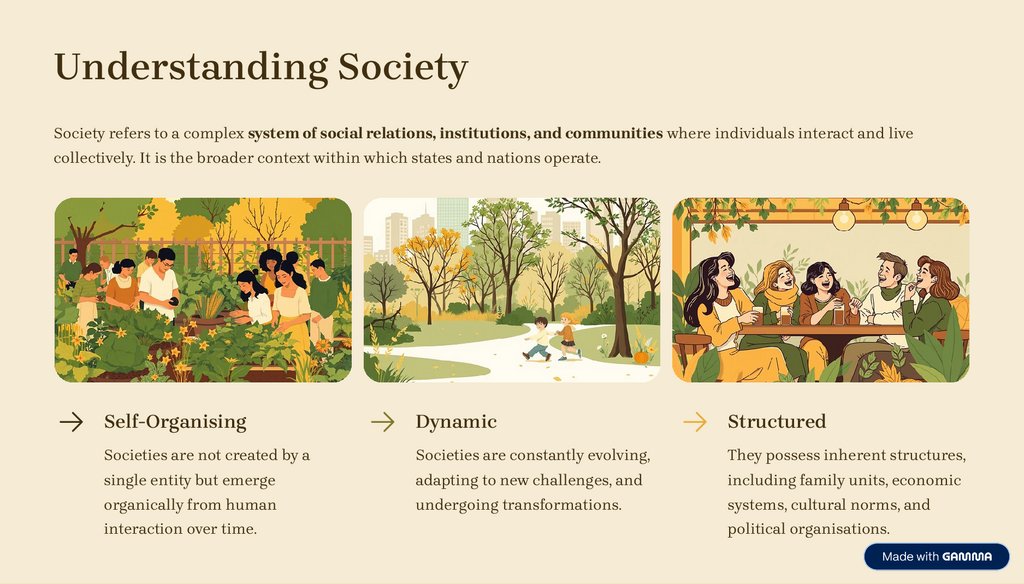
Understanding SocietySociety refers to a complex system of social relations, institutions, and communities where individuals interact and live
collectively. It is the broader context within which states and nations operate.
Self-Organising
Dynamic
Structured
Societies are not created by a
Societies are constantly evolving,
They possess inherent structures,
single entity but emerge
adapting to new challenges, and
including family units, economic
organically from human
undergoing transformations.
systems, cultural norms, and
interaction over time.
political organisations.
6.
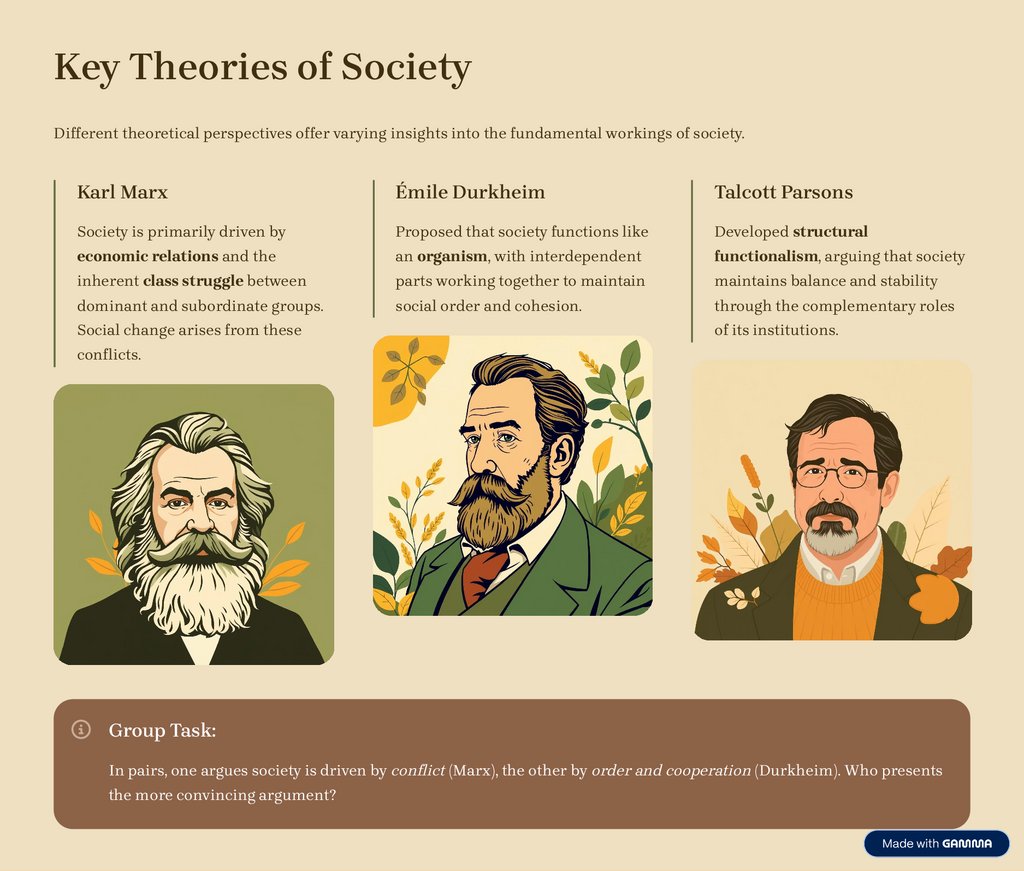
Key Theories of SocietyDifferent theoretical perspectives offer varying insights into the fundamental workings of society.
Karl Marx
Émile Durkheim
Talcott Parsons
Society is primarily driven by
Proposed that society functions like
Developed structural
economic relations and the
an organism, with interdependent
functionalism, arguing that society
inherent class struggle between
parts working together to maintain
maintains balance and stability
dominant and subordinate groups.
social order and cohesion.
through the complementary roles
Social change arises from these
of its institutions.
conflicts.
Group Task:
In pairs, one argues society is driven by conflict (Marx), the other by order and cooperation (Durkheim). Who presents
the more convincing argument?
7.
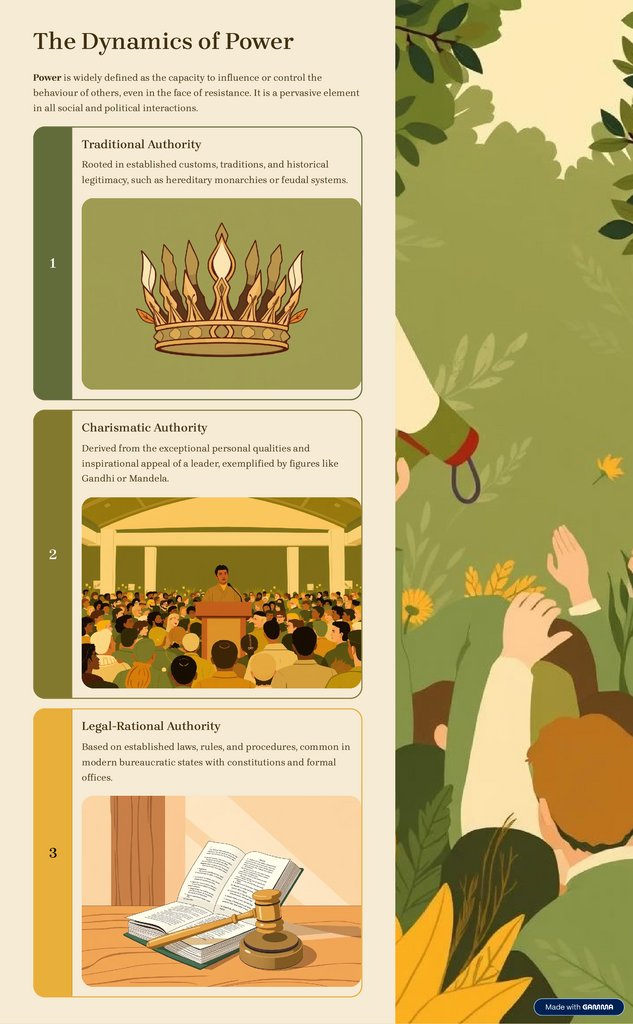
The Dynamics of PowerPower is widely defined as the capacity to influence or control the
behaviour of others, even in the face of resistance. It is a pervasive element
in all social and political interactions.
Traditional Authority
Rooted in established customs, traditions, and historical
legitimacy, such as hereditary monarchies or feudal systems.
1
Charismatic Authority
Derived from the exceptional personal qualities and
inspirational appeal of a leader, exemplified by figures like
Gandhi or Mandela.
2
Legal-Rational Authority
Based on established laws, rules, and procedures, common in
modern bureaucratic states with constitutions and formal
offices.
3
8.
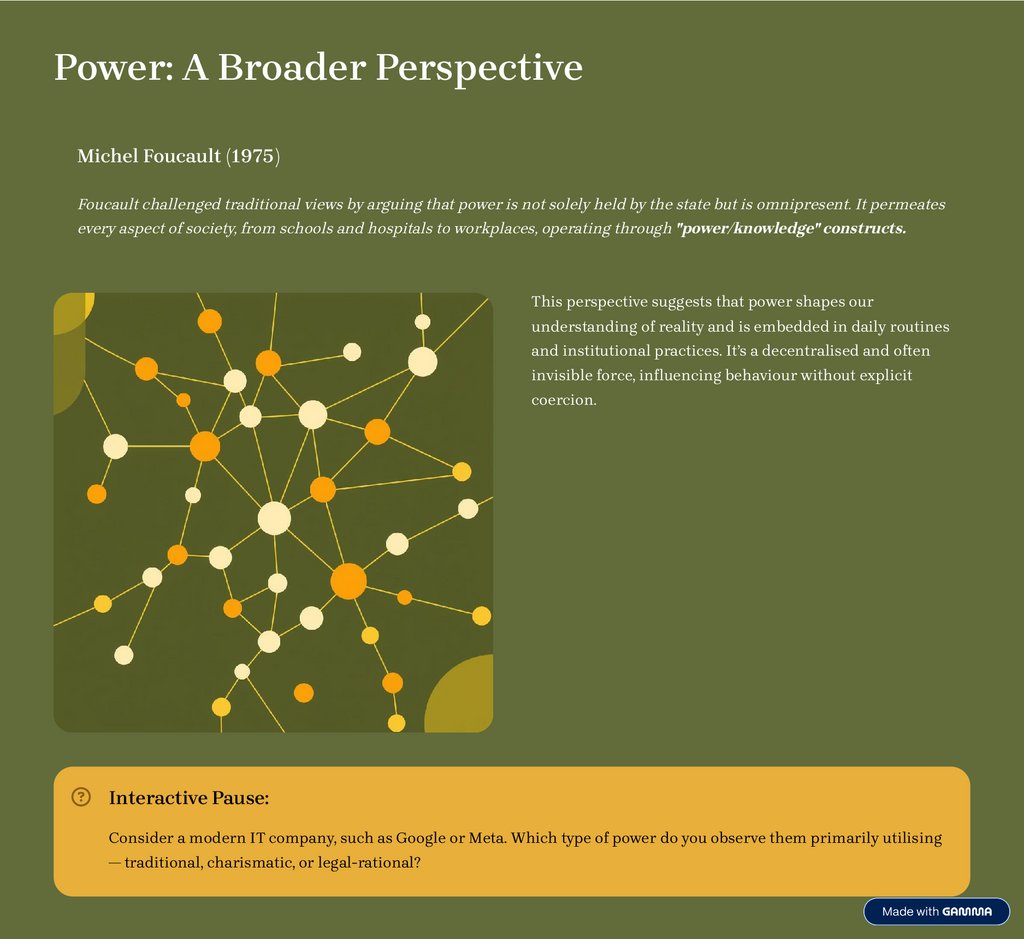
Power: A Broader PerspectiveMichel Foucault (1975)
Foucault challenged traditional views by arguing that power is not solely held by the state but is omnipresent. It permeates
every aspect of society, from schools and hospitals to workplaces, operating through "power/knowledge" constructs.
This perspective suggests that power shapes our
understanding of reality and is embedded in daily routines
and institutional practices. It9s a decentralised and often
invisible force, influencing behaviour without explicit
coercion.
Interactive Pause:
Consider a modern IT company, such as Google or Meta. Which type of power do you observe them primarily utilising
4 traditional, charismatic, or legal-rational?
9.
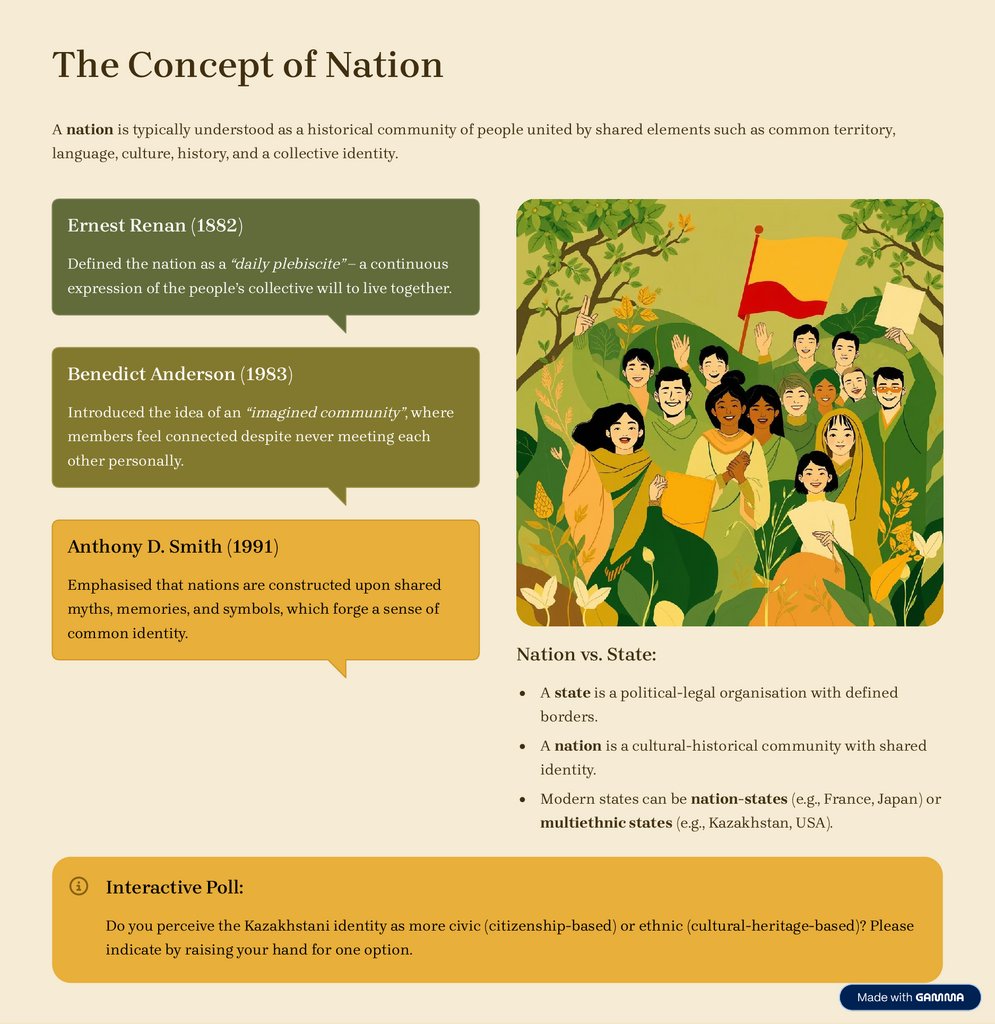
The Concept of NationA nation is typically understood as a historical community of people united by shared elements such as common territory,
language, culture, history, and a collective identity.
Ernest Renan (1882)
Defined the nation as a <daily plebiscite= 3 a continuous
expression of the people9s collective will to live together.
Benedict Anderson (1983)
Introduced the idea of an <imagined community=, where
members feel connected despite never meeting each
other personally.
Anthony D. Smith (1991)
Emphasised that nations are constructed upon shared
myths, memories, and symbols, which forge a sense of
common identity.
Nation vs. State:
A state is a political-legal organisation with defined
borders.
A nation is a cultural-historical community with shared
identity.
Modern states can be nation-states (e.g., France, Japan) or
multiethnic states (e.g., Kazakhstan, USA).
Interactive Poll:
Do you perceive the Kazakhstani identity as more civic (citizenship-based) or ethnic (cultural-heritage-based)? Please
indicate by raising your hand for one option.
10.
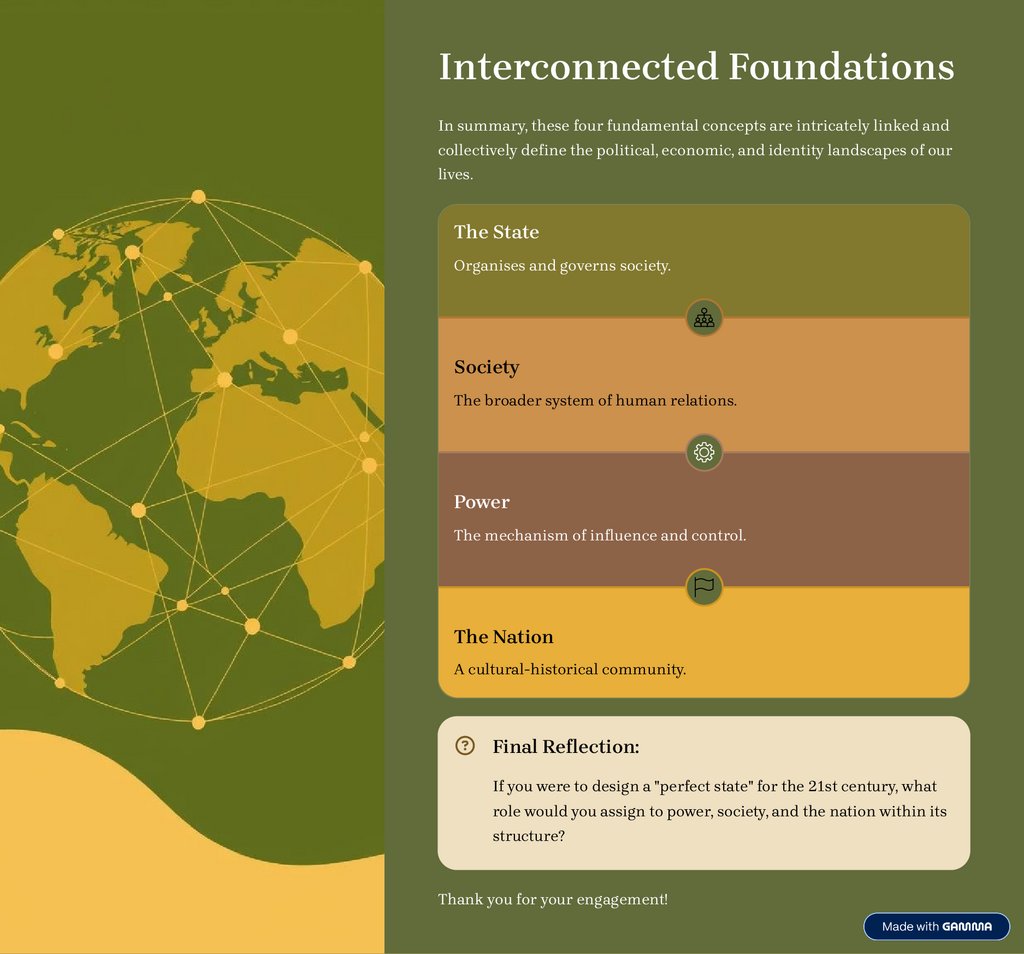
Interconnected FoundationsIn summary, these four fundamental concepts are intricately linked and
collectively define the political, economic, and identity landscapes of our
lives.
The State
Organises and governs society.
Society
The broader system of human relations.
Power
The mechanism of influence and control.
The Nation
A cultural-historical community.
Final Reflection:
If you were to design a "perfect state" for the 21st century, what
role would you assign to power, society, and the nation within its
structure?
Thank you for your engagement!