 finance
Similar presentations:










T+1 FOCUS
1.
T+1 FOCUSStrategic responses to the emerging trends on securities settlement and
custody landscape in frame of the settlement cycle shortening
Intenal Kick off
25.05.2025
2.
AgendaTowards the new settlement cycle
1
Impacts analysis
2
Project roadmap and delivery plan
3
Implementation appoach
4
Communication and execution
5
Appendix
T+1 Focus
3.
Towards the new settlement cycleGlobal context
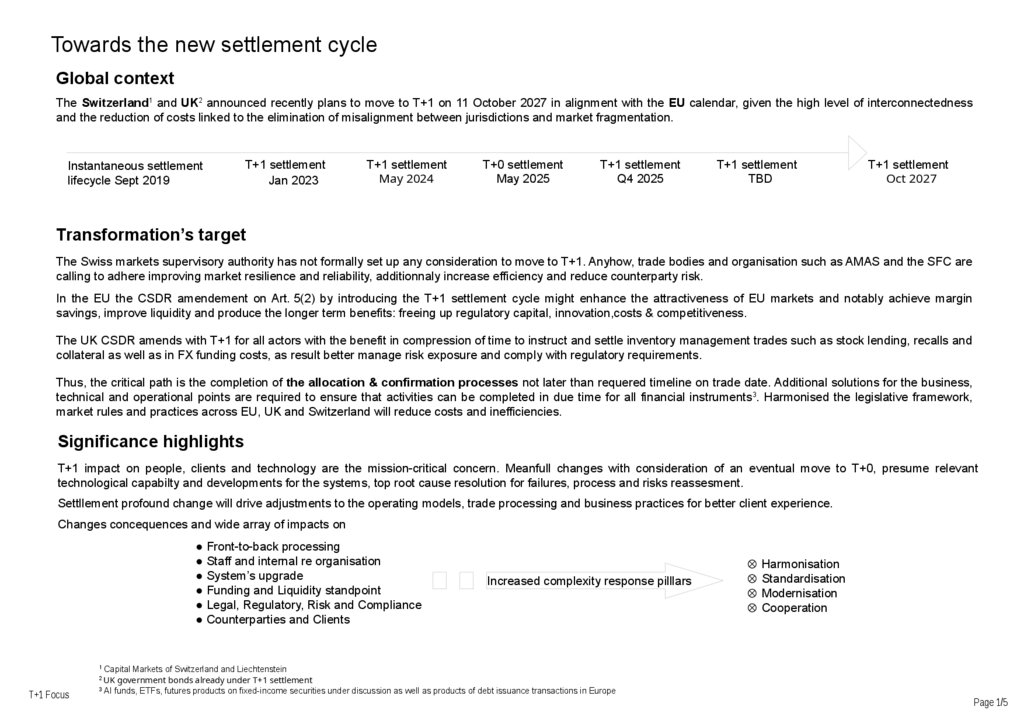
The Switzerland1 and UK2 announced recently plans to move to T+1 on 11 October 2027 in alignment with the EU calendar, given the high level of interconnectedness
and the reduction of costs linked to the elimination of misalignment between jurisdictions and market fragmentation.
Instantaneous settlement
lifecycle Sept 2019
T+1 settlement
Jan 2023
T+1 settlement
May 2024
T+0 settlement
May 2025
T+1 settlement
Q4 2025
T+1 settlement
TBD
T+1 settlement
Oct 2027
Transformation’s target
The Swiss markets supervisory authority has not formally set up any consideration to move to T+1. Anyhow, trade bodies and organisation such as AMAS and the SFC are
calling to adhere improving market resilience and reliability, additionnaly increase efficiency and reduce counterparty risk.
In the EU the CSDR amendement on Art. 5(2) by introducing the T+1 settlement cycle might enhance the attractiveness of EU markets and notably achieve margin
savings, improve liquidity and produce the longer term benefits: freeing up regulatory capital, innovation,costs & competitiveness.
The UK CSDR amends with T+1 for all actors with the benefit in compression of time to instruct and settle inventory management trades such as stock lending, recalls and
collateral as well as in FX funding costs, as result better manage risk exposure and comply with regulatory requirements.
Thus, the critical path is the completion of the allocation & confirmation processes not later than requered timeline on trade date. Additional solutions for the business,
technical and operational points are required to ensure that activities can be completed in due time for all financial instruments3. Harmonised the legislative framework,
market rules and practices across EU, UK and Switzerland will reduce costs and inefficiencies.
Significance highlights
T+1 impact on people, clients and technology are the mission-critical concern. Meanfull changes with consideration of an eventual move to T+0, presume relevant
technological capabilty and developments for the systems, top root cause resolution for failures, process and risks reassesment.
Settllement profound change will drive adjustments to the operating models, trade processing and business practices for better client experience.
Changes concequences and wide array of impacts on
● Front-to-back processing
● Staff and internal re organisation
● System’s upgrade
● Funding and Liquidity standpoint
● Legal, Regulatory, Risk and Compliance
● Counterparties and Clients
Increased complexity response pilllars
⊗ Harmonisation
⊗ Standardisation
⊗ Modernisation
⊗ Cooperation
Capital Markets of Switzerland and Liechtenstein
UK government bonds already under T+1 settlement
3
AI funds, ETFs, futures products on fixed-income securities under discussion as well as products of debt issuance transactions in Europe
1
2
T+1 Focus
Page 1/5
4.
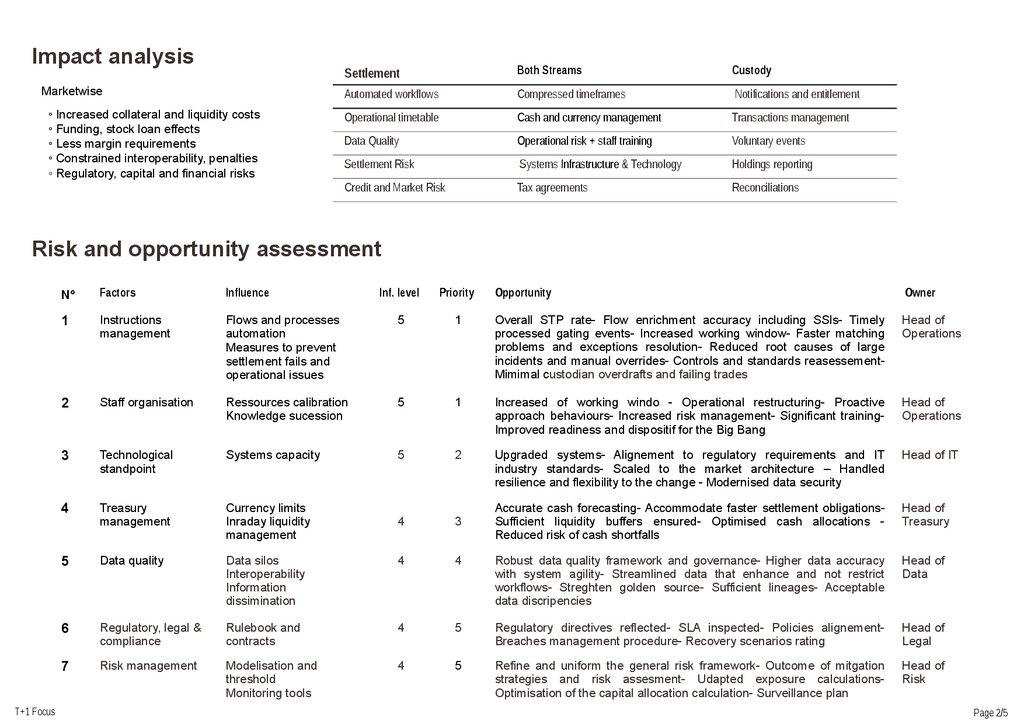
Impact analysisSettlement
Both Streams
Custody
Marketwise
Automated workflows
Compressed timeframes
Notifications and entitlement
◦ Increased collateral and liquidity costs
◦ Funding, stock loan effects
◦ Less margin requirements
◦ Constrained interoperability, penalties
◦ Regulatory, capital and financial risks
Operational timetable
Cash and currency management
Transactions management
Data Quality
Operational risk + staff training
Voluntary events
Settlement Risk
Systems Infrastructure & Technology
Holdings reporting
Credit and Market Risk
Tax agreements
Reconciliations
Risk and opportunity assessment
T+1 Focus
N°
Factors
Influence
Inf. level
Priority
Opportunity
Owner
1
Instructions
management
Flows and processes
automation
Measures to prevent
settlement fails and
operational issues
5
1
Overall STP rate- Flow enrichment accuracy including SSIs- Timely
processed gating events- Increased working window- Faster matching
problems and exceptions resolution- Reduced root causes of large
incidents and manual overrides- Controls and standards reasessementMimimal custodian overdrafts and failing trades
Head of
Operations
2
Staff organisation
Ressources calibration
Knowledge sucession
5
1
Increased of working windo - Operational restructuring- Proactive
approach behaviours- Increased risk management- Significant trainingImproved readiness and dispositif for the Big Bang
Head of
Operations
3
Technological
standpoint
Systems capacity
5
2
Upgraded systems- Alignement to regulatory requirements and IT
industry standards- Scaled to the market architecture – Handled
resilience and flexibility to the change - Modernised data security
Head of IT
4
Treasury
management
Currency limits
Inraday liquidity
management
4
3
Accurate cash forecasting- Accommodate faster settlement obligationsSufficient liquidity buffers ensured- Optimised cash allocations Reduced risk of cash shortfalls
Head of
Treasury
5
Data quality
Data silos
Interoperability
Information
dissimination
4
4
Robust data quality framework and governance- Higher data accuracy
with system agility- Streamlined data that enhance and not restrict
workflows- Streghten golden source- Sufficient lineages- Acceptable
data discripencies
Head of
Data
6
Regulatory, legal &
compliance
Rulebook and
contracts
4
5
Regulatory directives reflected- SLA inspected- Policies alignementBreaches management procedure- Recovery scenarios rating
Head of
Legal
7
Risk management
Modelisation and
threshold
Monitoring tools
4
5
Refine and uniform the general risk framework- Outcome of mitgation
strategies and risk assesment- Udapted exposure calculationsOptimisation of the capital allocation calculation- Surveillance plan
Head of
Risk
Page 2/5
5.
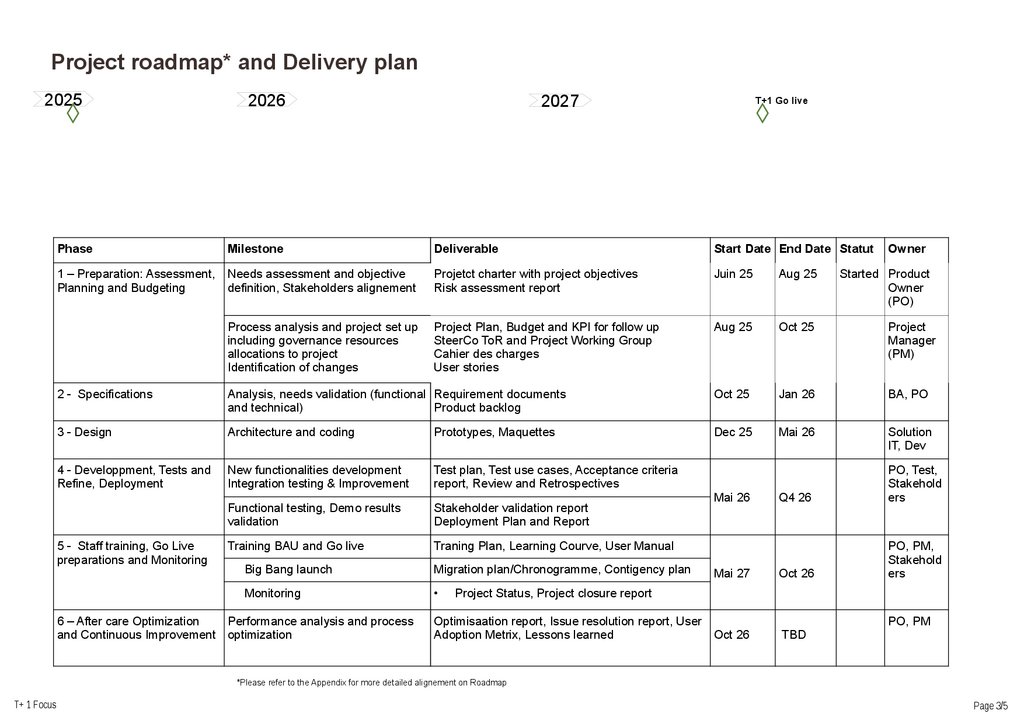
Project roadmap* and Delivery plan2025
Preparation
2026
Specifications
Design
2027
Development, Tests and Deployment
T+1 Go live
Staff training
and Migration
After care and
Continius Improvement
Phase
Milestone
Deliverable
Start Date End Date Statut
Owner
1 – Preparation: Assessment,
Planning and Budgeting
Needs assessment and objective
definition, Stakeholders alignement
Projetct charter with project objectives
Risk assessment report
Juin 25
Aug 25
Started Product
Owner
(PO)
Process analysis and project set up
including governance resources
allocations to project
Identification of changes
Project Plan, Budget and KPI for follow up
SteerCo ToR and Project Working Group
Cahier des charges
User stories
Aug 25
Oct 25
Project
Manager
(PM)
2 - Specifications
Analysis, needs validation (functional Requirement documents
and technical)
Product backlog
Oct 25
Jan 26
BA, PO
3 - Design
Architecture and coding
Prototypes, Maquettes
Dec 25
Mai 26
Solution
IT, Dev
4 - Developpment, Tests and
Refine, Deployment
New functionalities development
Integration testing & Improvement
Test plan, Test use cases, Acceptance criteria
report, Review and Retrospectives
Functional testing, Demo results
validation
Stakeholder validation report
Deployment Plan and Report
Training BAU and Go live
Traning Plan, Learning Courve, User Manual
5 - Staff training, Go Live
preparations and Monitoring
Q4 26
PO, Test,
Stakehold
ers
Mai 27
Oct 26
PO, PM,
Stakehold
ers
Optimisaation report, Issue resolution report, User
Adoption Metrix, Lessons learned
Oct 26
TBD
Big Bang launch
Migration plan/Chronogramme, Contigency plan
Monitoring
6 – After care Optimization
Performance analysis and process
and Continuous Improvement optimization
Mai 26
Project Status, Project closure report
PO, PM
*Please refer to the Appendix for more detailed alignement on Roadmap
T+ 1 Focus
Page 3/5
6.
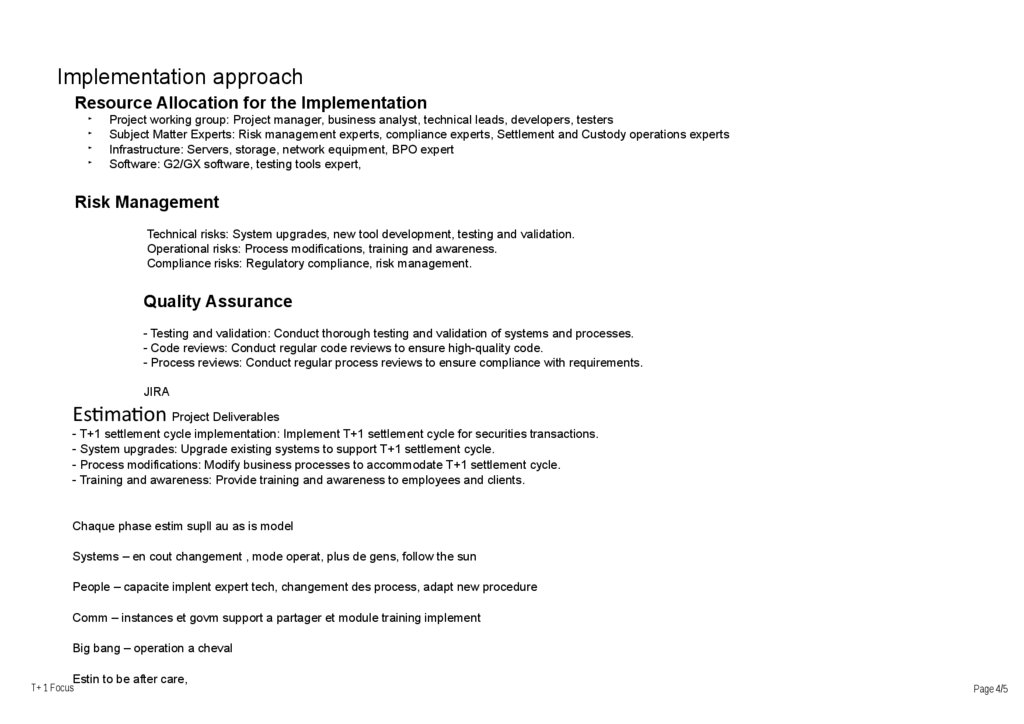
Implementation approachResource Allocation for the Implementation
Project working group: Project manager, business analyst, technical leads, developers, testers
Subject Matter Experts: Risk management experts, compliance experts, Settlement and Custody operations experts
Infrastructure: Servers, storage, network equipment, BPO expert
Software: G2/GX software, testing tools expert,
Risk Management
Technical risks: System upgrades, new tool development, testing and validation.
Operational risks: Process modifications, training and awareness.
Compliance risks: Regulatory compliance, risk management.
Quality Assurance
- Testing and validation: Conduct thorough testing and validation of systems and processes.
- Code reviews: Conduct regular code reviews to ensure high-quality code.
- Process reviews: Conduct regular process reviews to ensure compliance with requirements.
JIRA
Estimation Project Deliverables
- T+1 settlement cycle implementation: Implement T+1 settlement cycle for securities transactions.
- System upgrades: Upgrade existing systems to support T+1 settlement cycle.
- Process modifications: Modify business processes to accommodate T+1 settlement cycle.
- Training and awareness: Provide training and awareness to employees and clients.
Chaque phase estim supll au as is model
Systems – en cout changement , mode operat, plus de gens, follow the sun
People – capacite implent expert tech, changement des process, adapt new procedure
Comm – instances et govm support a partager et module training implement
Big bang – operation a cheval
Estin to be after care,
T+ 1 Focus
Page 4/5
7.
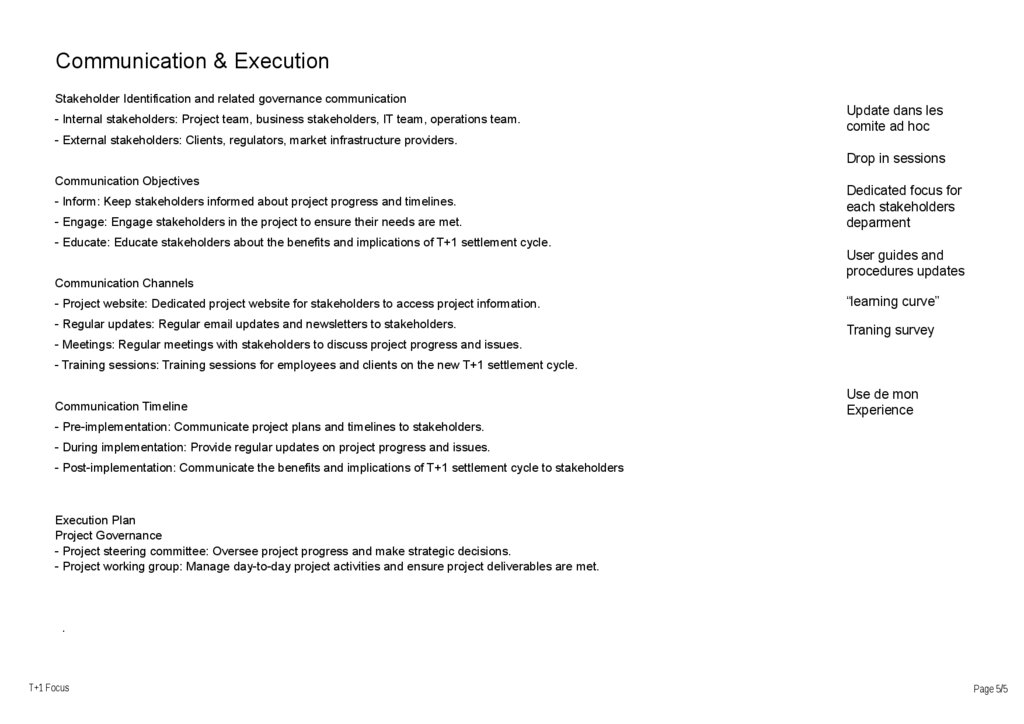
Communication & ExecutionStakeholder Identification and related governance communication
- Internal stakeholders: Project team, business stakeholders, IT team, operations team.
- External stakeholders: Clients, regulators, market infrastructure providers.
Update dans les
comite ad hoc
Drop in sessions
Communication Objectives
- Inform: Keep stakeholders informed about project progress and timelines.
- Engage: Engage stakeholders in the project to ensure their needs are met.
- Educate: Educate stakeholders about the benefits and implications of T+1 settlement cycle.
Communication Channels
Dedicated focus for
each stakeholders
deparment
User guides and
procedures updates
- Project website: Dedicated project website for stakeholders to access project information.
“learning curve”
- Regular updates: Regular email updates and newsletters to stakeholders.
Traning survey
- Meetings: Regular meetings with stakeholders to discuss project progress and issues.
- Training sessions: Training sessions for employees and clients on the new T+1 settlement cycle.
Communication Timeline
Use de mon
Experience
- Pre-implementation: Communicate project plans and timelines to stakeholders.
- During implementation: Provide regular updates on project progress and issues.
- Post-implementation: Communicate the benefits and implications of T+1 settlement cycle to stakeholders
Execution Plan
Project Governance
- Project steering committee: Oversee project progress and make strategic decisions.
- Project working group: Manage day-to-day project activities and ensure project deliverables are met.
.
T+1 Focus
Page 5/5
8.
AppendixProject complexity
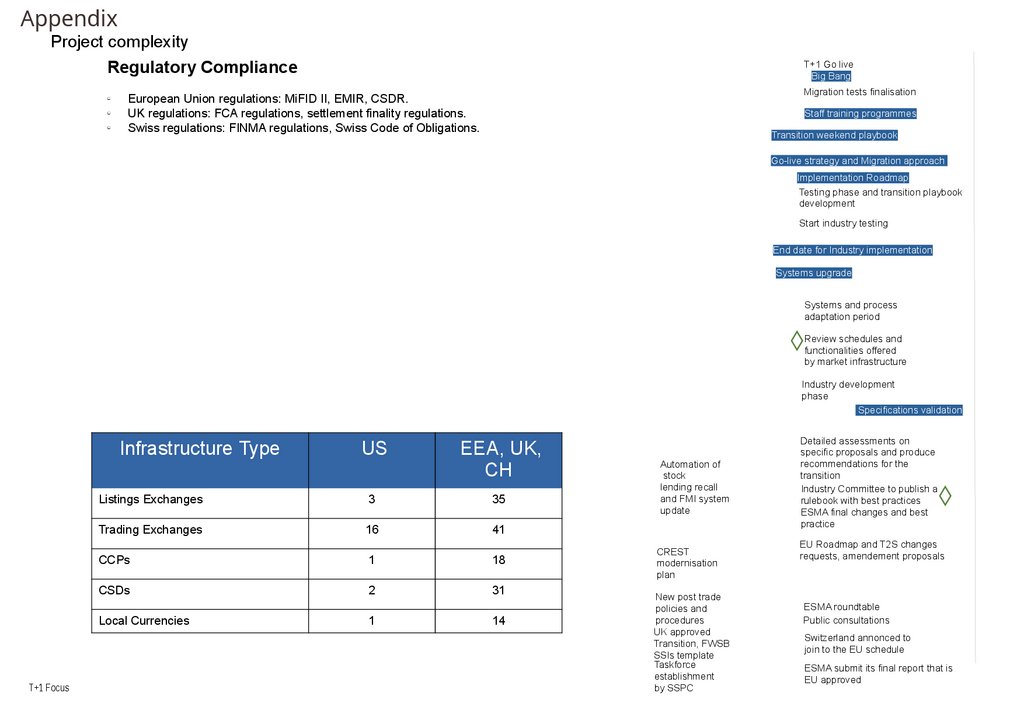
Regulatory Compliance
T+1 Go live
Big Bang
Migration tests finalisation
European Union regulations: MiFID II, EMIR, CSDR.
UK regulations: FCA regulations, settlement finality regulations.
Swiss regulations: FINMA regulations, Swiss Code of Obligations.
Staff training programmes
Transition weekend playbook
Go-live strategy and Migration approach
Implementation Roadmap
Testing phase and transition playbook
development
Start industry testing
End date for Industry implementation
Systems upgrade
Systems and process
adaptation period
Review schedules and
functionalities offered
by market infrastructure
Industry development
phase
Specifications validation
Infrastructure Type
T+1 Focus
US
EEA, UK,
CH
Listings Exchanges
3
35
Trading Exchanges
16
41
CCPs
1
18
CSDs
2
31
Local Currencies
1
14
Automation of
stock
lending recall
and FMI system
update
CREST
modernisation
plan
New post trade
policies and
procedures
UK approved
Transition, FWSB
SSIs template
Taskforce
establishment
by SSPC
Detailed assessments on
specific proposals and produce
recommendations for the
transition
Industry Committee to publish a
rulebook with best practices
ESMA final changes and best
practice
EU Roadmap and T2S changes
requests, amendement proposals
ESMA roundtable
Public consultations
Switzerland annonced to
join to the EU schedule
ESMA submit its final report that is
EU approved