


 biology
Similar presentations:





Bioinformatics analysis of polycultures and monocultures of associated microbiota of epilithic lichen Parmelia saxatilis
1. Bioinformatics analysis of polycultures and monocultures of associated microbiota of epilithic lichen Parmelia saxatilis (L.)
AchStudent: Bobko Alexander Sergeevich
A4142
Molecular biology and biotechnology
Supervisor Koshel Elena Ivanovna
2.
Relevance of researchMesoecosystem
•Mid-level ecosystem
•The existence of a stable complex of species
•Common abiotic and biotic components and dynamics
•Specific interactions between organisms and the habitat
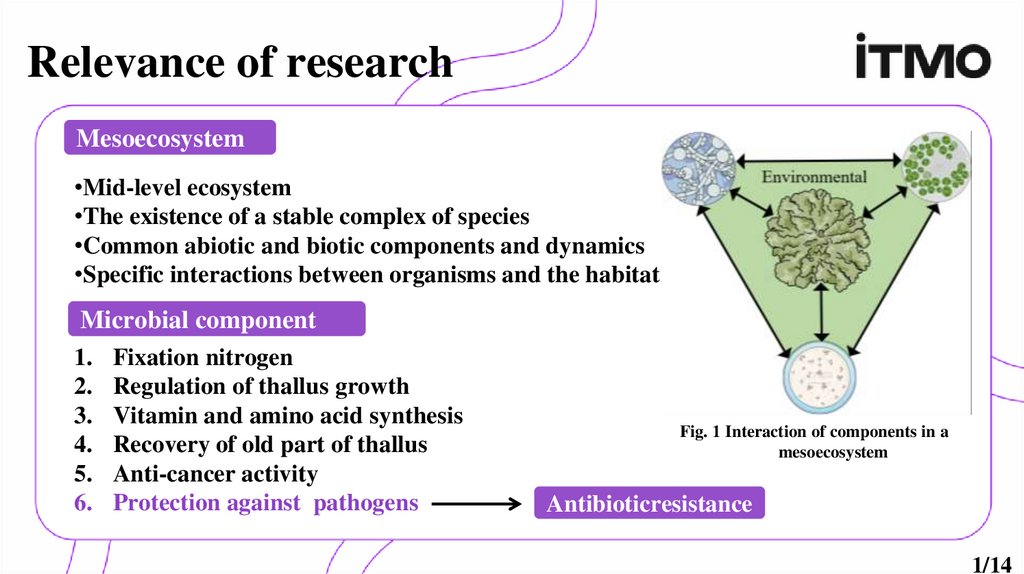
Microbial component
1.
2.
3.
4.
5.
6.
Fixation nitrogen
Regulation of thallus growth
Vitamin and amino acid synthesis
Recovery of old part of thallus
Anti-cancer activity
Protection against pathogens
Fig. 1 Interaction of components in a
mesoecosystem
Antibioticresistance
1/14
3.
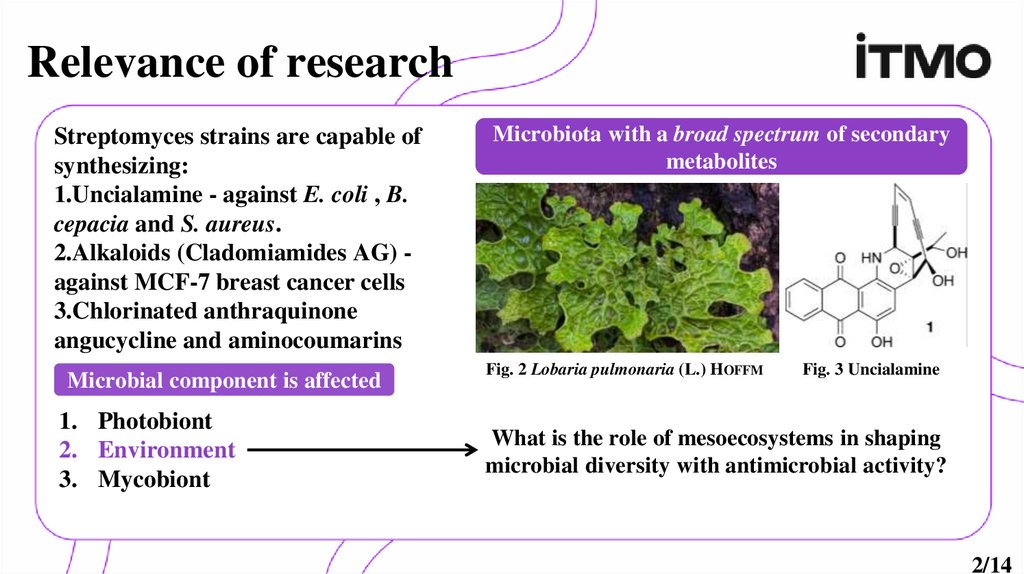
Relevance of researchStreptomyces strains are capable of
synthesizing:
1.Uncialamine - against E. coli , B.
cepacia and S. aureus.
2.Alkaloids (Cladomiamides AG) against MCF-7 breast cancer cells
3.Chlorinated anthraquinone
angucycline and aminocoumarins
Microbial component is affected
1. Photobiont
2. Environment
3. Mycobiont
Microbiota with a broad spectrum of secondary
metabolites
Fig. 2 Lobaria pulmonaria (L.) HOFFM
Fig. 3 Uncialamine
What is the role of mesoecosystems in shaping
microbial diversity with antimicrobial activity?
2/14
4.
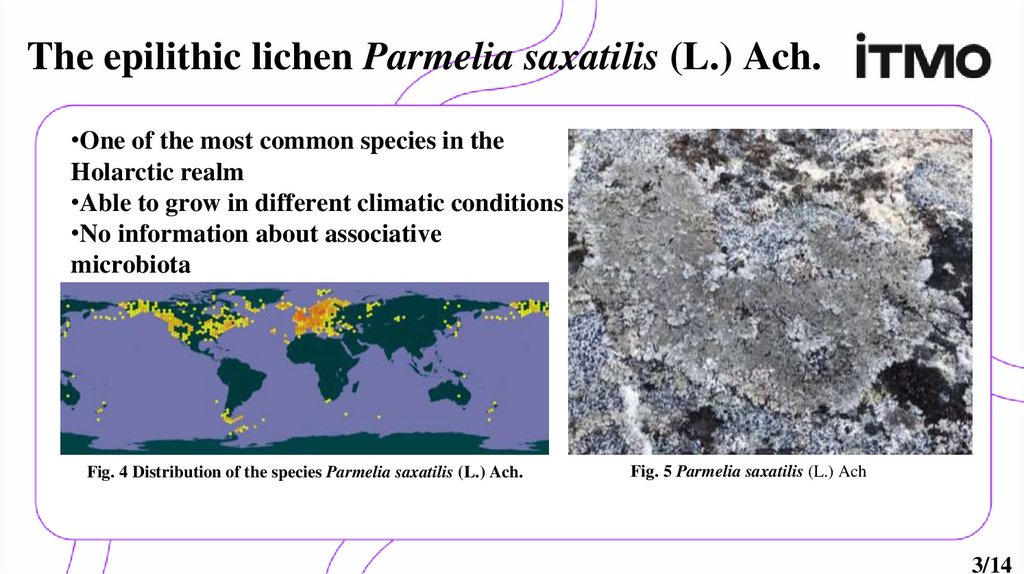
The epilithic lichen Parmelia saxatilis (L.) Ach.•One of the most common species in the
Holarctic realm
•Able to grow in different climatic conditions
•No information about associative
microbiota
Fig. 4 Distribution of the species Parmelia saxatilis (L.) Ach.
Fig. 5 Parmelia saxatilis (L.) Ach
3/14
5.
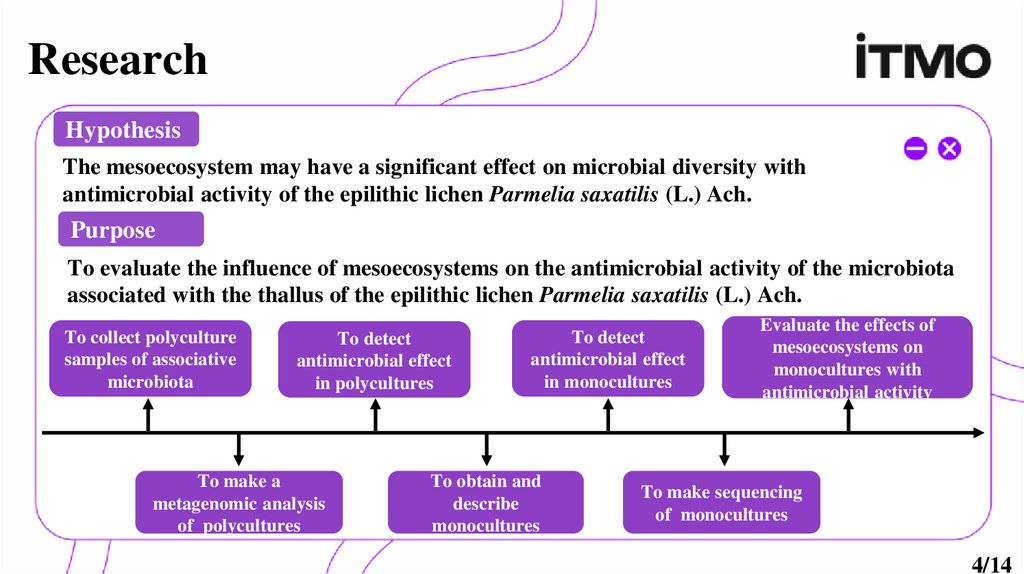
ResearchHypothesis
The mesoecosystem may have a significant effect on microbial diversity with
antimicrobial activity of the epilithic lichen Parmelia saxatilis (L.) Ach.
Purpose
To evaluate the influence of mesoecosystems on the antimicrobial activity of the microbiota
associated with the thallus of the epilithic lichen Parmelia saxatilis (L.) Ach.
To collect polyculture
samples of associative
microbiota
To detect
antimicrobial effect
in polycultures
To make a
metagenomic analysis
of polycultures
To detect
antimicrobial effect
in monocultures
To obtain and
describe
monocultures
Evaluate the effects of
mesoecosystems on
monocultures with
antimicrobial activity
To make sequencing
of monocultures
4/14
6.
Results of sample collectionForest biotope
Criteria
Plant
community
Sample 1
Sample 2
Coastal biotope
Ruderal biotope
Sample 3
Sample 4
Sample 5
Sample 6
Sample 7
Sample 8
Blueberry-blossom-grass pine
forest
Rock surface
White Sea Supralittoral
Basalt
Shungite containing
Gneiss
Type of
stone
Lightness
5%
40%
25%
100%
100%
60 %
80%
65%
Exposition
Southeast
Eastern
South
Eastern
Eastern
West to the
sea
Northwestern
Western
Tilt angle
5%
0
0
2%
30%
7%
10%
0%
Coverage
70%
80%
100%
85%
55%
60%
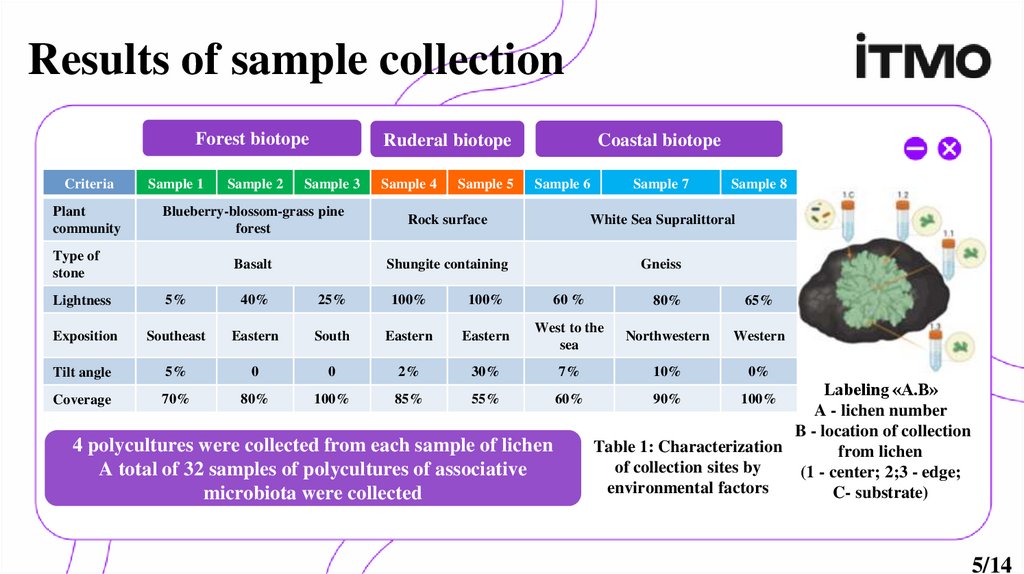
4 polycultures were collected from each sample of lichen
A total of 32 samples of polycultures of associative
microbiota were collected
Labeling «A.B»
A - lichen number
B - location of collection
Table 1: Characterization
from lichen
of collection sites by
(1 - center; 2;3 - edge;
environmental factors
C- substrate)
90%
100%
5/14
7.
Results of metagenomic analysis of polyculturesComparing alpha diversity between samples
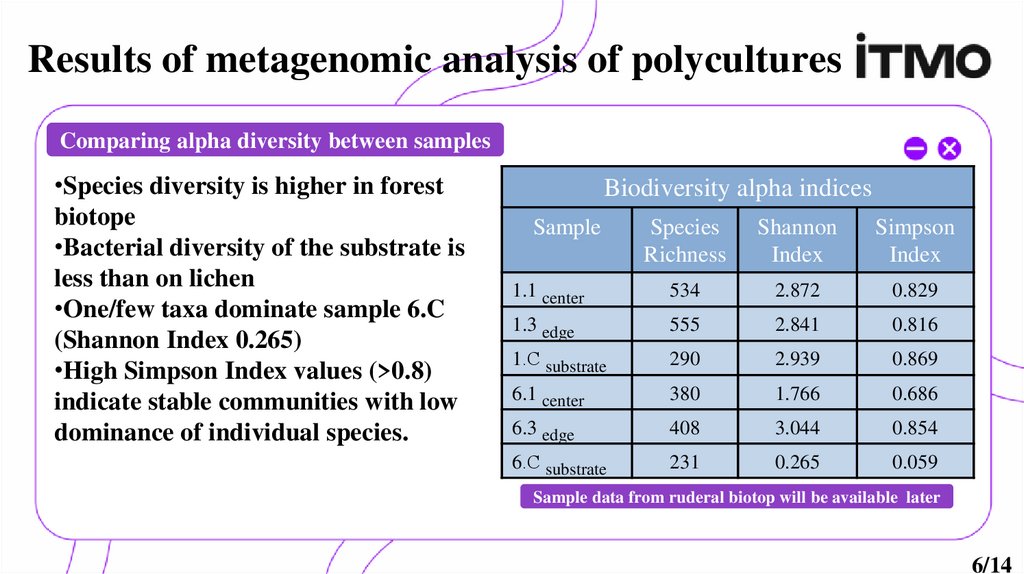
•Species diversity is higher in forest
biotope
•Bacterial diversity of the substrate is
less than on lichen
•One/few taxa dominate sample 6.C
(Shannon Index 0.265)
•High Simpson Index values (>0.8)
indicate stable communities with low
dominance of individual species.
Biodiversity alpha indices
Sample
Species
Richness
Shannon
Index
Simpson
Index
1.1 center
534
2.872
0.829
1.3 edge
555
2.841
0.816
1.С substrate
290
2.939
0.869
6.1 center
380
1.766
0.686
6.3 edge
408
3.044
0.854
6.С substrate
231
0.265
0.059
Sample data from ruderal biotop will be available later
6/14
8.
Results of metagenomic analysis of polyculturesComparing beta diversity between samples
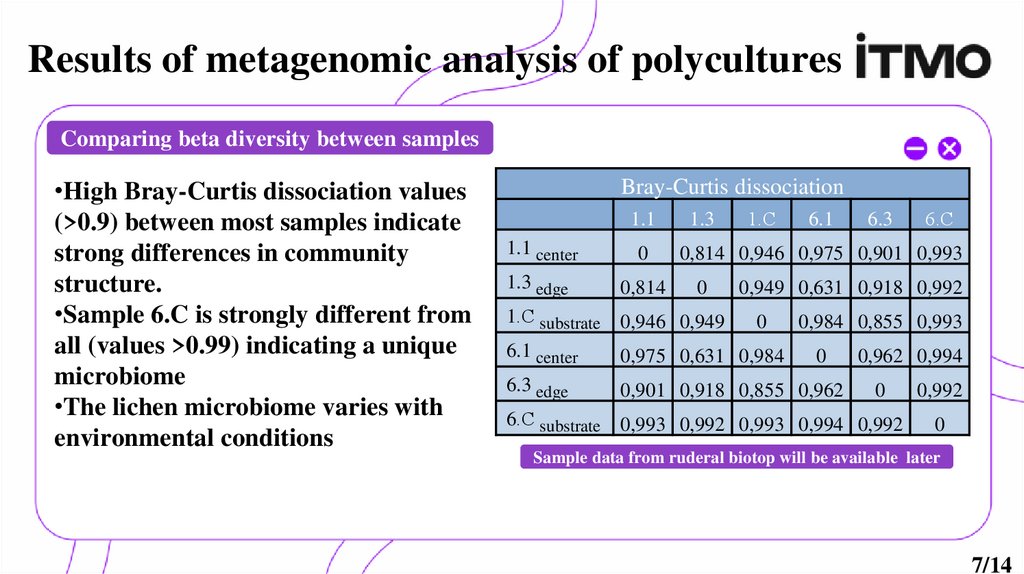
•High Bray-Curtis dissociation values
(>0.9) between most samples indicate
strong differences in community
structure.
•Sample 6.C is strongly different from
all (values >0.99) indicating a unique
microbiome
•The lichen microbiome varies with
environmental conditions
Bray-Curtis dissociation
1.С
1.3
1.1 center
0
0,814 0,946 0,975 0,901 0,993
1.3 edge
0,814
0
6.1
6.3
6.С
1.1
0,949 0,631 0,918 0,992
1.С substrate 0,946 0,949
0
0,984 0,855 0,993
6.1 center
0,975 0,631 0,984
0
0,962 0,994
6.3 edge
0,901 0,918 0,855 0,962
0
0,992
6.С substrate 0,993 0,992 0,993 0,994 0,992
0
Sample data from ruderal biotop will be available later
7/14
9.
Results of metagenomic analysis of polyculturesComparing the microbial community between biotopes
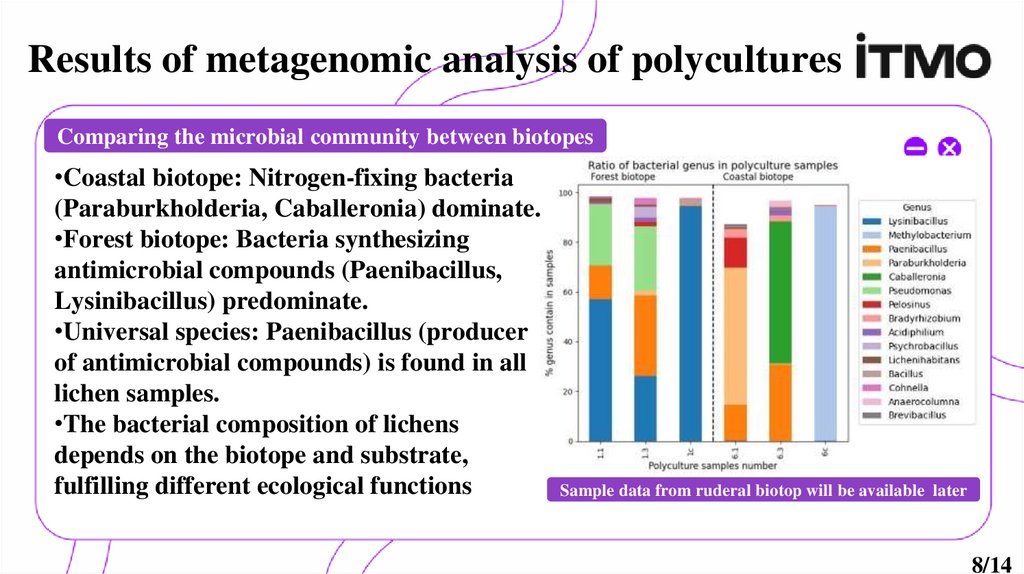
•Coastal biotope: Nitrogen-fixing bacteria
(Paraburkholderia, Caballeronia) dominate.
•Forest biotope: Bacteria synthesizing
antimicrobial compounds (Paenibacillus,
Lysinibacillus) predominate.
•Universal species: Paenibacillus (producer
of antimicrobial compounds) is found in all
lichen samples.
•The bacterial composition of lichens
depends on the biotope and substrate,
fulfilling different ecological functions
Sample data from ruderal biotop will be available later
8/14
10.
Results of antimicrobial activityAntimicrobial activity of polycultures
•9 polycultures samples have antibacterial activity
• 4 out of 9 are samples have antimicrobial activity
•Pathogen inhibition is observed in most samples collected from the edge of the thallus
•The largest zone of inhibition was found in the sample from the coastal biotope
S. aureus ATCC 29213
C. albicans
Color indicates biotope: Forest; Ruderal; Coastal
Fig. 6 Antimicrobial
activity of the
polyculture
9/14
11.
Results of characterization of monocultures withantimicrobial activity
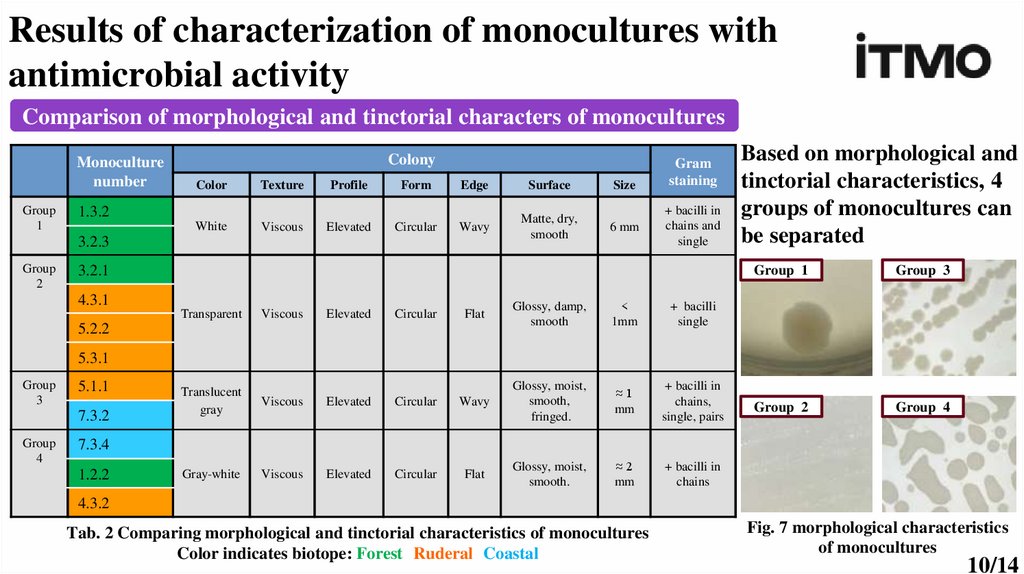
Comparison of morphological and tinctorial characters of monocultures
Monoculture
number
Group
1
Colony
Color
Texture
Profile
Form
Edge
Surface
Size
White
Viscous
Elevated
Circular
Wavy
Matte, dry,
smooth
6 mm
1.3.2
3.2.3
Group
2
Gram
staining
+ bacilli in
chains and
single
3.2.1
4.3.1
Transparent
Viscous
Elevated
Circular
Flat
Glossy, damp,
smooth
<
1mm
+ bacilli
single
Translucent
gray
Viscous
Elevated
Circular
Wavy
Glossy, moist,
smooth,
fringed.
≈1
mm
+ bacilli in
chains,
single, pairs
Gray-white
Viscous
Elevated
Circular
Flat
Glossy, moist,
smooth.
≈2
mm
+ bacilli in
chains
5.2.2
Based on morphological and
tinctorial characteristics, 4
groups of monocultures can
be separated
Group 1
Group 3
Group 2
Group 4
5.3.1
Group
3
5.1.1
7.3.2
Group
4
7.3.4
1.2.2
4.3.2
Tab. 2 Comparing morphological and tinctorial characteristics of monocultures
Color indicates biotope: Forest; Ruderal; Coastal
Fig. 7 morphological characteristics
of monocultures
10/14
12.
Results of characterization of monocultureswith antimicrobial activity
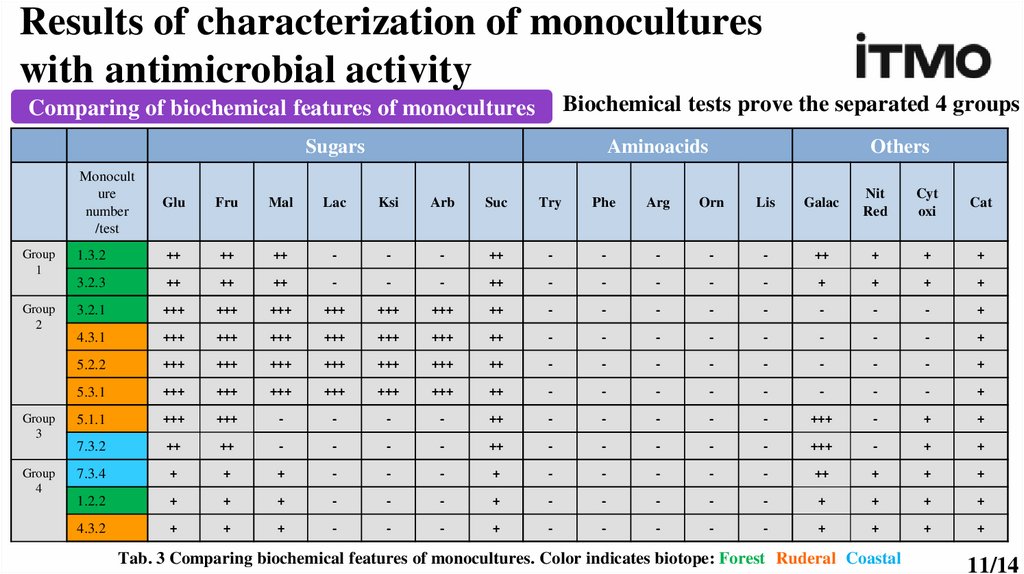
Biochemical tests prove the separated 4 groups
Comparing of biochemical features of monocultures
Sugars
Group
1
Group
2
Group
3
Group
4
Aminoacids
Others
Monocult
ure
number
/test
Glu
Fru
Mal
Lac
Ksi
Arb
Suc
Try
Phe
Arg
Orn
Lis
Galac
Nit
Red
Cyt
oxi
Cat
1.3.2
++
++
++
-
-
-
++
-
-
-
-
-
++
+
+
+
3.2.3
++
++
++
-
-
-
++
-
-
-
-
-
+
+
+
+
3.2.1
+++
+++
+++
+++
+++
+++
++
-
-
-
-
-
-
-
-
+
4.3.1
+++
+++
+++
+++
+++
+++
++
-
-
-
-
-
-
-
-
+
5.2.2
+++
+++
+++
+++
+++
+++
++
-
-
-
-
-
-
-
-
+
5.3.1
+++
+++
+++
+++
+++
+++
++
-
-
-
-
-
-
-
-
+
5.1.1
+++
+++
-
-
-
-
++
-
-
-
-
-
+++
-
+
+
7.3.2
++
++
-
-
-
-
++
-
-
-
-
-
+++
-
+
+
7.3.4
+
+
+
-
-
-
+
-
-
-
-
-
++
+
+
+
1.2.2
+
+
+
-
-
-
+
-
-
-
-
-
+
+
+
+
4.3.2
+
+
+
-
-
-
+
-
-
-
-
-
+
+
+
+
Tab. 3 Comparing biochemical features of monocultures. Color indicates biotope: Forest; Ruderal; Coastal
11/14
13.
Results of metagenomic analysis ofmonocultures with antimicrobial activity
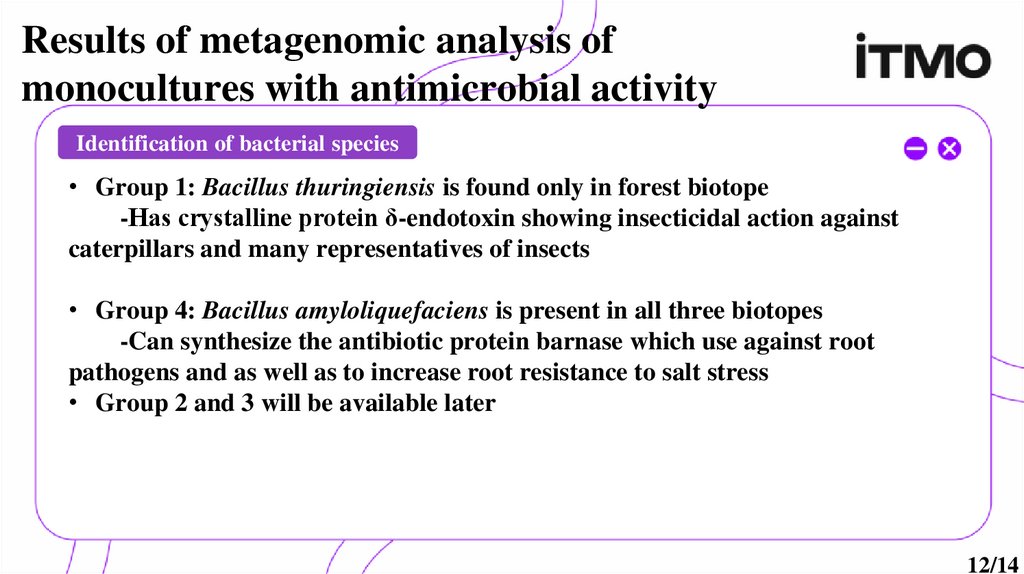
Identification of bacterial species
• Group 1: Bacillus thuringiensis is found only in forest biotope
-Has crystalline protein δ-endotoxin showing insecticidal action against
caterpillars and many representatives of insects
• Group 4: Bacillus amyloliquefaciens is present in all three biotopes
-Can synthesize the antibiotic protein barnase which use against root
pathogens and as well as to increase root resistance to salt stress
• Group 2 and 3 will be available later
12/14
14.
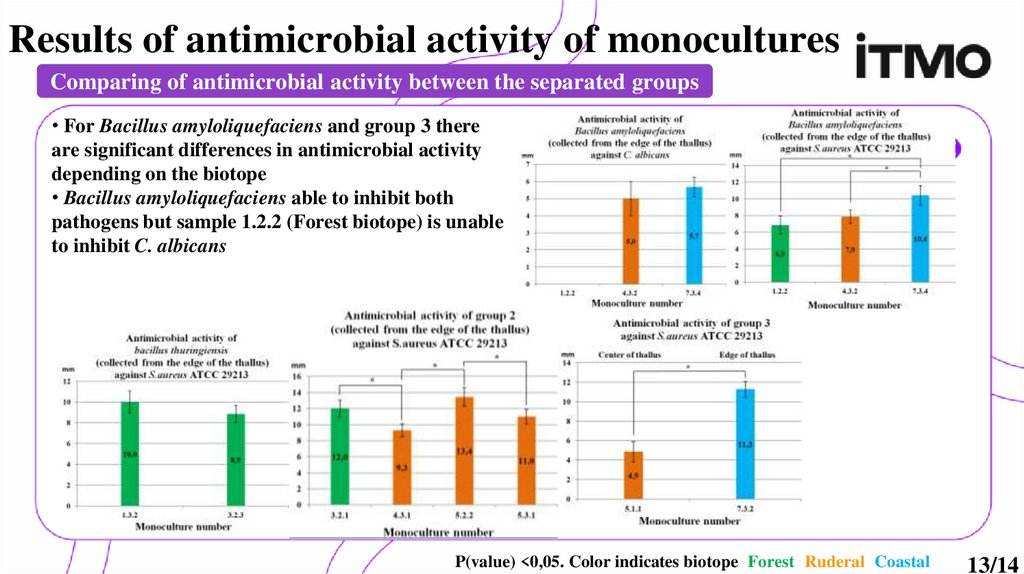
Results of antimicrobial activity of monoculturesComparing of antimicrobial activity between the separated groups
• For Bacillus amyloliquefaciens and group 3 there
are significant differences in antimicrobial activity
depending on the biotope
• Bacillus amyloliquefaciens able to inhibit both
pathogens but sample 1.2.2 (Forest biotope) is unable
to inhibit C. albicans
P(value) <0,05. Color indicates biotope: Forest; Ruderal; Coastal
13/14
15.
Conclusions•The lichen microbiome varies with environmental
•All samples of Bacillus amyloliquefaciens inhibited the
conditions
growth of S.aureus ATCC 29213
•The bacterial composition of lichens depends on the
•Samples of Bacillus amyloliquefaciens (4.3.2 and 7.3.4)
biotope and substrate, fulfilling different ecological
inhibited the growth of C. albicans. But sample 1.2.2 is
functions.
unable to inhibit the growth of C. albicans
• Nitrogen-fixing bacteria in coastal biotope, bacteria
•Bacillus thuringiensis with antimicrobial activity
synthesizing antimicrobial compounds in the forest
isolated only from forest biotope
biotope are dominant
•In mesoecosystems where harsh environmental factors
•Antimicrobial activity in monocultures is higher than in are observed, greater antimicrobial effects and more
polycultures
diverse antimicrobial compounds have been found
•Monocultures from the coastal and ruderal biotopes
•Mesoecosystems shape microbial diversity with
have the highest inhibition zones
antimicrobial activity
•Bacillus amyloliquefaciens was found in three biotopes.
14/14