
 biography
 physics
Similar presentations:






Niels bohr: a pioneer of modern physics
1.
Kazan Volga Region Federal UniversityInstitute of physics
NIELS BOHR: A PIONEER OF MODERN
PHYSICS
Prepared by:
Verevkin Artem 06-445
Kazan – 2025
2.
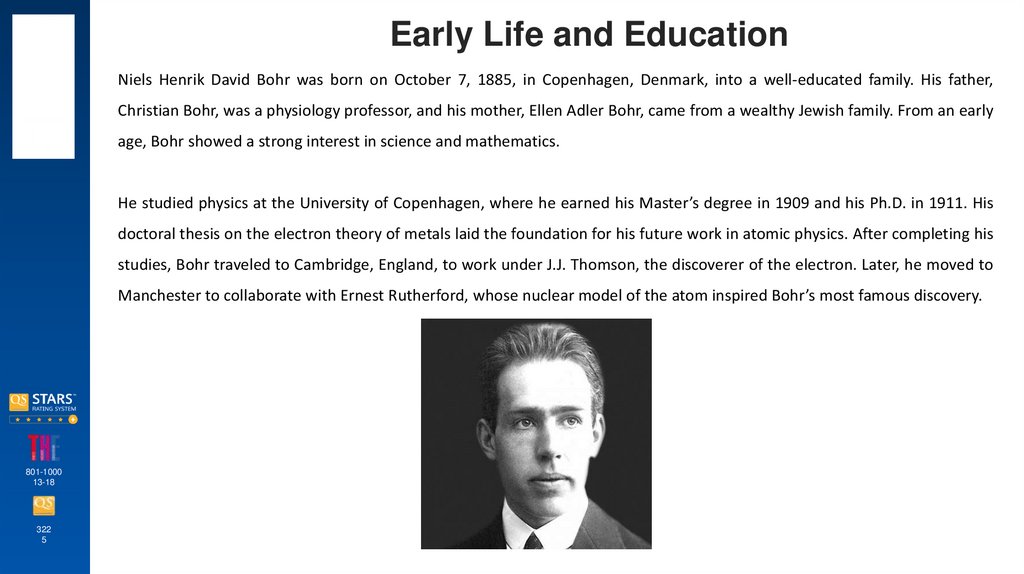
Early Life and EducationNiels Henrik David Bohr was born on October 7, 1885, in Copenhagen, Denmark, into a well-educated family. His father,
Christian Bohr, was a physiology professor, and his mother, Ellen Adler Bohr, came from a wealthy Jewish family. From an early
age, Bohr showed a strong interest in science and mathematics.
He studied physics at the University of Copenhagen, where he earned his Master’s degree in 1909 and his Ph.D. in 1911. His
doctoral thesis on the electron theory of metals laid the foundation for his future work in atomic physics. After completing his
studies, Bohr traveled to Cambridge, England, to work under J.J. Thomson, the discoverer of the electron. Later, he moved to
Manchester to collaborate with Ernest Rutherford, whose nuclear model of the atom inspired Bohr’s most famous discovery.
801-1000
13-18
322
5
3.
Discovery of The Bohr Model of the Atomn 1913, Bohr proposed his revolutionary atomic model, which explained how electrons move around the
nucleus. Before Bohr, Rutherford’s model suggested that electrons orbited the nucleus like planets around
the sun, but it failed to explain why atoms didn’t collapse due to energy loss.
Bohr introduced three key ideas:
1. Electrons move in fixed orbits (energy levels) around the nucleus without radiating energy.
2. Electrons can jump between orbits by absorbing or emitting energy in the form of photons.
3. Each orbit has a specific energy level, and the energy difference between levels determines the light’s
wavelength.
This model successfully explained the hydrogen spectrum, particularly why hydrogen emits light at specific
wavelengths (the Balmer series).
801-1000
13-18
322
5
4.
Why The Bohr Model mattersBohr’s model was a major breakthrough in quantum physics and had far-reaching consequences:
1. Foundation for Quantum Mechanics: His ideas influenced later scientists like Heisenberg and Schrödinger,
leading to the full development of quantum theory.
2. Understanding Atomic Structure: It explained chemical bonding and the behavior of electrons, shaping
modern chemistry.
3. Technological Advances: Bohr’s work contributed to technologies like lasers, semiconductors, and nuclear
energy.
4. Nobel Prize: In 1922, Bohr received the Nobel Prize in Physics for his atomic model.
Beyond his scientific contributions, Bohr played a crucial role in nuclear research during WWII. He fled Nazioccupied Denmark and worked on the Manhattan Project, though he later advocated for peaceful uses of atomic
energy.
801-1000
13-18
322
5
5.
ConclusionNiels Bohr was one of the greatest physicists of the 20th century. His atomic model revolutionized
science, bridging classical and quantum physics. His legacy lives on in modern technology, from medical
imaging to quantum computing. Bohr also emphasized the ethical responsibility of scientists,
reminding the world that great knowledge must be used wisely.
His famous quote, “If quantum mechanics hasn’t profoundly shocked you, you haven’t understood it
yet,” reflects the depth of his discoveries—and their lasting impact on our understanding of the
universe.
801-1000
13-18
322
5
6.
References• Aaserud, F. (2000). “Niels Bohr’s Political Crusade During WWII”. Princeton University
Press
• Heilbron, J. L., & Kuhn, T. S. (1969). “The Genesis of the Bohr Atom. Historical Studies in
the Physical Sciences”.
801-1000
13-18
322
5
7.
Thank You for Your Attention!Prepared by: Artem Verevkin 06-445