 pedagogy
Similar presentations:




Modern approaches to assessing learners' educational achievements
1.
Modern approaches to assessinglearners' educational
achievements
2. Goal and expected results
Objective: Understand the importanceof analyzing results for successful
learning, learn principles of effective
feedback, and practice providing
constructive feedback based on case
studies
Outcome: Participants demonstrate
practical knowledge and skills to
analyze learner results and provide
effective feedback
3. Answer the questions:
Do you always study the Englishlanguage subject programmes
before the beginning of the school
year to refresh the content?
Do you study in detail the annual
Instructions and Methods
Message to teachers in August?
What do you like in these
documents?
4. Pair work: sharing ideas
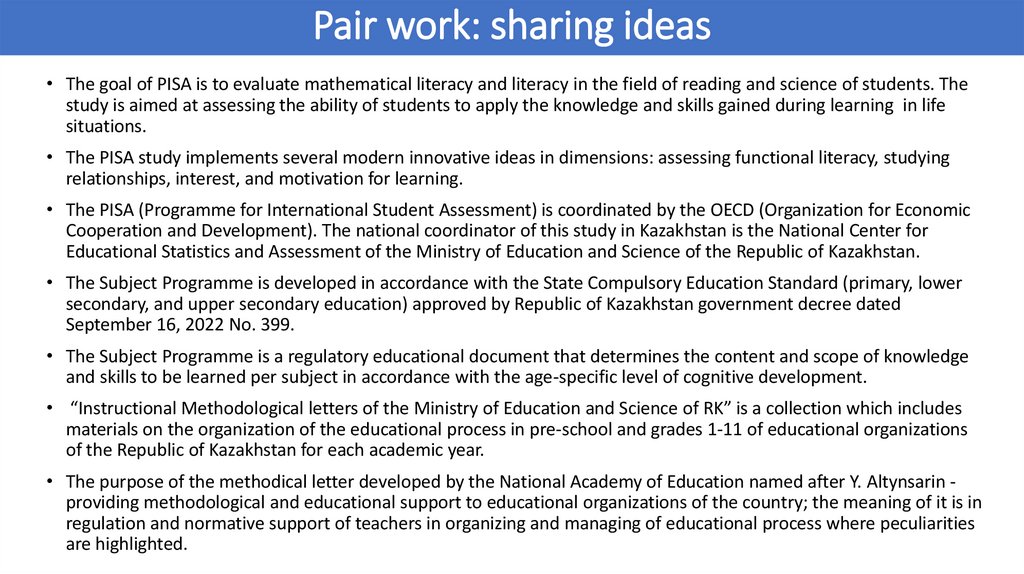
• The goal of PISA is to evaluate mathematical literacy and literacy in the field of reading and science of students. Thestudy is aimed at assessing the ability of students to apply the knowledge and skills gained during learning in life
situations.
• The PISA study implements several modern innovative ideas in dimensions: assessing functional literacy, studying
relationships, interest, and motivation for learning.
• The PISA (Programme for International Student Assessment) is coordinated by the OECD (Organization for Economic
Cooperation and Development). The national coordinator of this study in Kazakhstan is the National Center for
Educational Statistics and Assessment of the Ministry of Education and Science of the Republic of Kazakhstan.
• The Subject Programme is developed in accordance with the State Compulsory Education Standard (primary, lower
secondary, and upper secondary education) approved by Republic of Kazakhstan government decree dated
September 16, 2022 No. 399.
• The Subject Programme is a regulatory educational document that determines the content and scope of knowledge
and skills to be learned per subject in accordance with the age-specific level of cognitive development.
• “Instructional Methodological letters of the Ministry of Education and Science of RK” is a collection which includes
materials on the organization of the educational process in pre-school and grades 1-11 of educational organizations
of the Republic of Kazakhstan for each academic year.
• The purpose of the methodical letter developed by the National Academy of Education named after Y. Altynsarin providing methodological and educational support to educational organizations of the country; the meaning of it is in
regulation and normative support of teachers in organizing and managing of educational process where peculiarities
are highlighted.
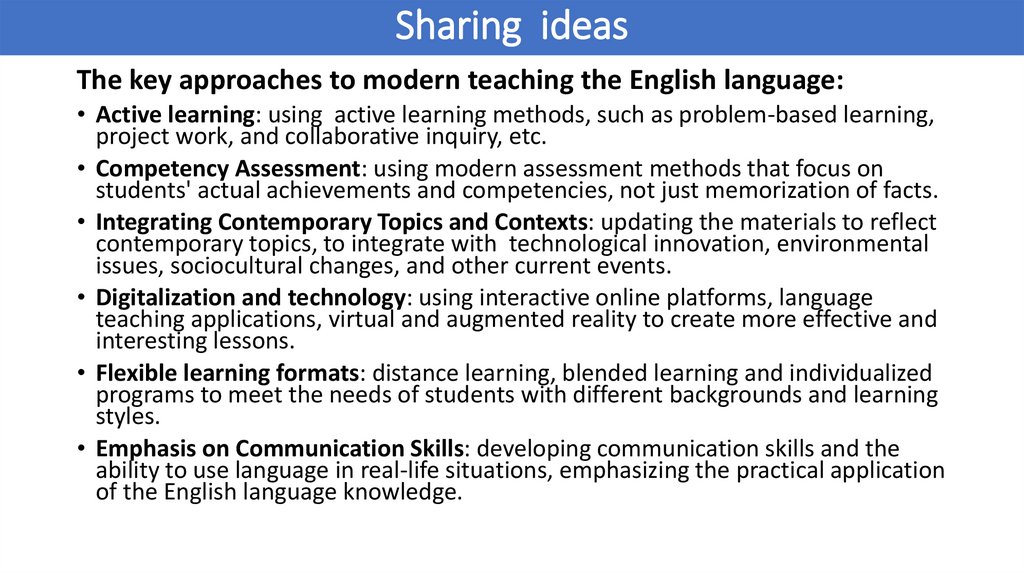
5. Sharing ideas
The key approaches to modern teaching the English language:• Active learning: using active learning methods, such as problem-based learning,
project work, and collaborative inquiry, etc.
• Competency Assessment: using modern assessment methods that focus on
students' actual achievements and competencies, not just memorization of facts.
• Integrating Contemporary Topics and Contexts: updating the materials to reflect
contemporary topics, to integrate with technological innovation, environmental
issues, sociocultural changes, and other current events.
• Digitalization and technology: using interactive online platforms, language
teaching applications, virtual and augmented reality to create more effective and
interesting lessons.
• Flexible learning formats: distance learning, blended learning and individualized
programs to meet the needs of students with different backgrounds and learning
styles.
• Emphasis on Communication Skills: developing communication skills and the
ability to use language in real-life situations, emphasizing the practical application
of the English language knowledge.
6. ??????
Why is it necessary to develop students’ functionalliteracy, especially in reading?