 pedagogy
Similar presentations:




Assessment principles and types (formative, summative and selfassessment)
1.
Topic 2.1 Assessment principles andtypes (formative, summative and selfassessment)
2. Expected results
- know about types ofassessment;
- know about formative,
summative and selfassessment, and their role in
teaching;
- know how to use types of
assessment;
3. Brainstorming: What is assessment?
4. Understanding Formative Assessments
Understanding Formative AssessmentsFormative assessments are a crucial part of the learning process, providing valuable insights into
student progress and understanding. Unlike summative assessments that focus on grading and final outcomes,
formative assessments are designed to offer feedback and support ongoing learning. By implementing formative
assessments, educators can create a supportive and engaging learning environment that promotes student
growth and success.
There are various types of formative assessments that teachers can use to monitor student learning.
Some common examples include:
Informal questions: Engaging students in class discussions and asking questions to gauge their understanding.
Practice quizzes: Providing students with opportunities to test their knowledge and identify areas for
improvement.
One-minute papers: Asking students to summarize what they’ve learned in a short written response.
The benefits of formative assessments are manifold. Firstly, they provide students with regular
feedback, allowing them to reflect on their progress and make necessary adjustments. This feedback helps
students identify their strengths and weaknesses, enabling them to focus on areas that need improvement.
Additionally, formative assessments promote active learning, as they require students to actively engage with the
material and apply their knowledge. By incorporating formative assessments into their teaching strategies,
educators can create a more dynamic and student-centered learning environment.
5. Exploring Summative Assessments
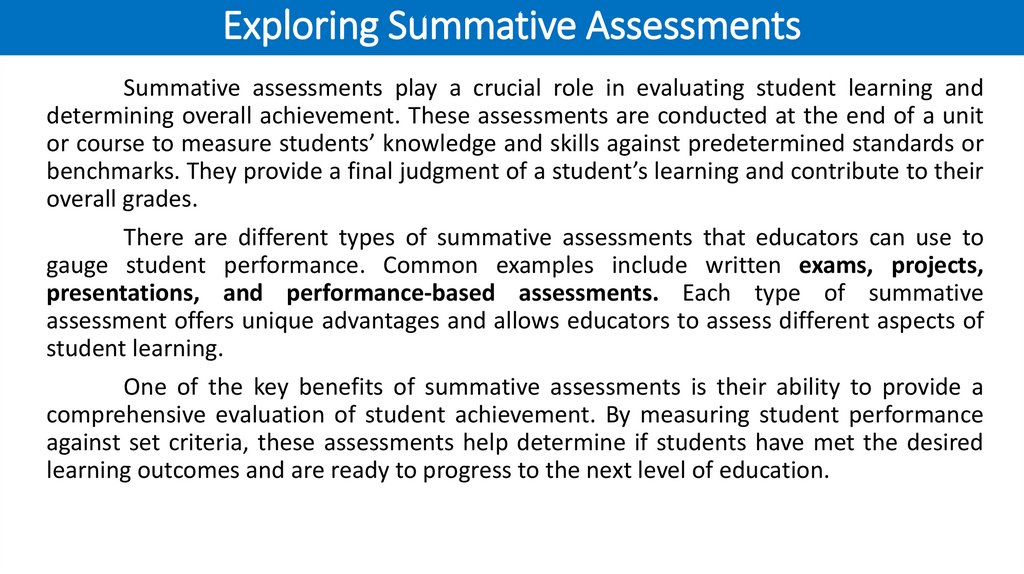
Summative assessments play a crucial role in evaluating student learning anddetermining overall achievement. These assessments are conducted at the end of a unit
or course to measure students’ knowledge and skills against predetermined standards or
benchmarks. They provide a final judgment of a student’s learning and contribute to their
overall grades.
There are different types of summative assessments that educators can use to
gauge student performance. Common examples include written exams, projects,
presentations, and performance-based assessments. Each type of summative
assessment offers unique advantages and allows educators to assess different aspects of
student learning.
One of the key benefits of summative assessments is their ability to provide a
comprehensive evaluation of student achievement. By measuring student performance
against set criteria, these assessments help determine if students have met the desired
learning outcomes and are ready to progress to the next level of education.
6. Self-assessment
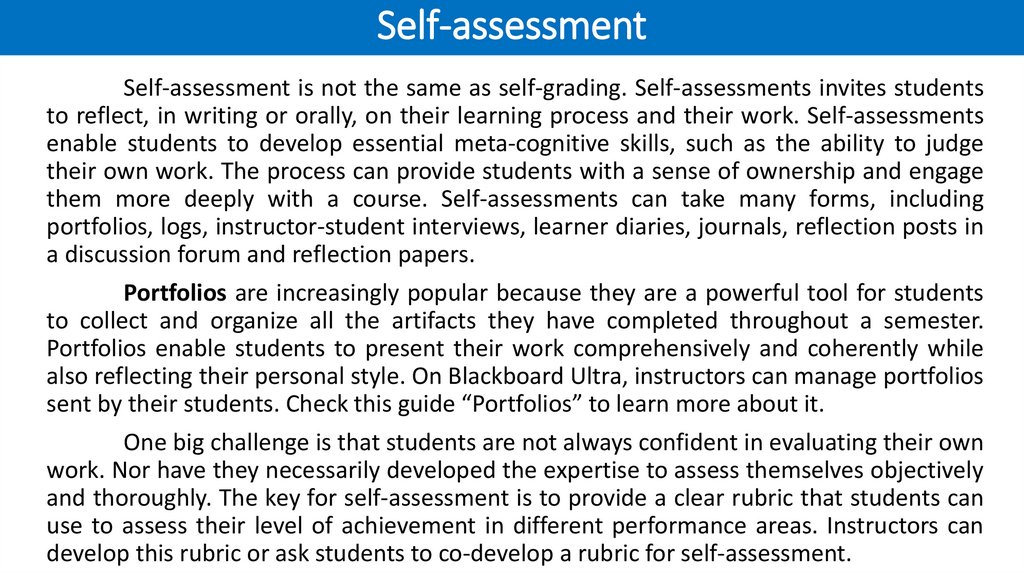
Self-assessment is not the same as self-grading. Self-assessments invites studentsto reflect, in writing or orally, on their learning process and their work. Self-assessments
enable students to develop essential meta-cognitive skills, such as the ability to judge
their own work. The process can provide students with a sense of ownership and engage
them more deeply with a course. Self-assessments can take many forms, including
portfolios, logs, instructor-student interviews, learner diaries, journals, reflection posts in
a discussion forum and reflection papers.
Portfolios are increasingly popular because they are a powerful tool for students
to collect and organize all the artifacts they have completed throughout a semester.
Portfolios enable students to present their work comprehensively and coherently while
also reflecting their personal style. On Blackboard Ultra, instructors can manage portfolios
sent by their students. Check this guide “Portfolios” to learn more about it.
One big challenge is that students are not always confident in evaluating their own
work. Nor have they necessarily developed the expertise to assess themselves objectively
and thoroughly. The key for self-assessment is to provide a clear rubric that students can
use to assess their level of achievement in different performance areas. Instructors can
develop this rubric or ask students to co-develop a rubric for self-assessment.
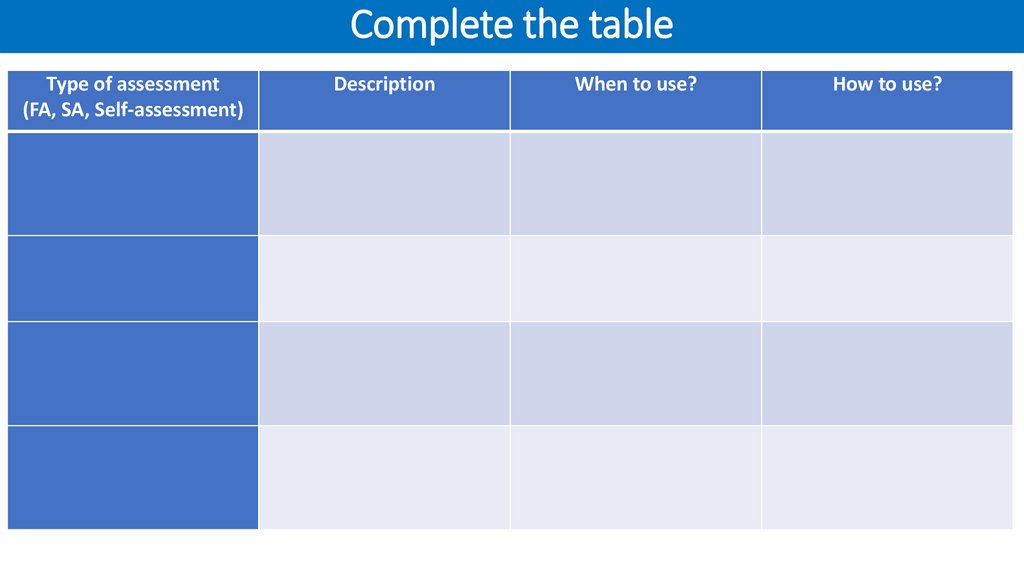
7. Complete the table
Type of assessment(FA, SA, Self-assessment)
Description
When to use?
How to use?
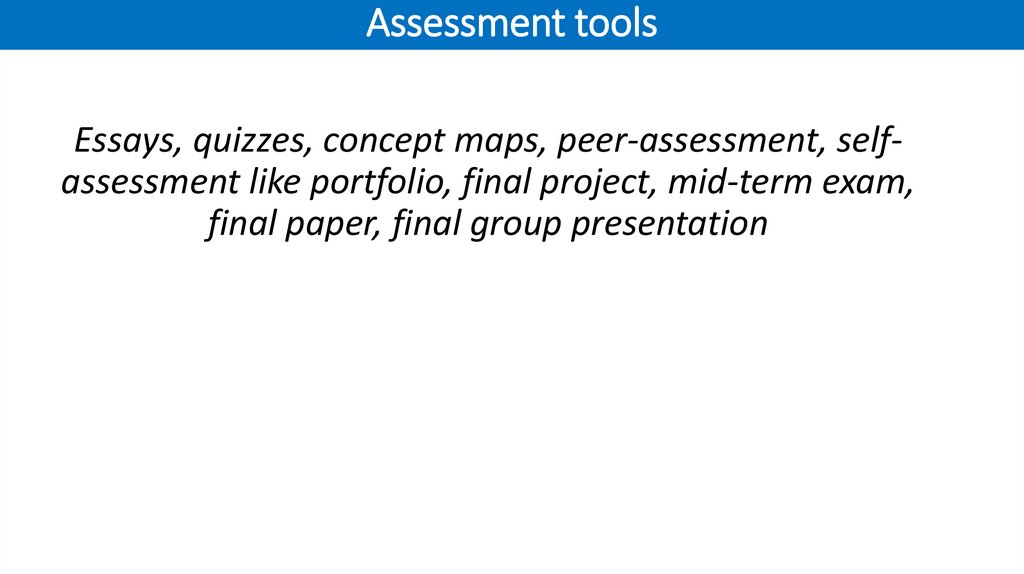
8. Assessment tools
Essays, quizzes, concept maps, peer-assessment, selfassessment like portfolio, final project, mid-term exam,final paper, final group presentation
9. Essays
Essays are a common form of a writing assignmentin online courses. Short essays are often used to
examine students’ understanding of concepts,
principles, and theories in one field. Long essays are
often used to assess students’ skills in analyzing,
problem solving, or completing creative work.
The key to an effective essay assignment is to
provide a clear rubric and effective prompts that can
encourage students to think critically and create
something new.
10. Exams
Exams have long been a go-to method for assessingstudents’ knowledge and skills. Exam questions can be multiple
choice, true/false, matching, essay questions, etc. It might take a
lot of time for instructors to design and develop exam questions,
but grading an exam tends to be easier than it is to evaluate
projects or research papers. One big challenge when preparing
exams is to make sure questions are valid and reliable for
students who might perform at different levels.
A key part of the process is to engage students in the exam
preparation process, so as to avoid cramming and surface
learning. A good strategy for mitigating cramming is for an
instructor to review key concepts, theories, principles, and
applications with students through lecture videos or module
overviews in online courses.
11. Quizzes
Quizzes are often provided at regular intervals, usuallyby week or by module in an online course. These quizzes can
help instructors make sure whether their students are on the
right track. Quizzes can help students review what they are
learning, identify their knowledge gaps, and retain
information. For students who are nervous about mid-term
and final exams, quizzes can help them prepare and ease
anxiety.
The Bloom’s Taxonomy as shown in the figure classifies
the cognitive domain of learning into six levels. Using these
levels as a guide can assist instructors in developing effective
quiz questions.
12. Self-assessment
Self-assessment is not the same as self-grading. Self-assessmentsinvites students to reflect, in writing or orally, on their learning
process and their work. Self-assessments enable students to
develop essential meta-cognitive skills, such as the ability to judge
their own work. The process can provide students with a sense of
ownership and engage them more deeply with a course. Selfassessments can take many forms, including portfolios, logs,
instructor-student interviews, learner diaries, journals, reflection
posts in a discussion forum and reflection papers.
Portfolios are increasingly popular because they are a powerful
tool for students to collect and organize all the artifacts they have
completed throughout a semester. Portfolios enable students to
present their work comprehensively and coherently while also
reflecting their personal style. On Blackboard Ultra, instructors can
manage portfolios sent by their students.
13. Peer-assessment
Peer-assessment is not the same as peer grading. Instructors hold theauthority to assign grade or points. However, peer-assessments can provide
students with an opportunity to use an existing rubric to assess their peers’
work. By assessing other’s work, students can compare and contrast a peer’s
performance with their own. Students can also gain insight from seeing how a
peer interprets a common rubric.
It is a challenge is to assure that peer assessment is fair and accurate.
Given students’ varied knowledge, experience, and backgrounds, bias is often
unavoidable. Instructor feedback is often needed to supplement peer feedback
on students’ work to maintain fairness and accuracy.
As with portfolios, it is necessary to provide guidance via a clear rubric.
Tool such as those provided through FeedbackFruits can dramatically streamline
the peer-assessment process. Feedback Fruits’ Peer Review tool has gained
considerable attention in higher education because the tool makes it easier for
instructors to randomly assign work to different students and grade the whole
peer-review activity. It also makes it easier for students to submit their work for
review, review their peers’ work, and read the feedback they have received.
14. Case studies
Case studies can provide a good opportunity forstudents to apply what they learned by solving a real world
problem. While working on case studies, students engage in
critical thinking and problem solving.
Case studies can take different forms in different
disciplines. For instance, instructors in the Nursing
department often apply case studies through which students
apply a concept or theory to diagnose patients and provide
possible treatments. Instructors in the Psychology department
often apply case studies in which they ask students to analyze
scenarios for patients and come up with treatment strategies
and a plan of care.
15. Authentic assessments
Authentic assessments can provide students opportunities to solvereal-world problems by applying related knowledge and skills. Authentic
assessments can help students see how the knowledge is used in real
world.
Authentic assessments is consider as one important characteristics in the
framework about authentic learning proposed by Herrington and Oliver
(2000). Messier (2022) provides a detailed guideline about types of
authentic assessments, why to use authentic assessments, considerations
when designing authentic assessments, types of authentic assessment
products and performance, and how to communicate authentic
assessments. The list of examples for different types of authentic
assessment can be useful.
There four frequently used types of authentic assessment products and
performance: writing for an actual audience in one field like a strategic
plan and proposal, performance, design of products, and creation of
products.
16. Group projects
Group projects can provide a good opportunity for students towork with their peers closely to exchange knowledge,
brainstorm their ideas, and collaboratively work on
deliverables. To complete a group project, students will spend
time in searching for materials, discuss with team members,
and collaboratively edit deliverables.
17. Expected results on reflection
-know what reflection is, what strategies can be usedfor students’ reflection stage;
-be able to plan and organize monitoring of students’
results in learning by means of different methods and
techniques.
18. Reflection: What & Why
Reflection: What & WhyAnswer the questions:
What is reflection?
Why is it important in learning?
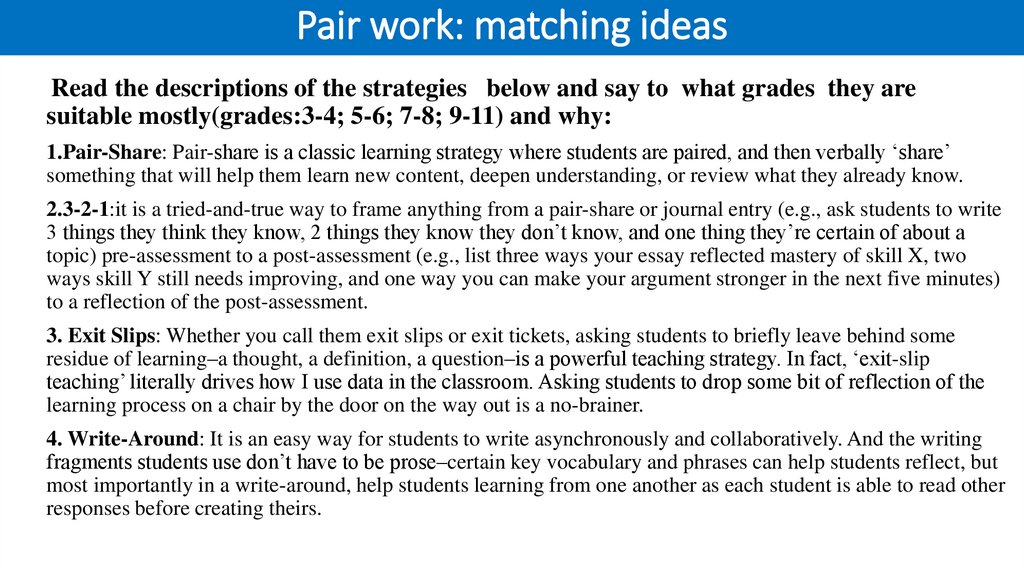
19. Pair work: matching ideas
Read the descriptions of the strategies below and say to what grades they aresuitable mostly(grades:3-4; 5-6; 7-8; 9-11) and why:
1.Pair-Share: Pair-share is a classic learning strategy where students are paired, and then verbally ‘share’
something that will help them learn new content, deepen understanding, or review what they already know.
2.3-2-1:it is a tried-and-true way to frame anything from a pair-share or journal entry (e.g., ask students to write
3 things they think they know, 2 things they know they don’t know, and one thing they’re certain of about a
topic) pre-assessment to a post-assessment (e.g., list three ways your essay reflected mastery of skill X, two
ways skill Y still needs improving, and one way you can make your argument stronger in the next five minutes)
to a reflection of the post-assessment.
3. Exit Slips: Whether you call them exit slips or exit tickets, asking students to briefly leave behind some
residue of learning–a thought, a definition, a question–is a powerful teaching strategy. In fact, ‘exit-slip
teaching’ literally drives how I use data in the classroom. Asking students to drop some bit of reflection of the
learning process on a chair by the door on the way out is a no-brainer.
4. Write-Around: It is an easy way for students to write asynchronously and collaboratively. And the writing
fragments students use don’t have to be prose–certain key vocabulary and phrases can help students reflect, but
most importantly in a write-around, help students learning from one another as each student is able to read other
responses before creating theirs.