

 business
Similar presentations:










8.Risks in the business administration system
1. 8. Risks in the business administration system
USTSINOVICH IRINAMANAGERIAL ECONOMICS
8. RISKS IN THE BUSINESS
ADMINISTRATION SYSTEM
2. 8.Risks in the business administration system
8.RISKS IN THE BUSINESS ADMINISTRATION SYSTEM1. Economic risk: essence, place and role in planning. Types of loss
and risk
2. Entrepreneurial planning risks assessment
3. Risk reduction methods
Ustsinovich I.V.
2
3. 1. Economic risk: essence, place and role in planning. Types of loss and risk
1. ECONOMIC RISK: ESSENCE, PLACE AND ROLE IN PLANNING. TYPESOF LOSS AND RISK
Ustsinovich I.V.
3
4.
• The source of the risk is uncertainty, which refersto the lack of complete and reliable information
used in the preparation and implementation of the
plan.
Ustsinovich I.V.
4
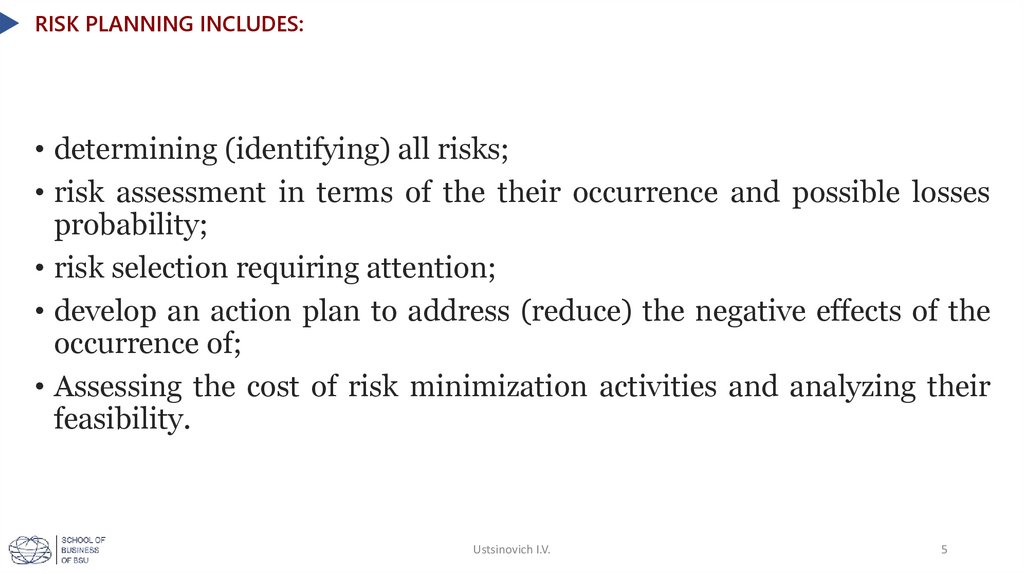
5. Risk planning includes:
RISK PLANNING INCLUDES:• determining (identifying) all risks;
• risk assessment in terms of the their occurrence and possible losses
probability;
• risk selection requiring attention;
• develop an action plan to address (reduce) the negative effects of the
occurrence of;
• Assessing the cost of risk minimization activities and analyzing their
feasibility.
Ustsinovich I.V.
5
6. Losses types:
LOSSES TYPES:• material;
• labor;
• financial;
• timing;
• image;
• other.
Ustsinovich I.V.
6
7. 2. Entrepreneurial planning risks assessment
2. ENTREPRENEURIAL PLANNING RISKS ASSESSMENTUstsinovich I.V.
7
8.
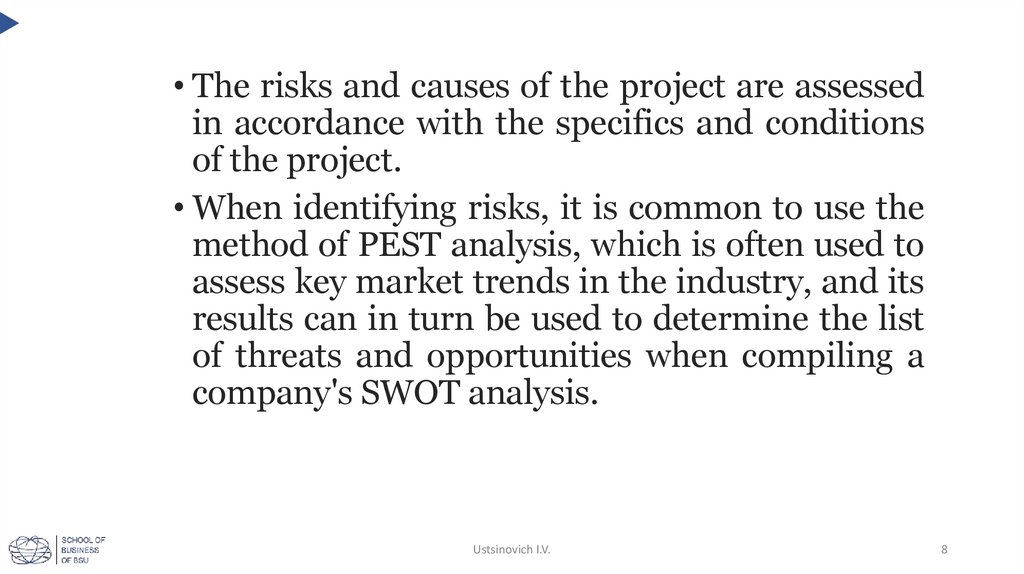
• The risks and causes of the project are assessedin accordance with the specifics and conditions
of the project.
• When identifying risks, it is common to use the
method of PEST analysis, which is often used to
assess key market trends in the industry, and its
results can in turn be used to determine the list
of threats and opportunities when compiling a
company's SWOT analysis.
Ustsinovich I.V.
8
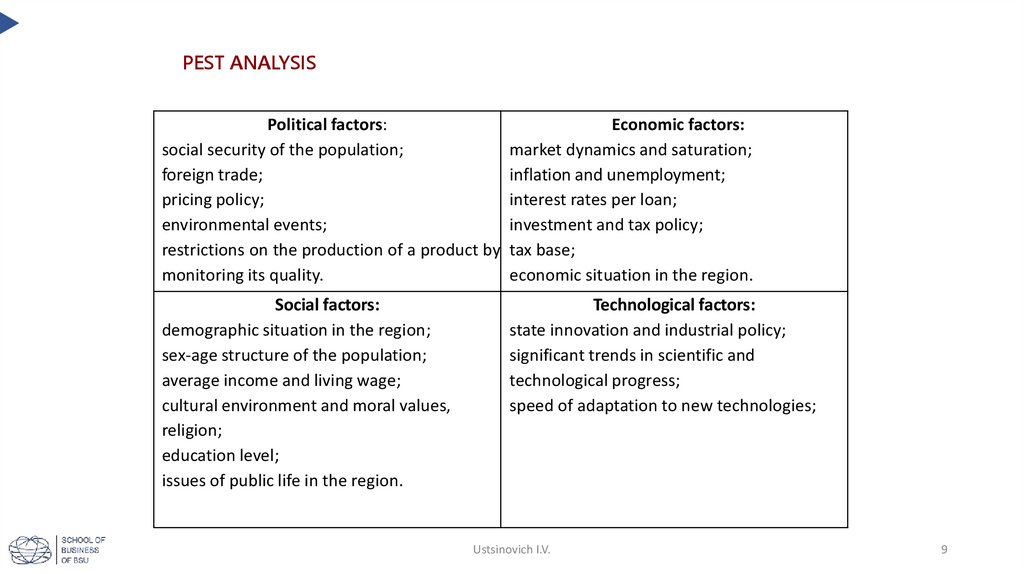
9. PEST analysis
PEST ANALYSISPolitical factors:
Economic factors:
social security of the population;
market dynamics and saturation;
foreign trade;
inflation and unemployment;
pricing policy;
interest rates per loan;
environmental events;
investment and tax policy;
restrictions on the production of a product by tax base;
monitoring its quality.
economic situation in the region.
Social factors:
demographic situation in the region;
sex-age structure of the population;
average income and living wage;
cultural environment and moral values,
religion;
education level;
issues of public life in the region.
Technological factors:
state innovation and industrial policy;
significant trends in scientific and
technological progress;
speed of adaptation to new technologies;
Ustsinovich I.V.
9
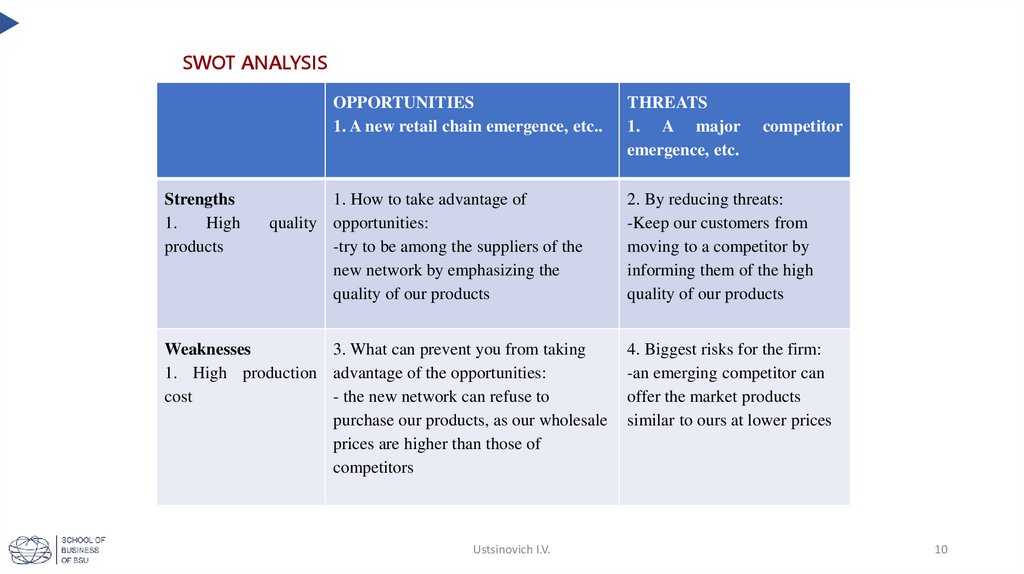
10. SWOT analysis
SWOT ANALYSISOPPORTUNITIES
1. A new retail chain emergence, etc..
Strengths
1.
High
products
1. How to take advantage of
quality opportunities:
-try to be among the suppliers of the
new network by emphasizing the
quality of our products
Weaknesses
3. What can prevent you from taking
1. High production advantage of the opportunities:
cost
- the new network can refuse to
purchase our products, as our wholesale
prices are higher than those of
competitors
Ustsinovich I.V.
THREATS
1. A major
emergence, etc.
competitor
2. By reducing threats:
-Keep our customers from
moving to a competitor by
informing them of the high
quality of our products
4. Biggest risks for the firm:
-an emerging competitor can
offer the market products
similar to ours at lower prices
10
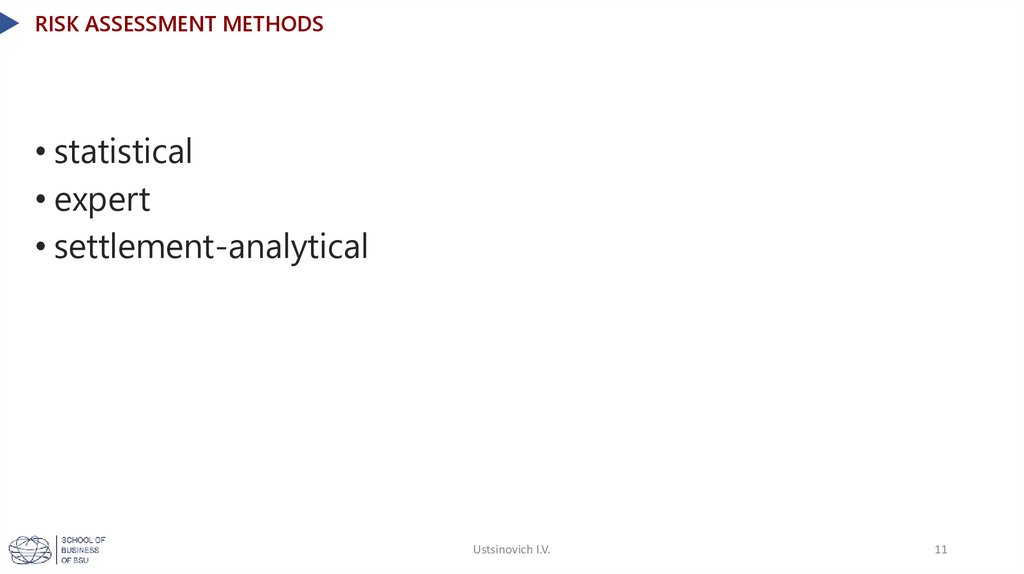
11. Risk assessment methods
RISK ASSESSMENT METHODS• statistical
• expert
• settlement-analytical
Ustsinovich I.V.
11
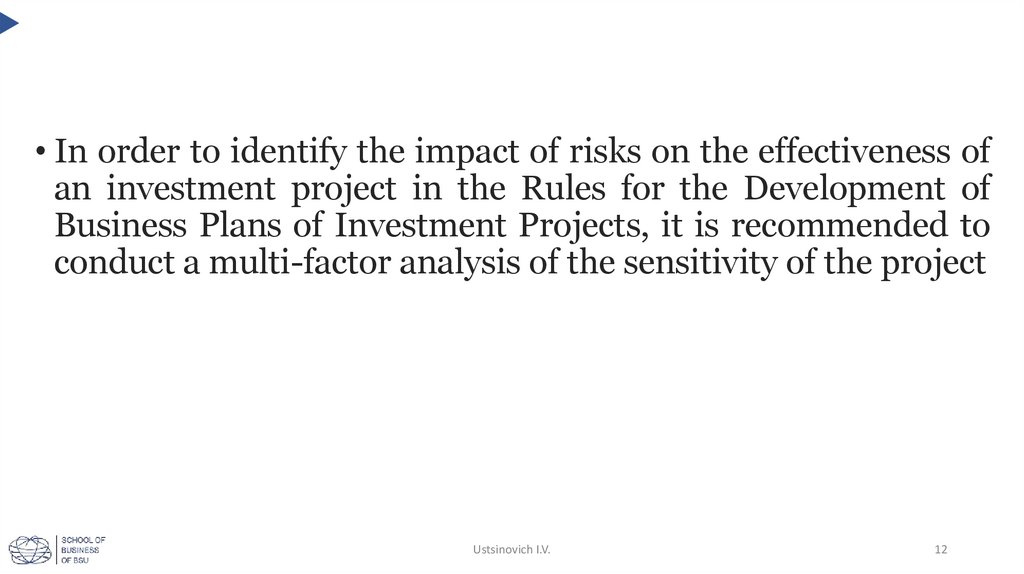
12.
• In order to identify the impact of risks on the effectiveness ofan investment project in the Rules for the Development of
Business Plans of Investment Projects, it is recommended to
conduct a multi-factor analysis of the sensitivity of the project
Ustsinovich I.V.
12
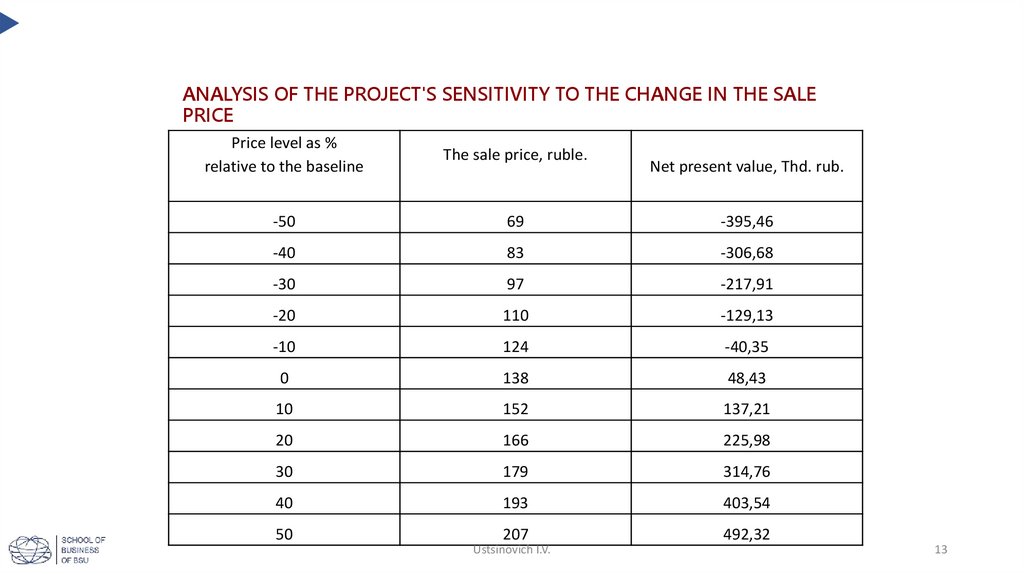
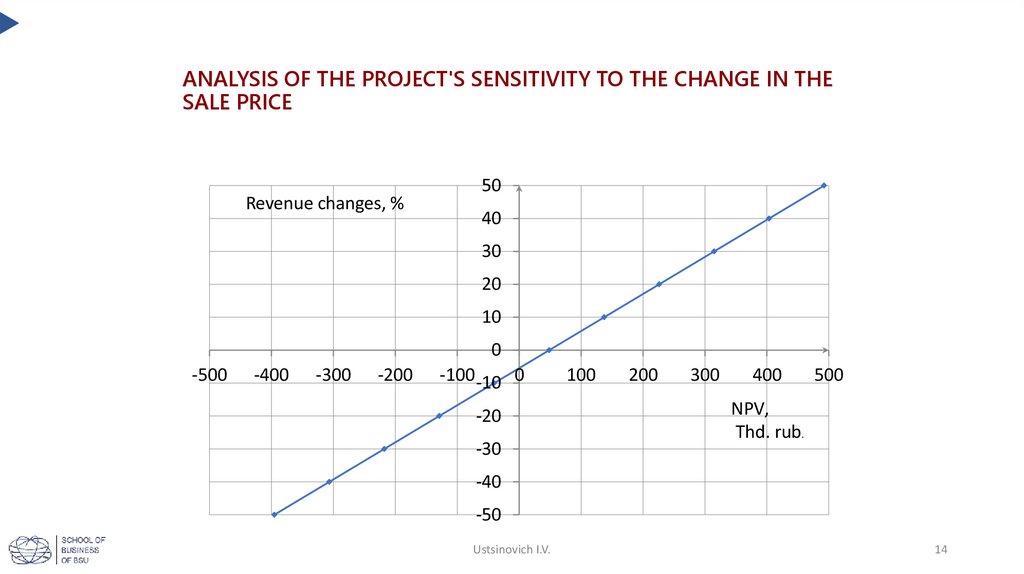
13. Analysis of the project's sensitivity to the change in the sale price
ANALYSIS OF THE PROJECT'S SENSITIVITY TO THE CHANGE IN THE SALEPRICE
Price level as %
relative to the baseline
The sale price, ruble.
-50
69
-395,46
-40
83
-306,68
-30
97
-217,91
-20
110
-129,13
-10
124
-40,35
0
138
48,43
10
152
137,21
20
166
225,98
30
179
314,76
40
193
403,54
207
492,32
50
Ustsinovich I.V.
Net present value, Thd. rub.
13
14. Analysis of the project's sensitivity to the change in the sale price
ANALYSIS OF THE PROJECT'S SENSITIVITY TO THE CHANGE IN THESALE PRICE
Revenue changes, %
50
40
30
20
10
0
-500
-400
-300
-200
-100 -10 0
-20
-30
100
200
300
400
500
NPV,
Thd. rub.
-40
-50
Ustsinovich I.V.
14
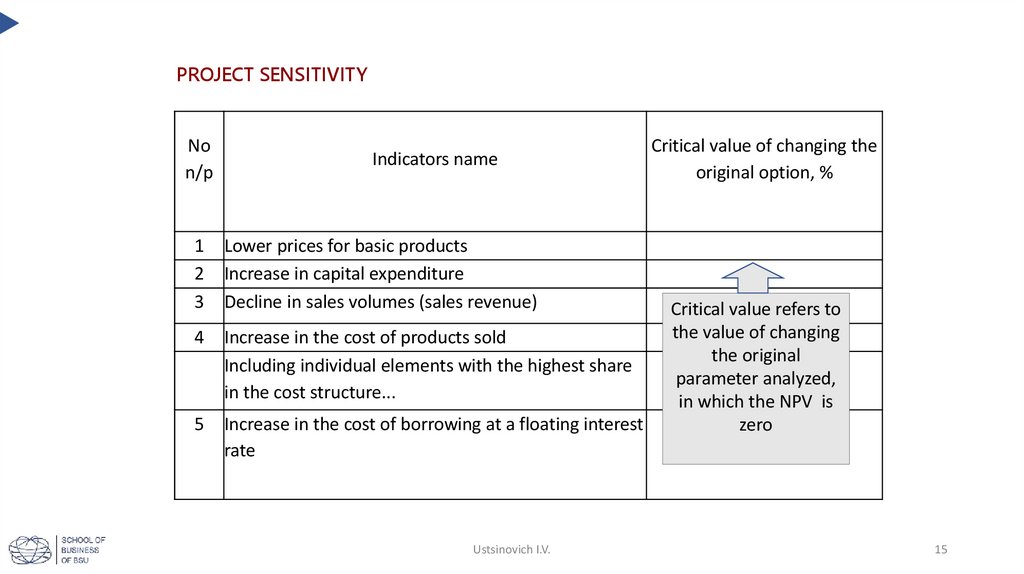
15. Project sensitivity
PROJECT SENSITIVITYNo
n/p
Indicators name
1
2
3
Lower prices for basic products
Increase in capital expenditure
Decline in sales volumes (sales revenue)
4
Increase in the cost of products sold
Including individual elements with the highest share
in the cost structure...
5
Increase in the cost of borrowing at a floating interest
rate
Ustsinovich I.V.
Critical value of changing the
original option, %
Critical value refers to
the value of changing
the original
parameter analyzed,
in which the NPV is
zero
15
16. Script analysis sequence:
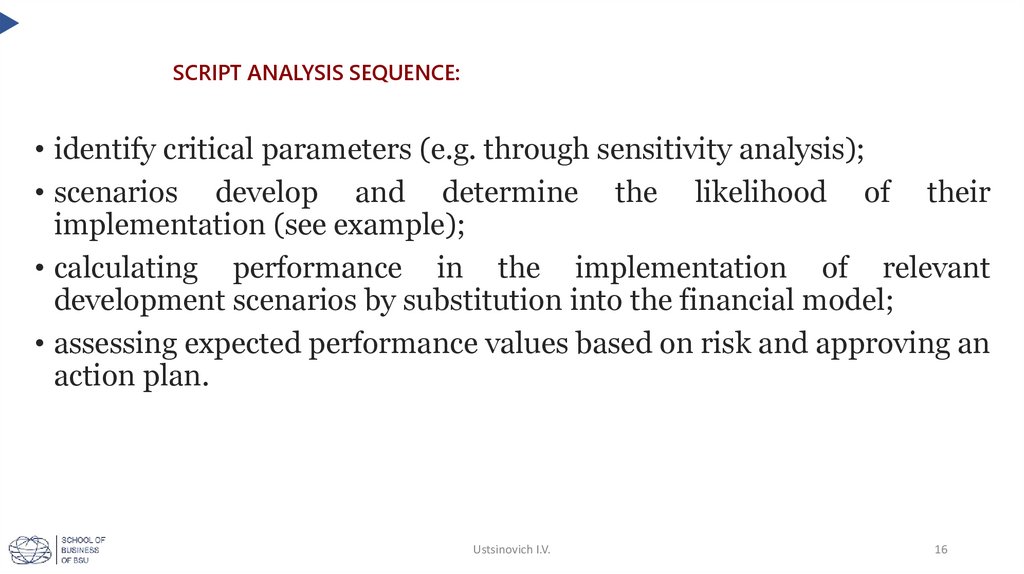
SCRIPT ANALYSIS SEQUENCE:• identify critical parameters (e.g. through sensitivity analysis);
• scenarios develop and determine the likelihood of their
implementation (see example);
• calculating performance in the implementation of relevant
development scenarios by substitution into the financial model;
• assessing expected performance values based on risk and approving an
action plan.
Ustsinovich I.V.
16
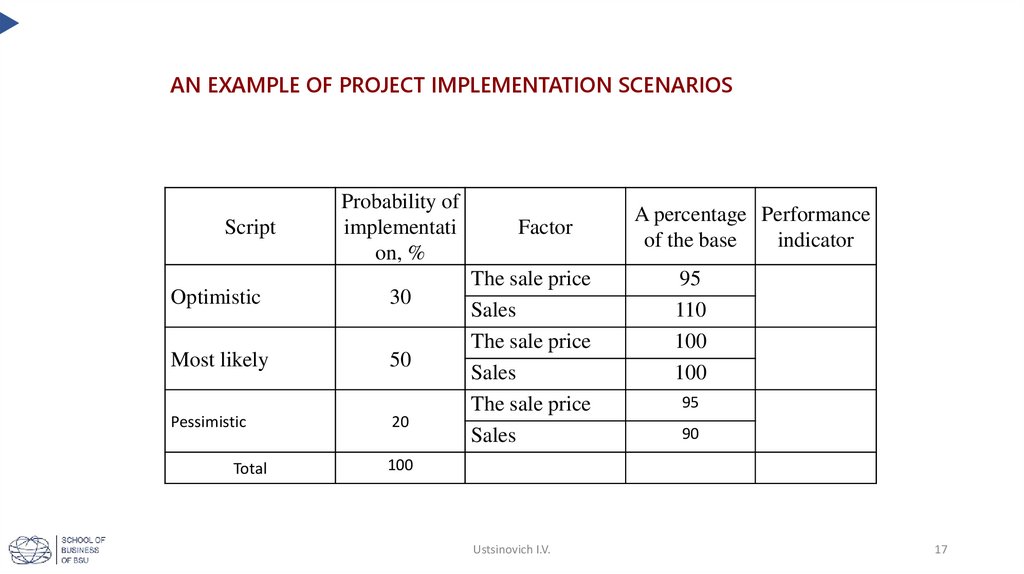
17. An example of project implementation scenarios
AN EXAMPLE OF PROJECT IMPLEMENTATION SCENARIOSScript
Probability of
implementati
on, %
Optimistic
30
Most likely
50
Pessimistic
Total
20
Factor
The sale price
Sales
The sale price
Sales
The sale price
Sales
A percentage Performance
of the base
indicator
95
110
100
100
95
90
100
Ustsinovich I.V.
17
18.
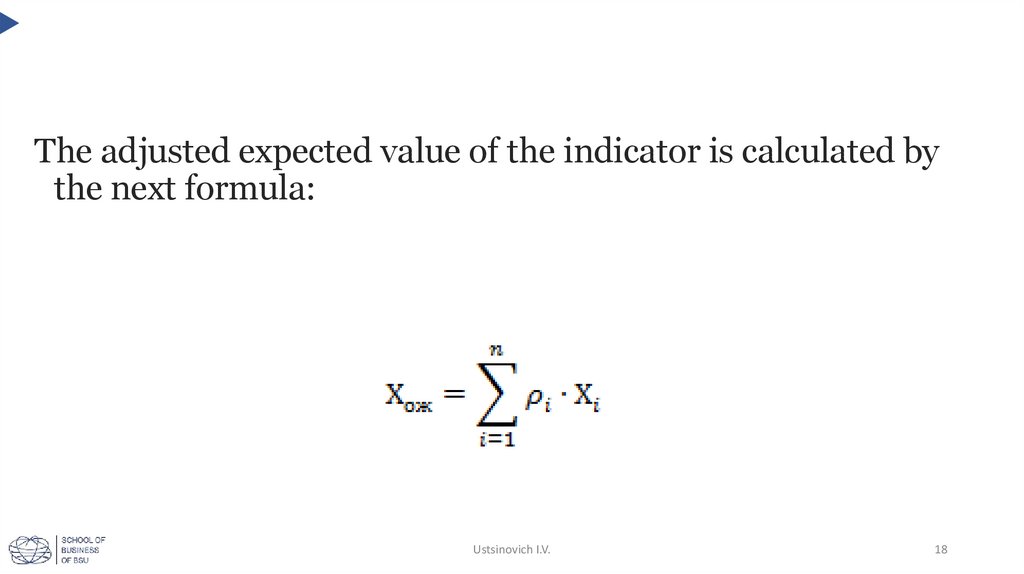
The adjusted expected value of the indicator is calculated bythe next formula:
Ustsinovich I.V.
18
19. 3. Risk reduction methods
3. RISK REDUCTION METHODSUstsinovich I.V.
19
20. Risk reduction methods
RISK REDUCTION METHODS• risk evasion;
• localization;
• taking hold of risk;
• diversification.
Ustsinovich I.V.
20
21. Thank you for your attention!
THANK YOU FOR YOUR ATTENTION!Irina Valeryevna Ustsinovitch, Ph.D. in Economics, Associate Professor
+375 (29) 7785456
i.ustinovich@yandex.ru
Ustsinovich I.V.
21