
 english
Similar presentations:










Secured Hash Algorithm (SHA)
1. Secured Hash Algorithm(SHA)
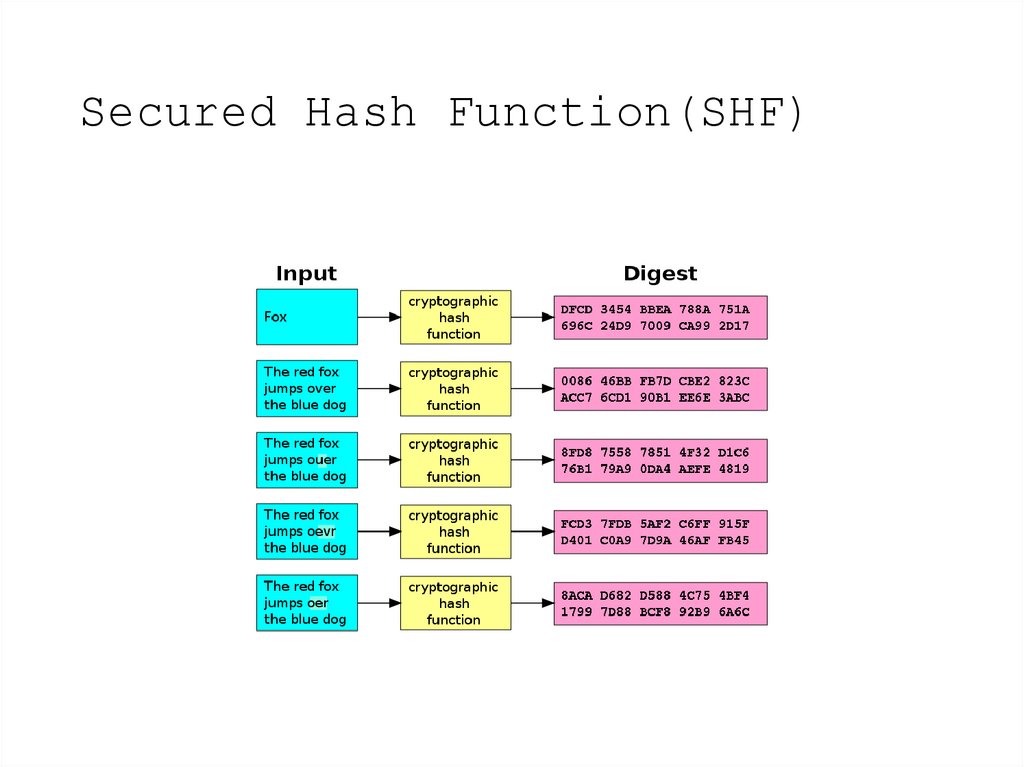
2. Secured Hash Function(SHF)
3.
• A cryptographic hash function takes anarbitrary block of data and returns a fixedsize bit string.
• The data to be encoded is often called the
"message," and the hash value is sometimes
called the message digest or simply digest.
• Used in digital signatures and message
authentication codes.
4. Properties of SHA
• It is easy to compute the hash value for anygiven message
• It is infeasible to generate a message that
has a given hash
• It is infeasible to modify a message without
changing the hash
• It is infeasible to find two different
messages with the same hash
5. Pre-image resistance
• Given a hash h it should be difficult to findany message m such that
h = hash(m)
• This concept is related to that of one-way .
Functions that lack this property are
vulnerable to preimage attacks.
6. Second pre-image resistance
• Given an input m1 it should be difficult tofind another input m2 where m1 ≠ m2 such that
hash(m1) = hash(m2)
• This property is sometimes referred to as
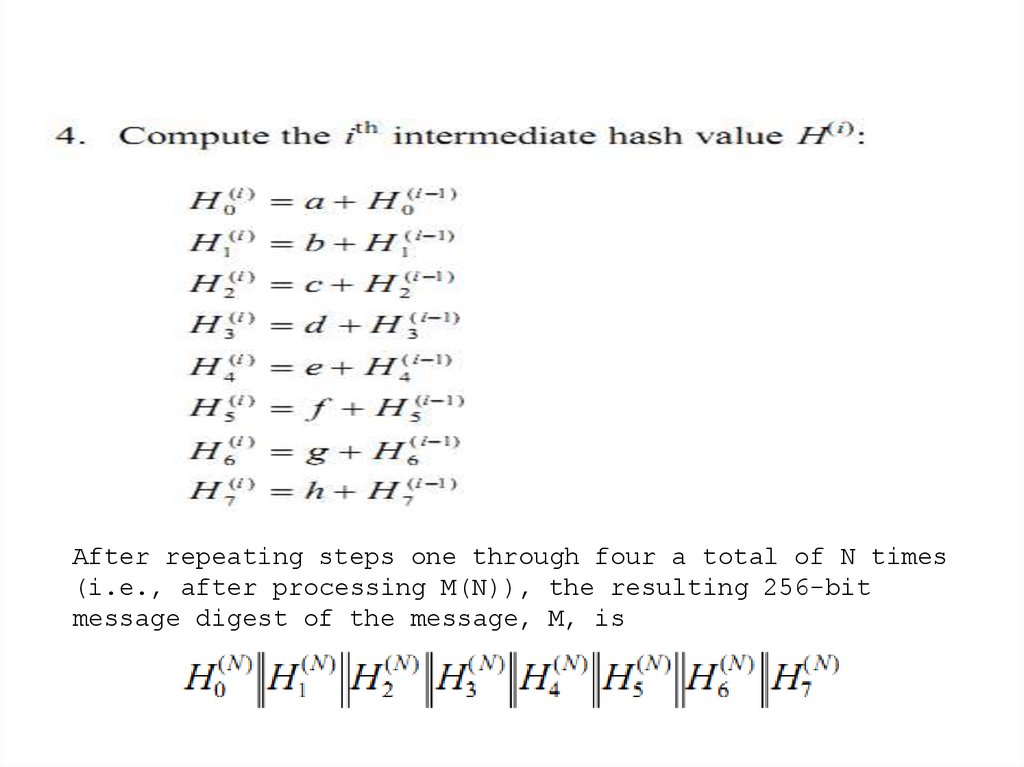
weak collision resistance, and functions that
lack this property are vulnerable to secondpreimage attacks.
7. Collision resistance
• It should be difficult to find two differentmessages m1 and m2 such that
hash(m1) = hash(m2)
• Such a pair is called a cryptographic hash
collision. This property is sometimes referred
to as strong collision resistance. It requires
a hash value at least twice as long as that
required for preimage-resistance, otherwise
collisions may be found by a birthday attack.
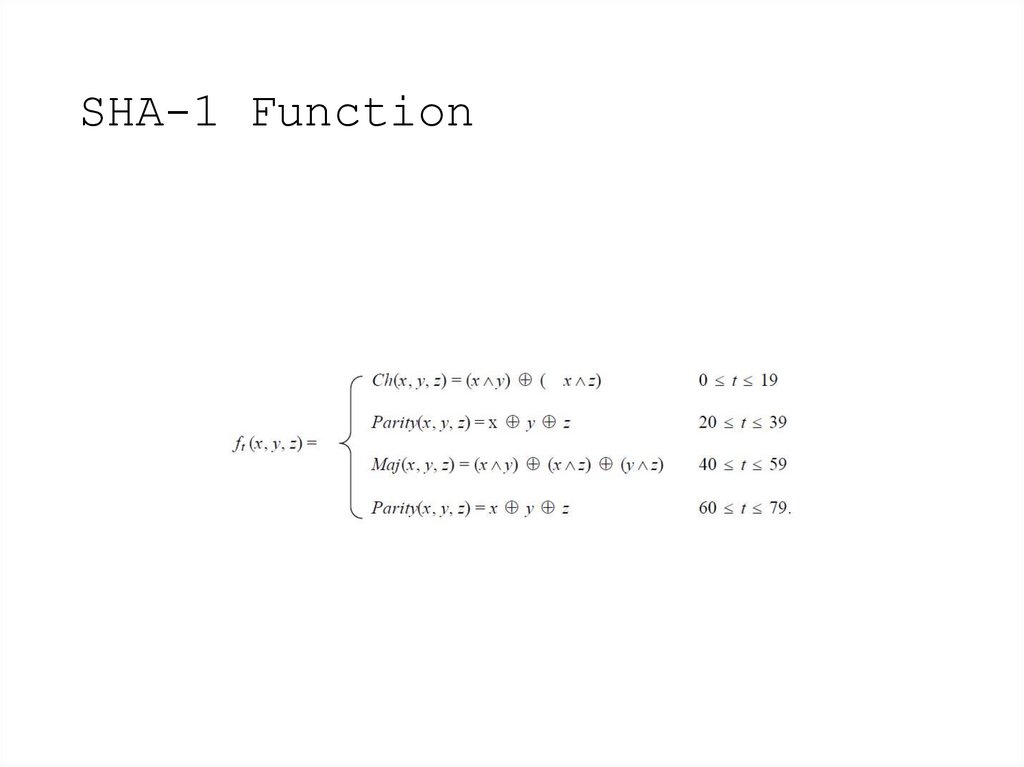
8. SHA-1 Function
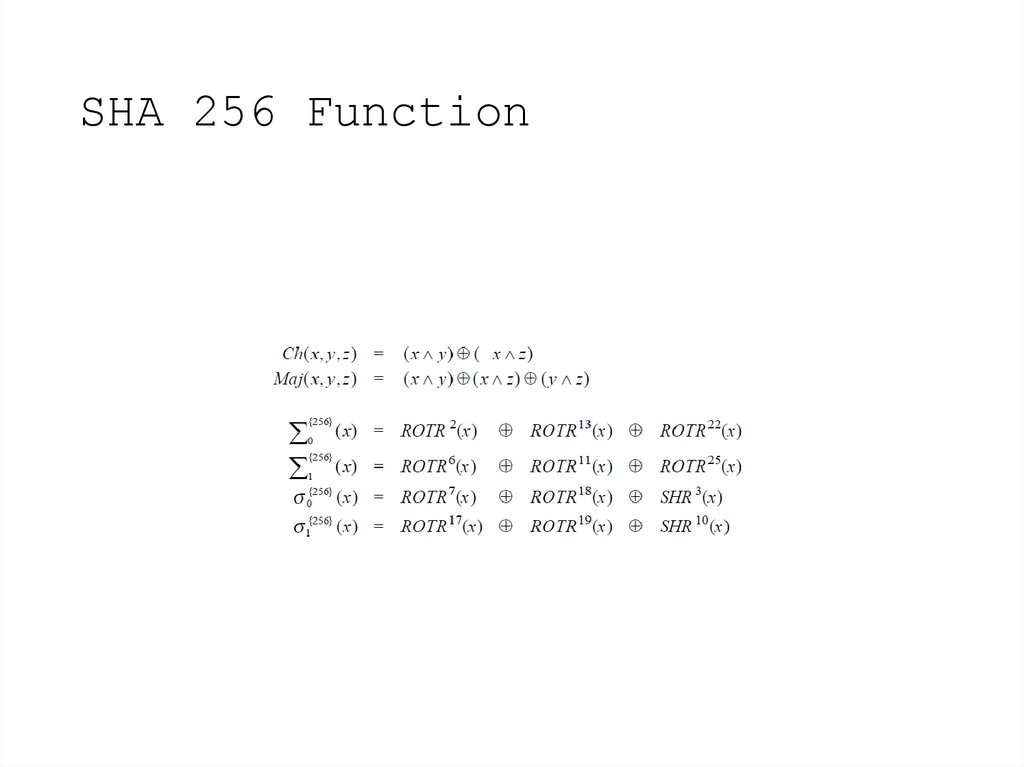
9. SHA 256 Function
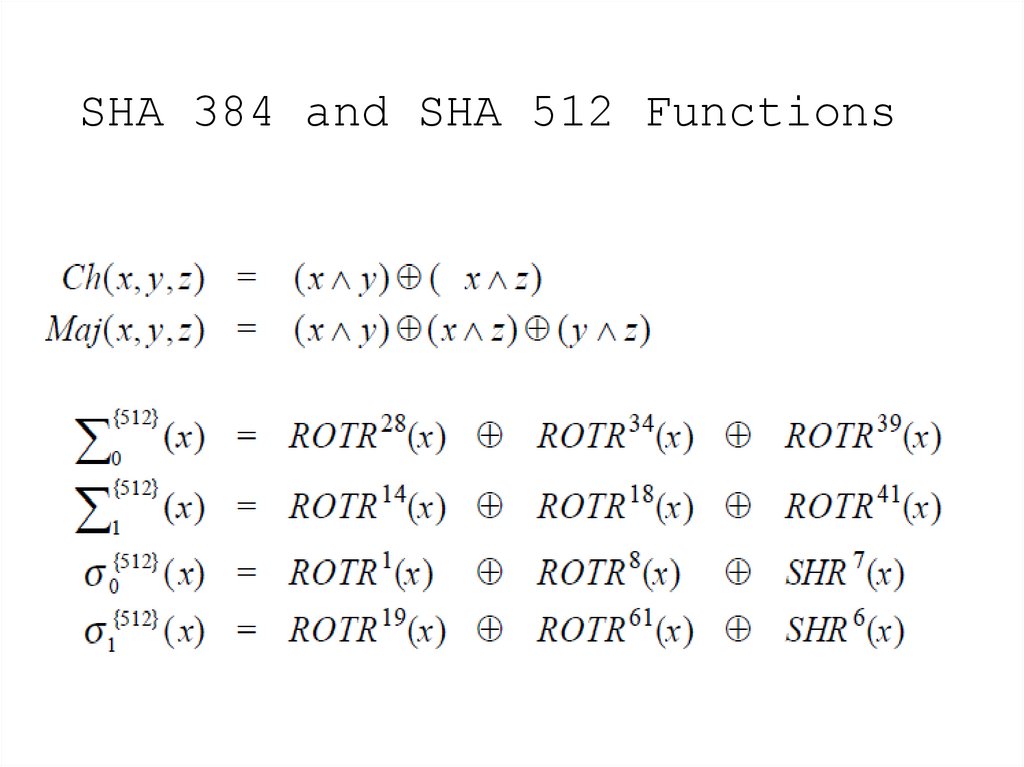
10. SHA 384 and SHA 512 Functions
11. SHA 1 Constants
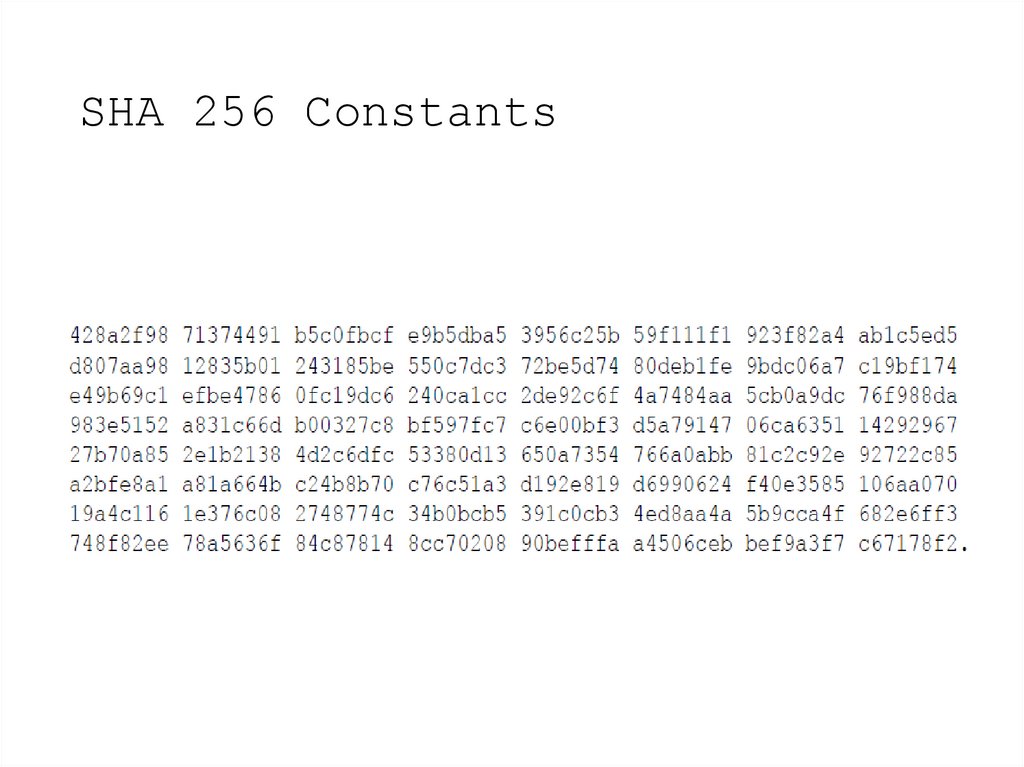
12. SHA 256 Constants
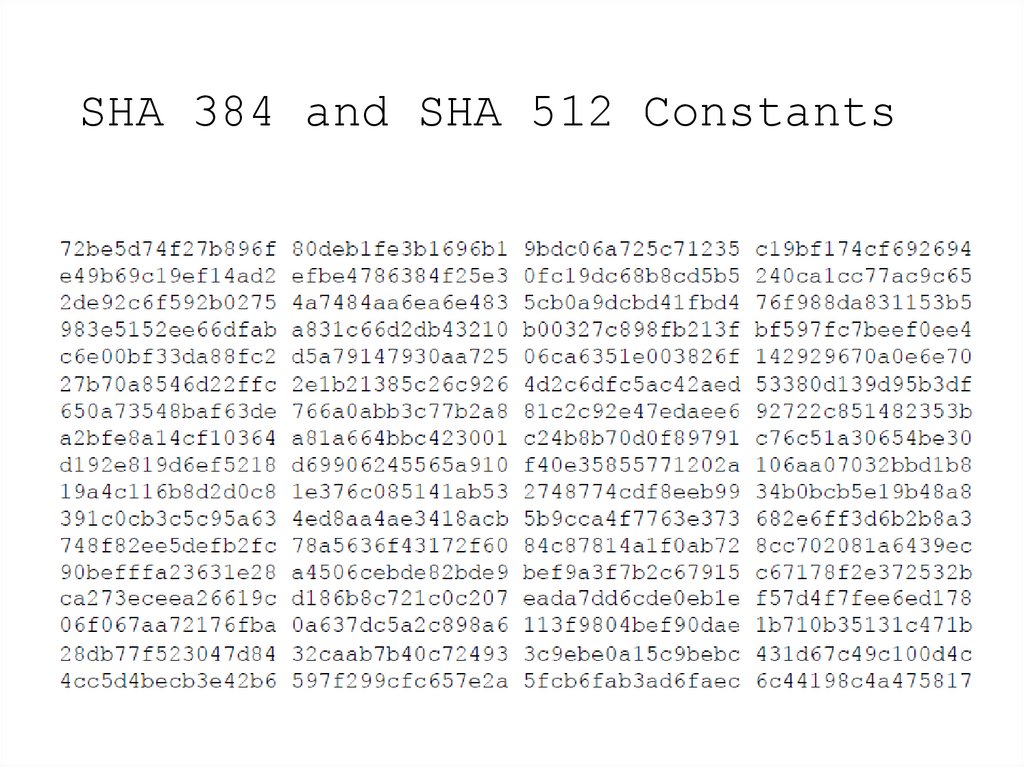
13. SHA 384 and SHA 512 Constants
14. Steps involved in SHA
• Preprocessing• Hashing
15. Preprocessing
• It consists of three steps• Padding• Parsing
• Setting initial hash value
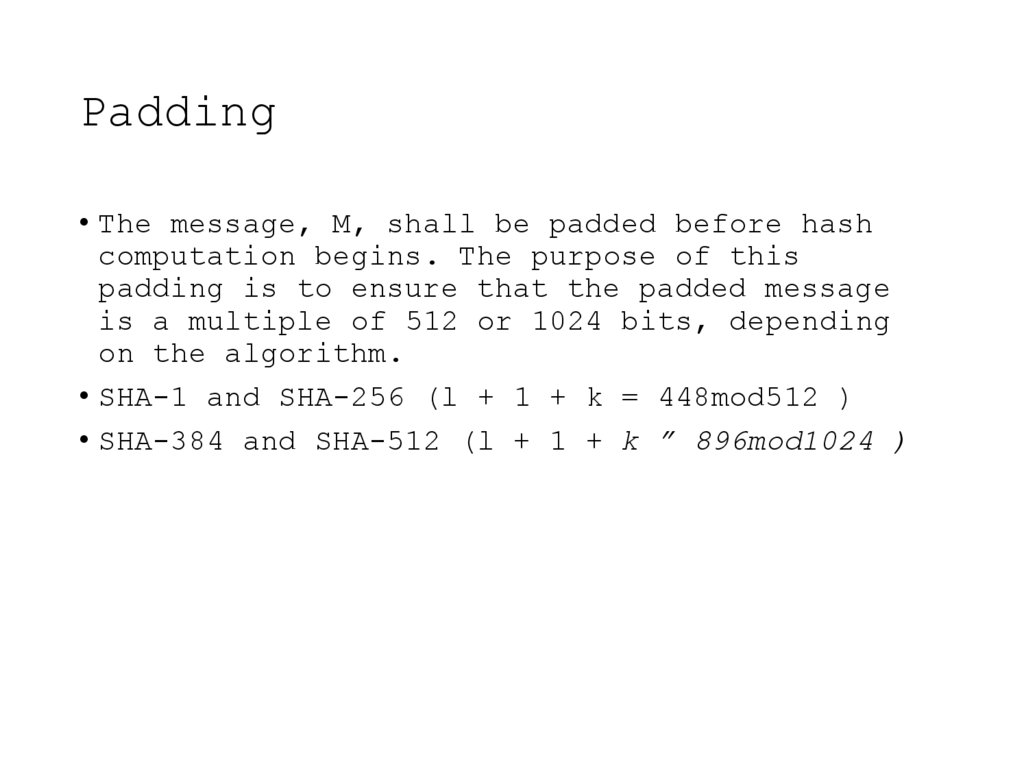
16. Padding
• The message, M, shall be padded before hashcomputation begins. The purpose of this
padding is to ensure that the padded message
is a multiple of 512 or 1024 bits, depending
on the algorithm.
• SHA-1 and SHA-256 (l + 1 + k = 448mod512 )
• SHA-384 and SHA-512 (l + 1 + k ” 896mod1024 )
17. Parsing the Padded Message
• After a message has been padded, it must beparsed into Nm-bit blocks before the hash
computation can begin.
• SHA-1 and SHA-256
• SHA-384 and SHA-512
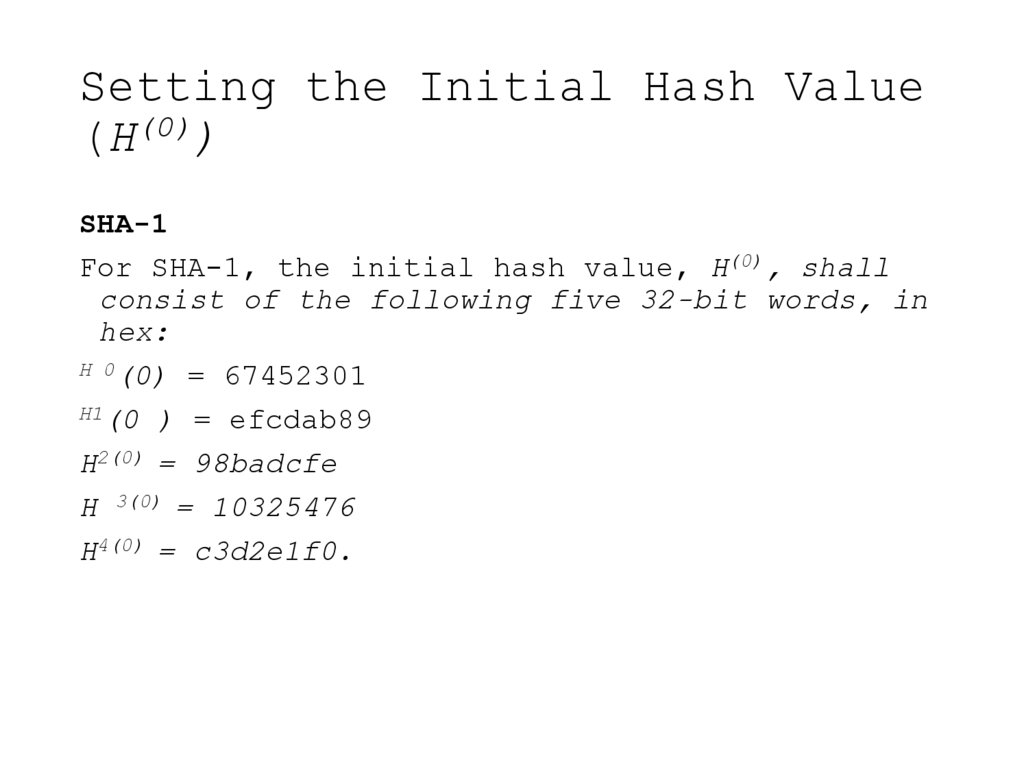
18. Setting the Initial Hash Value (H(0))
SHA-1For SHA-1, the initial hash value, H(0), shall
consist of the following five 32-bit words, in
hex:
H 0(0) = 67452301
H1(0 ) = efcdab89
H2(0) = 98badcfe
H 3(0) = 10325476
H4(0) = c3d2e1f0.
19.
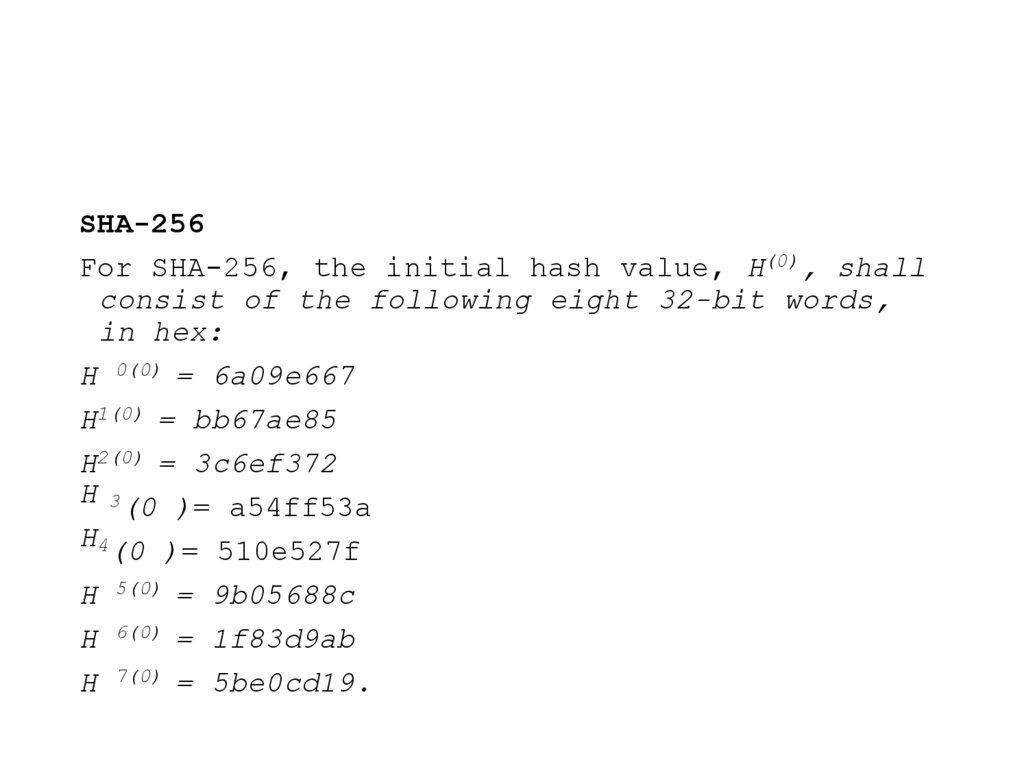
SHA-256For SHA-256, the initial hash value, H(0), shall
consist of the following eight 32-bit words,
in hex:
H 0(0) = 6a09e667
H1(0) = bb67ae85
H2(0) = 3c6ef372
H 3(0 )= a54ff53a
H4(0 )= 510e527f
H 5(0) = 9b05688c
H 6(0) = 1f83d9ab
H 7(0) = 5be0cd19.
20.
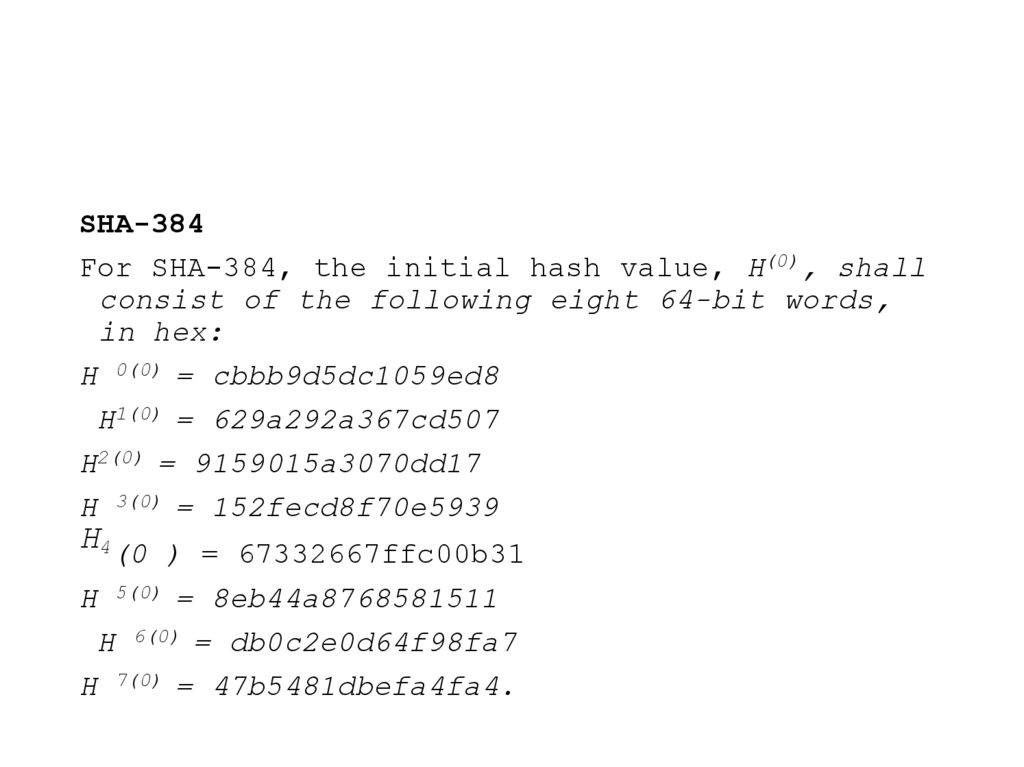
SHA-384For SHA-384, the initial hash value, H(0), shall
consist of the following eight 64-bit words,
in hex:
H 0(0) = cbbb9d5dc1059ed8
H1(0) = 629a292a367cd507
H2(0) = 9159015a3070dd17
H 3(0) = 152fecd8f70e5939
H4(0 ) = 67332667ffc00b31
H 5(0) = 8eb44a8768581511
H 6(0) = db0c2e0d64f98fa7
H 7(0) = 47b5481dbefa4fa4.
21.
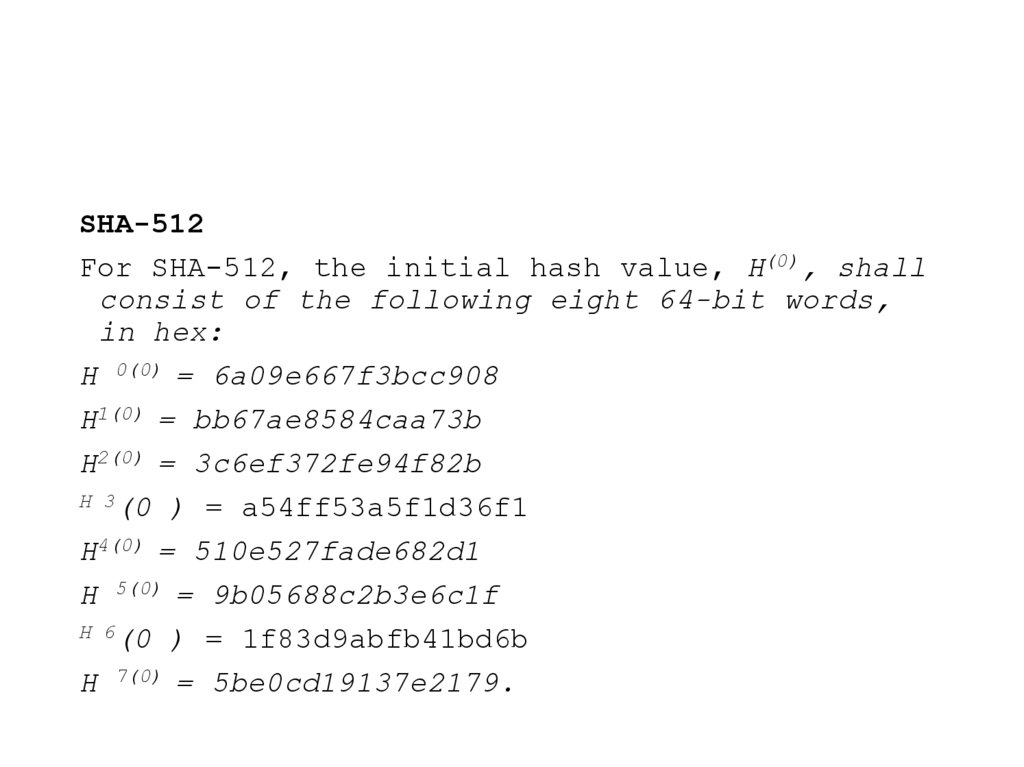
SHA-512For SHA-512, the initial hash value, H(0), shall
consist of the following eight 64-bit words,
in hex:
H 0(0) = 6a09e667f3bcc908
H1(0) = bb67ae8584caa73b
H2(0) = 3c6ef372fe94f82b
H 3(0 ) = a54ff53a5f1d36f1
H4(0) = 510e527fade682d1
H 5(0) = 9b05688c2b3e6c1f
H 6(0 ) = 1f83d9abfb41bd6b
H 7(0) = 5be0cd19137e2179.
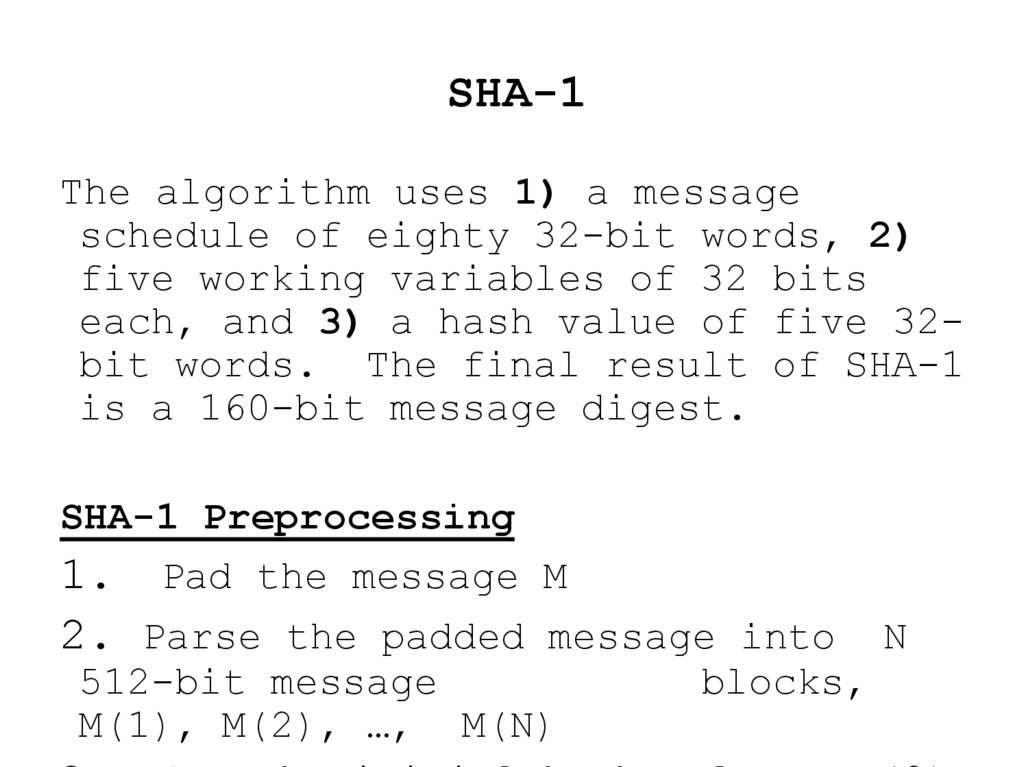
22. SHA-1
The algorithm uses 1) a messageschedule of eighty 32-bit words, 2)
five working variables of 32 bits
each, and 3) a hash value of five 32bit words. The final result of SHA-1
is a 160-bit message digest.
SHA-1 Preprocessing
1. Pad the message M
2. Parse the padded message into
512-bit message
M(1), M(2), …, M(N)
blocks,
N
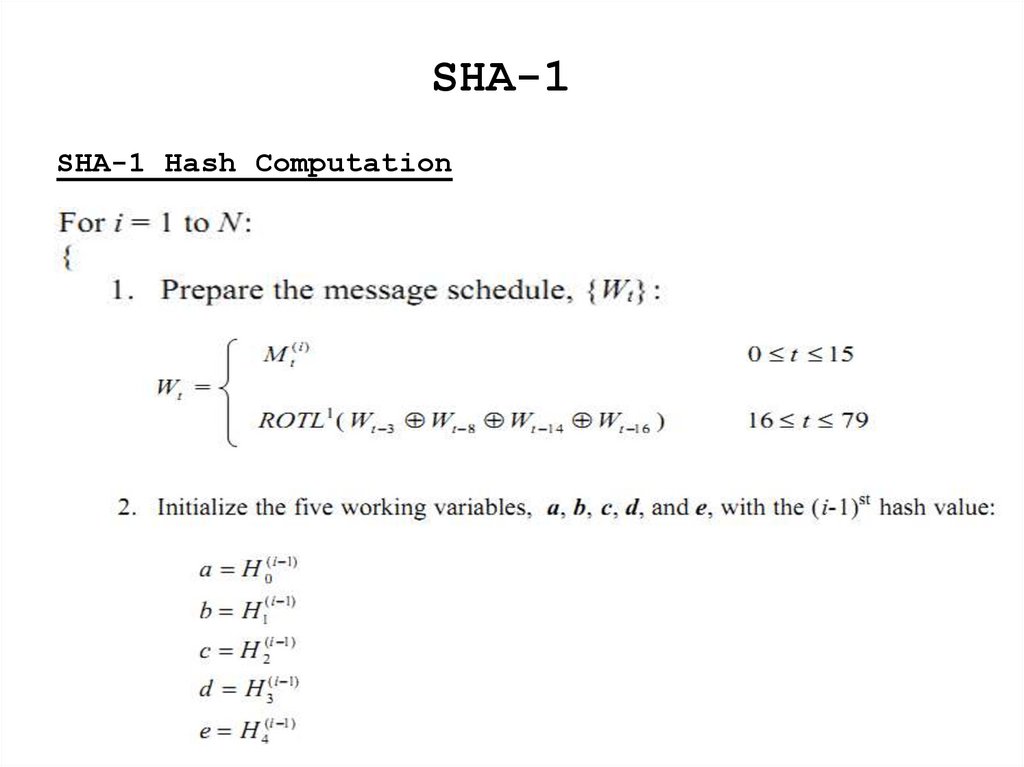
23. SHA-1
SHA-1 Hash Computation24.
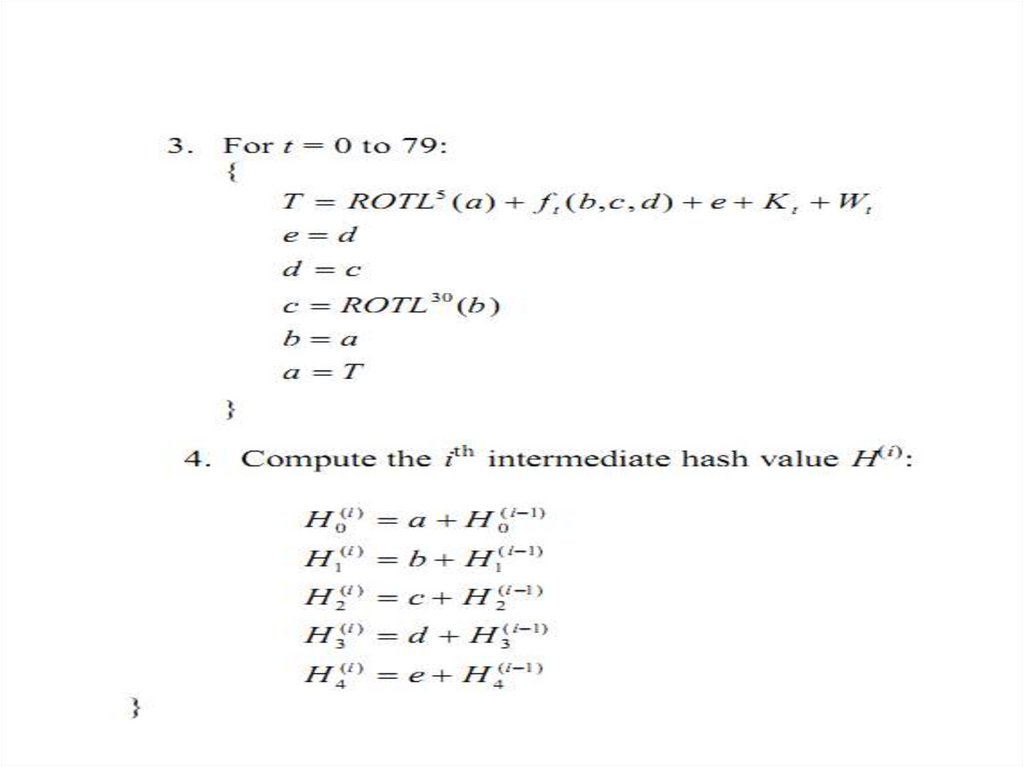
25.
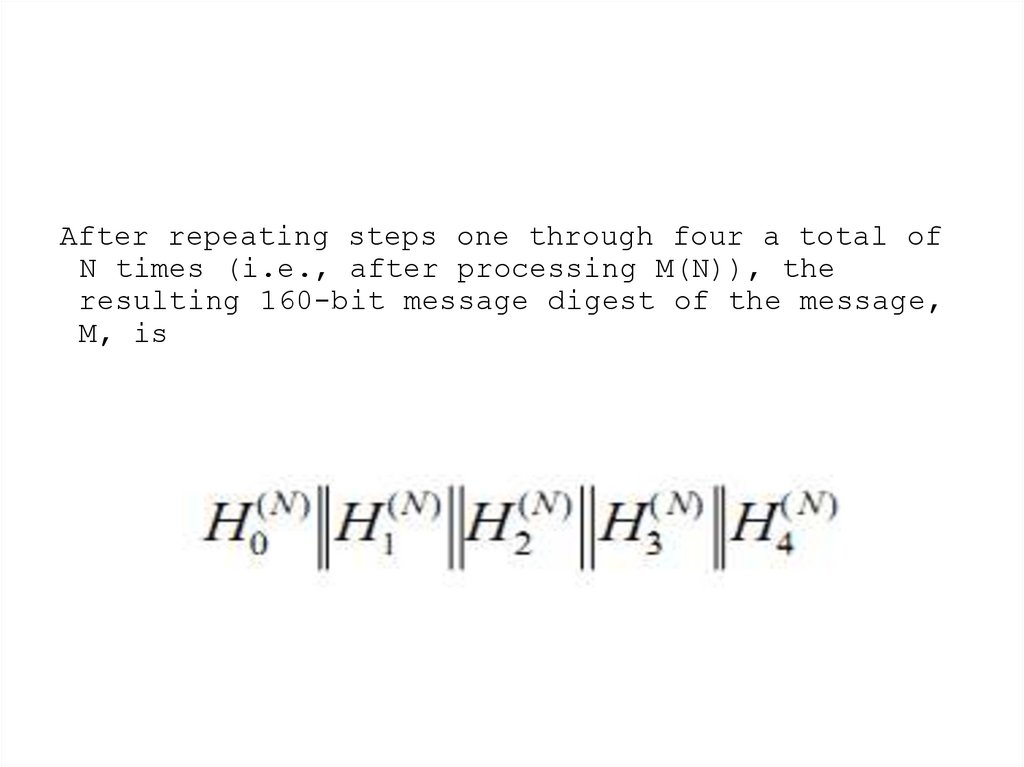
After repeating steps one through four a total ofN times (i.e., after processing M(N)), the
resulting 160-bit message digest of the message,
M, is
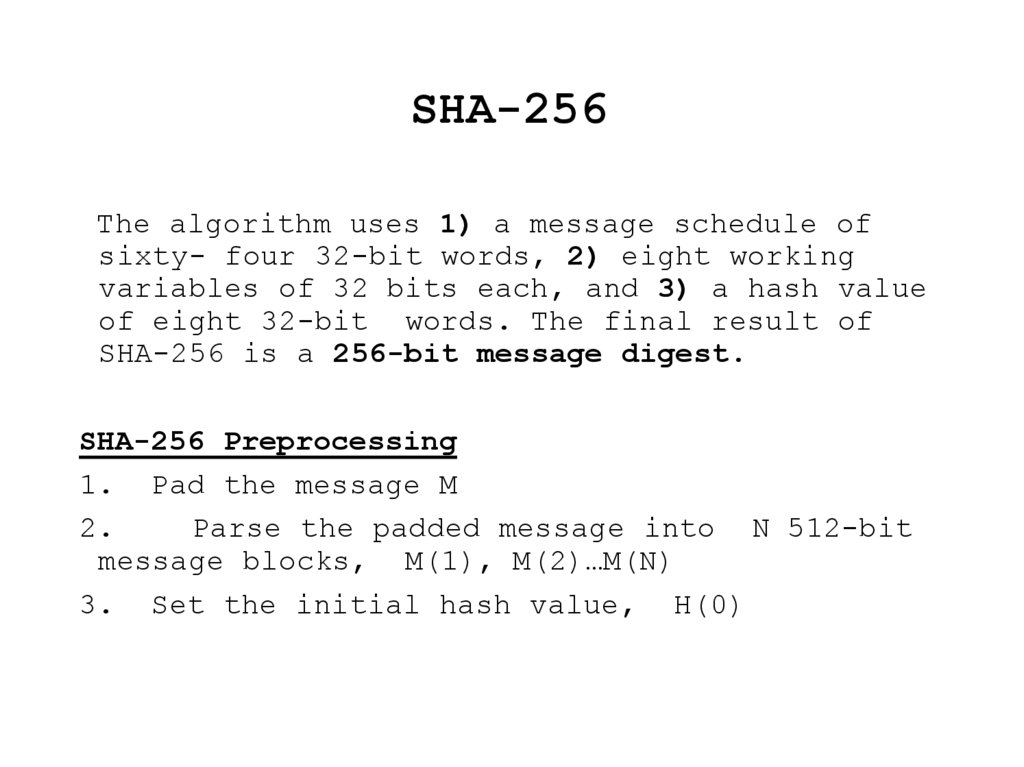
26. SHA-256
The algorithm uses 1) a message schedule ofsixty- four 32-bit words, 2) eight working
variables of 32 bits each, and 3) a hash value
of eight 32-bit words. The final result of
SHA-256 is a 256-bit message digest.
SHA-256 Preprocessing
1. Pad the message M
2.
Parse the padded message into N 512-bit
message blocks, M(1), M(2)…M(N)
3. Set the initial hash value, H(0)
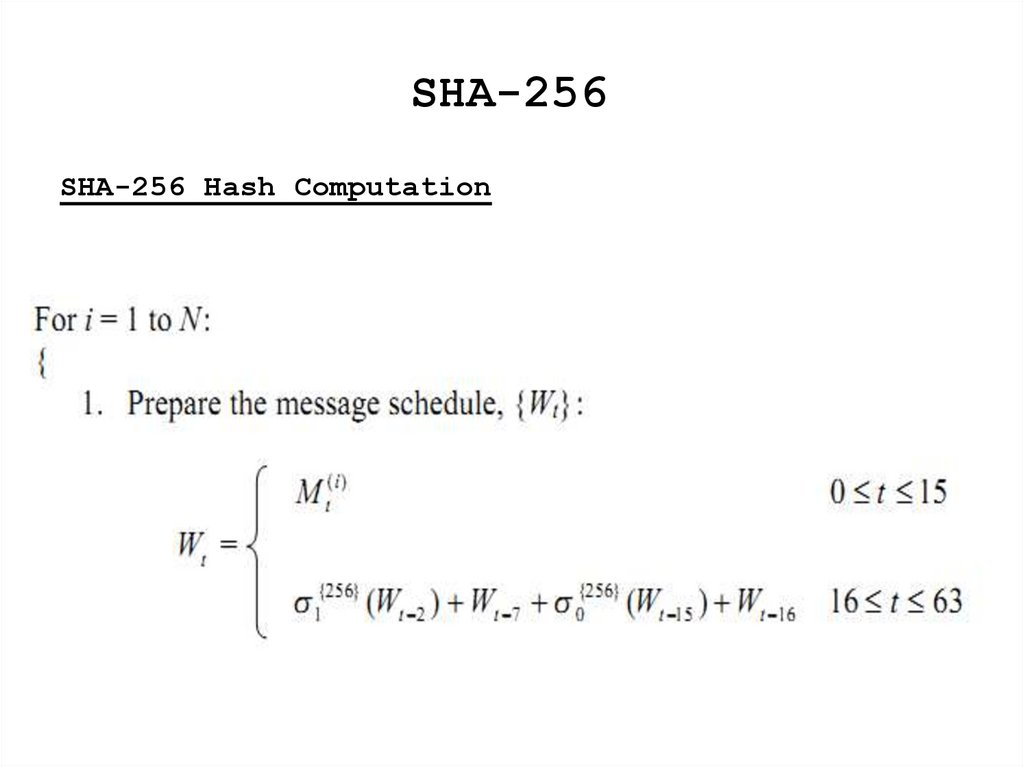
27. SHA-256
SHA-256 Hash Computation28.
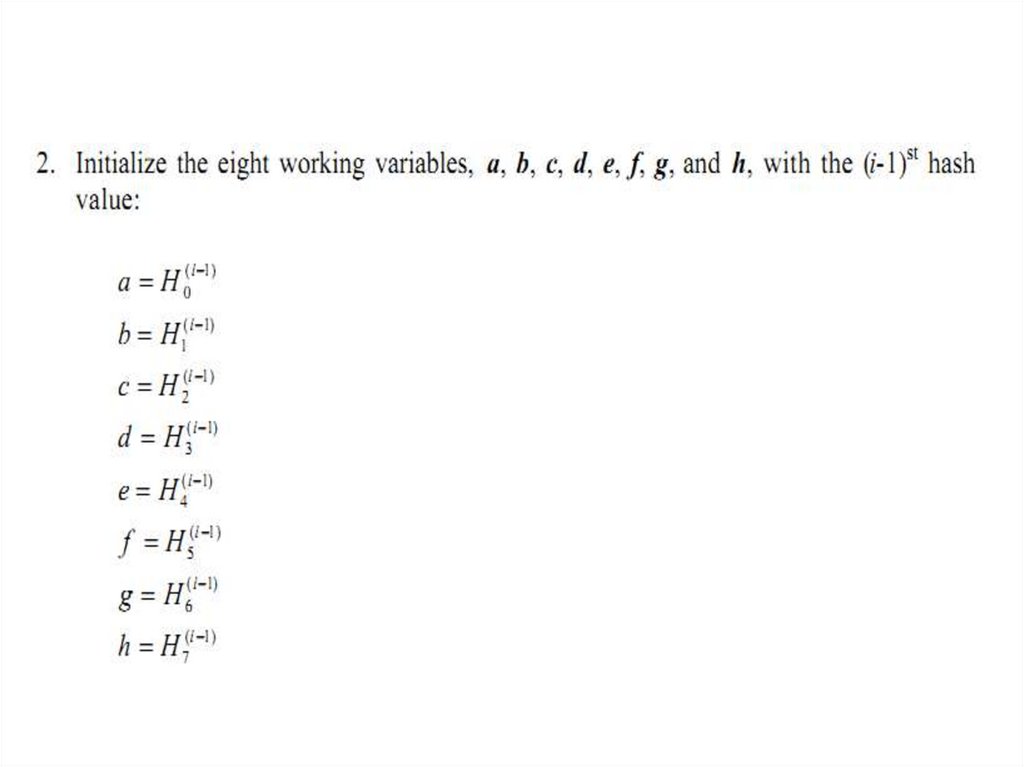
29.
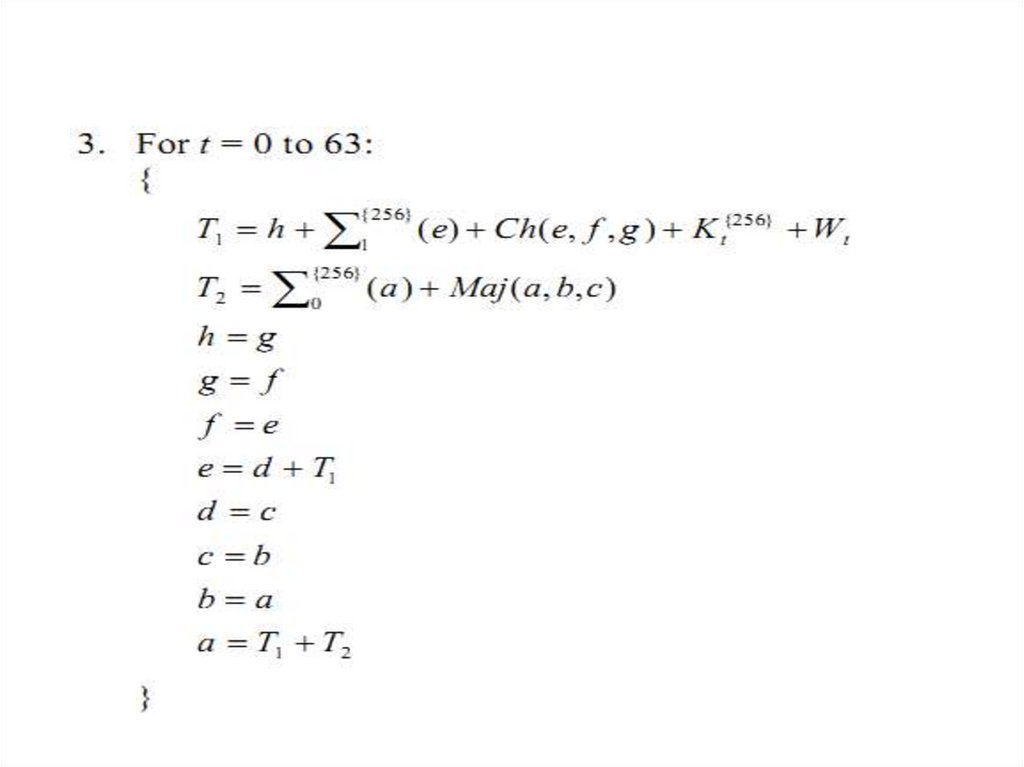
30.
After repeating steps one through four a total of N times(i.e., after processing M(N)), the resulting 256-bit
message digest of the message, M, is
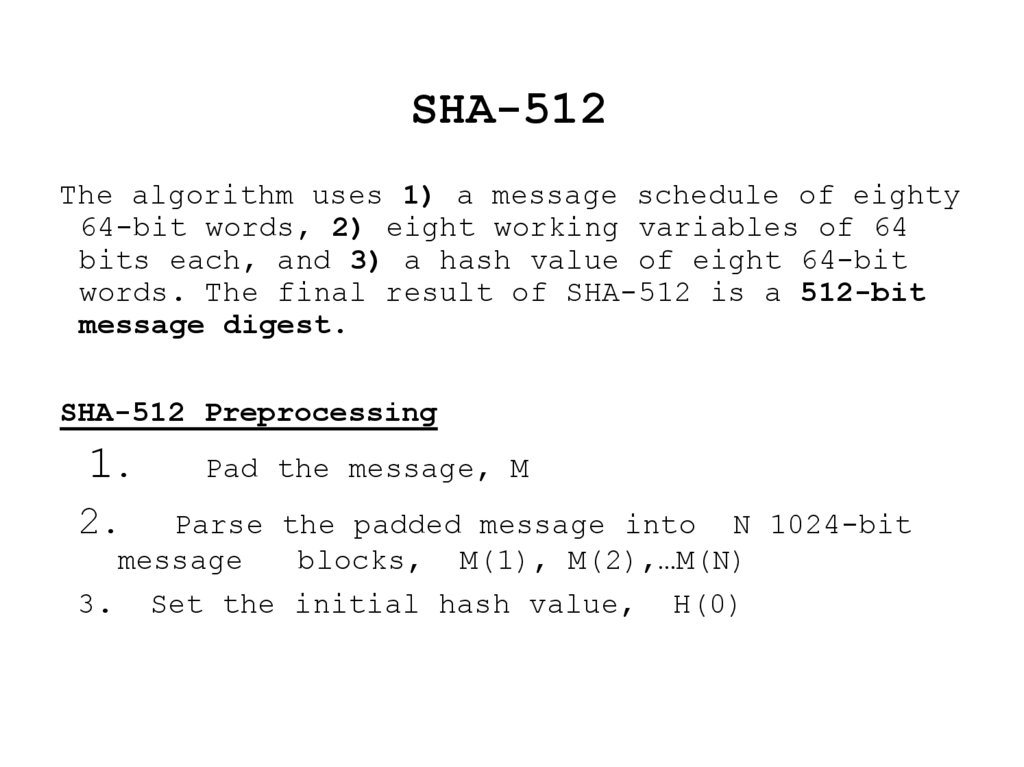
31. SHA-512
The algorithm uses 1) a message schedule of eighty64-bit words, 2) eight working variables of 64
bits each, and 3) a hash value of eight 64-bit
words. The final result of SHA-512 is a 512-bit
message digest.
SHA-512 Preprocessing
1.
2.
Pad the message, M
Parse the padded message into N 1024-bit
message
blocks, M(1), M(2),…M(N)
3. Set the initial hash value, H(0)
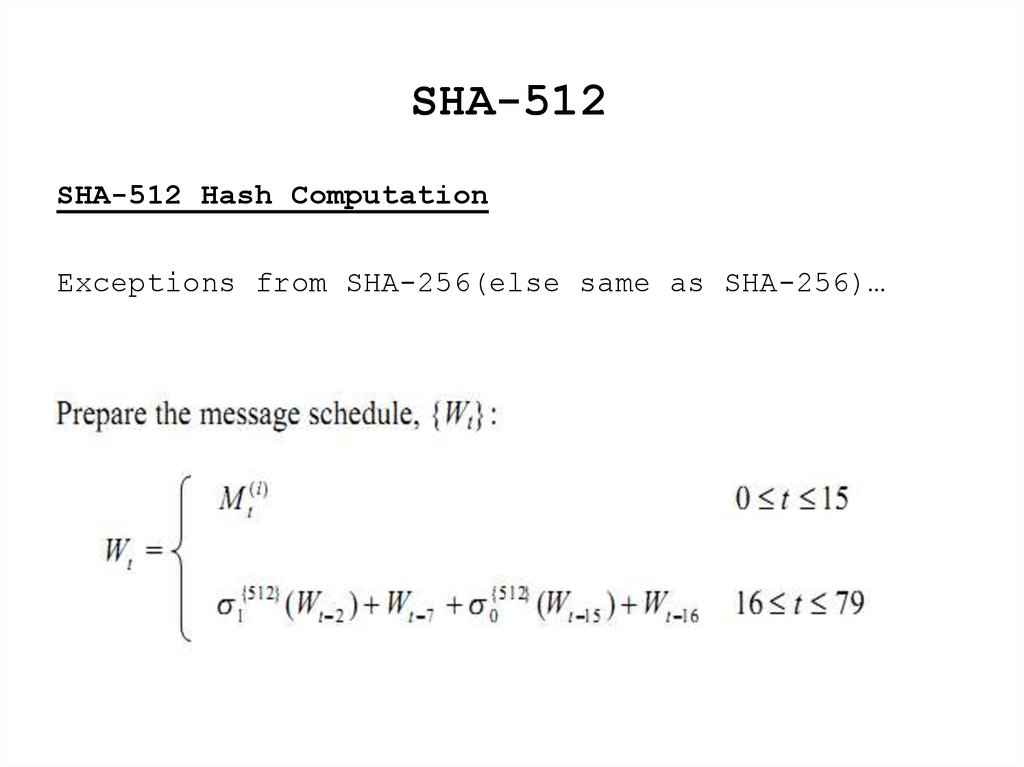
32. SHA-512
SHA-512 Hash ComputationExceptions from SHA-256(else same as SHA-256)…
33.
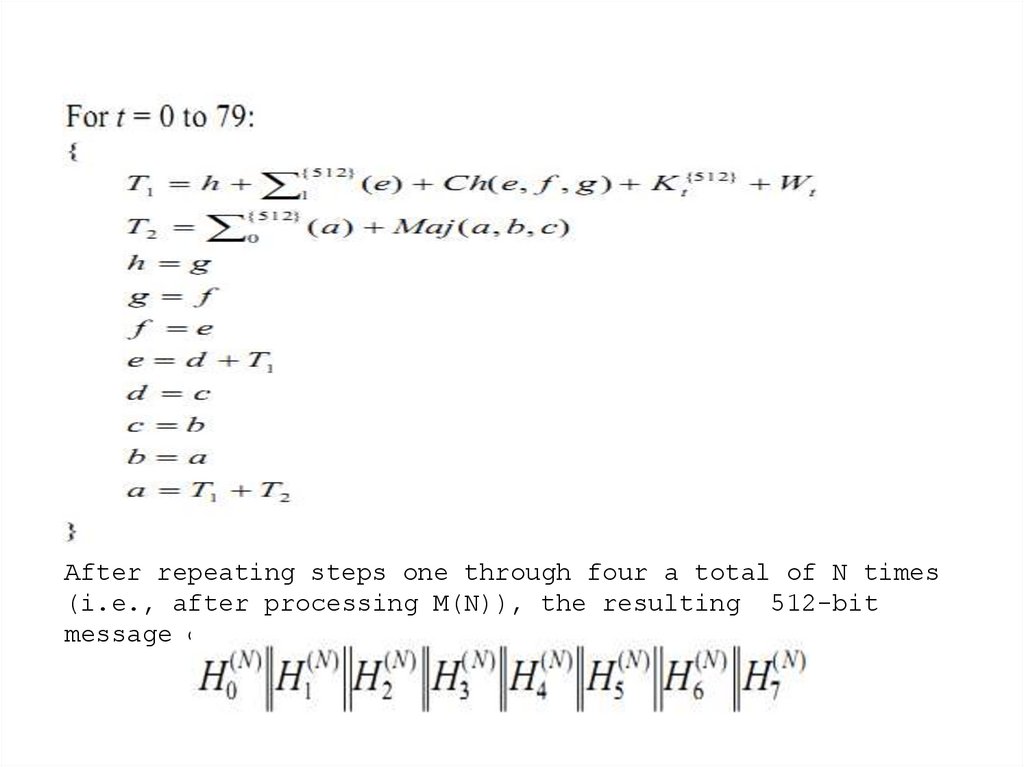
After repeating steps one through four a total of N times(i.e., after processing M(N)), the resulting 512-bit
message digest of the message, M, is