
 pedagogy
Similar presentations:










Teaching Grammar
1.
CA : TEACHINGGRAMMAR
2.
BY THE END OF THIS LESSON WE WILL BE ABLE TOUNDERSTAND AND USE THESE KEY CONCEPTS:
- Timelines
-
3 approaches and different stages of teaching grammar
CCQs (Concept Check Questions)
10 steps in the drilling procedure.
3.
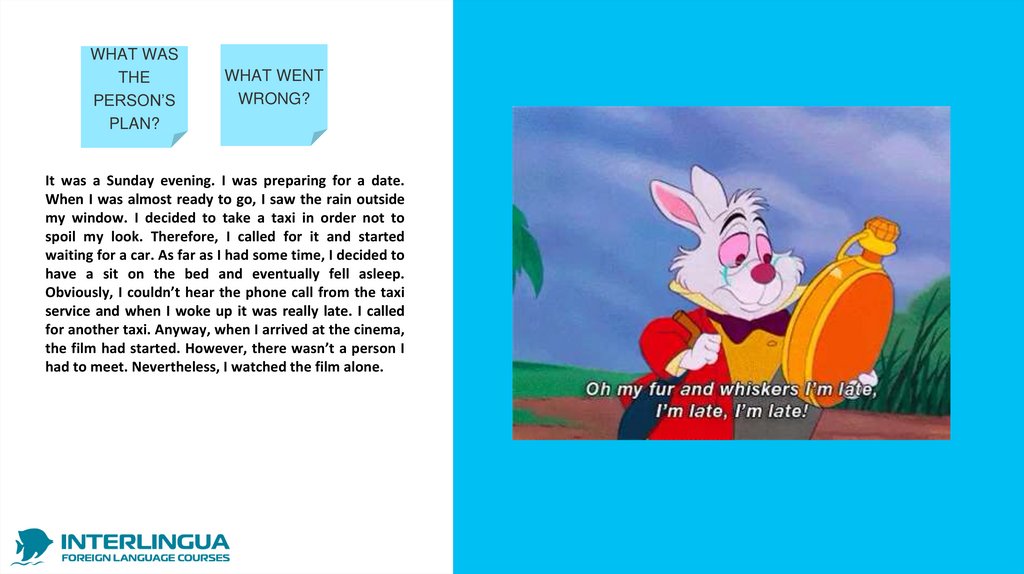
WHAT WASTHE
PERSON’S
PLAN?
WHAT WENT
WRONG?
It was a Sunday evening. I was preparing for a date.
When I was almost ready to go, I saw the rain outside
my window. I decided to take a taxi in order not to
spoil my look. Therefore, I called for it and started
waiting for a car. As far as I had some time, I decided to
have a sit on the bed and eventually fell asleep.
Obviously, I couldn’t hear the phone call from the taxi
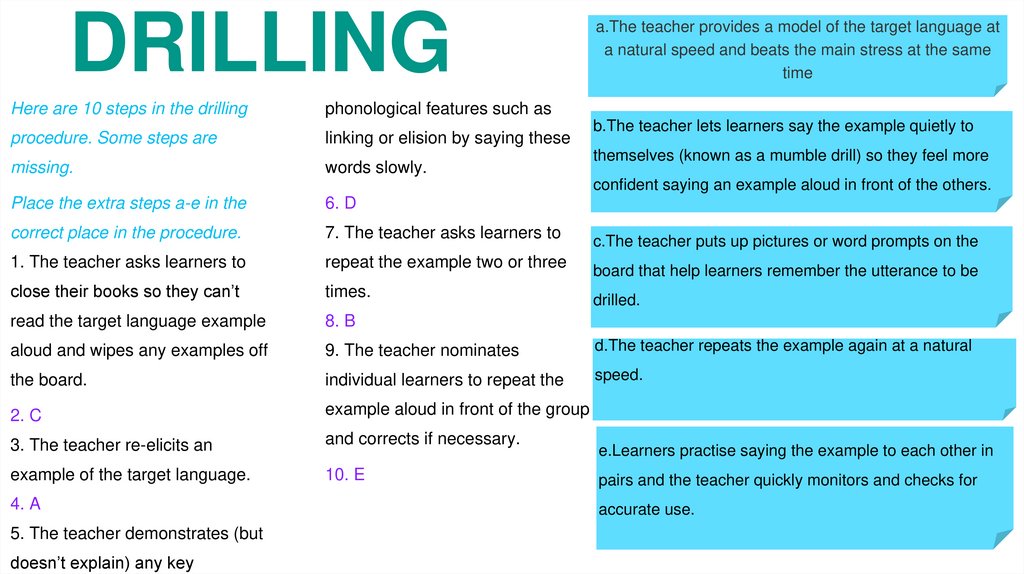
service and when I woke up it was really late. I called
for another taxi. Anyway, when I arrived at the cinema,
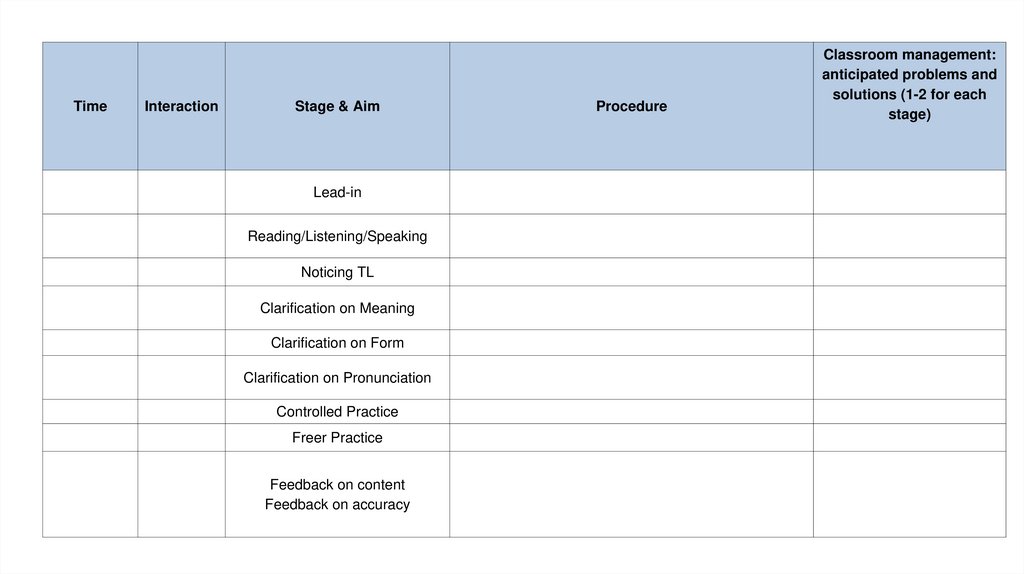
the film had started. However, there wasn’t a person I
had to meet. Nevertheless, I watched the film alone.
4.
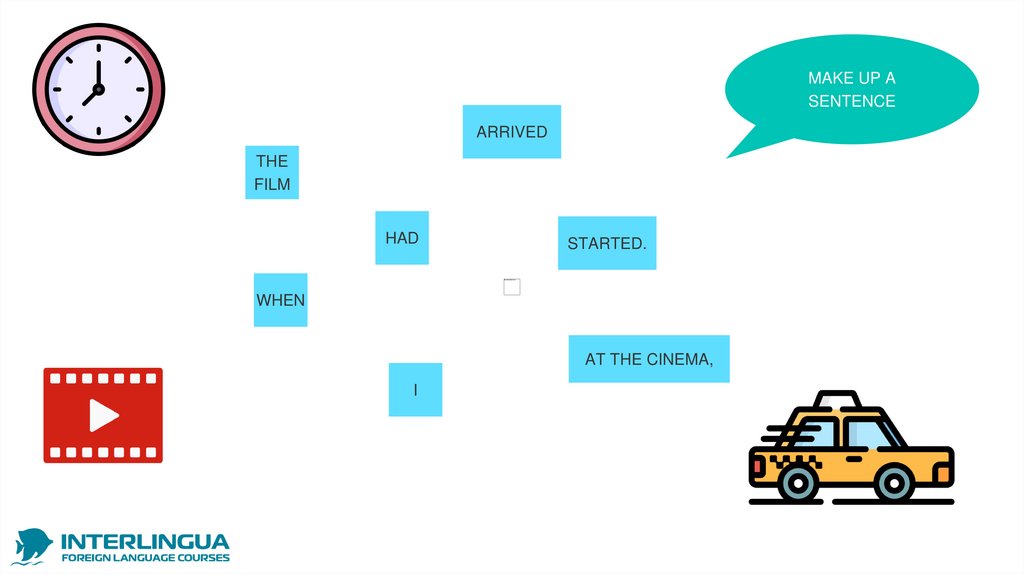
MAKE UP ASENTENCE
ARRIVED
THE
FILM
HAD
STARTED.
WHEN
AT THE CINEMA,
I
5.
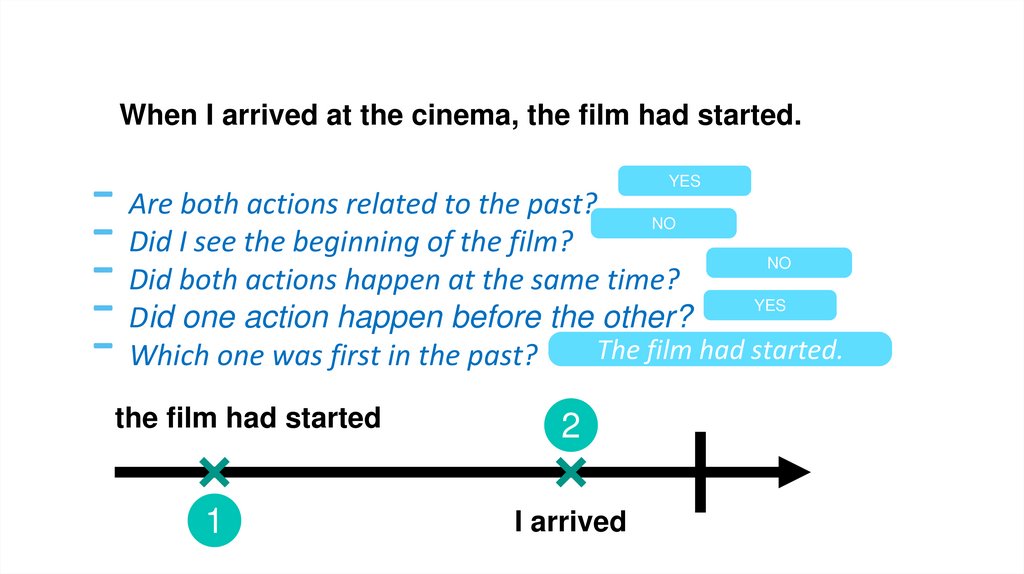
When I arrived at the cinema, the film had started.-- Are
both actions related to the past?
Did I see the beginning of the film?
-- Did
both actions happen at the same time?
Did one action happen before the other?
- Which one was first in the past?
YES
NO
NO
YES
The film had started.
the film had started
1
2
I arrived
6.
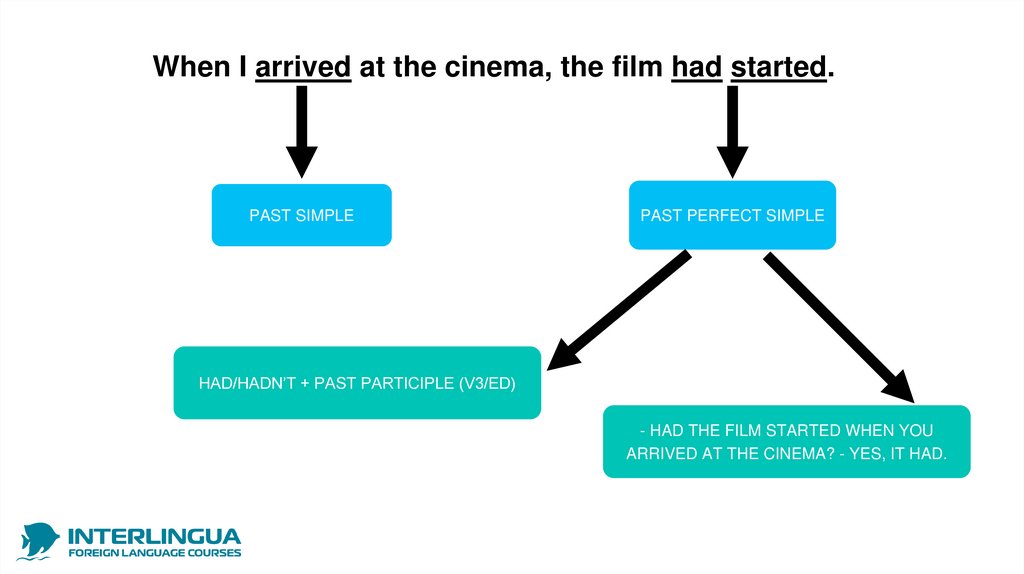
When I arrived at the cinema, the film had started.PAST SIMPLE
PAST PERFECT SIMPLE
HAD/HADN’T + PAST PARTICIPLE (V3/ED)
- HAD THE FILM STARTED WHEN YOU
ARRIVED AT THE CINEMA? - YES, IT HAD.
7.
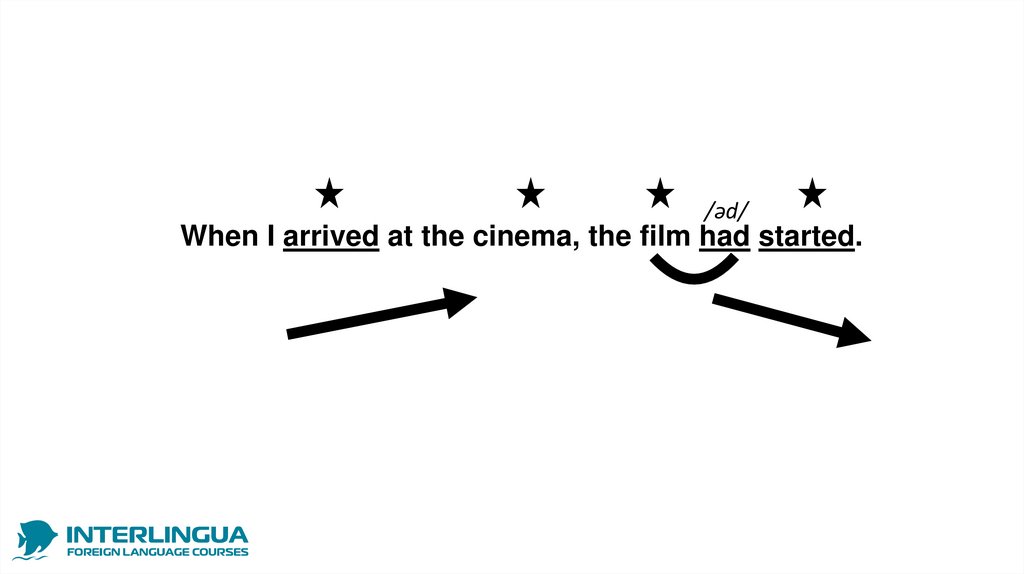
/əd/When I arrived at the cinema, the film had started.
8.
DIFFERENT APPROACHES –DIFFERENT STAGES
9.
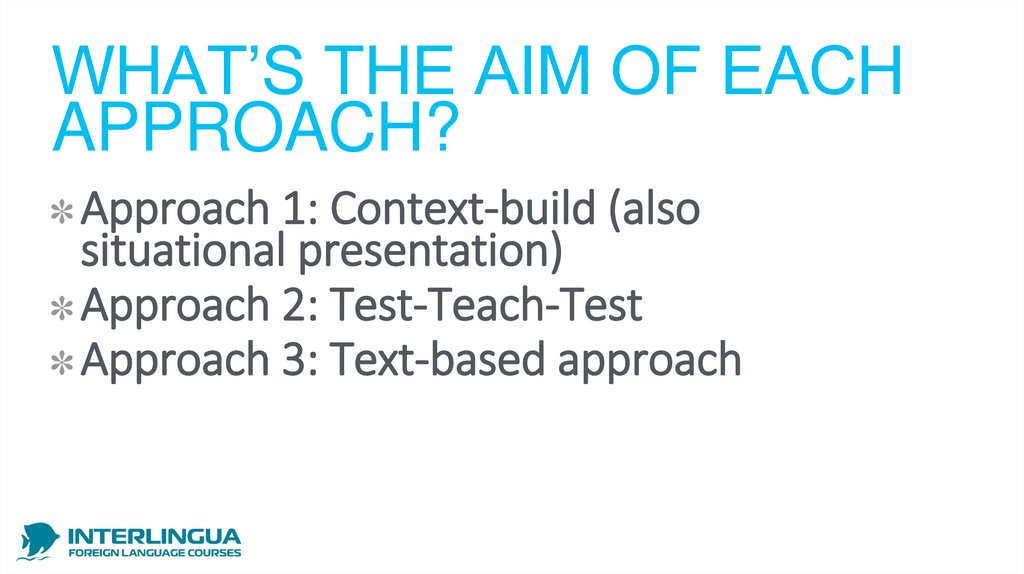
WHAT’S THE AIM OF EACHAPPROACH?
Approach 1: Context-build (also
situational presentation)
Approach 2: Test-Teach-Test
Approach 3: Text-based approach
10.
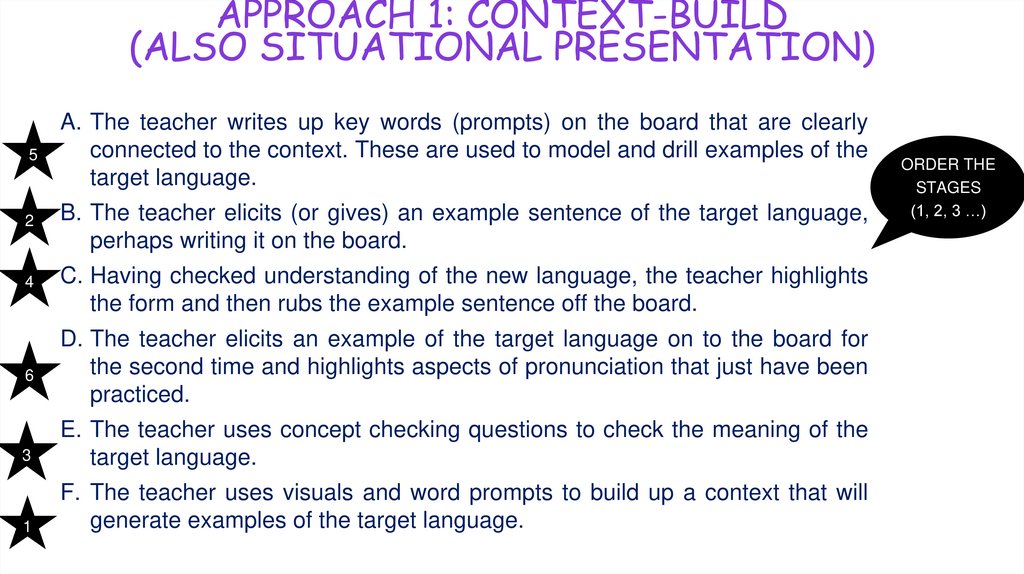
APPROACH 1: CONTEXT-BUILD(ALSO SITUATIONAL PRESENTATION)
5
A. The teacher writes up key words (prompts) on the board that are clearly
connected to the context. These are used to model and drill examples of the
target language.
2
B. The teacher elicits (or gives) an example sentence of the target language,
perhaps writing it on the board.
4
6
C. Having checked understanding of the new language, the teacher highlights
the form and then rubs the example sentence off the board.
D. The teacher elicits an example of the target language on to the board for
the second time and highlights aspects of pronunciation that just have been
practiced.
3
E. The teacher uses concept checking questions to check the meaning of the
target language.
1
F. The teacher uses visuals and word prompts to build up a context that will
generate examples of the target language.
ORDER THE
STAGES
(1, 2, 3 …)
11.
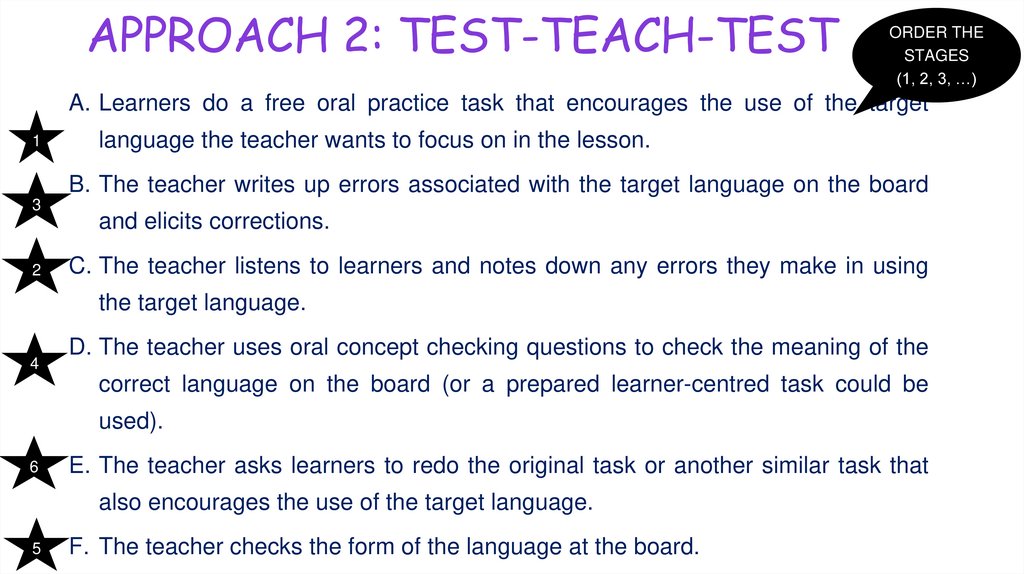
APPROACH 2: TEST-TEACH-TESTORDER THE
STAGES
(1, 2, 3, …)
A. Learners do a free oral practice task that encourages the use of the target
1
language the teacher wants to focus on in the lesson.
B. The teacher writes up errors associated with the target language on the board
3
2
and elicits corrections.
C. The teacher listens to learners and notes down any errors they make in using
the target language.
4
D. The teacher uses oral concept checking questions to check the meaning of the
correct language on the board (or a prepared learner-centred task could be
used).
6
E. The teacher asks learners to redo the original task or another similar task that
also encourages the use of the target language.
5
F. The teacher checks the form of the language at the board.
12.
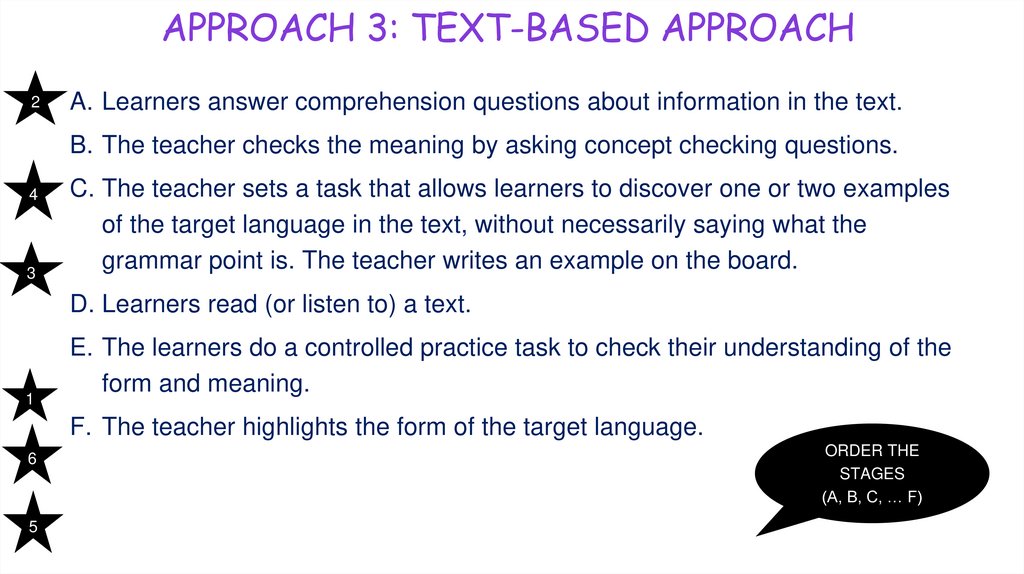
APPROACH 3: TEXT-BASED APPROACH2
A. Learners answer comprehension questions about information in the text.
B. The teacher checks the meaning by asking concept checking questions.
4
3
C. The teacher sets a task that allows learners to discover one or two examples
of the target language in the text, without necessarily saying what the
grammar point is. The teacher writes an example on the board.
D. Learners read (or listen to) a text.
1
E. The learners do a controlled practice task to check their understanding of the
form and meaning.
F. The teacher highlights the form of the target language.
6
5
ORDER THE
STAGES
(A, B, C, … F)
13.
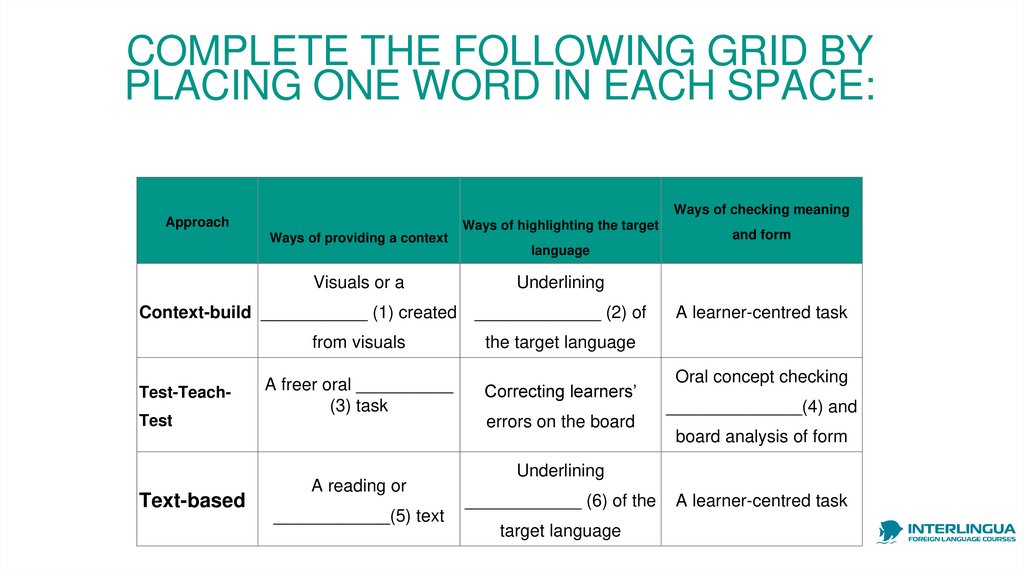
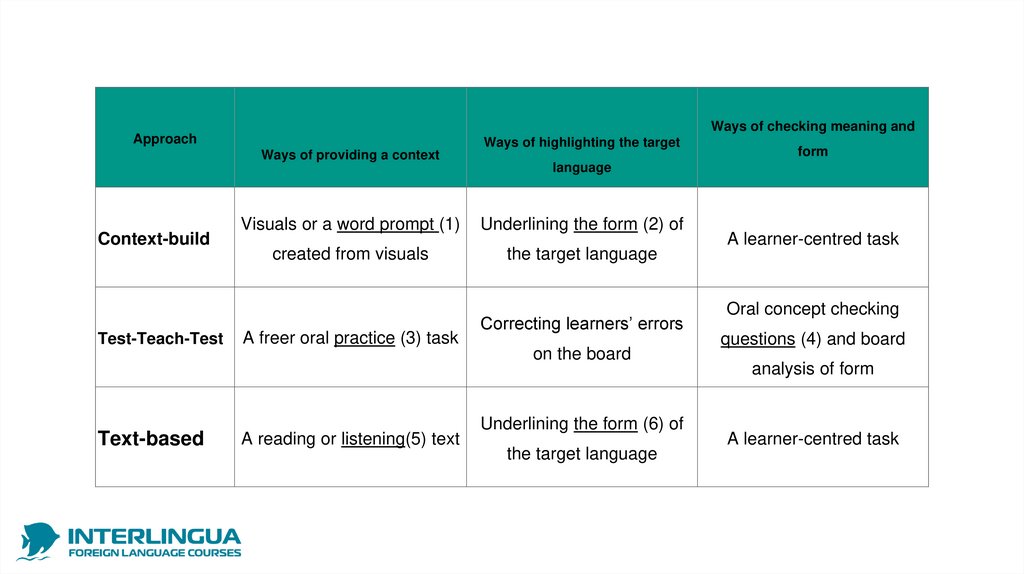
COMPLETE THE FOLLOWING GRID BYPLACING ONE WORD IN EACH SPACE:
Ways of checking meaning
Approach
Ways of highlighting the target
Ways of providing a context
and form
language
Visuals or a
Context-build ___________ (1) created
from visuals
Test-TeachTest
Text-based
A freer oral __________
(3) task
A reading or
____________(5) text
Underlining
_____________ (2) of
A learner-centred task
the target language
Correcting learners’
errors on the board
Oral concept checking
______________(4) and
board analysis of form
Underlining
____________ (6) of the
target language
A learner-centred task
14.
Ways of checking meaning andApproach
Ways of highlighting the target
Ways of providing a context
form
language
Context-build
Test-Teach-Test
Text-based
Visuals or a word prompt (1)
Underlining the form (2) of
created from visuals
the target language
A freer oral practice (3) task
A reading or listening(5) text
Correcting learners’ errors
on the board
Underlining the form (6) of
the target language
A learner-centred task
Oral concept checking
questions (4) and board
analysis of form
A learner-centred task
15.
WHICH APPROACH DID I USE ?WHAT WERE THE STAGES?
16.
CHECKINGUNDERSTANDING
17.
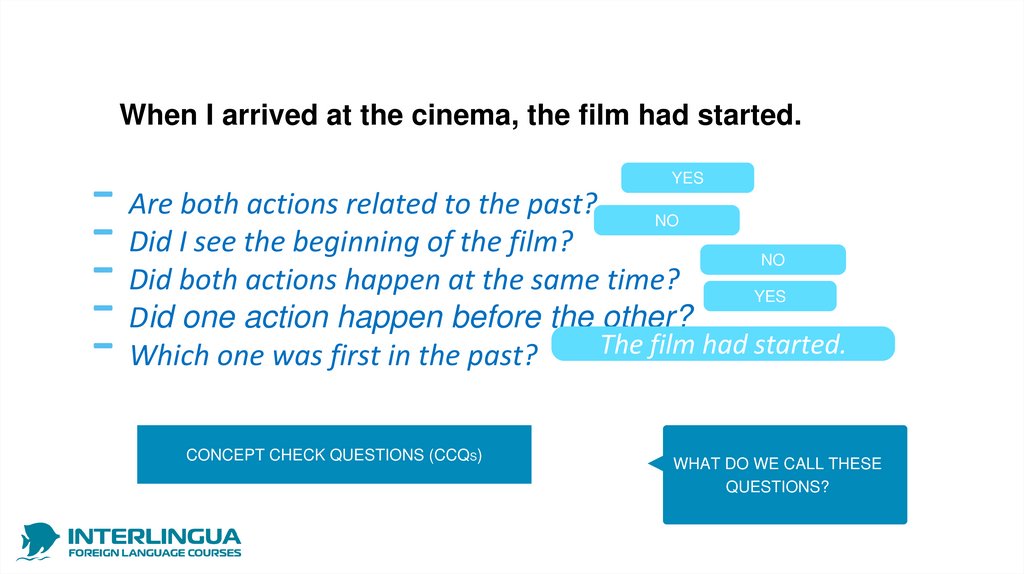
When I arrived at the cinema, the film had started.-- Are
both actions related to the past?
Did I see the beginning of the film?
-- Did
both actions happen at the same time?
Did one action happen before the other?
- Which one was first in the past?
YES
NO
NO
YES
The film had started.
CONCEPT CHECK QUESTIONS (CCQS)
WHAT DO WE CALL THESE
QUESTIONS?
18.
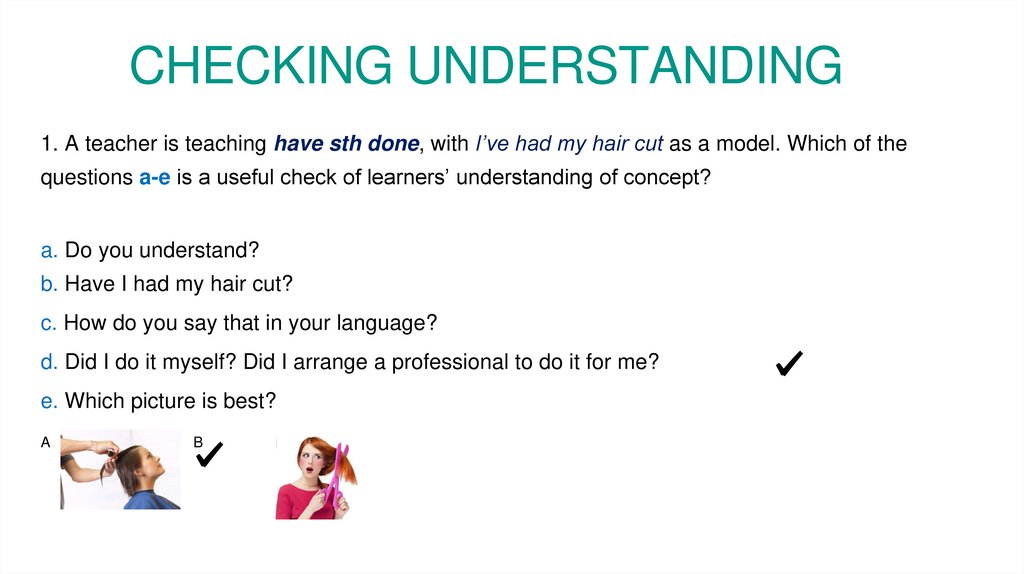
CHECKING UNDERSTANDING1. A teacher is teaching have sth done, with I’ve had my hair cut as a model. Which of the
questions a-e is a useful check of learners’ understanding of concept?
a. Do you understand?
b. Have I had my hair cut?
c. How do you say that in your language?
d. Did I do it myself? Did I arrange a professional to do it for me?
e. Which picture is best?
A
B
19.
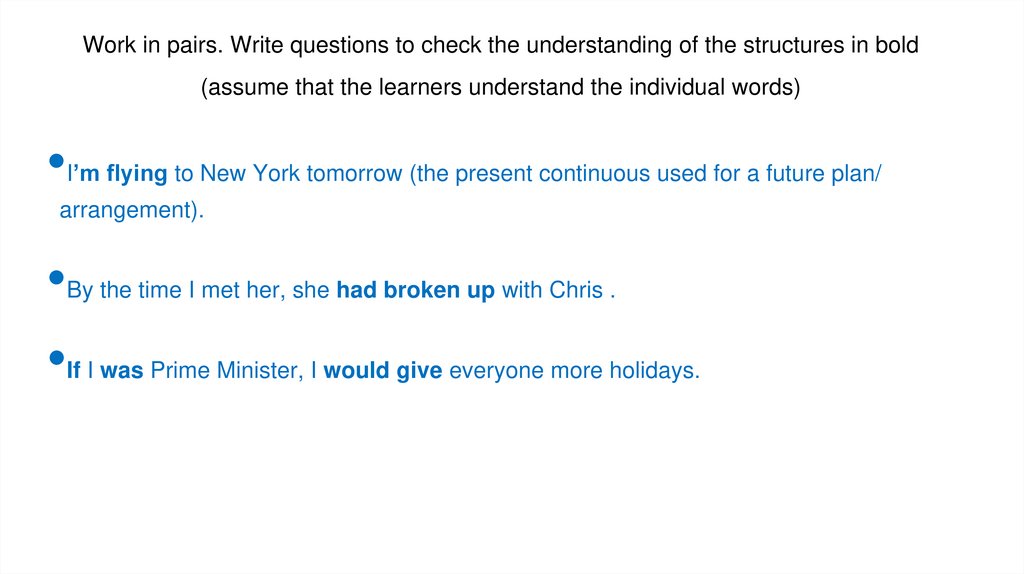
Work in pairs. Write questions to check the understanding of the structures in bold(assume that the learners understand the individual words)
I’m flying to New York tomorrow (the present continuous used for a future plan/
arrangement).
By the time I met her, she had broken up with Chris .
If I was Prime Minister, I would give everyone more holidays.
20.
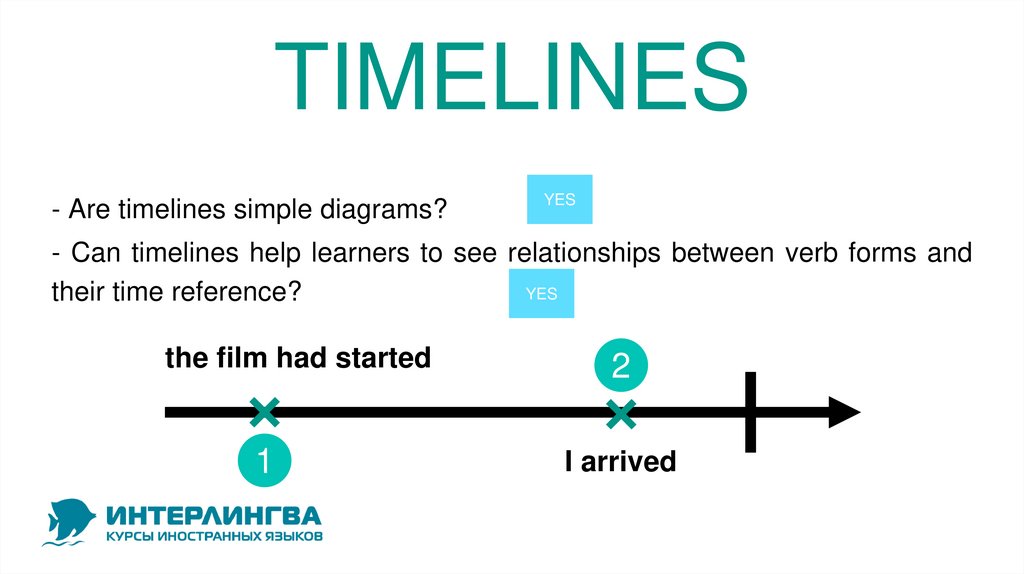
TIMELINES- Are timelines simple diagrams?
YES
- Can timelines help learners to see relationships between verb forms and
YES
their time reference?
the film had started
1
2
I arrived
21.
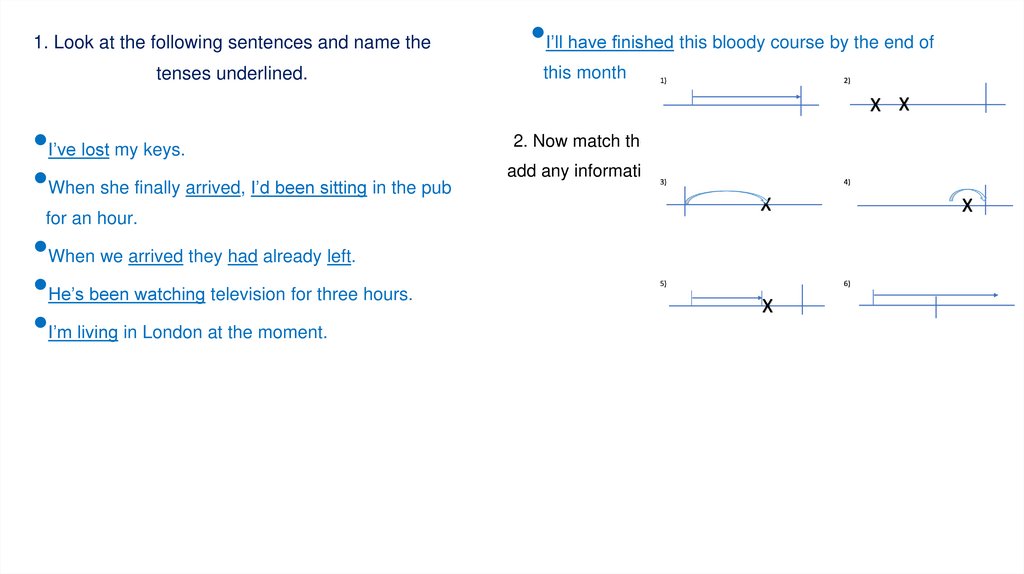
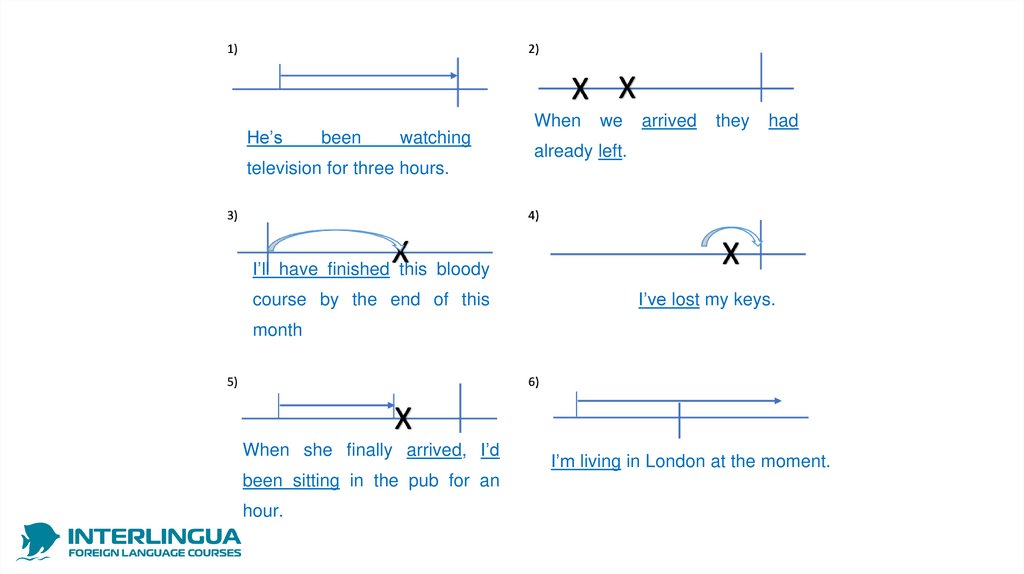
1. Look at the following sentences and name thetenses underlined.
I’ve lost my keys.
When she finally arrived, I’d been sitting in the pub
for an hour.
When we arrived they had already left.
He’s been watching television for three hours.
I’m living in London at the moment.
I’ll have finished this bloody course by the end of
this month
2. Now match the sentences to the timelines below, and
add any information to the timelines that yothink would be
useful.
22.
He’sWhen
been
watching
we
arrived
they
had
already left.
television for three hours.
I’ll have finished this bloody
course by the end of this
I’ve lost my keys.
month
When she finally arrived, I’d
been sitting in the pub for an
hour.
I’m living in London at the moment.
23.
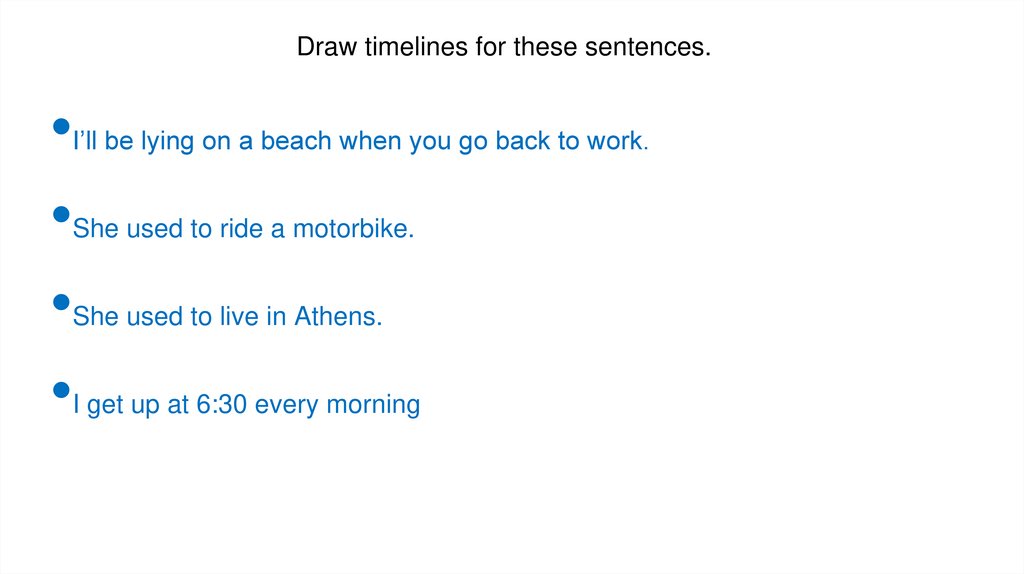
Draw timelines for these sentences.I’ll be lying on a beach when you go back to work.
She used to ride a motorbike.
She used to live in Athens.
I get up at 6:30 every morning
24.
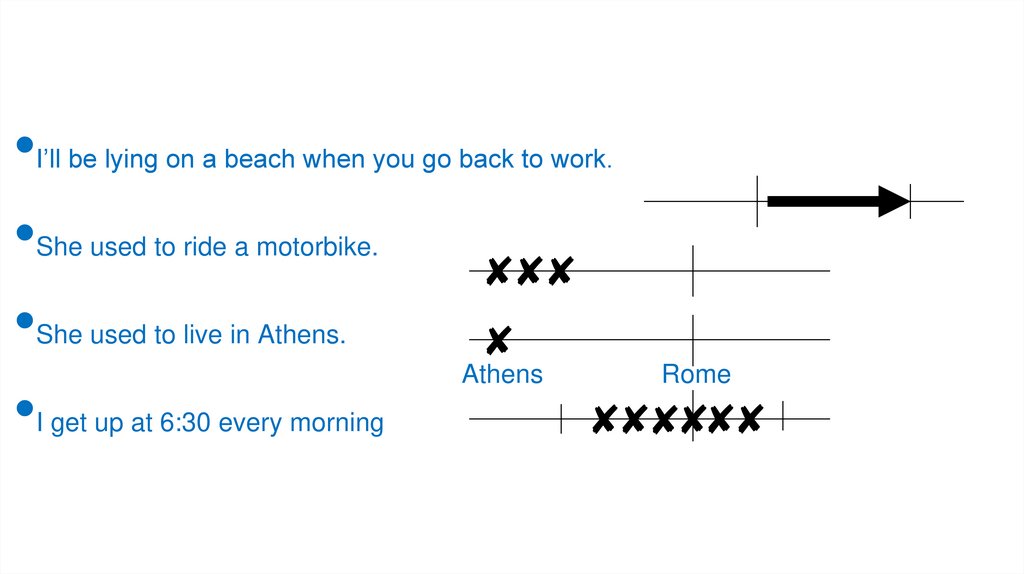
I’ll be lying on a beach when you go back to work.
She used to ride a motorbike.
She used to live in Athens.
I get up at 6:30 every morning
Athens
Rome
25.
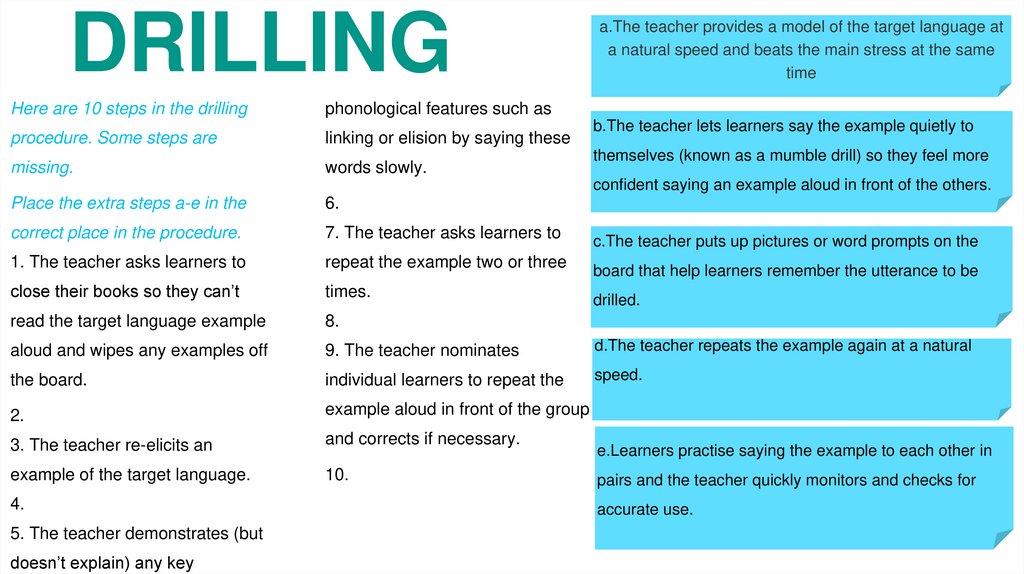
DRILLINGHere are 10 steps in the drilling
procedure. Some steps are
missing.
a.The teacher provides a model of the target language at
a natural speed and beats the main stress at the same
time
phonological features such as
linking or elision by saying these
words slowly.
b.The teacher lets learners say the example quietly to
themselves (known as a mumble drill) so they feel more
confident saying an example aloud in front of the others.
Place the extra steps a-e in the
6.
correct place in the procedure.
7. The teacher asks learners to
1. The teacher asks learners to
repeat the example two or three
close their books so they can’t
times.
read the target language example
8.
aloud and wipes any examples off
9. The teacher nominates
d.The teacher repeats the example again at a natural
the board.
individual learners to repeat the
speed.
2.
example aloud in front of the group
3. The teacher re-elicits an
and corrects if necessary.
example of the target language.
10.
4.
5. The teacher demonstrates (but
doesn’t explain) any key
c.The teacher puts up pictures or word prompts on the
board that help learners remember the utterance to be
drilled.
e.Learners practise saying the example to each other in
pairs and the teacher quickly monitors and checks for
accurate use.
26.
DRILLINGHere are 10 steps in the drilling
procedure. Some steps are
missing.
a.The teacher provides a model of the target language at
a natural speed and beats the main stress at the same
time
phonological features such as
linking or elision by saying these
words slowly.
b.The teacher lets learners say the example quietly to
themselves (known as a mumble drill) so they feel more
confident saying an example aloud in front of the others.
Place the extra steps a-e in the
6. D
correct place in the procedure.
7. The teacher asks learners to
1. The teacher asks learners to
repeat the example two or three
close their books so they can’t
times.
read the target language example
8. B
aloud and wipes any examples off
9. The teacher nominates
d.The teacher repeats the example again at a natural
the board.
individual learners to repeat the
speed.
2. C
example aloud in front of the group
3. The teacher re-elicits an
and corrects if necessary.
example of the target language.
10. E
4. A
5. The teacher demonstrates (but
doesn’t explain) any key
c.The teacher puts up pictures or word prompts on the
board that help learners remember the utterance to be
drilled.
e.Learners practise saying the example to each other in
pairs and the teacher quickly monitors and checks for
accurate use.
27.
TimeInteraction
Stage & Aim
Lead-in
Reading/Listening/Speaking
Noticing TL
Clarification on Meaning
Clarification on Form
Clarification on Pronunciation
Controlled Practice
Freer Practice
Feedback on content
Feedback on accuracy
Procedure
Classroom management:
anticipated problems and
solutions (1-2 for each
stage)