

 electronics
Similar presentations:










AGP Slot: An Overview
1.
AGP Slot: An OverviewUnderstanding the Accelerated
Graphics Port (AGP)
Presented by: [Your Name]
Date: [Your Date]
2.
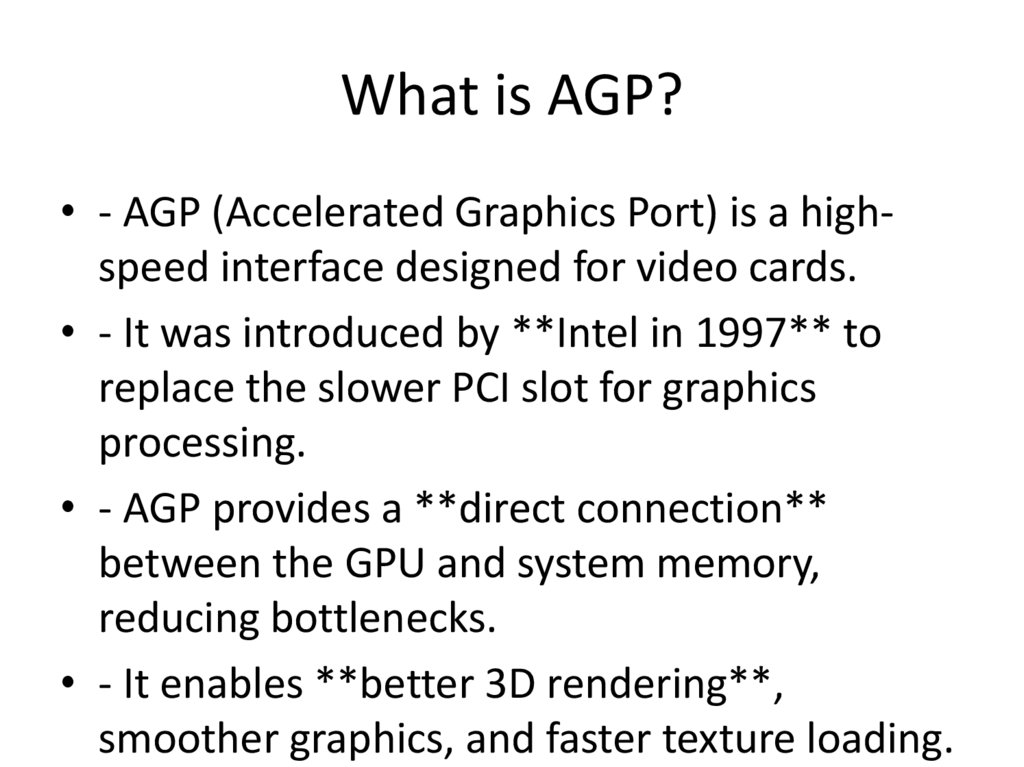
What is AGP?• - AGP (Accelerated Graphics Port) is a highspeed interface designed for video cards.
• - It was introduced by **Intel in 1997** to
replace the slower PCI slot for graphics
processing.
• - AGP provides a **direct connection**
between the GPU and system memory,
reducing bottlenecks.
• - It enables **better 3D rendering**,
smoother graphics, and faster texture loading.
3.
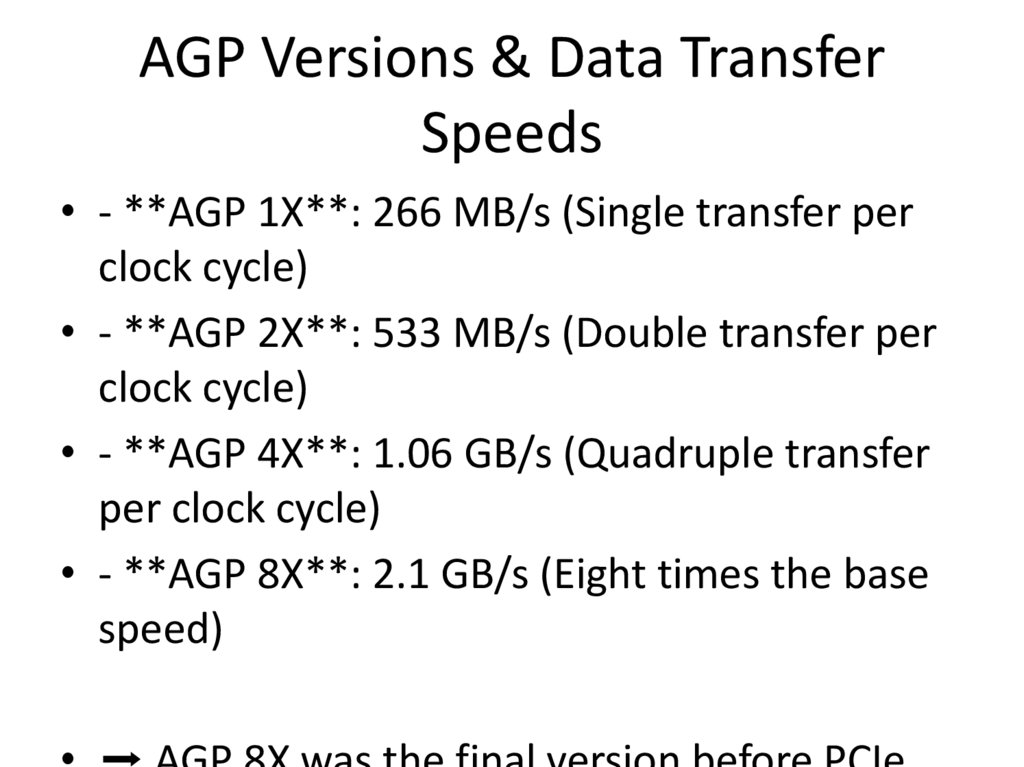
AGP Versions & Data TransferSpeeds
• - **AGP 1X**: 266 MB/s (Single transfer per
clock cycle)
• - **AGP 2X**: 533 MB/s (Double transfer per
clock cycle)
• - **AGP 4X**: 1.06 GB/s (Quadruple transfer
per clock cycle)
• - **AGP 8X**: 2.1 GB/s (Eight times the base
speed)
4.
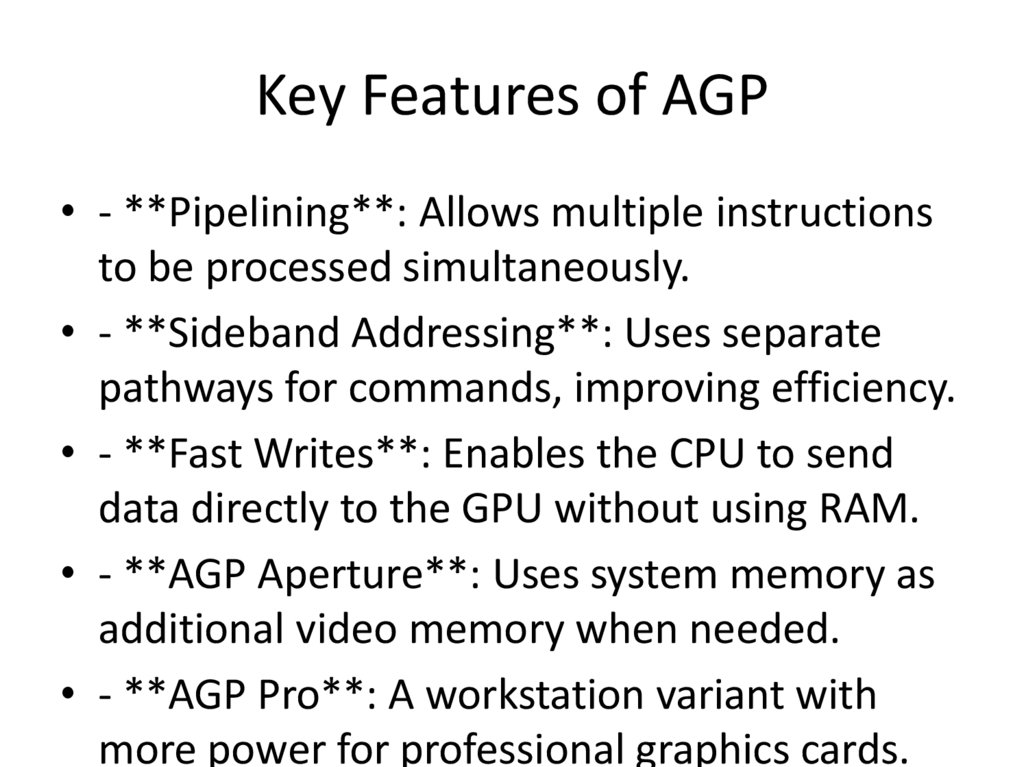
Key Features of AGP• - **Pipelining**: Allows multiple instructions
to be processed simultaneously.
• - **Sideband Addressing**: Uses separate
pathways for commands, improving efficiency.
• - **Fast Writes**: Enables the CPU to send
data directly to the GPU without using RAM.
• - **AGP Aperture**: Uses system memory as
additional video memory when needed.
• - **AGP Pro**: A workstation variant with
more power for professional graphics cards.
5.
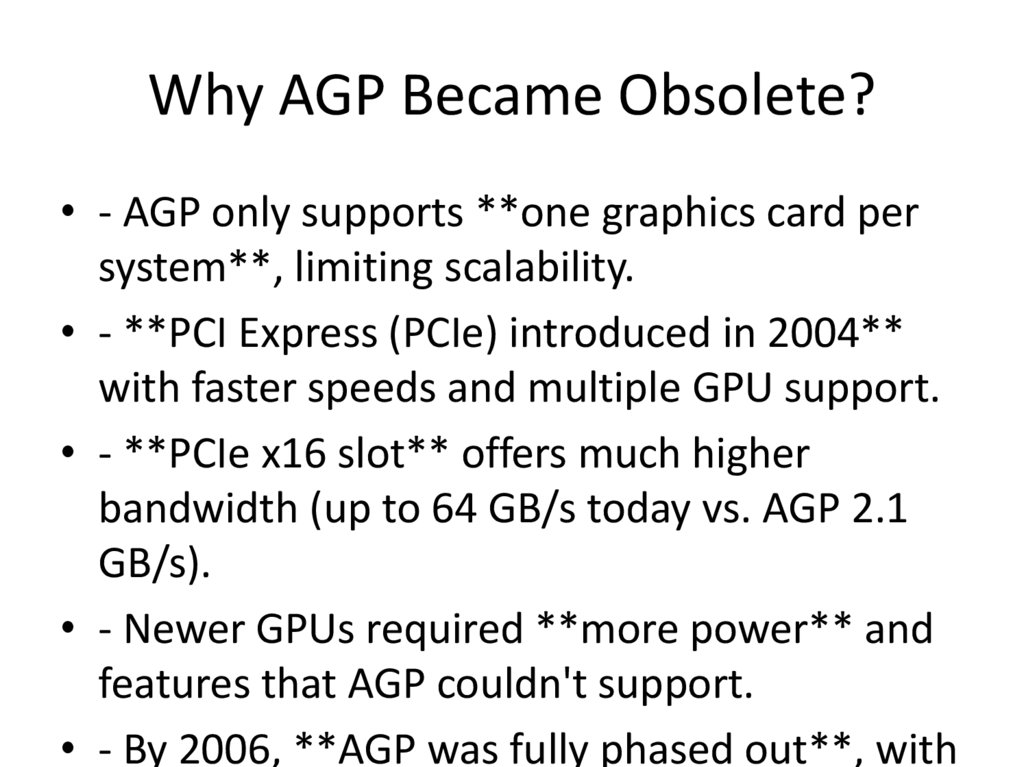
Why AGP Became Obsolete?• - AGP only supports **one graphics card per
system**, limiting scalability.
• - **PCI Express (PCIe) introduced in 2004**
with faster speeds and multiple GPU support.
• - **PCIe x16 slot** offers much higher
bandwidth (up to 64 GB/s today vs. AGP 2.1
GB/s).
• - Newer GPUs required **more power** and
features that AGP couldn't support.
• - By 2006, **AGP was fully phased out**, with
6.
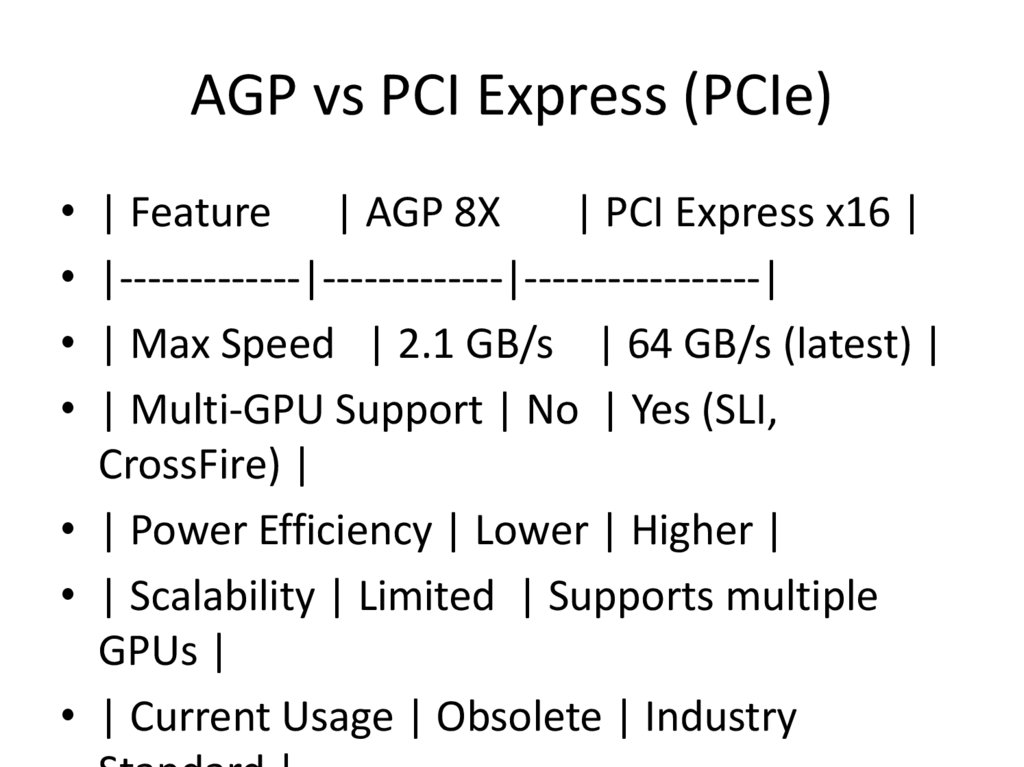
AGP vs PCI Express (PCIe)• | Feature | AGP 8X
| PCI Express x16 |
• |-------------|-------------|-----------------|
• | Max Speed | 2.1 GB/s | 64 GB/s (latest) |
• | Multi-GPU Support | No | Yes (SLI,
CrossFire) |
• | Power Efficiency | Lower | Higher |
• | Scalability | Limited | Supports multiple
GPUs |
• | Current Usage | Obsolete | Industry
7.
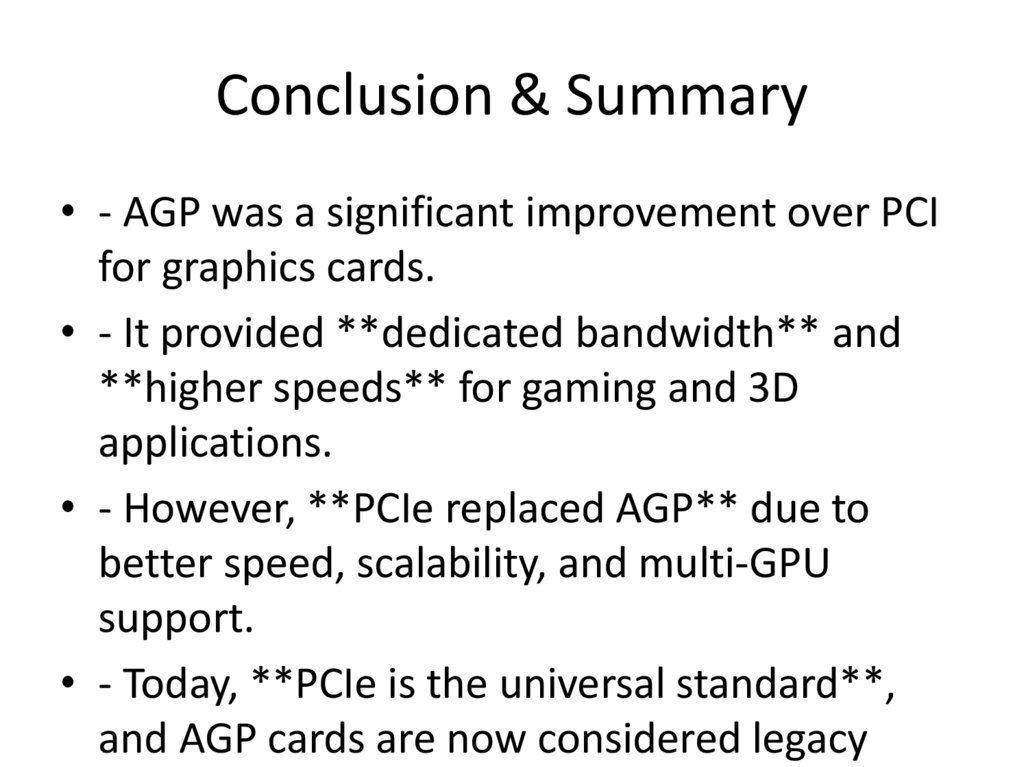
Conclusion & Summary• - AGP was a significant improvement over PCI
for graphics cards.
• - It provided **dedicated bandwidth** and
**higher speeds** for gaming and 3D
applications.
• - However, **PCIe replaced AGP** due to
better speed, scalability, and multi-GPU
support.
• - Today, **PCIe is the universal standard**,
and AGP cards are now considered legacy