





 education
Similar presentations:







Introduction to Classes and Objects
1.
Introduction to Classes andObjects
2.
Course General Information– Office: Room 512
– Email: s.suvanov@inha.uz
– Office hours Monday and Wednesday: 14:00 p.m
to 15:00 p.m
• Course managing style:
– Lecture & Lab class: covered by me
3.
Course General Information(Attendance)
5%
Quiz
15%
Project
10%
(Midterm
exam)
30%
(Final
Exam)
30%
Practical
Assignment
10%
Evaluation
Criteria
Class
Participation
Methods of
Evaluation
Total = 100 %
Assessment will be made based on the midterm exam (30%), final exam (30%), practical
Assignment (10%), Quizzes (15%), Class Attendance (5%) and Project(10%)
4.
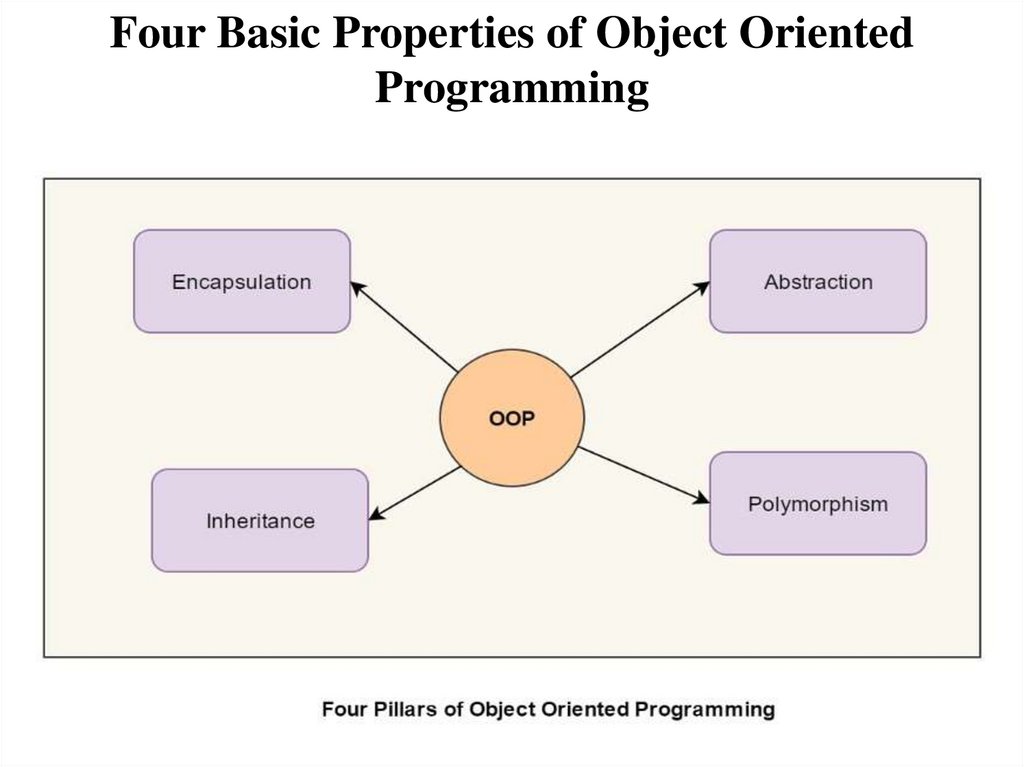
Four Basic Properties of Object OrientedProgramming
5.
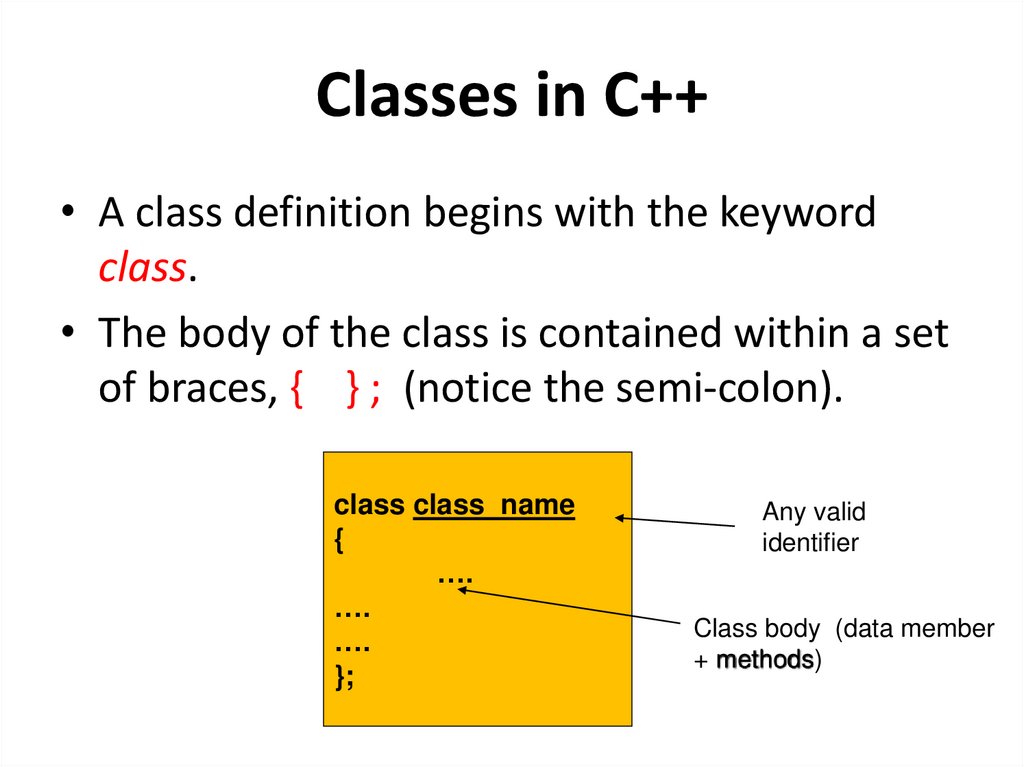
Classes in C++• A class definition begins with the keyword
class.
• The body of the class is contained within a set
of braces, { } ; (notice the semi-colon).
class class_name
{
….
….
….
};
Any valid
identifier
Class body (data member
+ methods)
6.
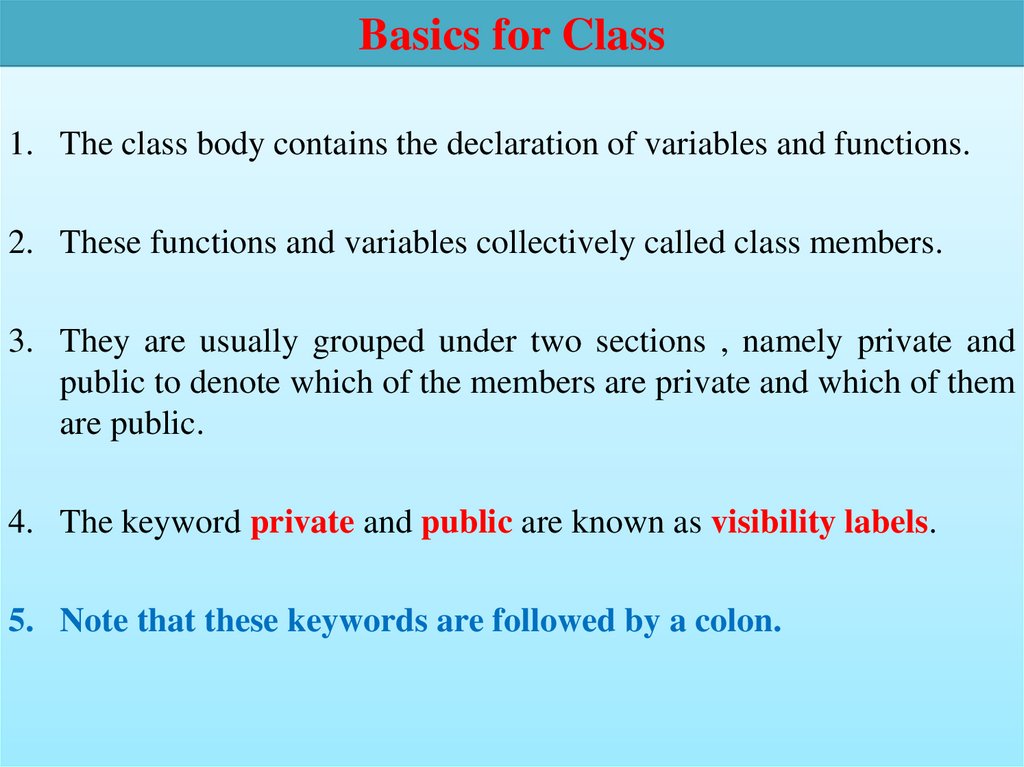
Basics for Class1. The class body contains the declaration of variables and functions.
2. These functions and variables collectively called class members.
3. They are usually grouped under two sections , namely private and
public to denote which of the members are private and which of them
are public.
4. The keyword private and public are known as visibility labels.
5. Note that these keywords are followed by a colon.
7.
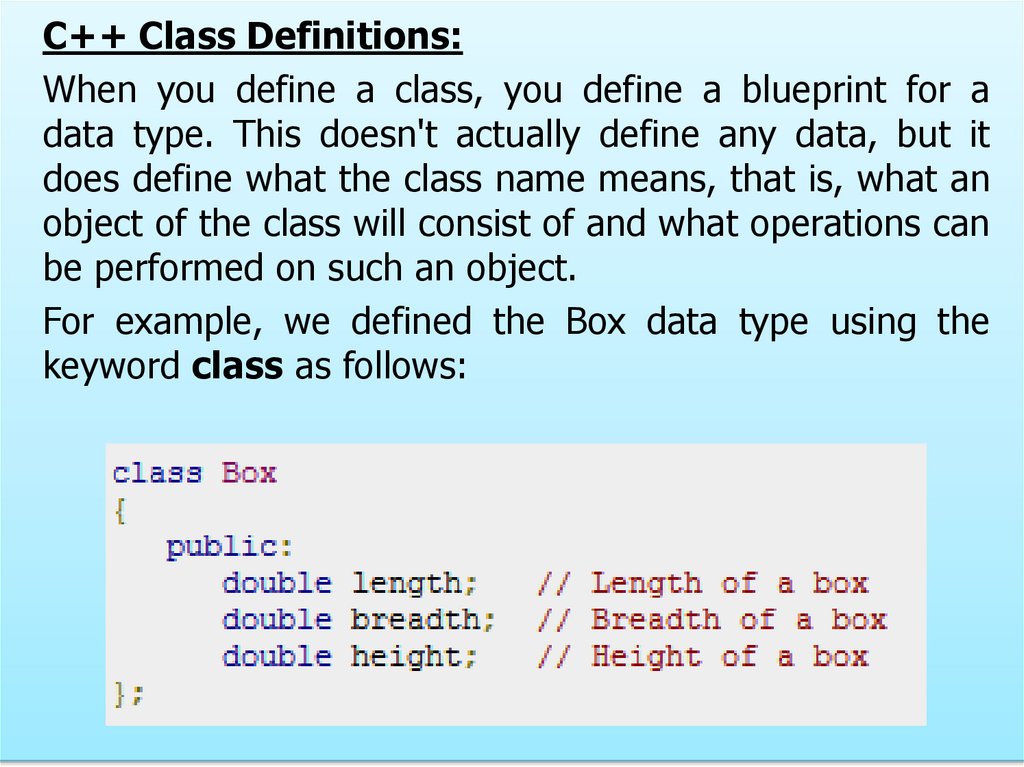
C++ Class Definitions:When you define a class, you define a blueprint for a
data type. This doesn't actually define any data, but it
does define what the class name means, that is, what an
object of the class will consist of and what operations can
be performed on such an object.
For example, we defined the Box data type using the
keyword class as follows:
8.
Define C++ Objects:A class provides the blueprints for objects, so basically an
object is created from a class. We declare objects of a
class with exactly the same sort of declaration that we
declare variables of basic types.
Following statements declare two objects of class Box:
Both of the objects Box1 and Box2 will have their own
copy of data members.
9.
10.
Private and Public Visibility Labels1. The class members that have been declared as private can be
accessed only from within the class
2. Public members can be accessed from outside the class also.
3. The data hiding(using private declaration)is the key feature of OOP.
4. The use of keyword private is optional.
5. By default , the members of class are private.
6. The variables declared inside the class are known as data members
and functions are known as member functions.
7. Only the member functions can have access to the private class
members.
8. However, the public members(both data and functions) can be
accessed from outside the class.
11.
12.
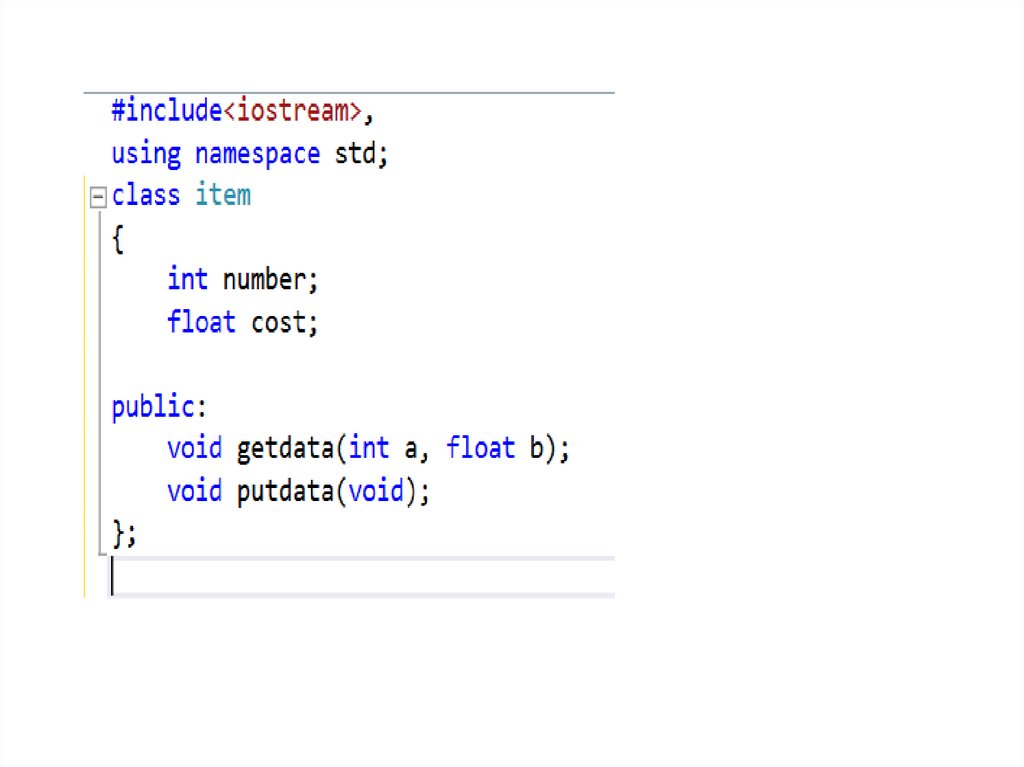
Defining Member FunctionsMember functions can be defined in two places:
1. Outside the class definition
2. Inside the class definition
13.
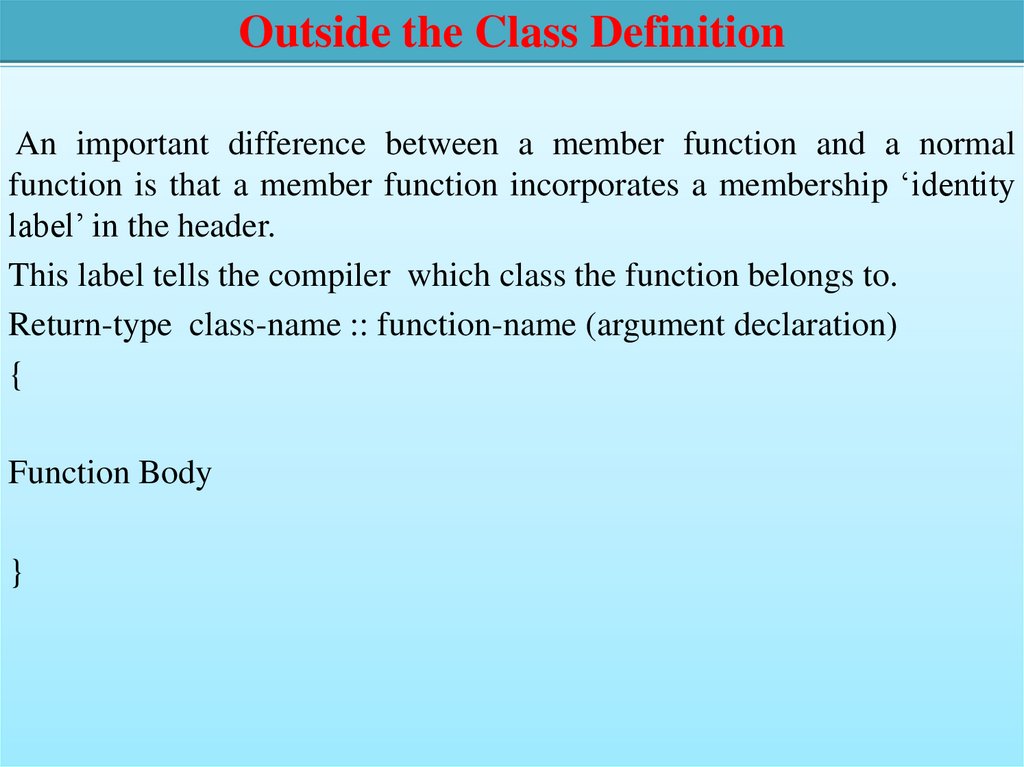
Outside the Class DefinitionAn important difference between a member function and a normal
function is that a member function incorporates a membership ‘identity
label’ in the header.
This label tells the compiler which class the function belongs to.
Return-type class-name :: function-name (argument declaration)
{
Function Body
}
14.
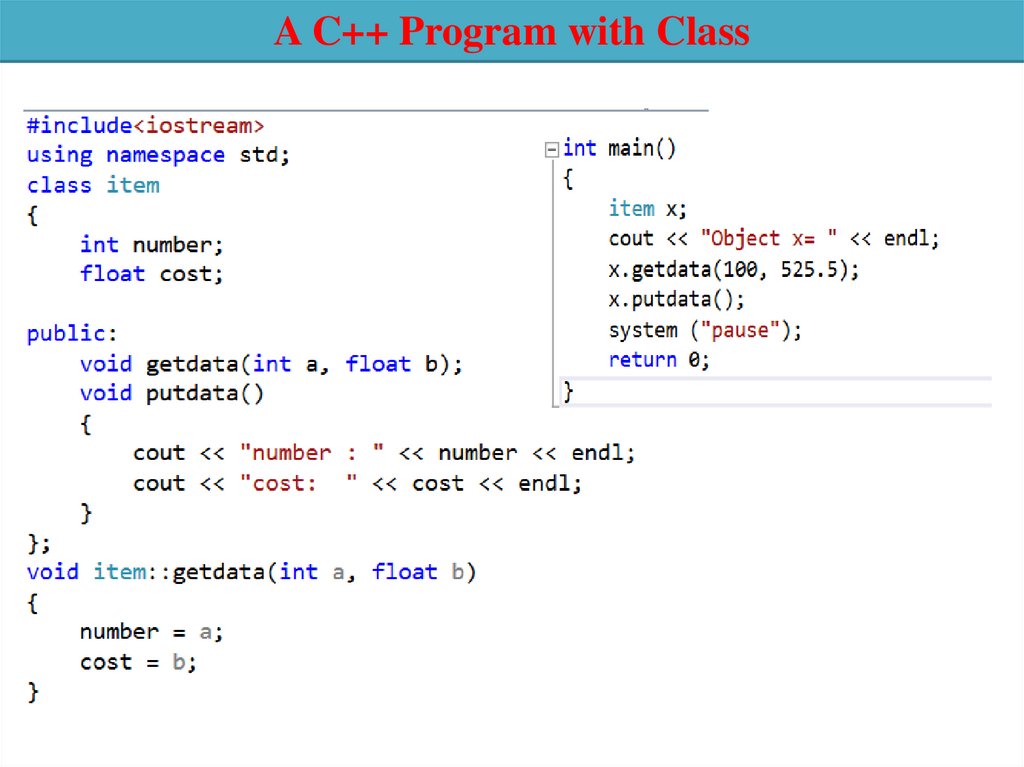
A C++ Program with Class15.
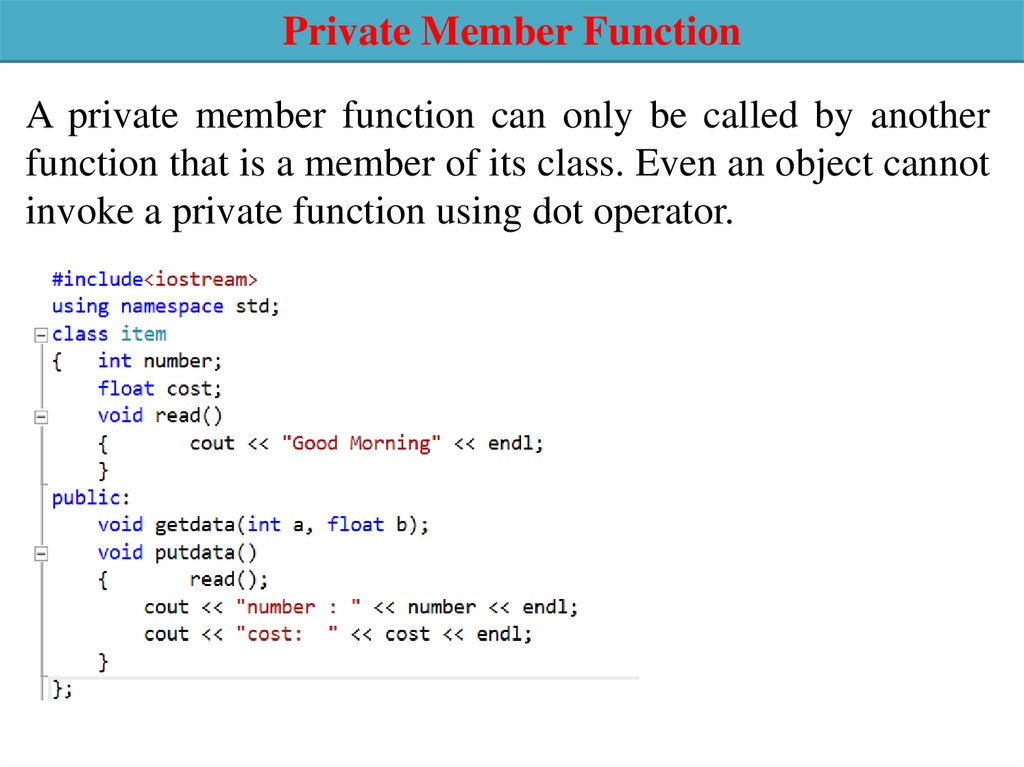
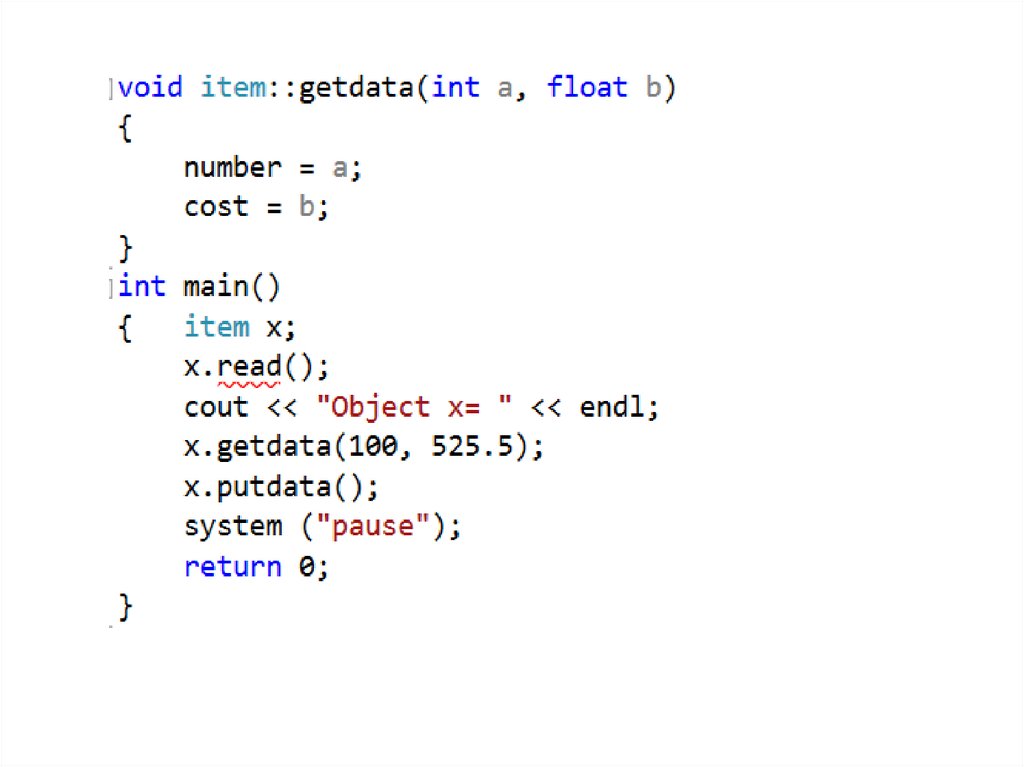
Private Member FunctionA private member function can only be called by another
function that is a member of its class. Even an object cannot
invoke a private function using dot operator.
16.
17.
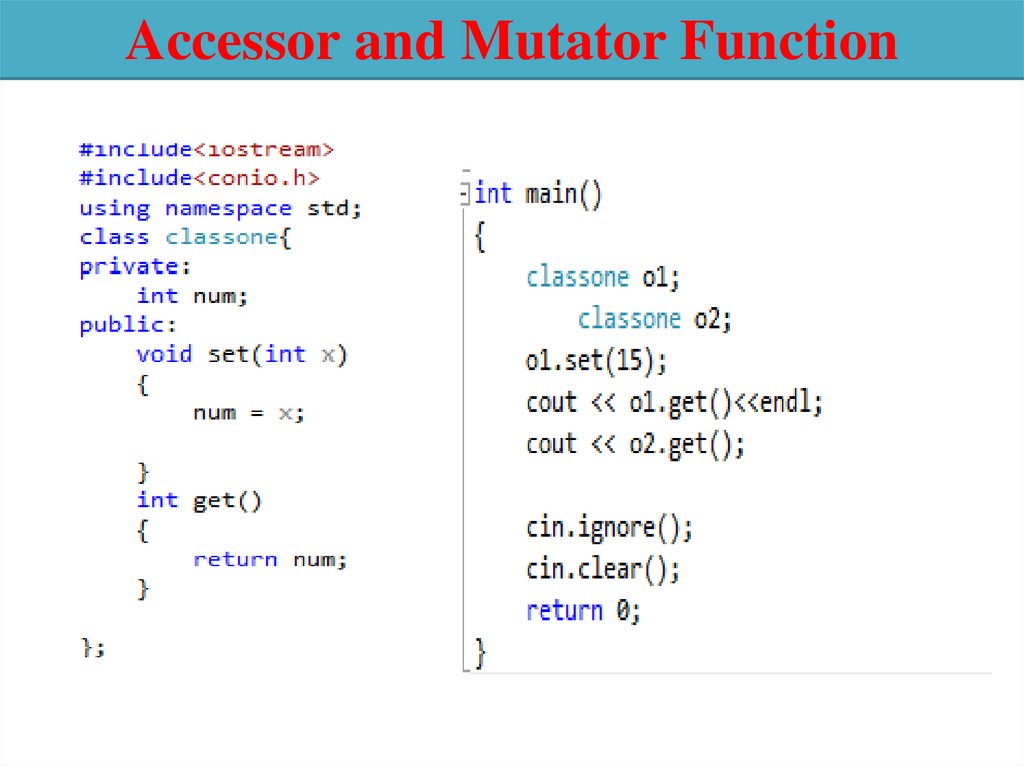
set Functions and get FunctionsSoftware engineering with set and get functions
1. public member functions that allow clients of a class to
set or get the values of private data members
2. set functions sometimes called mutators and get
functions sometimes called accessors
3. Allows the creator of the class to control how clients
access private data
4. Should also be used by other member functions of the
same class
18.
Accessor and Mutator Function19.
The Unified Modeling Language• UML stands for Unified Modeling Language.
• The UML provides a set of standard diagrams
for graphically depicting object-oriented
systems
20.
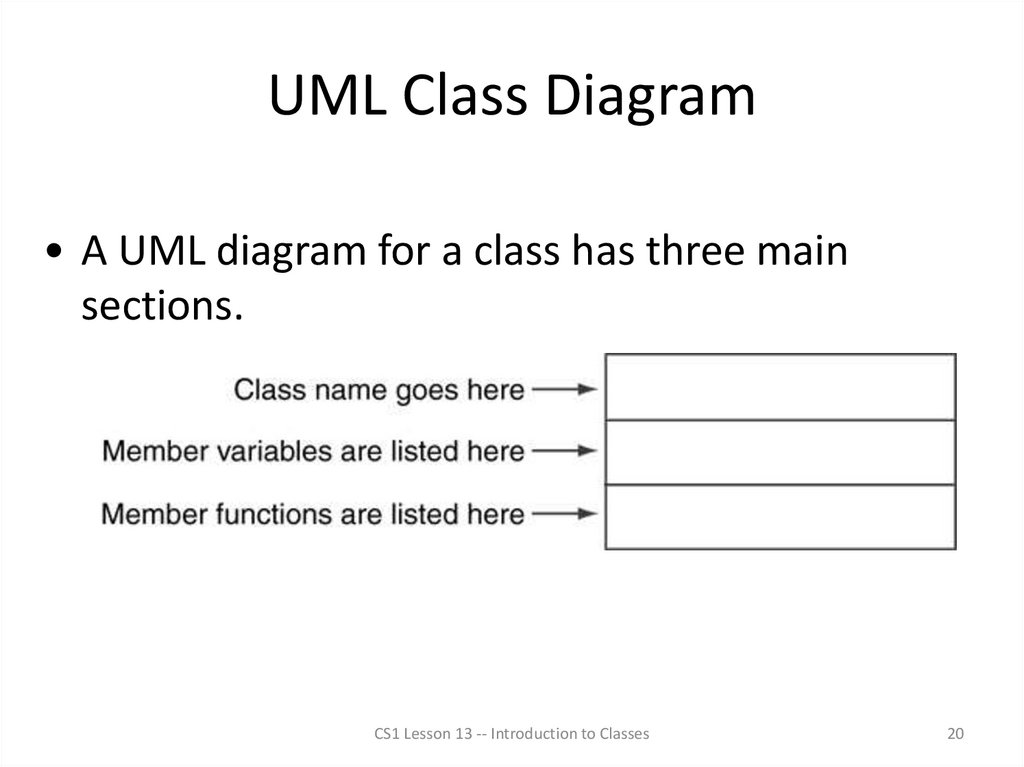
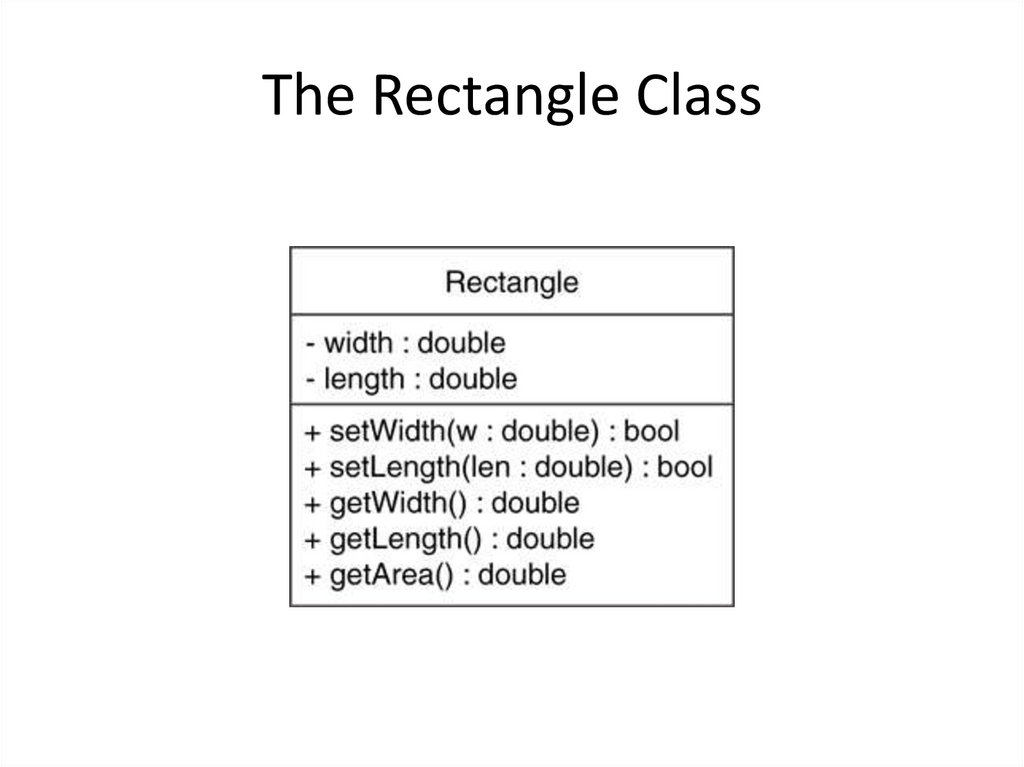
UML Class Diagram• A UML diagram for a class has three main
sections.
CS1 Lesson 13 -- Introduction to Classes
20
21.
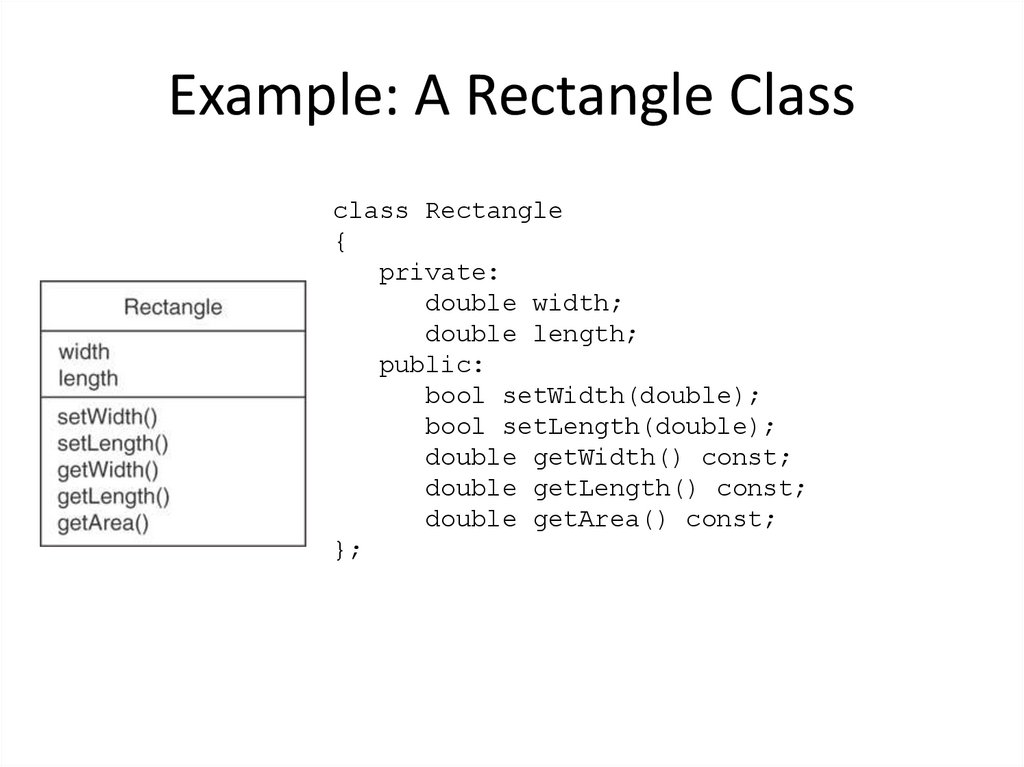
Example: A Rectangle Classclass Rectangle
{
private:
double width;
double length;
public:
bool setWidth(double);
bool setLength(double);
double getWidth() const;
double getLength() const;
double getArea() const;
};
22.
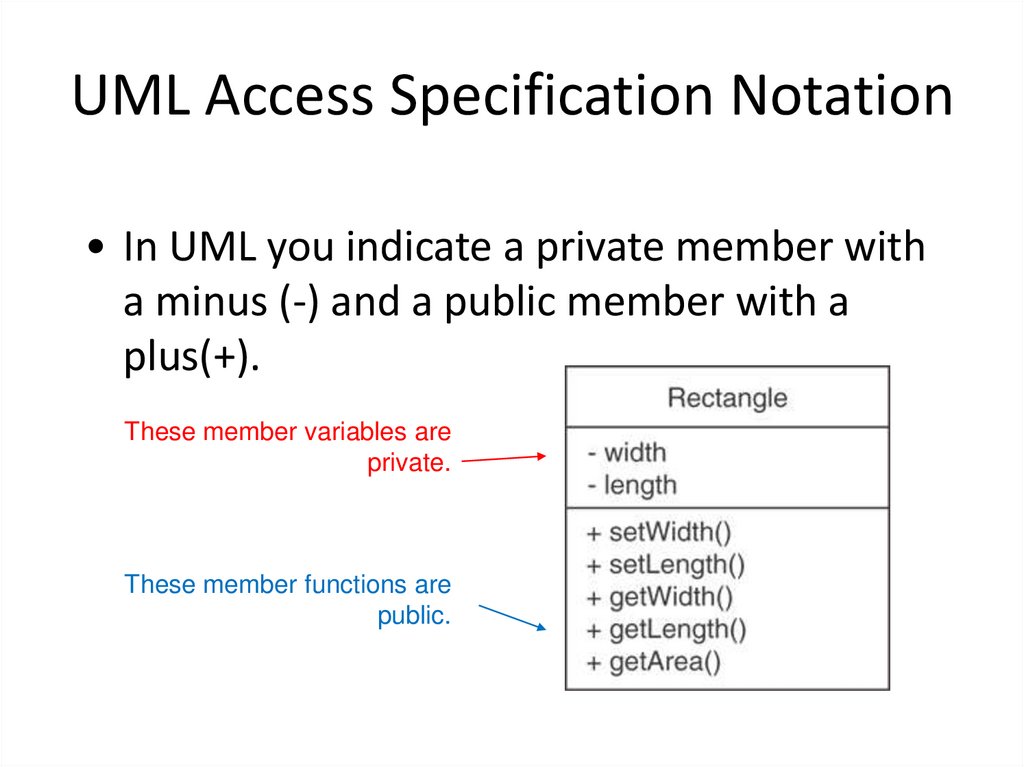
UML Access Specification Notation• In UML you indicate a private member with
a minus (-) and a public member with a
plus(+).
These member variables are
private.
These member functions are
public.
23.
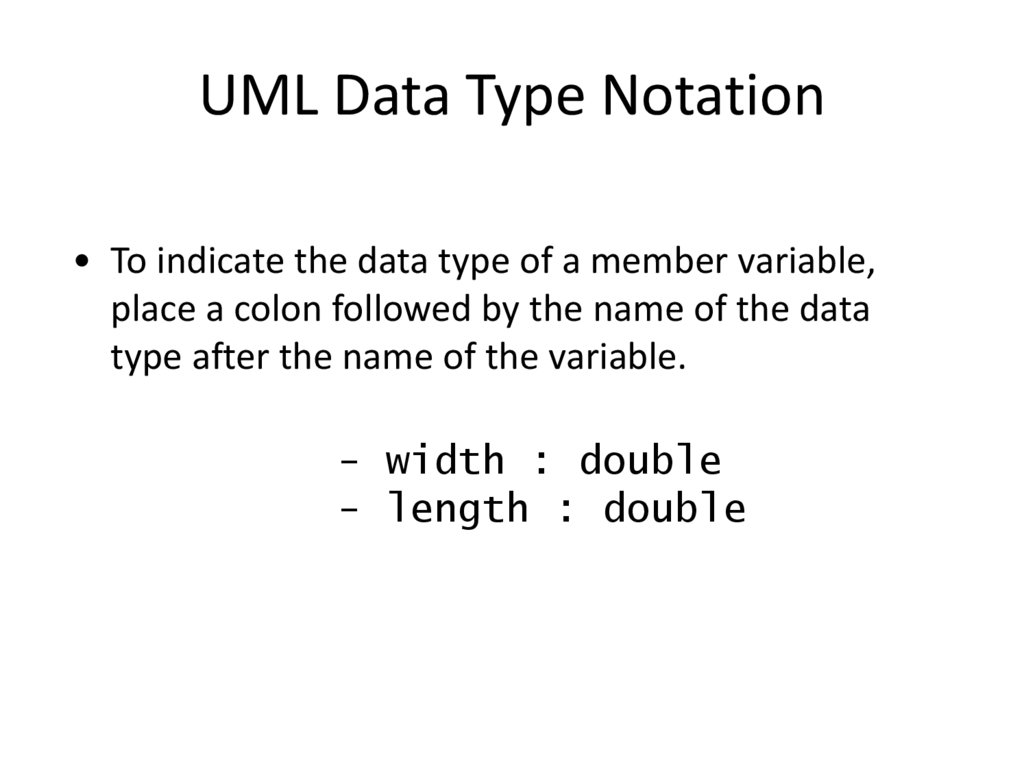
UML Data Type Notation• To indicate the data type of a member variable,
place a colon followed by the name of the data
type after the name of the variable.
- width : double
- length : double
24.
UML Parameter Type Notation• To indicate the data type of a function’s
parameter variable, place a colon followed by
the name of the data type after the name of
the variable.
+setWidth(w : double)
25.
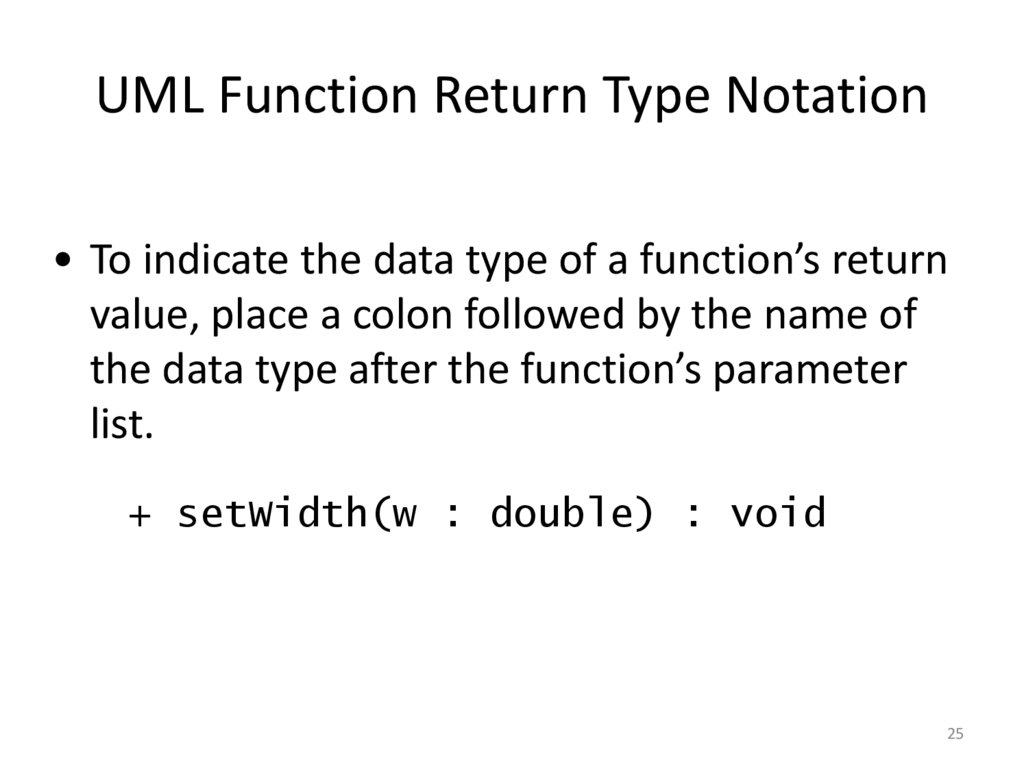
UML Function Return Type Notation• To indicate the data type of a function’s return
value, place a colon followed by the name of
the data type after the function’s parameter
list.
+ setWidth(w : double) : void
25