










 economics
Similar presentations:

Consumer Behavior
1. Chapter 3
Consumer Behavior2. Introduction
How are consumer preferences used todetermine demand?
How do consumers allocate income to
the purchase of different goods?
How do consumers with limited income
decide what to buy?
©2005 Pearson Education, Inc.
Chapter 3
2
3. Introduction
How can we determine the nature ofconsumer preferences for observations
of consumer behavior?
How can cost of living indexes measure
the well-being of consumers?
©2005 Pearson Education, Inc.
Chapter 3
3
4. Consumer Behavior - Applications
Consumer Behavior Applications1. How would General Mills determine the
price to charge for a new cereal before
it went to the market?
2. To what extent did the food stamp
program provide individuals with more
food versus merely subsidizing food
they bought anyway?
©2005 Pearson Education, Inc.
Chapter 3
4
5. Consumer Behavior
The theory of consumer behavior can beused to help answer these and many
more questions
Theory of consumer behavior
The explanation of how consumers allocate
income to the purchase of different goods
and services
©2005 Pearson Education, Inc.
Chapter 3
5
6. Consumer Behavior
There are three steps involved in thestudy of consumer behavior
1. Consumer Preferences
To describe how and why people prefer one
good to another
2. Budget Constraints
People have limited incomes
©2005 Pearson Education, Inc.
Chapter 3
6
7. Consumer Behavior
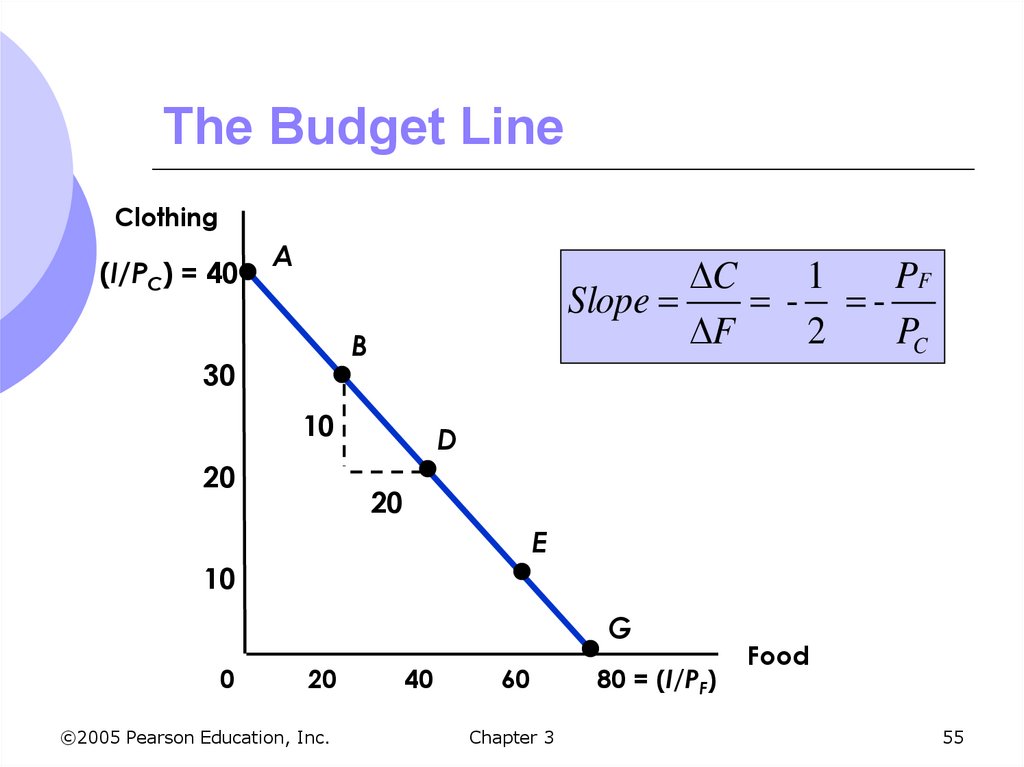
3. Given preferences and limited incomes,what amount and type of goods will be
purchased?
What combination of goods will consumers
buy to maximize their satisfaction?
©2005 Pearson Education, Inc.
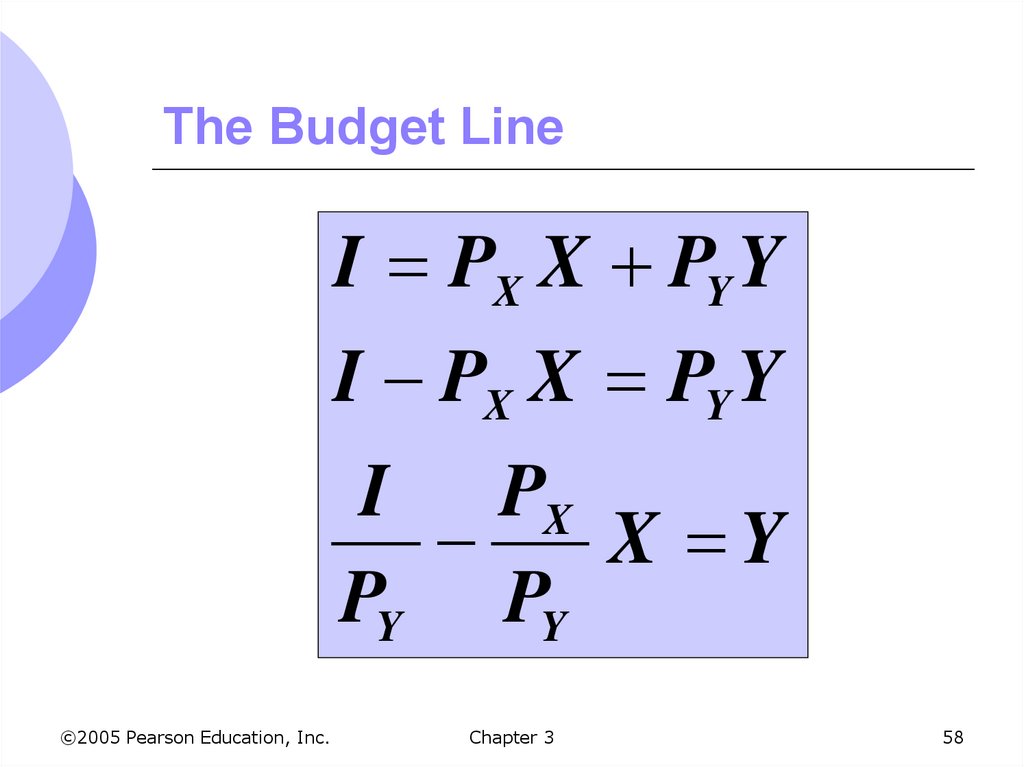
Chapter 3
7
8. Consumer Preferences
How might a consumer compare differentgroups of items available for purchase?
A market basket is a collection of one or
more commodities
Individuals can choose between market
baskets containing different goods
©2005 Pearson Education, Inc.
Chapter 3
8
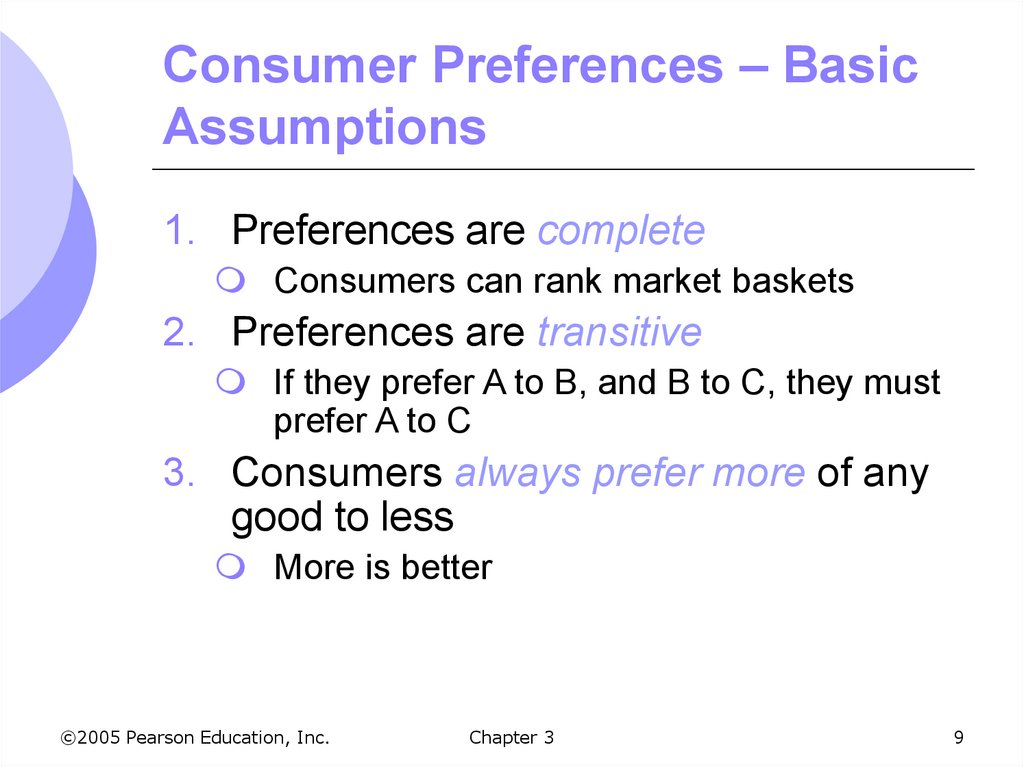
9. Consumer Preferences – Basic Assumptions
1. Preferences are completeConsumers can rank market baskets
2. Preferences are transitive
If they prefer A to B, and B to C, they must
prefer A to C
3. Consumers always prefer more of any
good to less
More is better
©2005 Pearson Education, Inc.
Chapter 3
9
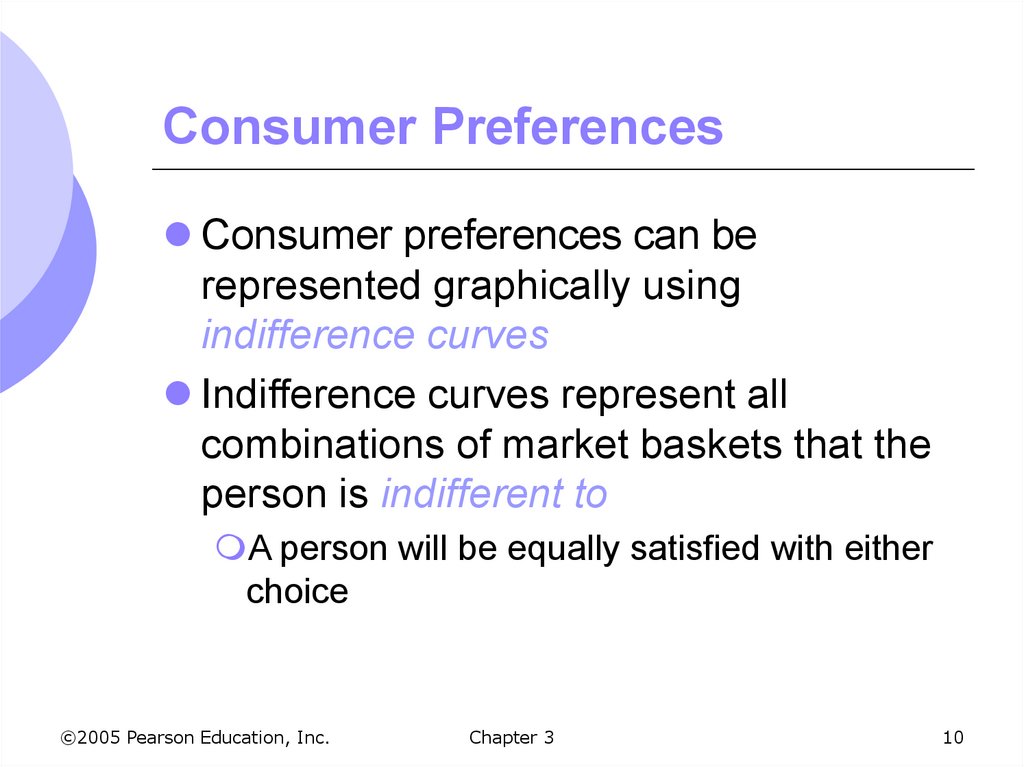
10. Consumer Preferences
Consumer preferences can berepresented graphically using
indifference curves
Indifference curves represent all
combinations of market baskets that the
person is indifferent to
A person will be equally satisfied with either
choice
©2005 Pearson Education, Inc.
Chapter 3
10
11. Indifference Curves: An Example
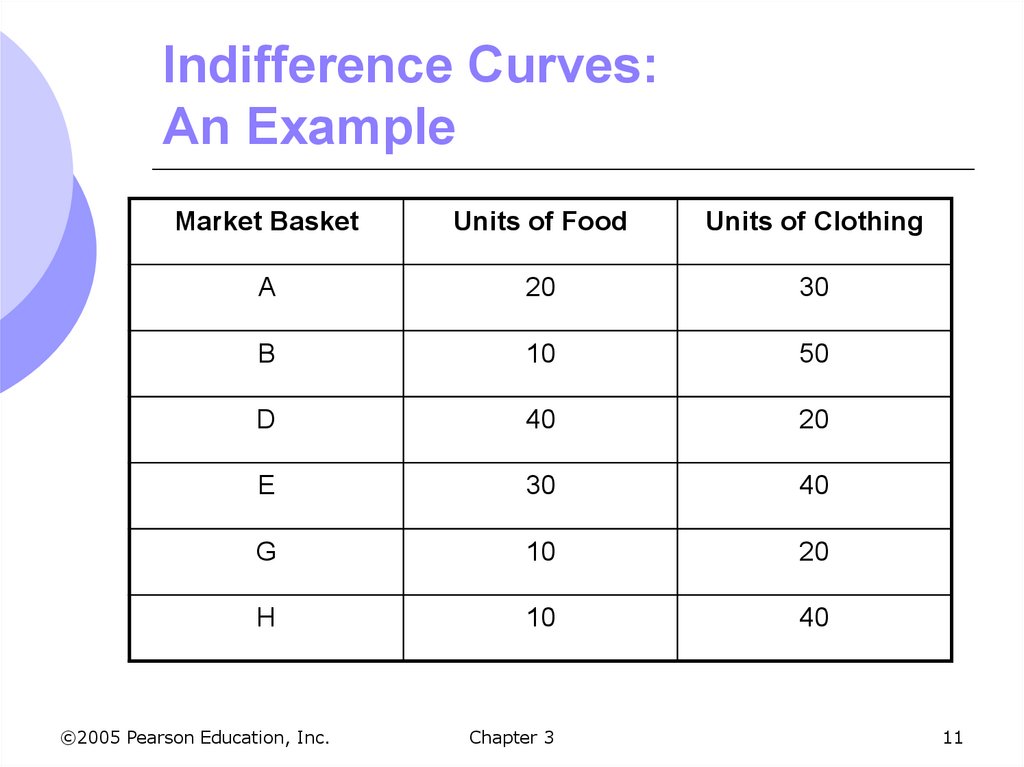
Market BasketUnits of Food
Units of Clothing
A
20
30
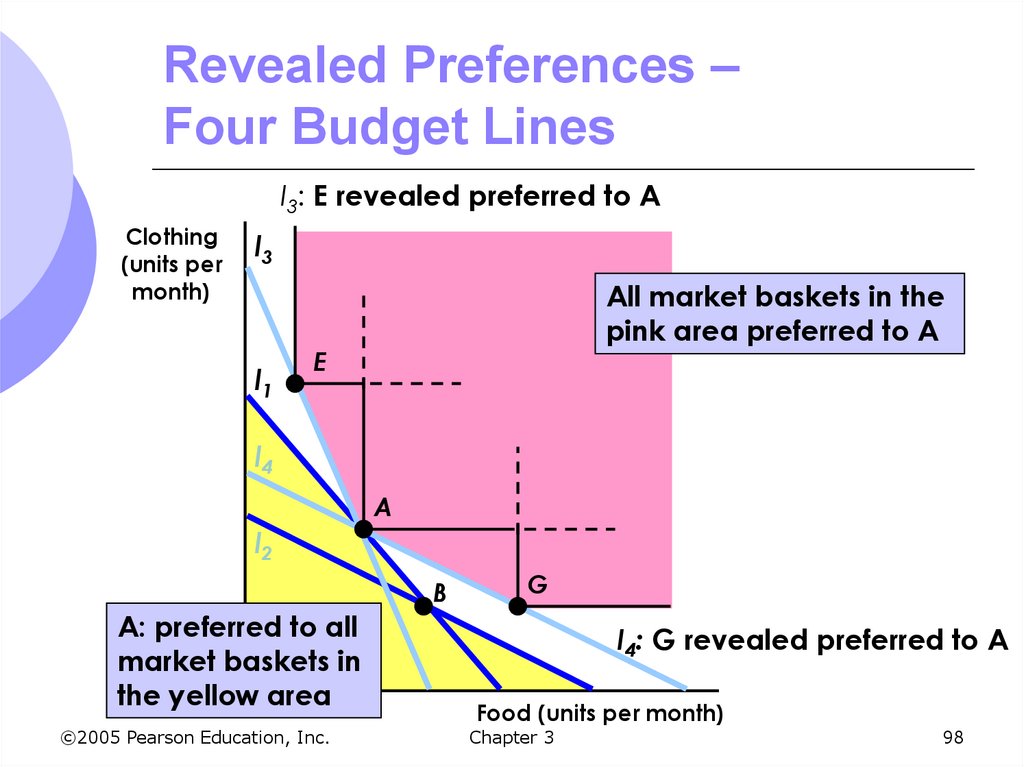
B
10
50
D
40
20
E
30
40
G
10
20
H
10
40
©2005 Pearson Education, Inc.
Chapter 3
11
12. Indifference Curves: An Example
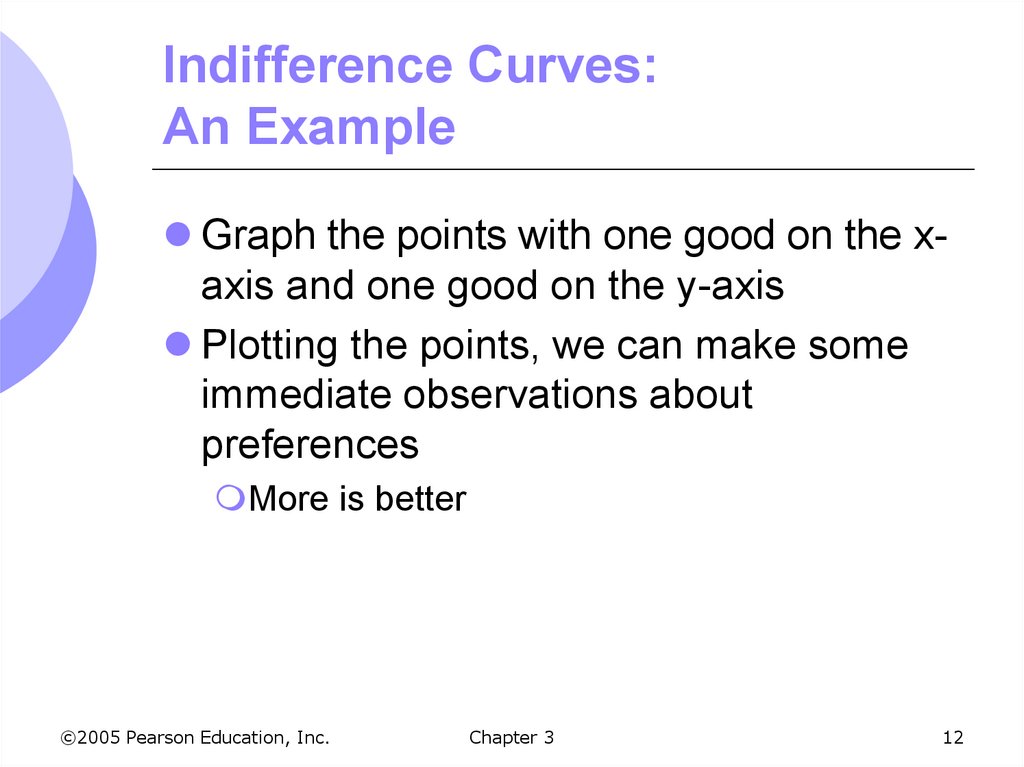
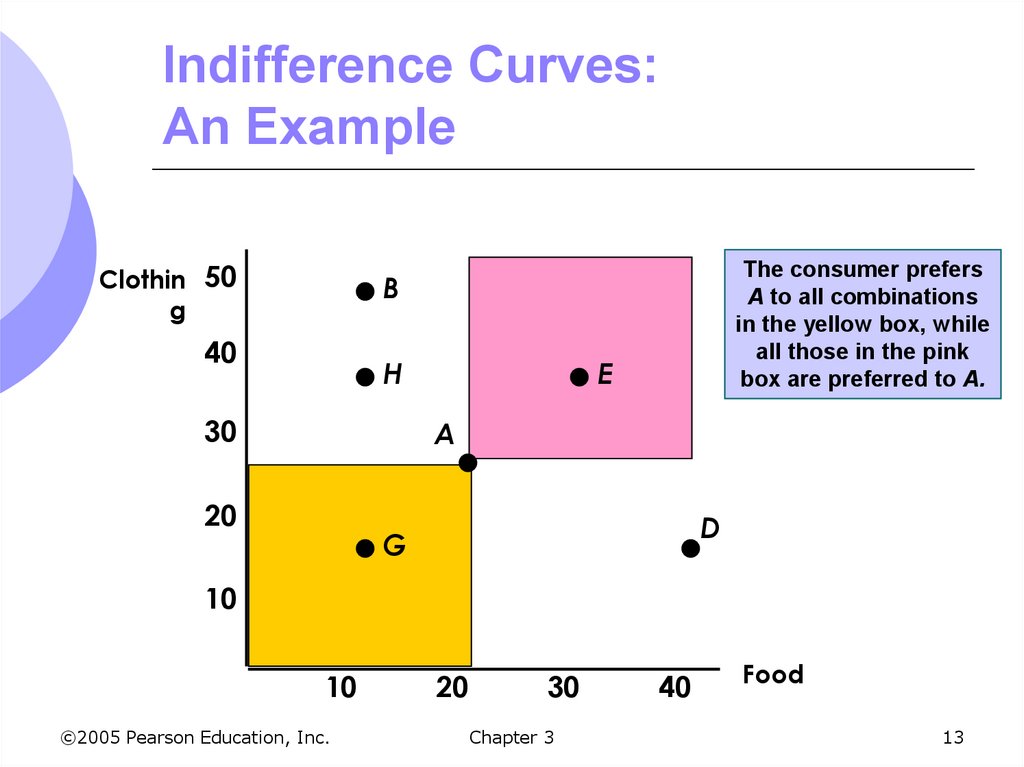
Graph the points with one good on the xaxis and one good on the y-axisPlotting the points, we can make some
immediate observations about
preferences
More is better
©2005 Pearson Education, Inc.
Chapter 3
12
13. Indifference Curves: An Example
Clothin 50g
The consumer prefers
A to all combinations
in the yellow box, while
all those in the pink
box are preferred to A.
B
40
H
30
E
A
20
D
G
10
10
©2005 Pearson Education, Inc.
20
30
Chapter 3
40
Food
13
14. Indifference Curves: An Example
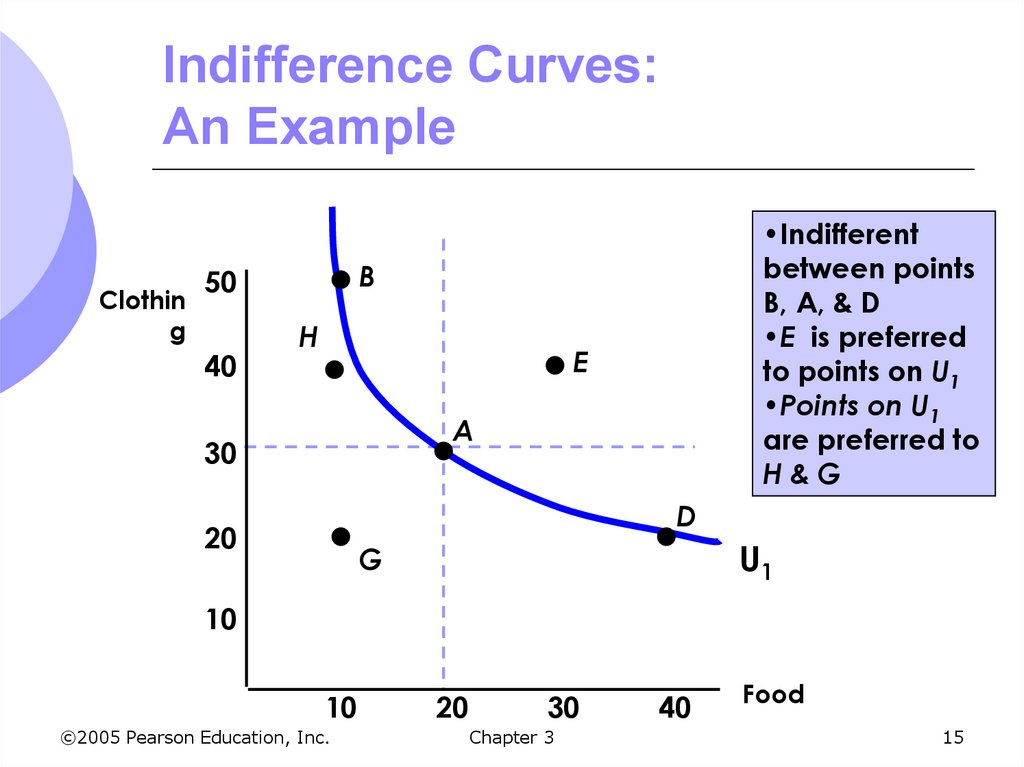
Points such as B & D have more of onegood but less of another compared to A
Need more information about consumer
ranking
Consumer may decide they are
indifferent between B, A and D
We can then connect those points with an
indifference curve
©2005 Pearson Education, Inc.
Chapter 3
14
15. Indifference Curves: An Example
Clothing
B
50
40
•Indifferent
between points
B, A, & D
•E is preferred
to points on U1
•Points on U1
are preferred to
H&G
H
E
A
30
D
20
U1
G
10
10
©2005 Pearson Education, Inc.
20
30
Chapter 3
40
Food
15
16. Indifference Curves
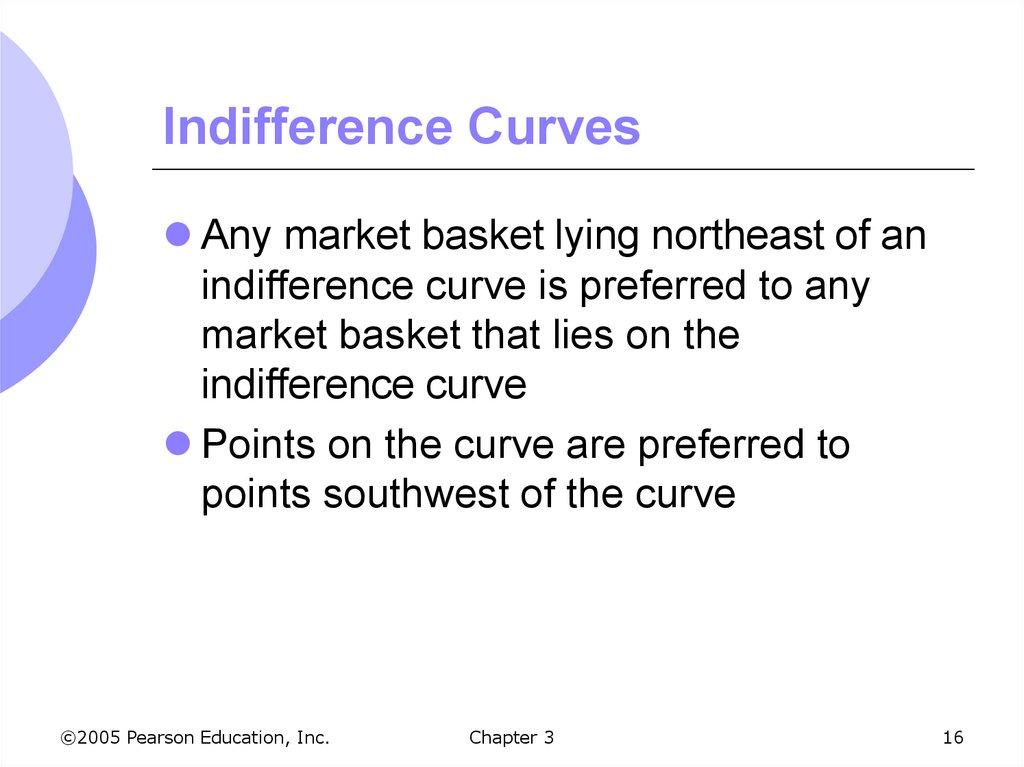
Any market basket lying northeast of anindifference curve is preferred to any
market basket that lies on the
indifference curve
Points on the curve are preferred to
points southwest of the curve
©2005 Pearson Education, Inc.
Chapter 3
16
17. Indifference Curves
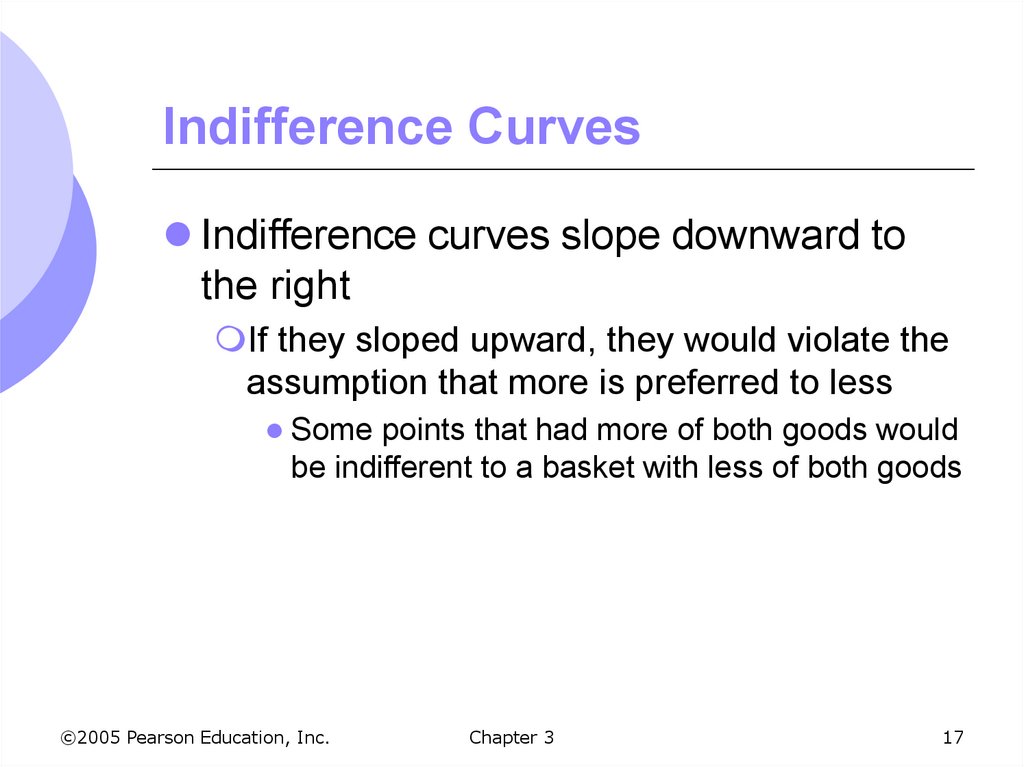
Indifference curves slope downward tothe right
If they sloped upward, they would violate the
assumption that more is preferred to less
Some points that had more of both goods would
be indifferent to a basket with less of both goods
©2005 Pearson Education, Inc.
Chapter 3
17
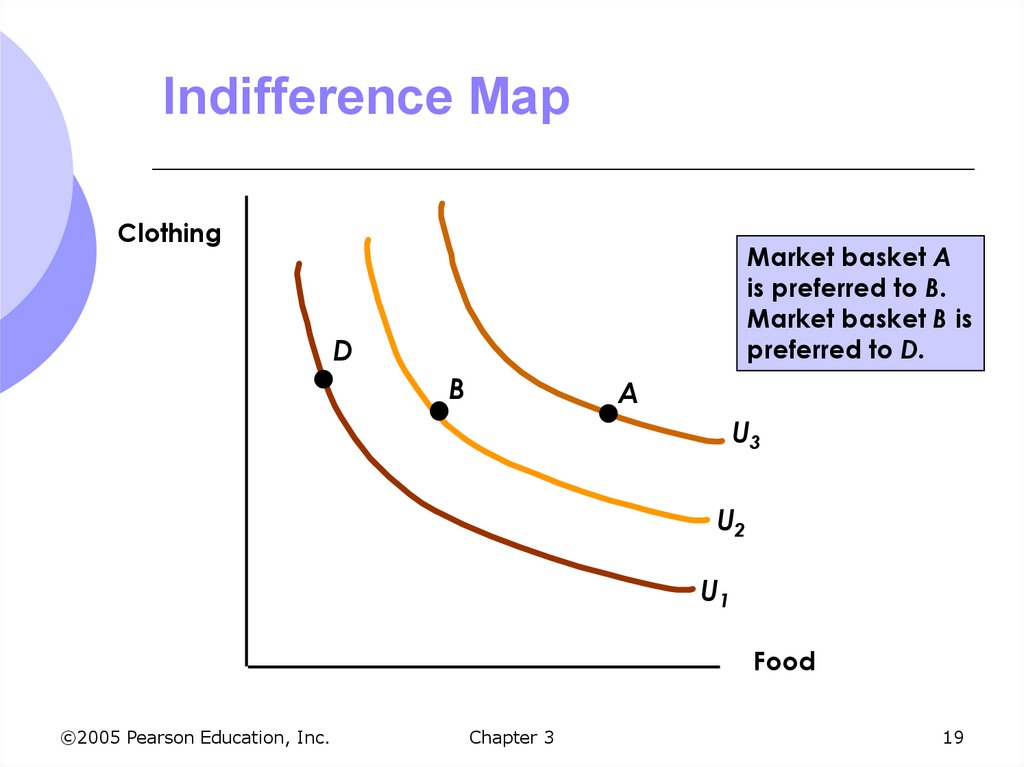
18. Indifference Curves
To describe preferences for allcombinations of goods/services, we have
a set of indifference curves – an
indifference map
Each indifference curve in the map shows
the market baskets among which the person
is indifferent
©2005 Pearson Education, Inc.
Chapter 3
18
19. Indifference Map
ClothingMarket basket A
is preferred to B.
Market basket B is
preferred to D.
D
B
A
U3
U2
U1
Food
©2005 Pearson Education, Inc.
Chapter 3
19
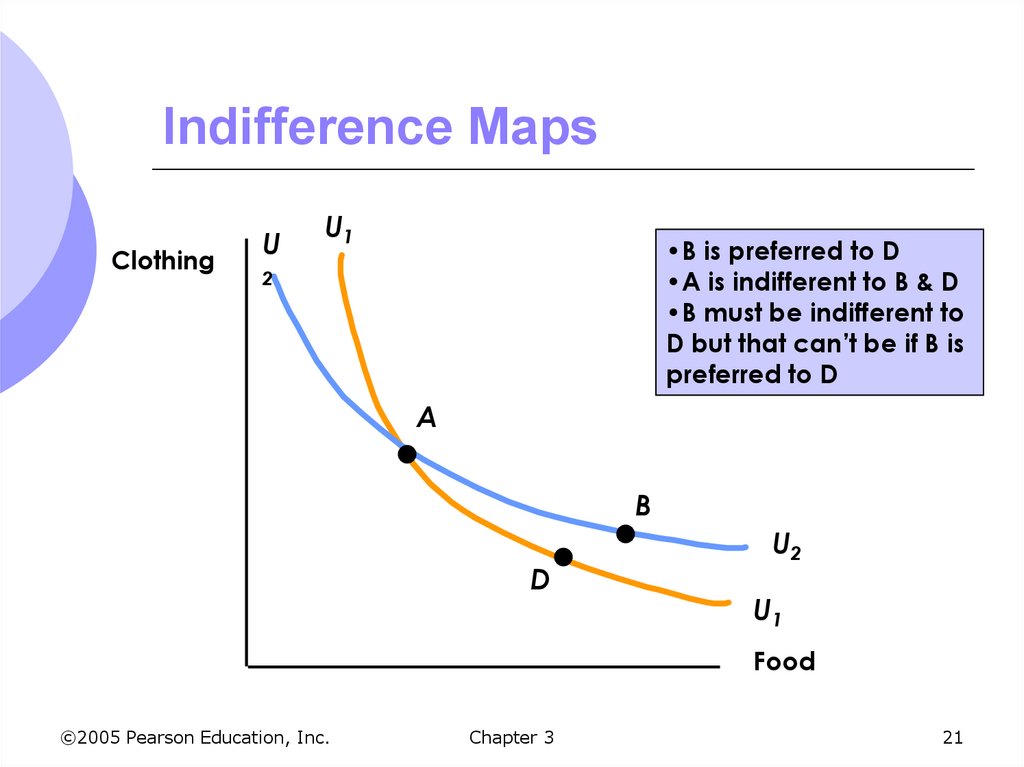
20. Indifference Maps
Indifference maps give more informationabout shapes of indifference curves
Indifference curves cannot cross
Violates assumption that more is better
Why? What if we assume they can cross?
©2005 Pearson Education, Inc.
Chapter 3
20
21. Indifference Maps
ClothingU
U1
•B is preferred to D
•A is indifferent to B & D
•B must be indifferent to
D but that can’t be if B is
preferred to D
2
A
B
D
U2
U1
Food
©2005 Pearson Education, Inc.
Chapter 3
21
22. Indifference Curves
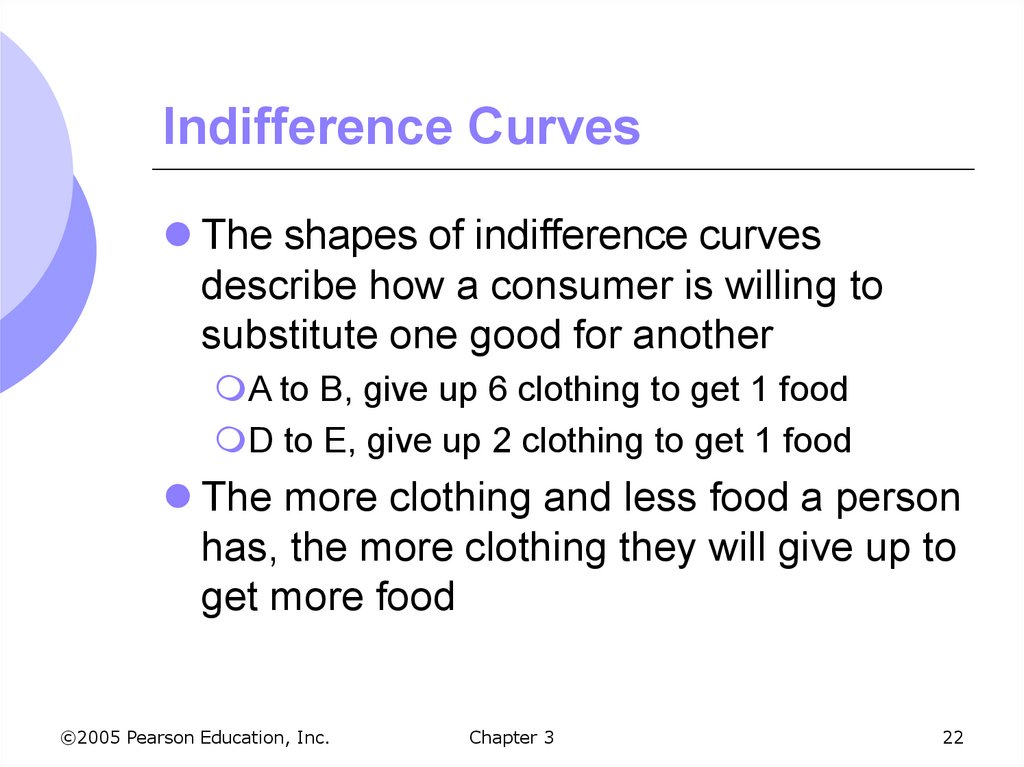
The shapes of indifference curvesdescribe how a consumer is willing to
substitute one good for another
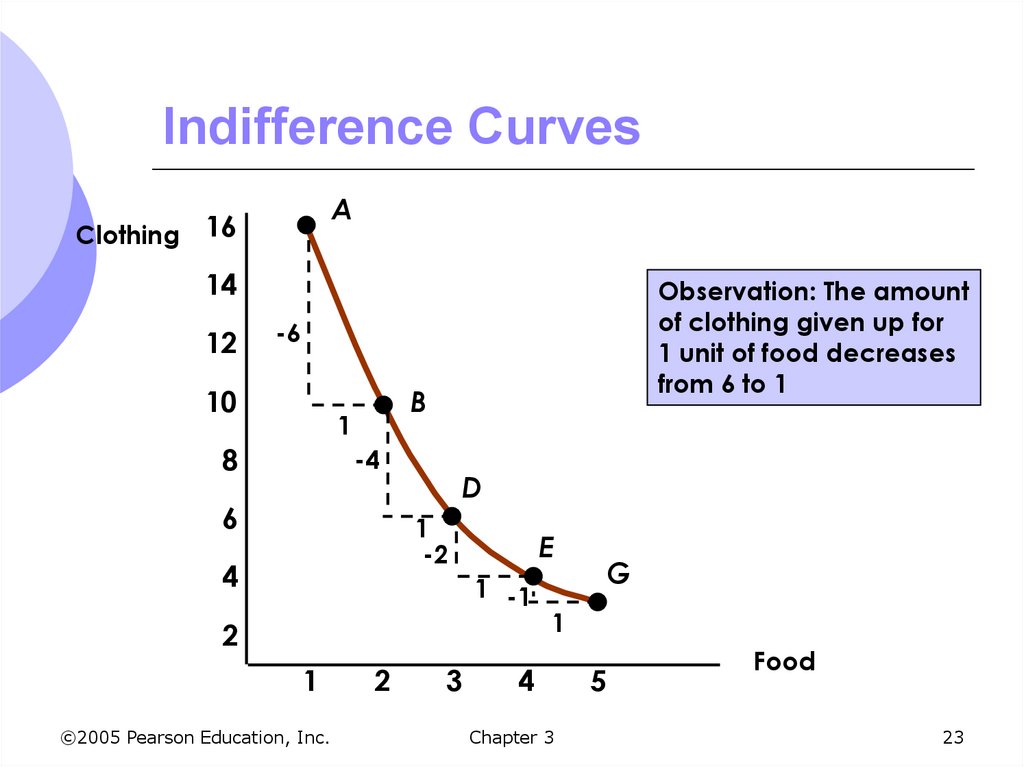
A to B, give up 6 clothing to get 1 food
D to E, give up 2 clothing to get 1 food
The more clothing and less food a person
has, the more clothing they will give up to
get more food
©2005 Pearson Education, Inc.
Chapter 3
22
23. Indifference Curves
AClothing 16
14
12
Observation: The amount
of clothing given up for
1 unit of food decreases
from 6 to 1
-6
10
B
1
8
-4
6
D
1
-2
4
E
1 -1
2
1
©2005 Pearson Education, Inc.
2
3
G
1
4
Chapter 3
5
Food
23
24. Indifference Curves
We measure how a person trades onegood for another using the marginal rate
of substitution (MRS)
It quantifies the amount of one good a
consumer will give up to obtain more of
another good
It is measured by the slope of the
indifference curve
©2005 Pearson Education, Inc.
Chapter 3
24
25. Marginal Rate of Substitution
AClothing 16
14
12
MRS C
MRS = 6
F
-6
10
B
1
8
-4
6
D
1
-2
4
MRS = 2
E
1 -1
2
1
1
©2005 Pearson Education, Inc.
2
3
4
Chapter 3
5
G
Food
25
26. Marginal Rate of Substitution
Indifference curves are convexAs more of one good is consumed, a
consumer would prefer to give up fewer units
of a second good to get additional units of
the first one
Consumers generally prefer a balanced
market basket
©2005 Pearson Education, Inc.
Chapter 3
26
27. Marginal Rate of Substitution
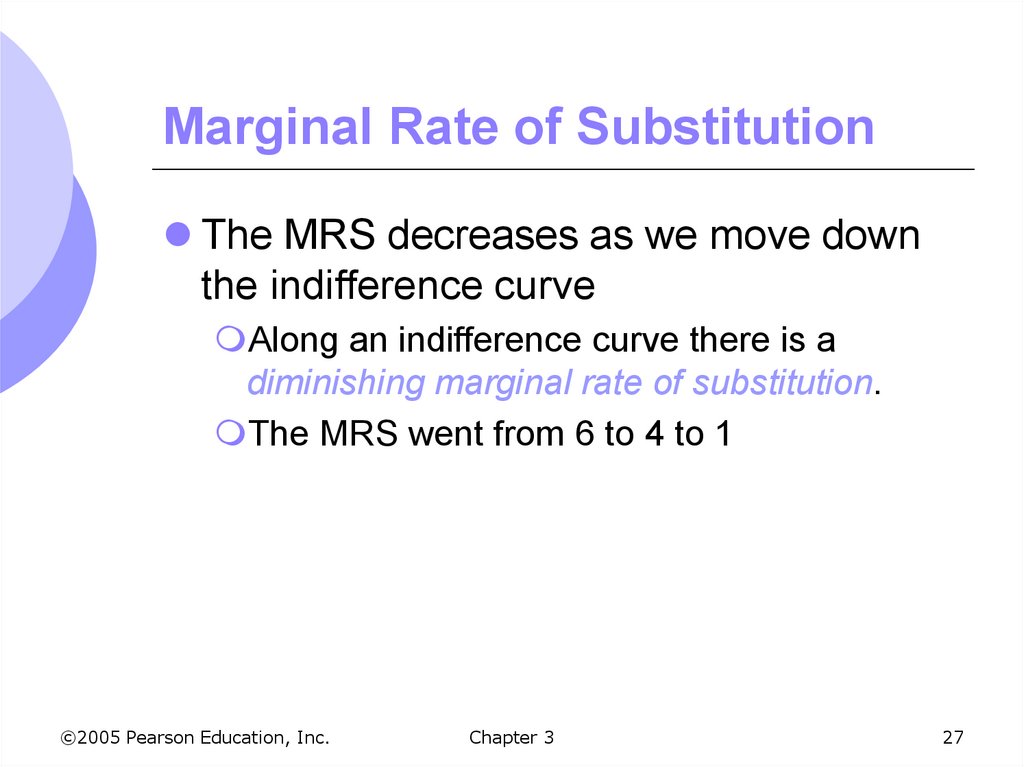
The MRS decreases as we move downthe indifference curve
Along an indifference curve there is a
diminishing marginal rate of substitution.
The MRS went from 6 to 4 to 1
©2005 Pearson Education, Inc.
Chapter 3
27
28. Marginal Rate of Substitution
Indifference curves with different shapesimply a different willingness to substitute
Two polar cases are of interest
Perfect substitutes
Perfect complements
©2005 Pearson Education, Inc.
Chapter 3
28
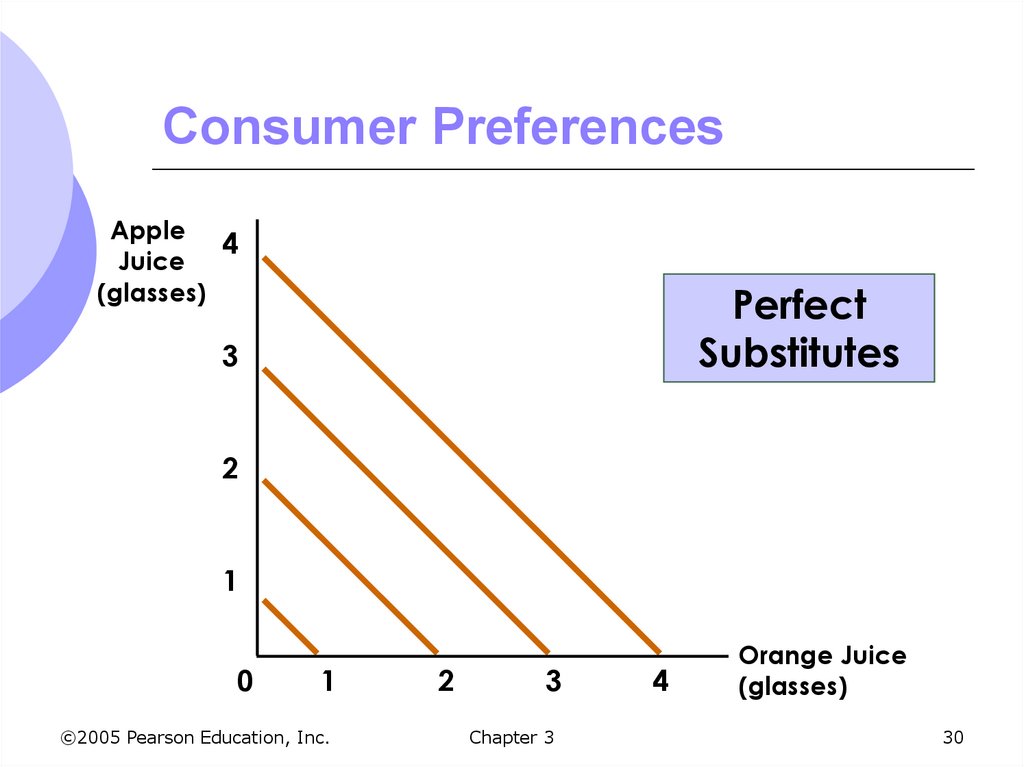
29. Marginal Rate of Substitution
Perfect SubstitutesTwo goods are perfect substitutes when the
marginal rate of substitution of one good for
the other is constant
Example: a person might consider apple
juice and orange juice perfect substitutes
They would always trade 1 glass of OJ for 1
glass of Apple Juice
©2005 Pearson Education, Inc.
Chapter 3
29
30. Consumer Preferences
Apple4
Juice
(glasses)
Perfect
Substitutes
3
2
1
0
1
©2005 Pearson Education, Inc.
2
3
Chapter 3
4
Orange Juice
(glasses)
30
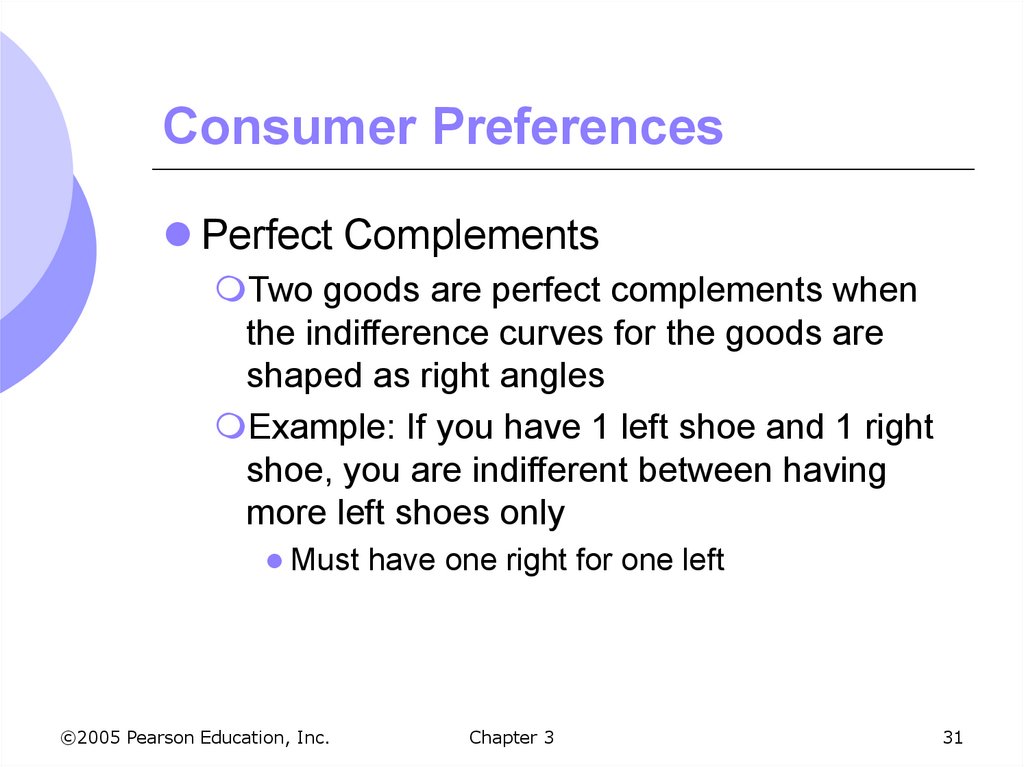
31. Consumer Preferences
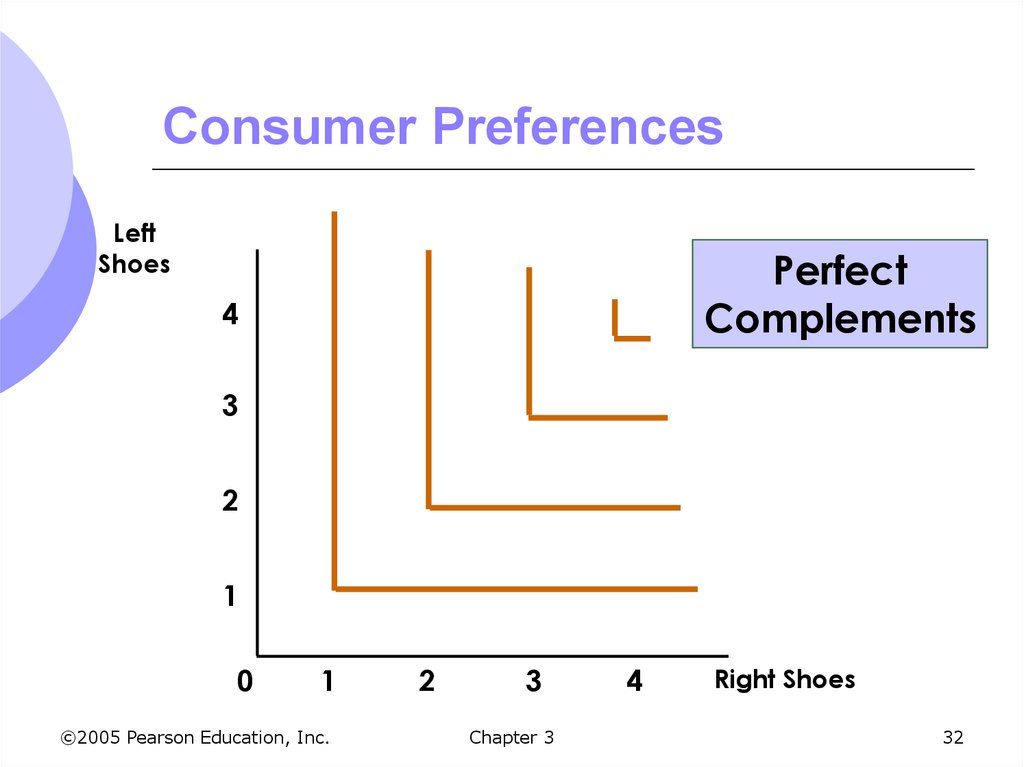
Perfect ComplementsTwo goods are perfect complements when
the indifference curves for the goods are
shaped as right angles
Example: If you have 1 left shoe and 1 right
shoe, you are indifferent between having
more left shoes only
Must have one right for one left
©2005 Pearson Education, Inc.
Chapter 3
31
32. Consumer Preferences
LeftShoes
Perfect
Complements
4
3
2
1
0
1
©2005 Pearson Education, Inc.
2
3
Chapter 3
4
Right Shoes
32
33. Consumer Preferences
We have assumed all our commoditiesare “goods”
There are commodities we don’t want
more of - bads
Things for which less is preferred to more
Examples
Air pollution
Asbestos
©2005 Pearson Education, Inc.
Chapter 3
33
34. Consumer Preferences
How do we account for bads in ourpreference analysis?
We redefine the commodity
Clean air
Pollution reduction
Asbestos removal
©2005 Pearson Education, Inc.
Chapter 3
34
35. Consumer Preferences: An Application
In designing new cars, automobileexecutives must determine how much
time and money to invest in restyling
versus increased performance
Higher demand for car with better styling and
performance
Both cost more to improve
©2005 Pearson Education, Inc.
Chapter 3
35
36. Consumer Preferences: An Application
An analysis of consumer preferenceswould help to determine where to spend
more on change: performance or styling
Some consumers will prefer better styling
and some will prefer better performance
©2005 Pearson Education, Inc.
Chapter 3
36
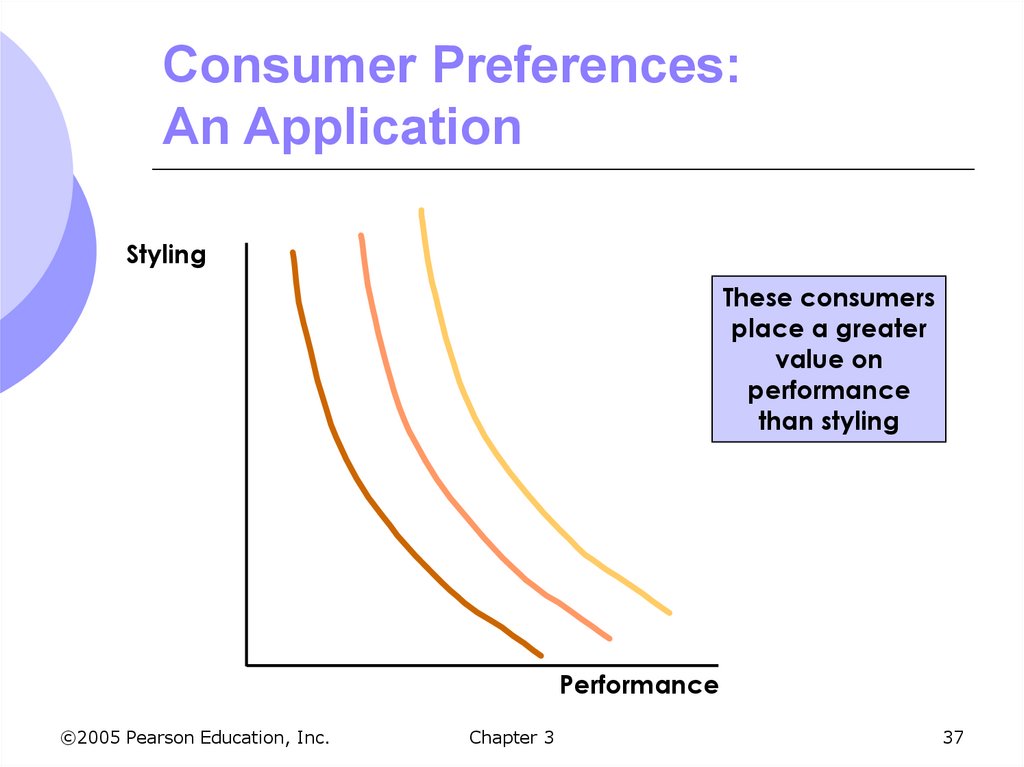
37. Consumer Preferences: An Application
StylingThese consumers
place a greater
value on
performance
than styling
Performance
©2005 Pearson Education, Inc.
Chapter 3
37
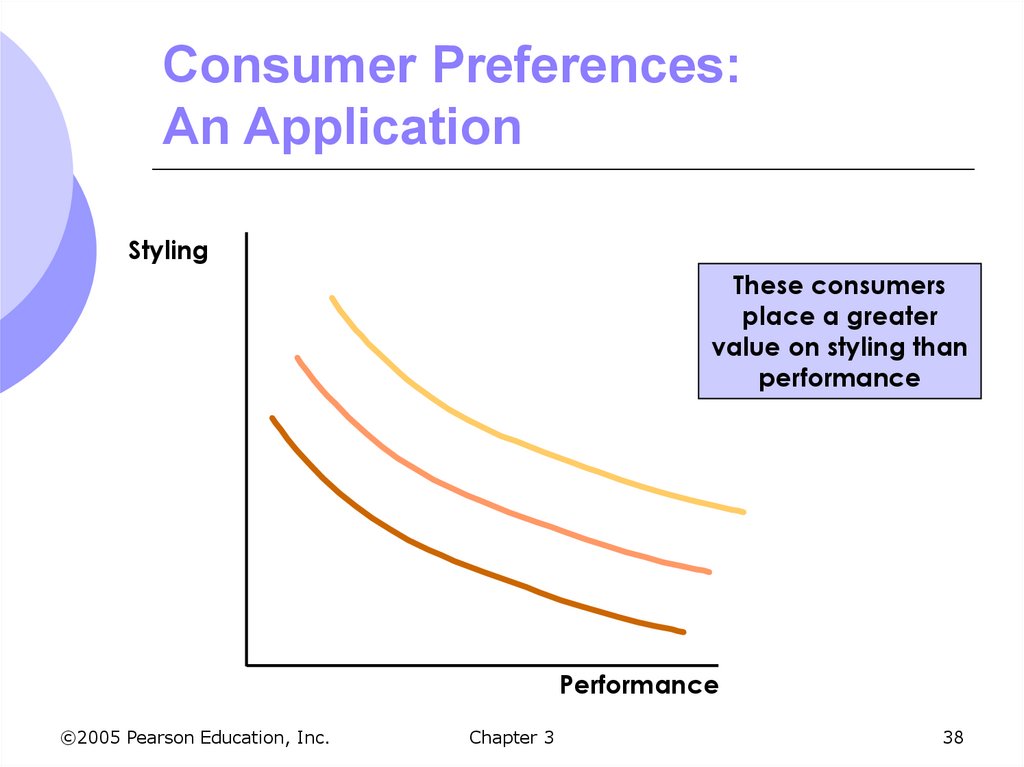
38. Consumer Preferences: An Application
StylingThese consumers
place a greater
value on styling than
performance
Performance
©2005 Pearson Education, Inc.
Chapter 3
38
39. Consumer Preferences: An Application
Knowing which group dominates themarket will help decide where
redesigning dollars should go
A recent study in the US shows that over
the past two decades, most consumers
have preferred styling over performance
©2005 Pearson Education, Inc.
Chapter 3
39
40. Consumer Preferences
The theory of consumer behavior doesnot required assigning a numerical value
to the level of satisfaction
Although ranking of market baskets is
good, sometimes numerical value is
useful
©2005 Pearson Education, Inc.
Chapter 3
40
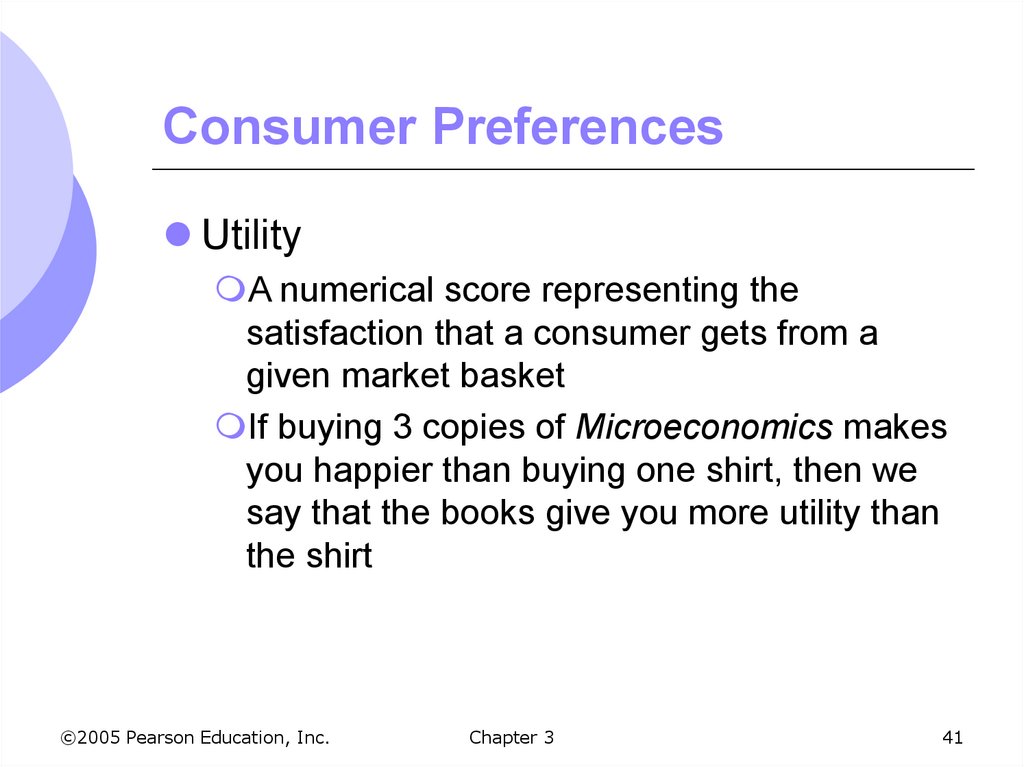
41. Consumer Preferences
UtilityA numerical score representing the
satisfaction that a consumer gets from a
given market basket
If buying 3 copies of Microeconomics makes
you happier than buying one shirt, then we
say that the books give you more utility than
the shirt
©2005 Pearson Education, Inc.
Chapter 3
41
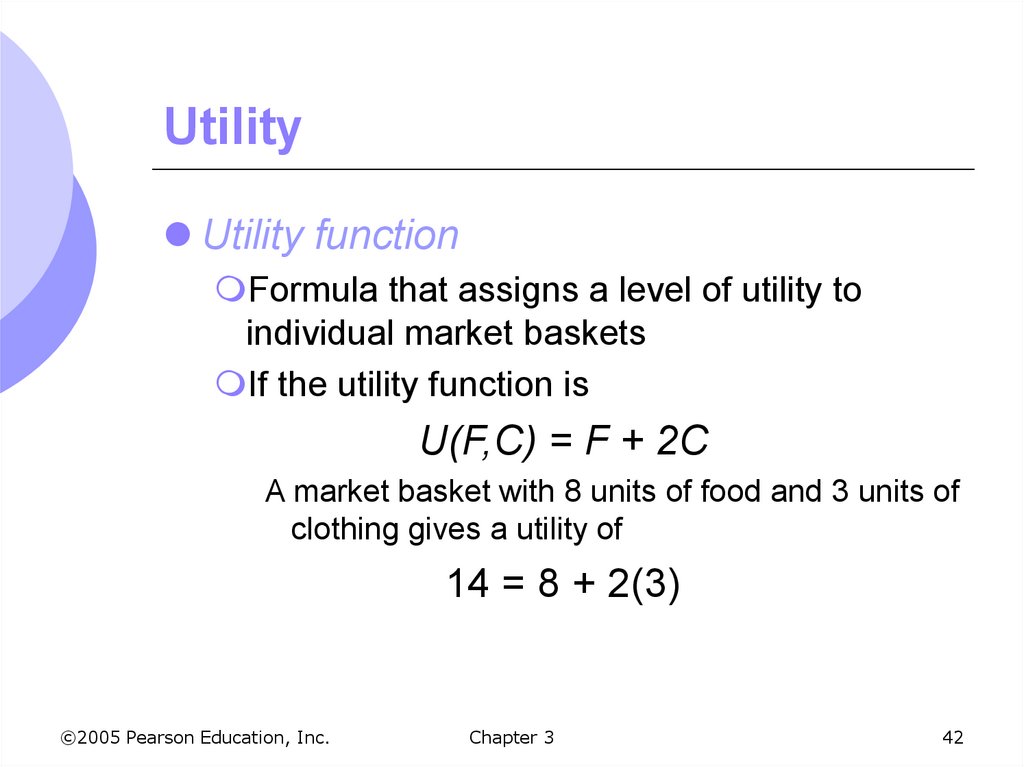
42. Utility
Utility functionFormula that assigns a level of utility to
individual market baskets
If the utility function is
U(F,C) = F + 2C
A market basket with 8 units of food and 3 units of
clothing gives a utility of
14 = 8 + 2(3)
©2005 Pearson Education, Inc.
Chapter 3
42
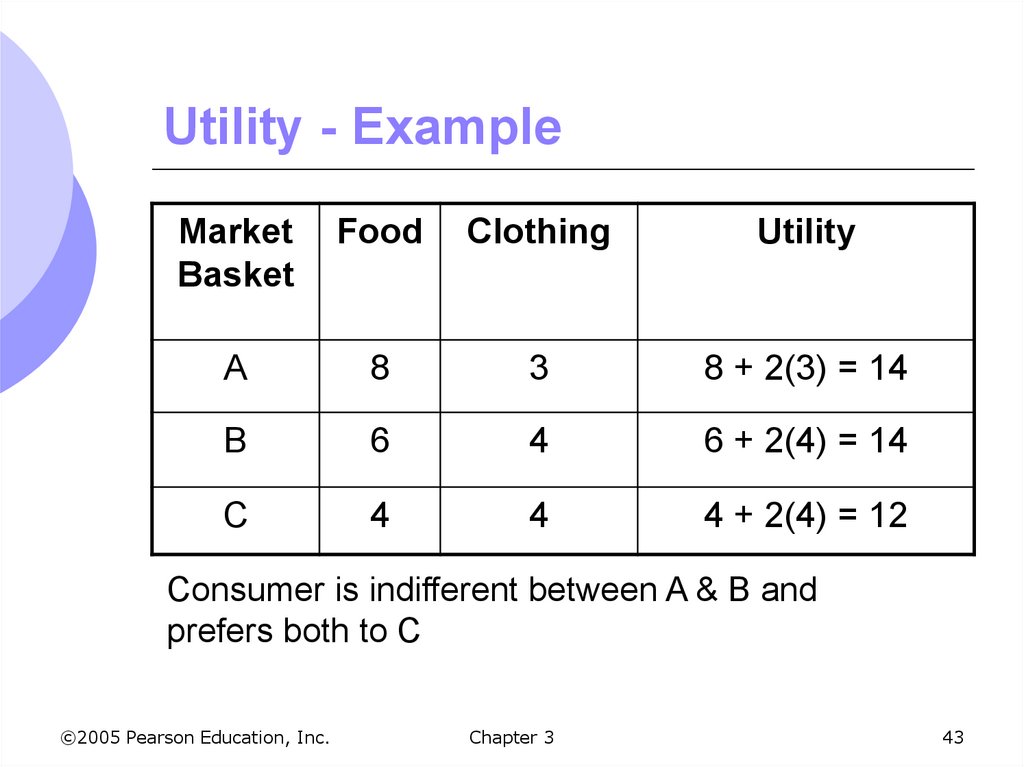
43. Utility - Example
MarketBasket
Food
Clothing
Utility
A
8
3
8 + 2(3) = 14
B
6
4
6 + 2(4) = 14
C
4
4
4 + 2(4) = 12
Consumer is indifferent between A & B and
prefers both to C
©2005 Pearson Education, Inc.
Chapter 3
43
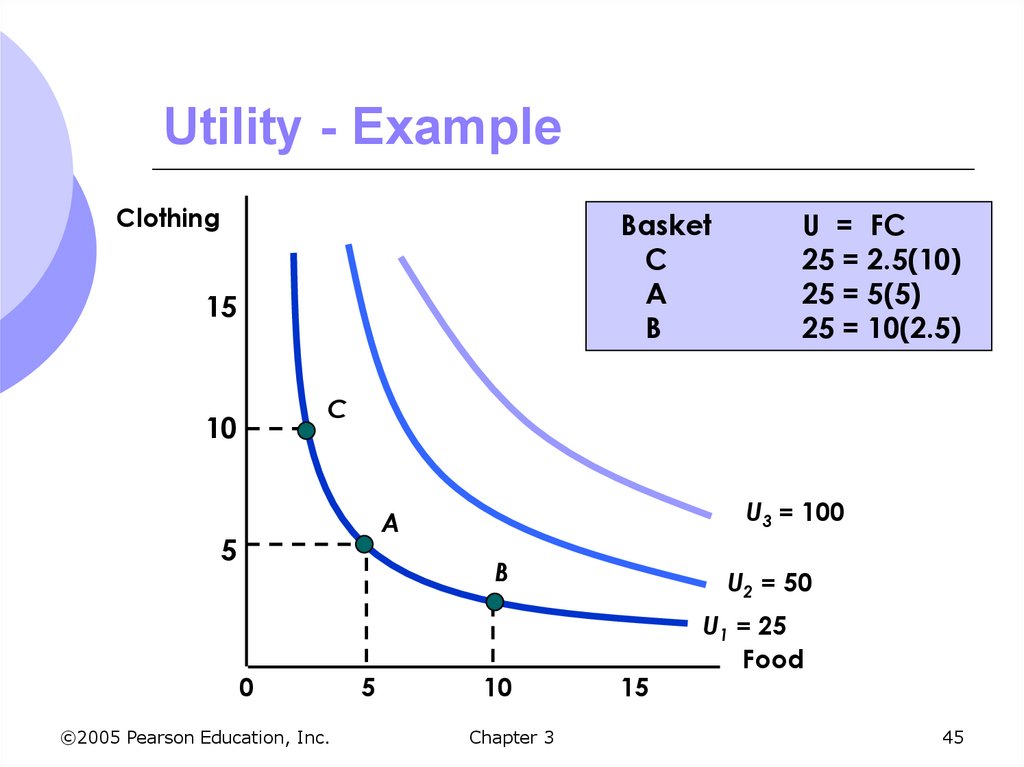
44. Utility - Example
Baskets for each level of utility can beplotted to get an indifference curve
To find the indifference curve for a utility of
14, we can change the combinations of food
and clothing that give us a utility of 14
©2005 Pearson Education, Inc.
Chapter 3
44
45. Utility - Example
ClothingBasket
C
A
B
15
U = FC
25 = 2.5(10)
25 = 5(5)
25 = 10(2.5)
C
10
U3 = 100
A
5
B
0
©2005 Pearson Education, Inc.
5
10
Chapter 3
U2 = 50
15
U1 = 25
Food
45
46. Utility
Although we numerically rank basketsand indifference curves, numbers are
ONLY for ranking
A utility of 4 is not necessarily twice as
good as a utility of 2
There are two types of rankings
Ordinal ranking
Cardinal ranking
©2005 Pearson Education, Inc.
Chapter 3
46
47. Utility
Ordinal Utility FunctionPlaces market baskets in the order of most
preferred to least preferred, but it does not
indicate how much one market basket is
preferred to another
Cardinal Utility Function
Utility function describing the extent to which
one market basket is preferred to another
©2005 Pearson Education, Inc.
Chapter 3
47
48. Utility
The actual unit of measurement for utilityis not important
An ordinal ranking is sufficient to explain
how most individual decisions are made
©2005 Pearson Education, Inc.
Chapter 3
48
49. Budget Constraints
Preferences do not explain all ofconsumer behavior
Budget constraints also limit an
individual’s ability to consume in light of
the prices they must pay for various
goods and services
©2005 Pearson Education, Inc.
Chapter 3
49
50. Budget Constraints
The Budget LineIndicates all combinations of two
commodities for which total money spent
equals total income
We assume only 2 goods are consumed, so
we do not consider savings
©2005 Pearson Education, Inc.
Chapter 3
50
51. The Budget Line
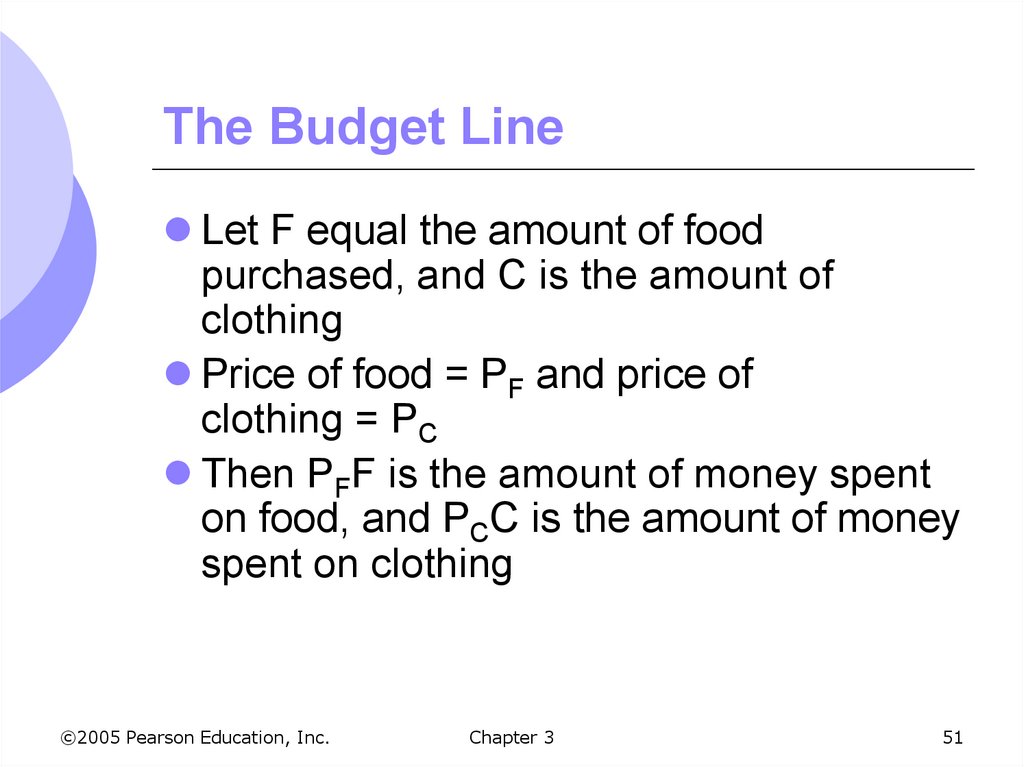
Let F equal the amount of foodpurchased, and C is the amount of
clothing
Price of food = PF and price of
clothing = PC
Then PFF is the amount of money spent
on food, and PCC is the amount of money
spent on clothing
©2005 Pearson Education, Inc.
Chapter 3
51
52. The Budget Line
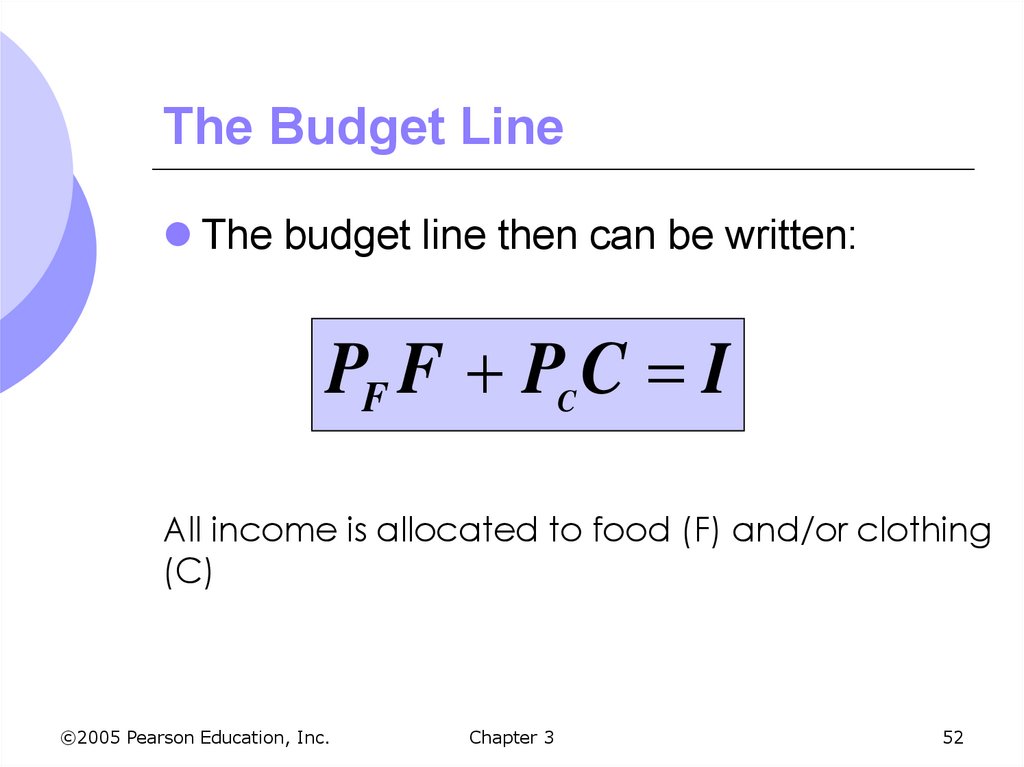
The budget line then can be written:PF F PC C I
All income is allocated to food (F) and/or clothing
(C)
©2005 Pearson Education, Inc.
Chapter 3
52
53. The Budget Line
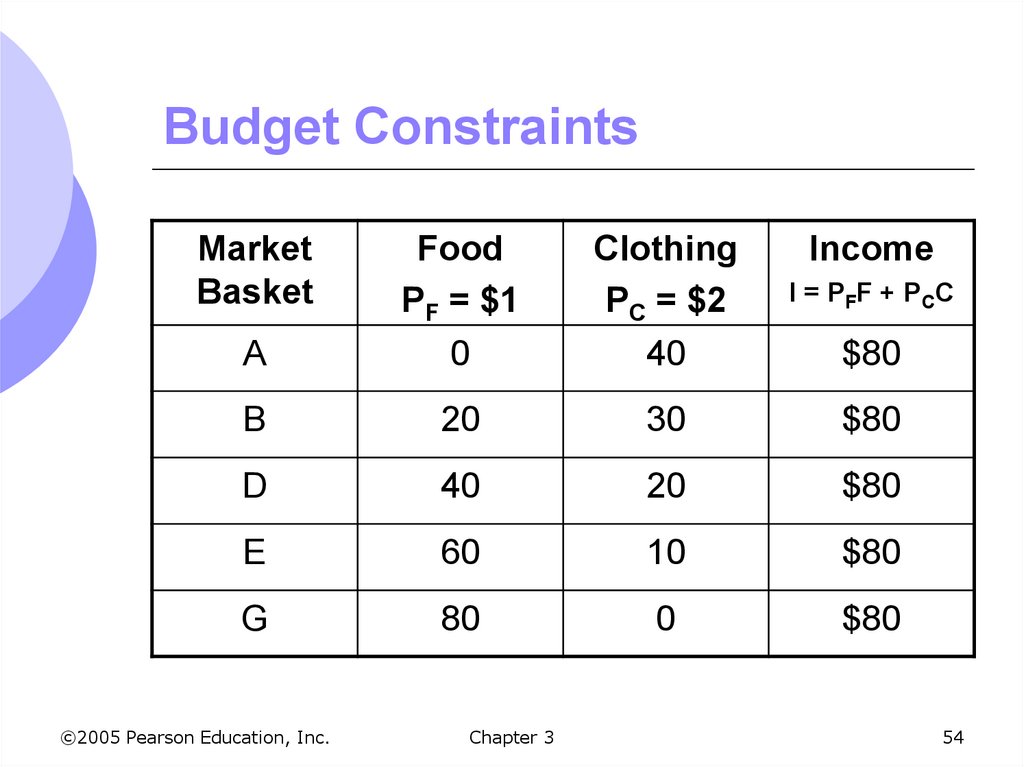
Different choices of food and clothing canbe calculated that use all income
These choices can be graphed as the budget
line
Example:
Assume income of $80/week, PF = $1 and PC
= $2
©2005 Pearson Education, Inc.
Chapter 3
53
54. Budget Constraints
MarketBasket
Clothing
PC = $2
40
I = PFF + PCC
A
Food
PF = $1
0
B
20
30
$80
D
40
20
$80
E
60
10
$80
G
80
0
$80
©2005 Pearson Education, Inc.
Chapter 3
Income
$80
54
55. The Budget Line
Clothing(I/PC) = 40
A
C
1
PF
Slope
- F
2
PC
B
30
10
20
D
20
E
10
G
0
20
©2005 Pearson Education, Inc.
40
60
Chapter 3
80 = (I/PF)
Food
55
56. The Budget Line
As consumption moves along a budgetline from the intercept, the consumer
spends less on one item and more on the
other
The slope of the line measures the
relative cost of food and clothing
The slope is the negative of the ratio of
the prices of the two goods
©2005 Pearson Education, Inc.
Chapter 3
56
57. The Budget Line
The slope indicates the rate at which thetwo goods can be substituted without
changing the amount of money spent
We can rearrange the budget line
equation to make this more clear
©2005 Pearson Education, Inc.
Chapter 3
57
58. The Budget Line
I PX X PY YI PX X PY Y
I PX
X Y
PY PY
©2005 Pearson Education, Inc.
Chapter 3
58
59. Budget Constraints
The Budget LineThe vertical intercept, I/PC, illustrates the
maximum amount of C that can be
purchased with income I
The horizontal intercept, I/PF, illustrates the
maximum amount of F that can be
purchased with income I
©2005 Pearson Education, Inc.
Chapter 3
59
60. The Budget Line
As we know, income and prices canchange
As incomes and prices change, there are
changes in budget lines
We can show the effects of these
changes on budget lines and consumer
choices
©2005 Pearson Education, Inc.
Chapter 3
60
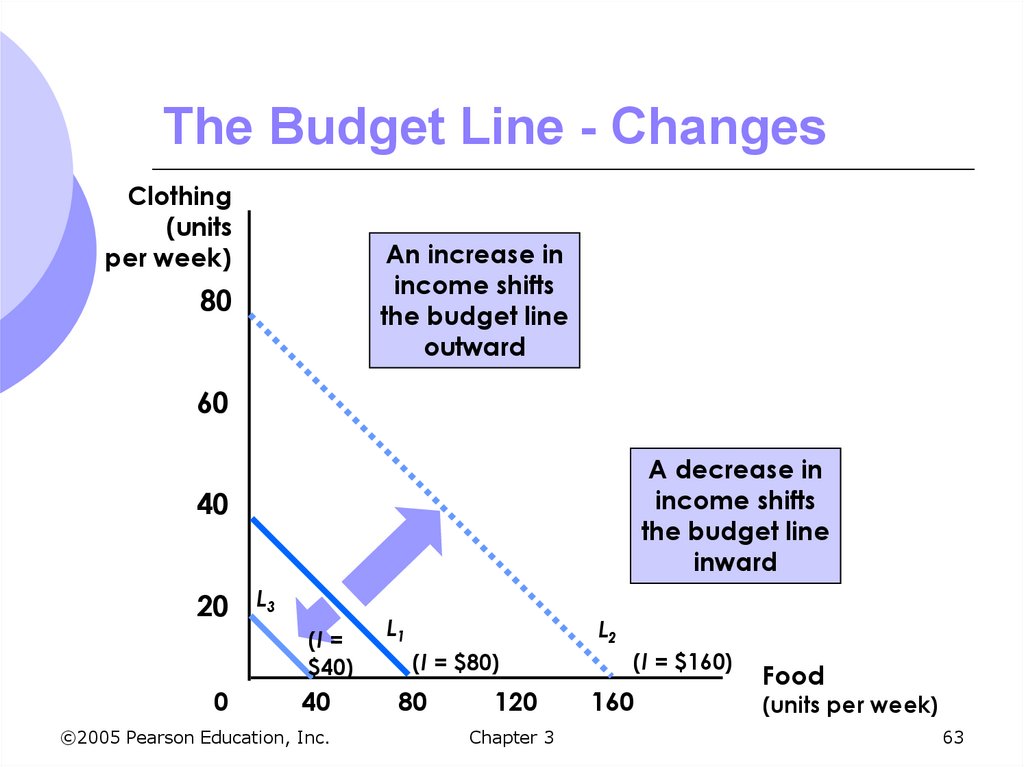
61. The Budget Line - Changes
The Effects of Changes in IncomeAn increase in income causes the budget
line to shift outward, parallel to the original
line (holding prices constant).
Can buy more of both goods with more
income
©2005 Pearson Education, Inc.
Chapter 3
61
62. The Budget Line - Changes
The Effects of Changes in IncomeA decrease in income causes the budget line
to shift inward, parallel to the original line
(holding prices constant)
Can buy less of both goods with less income
©2005 Pearson Education, Inc.
Chapter 3
62
63. The Budget Line - Changes
Clothing(units
per week)
An increase in
income shifts
the budget line
outward
80
60
A decrease in
income shifts
the budget line
inward
40
20
0
L3
(I =
$40)
L1
40
80
©2005 Pearson Education, Inc.
L2
(I = $80)
120
Chapter 3
(I = $160)
160
Food
(units per week)
63
64. The Budget Line - Changes
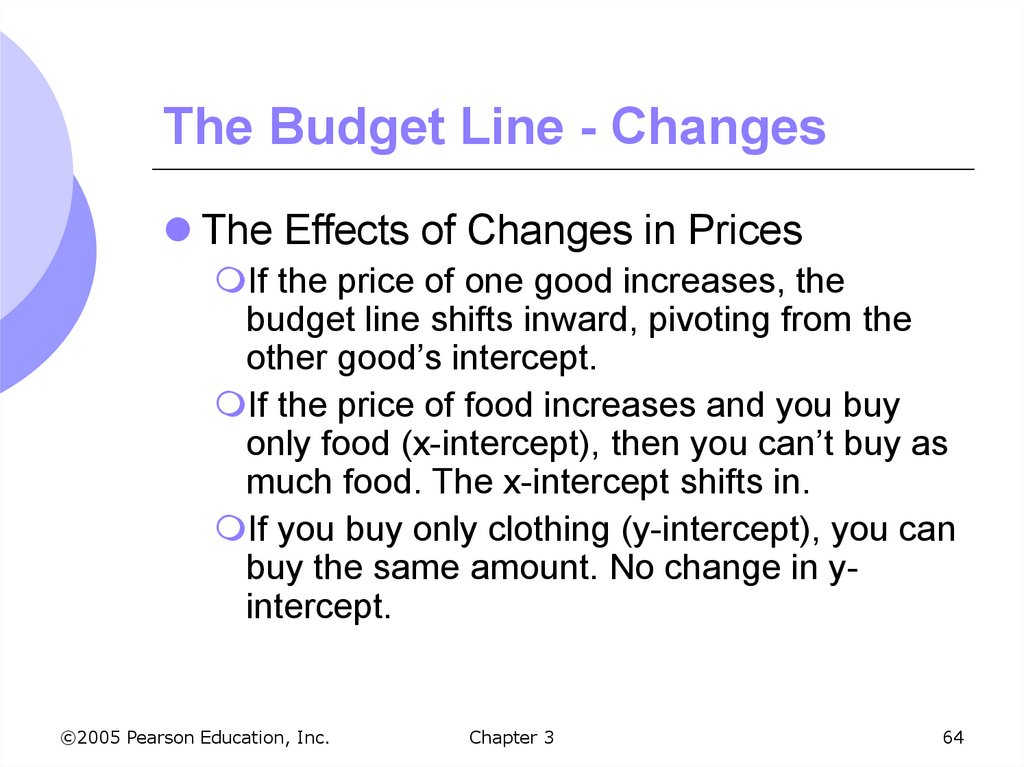
The Effects of Changes in PricesIf the price of one good increases, the
budget line shifts inward, pivoting from the
other good’s intercept.
If the price of food increases and you buy
only food (x-intercept), then you can’t buy as
much food. The x-intercept shifts in.
If you buy only clothing (y-intercept), you can
buy the same amount. No change in yintercept.
©2005 Pearson Education, Inc.
Chapter 3
64
65. The Budget Line - Changes
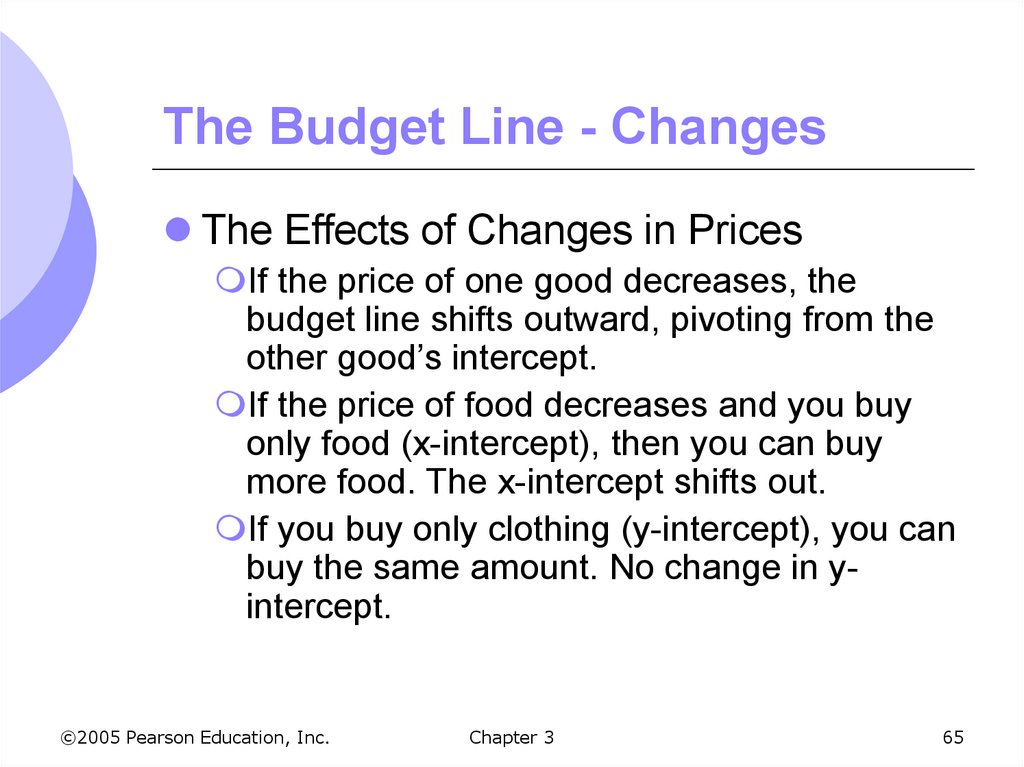
The Effects of Changes in PricesIf the price of one good decreases, the
budget line shifts outward, pivoting from the
other good’s intercept.
If the price of food decreases and you buy
only food (x-intercept), then you can buy
more food. The x-intercept shifts out.
If you buy only clothing (y-intercept), you can
buy the same amount. No change in yintercept.
©2005 Pearson Education, Inc.
Chapter 3
65
66. The Budget Line - Changes
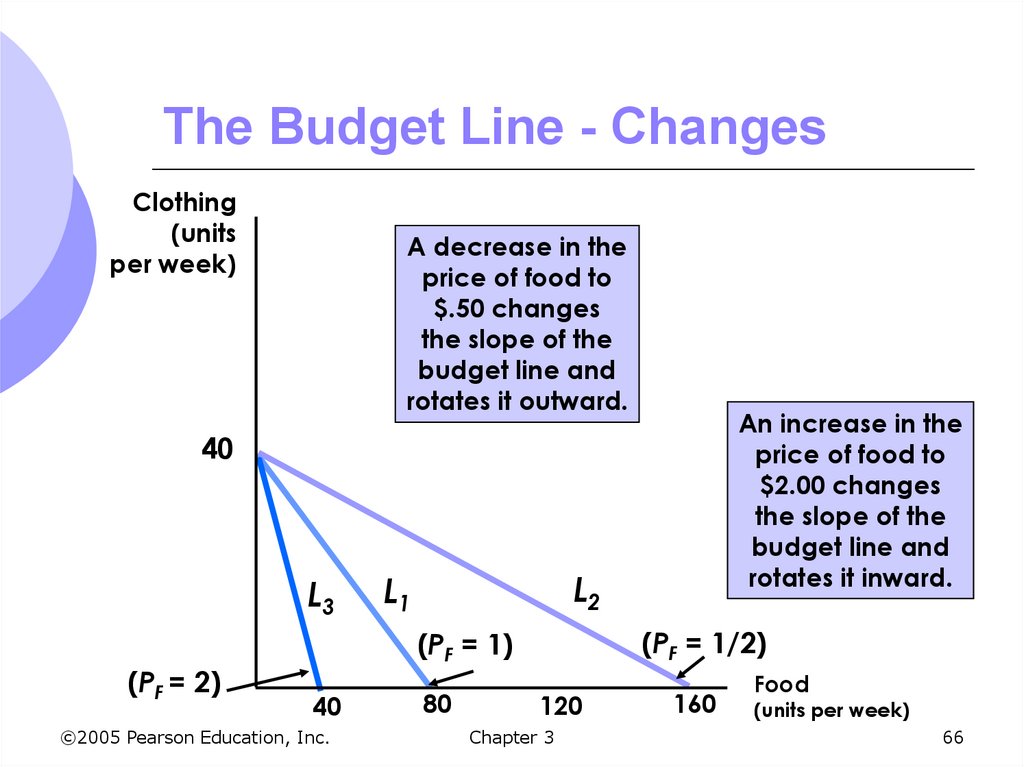
Clothing(units
per week)
A decrease in the
price of food to
$.50 changes
the slope of the
budget line and
rotates it outward.
An increase in the
price of food to
$2.00 changes
the slope of the
budget line and
rotates it inward.
40
L3
(PF = 2)
L2
L1
(PF = 1/2)
(PF = 1)
40
©2005 Pearson Education, Inc.
80
120
Chapter 3
160
Food
(units per week)
66
67. The Budget Line - Changes
The Effects of Changes in PricesIf the two goods increase in price, but the
ratio of the two prices is unchanged, the
slope will not change
However, the budget line will shift inward
parallel to the original budget line
©2005 Pearson Education, Inc.
Chapter 3
67
68. The Budget Line - Changes
The Effects of Changes in PricesIf the two goods decrease in price, but the
ratio of the two prices is unchanged, the
slope will not change
However, the budget line will shift outward
parallel to the original budget line
©2005 Pearson Education, Inc.
Chapter 3
68
69. Consumer Choice
Given preferences and budgetconstraints, how do consumers choose
what to buy?
Consumers choose a combination of
goods that will maximize their
satisfaction, given the limited budget
available to them
©2005 Pearson Education, Inc.
Chapter 3
69
70. Consumer Choice
The maximizing market basket mustsatisfy two conditions:
1. It must be located on the budget line
They spend all their income – more is better
2. It must give the consumer the most
preferred combination of goods and
services
©2005 Pearson Education, Inc.
Chapter 3
70
71. Consumer Choice
Graphically, we can see differentindifference curves of a consumer
choosing between clothing and food
Remember that U3 > U2 > U1 for our
indifference curves
Consumer wants to choose highest utility
within their budget
©2005 Pearson Education, Inc.
Chapter 3
71
72. Consumer Choice
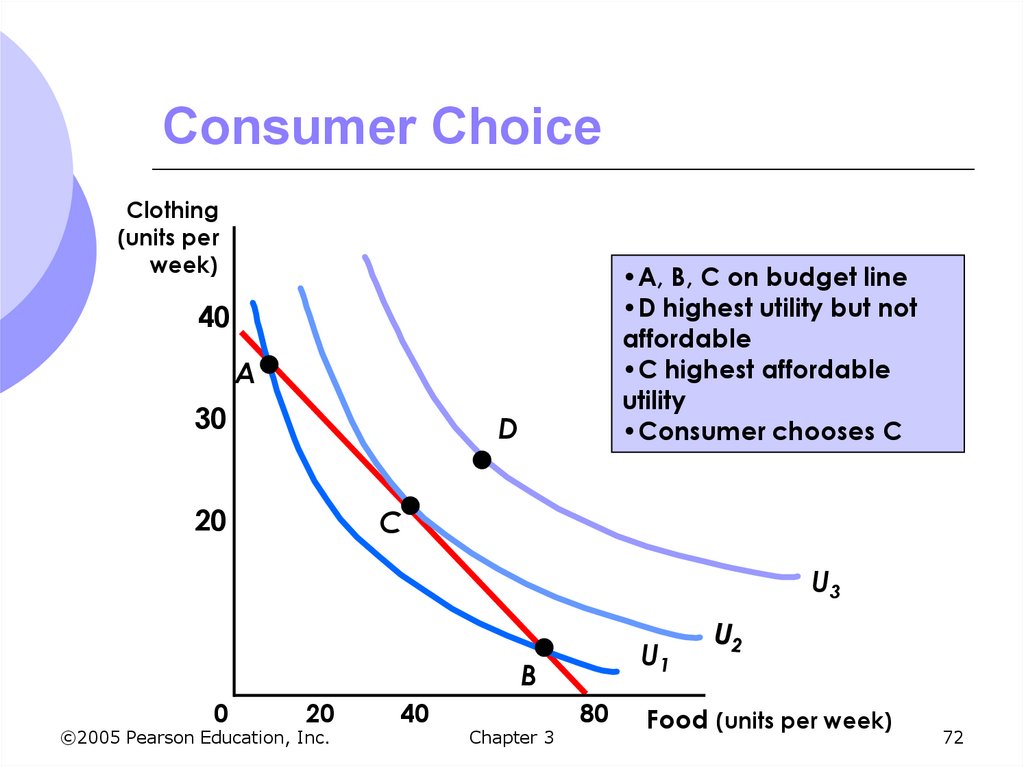
Clothing(units per
week)
•A, B, C on budget line
•D highest utility but not
affordable
•C highest affordable
utility
•Consumer chooses C
40
A
30
D
20
C
U3
U1
B
0
20
©2005 Pearson Education, Inc.
40
Chapter 3
80
Food (units per week)
72
73. Consumer Choice
Consumer will choose highestindifference curve on budget line
In previous graph, point C is where the
indifference curve is just tangent to the
budget line
Slope of the budget line equals the slope
of the indifference curve at this point
©2005 Pearson Education, Inc.
Chapter 3
73
74. Consumer Choice
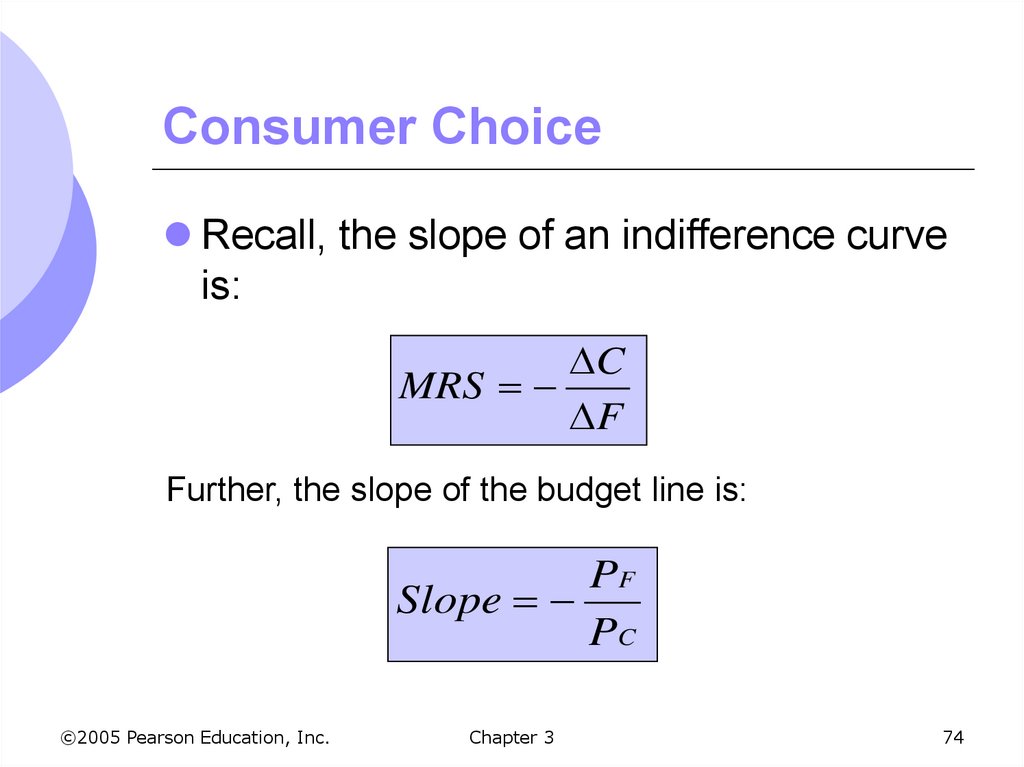
Recall, the slope of an indifference curveis:
C
MRS
F
Further, the slope of the budget line is:
PF
Slope
PC
©2005 Pearson Education, Inc.
Chapter 3
74
75. Consumer Choice
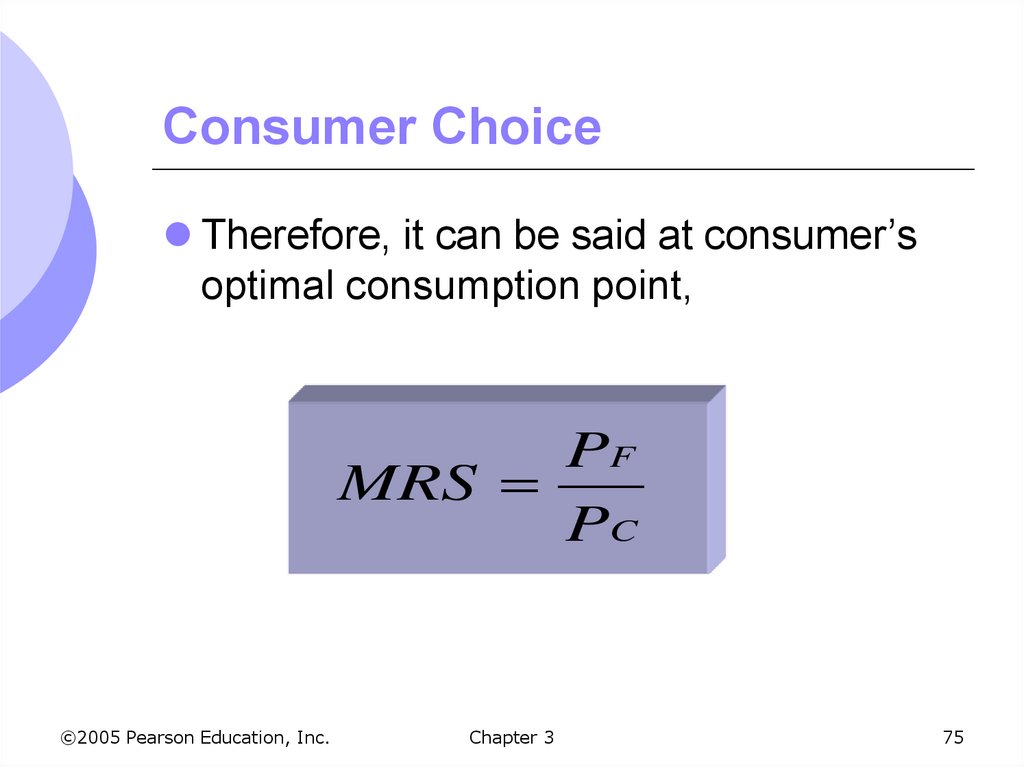
Therefore, it can be said at consumer’soptimal consumption point,
PF
MRS
PC
©2005 Pearson Education, Inc.
Chapter 3
75
76. Consumer Choice
It can be said that satisfaction ismaximized when marginal rate of
substitution (of F and C) is equal to the
ratio of the prices (of F and C)
Note this is ONLY true at the optimal
consumption point
©2005 Pearson Education, Inc.
Chapter 3
76
77. Consumer Choice
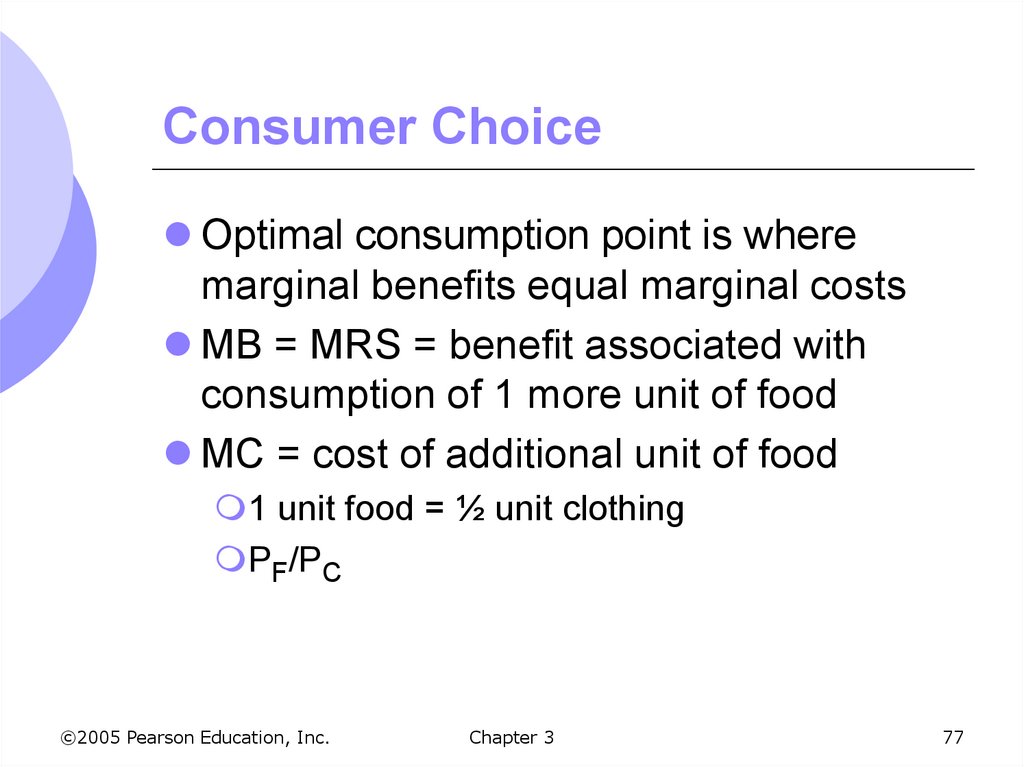
Optimal consumption point is wheremarginal benefits equal marginal costs
MB = MRS = benefit associated with
consumption of 1 more unit of food
MC = cost of additional unit of food
1 unit food = ½ unit clothing
PF/PC
©2005 Pearson Education, Inc.
Chapter 3
77
78. Consumer Choice
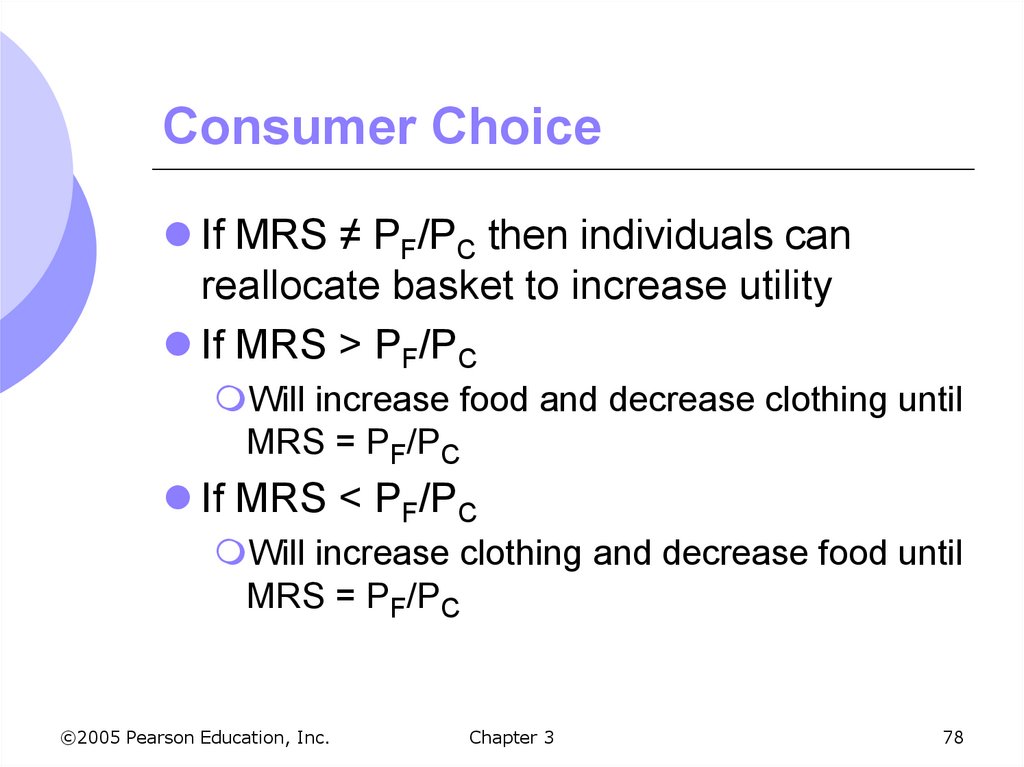
If MRS ≠ PF/PC then individuals canreallocate basket to increase utility
If MRS > PF/PC
Will increase food and decrease clothing until
MRS = PF/PC
If MRS < PF/PC
Will increase clothing and decrease food until
MRS = PF/PC
©2005 Pearson Education, Inc.
Chapter 3
78
79. Consumer Choice
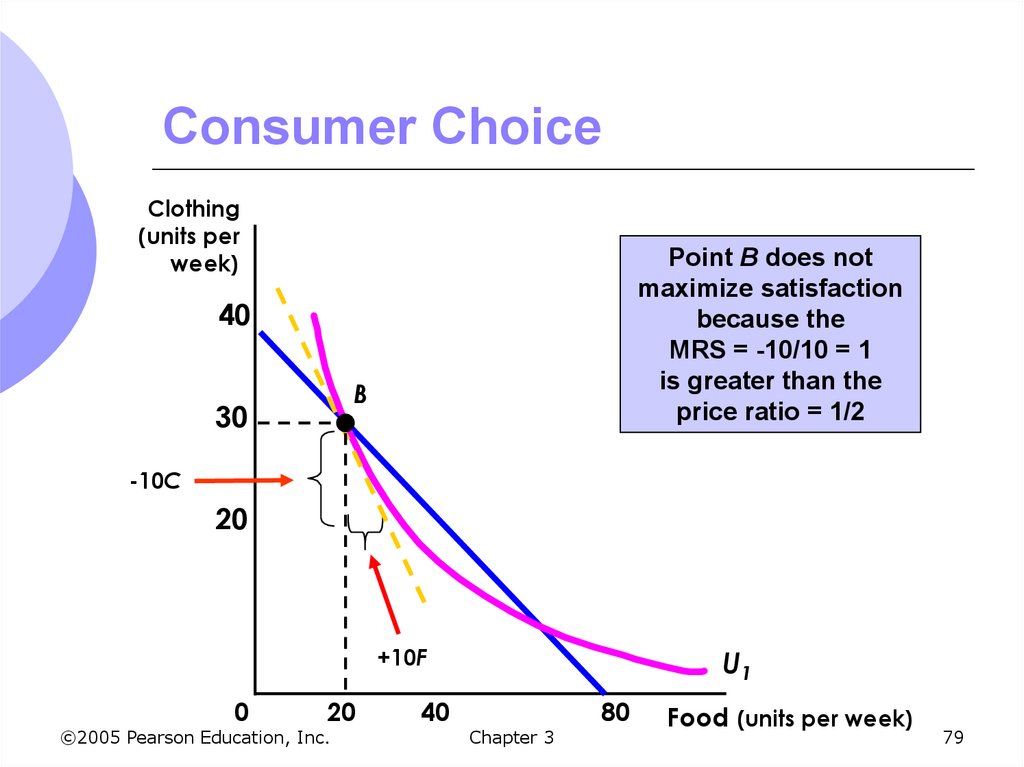
Clothing(units per
week)
Point B does not
maximize satisfaction
because the
MRS = -10/10 = 1
is greater than the
price ratio = 1/2
40
B
30
-10C
20
+10F
0
20
©2005 Pearson Education, Inc.
40
U1
Chapter 3
80
Food (units per week)
79
80. Consumer Choice: An Application Revisited
Consider two groups of consumers, eachwishing to spend $10,000 on the styling
and performance of a car
Each group has different preferences
©2005 Pearson Education, Inc.
Chapter 3
80
81. Consumer Choice: An Application Revisited
By finding the point of tangency betweena group’s indifference curve and the
budget constraint, auto companies can
see how much consumers value each
attribute
©2005 Pearson Education, Inc.
Chapter 3
81
82. Consumer Choice: An Application Revisited
Styling$10,000
These consumers
want performance
worth $7000 and styling
worth $3000
$3,000
$7,000
©2005 Pearson Education, Inc.
Chapter 3
$10,000 Performance
82
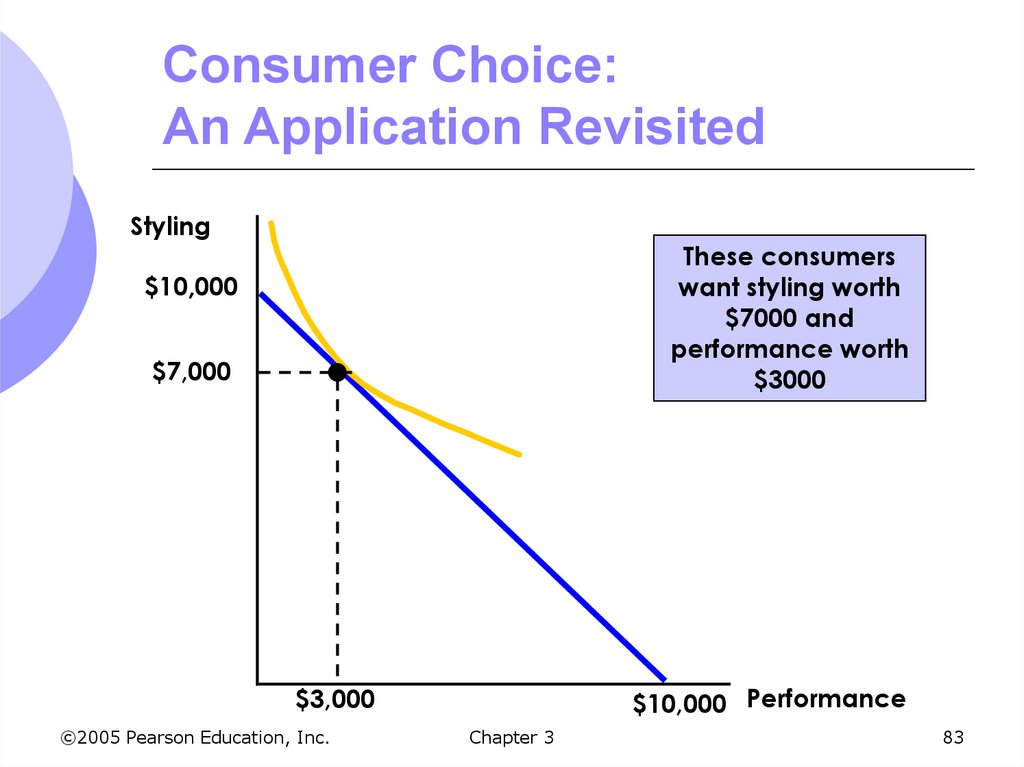
83. Consumer Choice: An Application Revisited
StylingThese consumers
want styling worth
$7000 and
performance worth
$3000
$10,000
$7,000
$10,000 Performance
$3,000
©2005 Pearson Education, Inc.
Chapter 3
83
84. Consumer Choice: An Application Revisited
Once a company knows preferences, itcan design a production and marketing
plan
Company can then make a sensible
strategic business decision on how to
allocate performance and styling on new
cars
©2005 Pearson Education, Inc.
Chapter 3
84
85. Consumer Choice
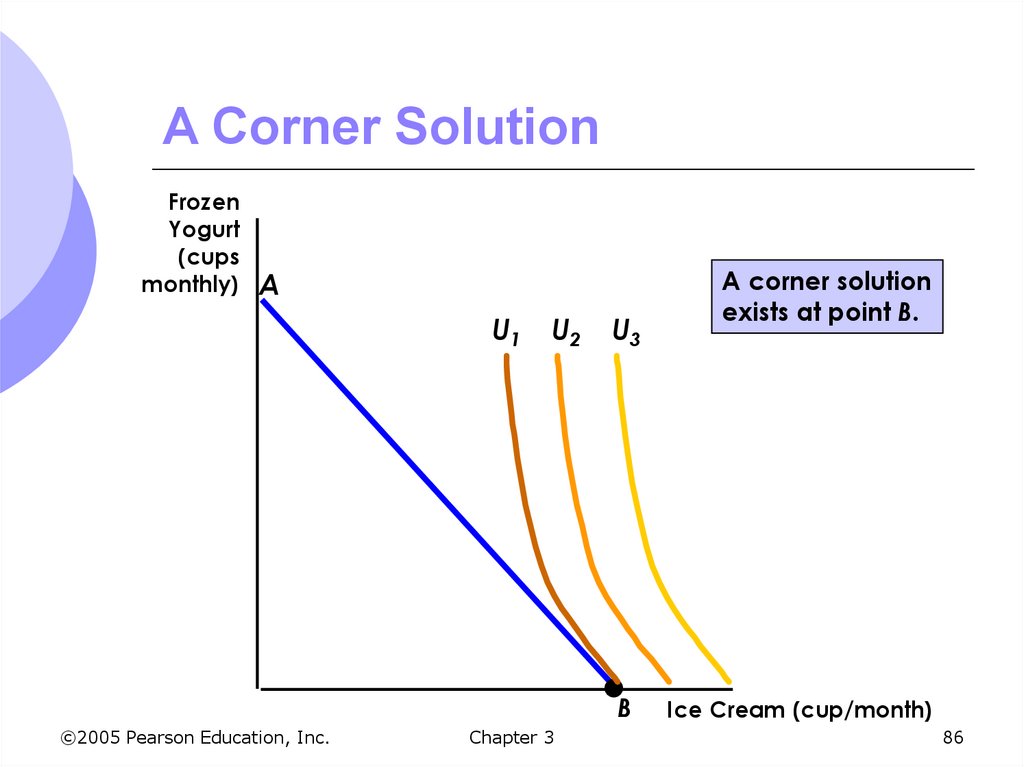
A corner solution exists if a consumerbuys in extremes, and buys all of one
category of good and none of another
MRS is not necessarily equal to PA/PB
©2005 Pearson Education, Inc.
Chapter 3
85
86. A Corner Solution
FrozenYogurt
(cups
monthly)
A
U1
U2
U3
B
©2005 Pearson Education, Inc.
Chapter 3
A corner solution
exists at point B.
Ice Cream (cup/month)
86
87. A Corner Solution
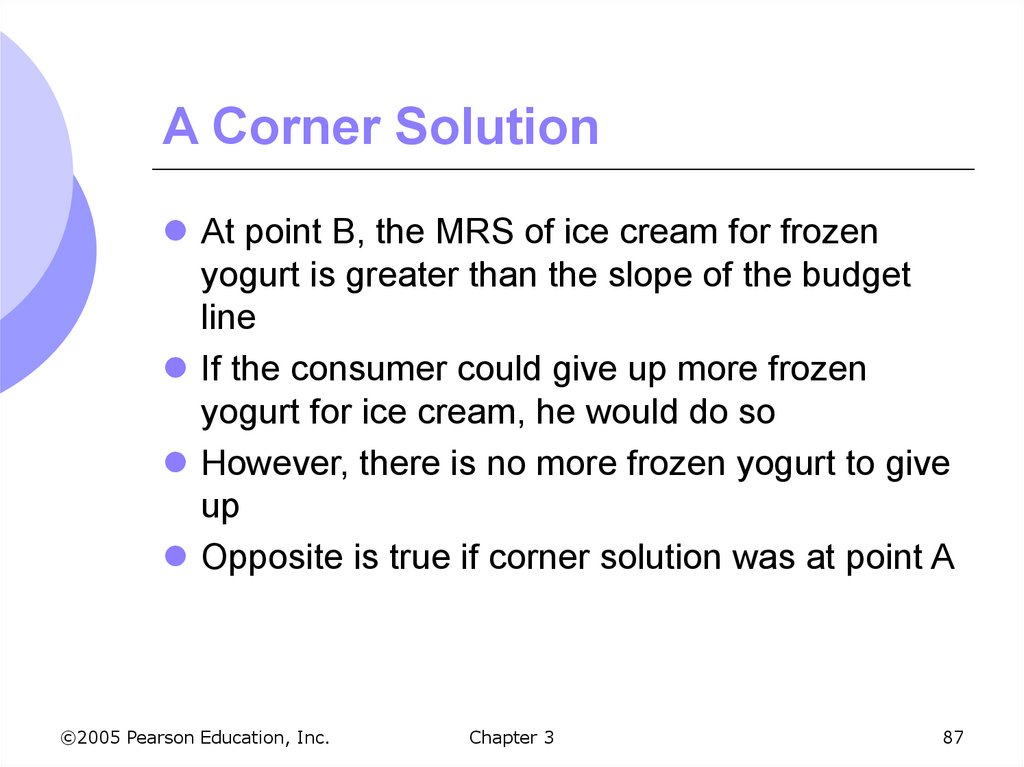
At point B, the MRS of ice cream for frozenyogurt is greater than the slope of the budget
line
If the consumer could give up more frozen
yogurt for ice cream, he would do so
However, there is no more frozen yogurt to give
up
Opposite is true if corner solution was at point A
©2005 Pearson Education, Inc.
Chapter 3
87
88. A Corner Solution
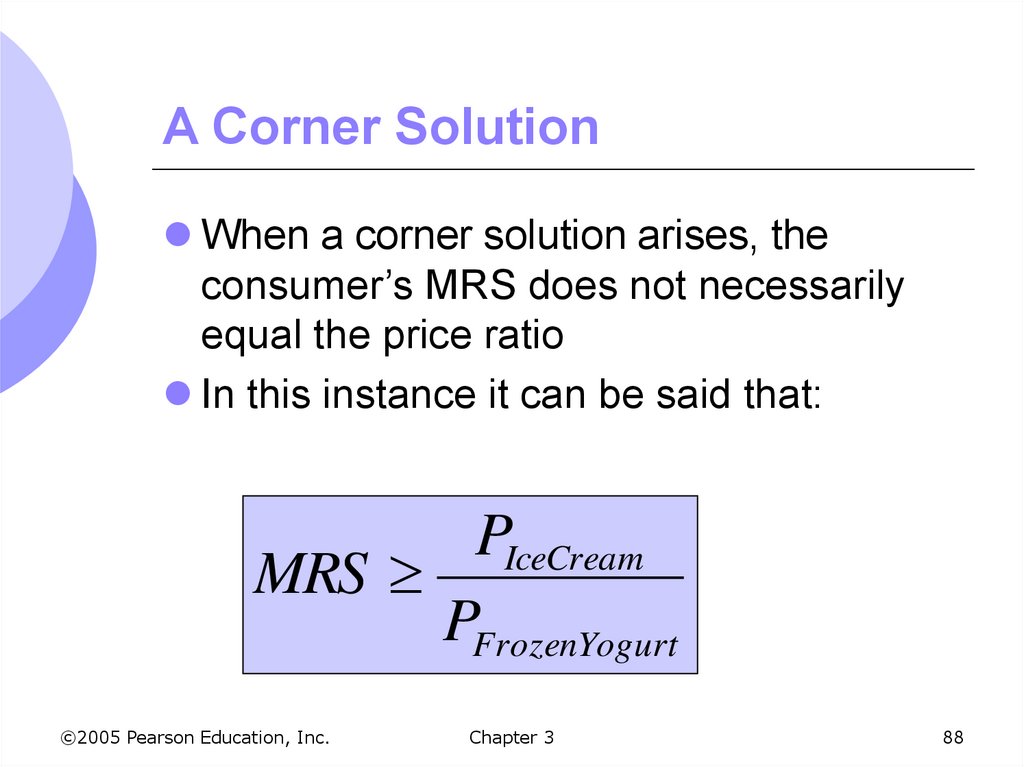
When a corner solution arises, theconsumer’s MRS does not necessarily
equal the price ratio
In this instance it can be said that:
PIceCream
MRS
PFrozenYogurt
©2005 Pearson Education, Inc.
Chapter 3
88
89. A Corner Solution
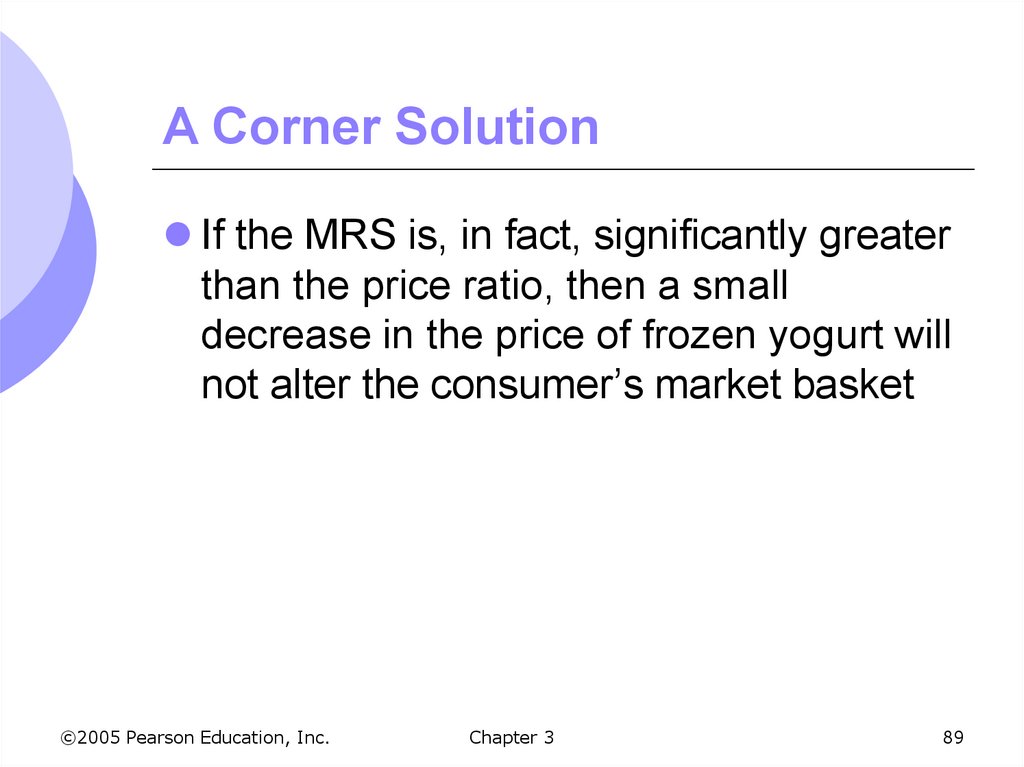
If the MRS is, in fact, significantly greaterthan the price ratio, then a small
decrease in the price of frozen yogurt will
not alter the consumer’s market basket
©2005 Pearson Education, Inc.
Chapter 3
89
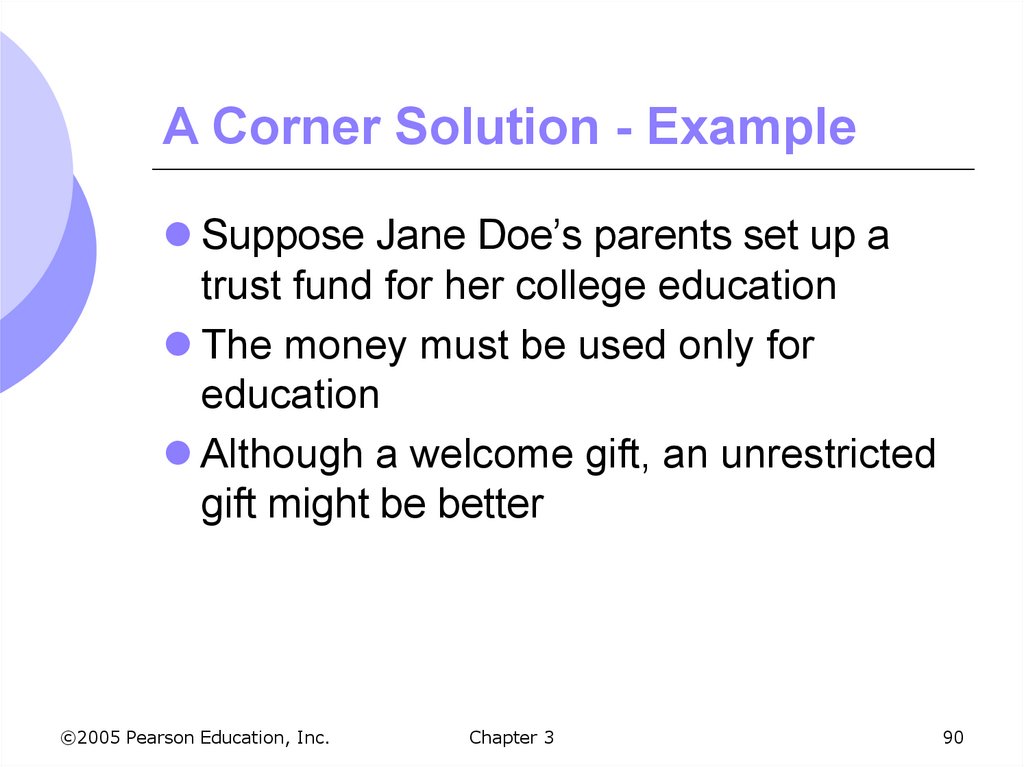
90. A Corner Solution - Example
Suppose Jane Doe’s parents set up atrust fund for her college education
The money must be used only for
education
Although a welcome gift, an unrestricted
gift might be better
©2005 Pearson Education, Inc.
Chapter 3
90
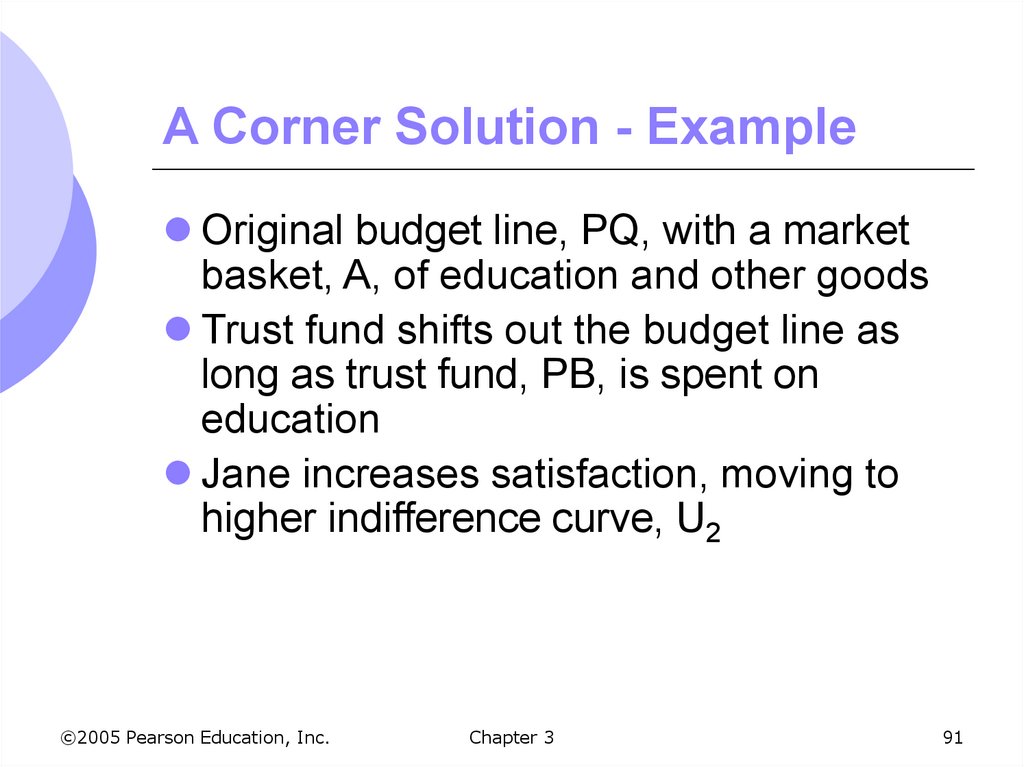
91. A Corner Solution - Example
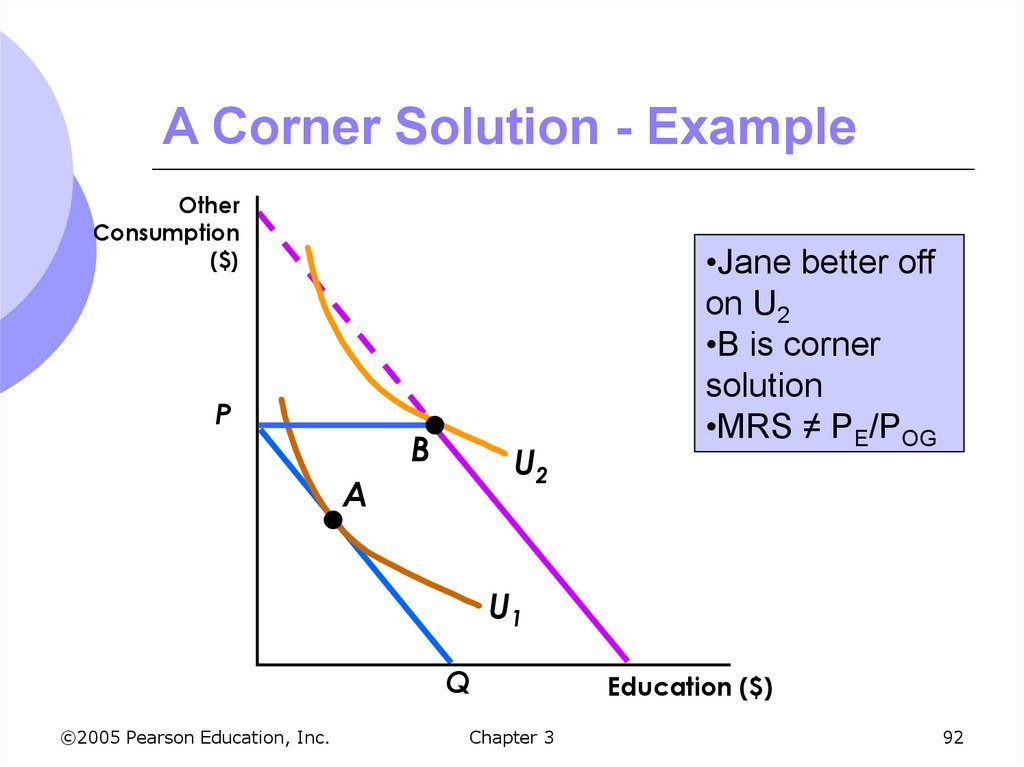
Original budget line, PQ, with a marketbasket, A, of education and other goods
Trust fund shifts out the budget line as
long as trust fund, PB, is spent on
education
Jane increases satisfaction, moving to
higher indifference curve, U2
©2005 Pearson Education, Inc.
Chapter 3
91
92. A Corner Solution - Example
OtherConsumption
($)
P
B
U2
A
•Jane better off
on U2
•B is corner
solution
•MRS ≠ PE/POG
U1
Q
©2005 Pearson Education, Inc.
Chapter 3
Education ($)
92
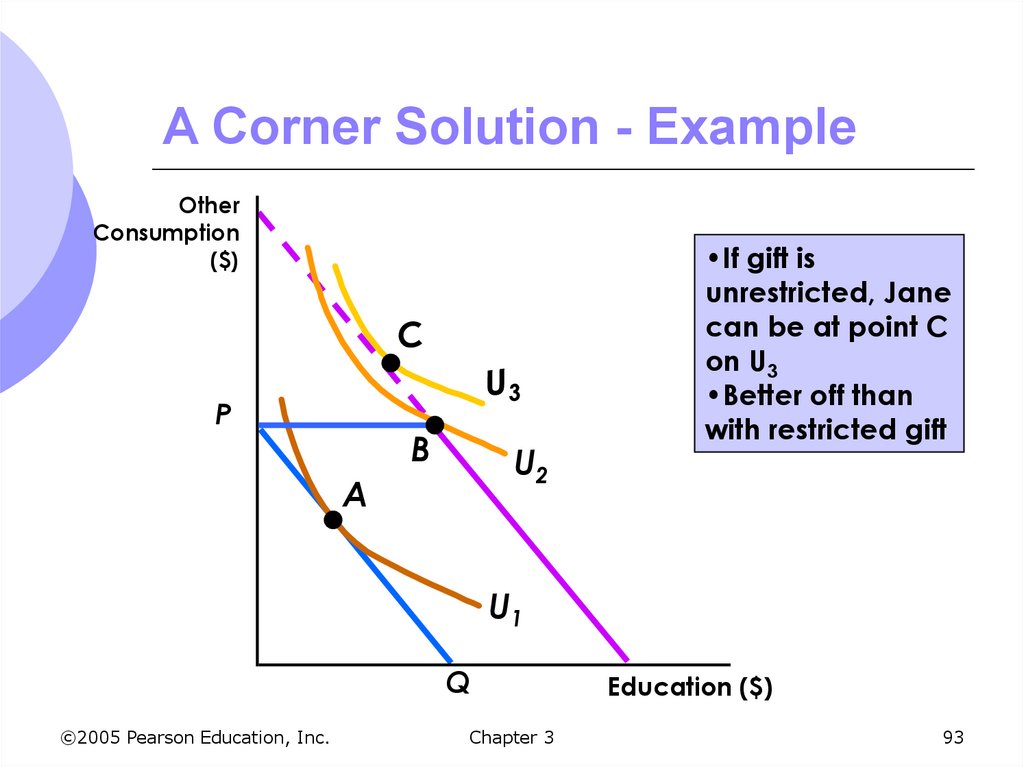
93. A Corner Solution - Example
OtherConsumption
($)
P
B
U2
A
•If gift is
unrestricted, Jane
can be at point C
on U3
•Better off than
with restricted gift
U1
Q
©2005 Pearson Education, Inc.
Chapter 3
Education ($)
93
94. Revealed Preferences
If we know the choices a consumer hasmade, we can determine what their
preferences are if we have information
about a sufficient number of choices that
are made when prices and incomes vary.
©2005 Pearson Education, Inc.
Chapter 3
94
95. Revealed Preferences – Two Budget Lines
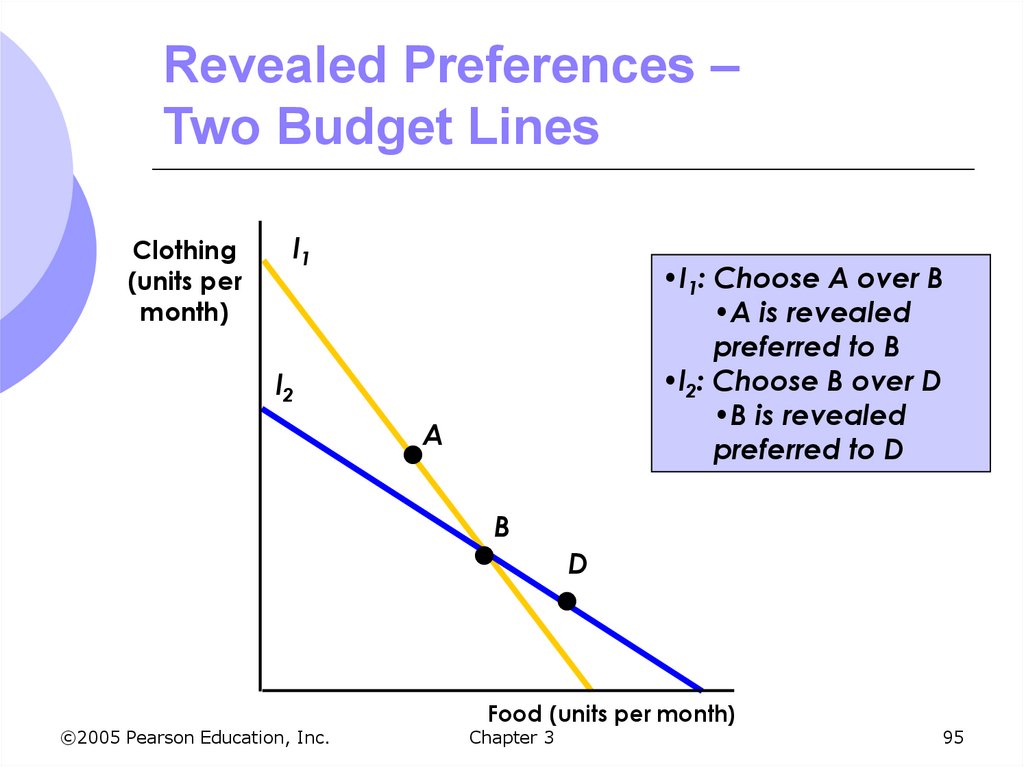
Clothing(units per
month)
l1
•I1: Choose A over B
•A is revealed
preferred to B
•l2: Choose B over D
•B is revealed
preferred to D
l2
A
B
D
©2005 Pearson Education, Inc.
Food (units per month)
Chapter 3
95
96. Revealed Preferences – Two Budget Lines
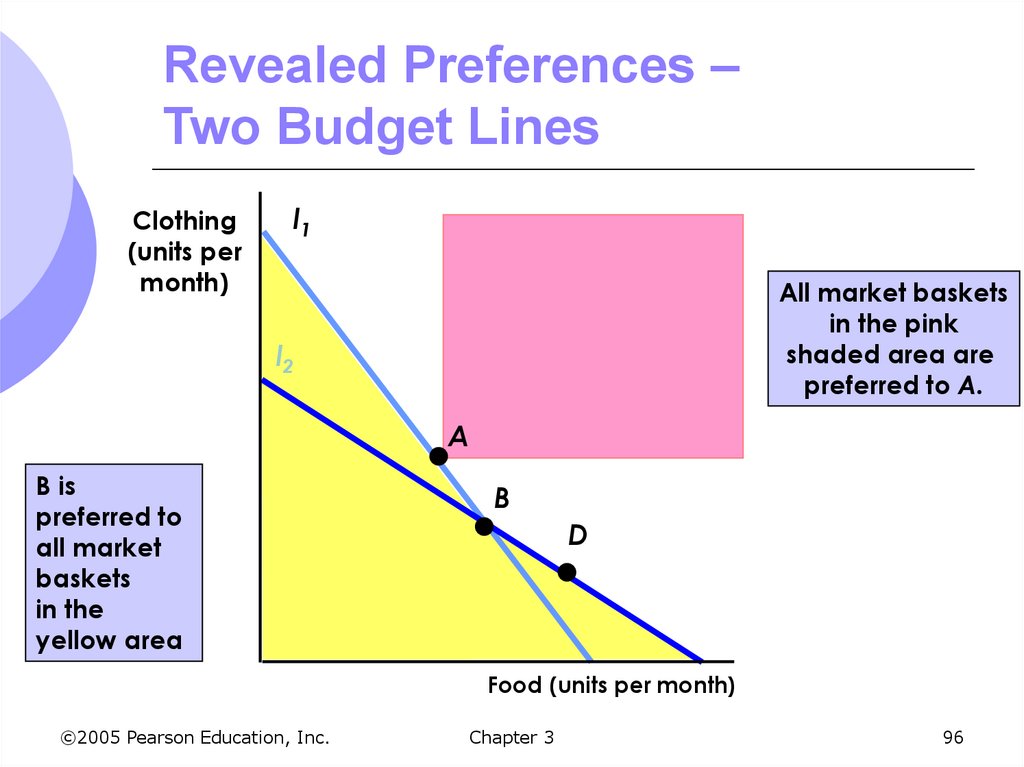
Clothing(units per
month)
l1
All market baskets
in the pink
shaded area are
preferred to A.
l2
A
B is
preferred to
all market
baskets
in the
yellow area
B
D
Food (units per month)
©2005 Pearson Education, Inc.
Chapter 3
96
97. Revealed Preference
As you continue to change the budgetline, individuals can tell you which basket
they prefer to others
The more the individual reveals, the more
you can discern about their preferences
Eventually you can map out an
indifference curve
©2005 Pearson Education, Inc.
Chapter 3
97
98. Revealed Preferences – Four Budget Lines
I3: E revealed preferred to AClothing
(units per
month)
l3
l1
All market baskets in the
pink area preferred to A
E
l4
A
l2
B
A: preferred to all
market baskets in
the yellow area
©2005 Pearson Education, Inc.
G
I4: G revealed preferred to A
Food (units per month)
Chapter 3
98
99. Marginal Utility and Consumer Choice
Marginal utility measures the additionalsatisfaction obtained from consuming
one additional unit of a good
How much happier is the individual from
consuming one more unit of food?
©2005 Pearson Education, Inc.
Chapter 3
99
100. Marginal Utility - Example
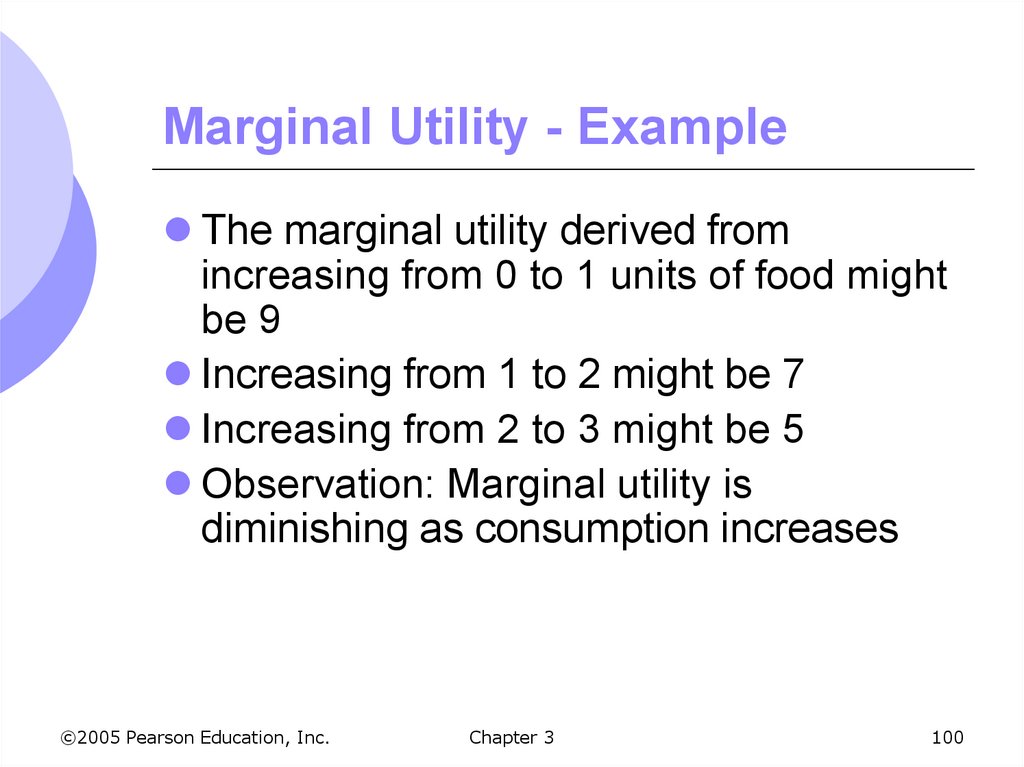
The marginal utility derived fromincreasing from 0 to 1 units of food might
be 9
Increasing from 1 to 2 might be 7
Increasing from 2 to 3 might be 5
Observation: Marginal utility is
diminishing as consumption increases
©2005 Pearson Education, Inc.
Chapter 3
100
101. Marginal Utility
The principle of diminishing marginalutility states that as more of a good is
consumed, the additional utility the
consumer gains will be smaller and
smaller
Note that total utility will continue to
increase since consumer makes choices
that make them happier
©2005 Pearson Education, Inc.
Chapter 3
101
102. Marginal Utility and Indifference Curves
As consumption moves along anindifference curve:
Additional utility derived from an increase in
the consumption one good, food (F), must
balance the loss of utility from the decrease
in the consumption in the other good,
clothing (C)
©2005 Pearson Education, Inc.
Chapter 3
102
103. Marginal Utility and Consumer Choice
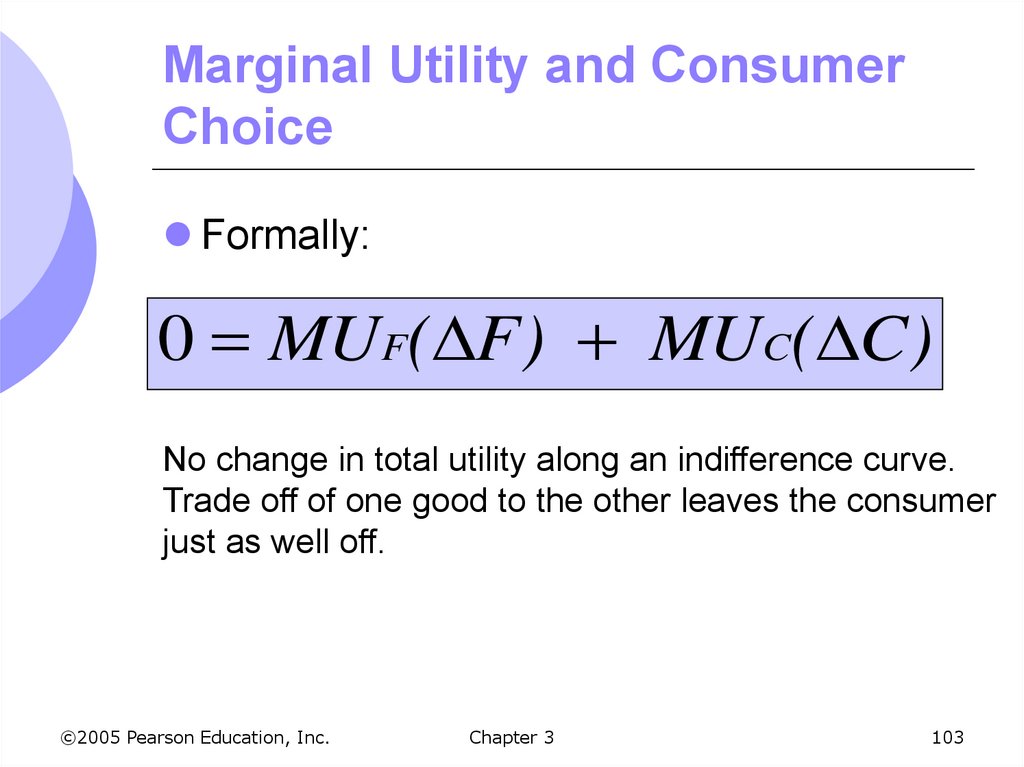
Formally:0 MUF( F) MUC( C)
No change in total utility along an indifference curve.
Trade off of one good to the other leaves the consumer
just as well off.
©2005 Pearson Education, Inc.
Chapter 3
103
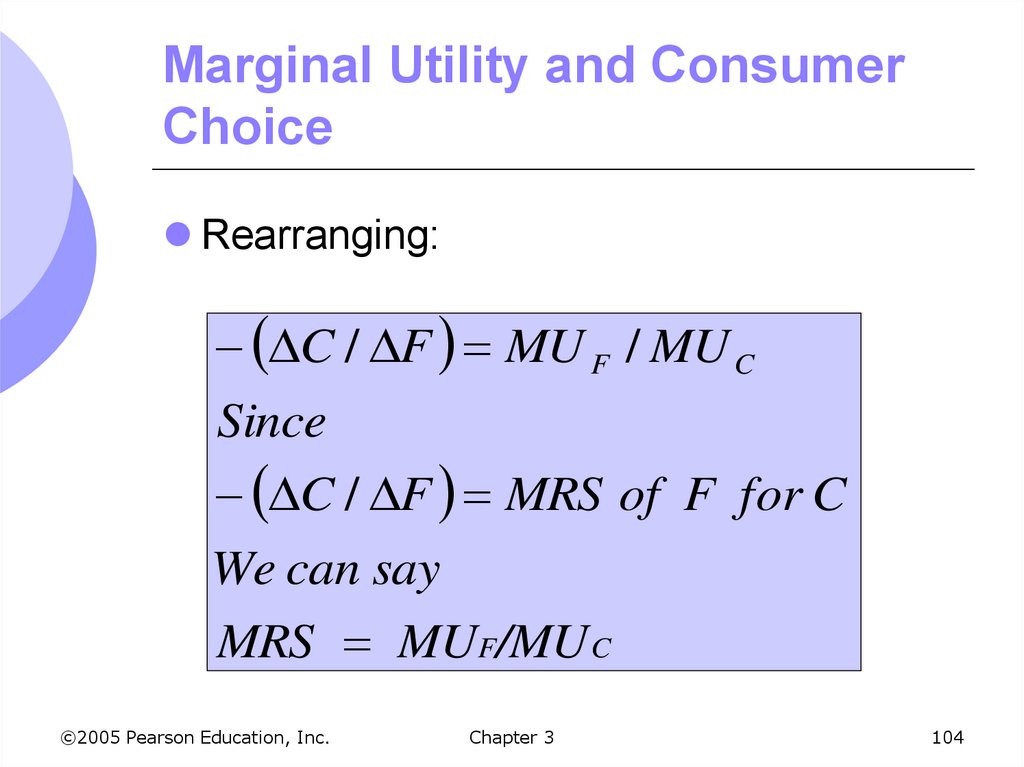
104. Marginal Utility and Consumer Choice
Rearranging:C / F MU F / MU C
Since
C / F MRS of F for C
We can say
MRS MUF/MU C
©2005 Pearson Education, Inc.
Chapter 3
104
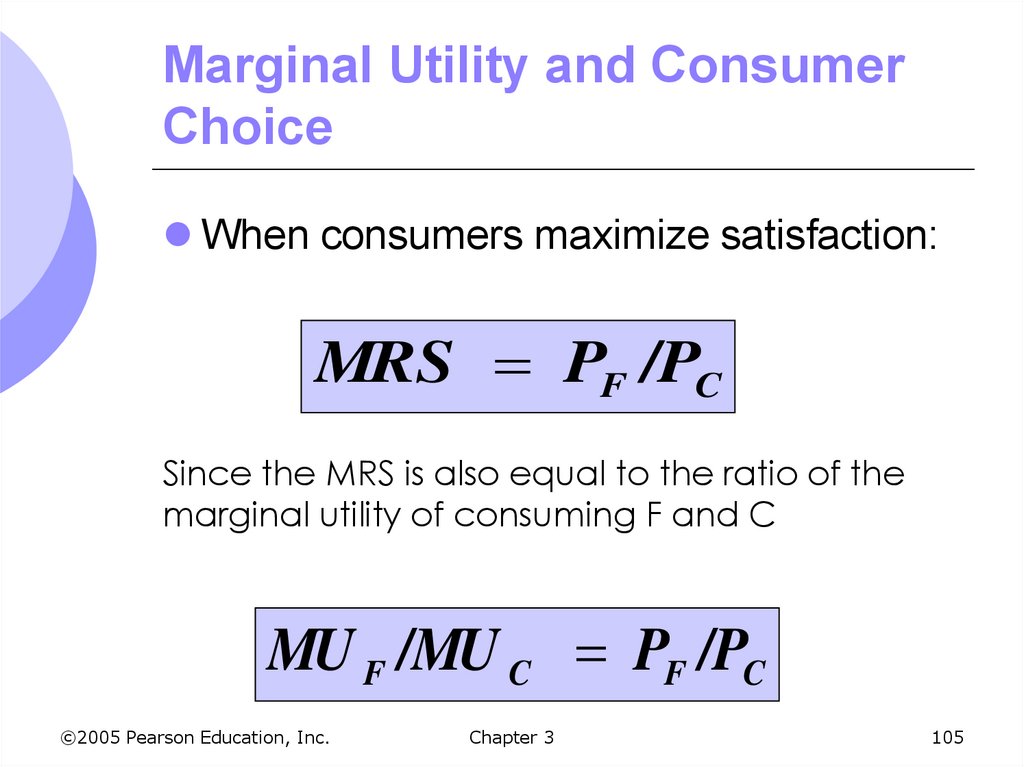
105. Marginal Utility and Consumer Choice
When consumers maximize satisfaction:MRS PF /PC
Since the MRS is also equal to the ratio of the
marginal utility of consuming F and C
MU F /MU C PF /PC
©2005 Pearson Education, Inc.
Chapter 3
105
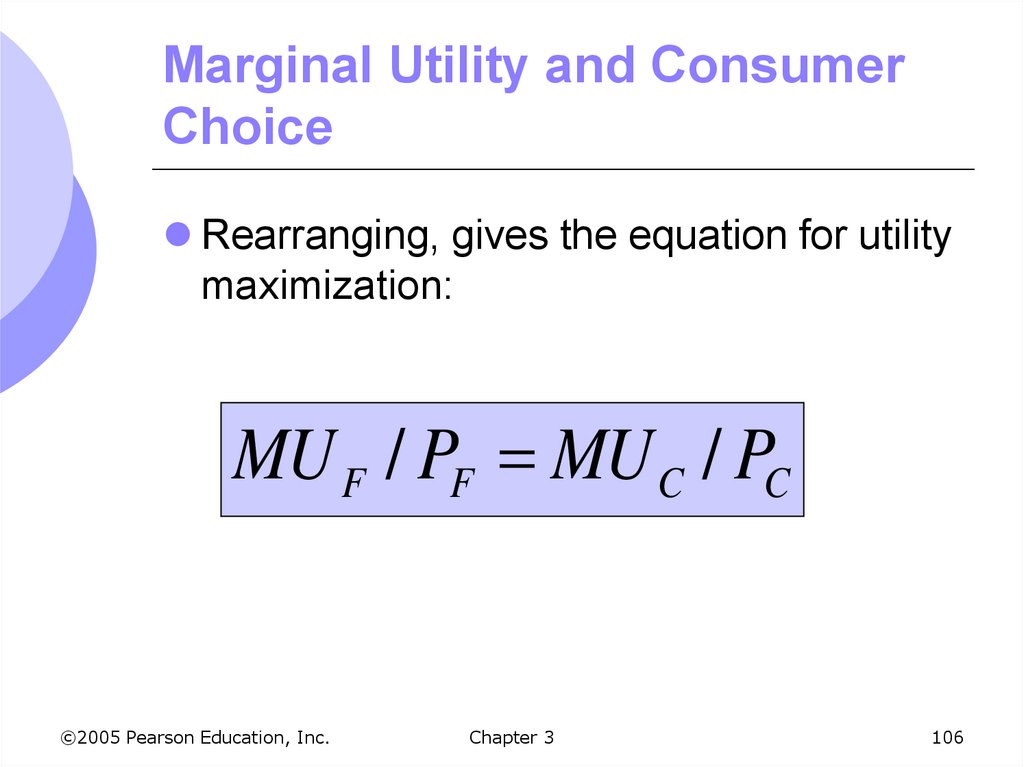
106. Marginal Utility and Consumer Choice
Rearranging, gives the equation for utilitymaximization:
MU F / PF MU C / PC
©2005 Pearson Education, Inc.
Chapter 3
106
107. Marginal Utility and Consumer Choice
Total utility is maximized when the budgetis allocated so that the marginal utility per
dollar of expenditure is the same for each
good.
This is referred to as the equal marginal
principle.
©2005 Pearson Education, Inc.
Chapter 3
107
108. Cost-of-Living Indexes
Social Security payments are given toqualifying individuals
Each year the benefit increases equal to
the rate of increase of the Consumer
Price Index (CPI)
Ratio of the present cost of typical bundle of
goods/services in comparison to the cost
during a base period
©2005 Pearson Education, Inc.
Chapter 3
108
109. Cost-of-Living Indexes
Does the CPI give a good measure ofinflation and therefore a measure of the
cost of living changes?
Should the CPI be used to measure how
much cost of living has increased,
determining increases in government
payment programs?
©2005 Pearson Education, Inc.
Chapter 3
109
110. Cost-of-Living Indexes
The ideal cost of living index representsthe cost of attaining a given level of utility
at current prices relative to the cost of
attaining the same utility at base prices
©2005 Pearson Education, Inc.
Chapter 3
110
111. Cost-of-Living Indexes
To obtain the ideal cost of living indexwould require too much information, such
as consumer preferences as well as
prices and expenditures
Actual price indexes are based on
consumer purchases, not preferences
©2005 Pearson Education, Inc.
Chapter 3
111
112. Cost-of-Living Indexes
Laspeyres price indexAmount of money at current year prices that
an individual requires to purchase a bundle
of goods/services chosen in a base year
divided by the cost of purchasing the same
bundle at base-year prices
Ex: CPI
©2005 Pearson Education, Inc.
Chapter 3
112
113. Cost-of-Living Indexes
The Laspeyres price index assumes thatconsumers do not alter their consumption
patterns as prices change
Tends to overstate the true cost of living
index
Using the CPI to adjust retirement
benefits will tend to overcompensate
most recipients, requiring greater
government expenditure
©2005 Pearson Education, Inc.
Chapter 3
113
114. Cost-of-Living Indexes
Paasche indexFocuses on the cost of buying the current
year’s bundle
Amount of money at current-year prices that
an individual requires to purchase a current
bundle of goods/services divided by the cost
of purchasing the same bundle in a base
year
©2005 Pearson Education, Inc.
Chapter 3
114
115. Cost-of-Living Indexes
Comparison of indexesBoth are fixed weight indexes
Quantities of various goods and services in
each index remain unchanged
Laspeyres index keeps quantities at base
year levels
Paasche index keeps unchanged quantities
at current year levels
©2005 Pearson Education, Inc.
Chapter 3
115
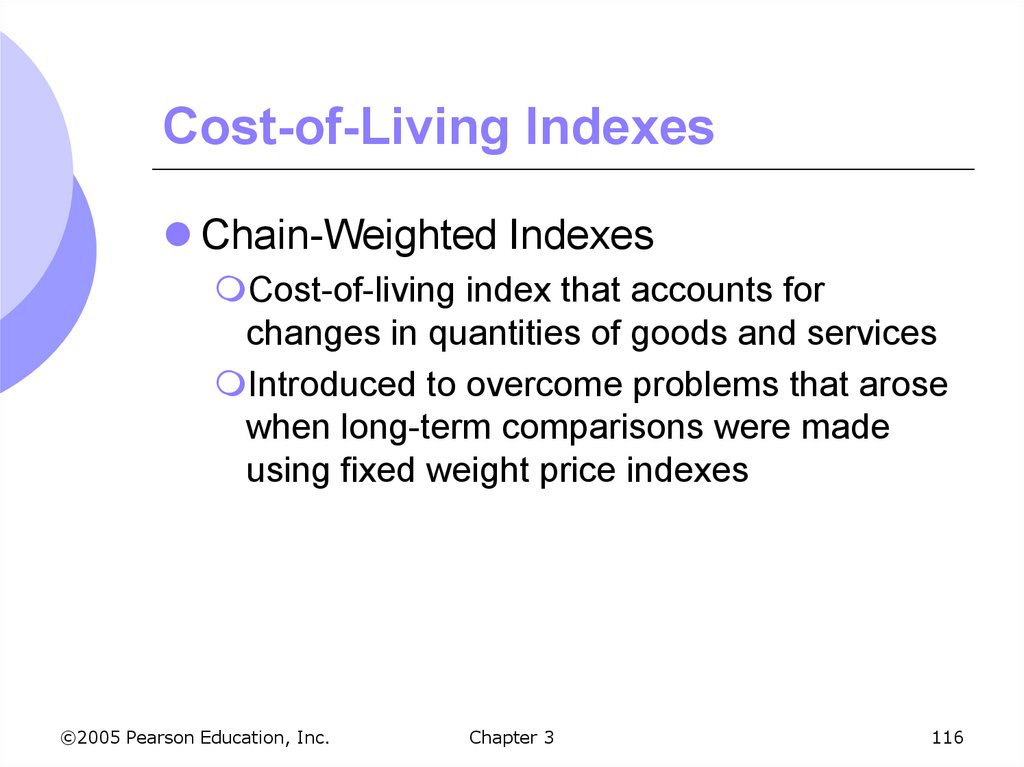
116. Cost-of-Living Indexes
Chain-Weighted IndexesCost-of-living index that accounts for
changes in quantities of goods and services
Introduced to overcome problems that arose
when long-term comparisons were made
using fixed weight price indexes
©2005 Pearson Education, Inc.
Chapter 3
116