






 economics
Similar presentations:



The Cost of Production
1. Chapter 7
The Cost of Production2. Topics to be Discussed
Measuring Cost: Which Costs Matter?Cost in the Short Run
Cost in the Long Run
Long-Run Versus Short-Run Cost Curves
©2005 Pearson Education, Inc.
Chapter 7
2
3. Topics to be Discussed
Production with Two Outputs:Economies of Scope
Dynamic Changes in Costs:
The Learning Curve
Estimating and Predicting Cost
©2005 Pearson Education, Inc.
Chapter 7
3
4. Introduction
Production technology measures therelationship between input and output
Production technology, together with
prices of factor inputs, determine the
firm’s cost of production
Given the production technology,
managers must choose how to produce
©2005 Pearson Education, Inc.
Chapter 7
4
5. Introduction
The optimal, cost minimizing, level ofinputs can be determined
A firm’s costs depend on the rate of
output and we will show how these costs
are likely to change over time
The characteristics of the firm’s
production technology can affect costs in
the long run and short run
©2005 Pearson Education, Inc.
Chapter 7
5
6. Measuring Cost: Which Costs Matter?
For a firm to minimize costs, we mustclarify what is meant by costs and how to
measure them
It is clear that if a firm has to rent equipment
or buildings, the rent they pay is a cost
What if a firm owns its own equipment or
building?
How are costs calculated here?
©2005 Pearson Education, Inc.
Chapter 7
6
7. Measuring Cost: Which Costs Matter?
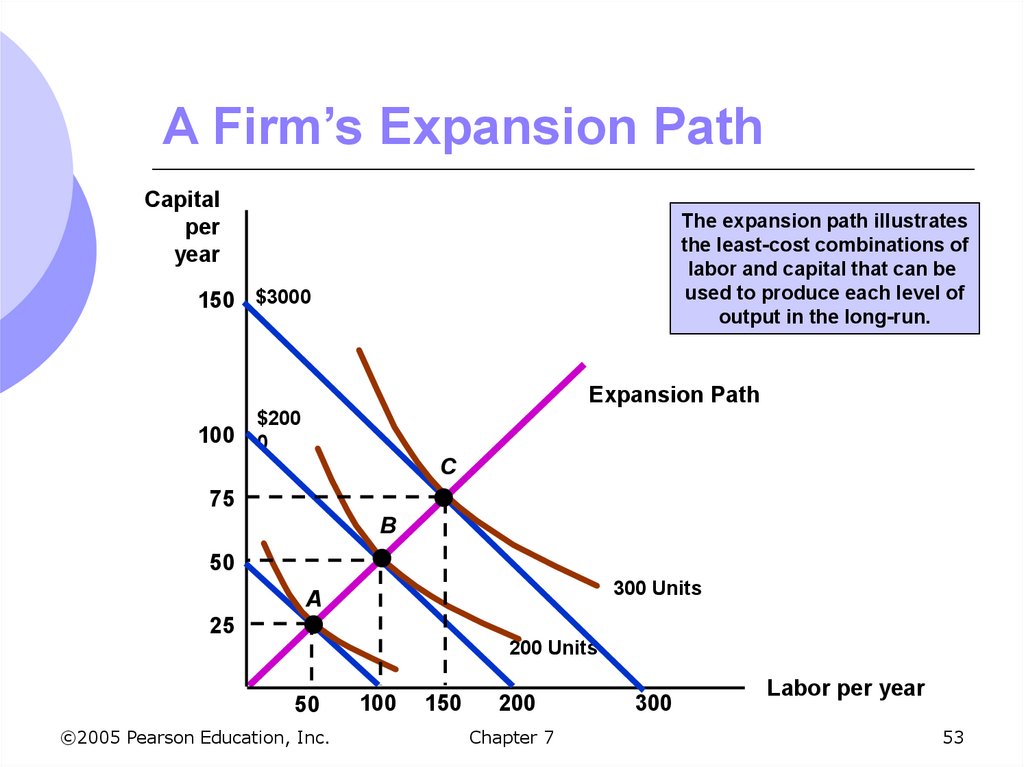
Accountants tend to take a retrospectiveview of firms’ costs, whereas economists
tend to take a forward-looking view
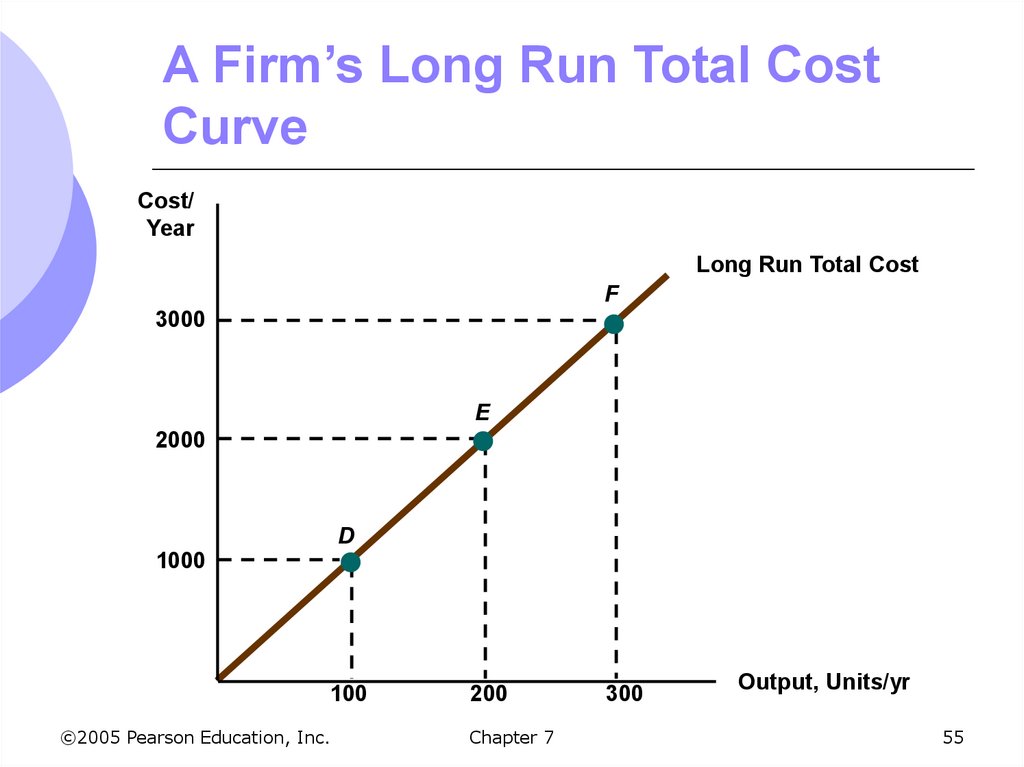
Accounting Cost
Actual expenses plus depreciation charges
for capital equipment
Economic Cost
Cost to a firm of utilizing economic resources
in production, including opportunity cost
©2005 Pearson Education, Inc.
Chapter 7
7
8. Measuring Cost: Which Costs Matter?
Economic costs distinguish betweencosts the firm can control and those it
cannot
Concept of opportunity cost plays an
important role
Opportunity cost
Cost associated with opportunities that are
foregone when a firm’s resources are not put
to their highest-value use
©2005 Pearson Education, Inc.
Chapter 7
8
9. Opportunity Cost
An ExampleA firm owns its own building and pays no rent
for office space
Does this mean the cost of office space is
zero?
The building could have been rented instead
Foregone rent is the opportunity cost of
using the building for production and should
be included in the economic costs of doing
business
©2005 Pearson Education, Inc.
Chapter 7
9
10. Opportunity Cost
A person starting their own businessmust take into account the opportunity
cost of their time
Could have worked elsewhere making a
competitive salary
Accountants and economists often treat
depreciation differently as well
©2005 Pearson Education, Inc.
Chapter 7
10
11. Measuring Cost: Which Costs Matter?
Although opportunity costs are hiddenand should be taken into account, sunk
costs should not
Sunk Cost
Expenditure that has been made and cannot
be recovered
Should not influence a firm’s future economic
decisions
©2005 Pearson Education, Inc.
Chapter 7
11
12. Sunk Cost
Firm buys a piece of equipment thatcannot be converted to another use
Expenditure on the equipment is a sunk
cost
Has no alternative use so cost cannot be
recovered – opportunity cost is zero
Decision to buy the equipment might have
been good or bad, but now does not matter
©2005 Pearson Education, Inc.
Chapter 7
12
13. Prospective Sunk Cost
An ExampleFirm is considering moving its headquarters
A firm paid $500,000 for an option to buy a
building
The cost of the building is $5 million for a
total of $5.5 million
The firm finds another building for $5.25
million
Which building should the firm buy?
©2005 Pearson Education, Inc.
Chapter 7
13
14. Prospective Sunk Cost
Example (cont.)The first building should be purchased
The $500,000 is a sunk cost and should
not be considered in the decision to buy
What should be considered is
Spending an additional $5,250,000 or
Spending an additional $5,000,000
©2005 Pearson Education, Inc.
Chapter 7
14
15. Measuring Cost: Which Costs Matter?
Some costs vary with output, whilesome remain the same no matter the
amount of output
Total cost can be divided into:
1. Fixed Cost
Does not vary with the level of output
2. Variable Cost
Cost that varies as output varies
©2005 Pearson Education, Inc.
Chapter 7
15
16. Fixed and Variable Costs
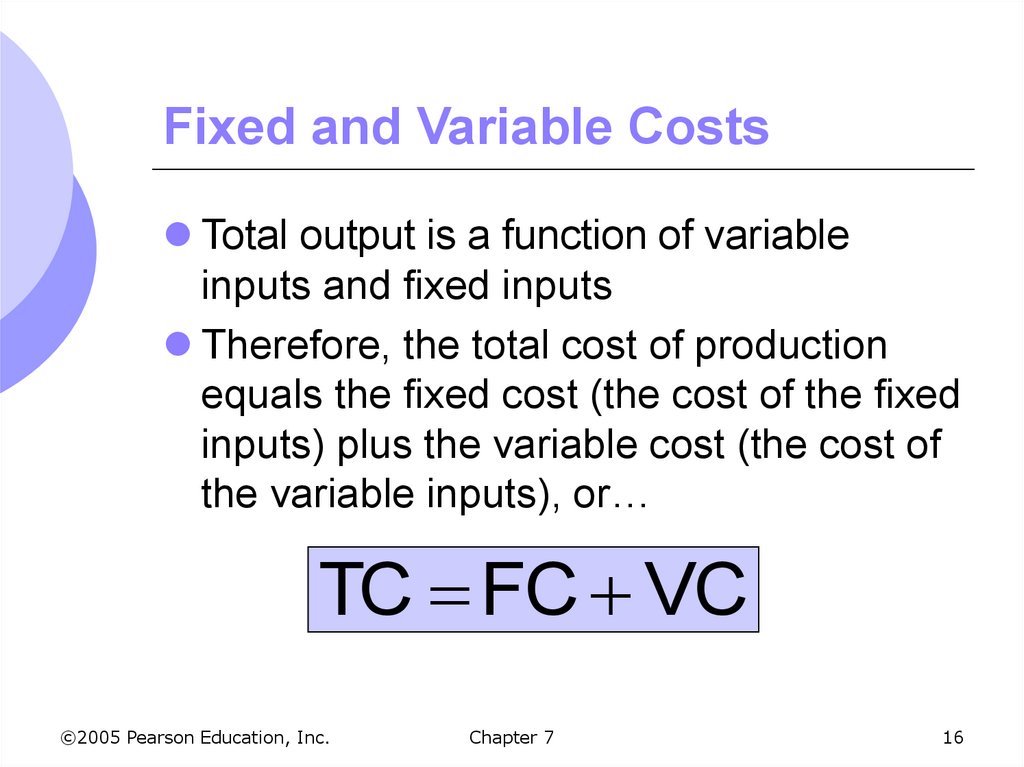
Total output is a function of variableinputs and fixed inputs
Therefore, the total cost of production
equals the fixed cost (the cost of the fixed
inputs) plus the variable cost (the cost of
the variable inputs), or…
TC FC VC
©2005 Pearson Education, Inc.
Chapter 7
16
17. Fixed and Variable Costs
Which costs are variable and which arefixed depends on the time horizon
Short time horizon – most costs are fixed
Long time horizon – many costs become
variable
In determining how changes in
production will affect costs, must consider
if fixed or variable costs are affected.
©2005 Pearson Education, Inc.
Chapter 7
17
18. Fixed Cost Versus Sunk Cost
Fixed cost and sunk cost are oftenconfused
Fixed Cost
Cost paid by a firm that is in business
regardless of the level of output
Sunk Cost
Cost that has been incurred and cannot be
recovered
©2005 Pearson Education, Inc.
Chapter 7
18
19. Measuring Cost: Which Costs Matter?
Personal ComputersMost costs are variable
Largest component: labor
Software
Most costs are sunk
Initial cost of developing the software
©2005 Pearson Education, Inc.
Chapter 7
19
20. Marginal and Average Cost
In completing a discussion of costs, mustalso distinguish between
Average Cost
Marginal Cost
After definition of costs is complete, one
can consider the analysis between shortrun and long-run costs
©2005 Pearson Education, Inc.
Chapter 7
20
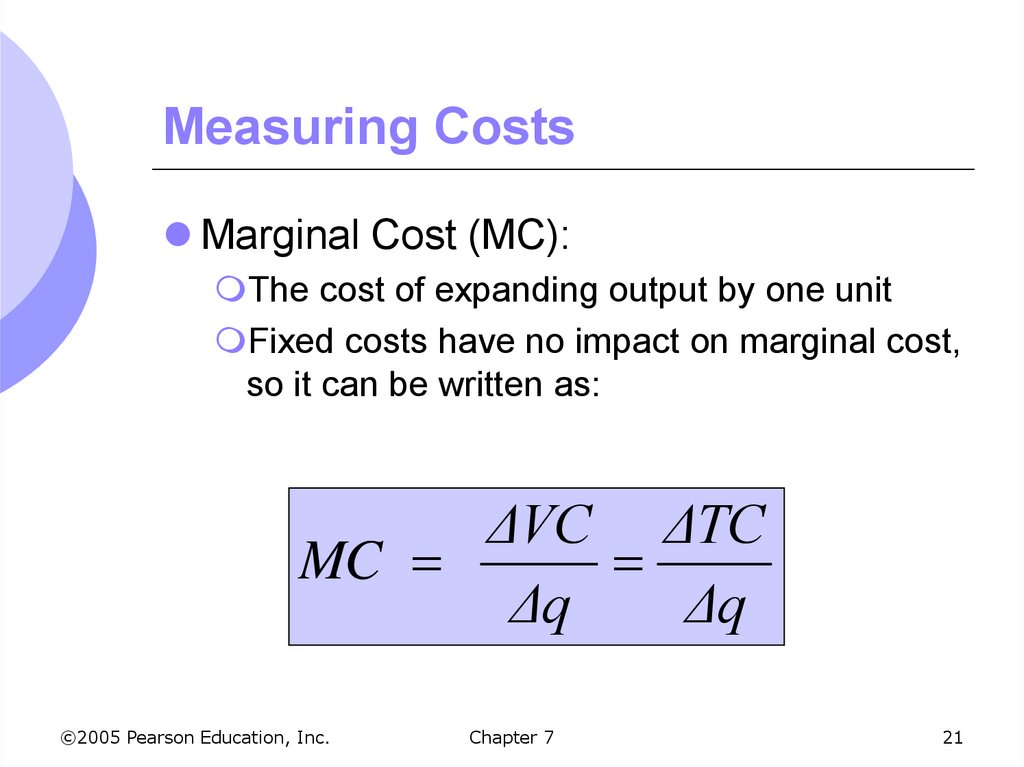
21. Measuring Costs
Marginal Cost (MC):The cost of expanding output by one unit
Fixed costs have no impact on marginal cost,
so it can be written as:
ΔVC ΔTC
MC
Δq
Δq
©2005 Pearson Education, Inc.
Chapter 7
21
22. Measuring Costs
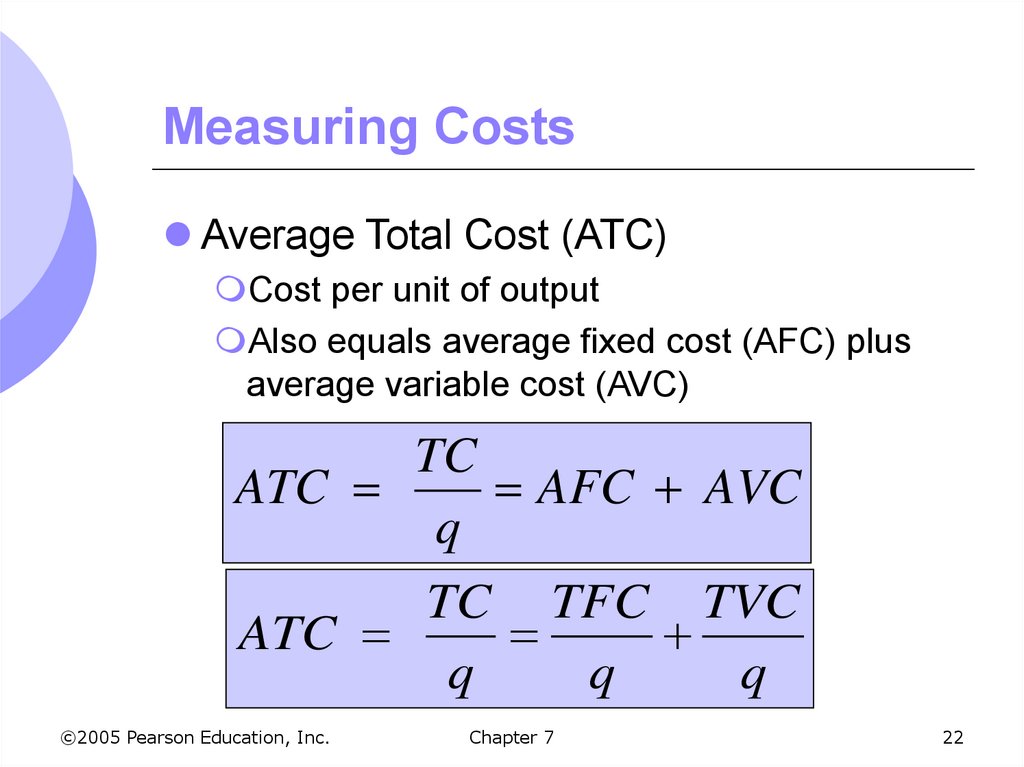
Average Total Cost (ATC)Cost per unit of output
Also equals average fixed cost (AFC) plus
average variable cost (AVC)
TC
ATC
AFC AVC
q
TC TFC TVC
ATC
q
q
q
©2005 Pearson Education, Inc.
Chapter 7
22
23. Measuring Costs
All the types of costs relevant toproduction have now been discussed
Can now discuss how they differ in the
long and short run
Costs that are fixed in the short run may
not be fixed in the long run
Typically in the long run, most if not all
costs are variable
©2005 Pearson Education, Inc.
Chapter 7
23
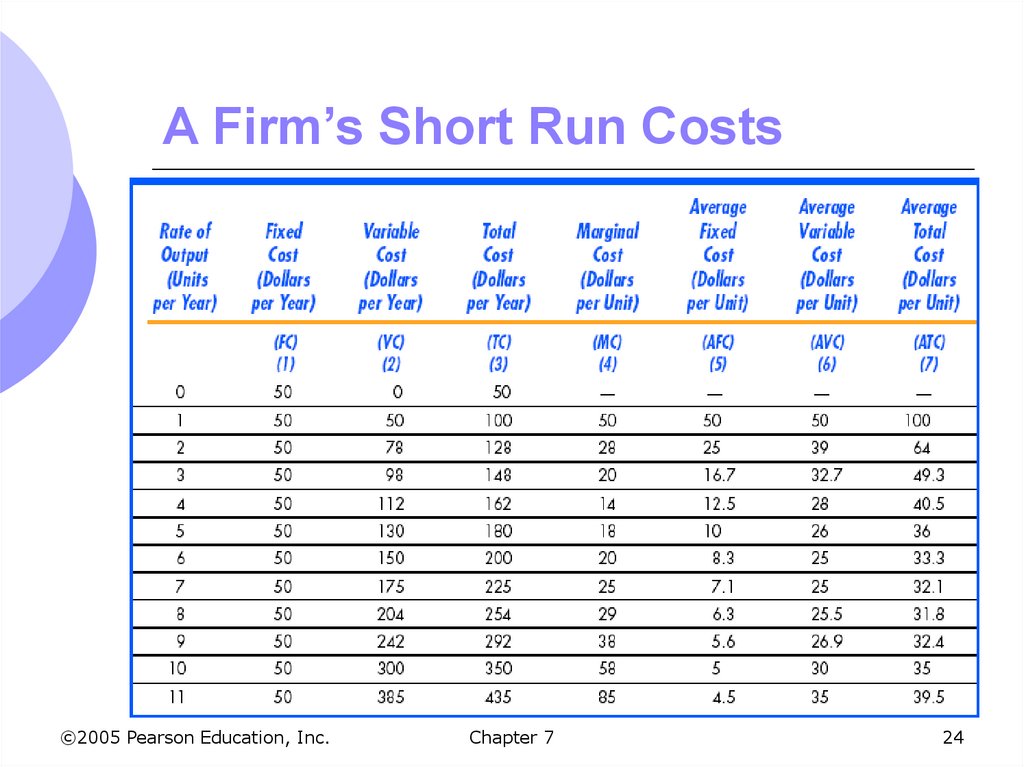
24. A Firm’s Short Run Costs
©2005 Pearson Education, Inc.Chapter 7
24
25. Determinants of Short Run Costs
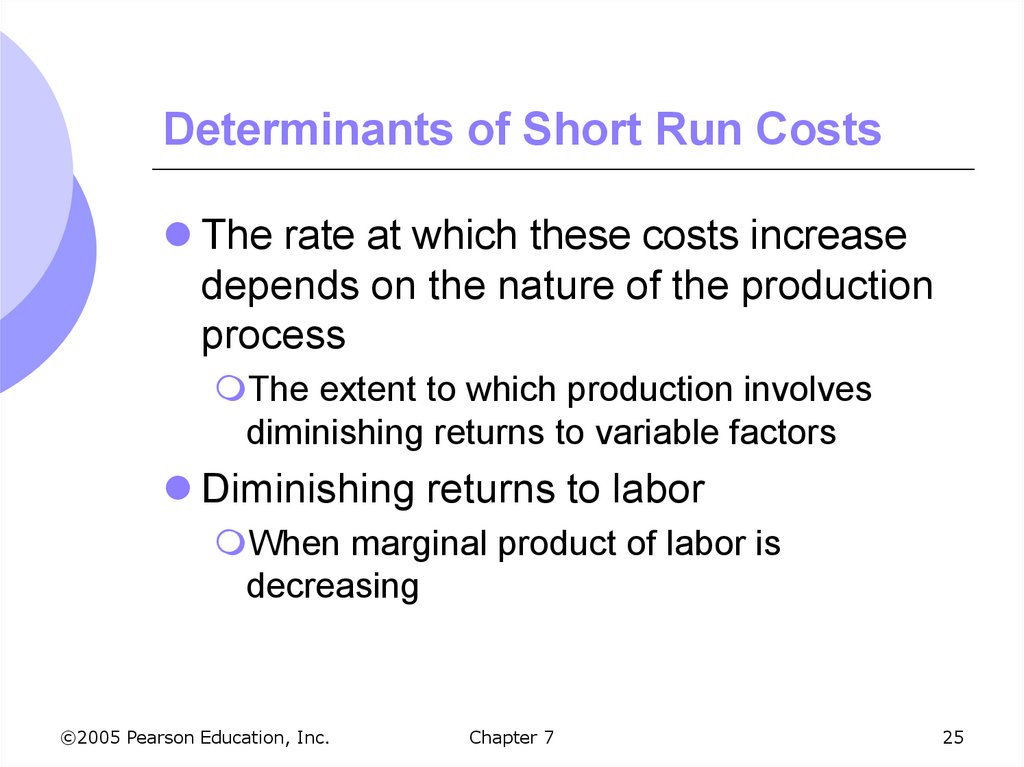
The rate at which these costs increasedepends on the nature of the production
process
The extent to which production involves
diminishing returns to variable factors
Diminishing returns to labor
When marginal product of labor is
decreasing
©2005 Pearson Education, Inc.
Chapter 7
25
26. Determinants of Short Run Costs
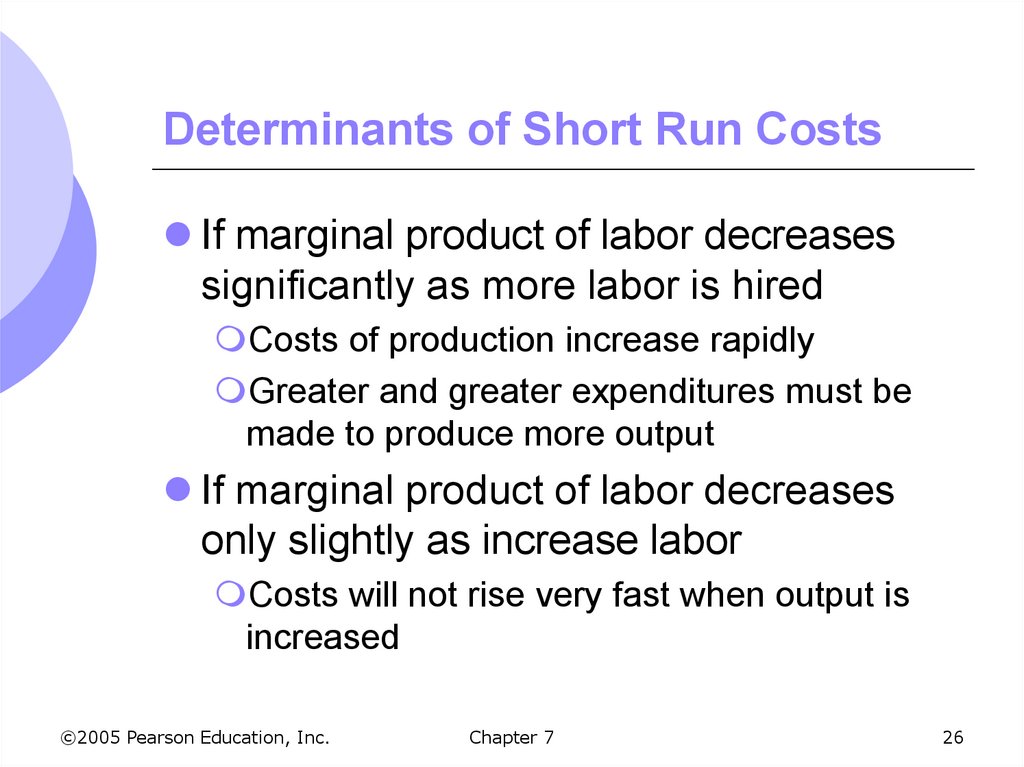
If marginal product of labor decreasessignificantly as more labor is hired
Costs of production increase rapidly
Greater and greater expenditures must be
made to produce more output
If marginal product of labor decreases
only slightly as increase labor
Costs will not rise very fast when output is
increased
©2005 Pearson Education, Inc.
Chapter 7
26
27. Determinants of Short Run Costs – An Example
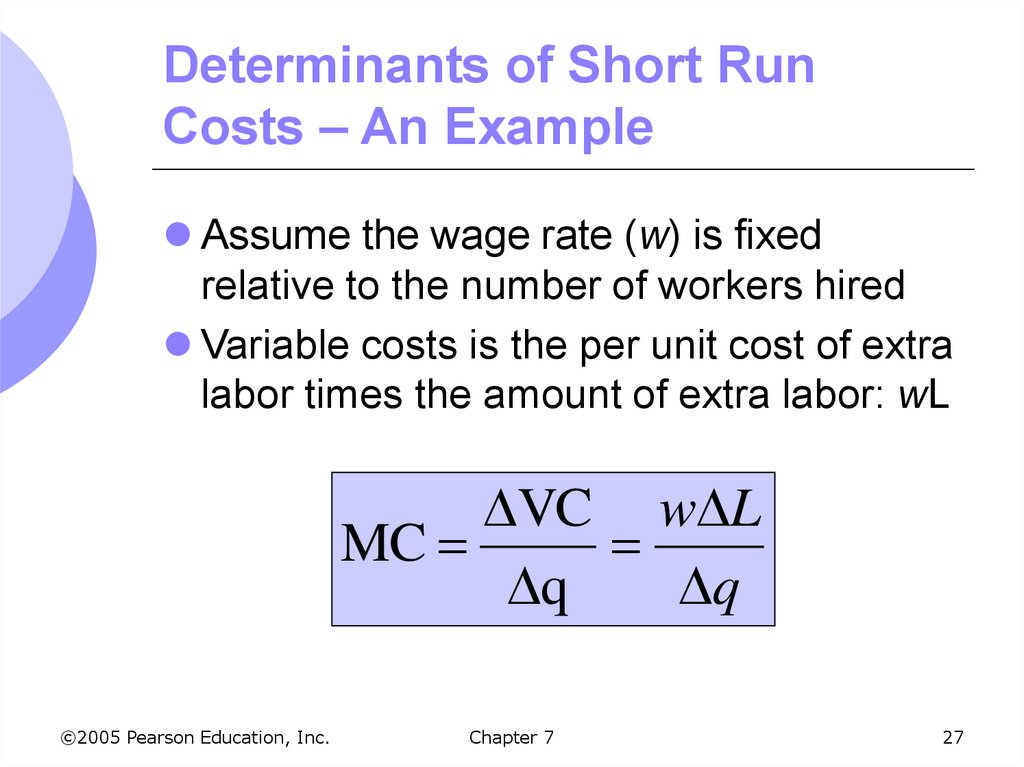
Assume the wage rate (w) is fixedrelative to the number of workers hired
Variable costs is the per unit cost of extra
labor times the amount of extra labor: wL
VC w L
MC
q
q
©2005 Pearson Education, Inc.
Chapter 7
27
28. Determinants of Short Run Costs – An Example
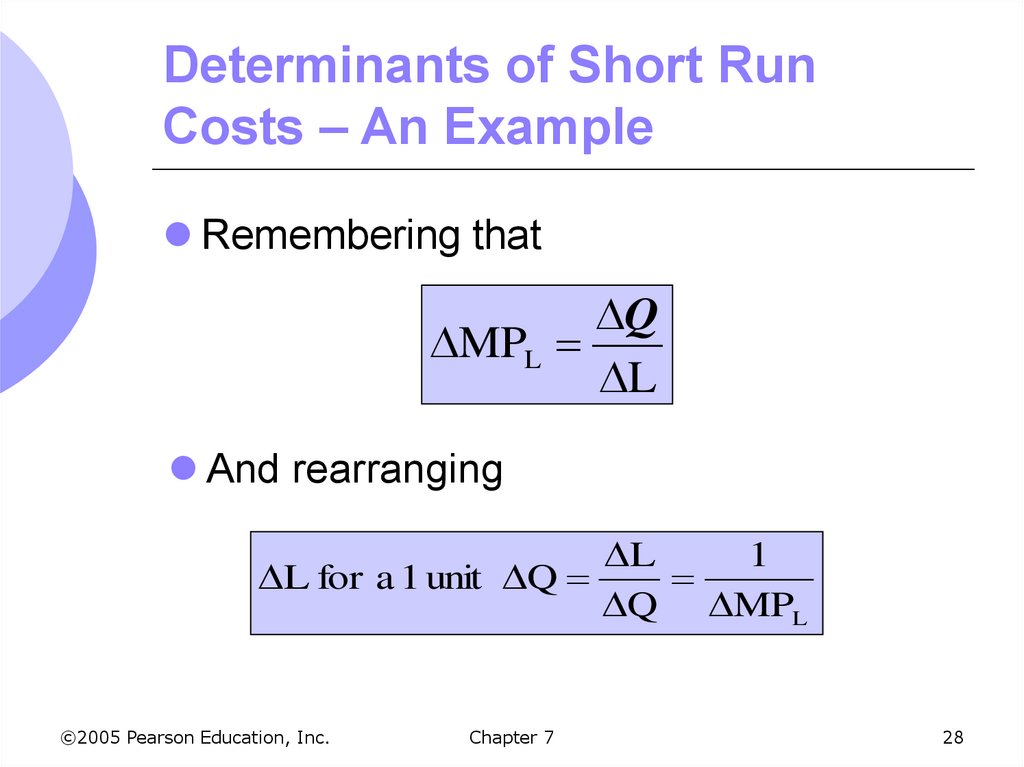
Remembering thatQ
MPL
L
And rearranging
L
1
L for a 1 unit Q
Q MPL
©2005 Pearson Education, Inc.
Chapter 7
28
29. Determinants of Short Run Costs – An Example
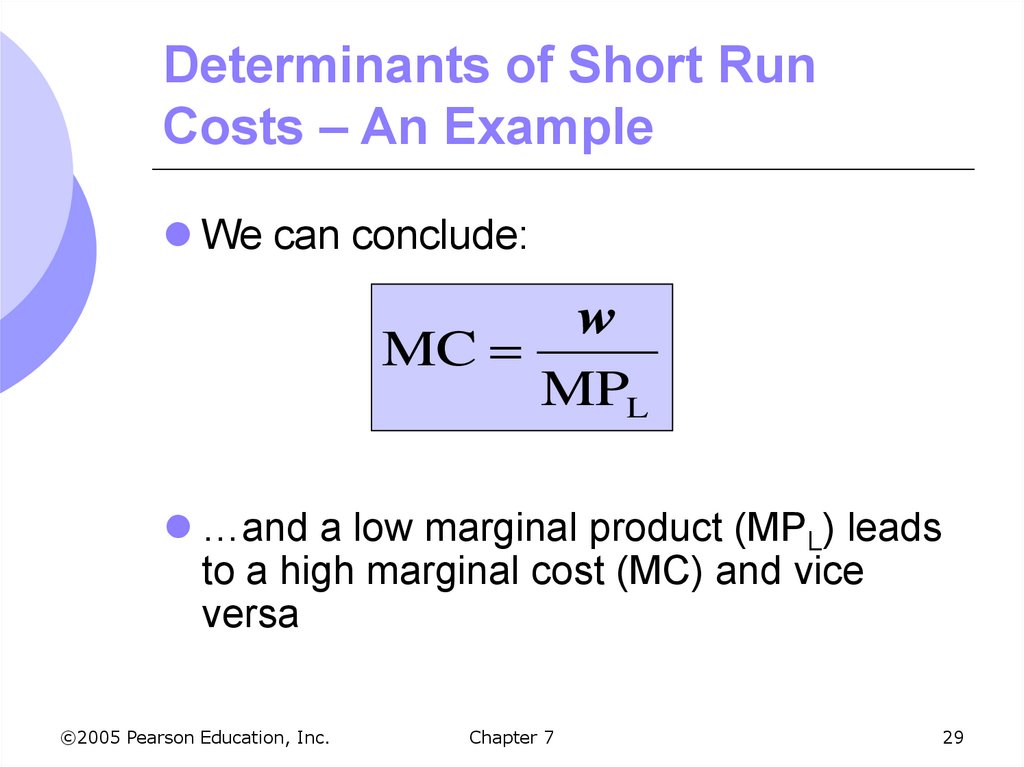
We can conclude:w
MC
MPL
…and a low marginal product (MPL) leads
to a high marginal cost (MC) and vice
versa
©2005 Pearson Education, Inc.
Chapter 7
29
30. Determinants of Short Run Costs
Consequently (from the table):MC decreases initially with increasing returns
0 through 4 units of output
MC increases with decreasing returns
5 through 11 units of output
©2005 Pearson Education, Inc.
Chapter 7
30
31. Cost Curves
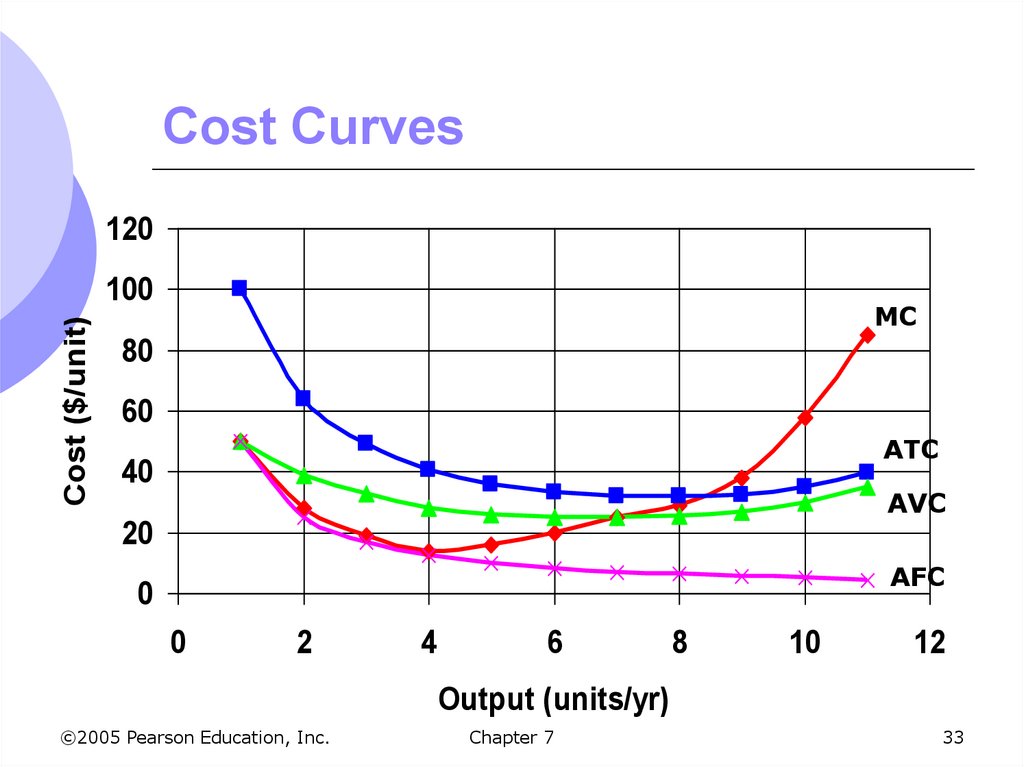
The following figures illustrate howvarious cost measures change as
outputs change
Curves based on the information in table
7.1 discussed earlier
©2005 Pearson Education, Inc.
Chapter 7
31
32. Cost Curves for a Firm
TCCost 400
($ per
year)
Total cost
is the vertical
sum of FC
and VC.
300
VC
Variable cost
increases with
production and
the rate varies with
increasing and
decreasing returns.
200
Fixed cost does not
vary with output
100
FC
50
0
1
2
©2005 Pearson Education, Inc.
3
4
5
6
7
Chapter 7
8
9
10
11
12
13
Output
32
33. Cost Curves
120Cost ($/unit)
100
MC
80
60
ATC
40
AVC
20
AFC
0
0
2
4
6
8
10
12
Output (units/yr)
©2005 Pearson Education, Inc.
Chapter 7
33
34. Cost Curves
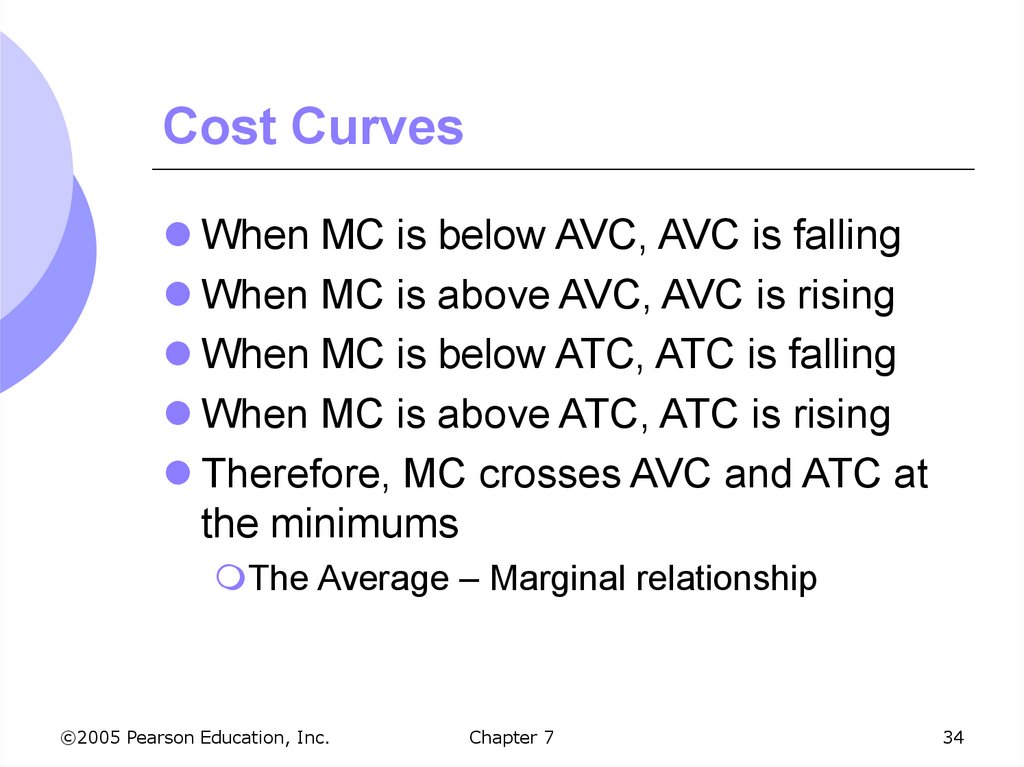
When MC is below AVC, AVC is fallingWhen MC is above AVC, AVC is rising
When MC is below ATC, ATC is falling
When MC is above ATC, ATC is rising
Therefore, MC crosses AVC and ATC at
the minimums
The Average – Marginal relationship
©2005 Pearson Education, Inc.
Chapter 7
34
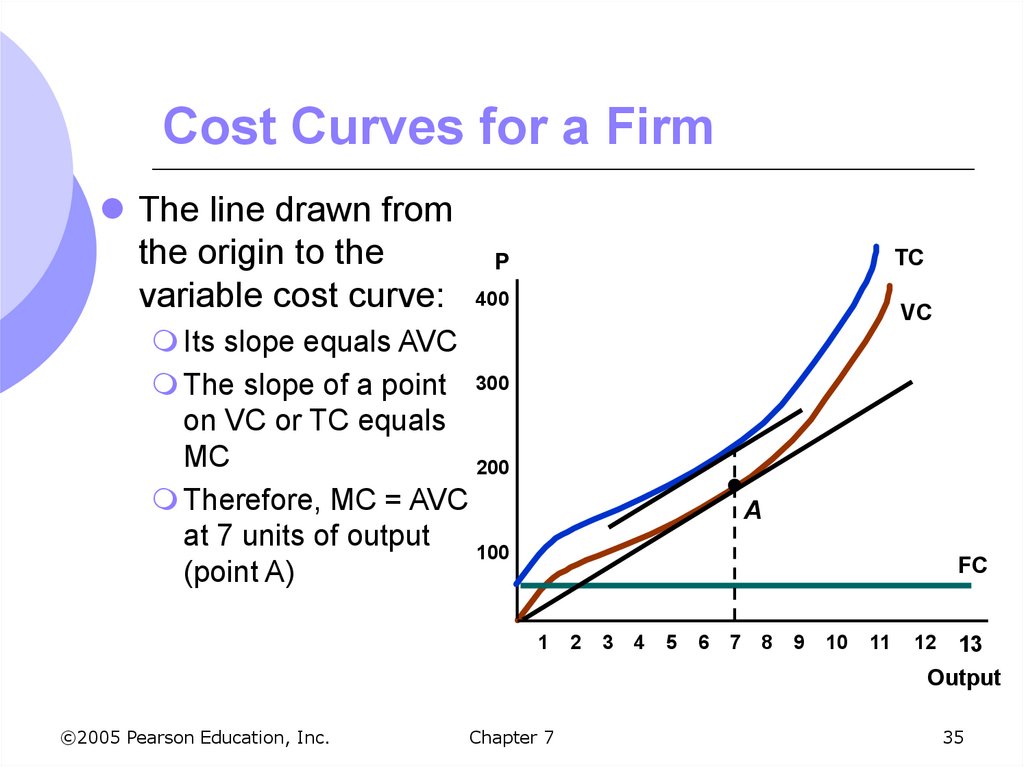
35. Cost Curves for a Firm
The line drawn fromthe origin to the
P
variable cost curve: 400
TC
VC
Its slope equals AVC
The slope of a point 300
on VC or TC equals
MC
200
Therefore, MC = AVC
at 7 units of output
100
(point A)
A
FC
1
©2005 Pearson Education, Inc.
Chapter 7
2
3
4
5
6
7
8
9
10
11
12
13
Output
35
36. Cost in the Long Run
In the long run a firm can change all of itsinputs
In making cost minimizing choices, must
look at the cost of using capital and labor
in production decisions
©2005 Pearson Education, Inc.
Chapter 7
36
37. Cost in the Long Run
Capital is either rented/leased orpurchased
We will consider capital rented as if it were
purchased
Assume Delta is considering purchasing
an airplane for $150 million
Plane lasts for 30 years
$5 million per year – economic depreciation
for the plane
©2005 Pearson Education, Inc.
Chapter 7
37
38. Cost in the Long Run
Delta needs to compare its revenues andcosts on an annual basis
If the firm had not purchased the plane, it
would have earned interest on the $150
million
Forgone interest is an opportunity cost
that must be considered
©2005 Pearson Education, Inc.
Chapter 7
38
39. User Cost of Capital
The user cost of capital must beconsidered
The annual cost of owning and using the
airplane instead of selling or never buying it
Sum of the economic depreciation and the
interest (the financial return) that could have
been earned had the money been invested
elsewhere
©2005 Pearson Education, Inc.
Chapter 7
39
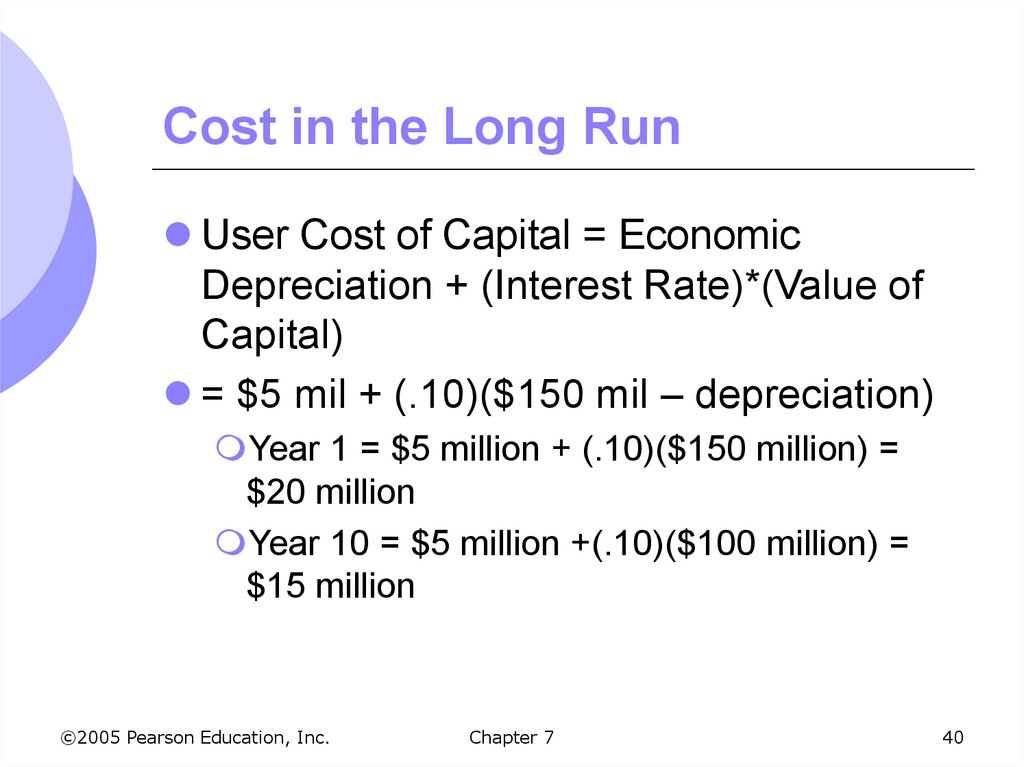
40. Cost in the Long Run
User Cost of Capital = EconomicDepreciation + (Interest Rate)*(Value of
Capital)
= $5 mil + (.10)($150 mil – depreciation)
Year 1 = $5 million + (.10)($150 million) =
$20 million
Year 10 = $5 million +(.10)($100 million) =
$15 million
©2005 Pearson Education, Inc.
Chapter 7
40
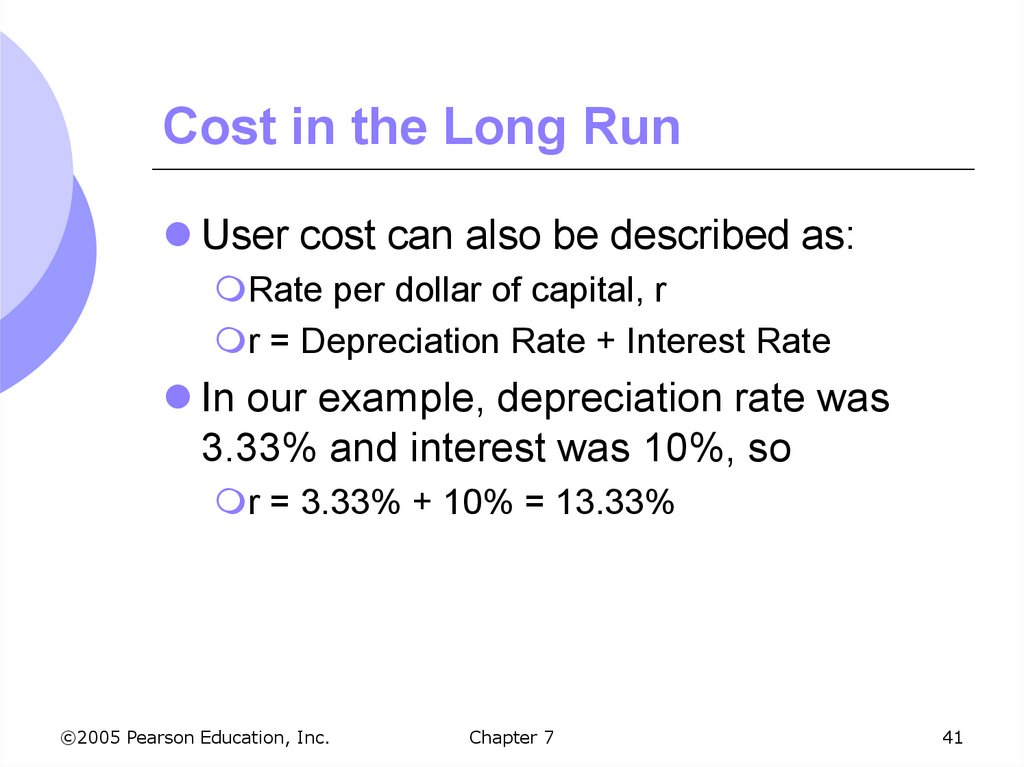
41. Cost in the Long Run
User cost can also be described as:Rate per dollar of capital, r
r = Depreciation Rate + Interest Rate
In our example, depreciation rate was
3.33% and interest was 10%, so
r = 3.33% + 10% = 13.33%
©2005 Pearson Education, Inc.
Chapter 7
41
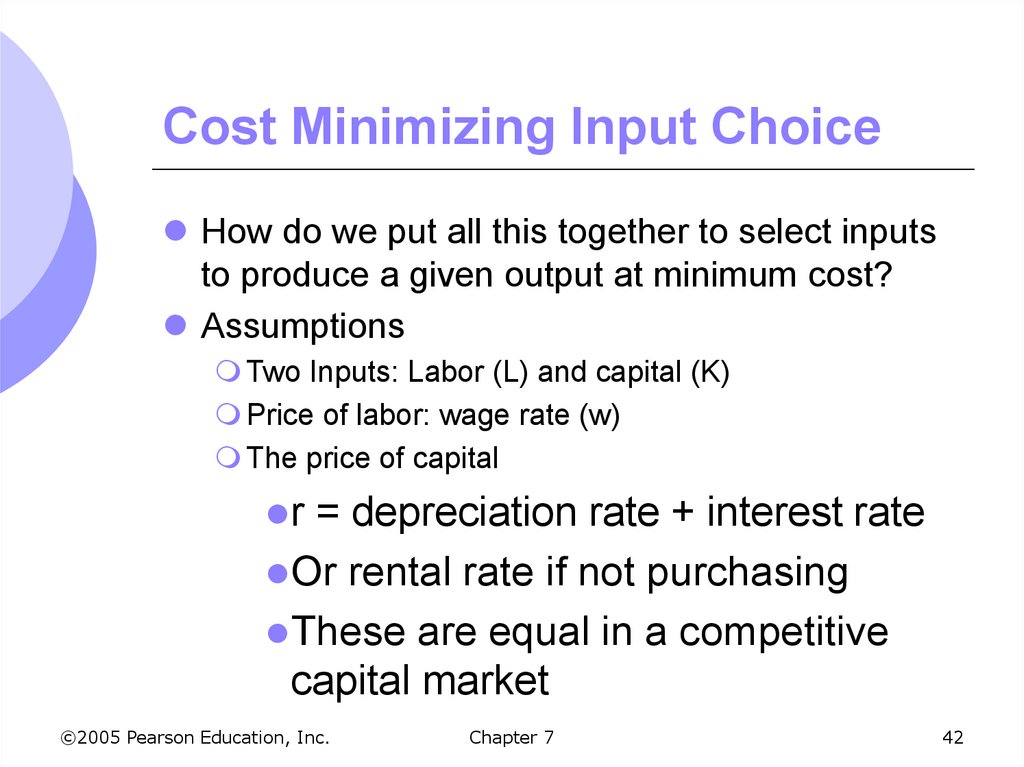
42. Cost Minimizing Input Choice
How do we put all this together to select inputsto produce a given output at minimum cost?
Assumptions
Two Inputs: Labor (L) and capital (K)
Price of labor: wage rate (w)
The price of capital
r = depreciation rate + interest rate
Or rental rate if not purchasing
These are equal in a competitive
capital market
©2005 Pearson Education, Inc.
Chapter 7
42
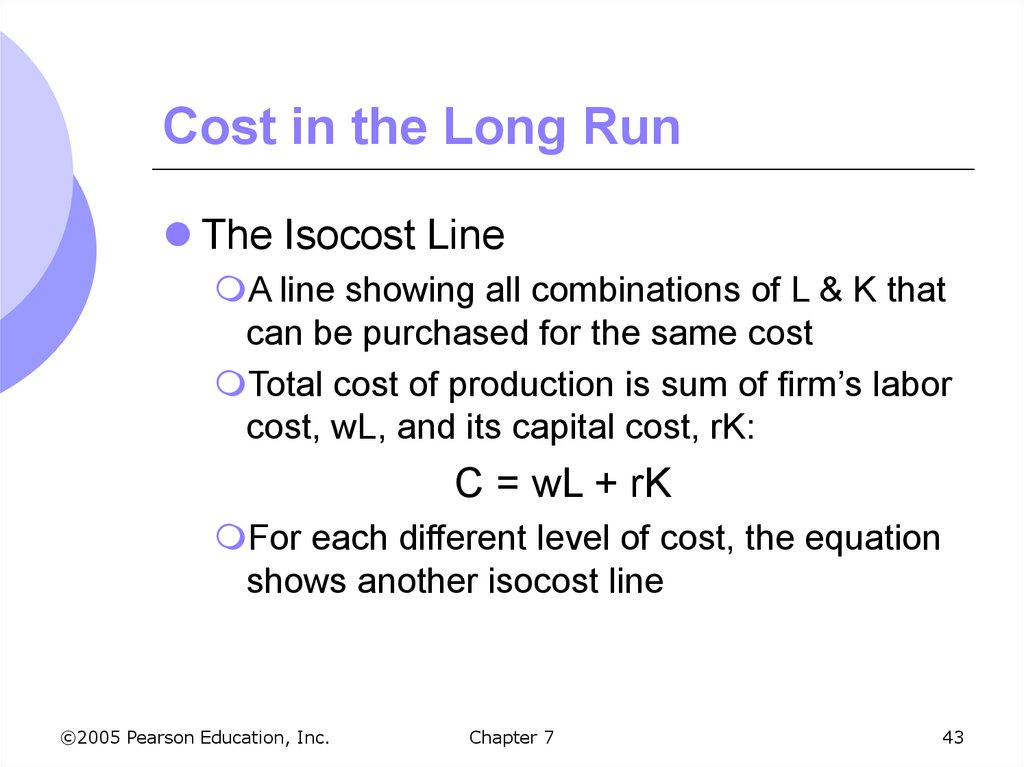
43. Cost in the Long Run
The Isocost LineA line showing all combinations of L & K that
can be purchased for the same cost
Total cost of production is sum of firm’s labor
cost, wL, and its capital cost, rK:
C = wL + rK
For each different level of cost, the equation
shows another isocost line
©2005 Pearson Education, Inc.
Chapter 7
43
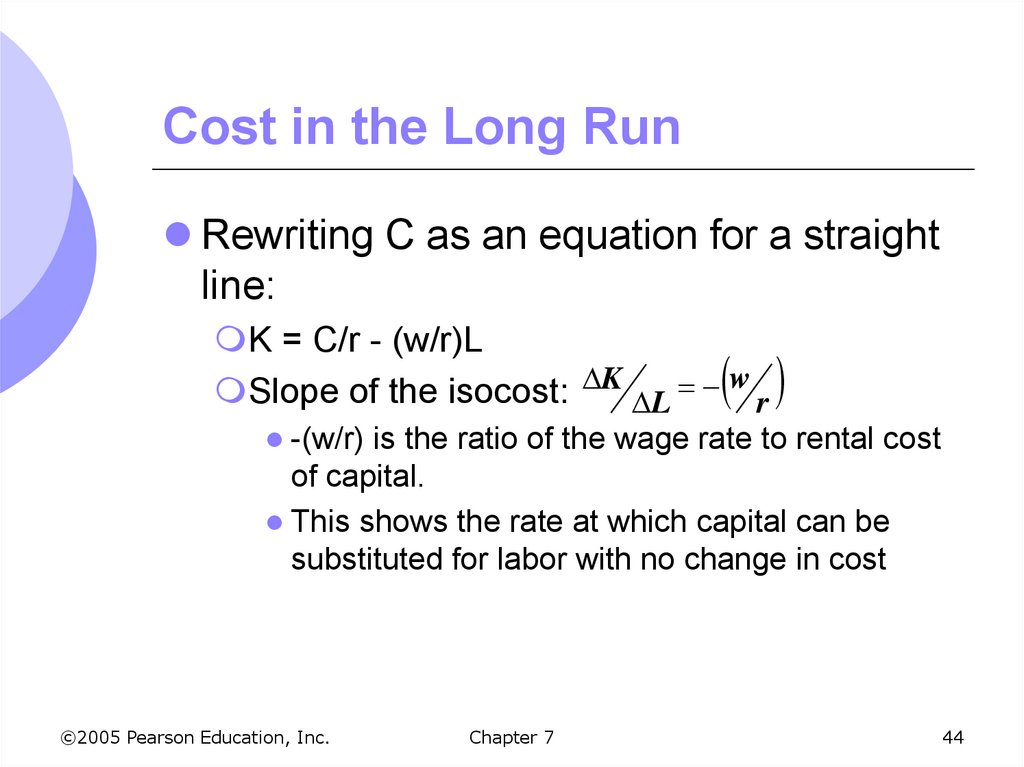
44. Cost in the Long Run
Rewriting C as an equation for a straightline:
K = C/r - (w/r)L
Slope of the isocost: K L w r
-(w/r) is the ratio of the wage rate to rental cost
of capital.
This shows the rate at which capital can be
substituted for labor with no change in cost
©2005 Pearson Education, Inc.
Chapter 7
44
45. Choosing Inputs
We will address how to minimize cost fora given level of output by combining
isocosts with isoquants
We choose the output we wish to
produce and then determine how to do
that at minimum cost
Isoquant is the quantity we wish to produce
Isocost is the combination of K and L that
gives a set cost
©2005 Pearson Education, Inc.
Chapter 7
45
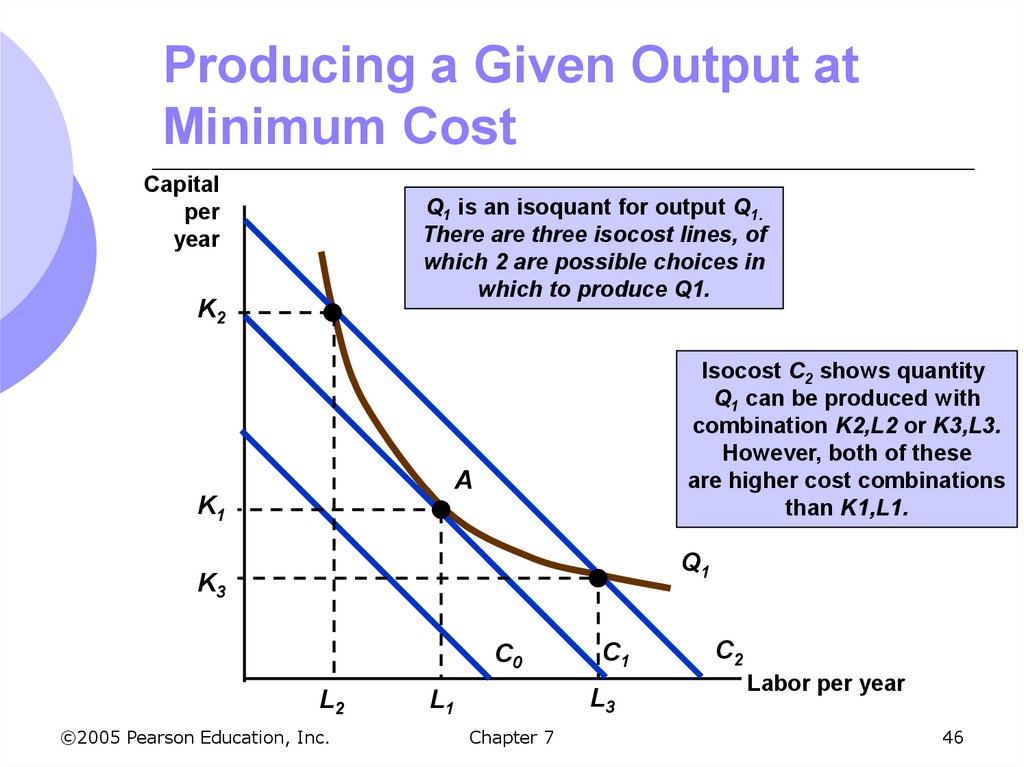
46. Producing a Given Output at Minimum Cost
Capitalper
year
Q1 is an isoquant for output Q1.
There are three isocost lines, of
which 2 are possible choices in
which to produce Q1.
K2
Isocost C2 shows quantity
Q1 can be produced with
combination K2,L2 or K3,L3.
However, both of these
are higher cost combinations
than K1,L1.
A
K1
Q1
K3
C0
L2
©2005 Pearson Education, Inc.
C1
L3
L1
Chapter 7
C2
Labor per year
46
47. Input Substitution When an Input Price Change
If the price of labor changes, then theslope of the isocost line changes, -(w/r)
It now takes a new quantity of labor and
capital to produce the output
If price of labor increases relative to price
of capital, and capital is substituted for
labor
©2005 Pearson Education, Inc.
Chapter 7
47
48. Input Substitution When an Input Price Change
Capitalper
year
If the price of labor
rises, the isocost curve
becomes steeper due to
the change in the slope -(w/L).
The new combination of K
and L is used to produce Q1.
Combination B is used in
place of combination A.
B
K2
A
K1
Q1
C2
©2005 Pearson Education, Inc.
L2
L1
Chapter 7
C1
Labor per year
48
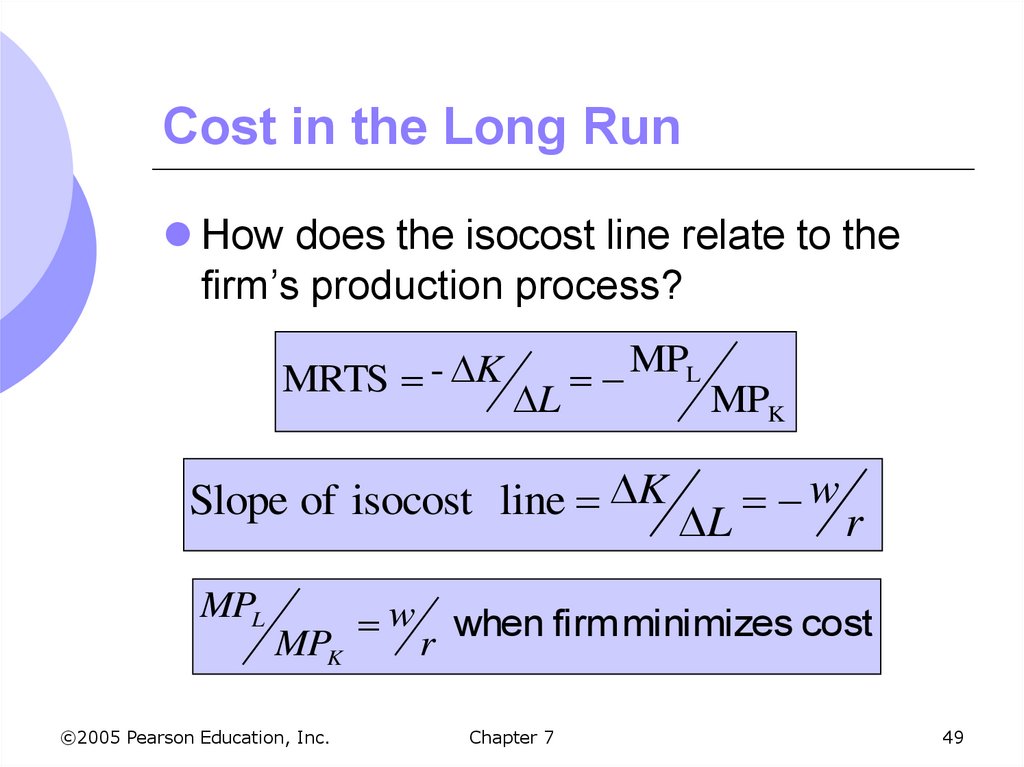
49. Cost in the Long Run
How does the isocost line relate to thefirm’s production process?
MRTS - K
L
MPL
Slope of isocost line K
MPL
MPK
©2005 Pearson Education, Inc.
w
r
MPK
L
w
r
when firm minimizes cost
Chapter 7
49
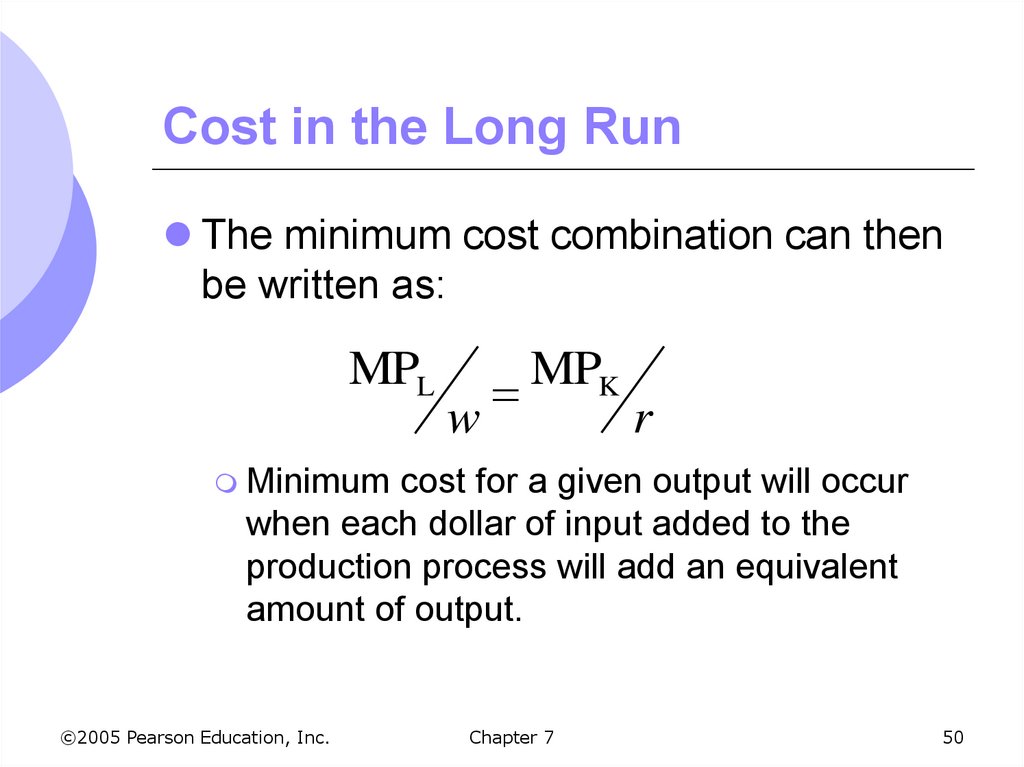
50. Cost in the Long Run
The minimum cost combination can thenbe written as:
MPL
w
MP
K
r
Minimum cost for a given output will occur
when each dollar of input added to the
production process will add an equivalent
amount of output.
©2005 Pearson Education, Inc.
Chapter 7
50
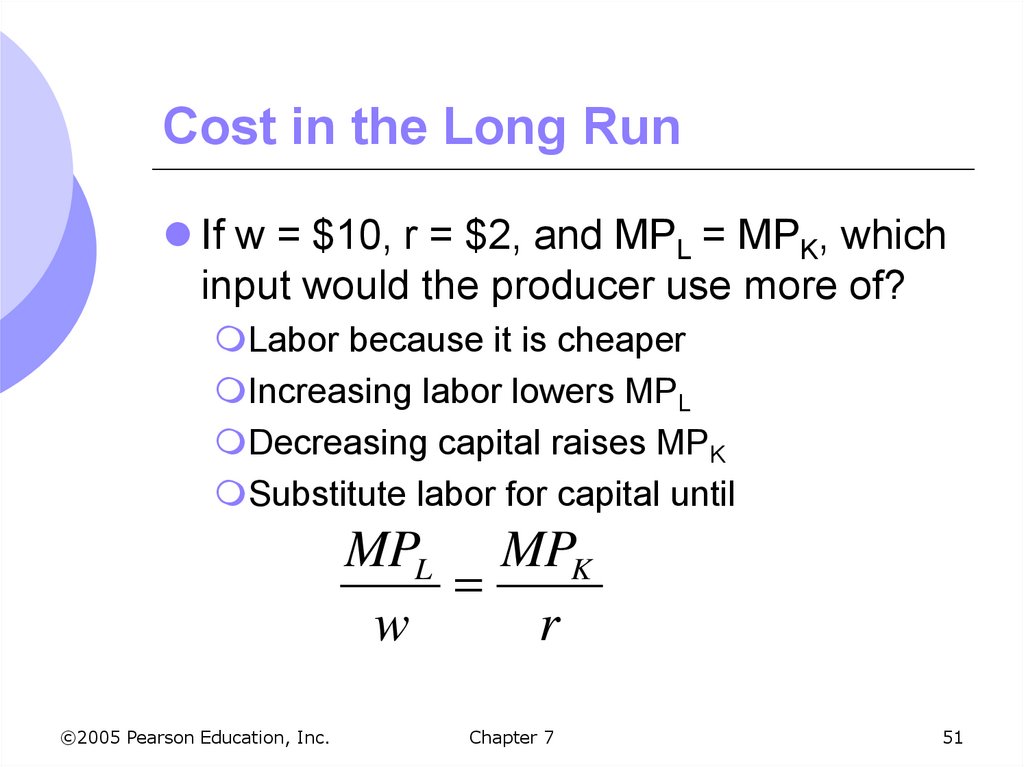
51. Cost in the Long Run
If w = $10, r = $2, and MPL = MPK, whichinput would the producer use more of?
Labor because it is cheaper
Increasing labor lowers MPL
Decreasing capital raises MPK
Substitute labor for capital until
MPL MPK
w
r
©2005 Pearson Education, Inc.
Chapter 7
51
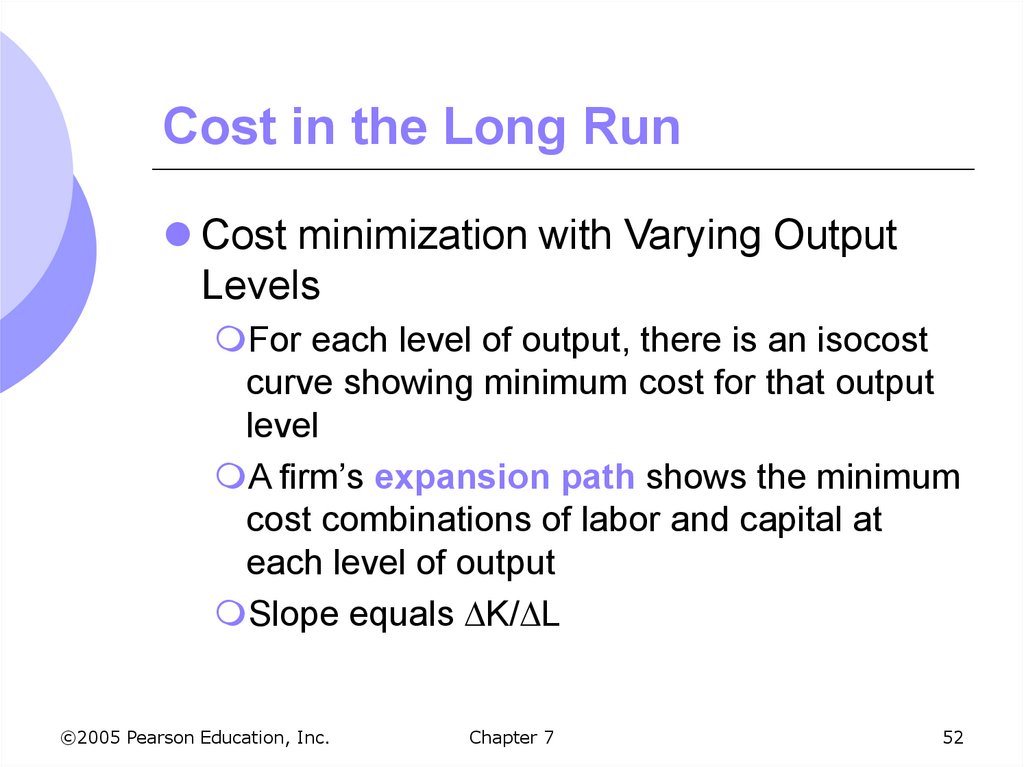
52. Cost in the Long Run
Cost minimization with Varying OutputLevels
For each level of output, there is an isocost
curve showing minimum cost for that output
level
A firm’s expansion path shows the minimum
cost combinations of labor and capital at
each level of output
Slope equals K/ L
©2005 Pearson Education, Inc.
Chapter 7
52
53. A Firm’s Expansion Path
Capitalper
year
The expansion path illustrates
the least-cost combinations of
labor and capital that can be
used to produce each level of
output in the long-run.
150 $3000
Expansion Path
$200
100 0
C
75
B
50
300 Units
A
25
200 Units
50
©2005 Pearson Education, Inc.
100
150
200
Chapter 7
300
Labor per year
53
54. Expansion Path and Long Run Costs
Firm’s expansion path has sameinformation as long-run total cost curve
To move from expansion path to LR cost
curve
Find tangency with isoquant and isocost
Determine min cost of producing the output
level selected
Graph output-cost combination
©2005 Pearson Education, Inc.
Chapter 7
54
55. A Firm’s Long Run Total Cost Curve
Cost/Year
Long Run Total Cost
F
3000
E
2000
D
1000
100
©2005 Pearson Education, Inc.
200
Chapter 7
300
Output, Units/yr
55
56. Long Run Versus Short Run Cost Curves
In the short run, some costs are fixedIn the long run, firm can change anything
including plant size
Can produce at a lower average cost in long
run than in short run
Capital and labor are both flexible
We can show this by holding capital fixed
in the short run and flexible in long run
©2005 Pearson Education, Inc.
Chapter 7
56
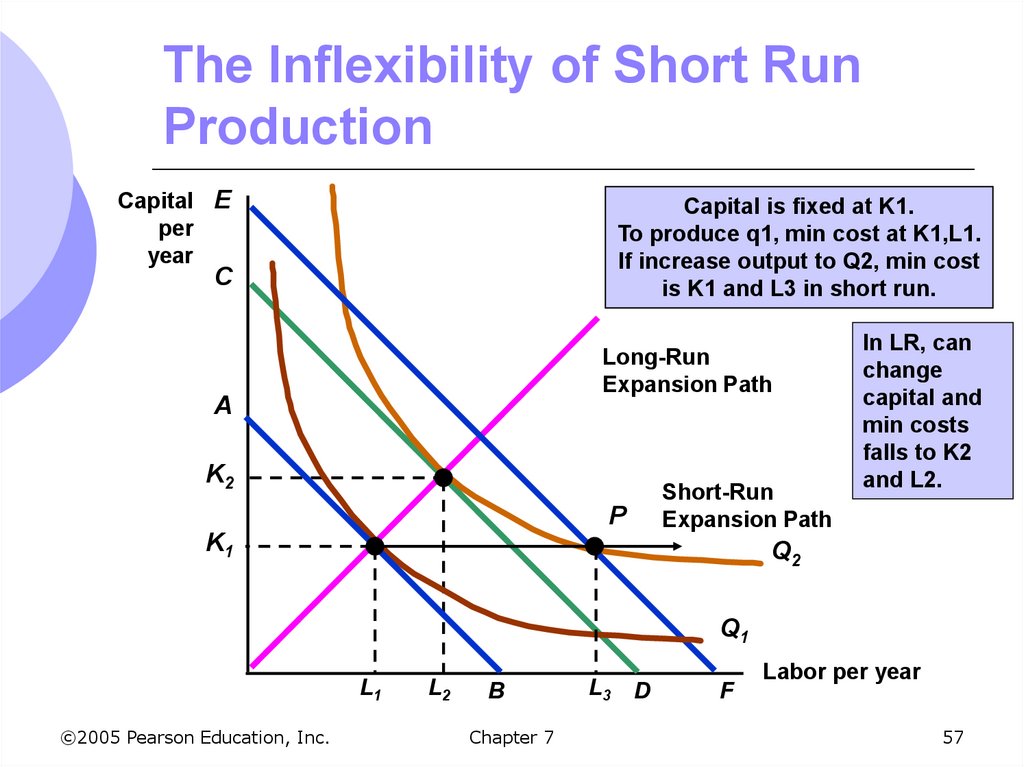
57. The Inflexibility of Short Run Production
Capital Eper
year
Capital is fixed at K1.
To produce q1, min cost at K1,L1.
If increase output to Q2, min cost
is K1 and L3 in short run.
C
Long-Run
Expansion Path
A
K2
Short-Run
Expansion Path
P
K1
In LR, can
change
capital and
min costs
falls to K2
and L2.
Q2
Q1
L1
©2005 Pearson Education, Inc.
L2
B
Chapter 7
L3
D
F
Labor per year
57
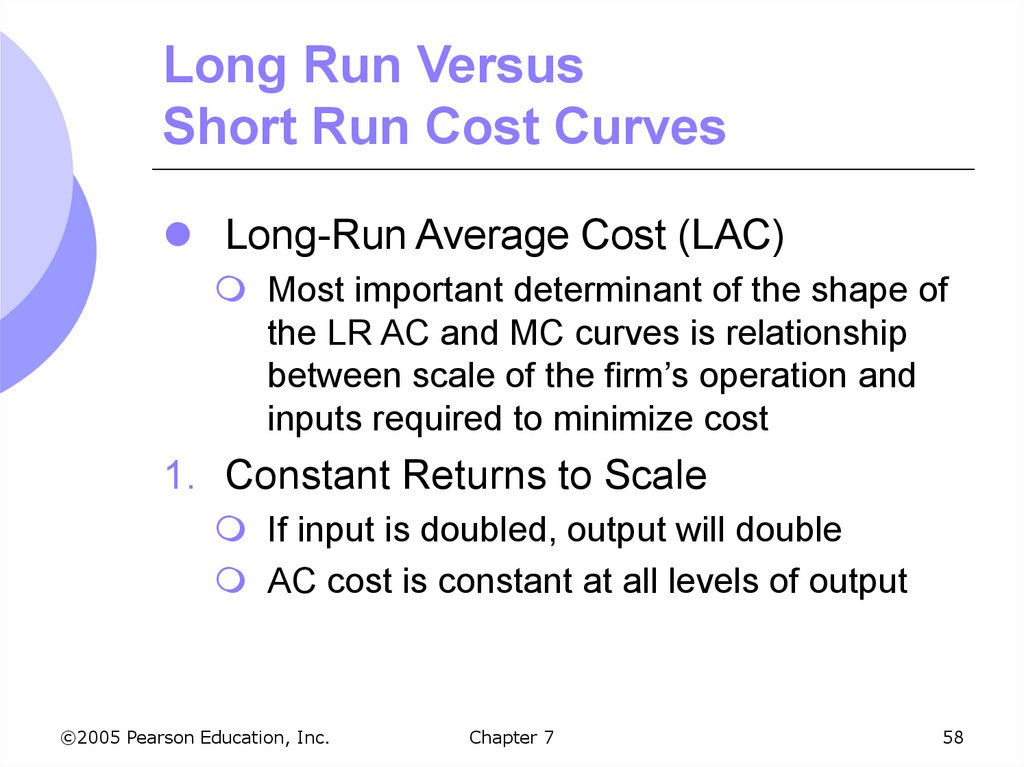
58. Long Run Versus Short Run Cost Curves
Long-Run Average Cost (LAC)Most important determinant of the shape of
the LR AC and MC curves is relationship
between scale of the firm’s operation and
inputs required to minimize cost
1. Constant Returns to Scale
If input is doubled, output will double
AC cost is constant at all levels of output
©2005 Pearson Education, Inc.
Chapter 7
58
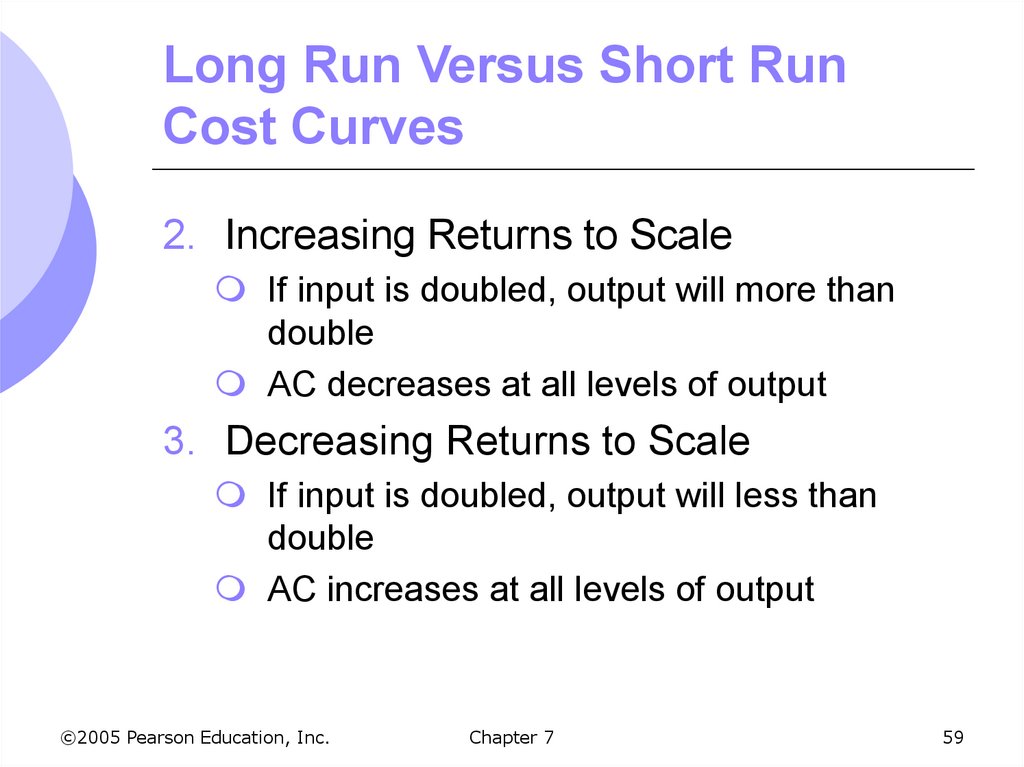
59. Long Run Versus Short Run Cost Curves
2. Increasing Returns to ScaleIf input is doubled, output will more than
double
AC decreases at all levels of output
3. Decreasing Returns to Scale
If input is doubled, output will less than
double
AC increases at all levels of output
©2005 Pearson Education, Inc.
Chapter 7
59
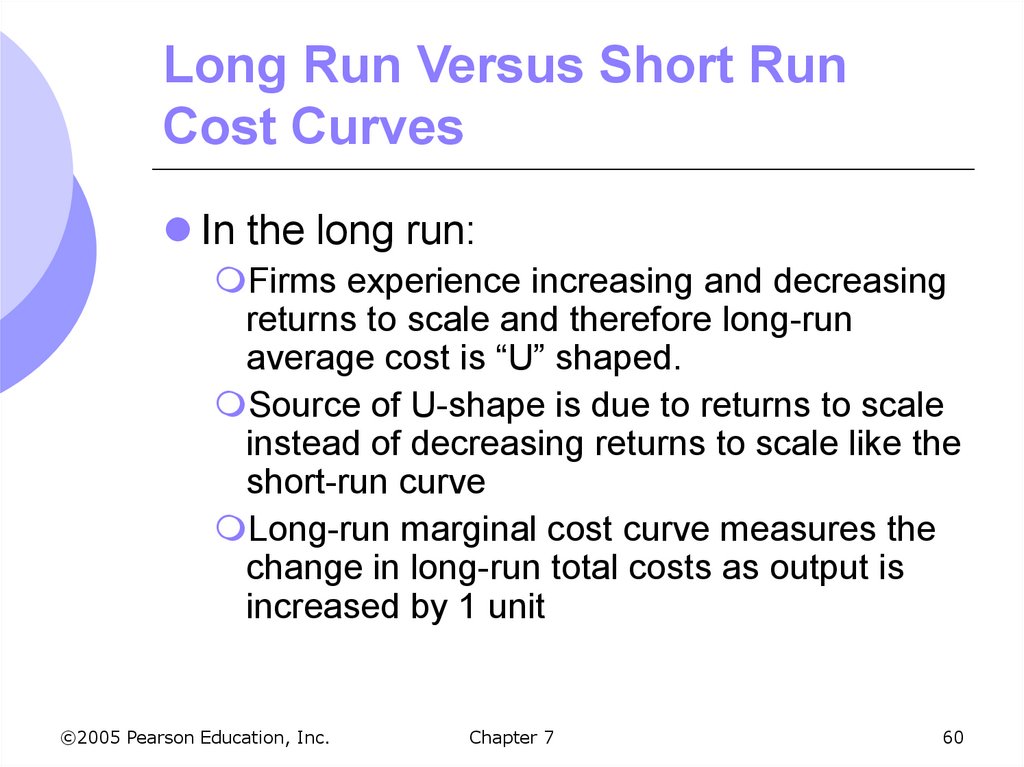
60. Long Run Versus Short Run Cost Curves
In the long run:Firms experience increasing and decreasing
returns to scale and therefore long-run
average cost is “U” shaped.
Source of U-shape is due to returns to scale
instead of decreasing returns to scale like the
short-run curve
Long-run marginal cost curve measures the
change in long-run total costs as output is
increased by 1 unit
©2005 Pearson Education, Inc.
Chapter 7
60
61. Long Run Versus Short Run Cost Curves
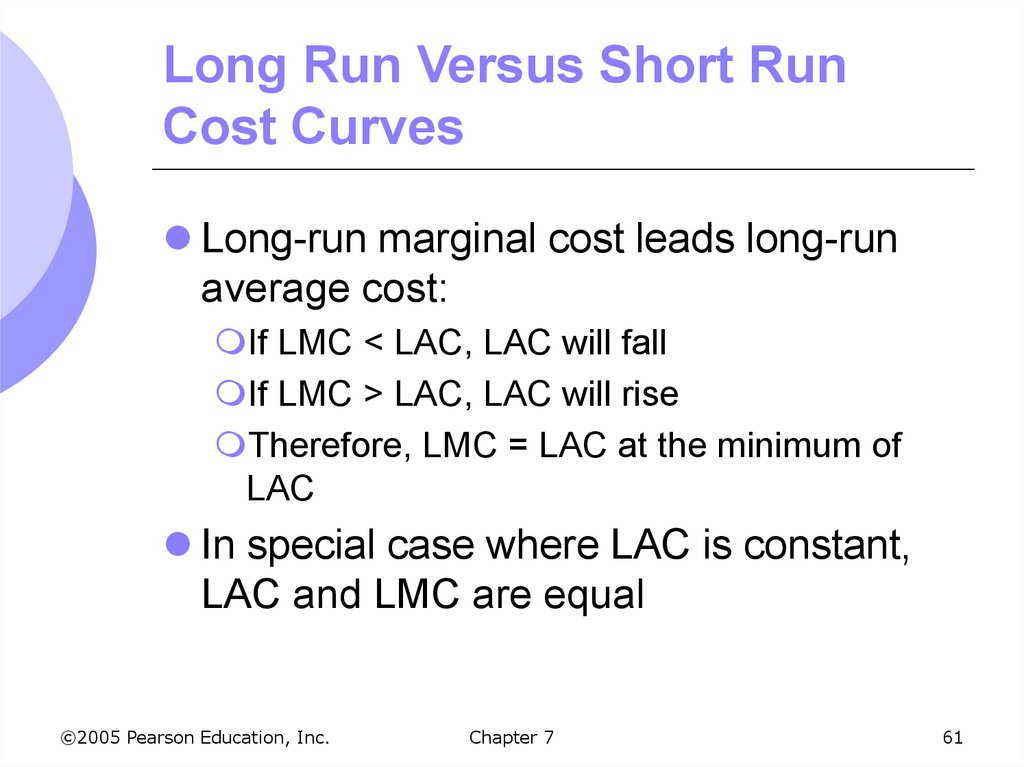
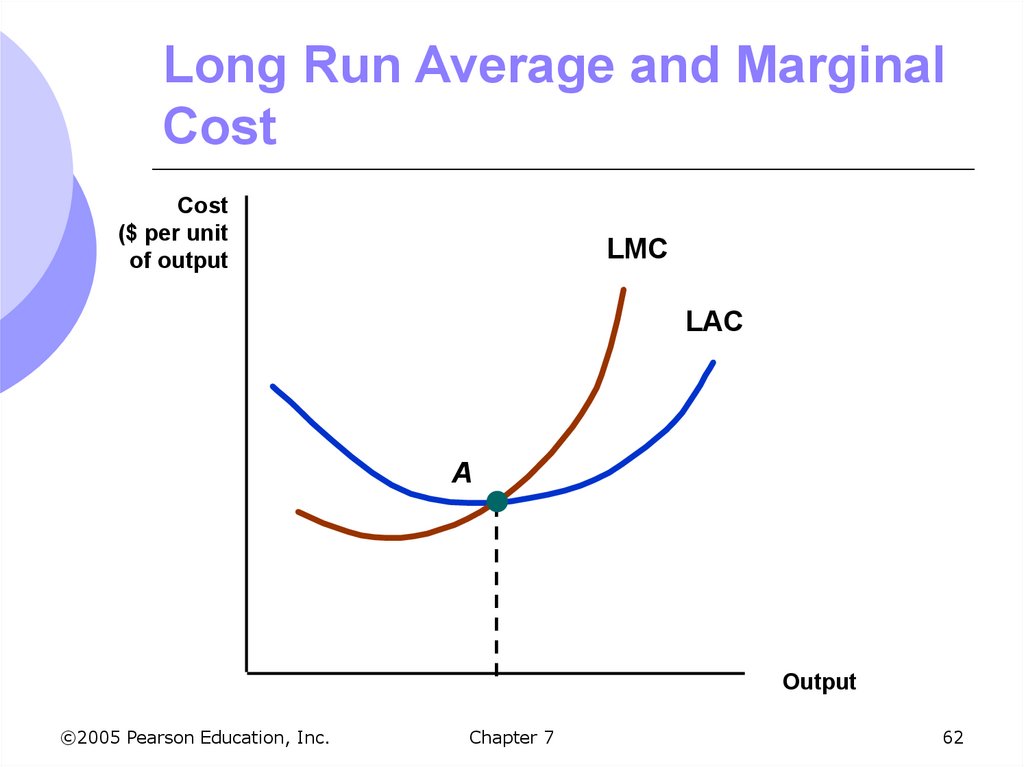
Long-run marginal cost leads long-runaverage cost:
If LMC < LAC, LAC will fall
If LMC > LAC, LAC will rise
Therefore, LMC = LAC at the minimum of
LAC
In special case where LAC is constant,
LAC and LMC are equal
©2005 Pearson Education, Inc.
Chapter 7
61
62. Long Run Average and Marginal Cost
Cost($ per unit
of output
LMC
LAC
A
Output
©2005 Pearson Education, Inc.
Chapter 7
62
63. Long Run Costs
As output increases, firm’s AC ofproducing is likely to decline to a point
1. On a larger scale, workers can better
specialize
2. Scale can provide flexibility – managers can
organize production more effectively
3. Firm may be able to get inputs at lower cost
if can get quantity discounts. Lower prices
might lead to different input mix.
©2005 Pearson Education, Inc.
Chapter 7
63
64. Long Run Costs
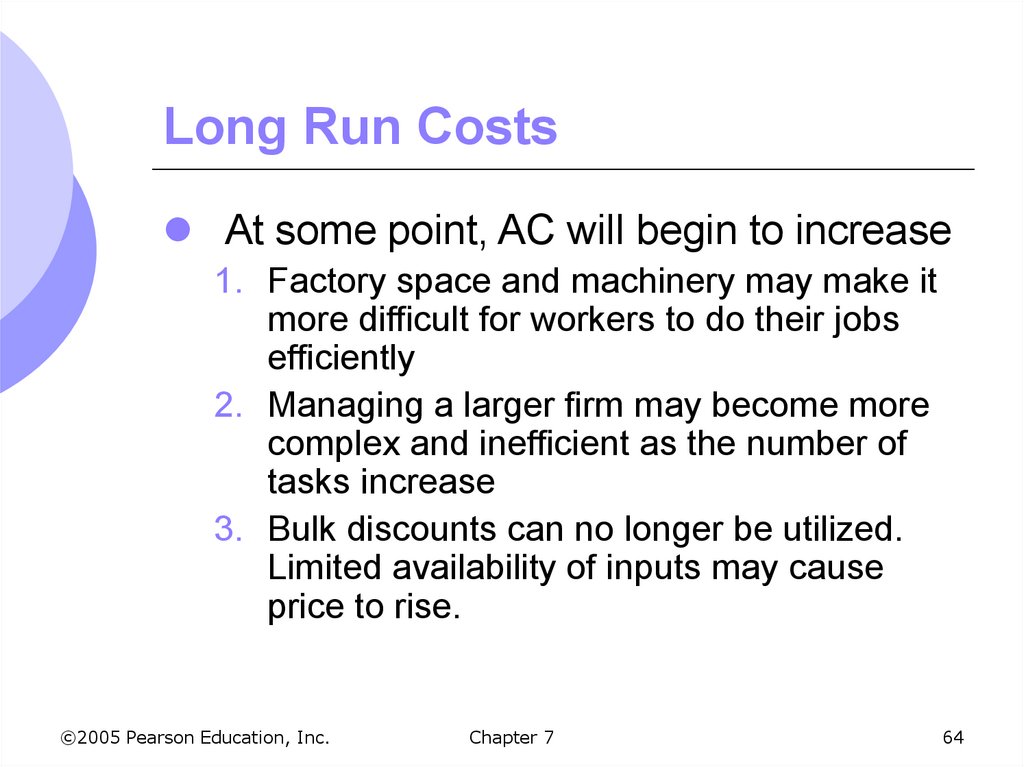
At some point, AC will begin to increase1. Factory space and machinery may make it
more difficult for workers to do their jobs
efficiently
2. Managing a larger firm may become more
complex and inefficient as the number of
tasks increase
3. Bulk discounts can no longer be utilized.
Limited availability of inputs may cause
price to rise.
©2005 Pearson Education, Inc.
Chapter 7
64
65. Long Run Costs
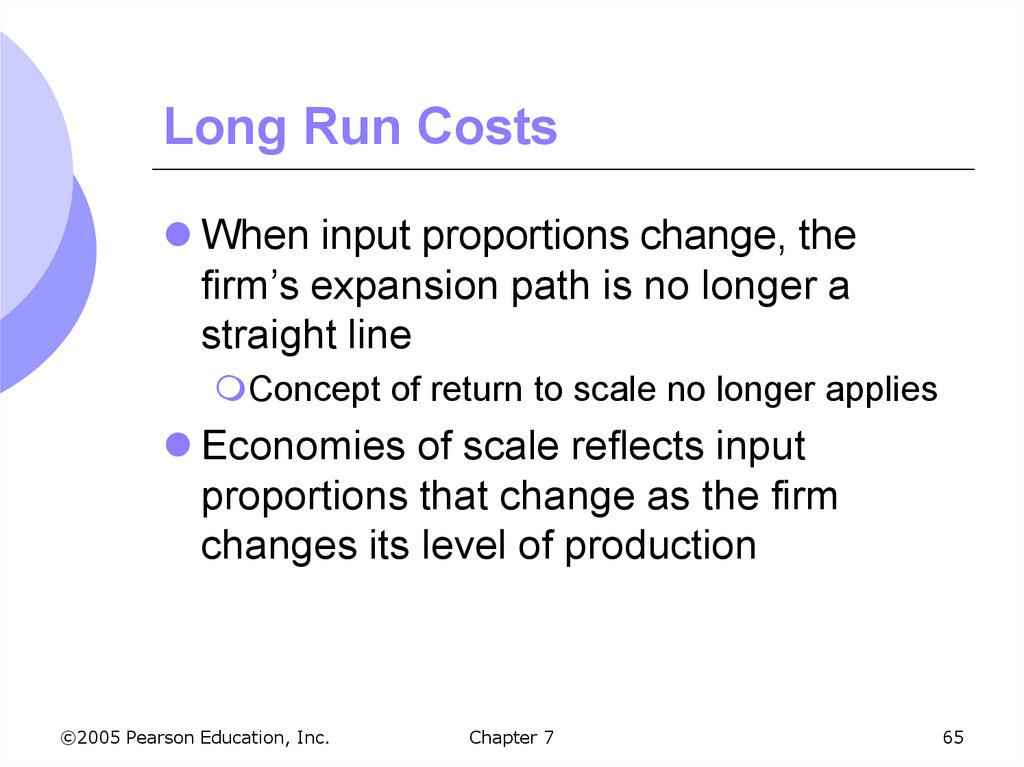
When input proportions change, thefirm’s expansion path is no longer a
straight line
Concept of return to scale no longer applies
Economies of scale reflects input
proportions that change as the firm
changes its level of production
©2005 Pearson Education, Inc.
Chapter 7
65
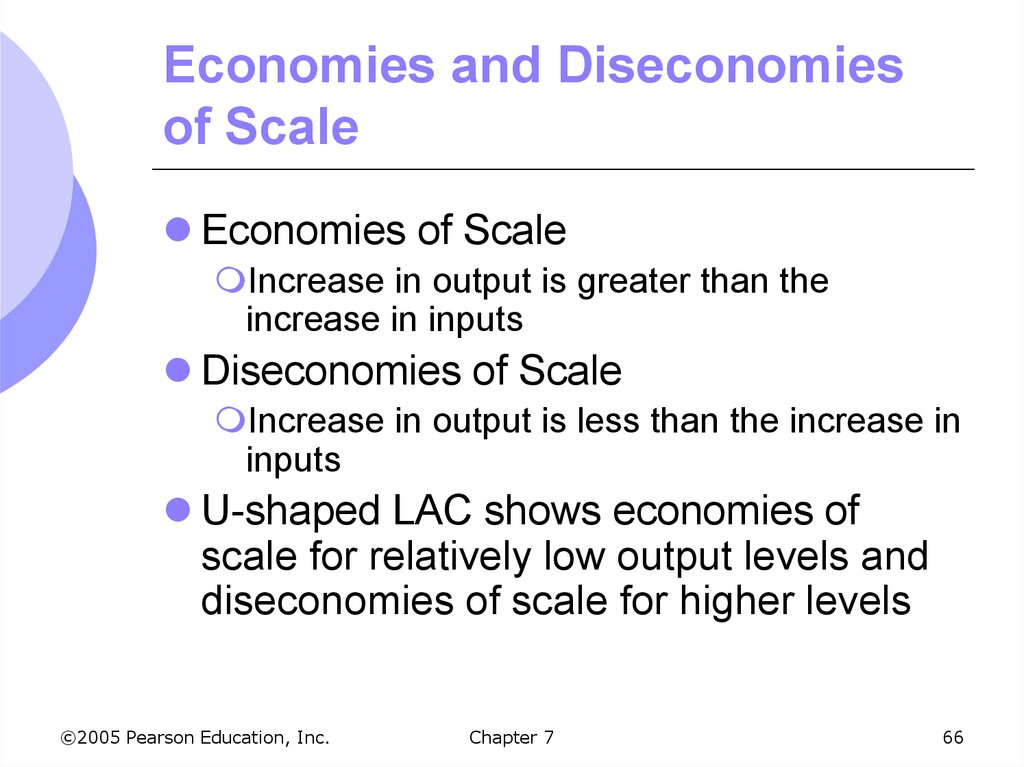
66. Economies and Diseconomies of Scale
Economies of ScaleIncrease in output is greater than the
increase in inputs
Diseconomies of Scale
Increase in output is less than the increase in
inputs
U-shaped LAC shows economies of
scale for relatively low output levels and
diseconomies of scale for higher levels
©2005 Pearson Education, Inc.
Chapter 7
66
67. Long Run Costs
Increasing Returns to ScaleOutput more than doubles when the
quantities of all inputs are doubled
Economies of Scale
Doubling of output requires less than a
doubling of cost
©2005 Pearson Education, Inc.
Chapter 7
67
68. Long Run Costs
Economies of scale are measured interms of cost-output elasticity, EC
EC is the percentage change in the cost
of production resulting from a 1-percent
increase in output
C
C
EC
©2005 Pearson Education, Inc.
Q Q
Chapter 7
MC
AC
68
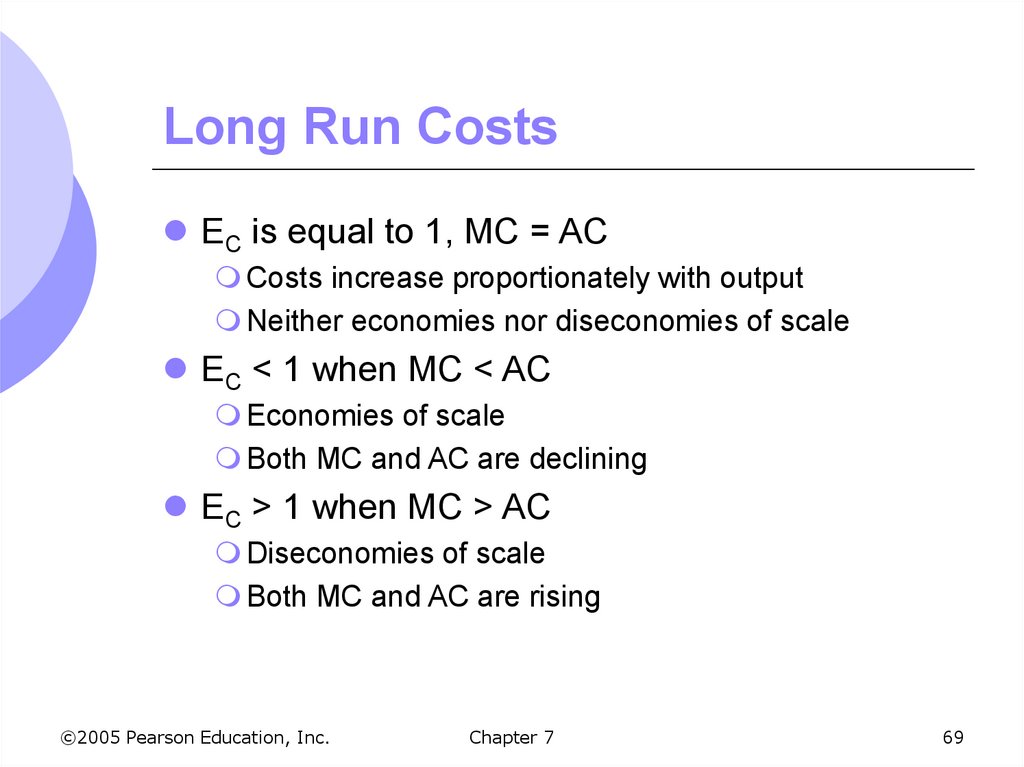
69. Long Run Costs
EC is equal to 1, MC = ACCosts increase proportionately with output
Neither economies nor diseconomies of scale
EC < 1 when MC < AC
Economies of scale
Both MC and AC are declining
EC > 1 when MC > AC
Diseconomies of scale
Both MC and AC are rising
©2005 Pearson Education, Inc.
Chapter 7
69
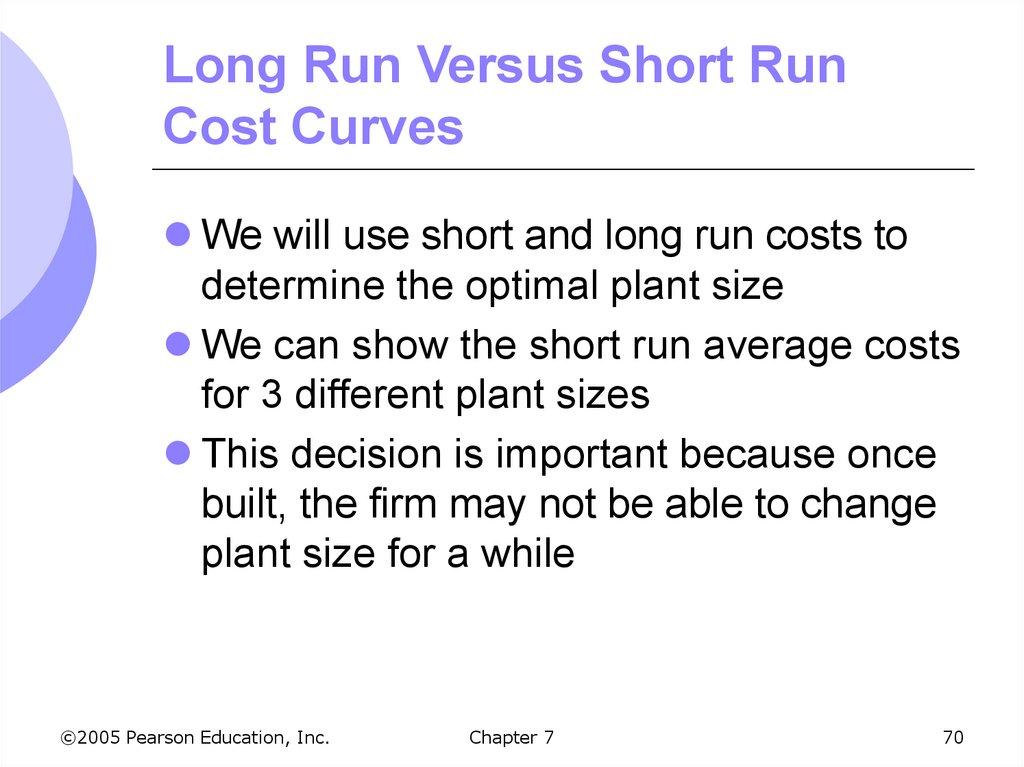
70. Long Run Versus Short Run Cost Curves
We will use short and long run costs todetermine the optimal plant size
We can show the short run average costs
for 3 different plant sizes
This decision is important because once
built, the firm may not be able to change
plant size for a while
©2005 Pearson Education, Inc.
Chapter 7
70
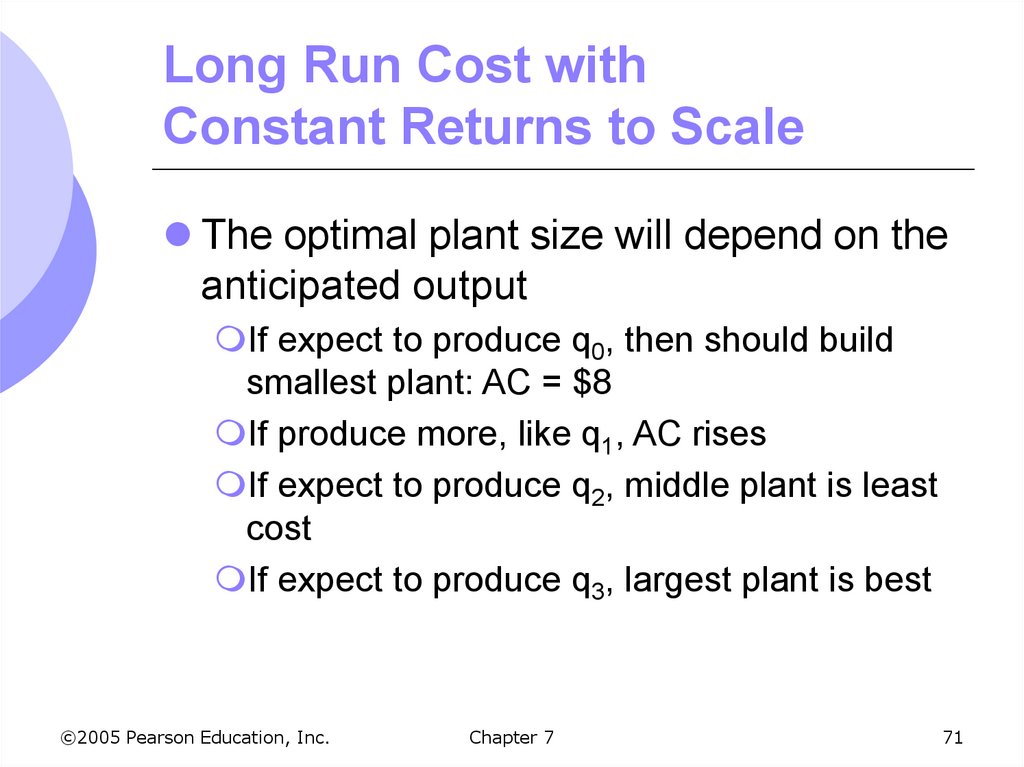
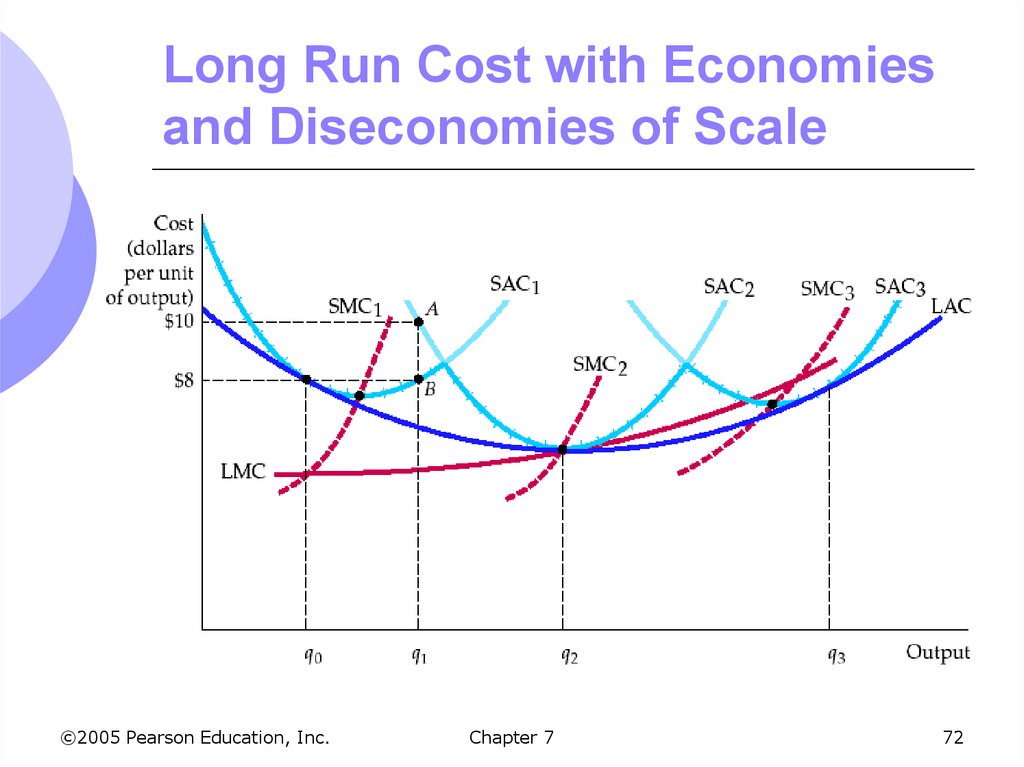
71. Long Run Cost with Constant Returns to Scale
The optimal plant size will depend on theanticipated output
If expect to produce q0, then should build
smallest plant: AC = $8
If produce more, like q1, AC rises
If expect to produce q2, middle plant is least
cost
If expect to produce q3, largest plant is best
©2005 Pearson Education, Inc.
Chapter 7
71
72. Long Run Cost with Economies and Diseconomies of Scale
©2005 Pearson Education, Inc.Chapter 7
72
73. Long Run Cost with Constant Returns to Scale
What is the firm’s long run cost curve?Firms can change scale to change output in
the long run
The long run cost curve is the dark blue
portion of the SAC curve which represents
the minimum cost for any level of output
Firm will always choose plant that minimizes
the average cost of production
©2005 Pearson Education, Inc.
Chapter 7
73
74. Long Run Cost with Constant Returns to Scale
The long-run average cost curveenvelops the short-run average cost
curves
The LAC curve exhibits economies of
scale initially but exhibits diseconomies
at higher output levels
©2005 Pearson Education, Inc.
Chapter 7
74
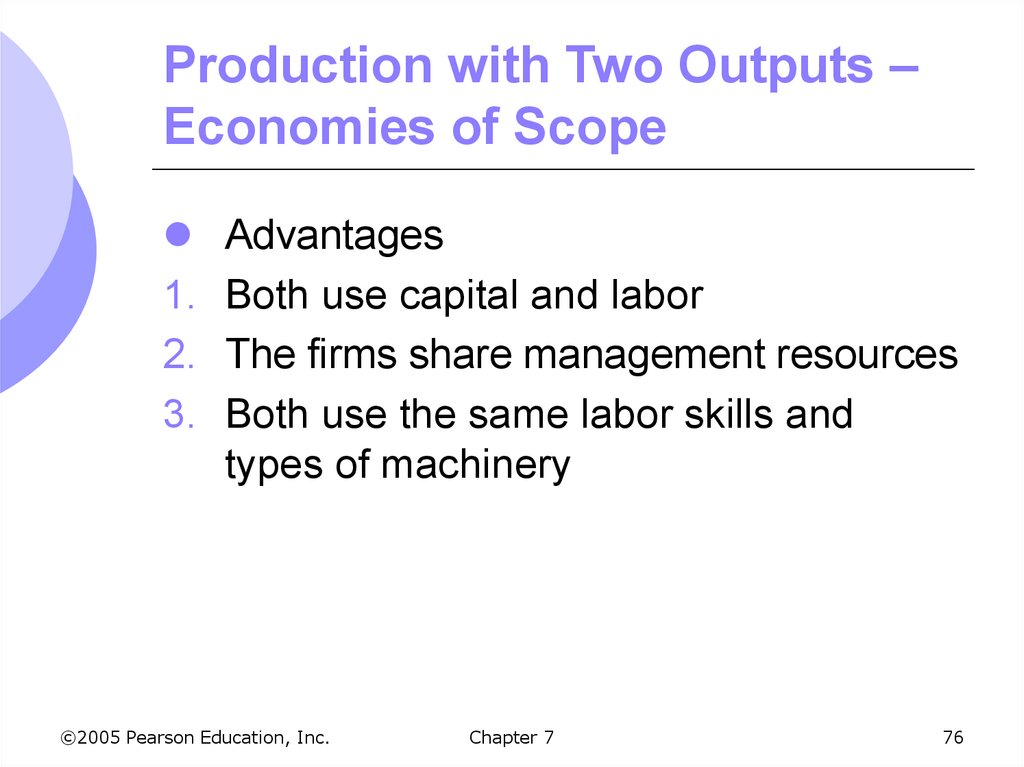
75. Production with Two Outputs – Economies of Scope
Many firms produce more than oneproduct and those products are closely
linked
Examples:
Chicken farm--poultry and eggs
Automobile company--cars and trucks
University--teaching and research
©2005 Pearson Education, Inc.
Chapter 7
75
76. Production with Two Outputs – Economies of Scope
Advantages1. Both use capital and labor
2. The firms share management resources
3. Both use the same labor skills and
types of machinery
©2005 Pearson Education, Inc.
Chapter 7
76
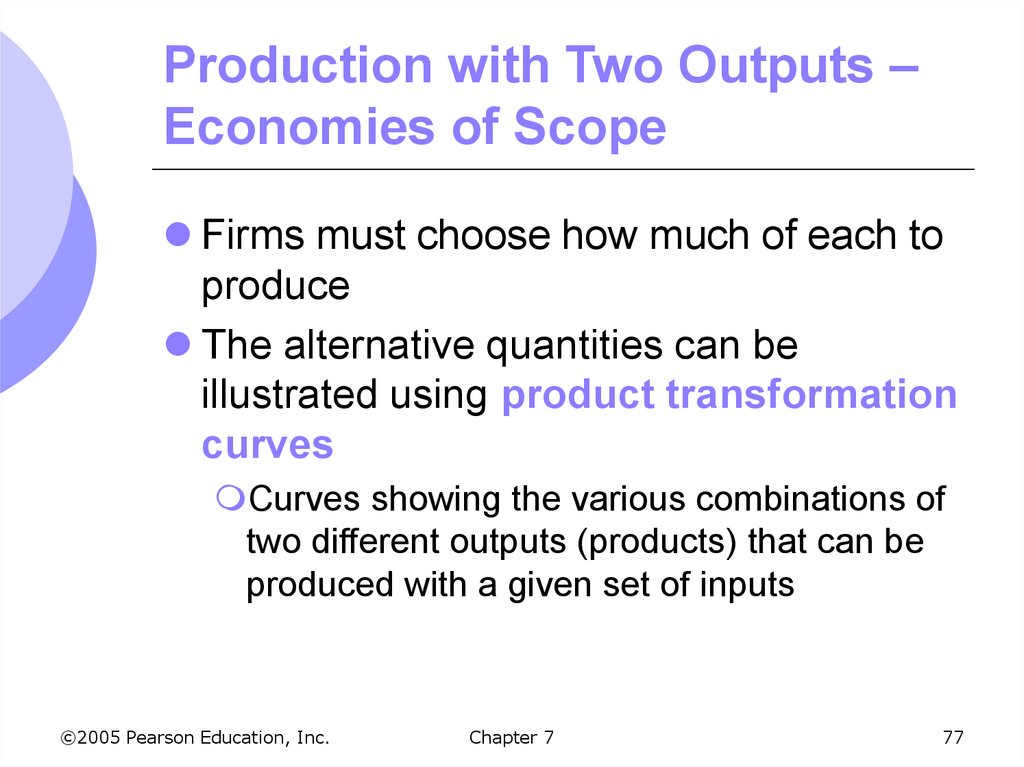
77. Production with Two Outputs – Economies of Scope
Firms must choose how much of each toproduce
The alternative quantities can be
illustrated using product transformation
curves
Curves showing the various combinations of
two different outputs (products) that can be
produced with a given set of inputs
©2005 Pearson Education, Inc.
Chapter 7
77
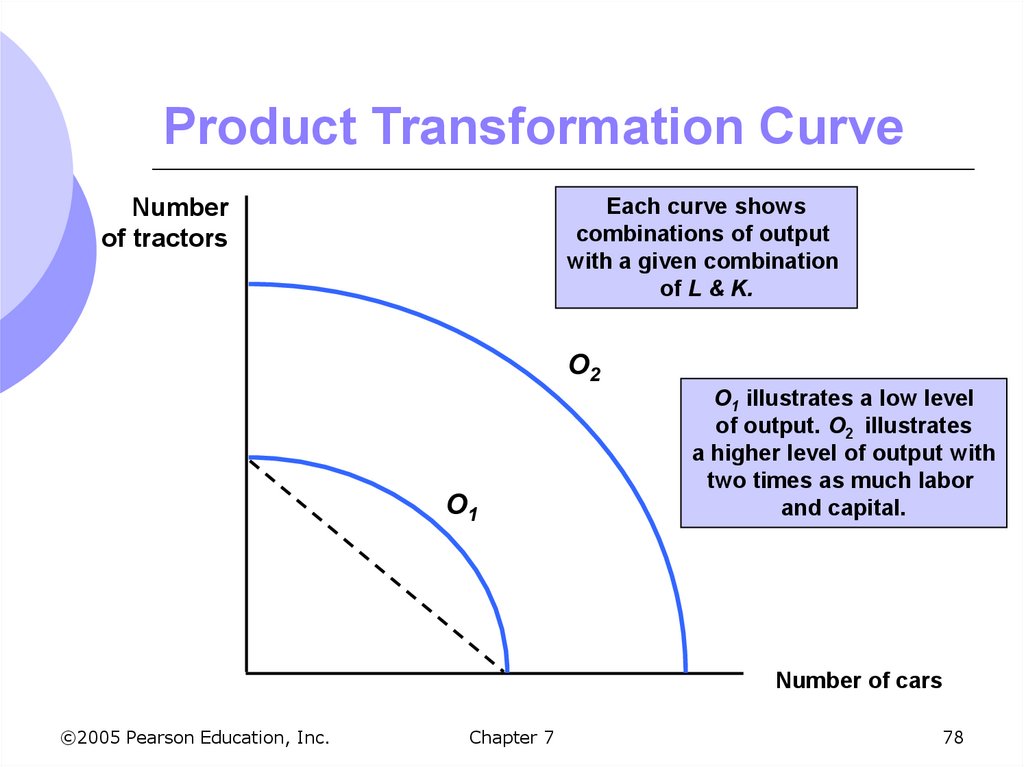
78. Product Transformation Curve
Numberof tractors
Each curve shows
combinations of output
with a given combination
of L & K.
O2
O1
O1 illustrates a low level
of output. O2 illustrates
a higher level of output with
two times as much labor
and capital.
Number of cars
©2005 Pearson Education, Inc.
Chapter 7
78
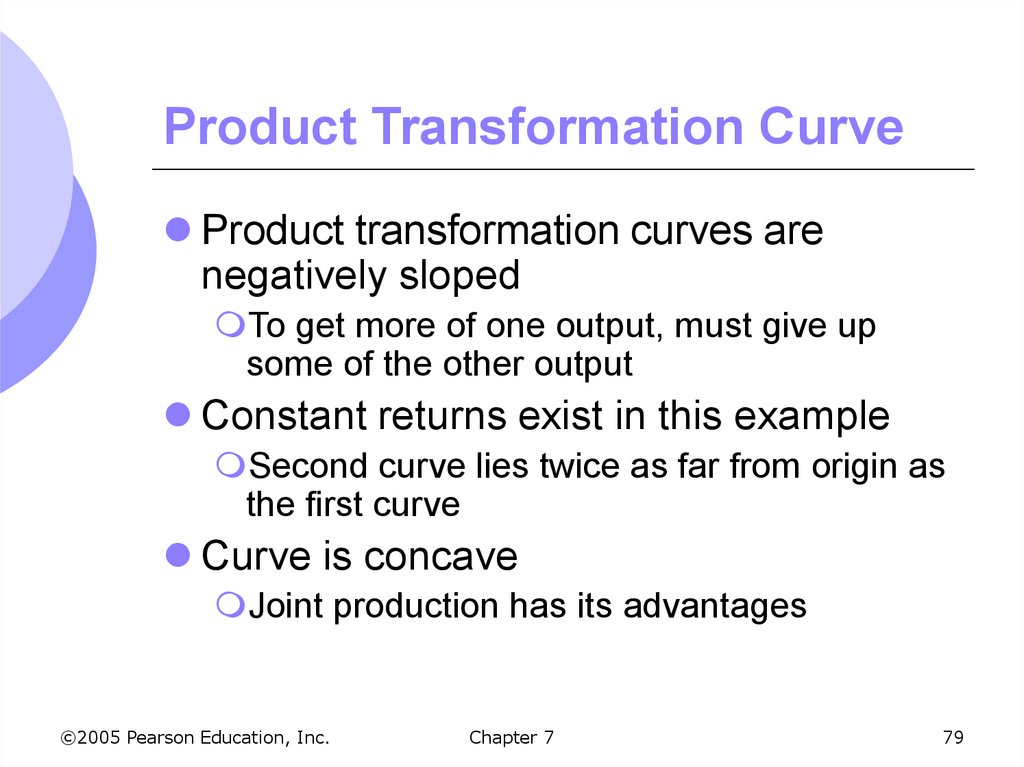
79. Product Transformation Curve
Product transformation curves arenegatively sloped
To get more of one output, must give up
some of the other output
Constant returns exist in this example
Second curve lies twice as far from origin as
the first curve
Curve is concave
Joint production has its advantages
©2005 Pearson Education, Inc.
Chapter 7
79
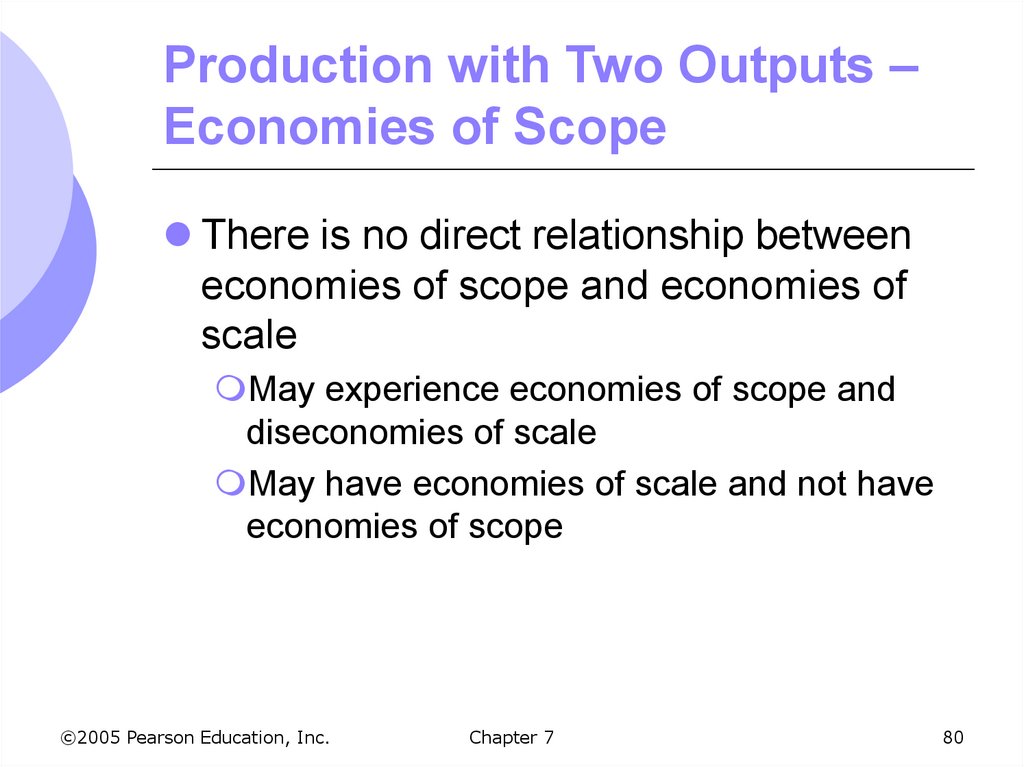
80. Production with Two Outputs – Economies of Scope
There is no direct relationship betweeneconomies of scope and economies of
scale
May experience economies of scope and
diseconomies of scale
May have economies of scale and not have
economies of scope
©2005 Pearson Education, Inc.
Chapter 7
80
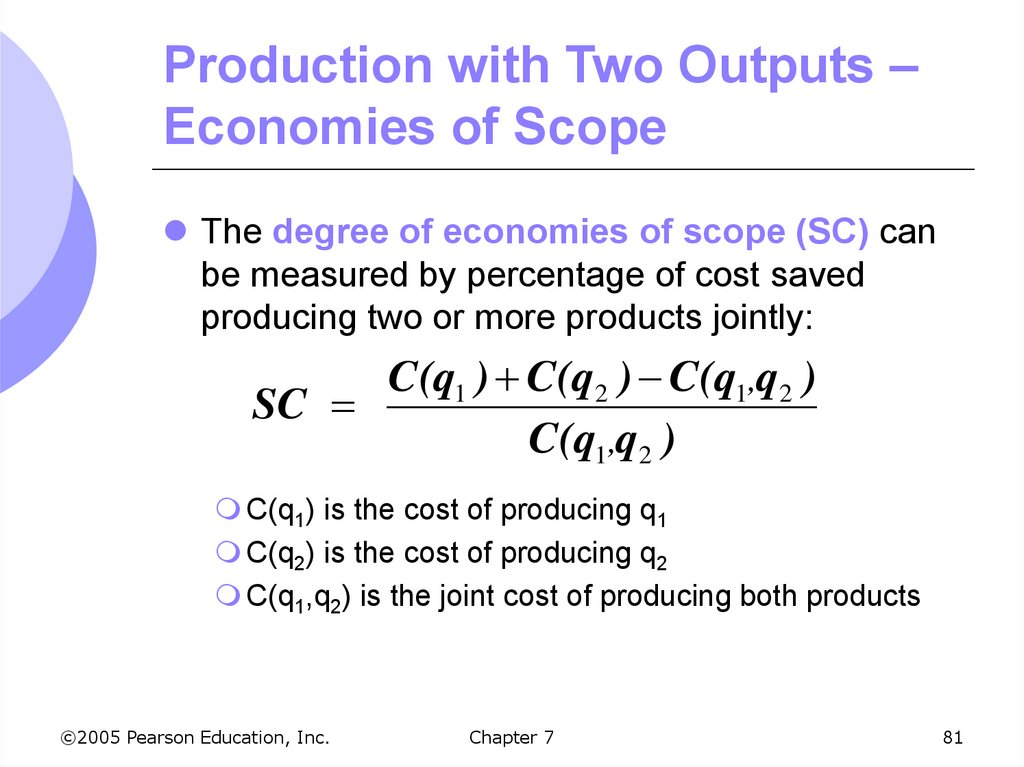
81. Production with Two Outputs – Economies of Scope
The degree of economies of scope (SC) canbe measured by percentage of cost saved
producing two or more products jointly:
C(q1 ) C(q2 ) C(q1 ,q2 )
SC
C(q1 ,q2 )
C(q1) is the cost of producing q1
C(q2) is the cost of producing q2
C(q1,q2) is the joint cost of producing both products
©2005 Pearson Education, Inc.
Chapter 7
81
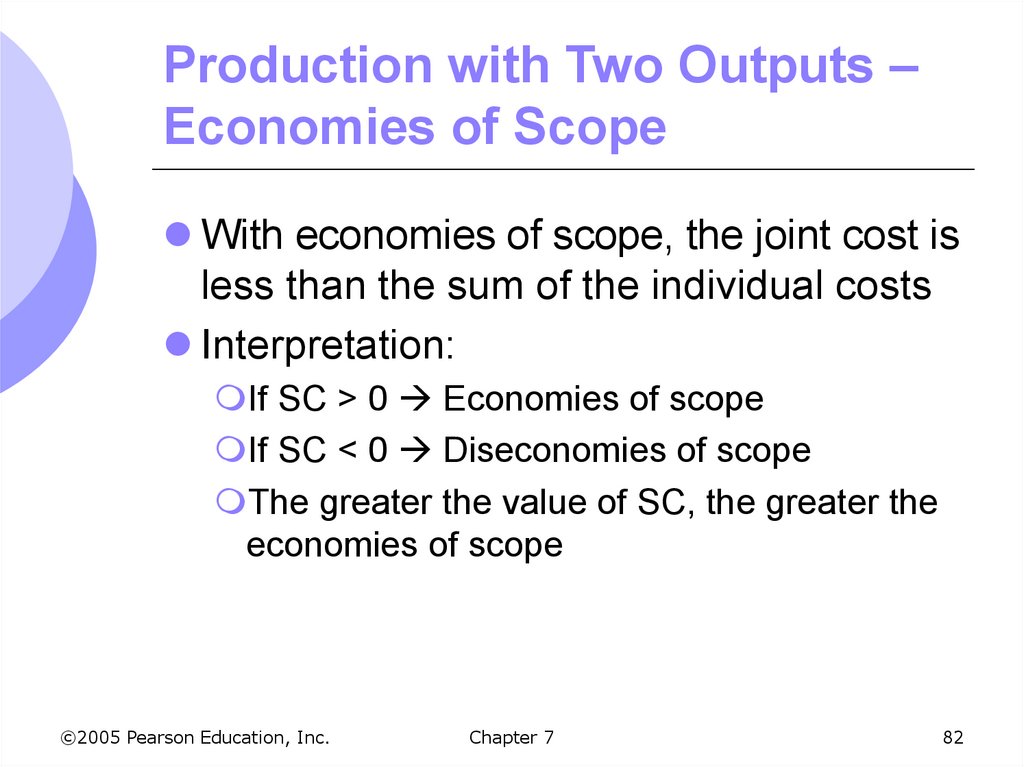
82. Production with Two Outputs – Economies of Scope
With economies of scope, the joint cost isless than the sum of the individual costs
Interpretation:
If SC > 0 Economies of scope
If SC < 0 Diseconomies of scope
The greater the value of SC, the greater the
economies of scope
©2005 Pearson Education, Inc.
Chapter 7
82
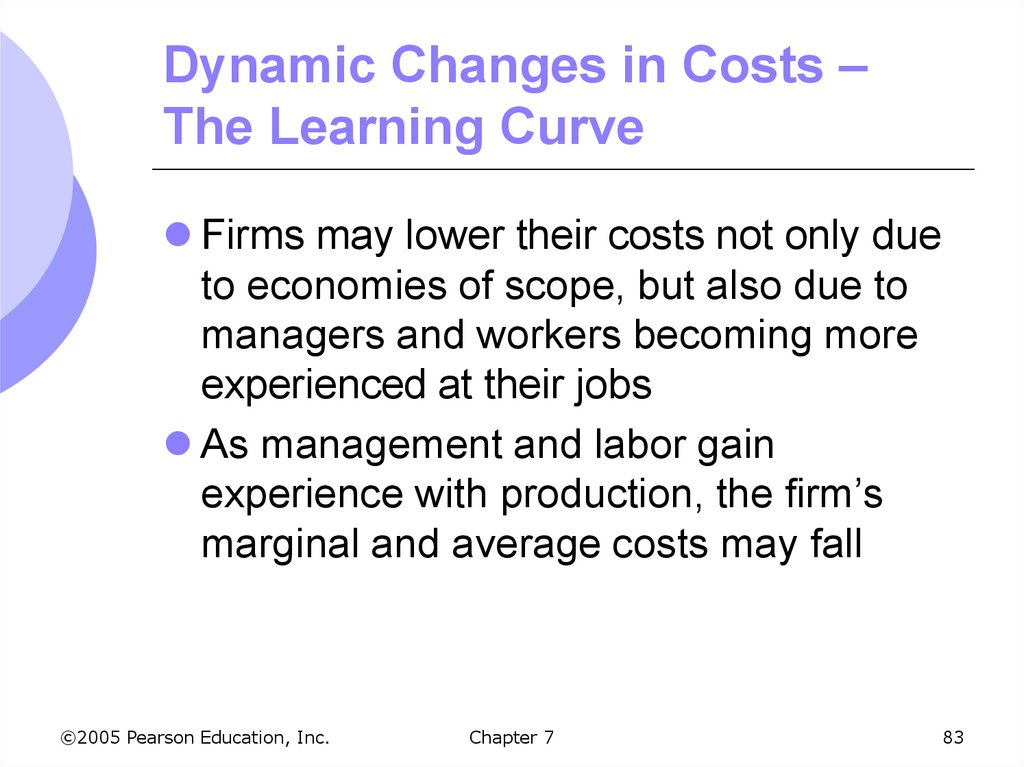
83. Dynamic Changes in Costs – The Learning Curve
Firms may lower their costs not only dueto economies of scope, but also due to
managers and workers becoming more
experienced at their jobs
As management and labor gain
experience with production, the firm’s
marginal and average costs may fall
©2005 Pearson Education, Inc.
Chapter 7
83
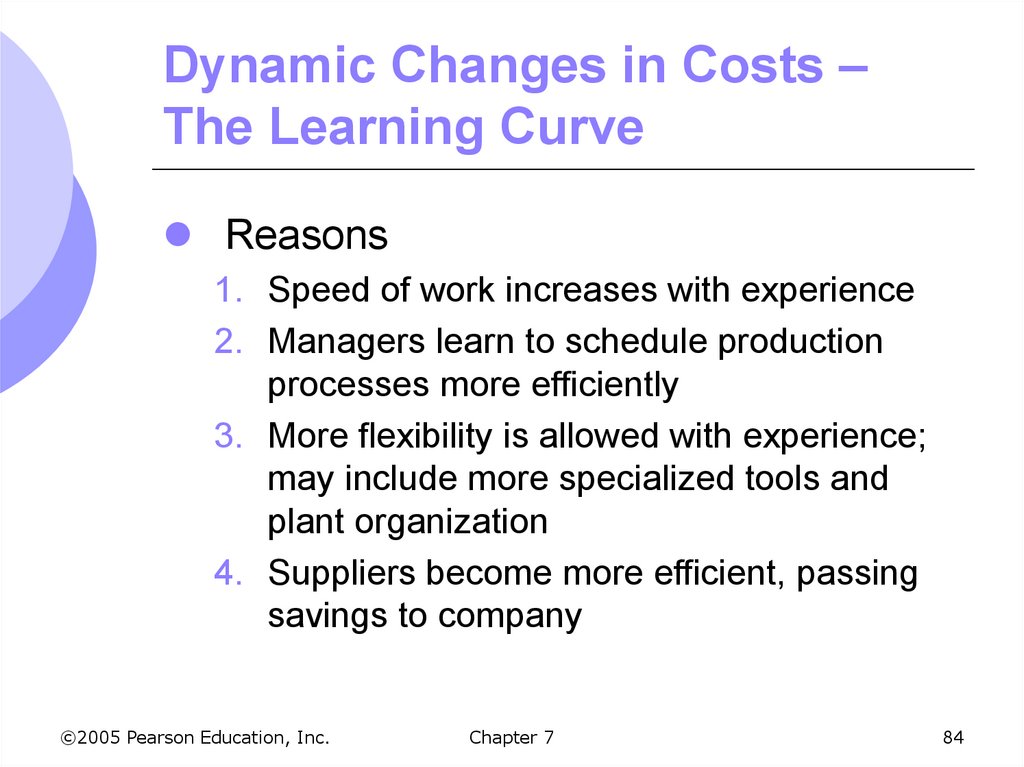
84. Dynamic Changes in Costs – The Learning Curve
Reasons1. Speed of work increases with experience
2. Managers learn to schedule production
processes more efficiently
3. More flexibility is allowed with experience;
may include more specialized tools and
plant organization
4. Suppliers become more efficient, passing
savings to company
©2005 Pearson Education, Inc.
Chapter 7
84
85. Dynamic Changes in Costs – The Learning Curve
The learning curve measures the impactof workers’ experience on the costs of
production
It describes the relationship between a
firm’s cumulative output and the amount
of inputs needed to produce a unit of
output
©2005 Pearson Education, Inc.
Chapter 7
85
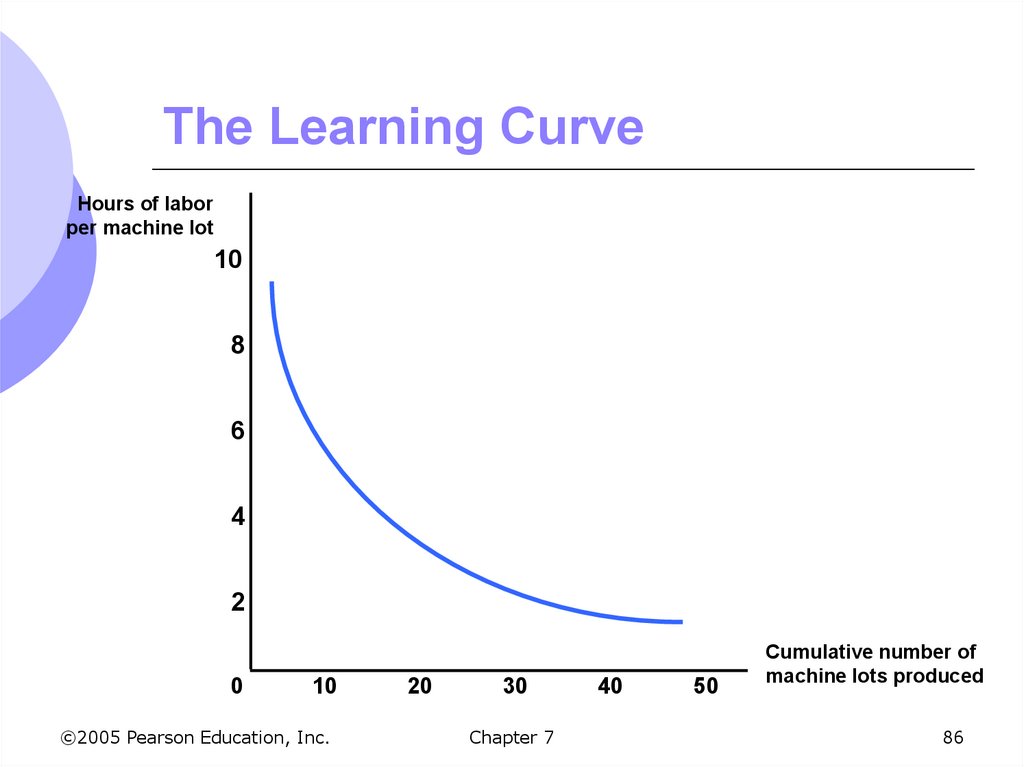
86. The Learning Curve
Hours of laborper machine lot
10
8
6
4
2
0
10
©2005 Pearson Education, Inc.
20
30
Chapter 7
40
50
Cumulative number of
machine lots produced
86
87. The Learning Curve
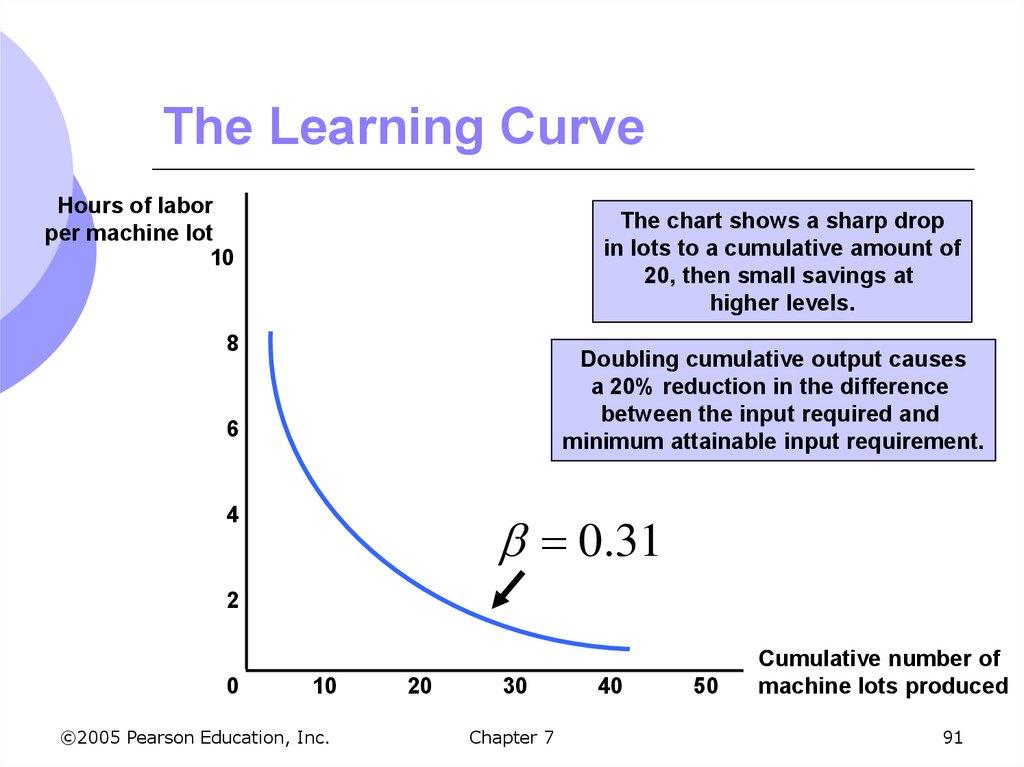
The horizontal axis measures thecumulative number of hours of machine
tools the firm has produced
The vertical axis measures the number of
hours of labor needed to produce each
lot
©2005 Pearson Education, Inc.
Chapter 7
87
88. Dynamic Changes in Costs – The Learning Curve
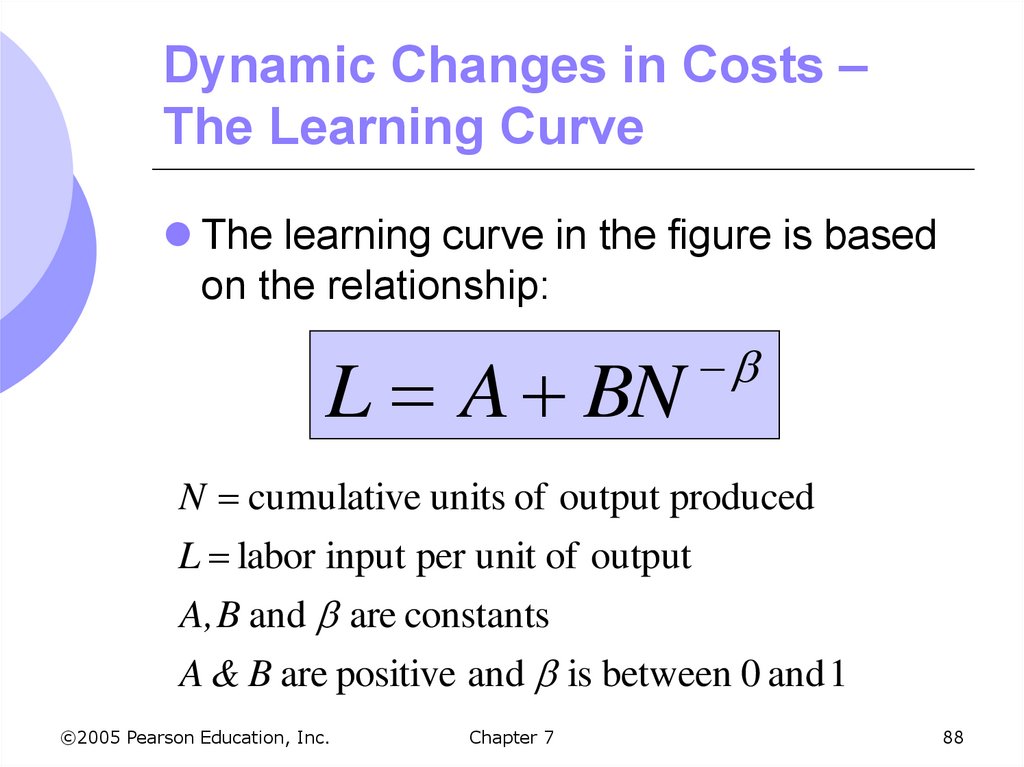
The learning curve in the figure is basedon the relationship:
L A BN
N cumulative units of output produced
L labor input per unit of output
A, B and are constants
A & B are positive and is between 0 and 1
©2005 Pearson Education, Inc.
Chapter 7
88
89. Dynamic Changes in Costs – The Learning Curve
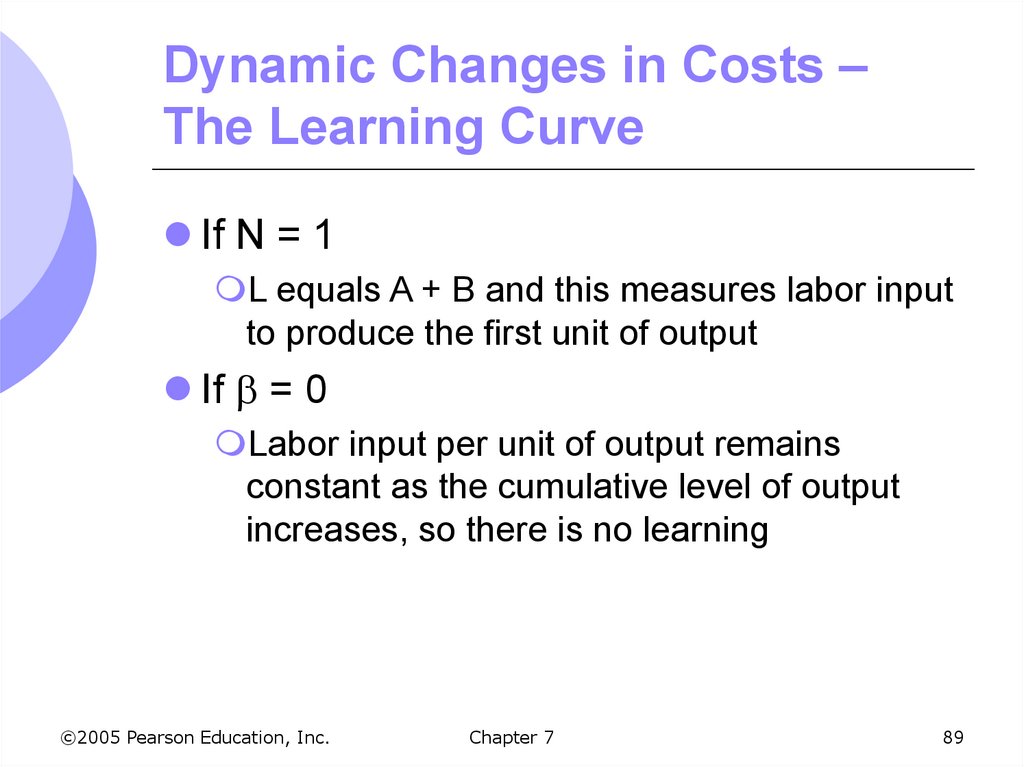
If N = 1L equals A + B and this measures labor input
to produce the first unit of output
If = 0
Labor input per unit of output remains
constant as the cumulative level of output
increases, so there is no learning
©2005 Pearson Education, Inc.
Chapter 7
89
90. Dynamic Changes in Costs – The Learning Curve
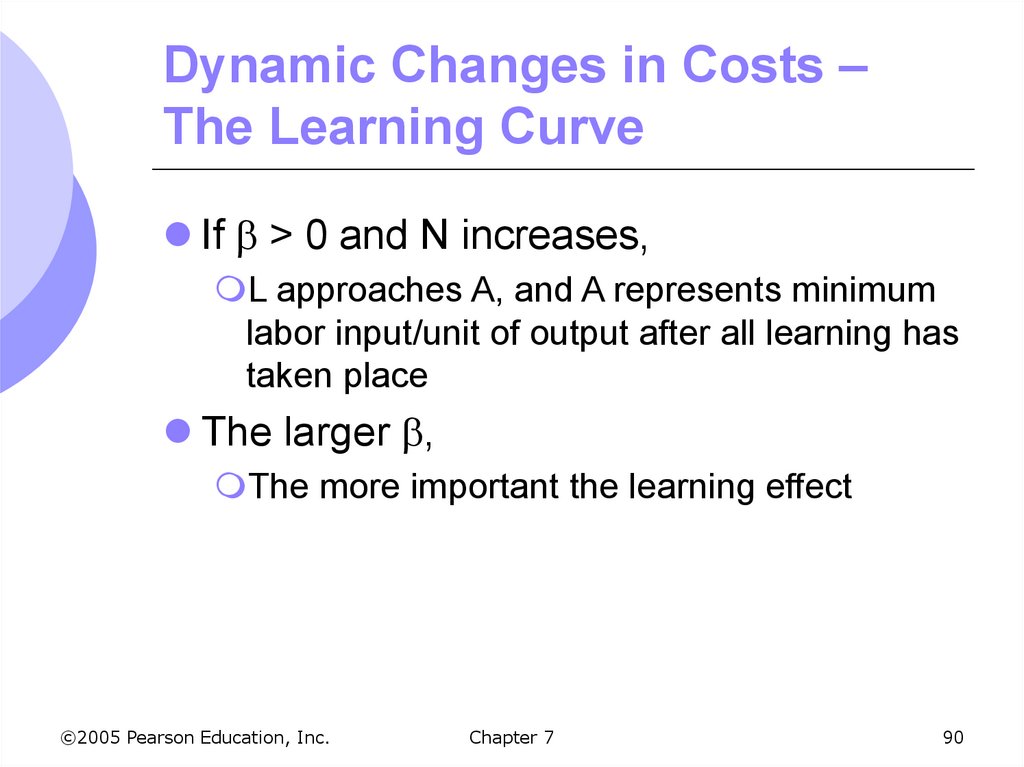
If > 0 and N increases,L approaches A, and A represents minimum
labor input/unit of output after all learning has
taken place
The larger ,
The more important the learning effect
©2005 Pearson Education, Inc.
Chapter 7
90
91. The Learning Curve
Hours of laborper machine lot
10
The chart shows a sharp drop
in lots to a cumulative amount of
20, then small savings at
higher levels.
8
Doubling cumulative output causes
a 20% reduction in the difference
between the input required and
minimum attainable input requirement.
6
0.31
4
2
0
10
©2005 Pearson Education, Inc.
20
30
Chapter 7
40
50
Cumulative number of
machine lots produced
91
92. Dynamic Changes in Costs – The Learning Curve
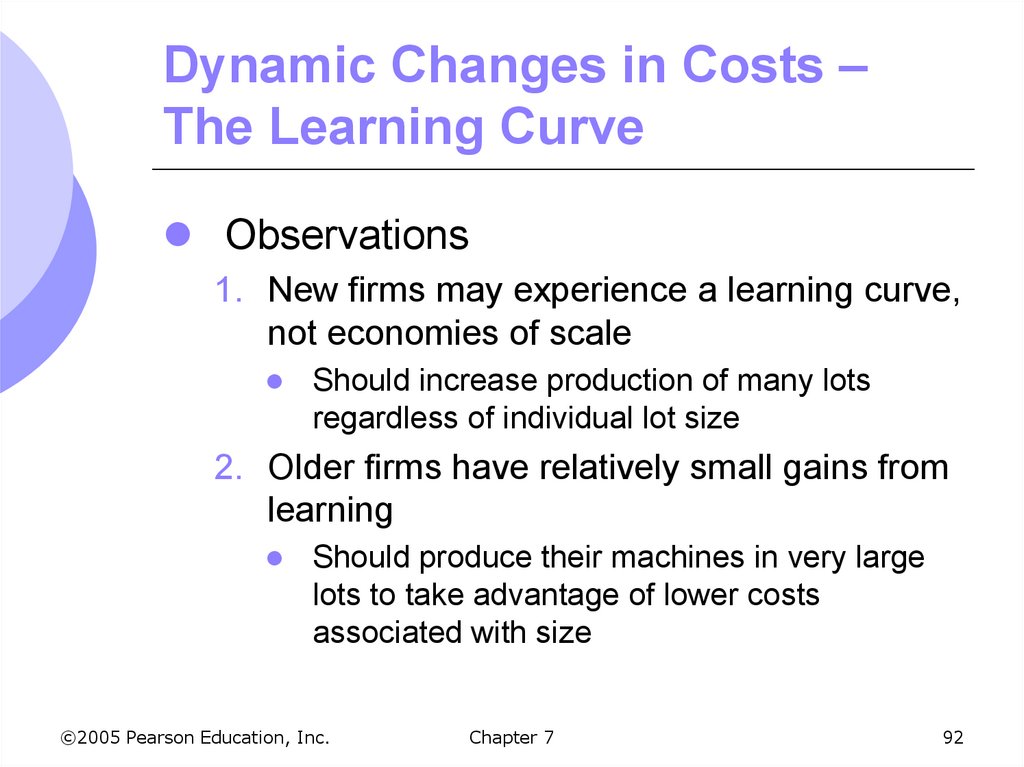
Observations1. New firms may experience a learning curve,
not economies of scale
Should increase production of many lots
regardless of individual lot size
2. Older firms have relatively small gains from
learning
Should produce their machines in very large
lots to take advantage of lower costs
associated with size
©2005 Pearson Education, Inc.
Chapter 7
92
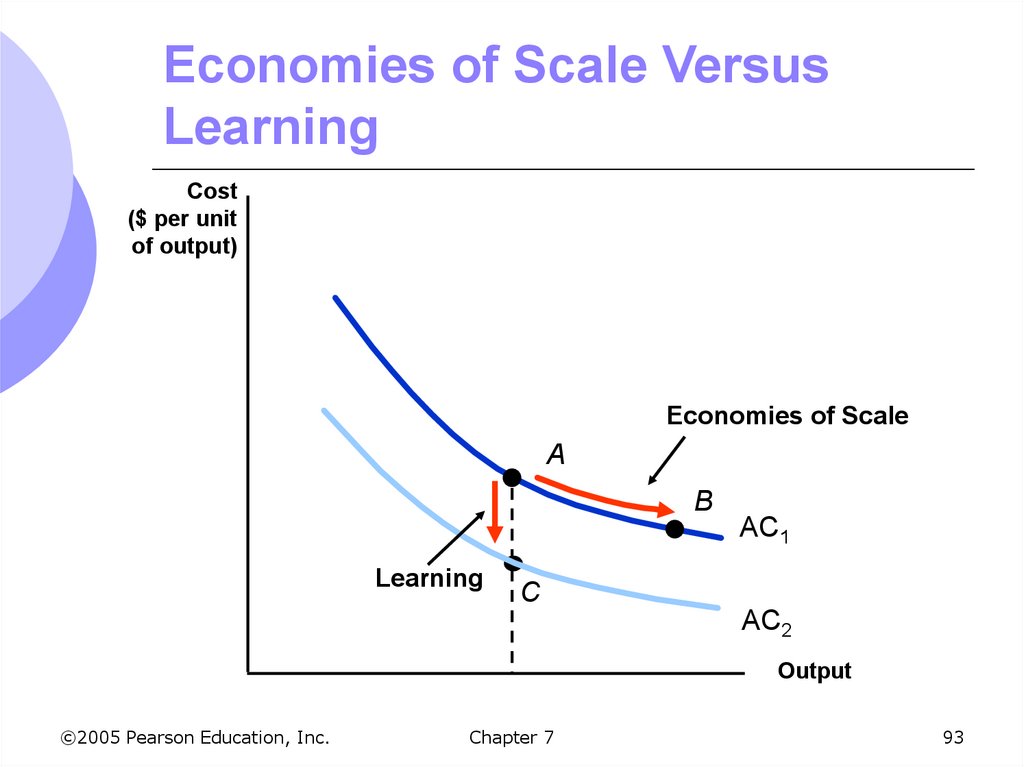
93. Economies of Scale Versus Learning
Cost($ per unit
of output)
Economies of Scale
A
B
Learning
AC1
C
AC2
Output
©2005 Pearson Education, Inc.
Chapter 7
93
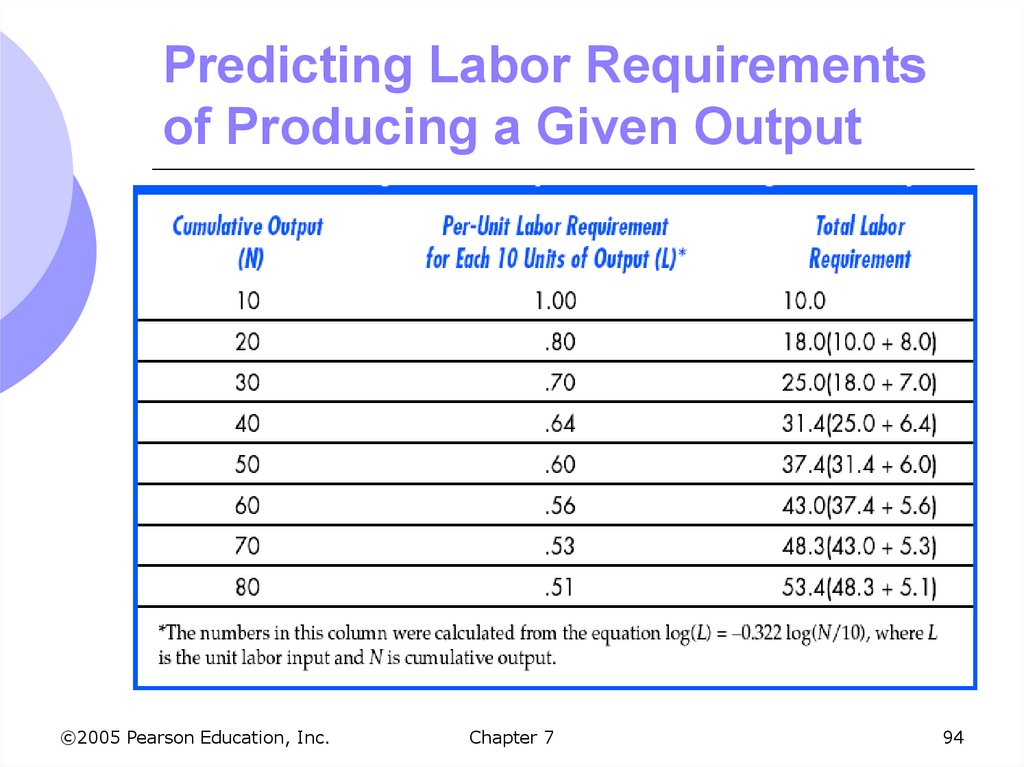
94. Predicting Labor Requirements of Producing a Given Output
©2005 Pearson Education, Inc.Chapter 7
94
95. Dynamic Changes in Costs – The Learning Curve
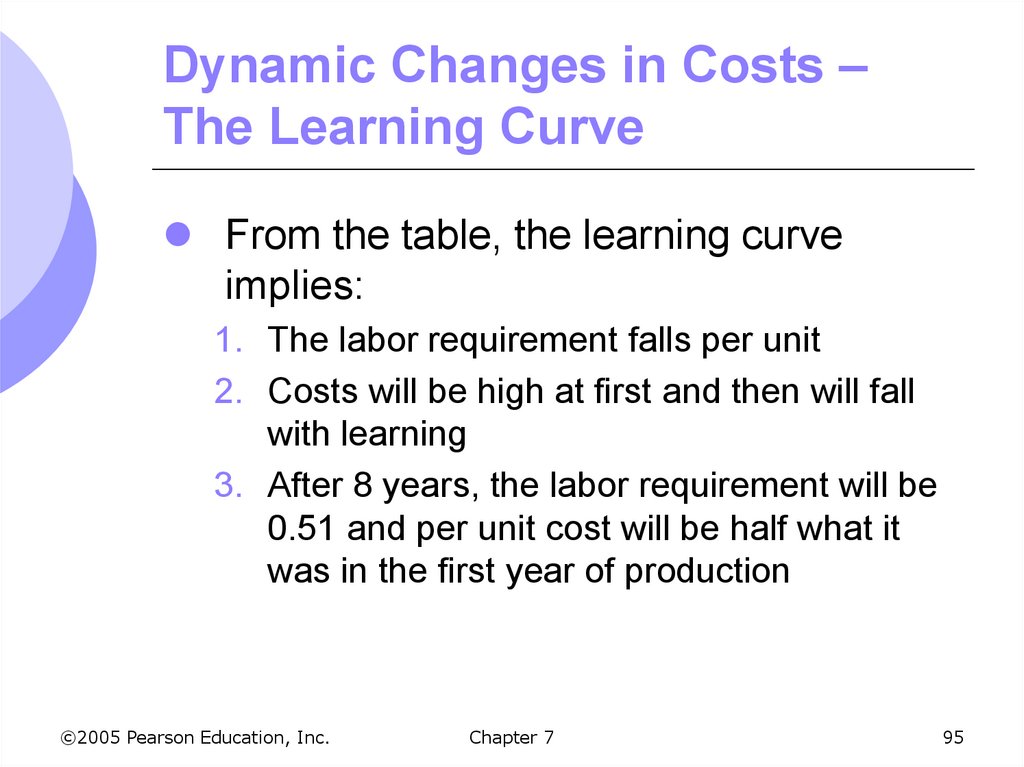
From the table, the learning curveimplies:
1. The labor requirement falls per unit
2. Costs will be high at first and then will fall
with learning
3. After 8 years, the labor requirement will be
0.51 and per unit cost will be half what it
was in the first year of production
©2005 Pearson Education, Inc.
Chapter 7
95
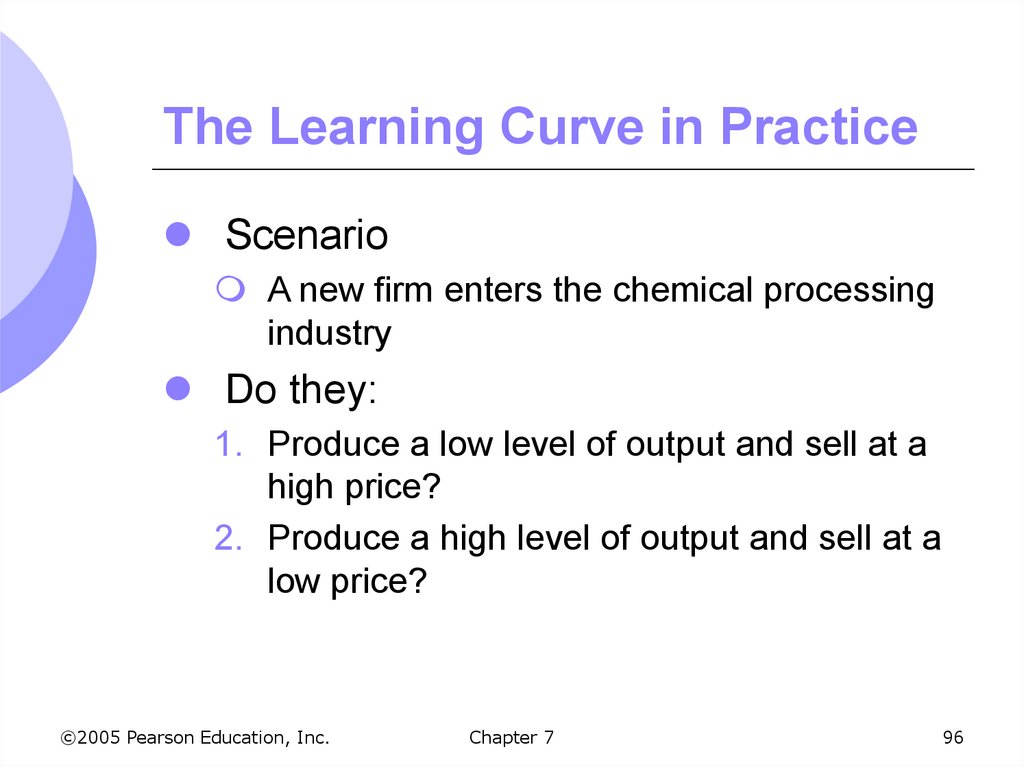
96. The Learning Curve in Practice
ScenarioA new firm enters the chemical processing
industry
Do they:
1. Produce a low level of output and sell at a
high price?
2. Produce a high level of output and sell at a
low price?
©2005 Pearson Education, Inc.
Chapter 7
96
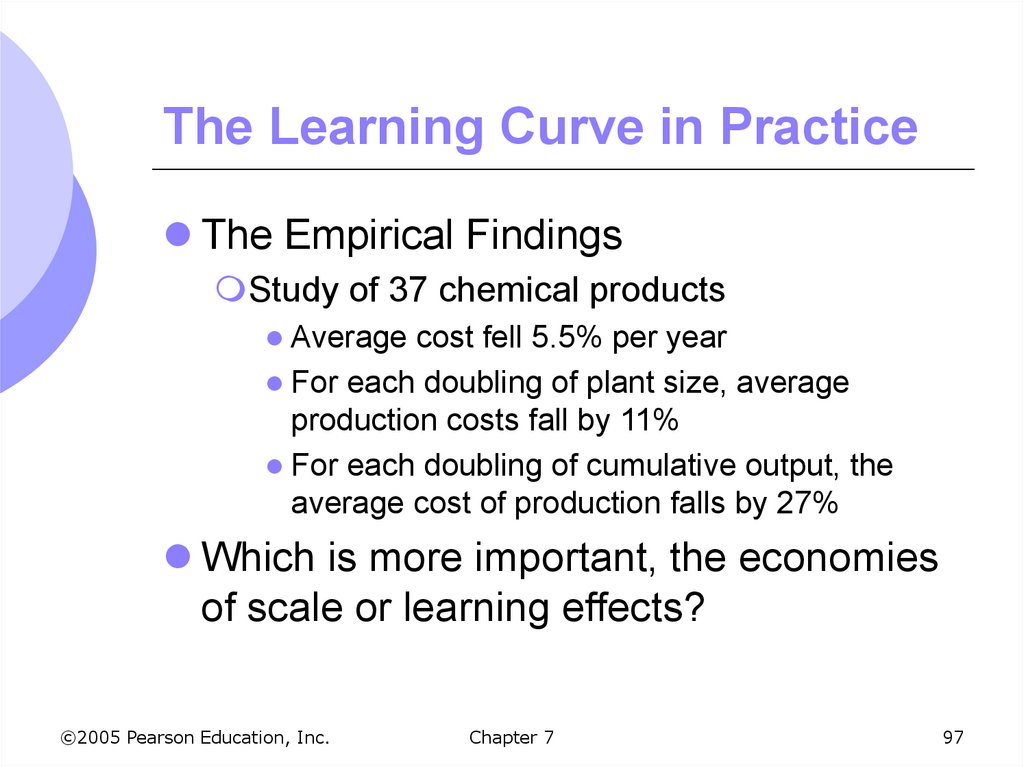
97. The Learning Curve in Practice
The Empirical FindingsStudy of 37 chemical products
Average cost fell 5.5% per year
For each doubling of plant size, average
production costs fall by 11%
For each doubling of cumulative output, the
average cost of production falls by 27%
Which is more important, the economies
of scale or learning effects?
©2005 Pearson Education, Inc.
Chapter 7
97
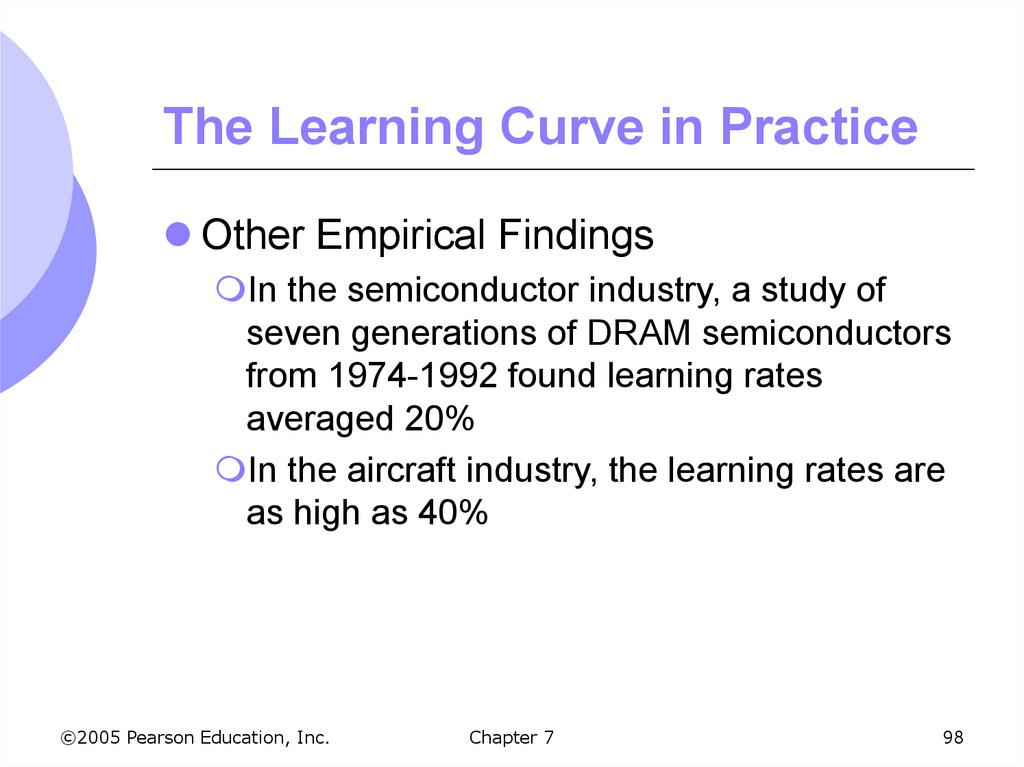
98. The Learning Curve in Practice
Other Empirical FindingsIn the semiconductor industry, a study of
seven generations of DRAM semiconductors
from 1974-1992 found learning rates
averaged 20%
In the aircraft industry, the learning rates are
as high as 40%
©2005 Pearson Education, Inc.
Chapter 7
98
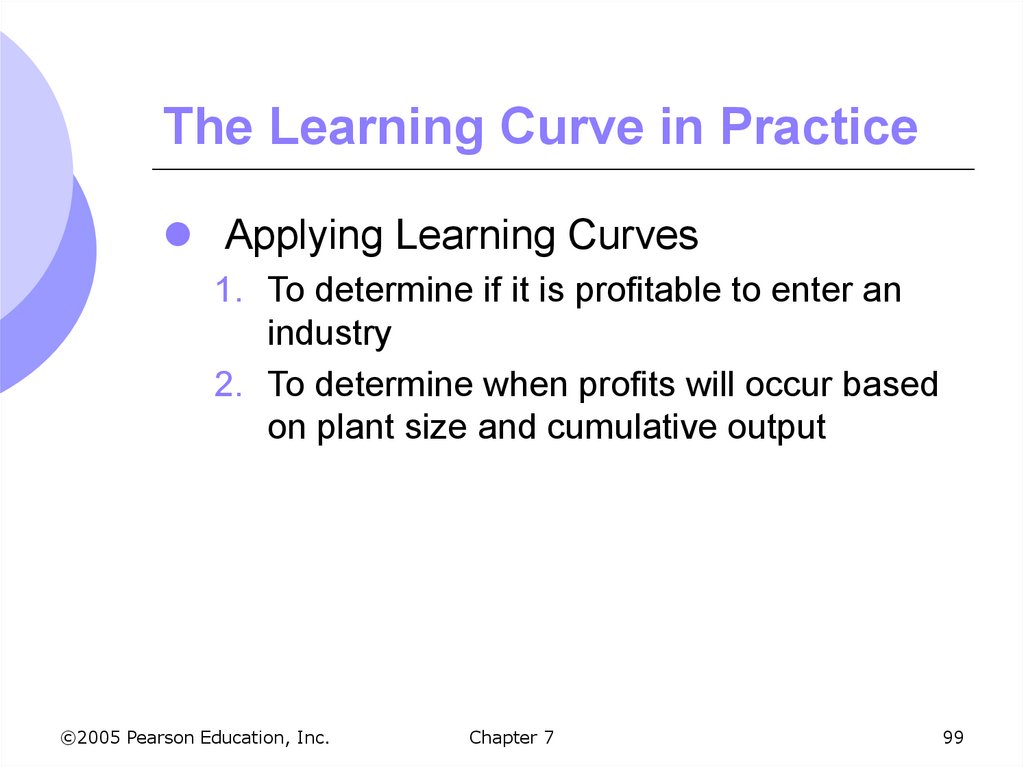
99. The Learning Curve in Practice
Applying Learning Curves1. To determine if it is profitable to enter an
industry
2. To determine when profits will occur based
on plant size and cumulative output
©2005 Pearson Education, Inc.
Chapter 7
99
100. Estimating and Predicting Cost
Estimates of future costs can be obtainedfrom a cost function, which relates the
cost of production to the level of output
and other variables that the firm can
control
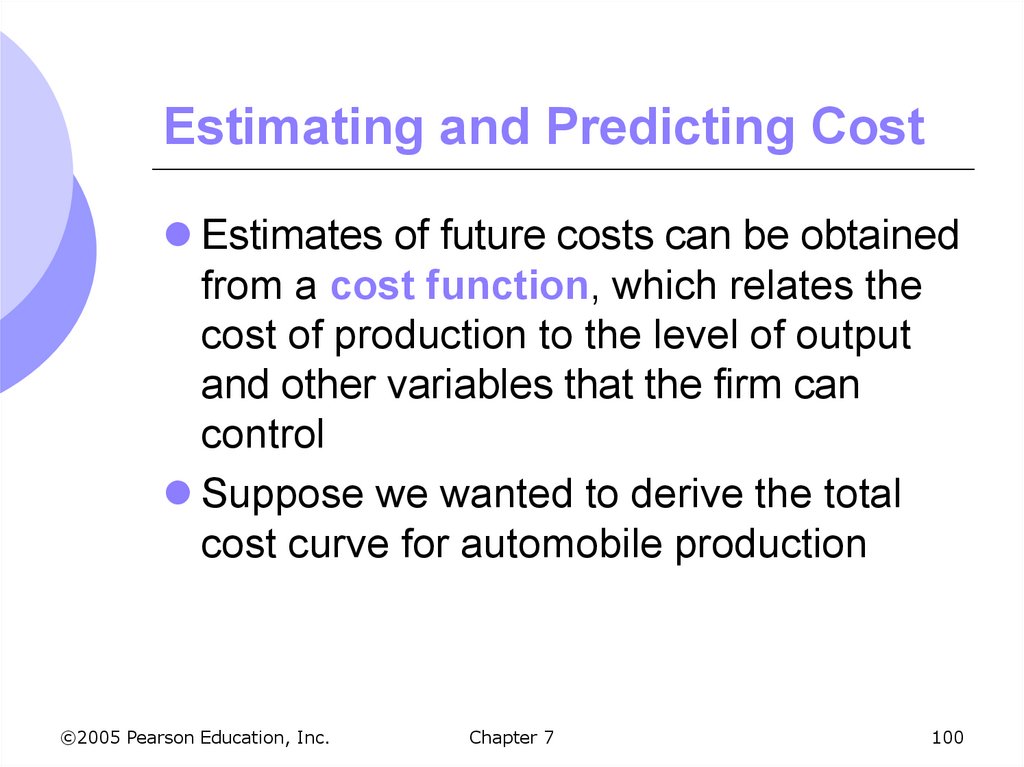
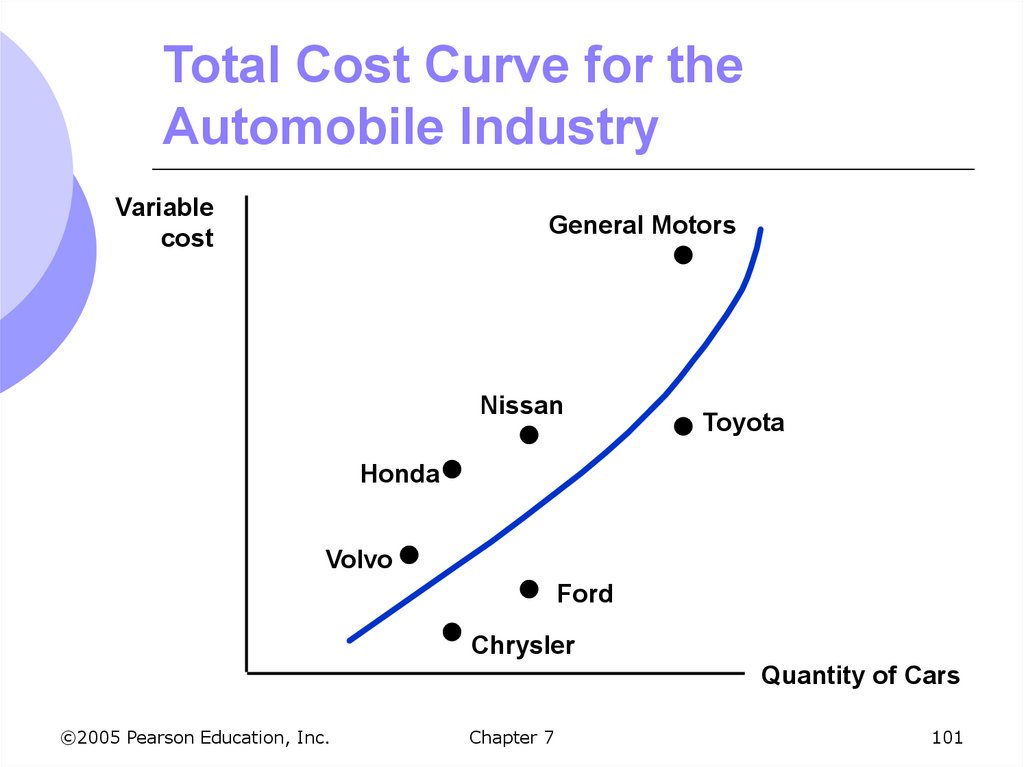
Suppose we wanted to derive the total
cost curve for automobile production
©2005 Pearson Education, Inc.
Chapter 7
100
101. Total Cost Curve for the Automobile Industry
Variablecost
General Motors
Nissan
Toyota
Honda
Volvo
Ford
Chrysler
Quantity of Cars
©2005 Pearson Education, Inc.
Chapter 7
101
102. Estimating and Predicting Cost
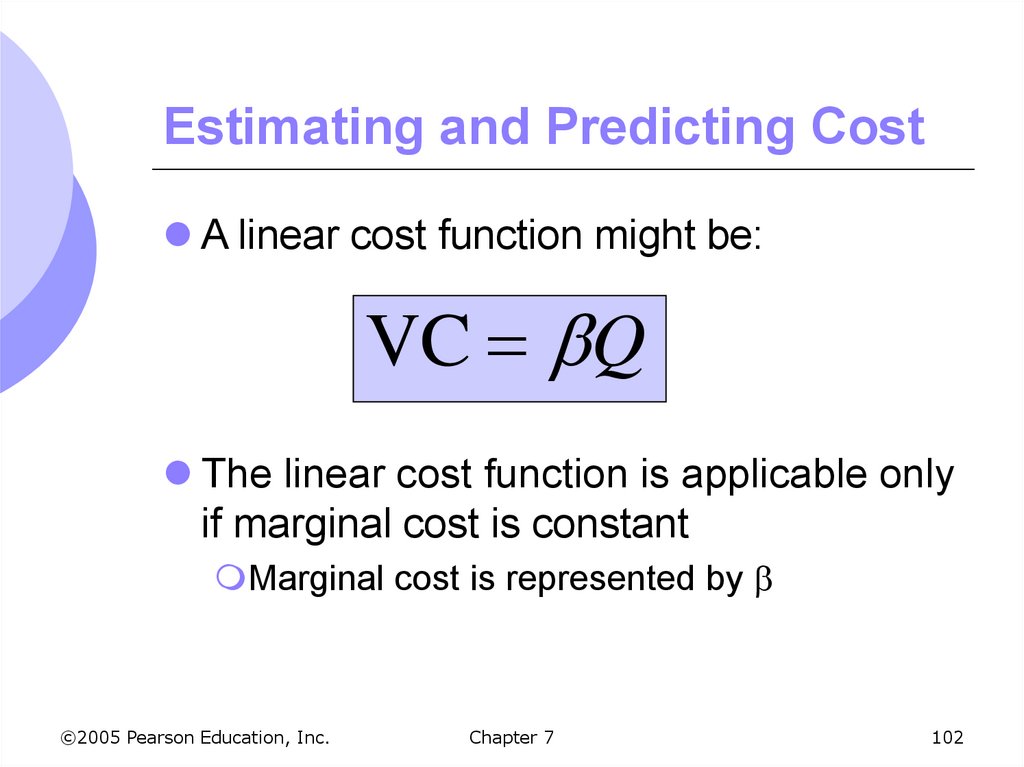
A linear cost function might be:VC Q
The linear cost function is applicable only
if marginal cost is constant
Marginal cost is represented by
©2005 Pearson Education, Inc.
Chapter 7
102
103. Estimating and Predicting Cost
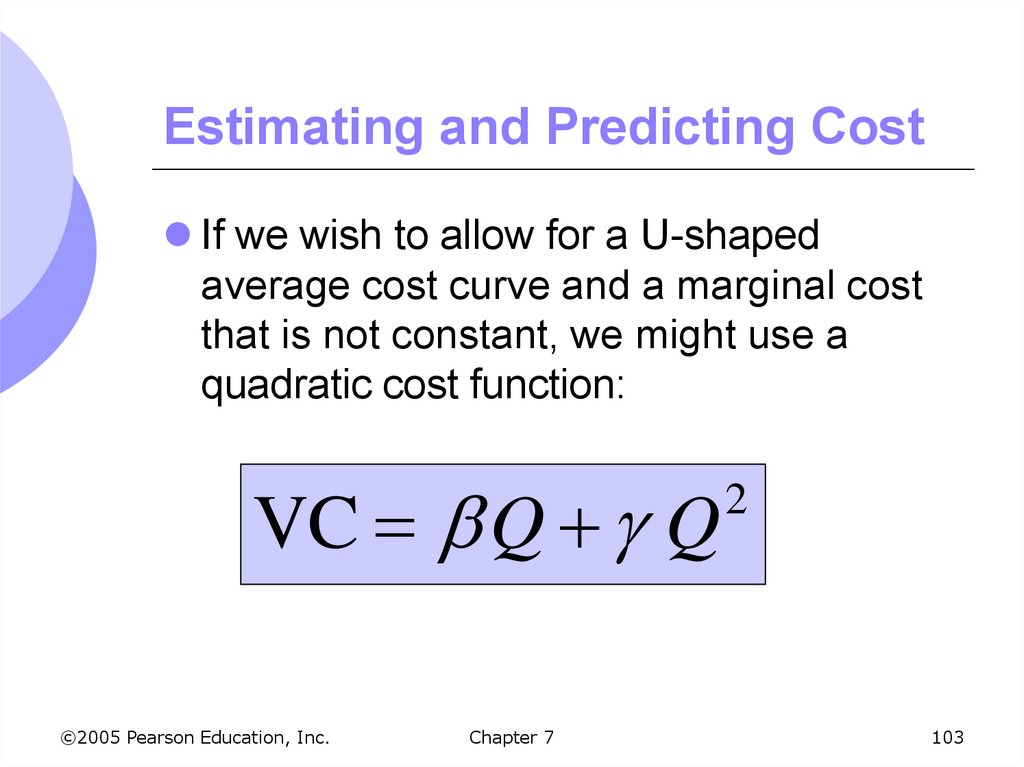
If we wish to allow for a U-shapedaverage cost curve and a marginal cost
that is not constant, we might use a
quadratic cost function:
VC Q Q
©2005 Pearson Education, Inc.
Chapter 7
2
103
104. Estimating and Predicting Cost
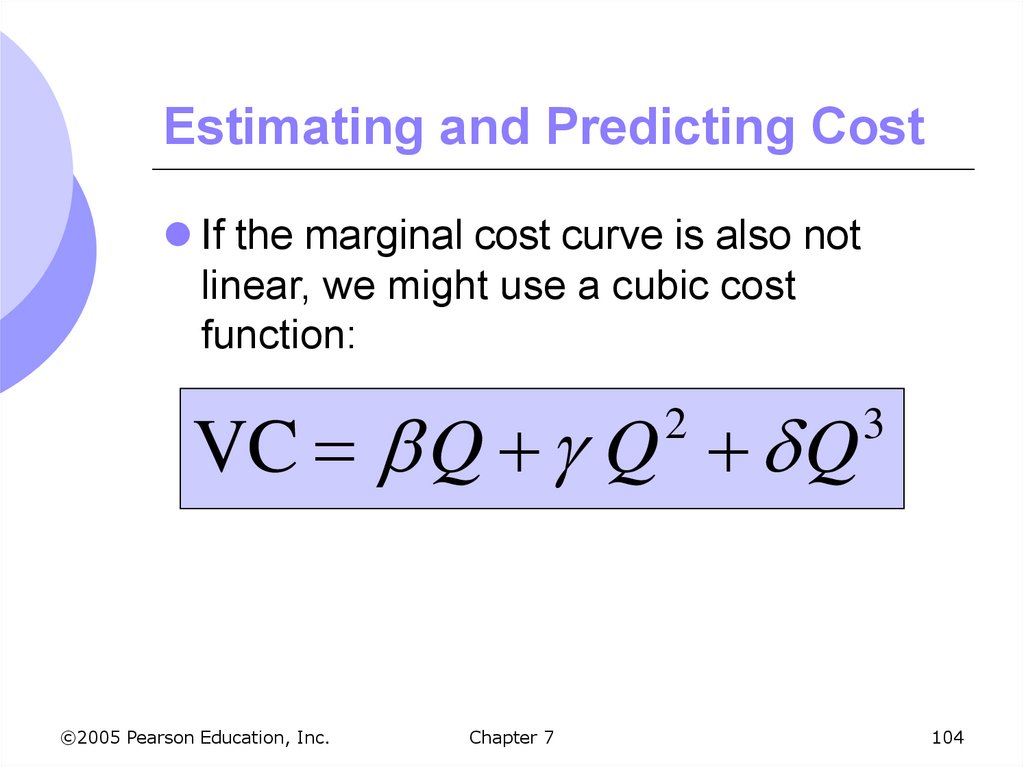
If the marginal cost curve is also notlinear, we might use a cubic cost
function:
VC Q Q Q
2
©2005 Pearson Education, Inc.
Chapter 7
3
104
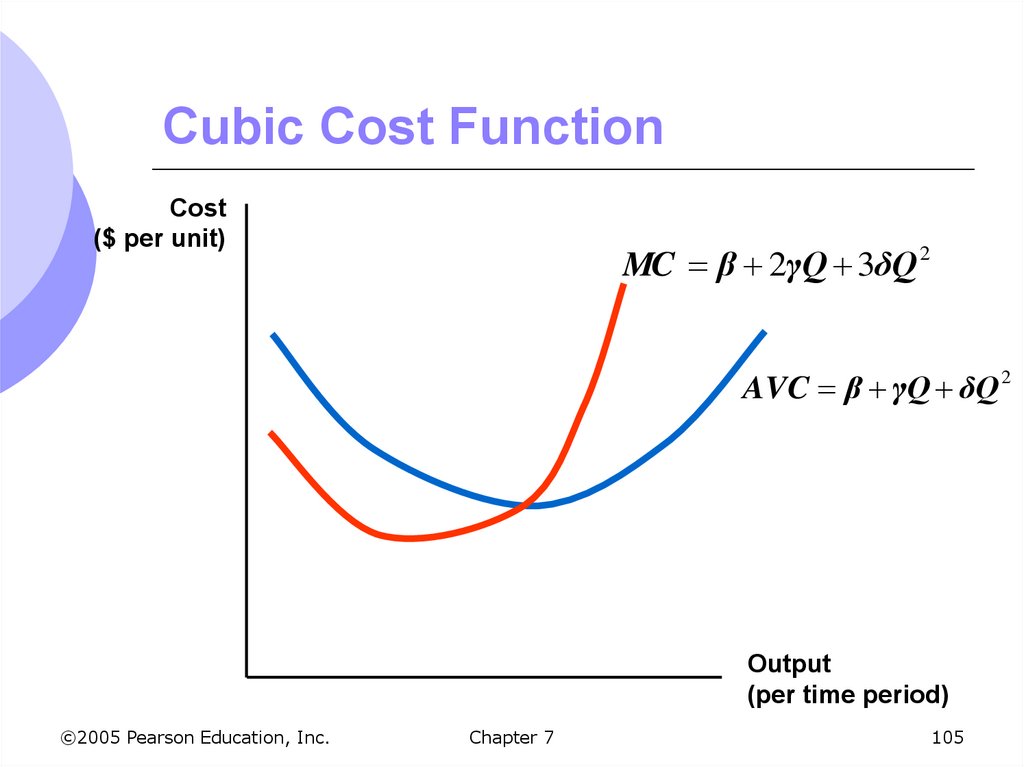
105. Cubic Cost Function
Cost($ per unit)
MC β 2γQ 3δQ 2
AVC β γQ δQ 2
Output
(per time period)
©2005 Pearson Education, Inc.
Chapter 7
105
106. Estimating and Predicting Cost
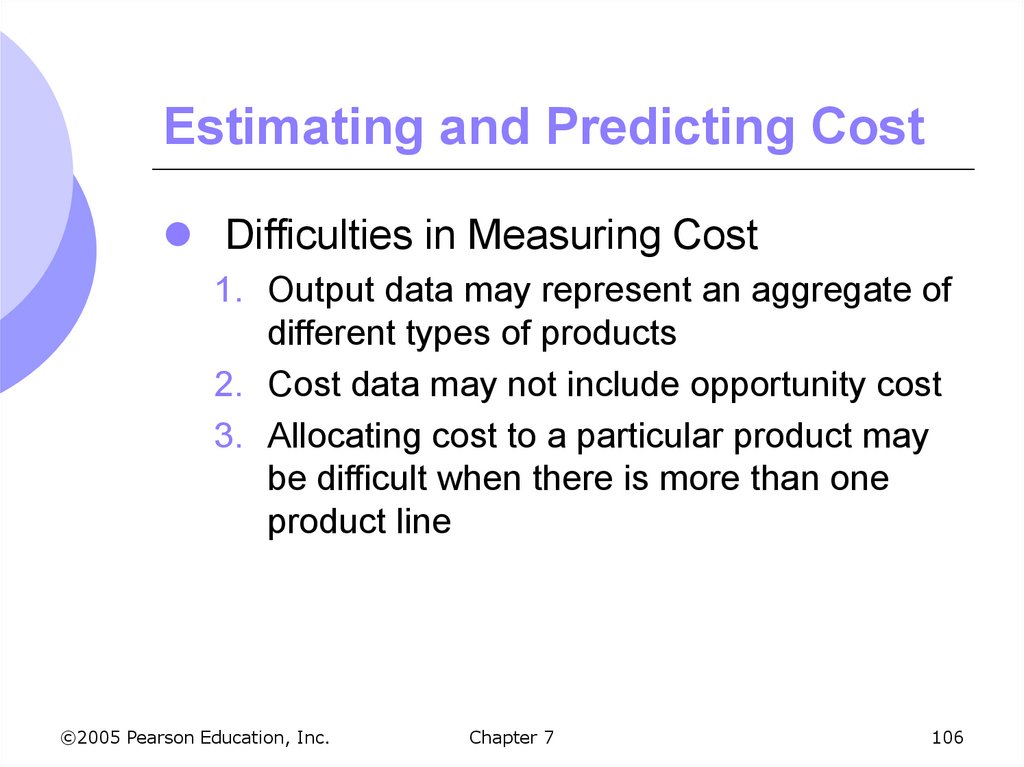
Difficulties in Measuring Cost1. Output data may represent an aggregate of
different types of products
2. Cost data may not include opportunity cost
3. Allocating cost to a particular product may
be difficult when there is more than one
product line
©2005 Pearson Education, Inc.
Chapter 7
106
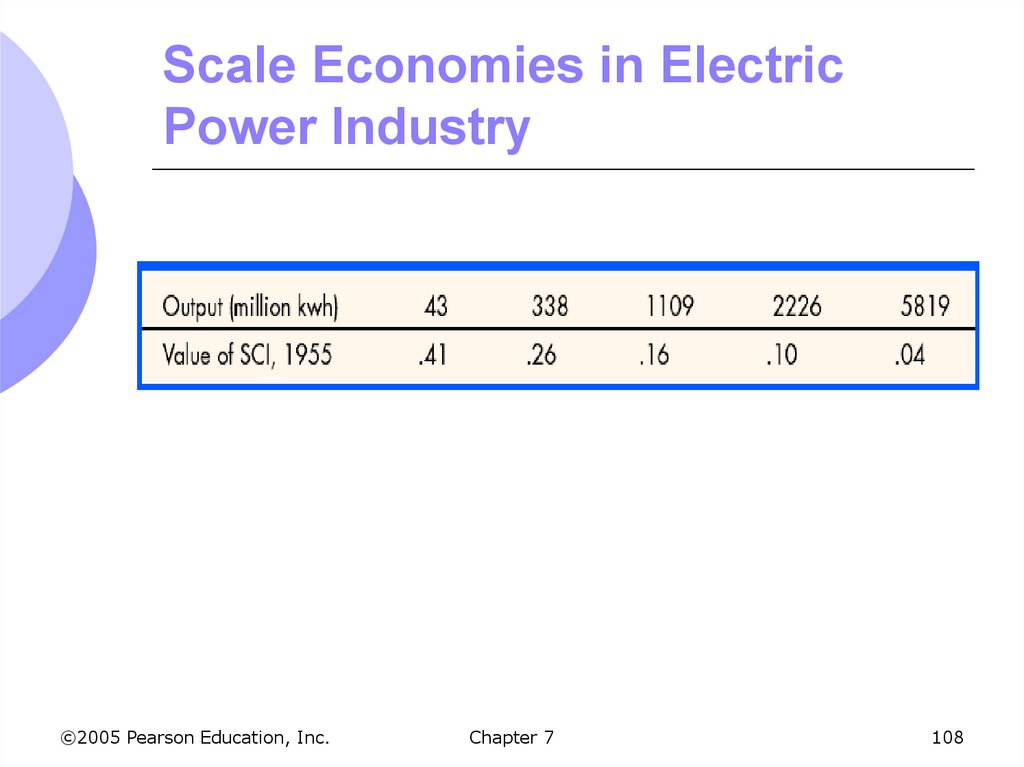
107. Cost Functions & Measurement of Scale Economies
Cost Functions & Measurementof Scale Economies
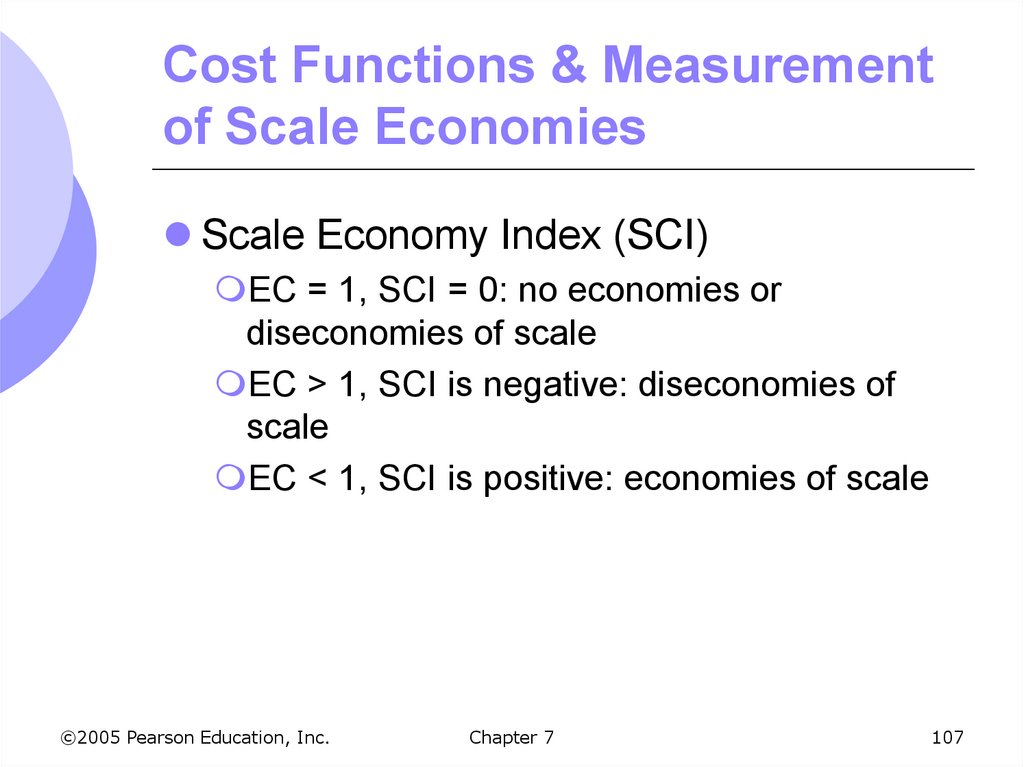
Scale Economy Index (SCI)
EC = 1, SCI = 0: no economies or
diseconomies of scale
EC > 1, SCI is negative: diseconomies of
scale
EC < 1, SCI is positive: economies of scale
©2005 Pearson Education, Inc.
Chapter 7
107
108. Scale Economies in Electric Power Industry
©2005 Pearson Education, Inc.Chapter 7
108
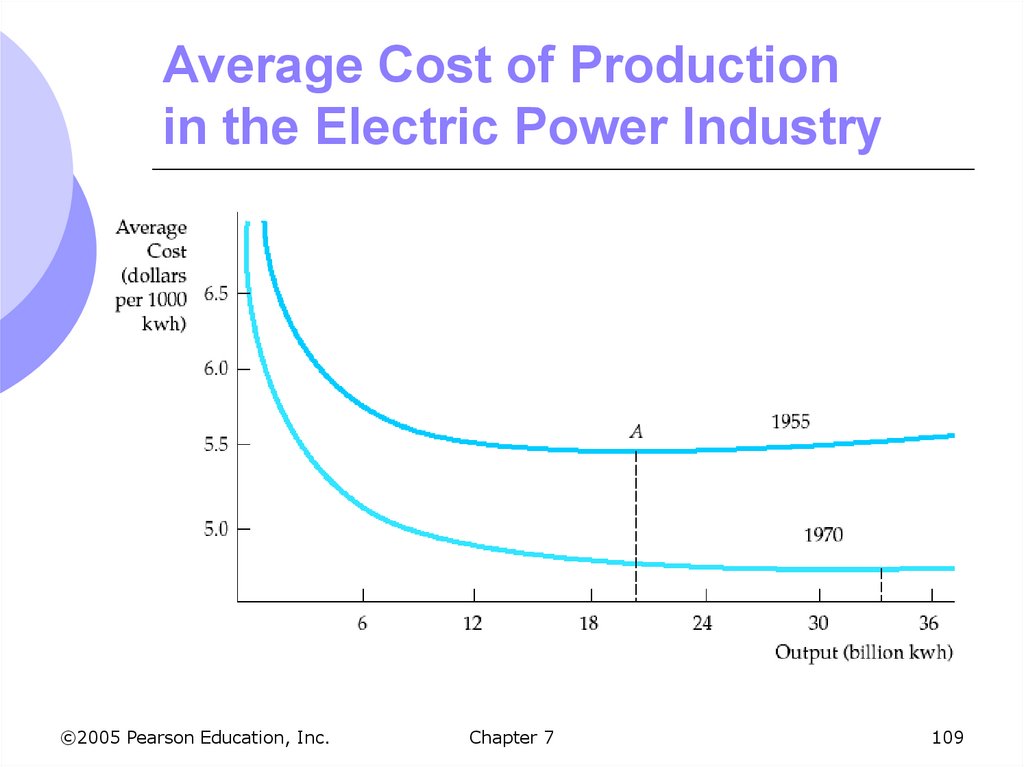
109. Average Cost of Production in the Electric Power Industry
©2005 Pearson Education, Inc.Chapter 7
109
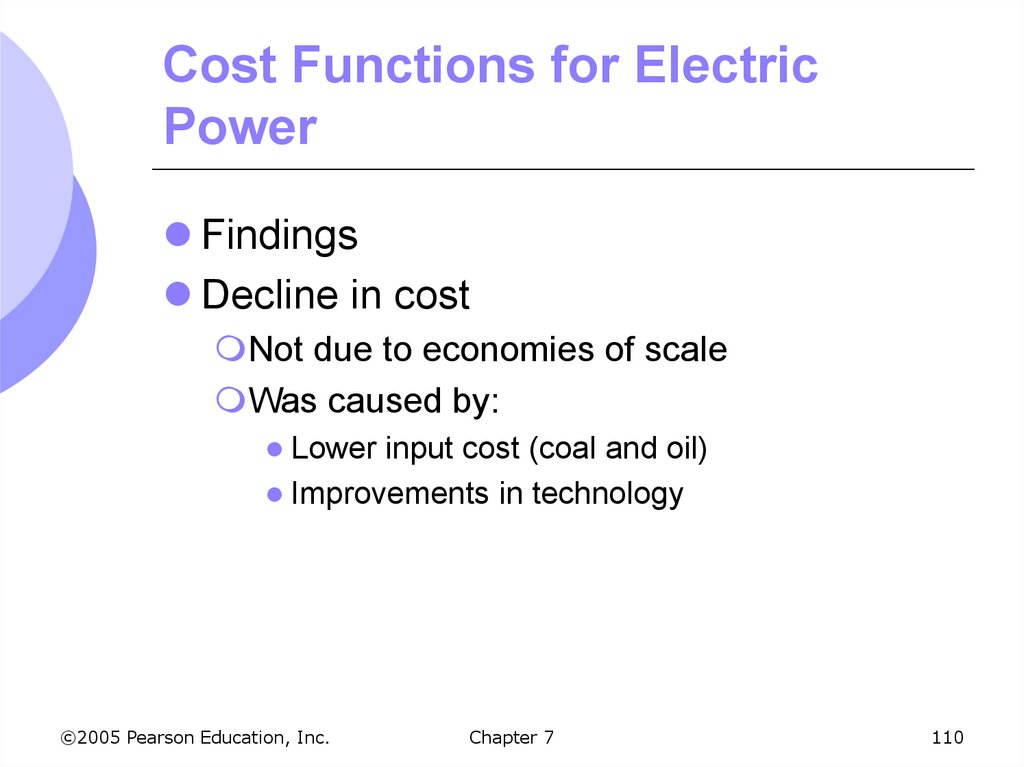
110. Cost Functions for Electric Power
FindingsDecline in cost
Not due to economies of scale
Was caused by:
Lower input cost (coal and oil)
Improvements in technology
©2005 Pearson Education, Inc.
Chapter 7
110