Similar presentations:







Technical Analysis of the CTP3.0 Kirin Battery from CATL
1.
Technical Analysis ofthe CTP3.0 Kirin Battery from CATL
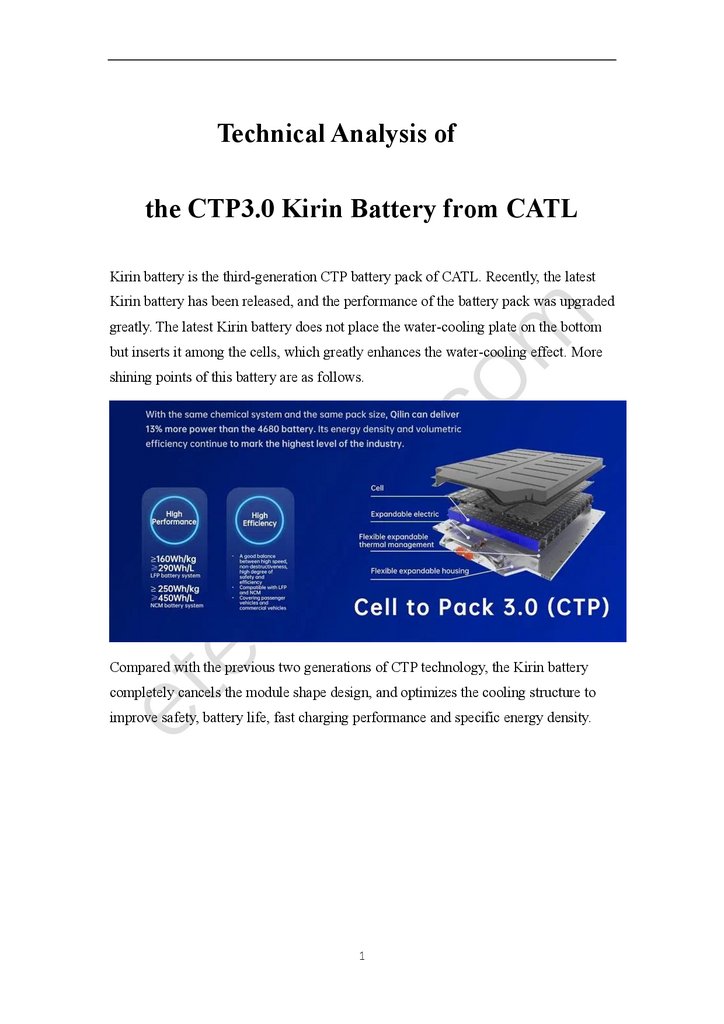
Kirin battery is the third-generation CTP battery pack of CATL. Recently, the latest
Kirin battery has been released, and the performance of the battery pack was upgraded
greatly. The latest Kirin battery does not place the water-cooling plate on the bottom
but inserts it among the cells, which greatly enhances the water-cooling effect. More
shining points of this battery are as follows.
Compared with the previous two generations of CTP technology, the Kirin battery
completely cancels the module shape design, and optimizes the cooling structure to
improve safety, battery life, fast charging performance and specific energy density.
1
2.
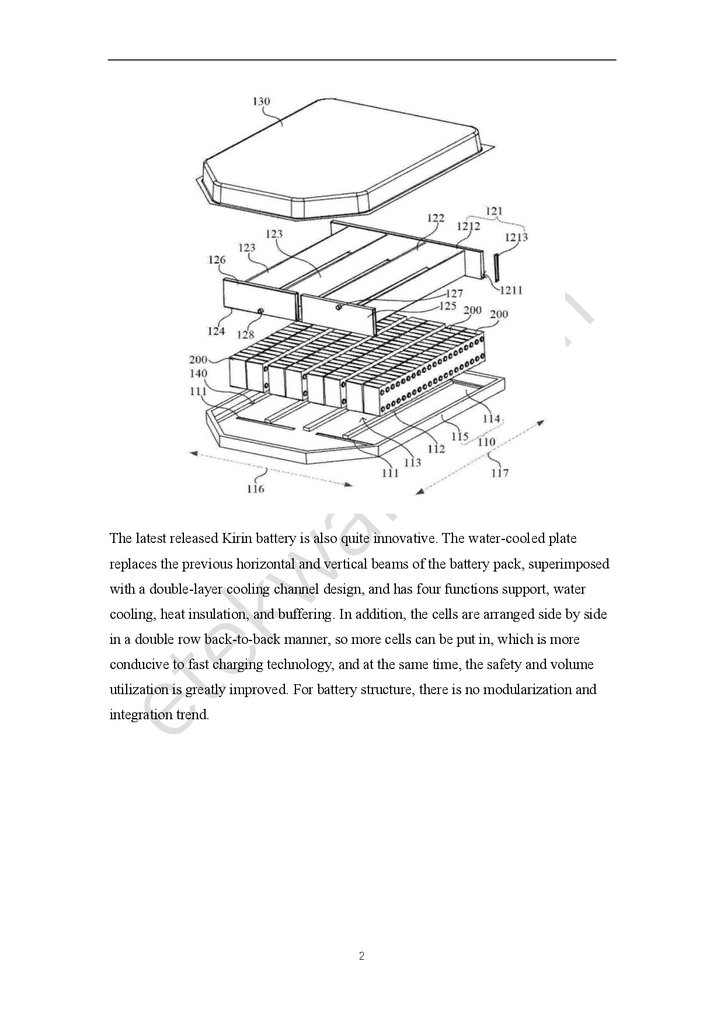
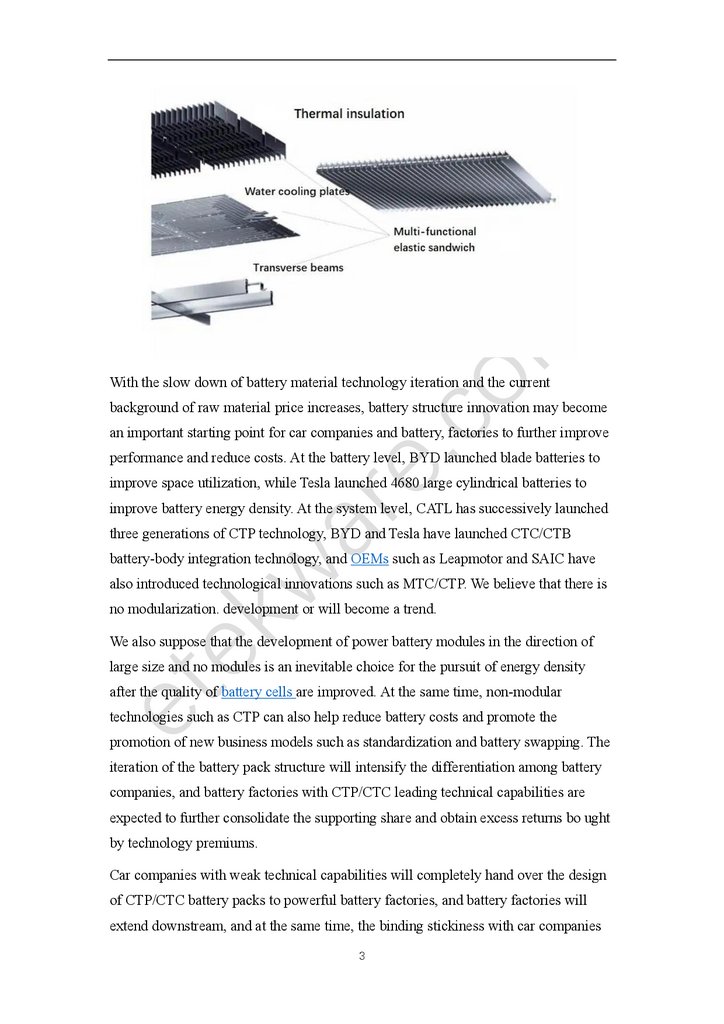
The latest released Kirin battery is also quite innovative. The water-cooled platereplaces the previous horizontal and vertical beams of the battery pack, superimposed
with a double-layer cooling channel design, and has four functions support, water
cooling, heat insulation, and buffering. In addition, the cells are arranged side by side
in a double row back-to-back manner, so more cells can be put in, which is more
conducive to fast charging technology, and at the same time, the safety and volume
utilization is greatly improved. For battery structure, there is no modularization and
integration trend.
2
3.
With the slow down of battery material technology iteration and the currentbackground of raw material price increases, battery structure innovation may become
an important starting point for car companies and battery, factories to further improve
performance and reduce costs. At the battery level, BYD launched blade batteries to
improve space utilization, while Tesla launched 4680 large cylindrical batteries to
improve battery energy density. At the system level, CATL has successively launched
three generations of CTP technology, BYD and Tesla have launched CTC/CTB
battery-body integration technology, and OEMs such as Leapmotor and SAIC have
also introduced technological innovations such as MTC/CTP. We believe that there is
no modularization. development or will become a trend.
We also suppose that the development of power battery modules in the direction of
large size and no modules is an inevitable choice for the pursuit of energy density
after the quality of battery cells are improved. At the same time, non-modular
technologies such as CTP can also help reduce battery costs and promote the
promotion of new business models such as standardization and battery swapping. The
iteration of the battery pack structure will intensify the differentiation among battery
companies, and battery factories with CTP/CTC leading technical capabilities are
expected to further consolidate the supporting share and obtain excess returns bo ught
by technology premiums.
Car companies with weak technical capabilities will completely hand over the design
of CTP/CTC battery packs to powerful battery factories, and battery factories will
extend downstream, and at the same time, the binding stickiness with car companies
3
4.
will be further strengthened. Car companies with strong technical capabilities willdominate the design of CTP/CTC and form differentiated competition. They will only
develop joint development with some battery factories with strong technical strength.
The remaining battery manufacturers will degenerate from module suppliers to battery
cell suppliers with the declining value contained.
But there are some potential risks. For instance, the sales of new energy vehicles
might not be as promising as expected and the application of new technologies might
meet some challenges. Also, industry competition is likely to be more and more
fierce.
4