 informatics
Similar presentations:





Risk Management and Security Governance
1.
Domain 2Risk Management and Security Governance
2.
Security Governance Concepts,Principles, and Policies
Objectives:
Understand and align security function to goals,
mission, and objectives of the organization
Understand and apply security governance
Understand and apply concepts of confidentiality,
integrity and availability
Develop and implement security policy
Manage the information life cycle (classification,
categorization and ownership)
3.
SecurityManagement
Planning
Security management planning ensures proper
creation, implementation, and enforcement of a
security policy.
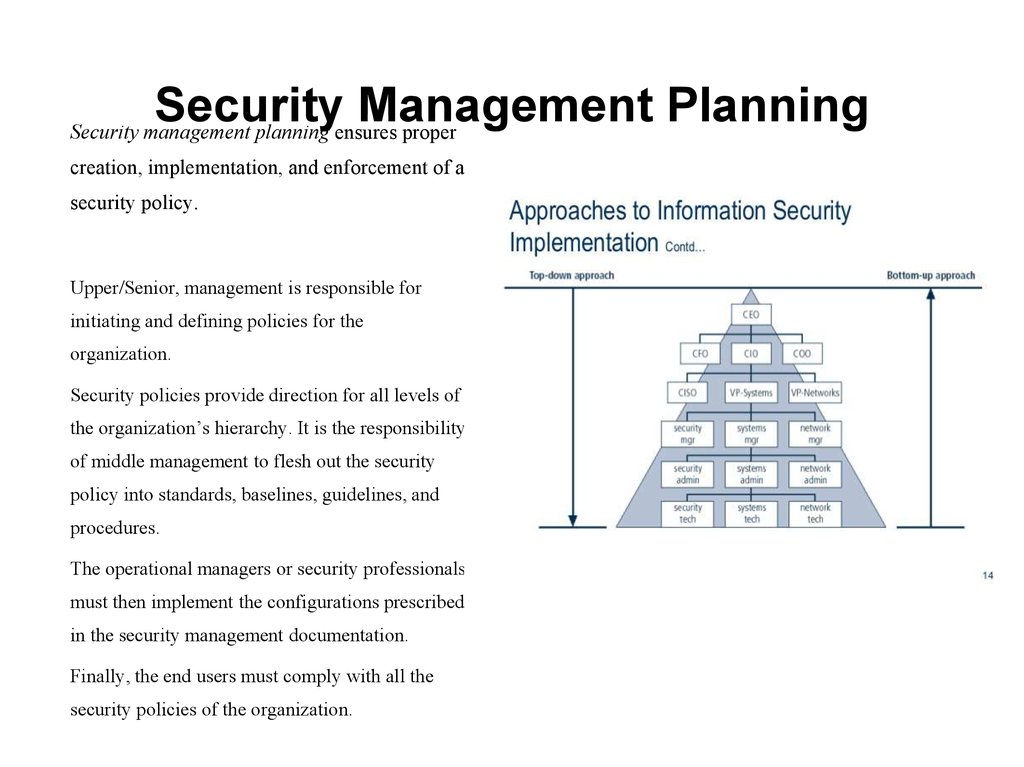
Upper/Senior, management is responsible for
initiating and defining policies for the
organization.
Security policies provide direction for all levels of
the organization’s hierarchy. It is the responsibility
of middle management to flesh out the security
policy into standards, baselines, guidelines, and
procedures.
The operational managers or security professionals
must then implement the configurations prescribed
in the security management documentation.
Finally, the end users must comply with all the
security policies of the organization.
4.
Security Management PlanningElements:
defining security roles;
prescribing how security will be managed,
who will be responsible for security,
and how security will be tested for effectiveness;
developing security policies;
performing risk analysis;
and requiring security education for employees.
5.
“The best security plan is useless without one keyfactor: approval by senior management.”
6.
A security management planning team should developStrategic plan
three types of plans:
Long-term plan. It defines the organization’s security purpose and helps to understand security function
and align it to goals, mission, and objectives of the organization. It’s useful for about five years. A
strategic plan should include a risk assessment.
Tactical plan
Midterm plan developed to provide more details on accomplishing the goals set forth in the strategic plan.
It is typically useful for about a year. Some examples of tactical plans include project plans, acquisition
plans, hiring plans, budget plans, maintenance plans, support plans, and system development plans.
Operational plan
Short-term plan. Highly detailed plan based on the strategic and tactical plans. Operational plans must be
updated often (such as monthly or quarterly) to retain compliance with tactical plans. Operational plans
include details on how the implementation processes are in compliance with the organization’s security
policy. Examples of operational plans include training plans, system deployment plans, and product
design plans.
7.
Security GovernanceSecurity governance is the collection of practices related to
supporting, defining, and directing the security efforts of an
organization.
Security governance must be assessed and verified from
time to time.
Security is an organizational process, not just something the IT geeks do behind the
scenes. Using the term security governance is an attempt to emphasize this point by
indicating that security needs to be managed and governed throughout the organization,
not just in the IT department.
8.
Security Roles and Responsibilities
Senior manager
Security professional, Information Security officer,
computer incident response team
Data owner
Data custodian
User
Auditor
9.
Layering, also known as defense in depth, is simply the use of multiple controls in a
Protection Mechanisms
series. No one control can protect against all possible threats. Using a multilayered
solution allows for numerous, different controls to guard against whatever threats come to
pass.
Abstraction is used for efficiency. Similar elements are put into groups, classes, or roles
that are assigned security controls, restrictions, or permissions as a collective. Abstraction
is used to define what types of data an object can contain, what types of functions can be
performed on or by that object, and what capabilities that object has.
Data hiding is preventing data from being discovered or accessed by a subject by
positioning the data in a logical storage compartment that is not accessible
or seen by the subject. Forms of data hiding include keeping a database from being
accessed by unauthorized visitors and restricting a subject at a lower classification level
from access- ing data at a higher classification level.
Encryption is the art and science of hiding the meaning or intent of a communication from
unintended recipients. Encryption is an important element in security controls, especially
in regard to the transmission of data between systems.
10.
Security Management Concepts and PrinciplesSELF-READING
CHAPTER 5
11.
Developand
Implement
Security
Policy
and discusses the assets that need protection and the extent to which security solutions should
A security policy is a document that defines the scope of security needed by the organization
go to provide the necessary protection.
Incudes:
Security objectives
Valuable assets
Terminology
Security goals and practices
Used to:
assign responsibilities,
define roles,
specify audit requirements,
outline enforcement processes,
indicate compliance requirements,
and define acceptable risk levels;
12.
Security Standards, Baselines, andGuidelines
Question
What are the four components of a complete
organizational security policy and their basic purpose?
13.
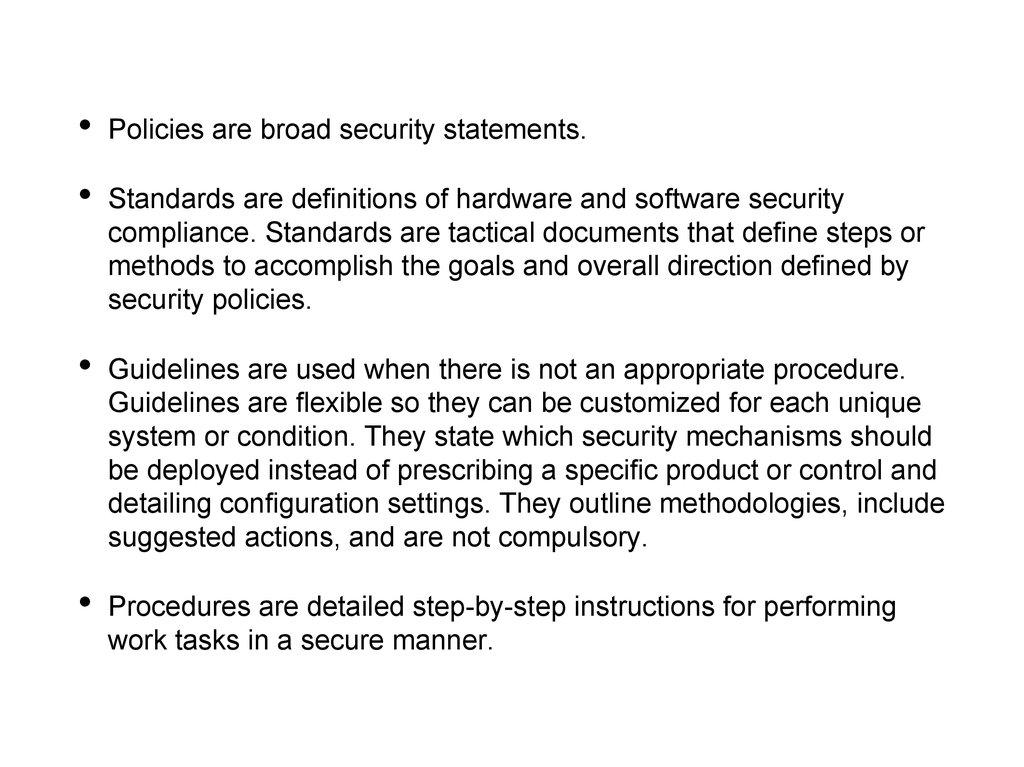
Policies are broad security statements.
Standards are definitions of hardware and software security
compliance. Standards are tactical documents that define steps or
methods to accomplish the goals and overall direction defined by
security policies.
Guidelines are used when there is not an appropriate procedure.
Guidelines are flexible so they can be customized for each unique
system or condition. They state which security mechanisms should
be deployed instead of prescribing a specific product or control and
detailing configuration settings. They outline methodologies, include
suggested actions, and are not compulsory.
Procedures are detailed step-by-step instructions for performing
work tasks in a secure manner.
14.
Change Control/ManagementData Classification
SELF-READING
SELF-READING
CHAPTER 5