


Similar presentations:




The_Invention_of_the_Plane_Simple_FINAL
1.
Technology, Science and InnovationTHE INVENTION
OF THE PLANE
From the first successful flight to modern
aviation
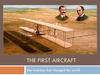
First flight of the Wright Flyer, 17 December 1903
The Wright Flyer, 1903
The Wright brothers
RTU MIREA · [Your name] · October 2026
2.
INTRODUCTIONWhy did people want to fly?
For centuries, travelling long distances was slow and difficult.
01
The problem
Ships and trains could not provide fast travel across oceans.
02
The goal
Inventors wanted to create a safe, controllable flying machine.
03
The result
Powered flight opened a new way to connect the world.
Research question: What made the first successful plane possible?
THE INVENTION OF THE PLANE
02
3.
H I S TO R YBefore the Wright brothers
The first aeroplane was based on many years of research and experiments.
1804
1890s
1900–1902
George Cayley
Otto Lilienthal
Wright brothers
Basic glider design
Thousands of glider flights
Tests of improved gliders
George Cayley design
Otto Lilienthal glider experiment
Wilbur and Orville Wright
Key idea: progress came through research, testing and better designs.
THE INVENTION OF THE PLANE
03
4.
T H E B R EA K T H R O U G H17 December 1903
12 seconds
First flight duration
36 metres
Distance travelled
Wright Flyer at Kitty Hawk, North Carolina
Wright Flyer · Kitty Hawk, North Carolina, USA
THE INVENTION OF THE PLANE
04
5.
EN G I N EE R I N GHow does a plane fly?
LIFT
The four forces
• Lift – pushes upward
• Weight – pulls downward
DRAG
THRUST
• Thrust – moves forward
• Drag – slows the plane
WEIGHT
THE INVENTION OF THE PLANE
05
6.
D E V E LO P M E N TFrom early aircraft to modern aviation
Aircraft became faster, safer and more efficient as technology developed.
1903
1930s
1950s
Today
Wright Flyer
Passenger planes
Jet engines
Modern aircraft
Wood and fabric
Metal aircraft
Faster long journeys
Advanced equipment
Boeing 787 Dreamliner, first flight (2009)
Modern engineering continues to improve aircraft safety and design.
THE INVENTION OF THE PLANE
06
7.
I M PAC THow planes changed society
01
Travel
People can cross continents in a matter of hours.
02
Trade and business
Air transport connects companies and international
markets.
03
Science and rescue
Aircraft help researchers and emergency teams.
Aviation changed both transport and communication between countries.
THE INVENTION OF THE PLANE
07
8.
C H A L L E NG E SProblems and the future of aviation
Current challenges
Possible solutions
• Fuel consumption and emissions
• More efficient engines
• Noise near airports
• Sustainable aviation fuels
• Safety requirements and costs
• Research into new aircraft
The future depends on continued scientific research and innovation.
THE INVENTION OF THE PLANE
08
9.
CO N C LU S I O NA small flight. A major change.
The Wright brothers combined research with practical experiments.
Controlled flight was as important as engine power.
Aircraft transformed transport, science and global communication.
Thank you for your attention! Any questions?
THE INVENTION OF THE PLANE
09
10.
R E F E R EN C E SSources and further reading
1.
Smithsonian National Air and Space Museum
1903 Wright Flyer · airandspace.si.edu/collection-objects/wright-flyer-1903/nasm_A19610048000
2.
NASA Glenn Research Center
Wright Brothers Aircraft · www1.grc.nasa.gov/beginners-guide-to-aeronautics/wright-brothers-aircraft/
3.
NASA
Wright Brothers First Flight · nasa.gov/image-article/wright-brothers-first-flight/
4.
RTU MIREA (2026)
English for Technical Universities, Part 1 · Vocabulary and language structures, pp. 1–120
Images: Wikimedia Commons — Wrightflyer.jpg, WrightBrothers.jpg, Otto Lilienthal gliding experiment ppmsca.02546.jpg, George Cayley, aeroplane design.jpg, 787 First Flight.jpg.
THE INVENTION OF THE PLANE
10