


 biography
Similar presentations:


Leonardo da Vinci: The Person Who Inspires Me
1. The person who inspires me
Completed by: Turushev MikhailForm 10.2
2. Leonardo da Vinci
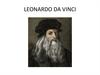
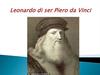
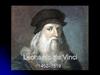
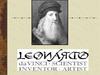
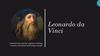
• Leonardo di ser Piero da Vinci (born April 15, 1452 - May2, 1519) was an Italian polymath of the High Renaissance
who excelled as an artist, engineer, theoretical scientist,
sculptor, and architect.
3. brief biography
• Leonardo da Vinci was born on April 15, 1452, inthe village of Anchiano, near the small town of
Vinci, near Florence, at three o'clock in the
morning.
• Born out of wedlock to a successful notary and a
lower-class woman in or near Vinci, he was
educated in Florence by the Italian artist and
sculptor Andrea del Verrocchio.
• He began his career in this city, but then spent a
great deal of time in the service of Lodovico
Sforza in Milan. Later, he worked again in
Florence and Milan, and also spent some time in
Rome, all the while attracting many followers and
students. At the invitation of Francis I, he spent his
last three years in France, where he died in 1519.
4. Paintings
• Despite Leonardo's recent recognition as a scientist andinventor, and his admiration, for most of the past four
hundred years, his fame has been based on his
achievements as an artist. Several works that are either
confirmed to be authentic or attributed to him are
considered some of the greatest masterpieces. These
paintings are renowned for their numerous virtues, which
have been emulated by many of his students and have
been the subject of extensive discussions among art
enthusiasts and critics. By the 1490s, Leonardo had
already been referred to as a "divine" artist. Most famous
his works: the Mona Lisa, the Last Supper and the
Vitruvian man.
5. Anatomy and physiology
• Leonardo began studying the anatomy of the humanbody under the guidance of Verrocchio, who required
his students to have a deep understanding of the
subject. As an artist, he quickly mastered topographic
anatomy, sketching muscles, tendons, and other
visible anatomical features.
• As a successful artist, Leonardo was granted
permission to dissect human corpses at the Santa
Maria Nuova Hospital in Florence, and later at
hospitals in Milan and Rome. From 1510 to 1511, he
collaborated with Dr. Marcantonio della Torre, a
professor of anatomy at the University of Pavia, on his
research. Leonardo created over 240 detailed
drawings and wrote approximately 13,000 words for a
treatise on anatomy. This work greatly contributed to
the advancement of anatomy.
6. Engineering and inventions
• During his lifetime, Leonardo was also valued as an engineer.With the same rational and analytical approach that led him to
depict the human body and study anatomy, Leonardo studied and
designed numerous machines and devices. He drew their
"anatomy" with unparalleled skill, creating the first form of modern
technical drawing, including an advanced technique of "unfolding"
to represent internal components. These studies and designs,
collected in his manuscripts, span over 5,000 pages. In a letter
dated 1482 to the Lord of Milan, Ludovico il Moro, he wrote that he
could create all kinds of machines for both the defense and the
siege of the city. When he fled from Milan to Venice in 1499, he
found work as an engineer and developed a system of mobile
barricades to protect the city from attack. In 1502, he designed a
scheme to divert the flow of the Arno River, which was also
worked on by Niccolò Machiavelli.
7. Legacy of Da Vinci
• Although Leonardo did not have aformal academic education, many
historians and scholars consider him to
be the ultimate example of a "Universal
Genius" or a "Renaissance Man", which
means "a man that talented in
everything". He is widely recognized as
one of the most multitalented people
who ever lived. According to art
historian Helen Gardner, the scope and
depth of his interests have no precedent
in history, and "his mind and personality
seem superhuman to us, while he
himself is enigmatic and distant."