





 psychology
Similar presentations:


Cognitive psychology
1.
Cognitive psychologySubmitted By
Sadia afrin (2024-3-40-032)
Tasnia Siddique Somprity (2024-3-40-148)
Sultan Mahmud (2024-1-10-129)
Al Imran Shaad (2021-1-66-036)
Sadiatut Taiba Shapnil ( 2023-3-40-001)
2. INTRODUCTION to Cognitive Psychology
Study of mental processesKey processes:
→ Thinking
→ Memory
→ Perception
→ Learning
“Why do we forget names but remember
songs?”
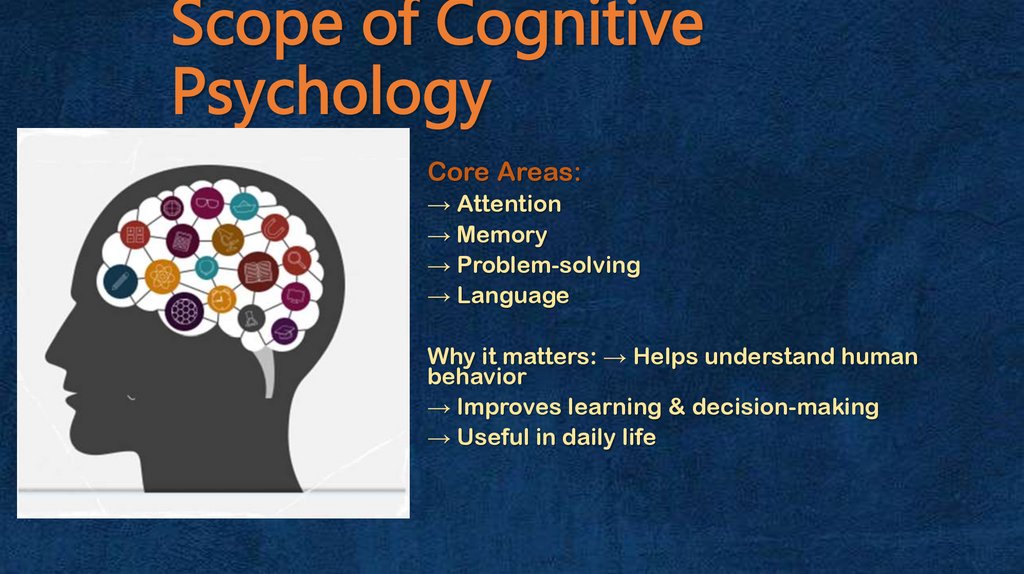
3. Scope of Cognitive Psychology
Core Areas:→ Attention
→ Memory
→ Problem-solving
→ Language
Why it matters: → Helps understand human
behavior
→ Improves learning & decision-making
→ Useful in daily life
4. Attention
Attention = Focus on specific informationNature & Types of attention
Nature of Attention
Types of attention
5. Theories of Attention
Broadbent’s Filter TheoryInformation is filtered early; only
important stimuli are processed
Treisman’s Attenuation Theory
Unimportant information is not
blocked completely but weakened
Late Selection Theory
All information is processed, but
only important information reaches
awareness.
6. Factors Affecting Attention
Internal factors:-Interest
-Motivation
-Emotions
-Mental state
Example: You focus more on your
favorite subject
External factors:
-Brightness
- Movement
-Intensity of stimuli
Example: Loud noise grabs your
attention
7. Psychology & Perception
Psychology & Perception• Cognitive Psychology studies how
people think, learn, and understand
the world
• Focuses on mental processes like
memory, attention, and perception
• Introduced by Jean Piaget
• Perception = the process of
interpreting sensory information
• Helps us make sense of what we
see, hear, and feel
8. How Perception Works
• Perception is how the brainorganizes and interprets sensory
input
• Brain combines past experience
with current sensory data
• Optical illusions show how
perception can be misleading
• Example: same image can be seen
in different ways
• Strong idea: “We don’t see reality—
we interpret it”
9. Memory
1. Short-Term Memory (STM)•Temporary storage (about 15–25 seconds)
•Limited capacity (7 ± 2 items)
•Also called working memory
Memory
•Information can be kept through rehearsal
(repetition)
2. Long-Term Memory (LTM)
•Stores information for a long time (possibly
lifetime)
•Unlimited capacity
Types:
•Declarative Memory (facts & events)
•Semantic (general knowledge)
•Episodic (personal experiences)
•Procedural Memory (skills & habits)
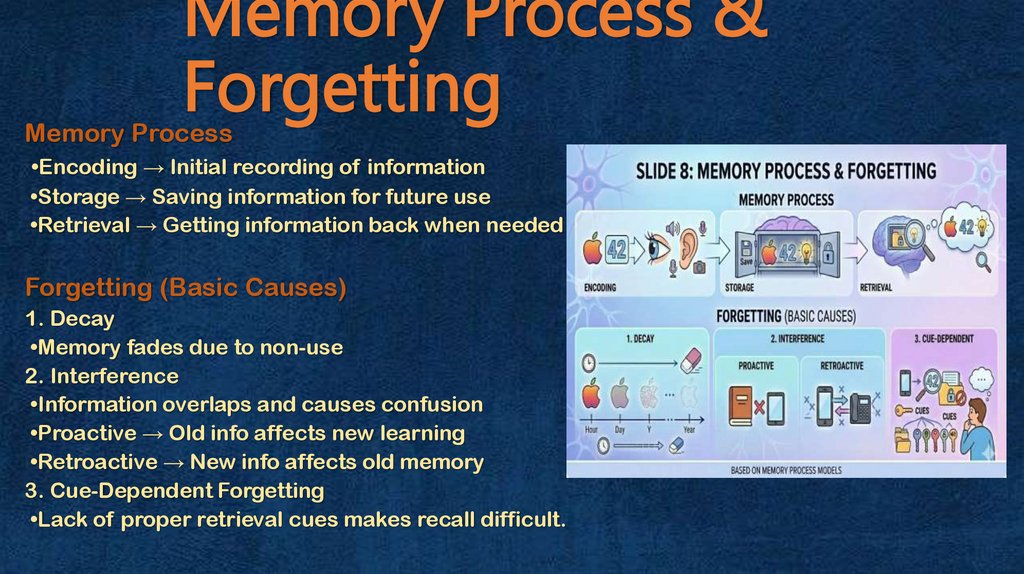
10. Memory Process & Forgetting
Memory Process &Forgetting
Memory Process
•Encoding → Initial recording of information
•Storage → Saving information for future use
•Retrieval → Getting information back when needed
Forgetting (Basic Causes)
1. Decay
•Memory fades due to non-use
2. Interference
•Information overlaps and causes confusion
•Proactive → Old info affects new learning
•Retroactive → New info affects old memory
3. Cue-Dependent Forgetting
•Lack of proper retrieval cues makes recall difficult.
11. Thinking & Problem Solving
Thinking & Problem SolvingThinking:
-Mental process of analyzing & decisionmaking
-Helps in solving everyday problems
Heuristics (mental shortcuts)
-Quick decisions based on experience
- Can lead to errors or bias
Example: Carrying an umbrella after seeing
dark clouds
12. Language
System of communication:-Helps us express ideas and thoughts
-Influences how we think and
understand the world
-Improves learning and concept
formation
Example: Better vocabulary →
clearer thinking
13. Conclusion
Conclusion
Cognitive psychology explains how
we:
- Think, learn, remember,
communicate
Real-life applications:
- Education
- Decision-making
- Everyday problem-solving