


 economics
 finance
Similar presentations:



Types of Taxes You Should Know About
1.
Types of TaxesYou Should
Know About
Understanding Global Taxation Systems and Policies
"Nothing is certain but death and taxes." —
Benjamin Franklin
2.
Basic Classificationof Taxes
Direct vs. Indirect Taxes
Direct Taxes: Paid directly to the government by
individuals or organizations (e.g., Personal Property Tax,
Federal Income Tax). These cannot be shifted to others.
Examples: Personal property taxes, federal income taxes.
Key Difference: In indirect taxes, the person paying the
tax to the government (the retailer) is different from
the person bearing the actual cost (the customer).
Indirect Taxes: Levied on the production or sale of goods
and services. Included in the price paid by the consumer
(e.g., VAT, Sales Tax, Excise Duties).
Examples: VAT (Value Added Tax), Sales Tax, Excise
duties on tobacco or alcohol.
3.
Common Types of TaxesIncome & Corporate:
• Individual Income Tax: Levied on wages,
salaries, and other earnings.
• Corporation Tax: Levied on business profits.
Note: Profits are often "taxed twice" (once
as corporate profit, and again as individual
income when dividends are paid).
Assets & Wealth:
• Capital Gains Tax: Tax on profits from selling assets
like stocks or shares (often at a lower rate than
income tax).
• Inheritance/Estate Tax: Often called "death duty,"
imposed on money or property passed down to
heirs.
International Trade:
• Tariffs: Special taxes charged on goods
imported from abroad to protect domestic
markets.
4.
Distribution ofthe Tax Burden
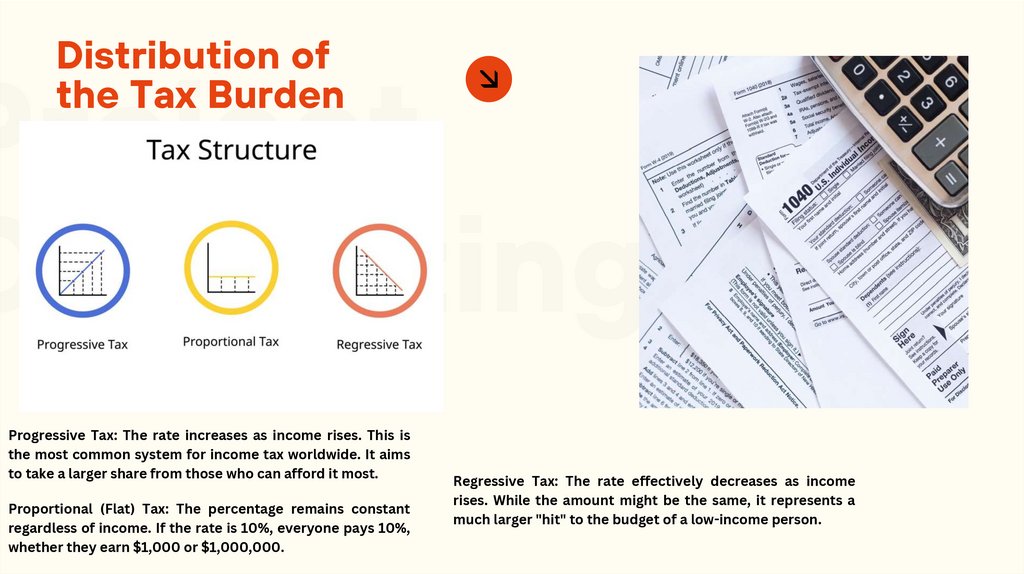
Progressive Tax: The rate increases as income rises. This is
the most common system for income tax worldwide. It aims
to take a larger share from those who can afford it most.
Proportional (Flat) Tax: The percentage remains constant
regardless of income. If the rate is 10%, everyone pays 10%,
whether they earn $1,000 or $1,000,000.
Regressive Tax: The rate effectively decreases as income
rises. While the amount might be the same, it represents a
much larger "hit" to the budget of a low-income person.
5.
Tax Avoidancevs. Tax Evasion
Tax
Avoidance
(Legal):
Using
legitimate "loopholes" or technicalities
to minimize payments.
Examples: Receiving "perks" (company
cars, free health insurance) instead of
taxable salary, or registering companies
in Tax Havens (Monaco, Cayman Islands)
where rates are extremely low.
Tax Evasion (Illegal): Deliberately
misreporting or not declaring income.
This is a criminal offense and leads to
severe legal penalties.
6.
Why they are Regressive: Lower-incomeconsumers spend nearly all their income on
essentials like food, clothing, and shelter.
The Math of Inequality:
• If a package of cigarettes has a $1 tax:
• For a person earning $10, that $1 is 10% of
their income.
• For a person earning $20, that same $1 is
only 5% of their income.
The Social Impact
of Sales Taxes
Conclusion: Uniform taxes on
essentials hit the poor harder
because they have less "disposable"
income left over.
7.
Conclusion: TheStrategic Goals of
Taxation
Economic Motivation: Regressive taxes can
sometimes be used to stimulate economic
activity among certain groups.
Social Justice: Progressive taxes are used to
reduce the "wealth gap" and income
inequality.
Public Welfare: The primary goal is to
mobilize surplus income from the "haves"
and reinvest it into public services
(healthcare, infrastructure, education) to
benefit the "have-nots."
8.
ThankYou