


 english
Similar presentations:
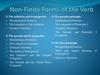









Understanding Non-Finite Verb Forms in English
1.
Understanding Non-FiniteVerb Forms in English
Unlock the secrets of English grammar by exploring verbs that don't
always follow the rules of tense, person, and number.
2.
What Are Non-Finite Verbs?Timeless & Impersonal
Not Main Verbs
Non-finite verbs do not show tense, person, or
They cannot function as the primary verb in an
number, offering a neutral perspective.
independent clause, serving supporting roles instead.
Three Key Types
Beyond Tense
These forms include Gerunds, Participles, and
Unlike finite verbs, they exist outside of traditional
Infinitives, each with unique functions.
past, present, or future time frames.
3.
Finite vs. Non-Finite Verbs: The Key DifferenceNon-Finite Verbs
No tense, person, or number.
Do not agree with the subject.
Cannot be the main verb in an
independent clause.
She likes running. / To run is healthy.
4.
Gerunds: Verbs as Nouns (-ing form)Gerunds blend the action of a verb with the role of a noun, always identifiable by their -ing ending.
Subject
Object
Complement
Swimming is
I enjoy reading
His favourite
fun. (The act of
novels. (The
hobby is
swimming is
activity of
gardening.
fun.)
reading is
(Gardening
enjoyed.)
completes the
meaning of the
hobby.)
Gerunds can also clarify who performs the action: We enjoyed their singing.
5.
Participles: Verbs as Adjectives or AdverbsParticiples describe or modify, adding detail to nouns and verbs alike.
Past Participle (-ed, -en, etc.)
Present Participle (-ing)
Functions as an adjective or adverb.
Describes ongoing action.
The running water is cold. (Adjective modifying water)
Breathing heavily, she finished the race. (Adverbial modifier)
Describes completed action or a state.
Functions as an adjective.
The broken vase was repaired. (Adjective
modifying vase)
The written report is detailed. (Adjective
modifying report)
6.
Infinitives: The “To” Form of VerbsInfinitives are the base form of a verb, often preceded by "to", acting as nouns, adjectives, or adverbs.
As Nouns
As Adjectives
As Adverbs
To travel is my dream. (Subject of the
She has work to finish. (Describes the
He stayed late to study. (Explains the
sentence)
type of work)
purpose of staying late)
Bare Infinitives
Sometimes, "to" is omitted after certain verbs (e.g., modals, sense verbs):
I will go now.
She made me laugh.
7.
Present Participle vs. Gerund: Same Form,Different Roles
Though both end in -ing, understanding their distinct grammatical functions is crucial.
Gerund
Present Participle
Acts as a noun, referring to an activity or concept.
Functions as an adjective or part of a continuous tense.
I love dancing. (Dancing is the object of my affection.)
The dancing girl is talented. (Describes the girl.)
Running is good for your health. (Running is the subject.)
She is dancing now. (Part of the present continuous verb.)
8.
Past Participles: Irregular and Regular FormsThese forms are essential for expressing completed actions and passive voice.
1
2
Regular Forms
Irregular Forms
Most past participles are formed by adding -ed to the
These vary widely and must often be memorised (e.g.,
base verb (e.g., walked, played).
gone, written, seen).
Past participles are crucial for perfect tenses and the passive voice:
Perfect Tense: She has written a letter.
Passive Voice: The cake was eaten by the children.
9.
Why Use Non-Finite Verbs?Mastering non-finite verbs enriches your writing, making it more dynamic
and sophisticated.
Add Variety & Complexity: They allow for more intricate sentence
structures, moving beyond simple subject-verb constructions.
Combine Ideas Concisely: Link related thoughts without redundant subjects
or verbs, streamlining your narrative.
Enhance Expression: Convey nuances and relationships between actions
more effectively, making your communication clearer and more impactful.
Examples:
Having finished the work, she left early.
To succeed, you must try hard.
The man standing there is my uncle.
10.
Summary & PracticeRecap
Non-finite verbs (gerunds, participles, infinitives) transcend tense, person, and
number, offering flexibility in sentence construction.
Roles
Gerunds function as nouns, participles as adjectives/adverbs, and infinitives are
highly versatile, adapting to noun, adjective, or adverbial roles.
Application
Integrate these forms into your writing to achieve greater conciseness,
complexity, and expressive power.
As Hamlet famously pondered: “To be or not to be.” Are you ready to spot non-finite
verbs in your own sentences?