






 english
Similar presentations:


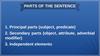


Sentence structure. Parts of the sentence sentence structure
1. SENTENCE STRUCTURE
PARTS OF THE SENTENCESENTENCE STRUCTURE
2. Sentence Structure
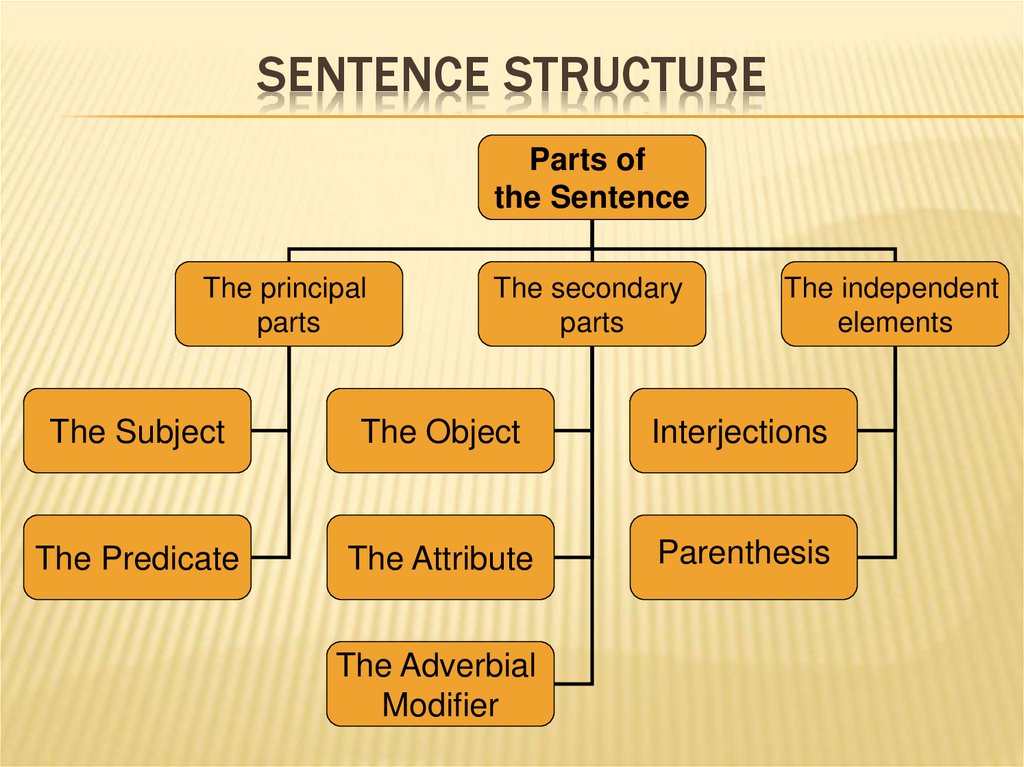
SENTENCE STRUCTUREParts of
the Sentence
The principal
parts
The secondary
parts
The independent
elements
The Subject
The Object
Interjections
The Predicate
The Attribute
Parenthesis
The Adverbial
Modifier
3. Parts of the Sentence
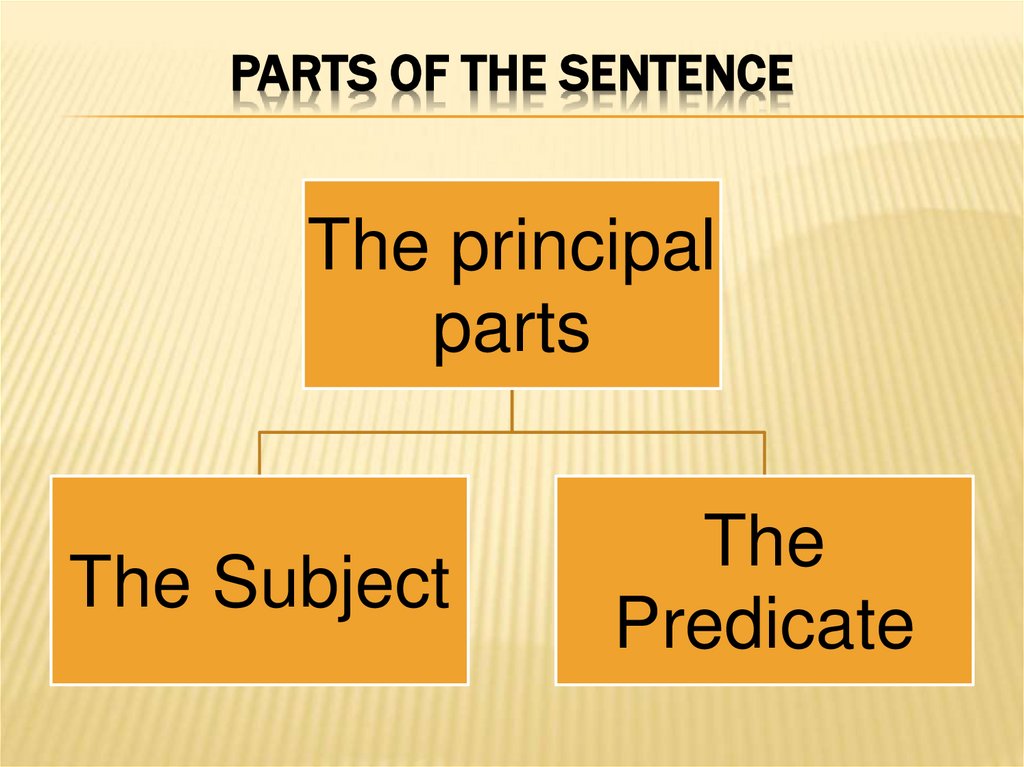
PARTS OF THE SENTENCEThe principal
parts
The Subject
The
Predicate
4. The Subject
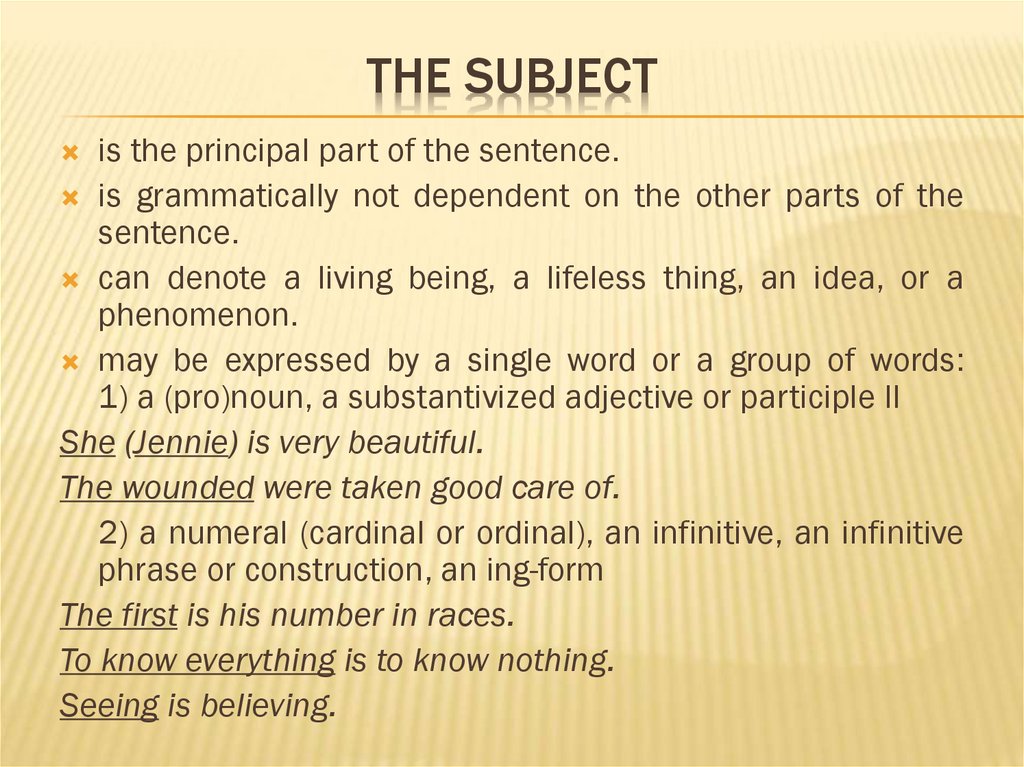
THE SUBJECTis the principal part of the sentence.
is grammatically not dependent on the other parts of the
sentence.
can denote a living being, a lifeless thing, an idea, or a
phenomenon.
may be expressed by a single word or a group of words:
1) a (pro)noun, a substantivized adjective or participle II
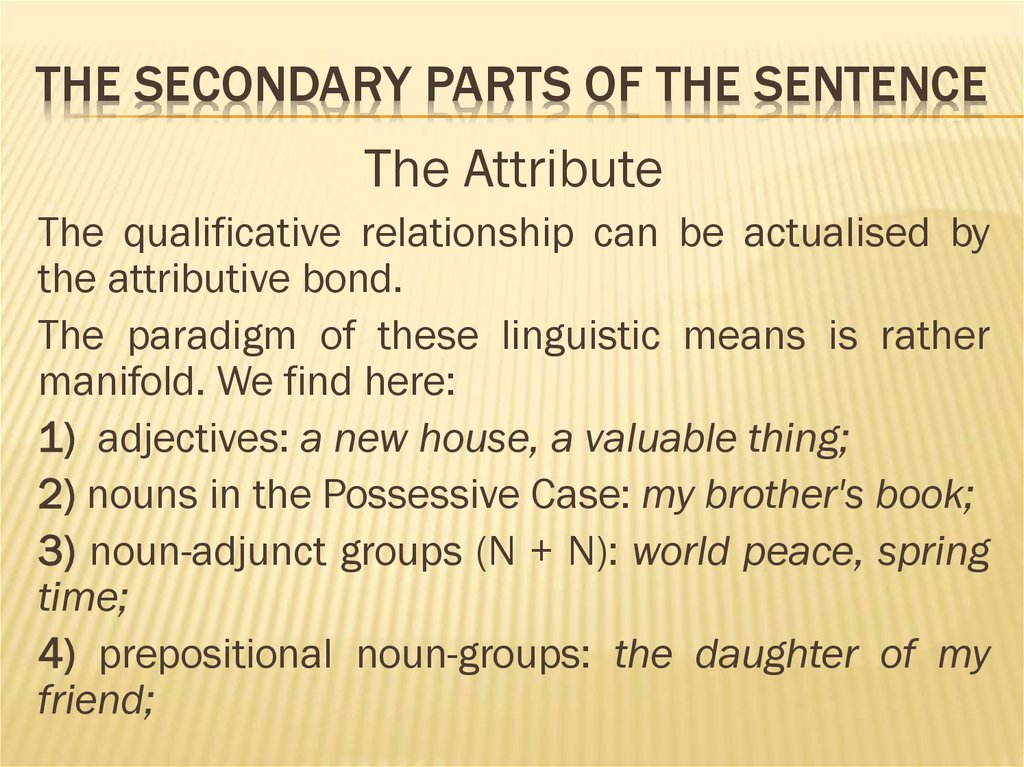
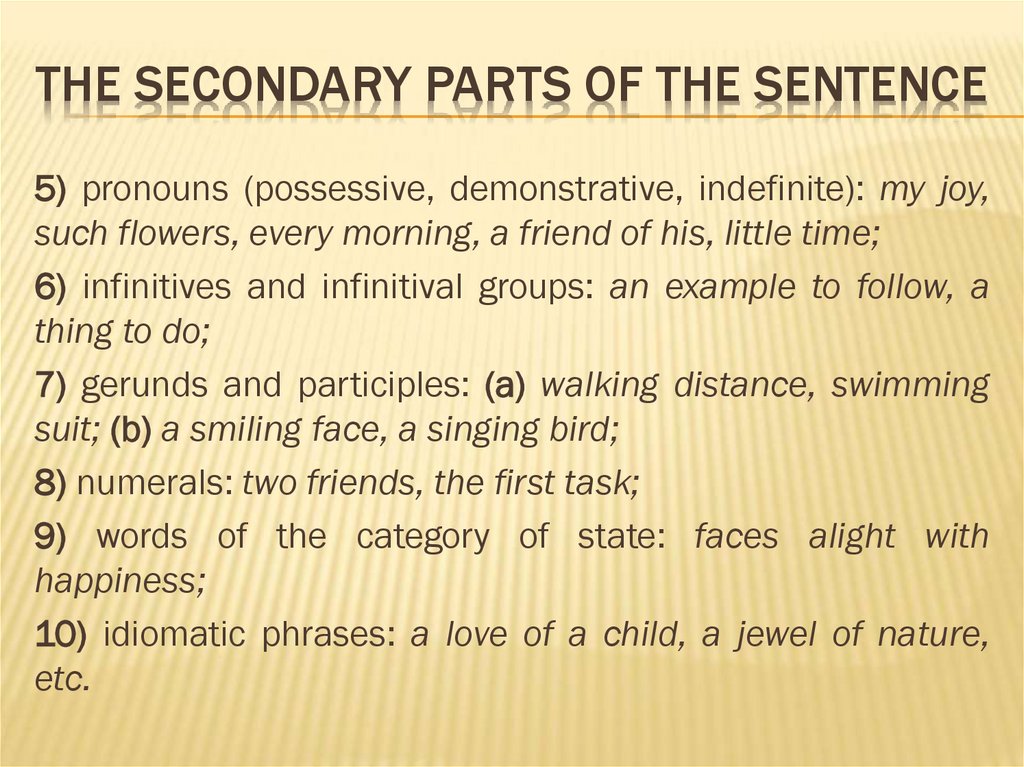
She (Jennie) is very beautiful.
The wounded were taken good care of.
2) a numeral (cardinal or ordinal), an infinitive, an infinitive
phrase or construction, an ing-form
The first is his number in races.
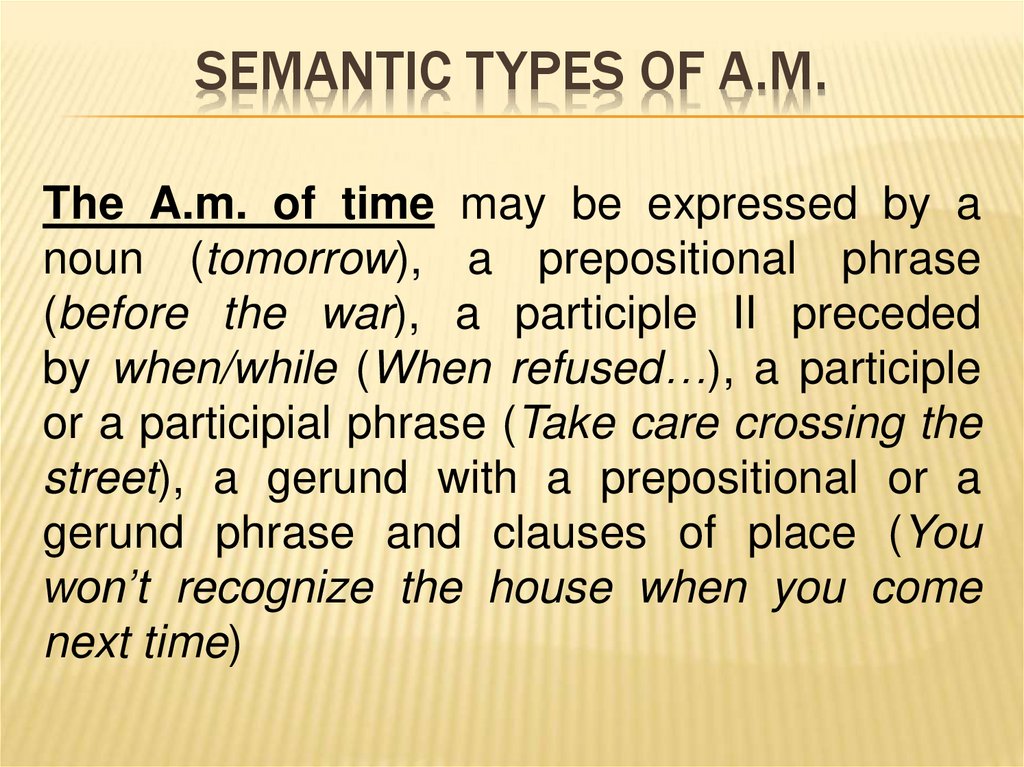
To know everything is to know nothing.
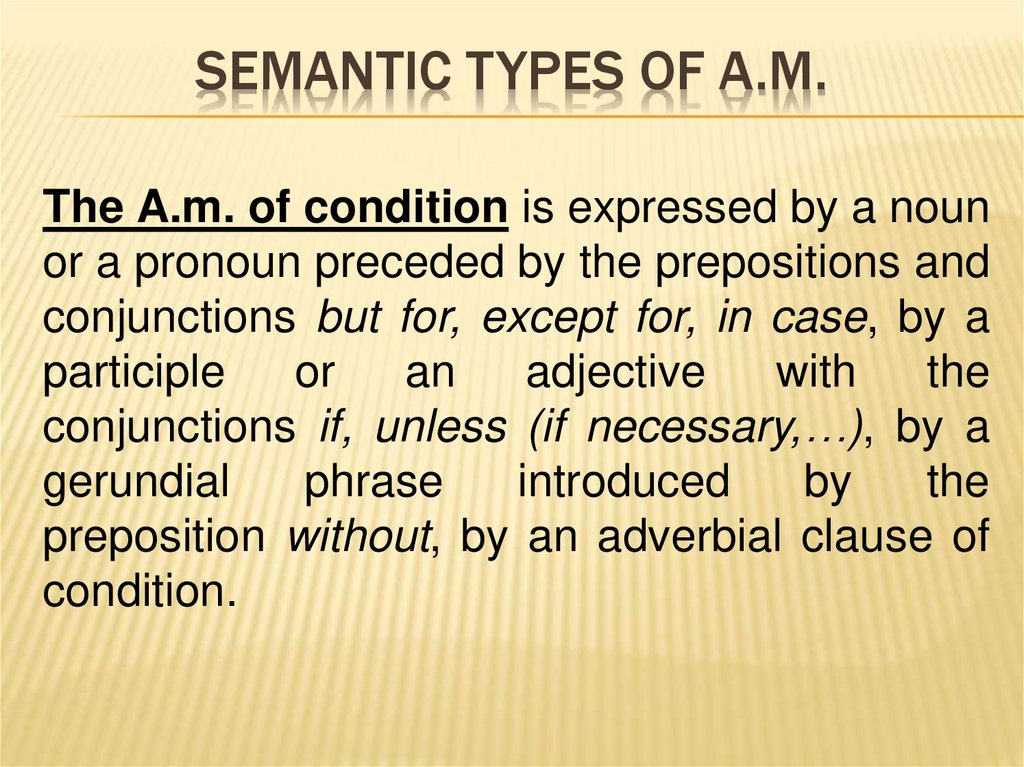
Seeing is believing.
5. The Subject
THE SUBJECTThe subject of a sentence is a noun (or a pronoun)
and all the modifiers that go with it.
e.g. Only one person in two billion will live to be 116 or older.
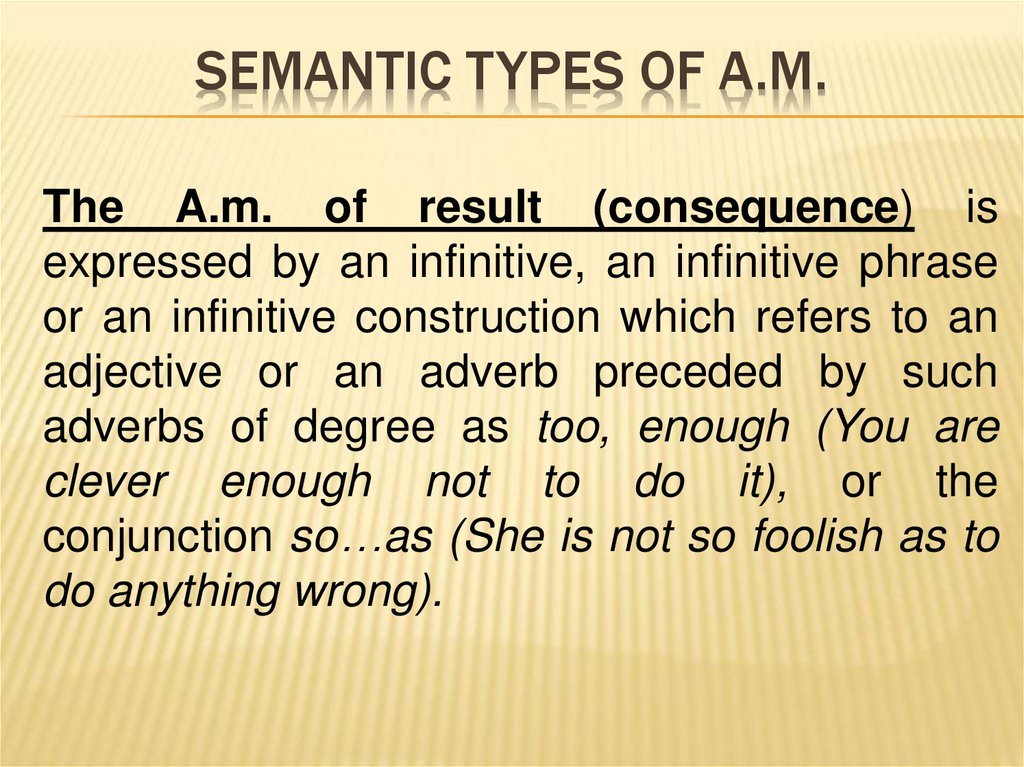
Digital currency will be the greatest social network of all.
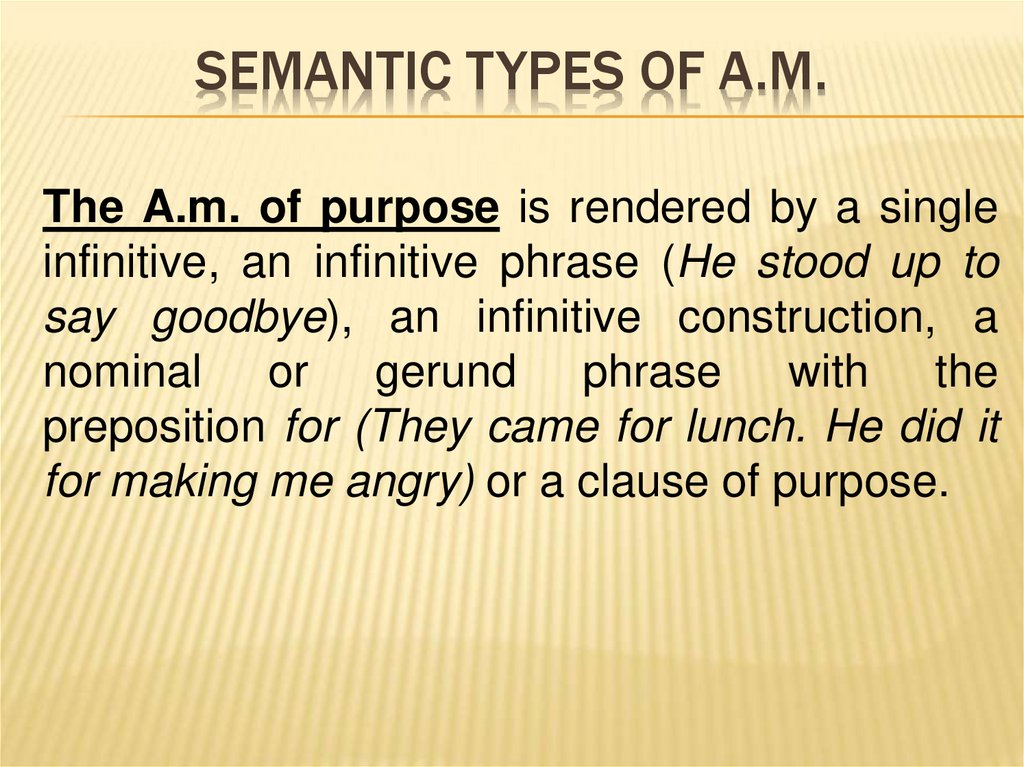
A simple subject is the key word or phrase being described.
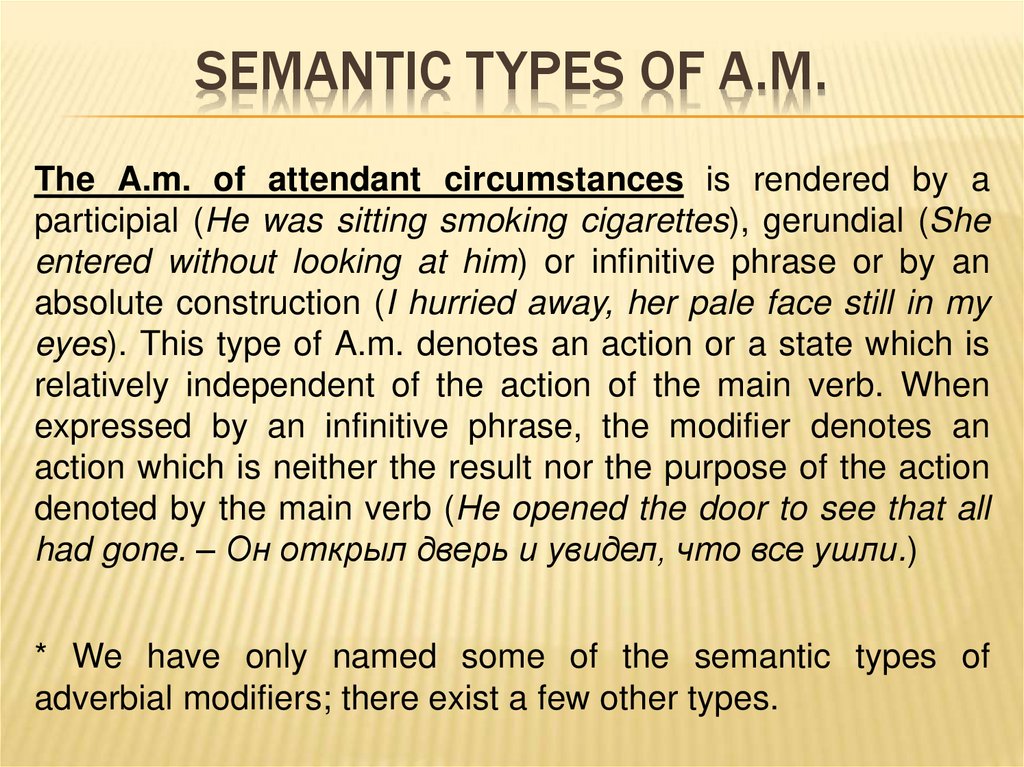
e.g. My new friend lives on Mars.
A complete subject includes the simple subject and its modifiers.
e.g. My new friend lives on Mars.
A compound subject, two words or phrases join to share the same verb.
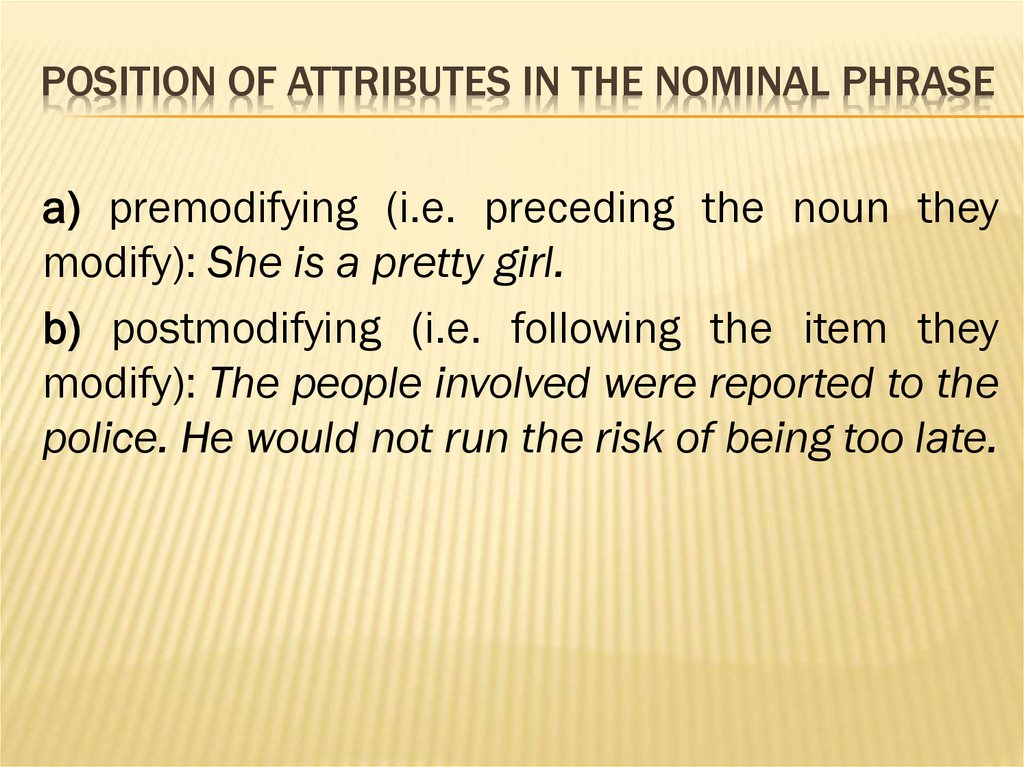
e.g. Lulu and Rita live on Mars.
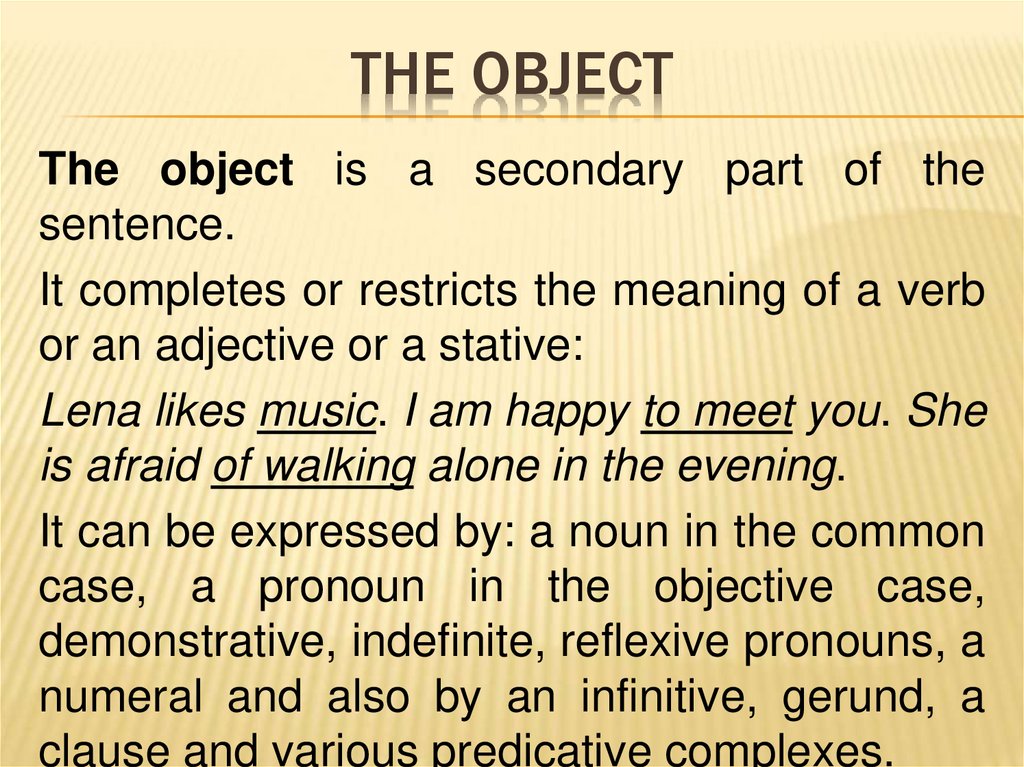
6. SIMPLE Subject
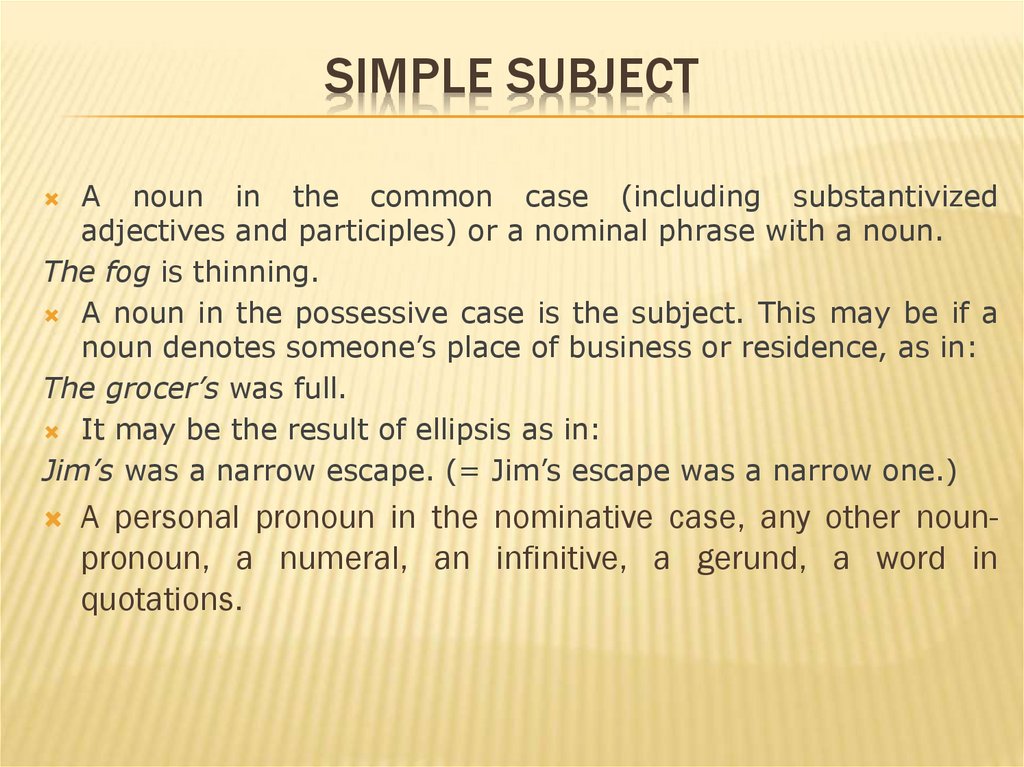
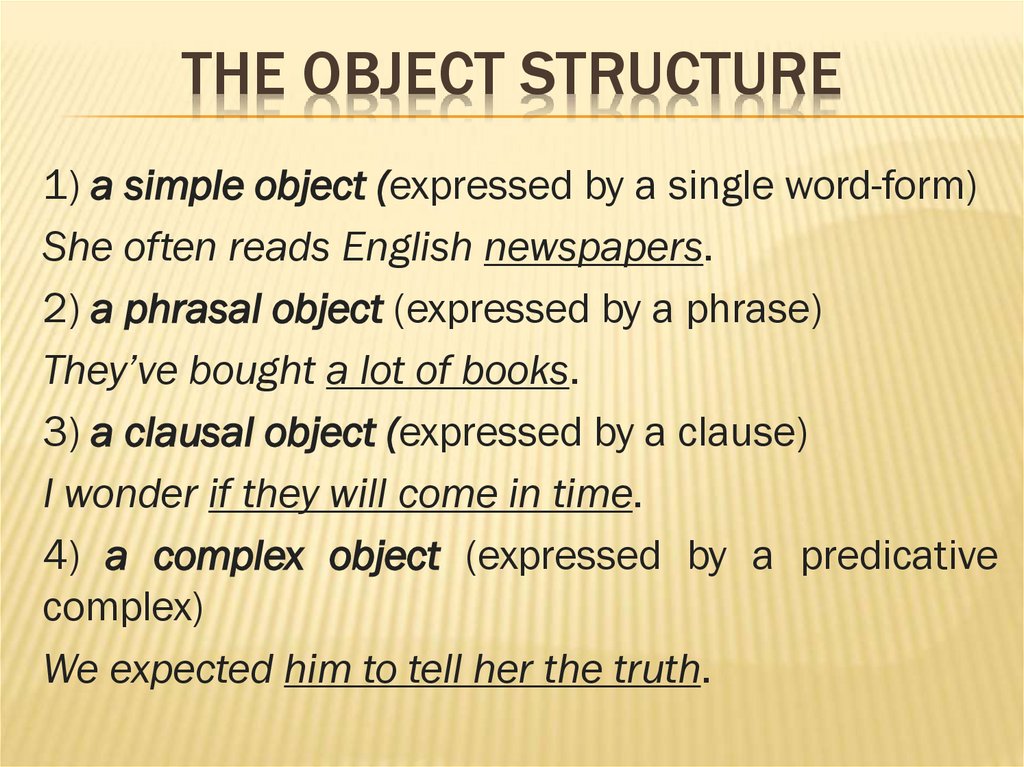
SIMPLE SUBJECTA noun in the common case (including substantivized
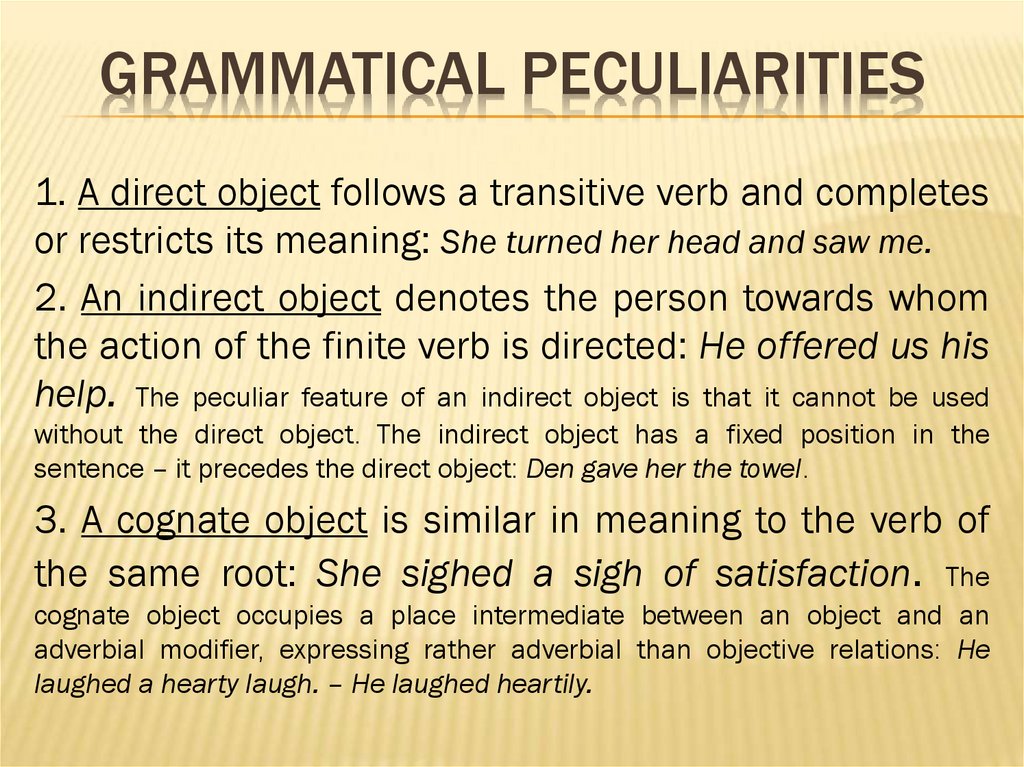
adjectives and participles) or a nominal phrase with a noun.
The fog is thinning.
A noun in the possessive case is the subject. This may be if a
noun denotes someone’s place of business or residence, as in:
The grocer’s was full.
It may be the result of ellipsis as in:
Jim’s was a narrow escape. (= Jim’s escape was a narrow one.)
A personal pronoun in the nominative case, any other nounpronoun, a numeral, an infinitive, a gerund, a word in
quotations.
7. Subject: GRAMMATICAL FORMS
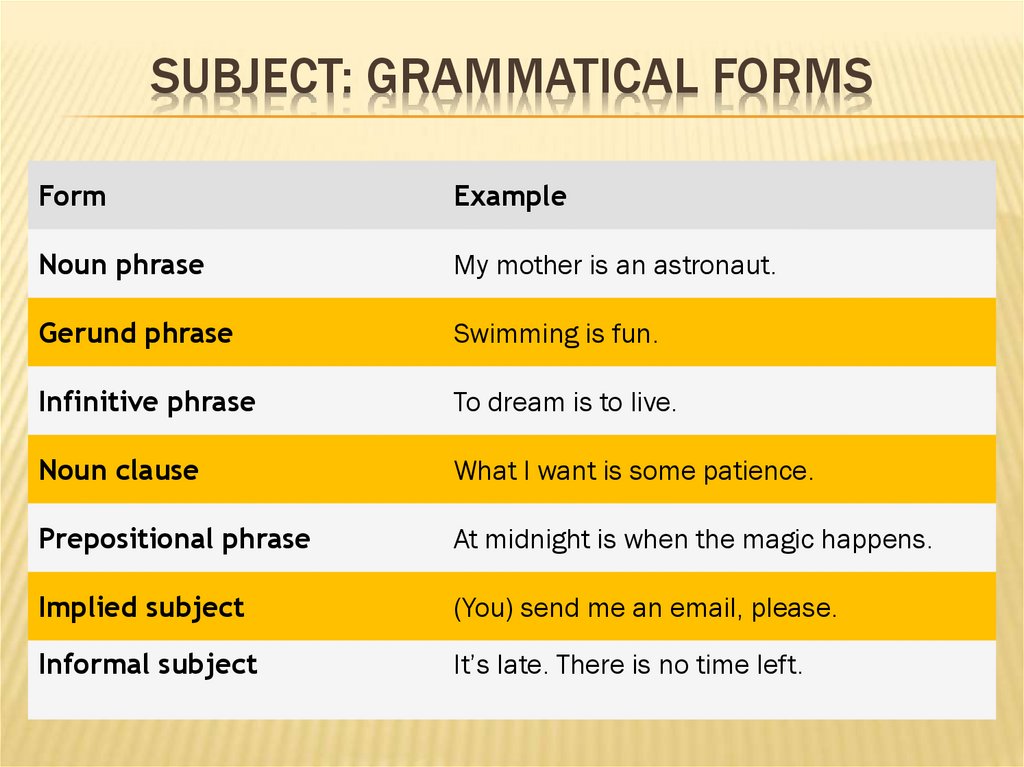
SUBJECT: GRAMMATICAL FORMSForm
Example
Noun phrase
My mother is an astronaut.
Gerund phrase
Swimming is fun.
Infinitive phrase
To dream is to live.
Noun clause
What I want is some patience.
Prepositional phrase
At midnight is when the magic happens.
Implied subject
(You) send me an email, please.
Informal subject
It’s late. There is no time left.
8. THE PRINCIPAL PARTS
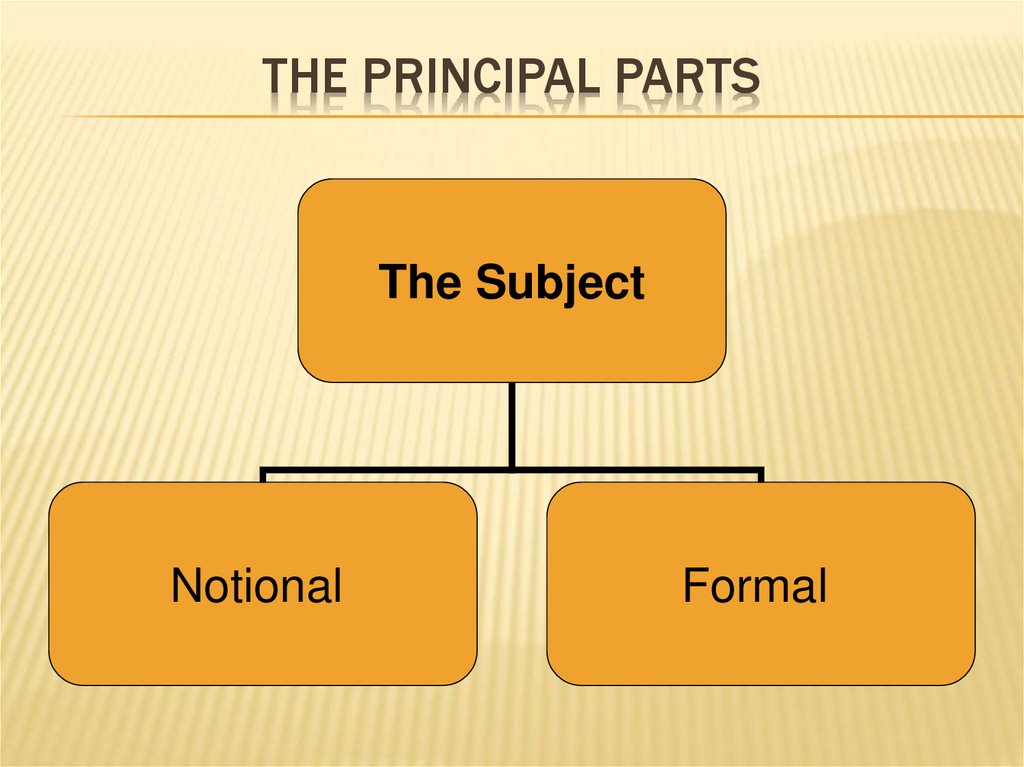
The SubjectNotional
Formal
9.
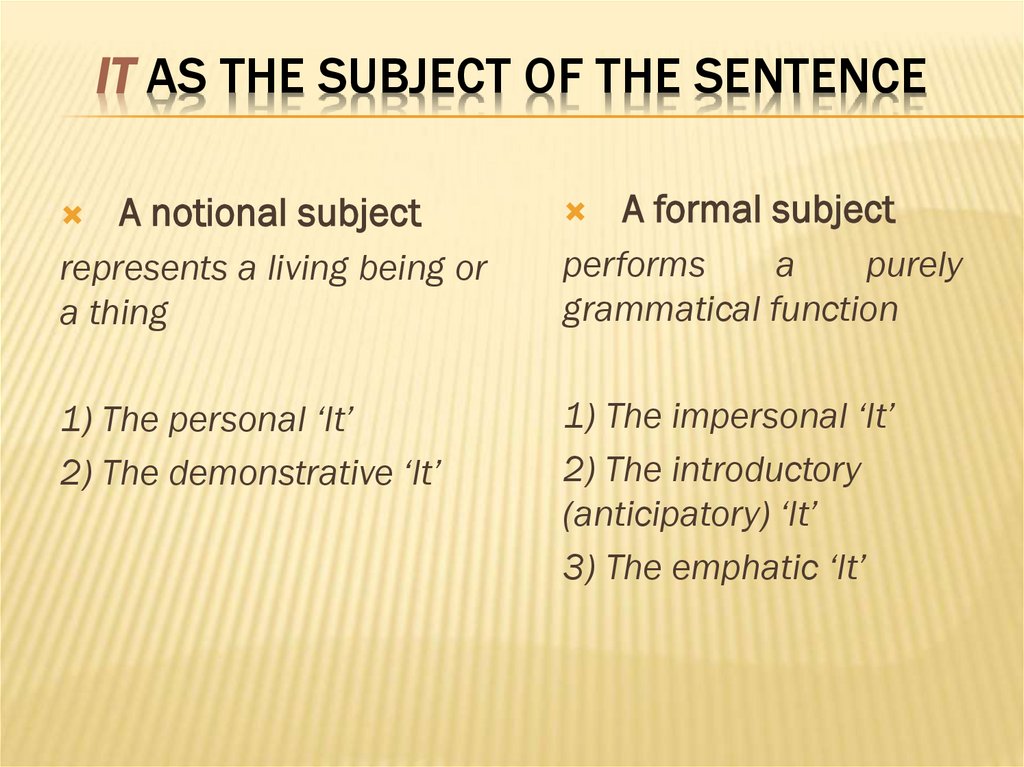
IT AS THE SUBJECT OF THE SENTENCEA notional subject
A formal subject
represents a living being or
a thing
performs
a
purely
grammatical function
1) The personal ‘It’
2) The demonstrative ‘It’
1) The impersonal ‘It’
2) The introductory
(anticipatory) ‘It’
3) The emphatic ‘It’
10.
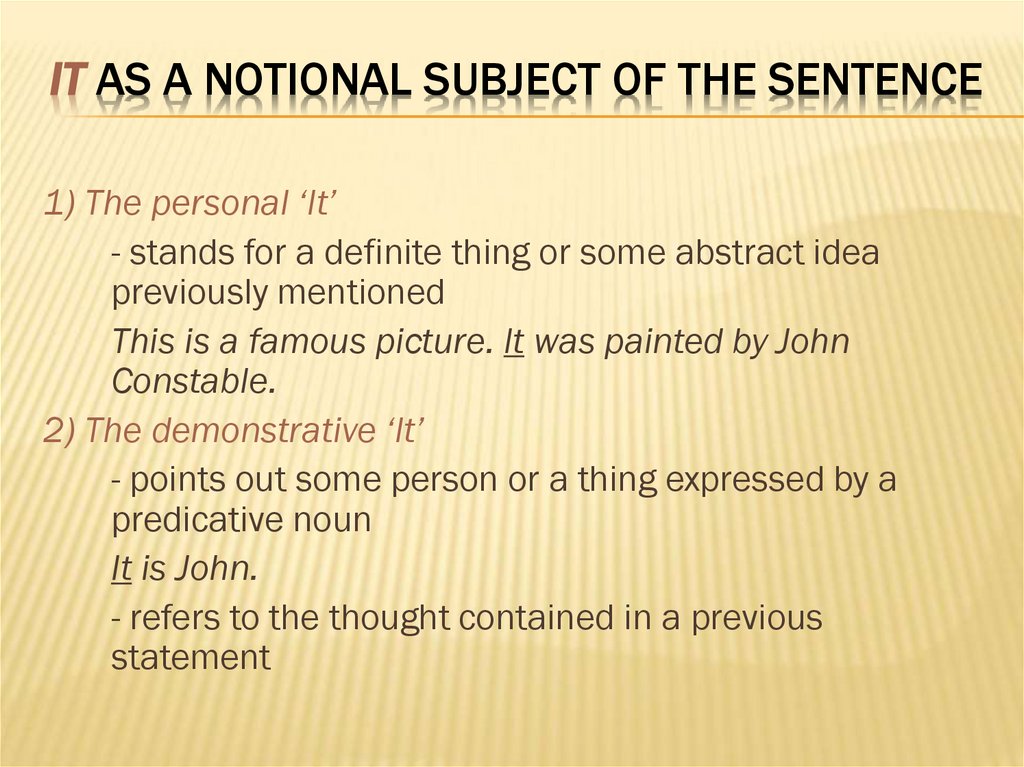
IT AS A NOTIONAL SUBJECT OF THE SENTENCE1) The personal ‘It’
- stands for a definite thing or some abstract idea
previously mentioned
This is a famous picture. It was painted by John
Constable.
2) The demonstrative ‘It’
- points out some person or a thing expressed by a
predicative noun
It is John.
- refers to the thought contained in a previous
statement
11.
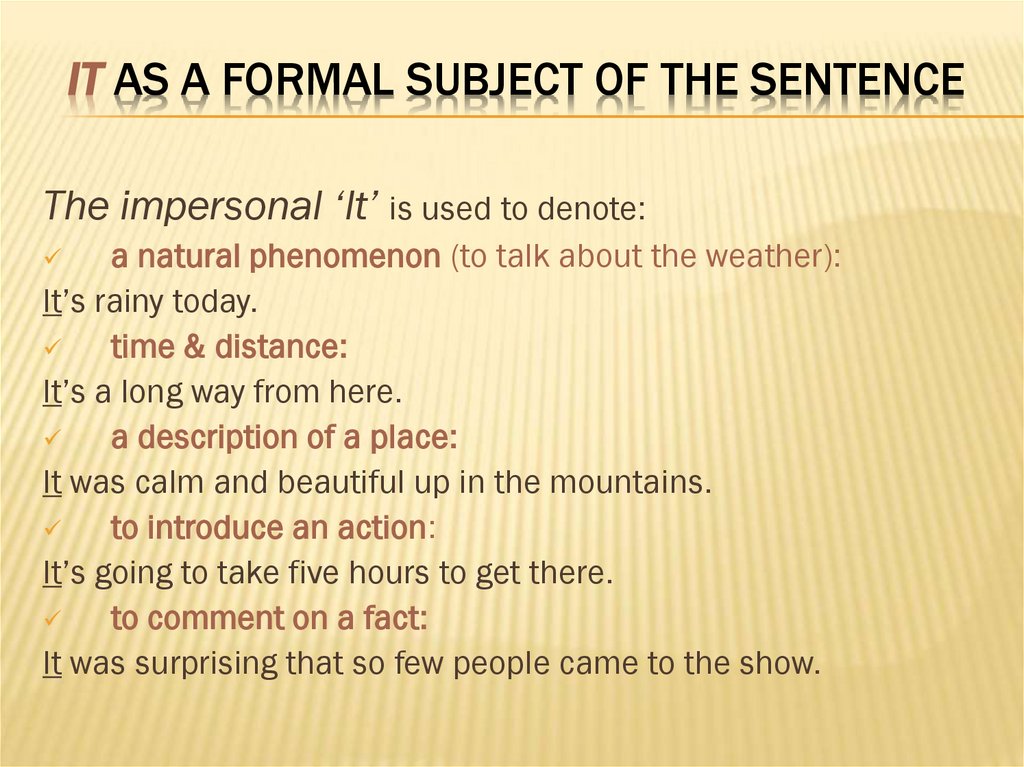
IT AS A FORMAL SUBJECT OF THE SENTENCEThe impersonal ‘It’ is used to denote:
a natural phenomenon (to talk about the weather):
It’s rainy today.
time & distance:
It’s a long way from here.
a description of a place:
It was calm and beautiful up in the mountains.
to introduce an action:
It’s going to take five hours to get there.
to comment on a fact:
It was surprising that so few people came to the show.
12.
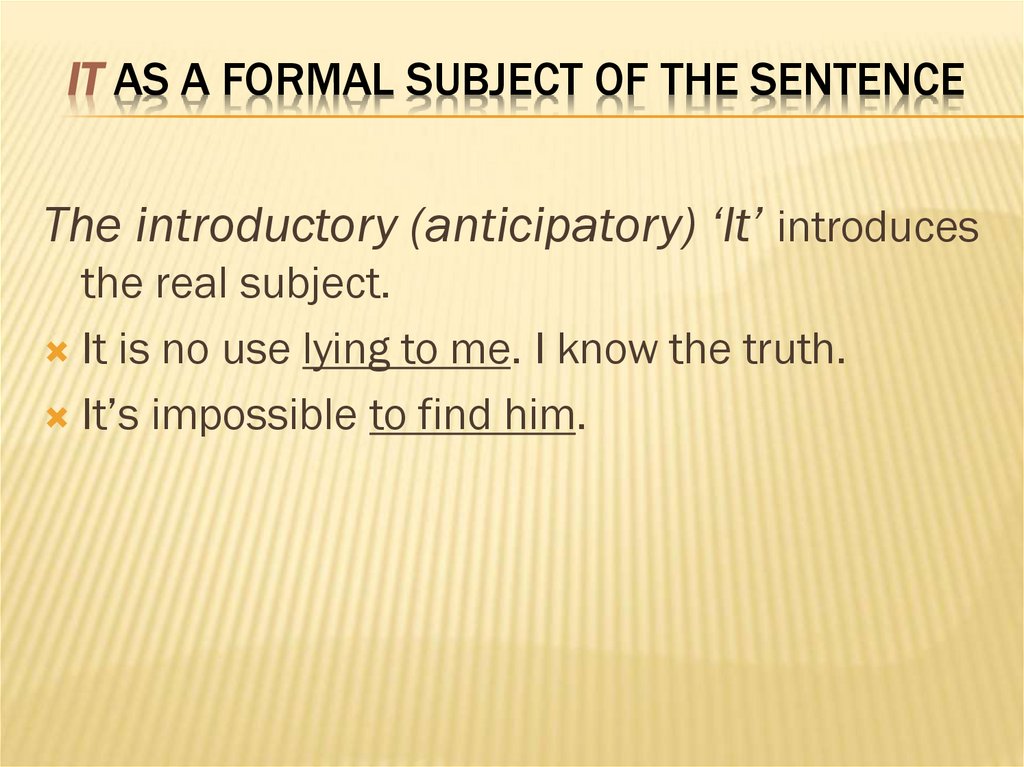
IT AS A FORMAL SUBJECT OF THE SENTENCEThe introductory (anticipatory) ‘It’ introduces
the real subject.
It is no use lying to me. I know the truth.
It’s impossible to find him.
13.
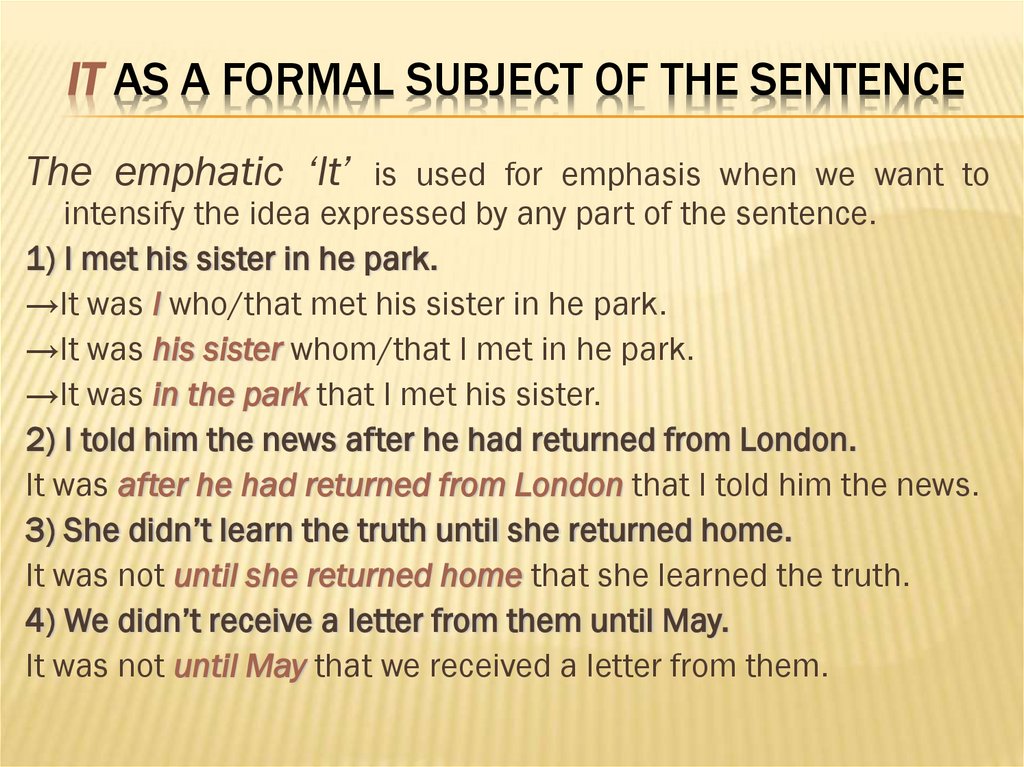
IT AS A FORMAL SUBJECT OF THE SENTENCEThe emphatic ‘It’ is used for emphasis when we want to
intensify the idea expressed by any part of the sentence.
1) I met his sister in he park.
→It was I who/that met his sister in he park.
→It was his sister whom/that I met in he park.
→It was in the park that I met his sister.
2) I told him the news after he had returned from London.
It was after he had returned from London that I told him the news.
3) She didn’t learn the truth until she returned home.
It was not until she returned home that she learned the truth.
4) We didn’t receive a letter from them until May.
It was not until May that we received a letter from them.
14.
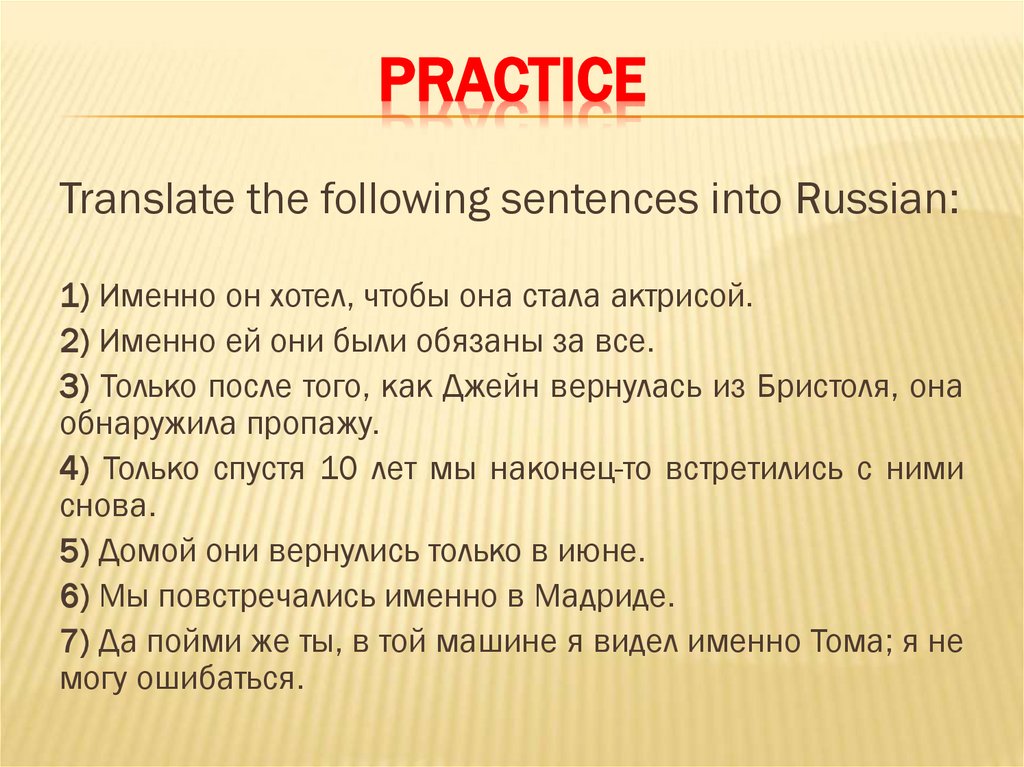
PRACTICETranslate the following sentences into Russian:
1) Именно он хотел, чтобы она стала актрисой.
2) Именно ей они были обязаны за все.
3) Только после того, как Джейн вернулась из Бристоля, она
обнаружила пропажу.
4) Только спустя 10 лет мы наконец-то встретились с ними
снова.
5) Домой они вернулись только в июне.
6) Мы повстречались именно в Мадриде.
7) Да пойми же ты, в той машине я видел именно Тома; я не
могу ошибаться.
15.
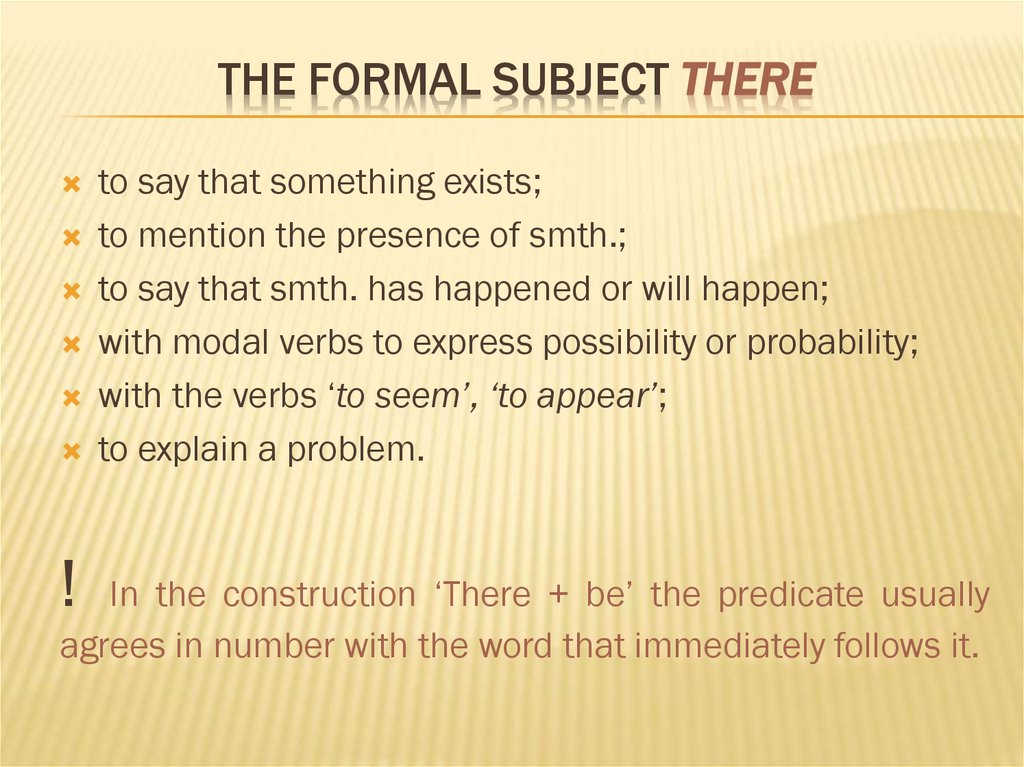
THE FORMAL SUBJECT THEREto say that something exists;
to mention the presence of smth.;
to say that smth. has happened or will happen;
with modal verbs to express possibility or probability;
with the verbs ‘to seem’, ‘to appear’;
to explain a problem.
! In the construction ‘There + be’ the predicate usually
agrees in number with the word that immediately follows it.
16.
FORMAL SUBJECTS ONE, THEY‘One’ as the subject is used when we think about the
doer of the action in general, any person or people (including
the speaker)
One should be careful when crossing the street.
One must always keep his word.
‘They’
as the subject is used when we think about
people in general (not including the speaker); usually followed
by the verb ‘to say’
They say wonders sometimes happen.
17.
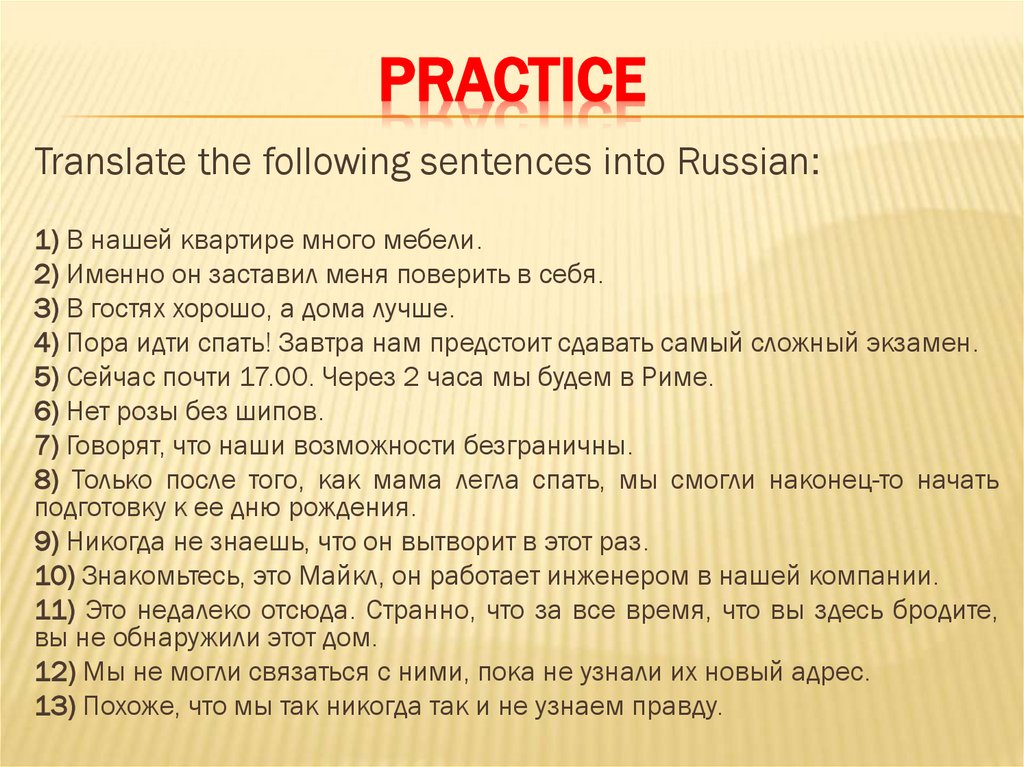
PRACTICETranslate the following sentences into Russian:
1) В нашей квартире много мебели.
2) Именно он заставил меня поверить в себя.
3) В гостях хорошо, а дома лучше.
4) Пора идти спать! Завтра нам предстоит сдавать самый сложный экзамен.
5) Сейчас почти 17.00. Через 2 часа мы будем в Риме.
6) Нет розы без шипов.
7) Говорят, что наши возможности безграничны.
8) Только после того, как мама легла спать, мы смогли наконец-то начать
подготовку к ее дню рождения.
9) Никогда не знаешь, что он вытворит в этот раз.
10) Знакомьтесь, это Майкл, он работает инженером в нашей компании.
11) Это недалеко отсюда. Странно, что за все время, что вы здесь бродите,
вы не обнаружили этот дом.
12) Мы не могли связаться с ними, пока не узнали их новый адрес.
13) Похоже, что мы так никогда так и не узнаем правду.
18.
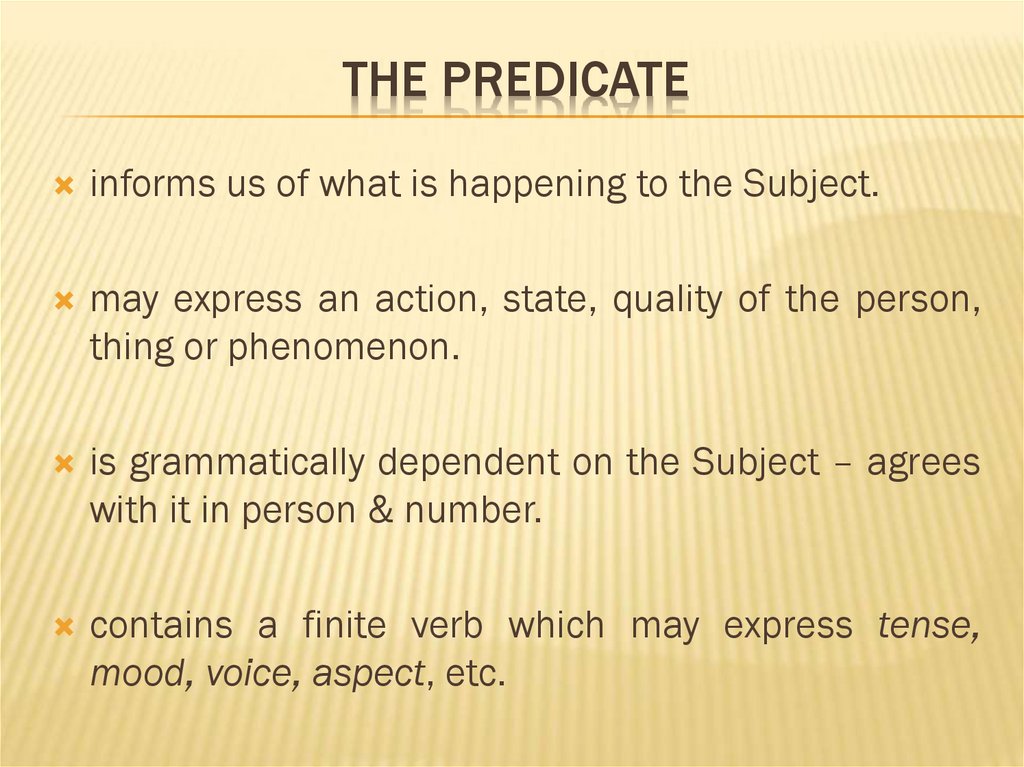
THE PREDICATEinforms us of what is happening to the Subject.
may express an action, state, quality of the person,
thing or phenomenon.
is grammatically dependent on the Subject – agrees
with it in person & number.
contains
a finite verb which may express tense,
mood, voice, aspect, etc.
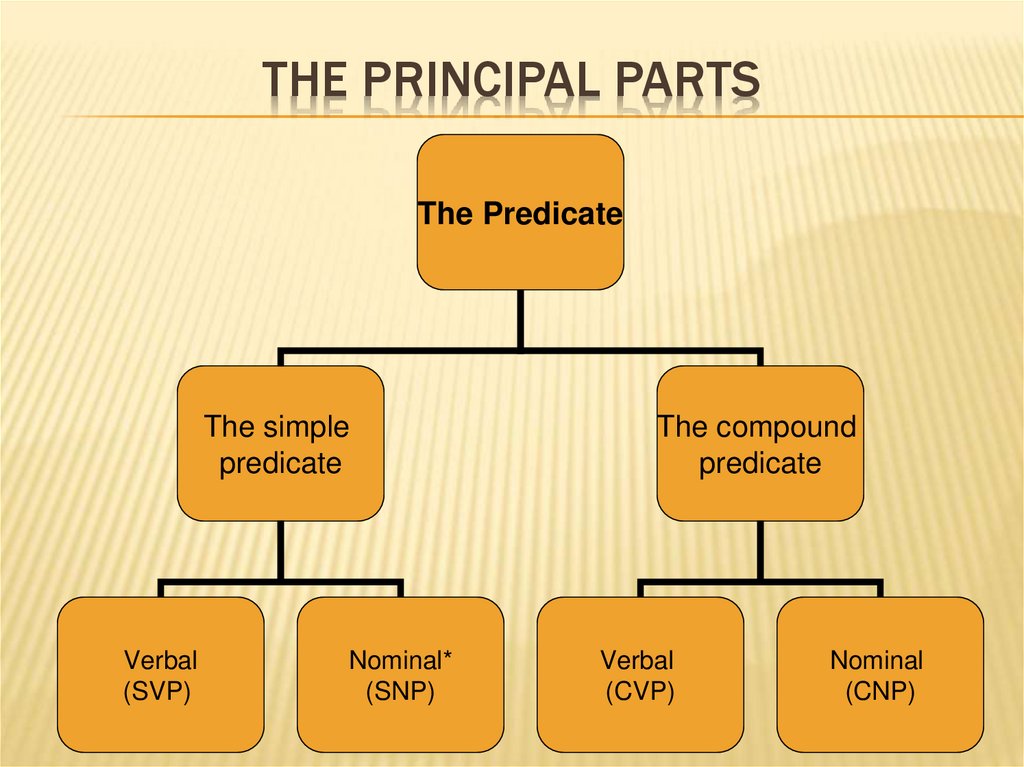
19. THE PRINCIPAL PARTS
The PredicateThe simple
predicate
Verbal
(SVP)
Nominal*
(SNP)
The compound
predicate
Verbal
(CVP)
Nominal
(CNP)
20. THE SIMPLE VERBAL PREDICATE
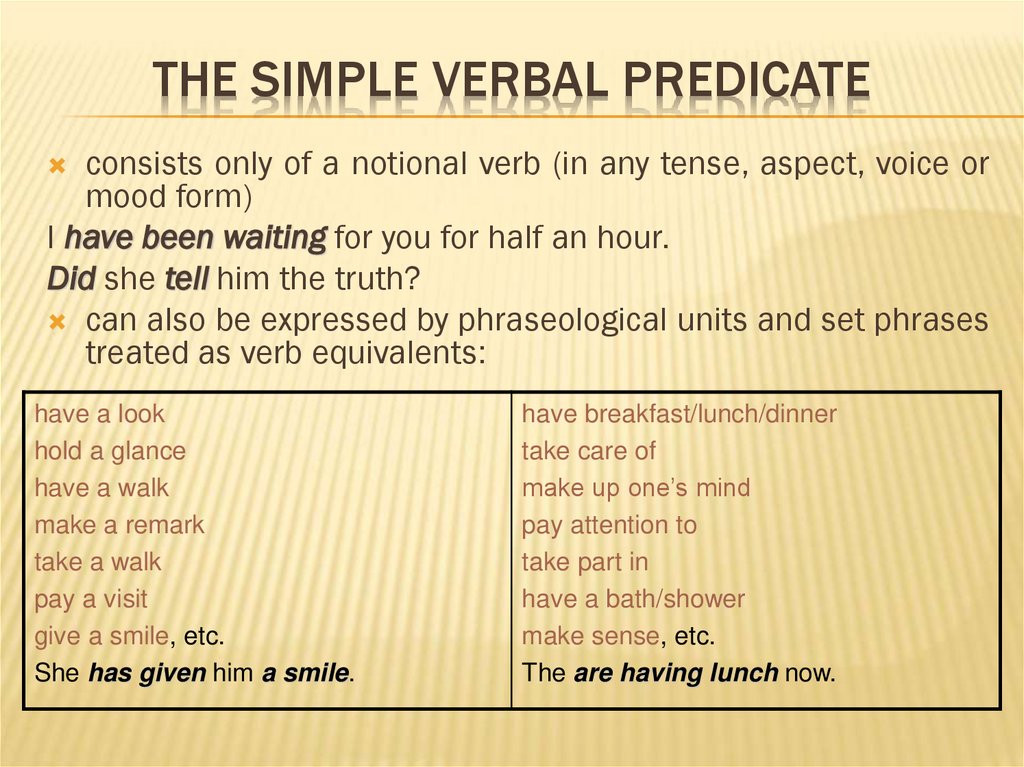
consists only of a notional verb (in any tense, aspect, voice ormood form)
I have been waiting for you for half an hour.
Did she tell him the truth?
can also be expressed by phraseological units and set phrases
treated as verb equivalents:
have a look
hold a glance
have a walk
make a remark
take a walk
pay a visit
give a smile, etc.
She has given him a smile.
have breakfast/lunch/dinner
take care of
make up one’s mind
pay attention to
take part in
have a bath/shower
make sense, etc.
The are having lunch now.
21. THE SIMPLE NOMINAL* PREDICATE
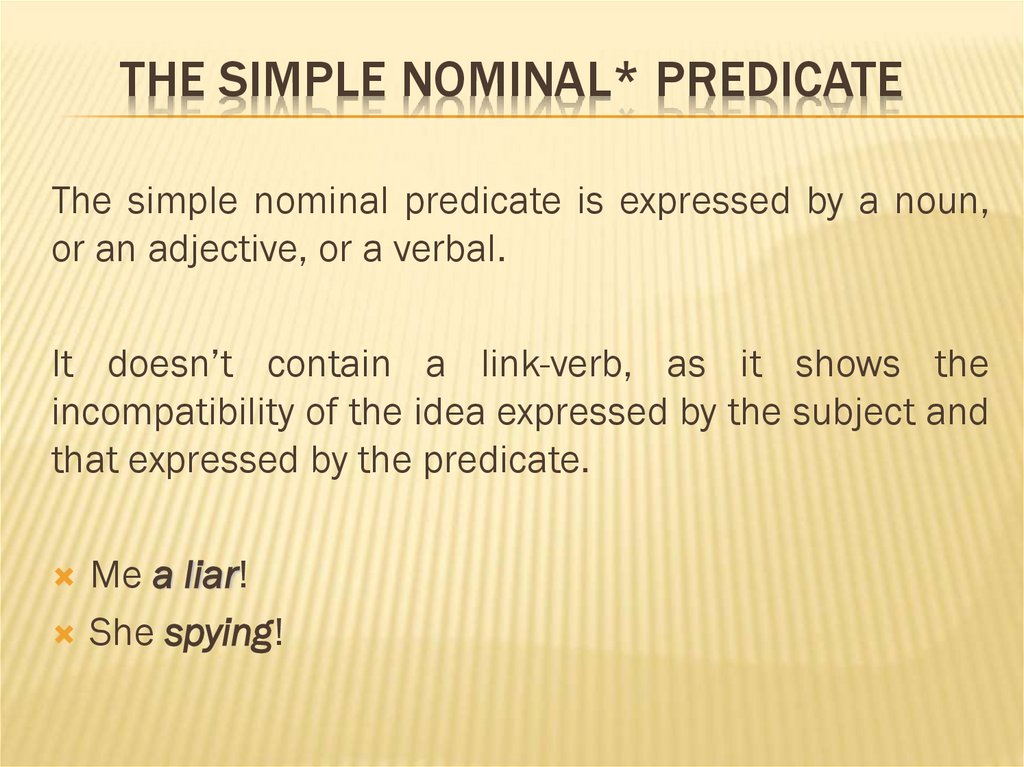
The simple nominal predicate is expressed by a noun,or an adjective, or a verbal.
It doesn’t contain a link-verb, as it shows the
incompatibility of the idea expressed by the subject and
that expressed by the predicate.
Me a liar!
She spying!
22. THE COMPOUND NOMINAL PREDICATE
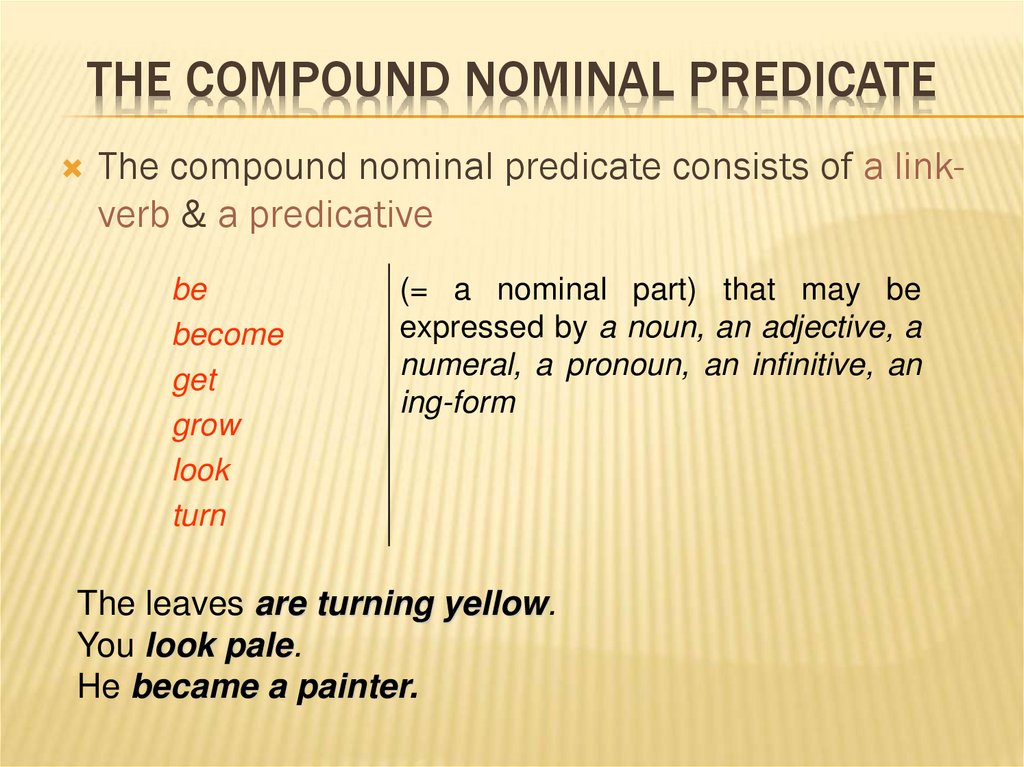
The compound nominal predicate consists of a link-verb & a predicative
be
become
get
grow
look
turn
(= a nominal part) that may be
expressed by a noun, an adjective, a
numeral, a pronoun, an infinitive, an
ing-form
The leaves are turning yellow.
You look pale.
He became a painter.
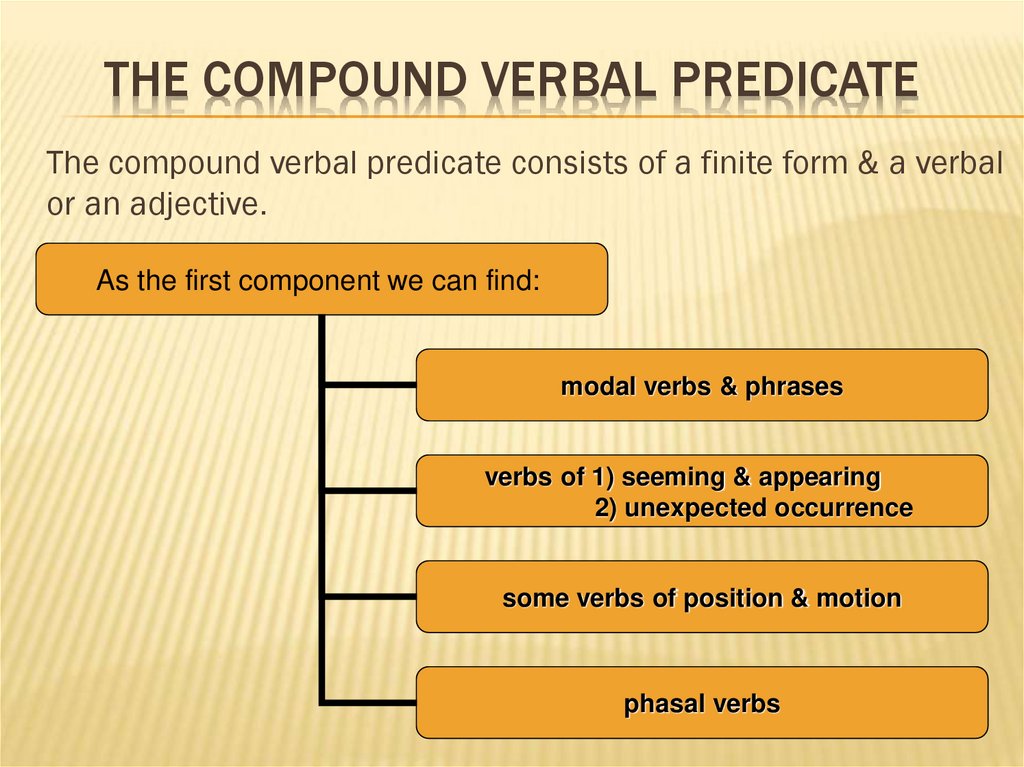
23. THE COMPOUND VERBAL PREDICATE
The compound verbal predicate consists of a finite form & a verbalor an adjective.
As the first component we can find:
modal verbs & phrases
verbs of 1) seeming & appearing
2) unexpected occurrence
some verbs of position & motion
phasal verbs
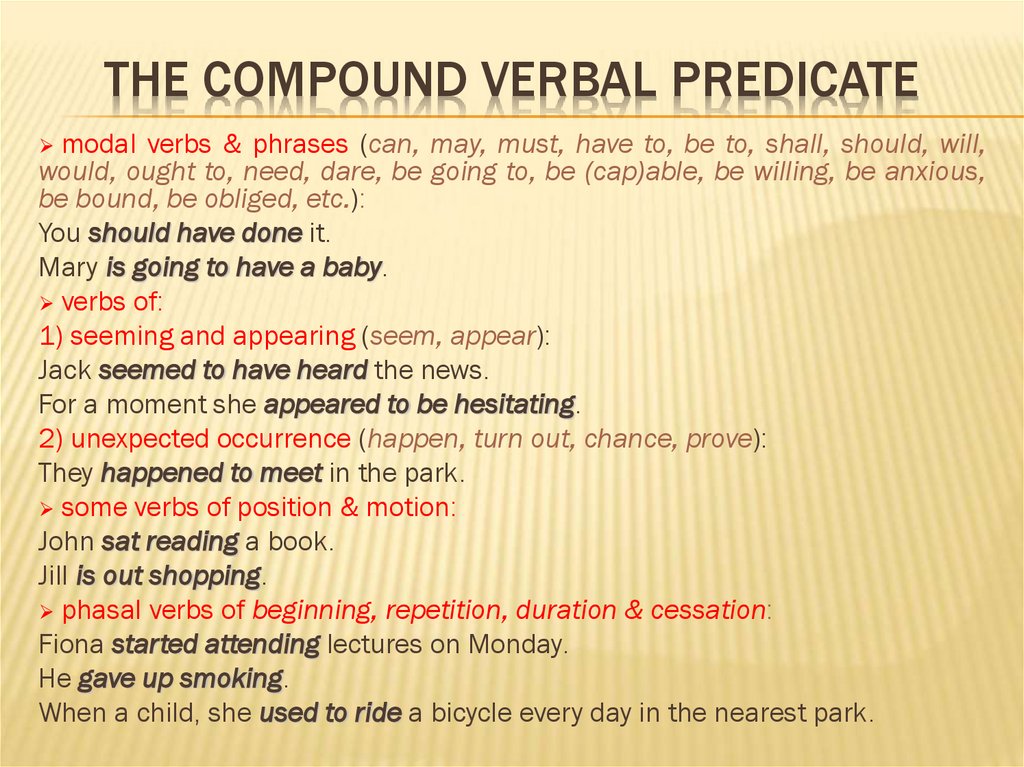
24. THE COMPOUND VERBAL PREDICATE
modal verbs & phrases (can, may, must, have to, be to, shall, should, will,would, ought to, need, dare, be going to, be (cap)able, be willing, be anxious,
be bound, be obliged, etc.):
You should have done it.
Mary is going to have a baby.
verbs of:
1) seeming and appearing (seem, appear):
Jack seemed to have heard the news.
For a moment she appeared to be hesitating.
2) unexpected occurrence (happen, turn out, chance, prove):
They happened to meet in the park.
some verbs of position & motion:
John sat reading a book.
Jill is out shopping.
phasal verbs of beginning, repetition, duration & cessation:
Fiona started attending lectures on Monday.
He gave up smoking.
When a child, she used to ride a bicycle every day in the nearest park.
25.
PRACTICEFind the predicate and characterize it:
1) The meeting will begin at 7 p.m.
2) She began crying.
3) John didn’t pay attention to the people around him.
4) It suddenly grew dark.
5) On hearing these words her face turned pale.
6) She can’t be sleeping now.
7) Mr. Atkinson is dining at the moment.
8) He never takes part in talk-shows.
9) I am to speak last at the meeting.
10) When a child, I used to ride my bicycle all days long.
11) You’re not allowed to come in.
12) I’ve just told you that.
13) She was the first to start speaking.
14) I’m willing to have a talk with him!
15) I’m not going to wake him up, he’s just fallen asleep.
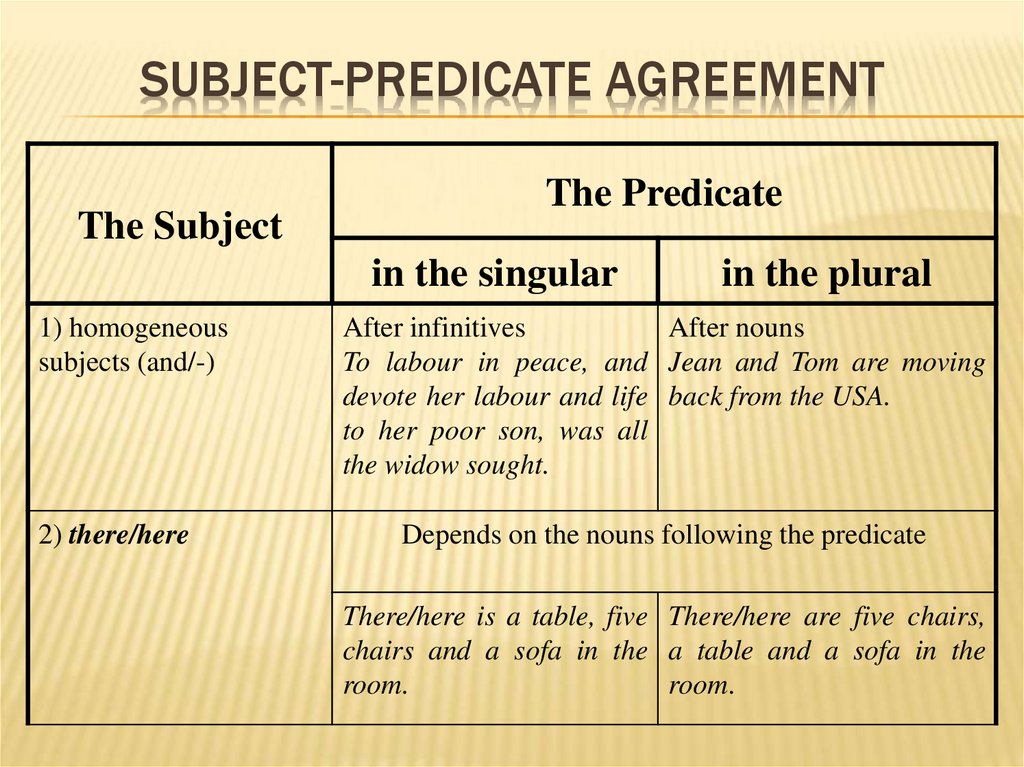
26. SUBJECT-PREDICATE AGREEMENT
The SubjectThe Predicate
in the singular
in the plural
1) homogeneous
subjects (and/-)
After infinitives
After nouns
To labour in peace, and Jean and Tom are moving
devote her labour and life back from the USA.
to her poor son, was all
the widow sought.
2) there/here
Depends on the nouns following the predicate
There/here is a table, five There/here are five chairs,
chairs and a sofa in the a table and a sofa in the
room.
room.
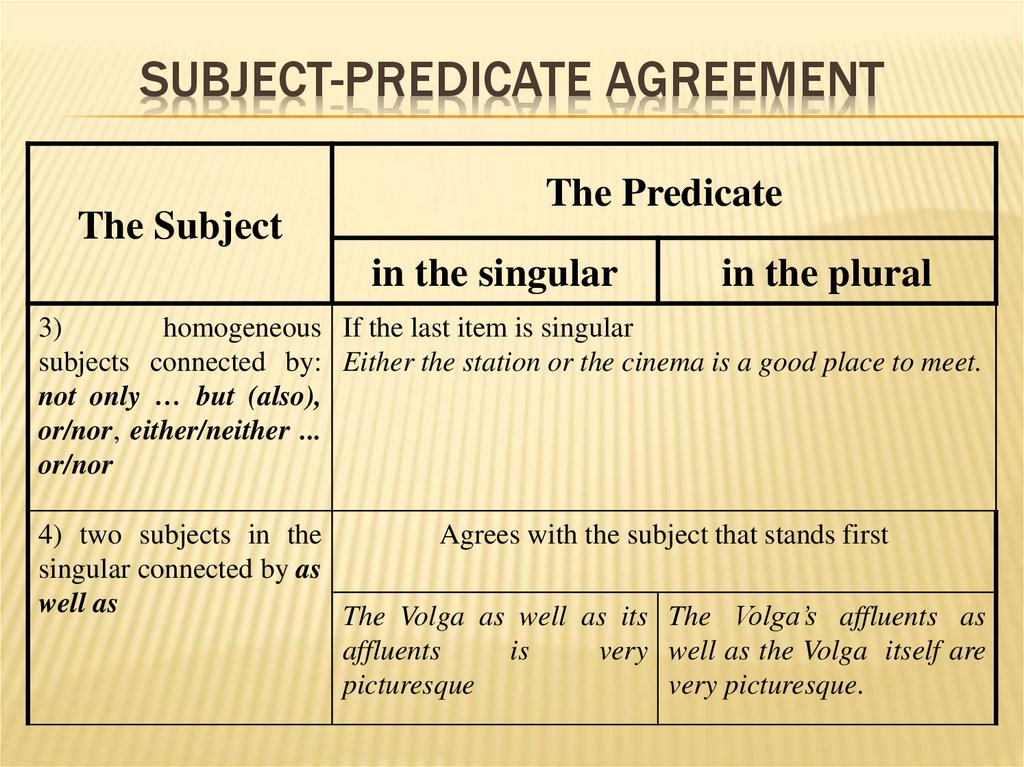
27. SUBJECT-PREDICATE AGREEMENT
The SubjectThe Predicate
in the singular
in the plural
3)
homogeneous If the last item is singular
subjects connected by: Either the station or the cinema is a good place to meet.
not only … but (also),
or/nor, either/neither ...
or/nor
4) two subjects in the
Agrees with the subject that stands first
singular connected by as
well as
The Volga as well as its The Volga’s affluents as
affluents
is
very well as the Volga itself are
picturesque
very picturesque.
28. SUBJECT-PREDICATE AGREEMENT
The SubjectThe Predicate
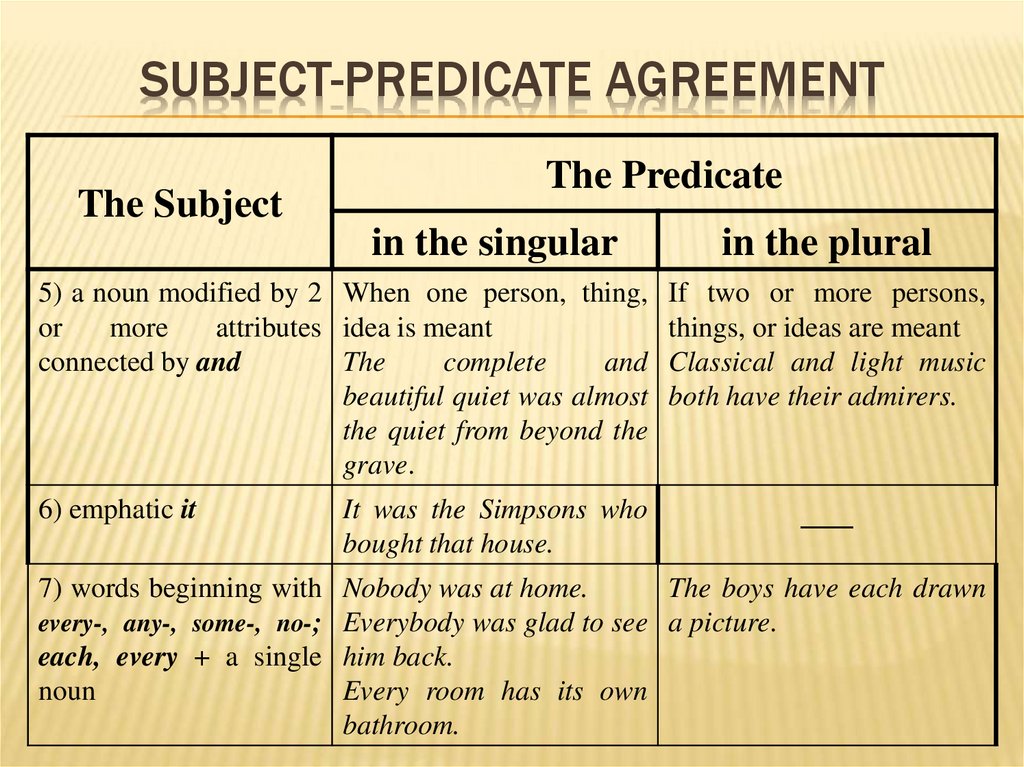
in the singular
5) a noun modified by 2 When one person, thing,
or
more
attributes idea is meant
connected by and
The
complete
and
beautiful quiet was almost
the quiet from beyond the
grave.
in the plural
If two or more persons,
things, or ideas are meant
Classical and light music
both have their admirers.
—
6) emphatic it
It was the Simpsons who
bought that house.
7) words beginning with
every-, any-, some-, no-;
each, every + a single
noun
Nobody was at home.
The boys have each drawn
Everybody was glad to see a picture.
him back.
Every room has its own
bathroom.
29. SUBJECT-PREDICATE AGREEMENT
The SubjectThe Predicate
in the singular
in the plural
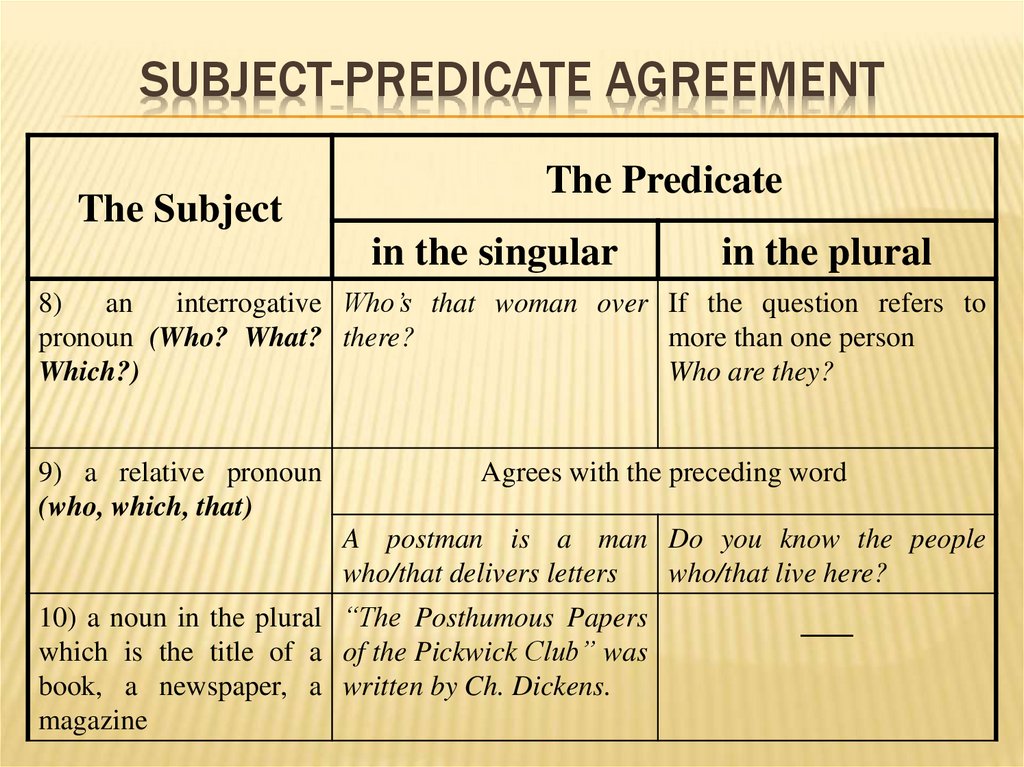
8)
an
interrogative Who’s that woman over If the question refers to
pronoun (Who? What? there?
more than one person
Which?)
Who are they?
9) a relative pronoun
(who, which, that)
Agrees with the preceding word
A postman is a man Do you know the people
who/that delivers letters
who/that live here?
10) a noun in the plural “The Posthumous Papers
which is the title of a of the Pickwick Club” was
book, a newspaper, a written by Ch. Dickens.
magazine
—
30. SUBJECT-PREDICATE AGREEMENT
The SubjectThe Predicate
in the singular
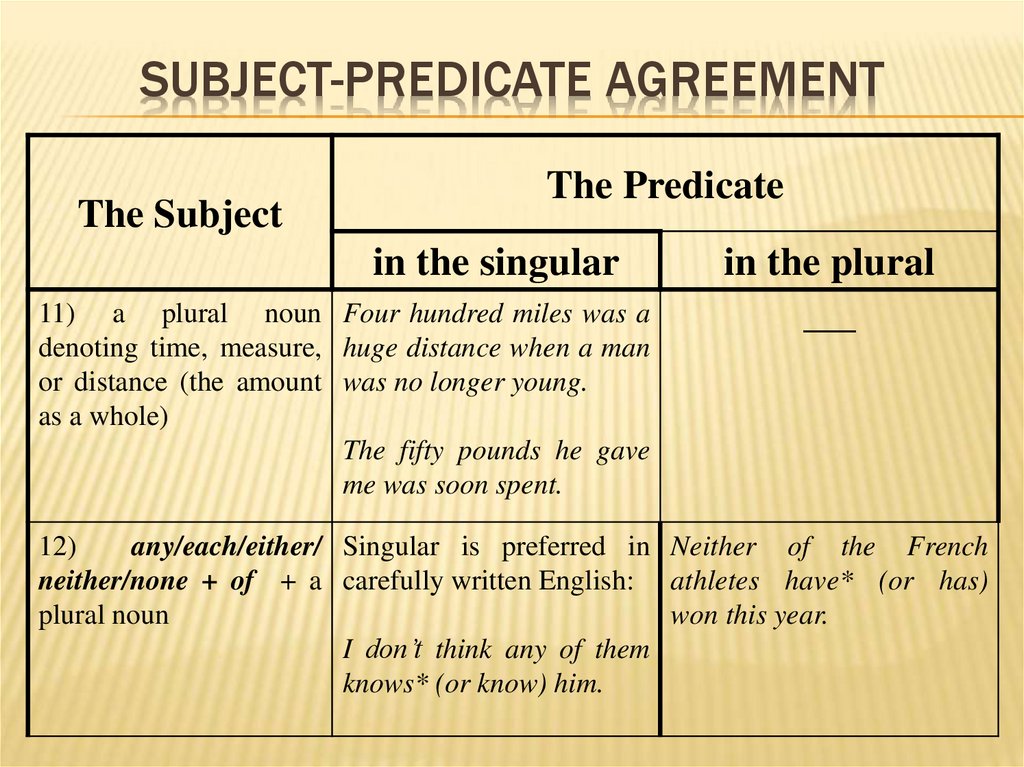
11) a plural noun Four hundred miles was a
denoting time, measure, huge distance when a man
or distance (the amount was no longer young.
as a whole)
The fifty pounds he gave
me was soon spent.
in the plural
—
12)
any/each/either/ Singular is preferred in Neither of the French
neither/none + of + a carefully written English: athletes have* (or has)
plural noun
won this year.
I don’t think any of them
knows* (or know) him.
31. SUBJECT-PREDICATE AGREEMENT
The SubjectThe Predicate
in the singular
in the plural
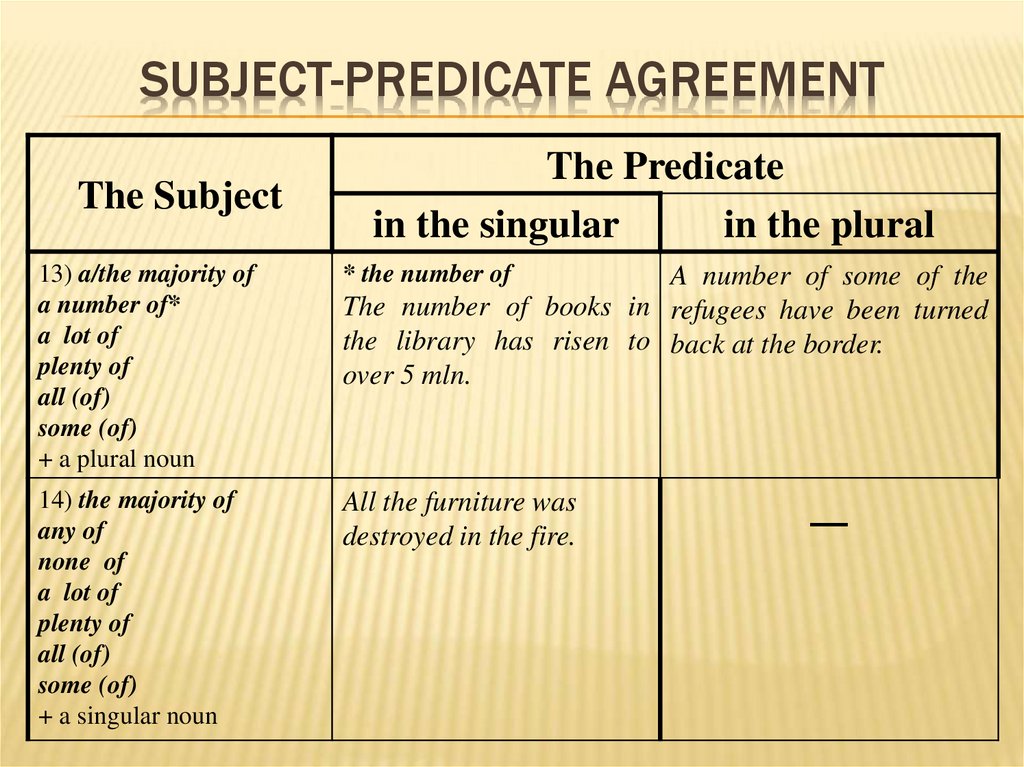
13) a/the majority of
a number of*
a lot of
plenty of
all (of)
some (of)
+ a plural noun
* the number of
14) the majority of
any of
none of
a lot of
plenty of
all (of)
some (of)
+ a singular noun
All the furniture was
destroyed in the fire.
A number of some of the
The number of books in refugees have been turned
the library has risen to back at the border.
over 5 mln.
—
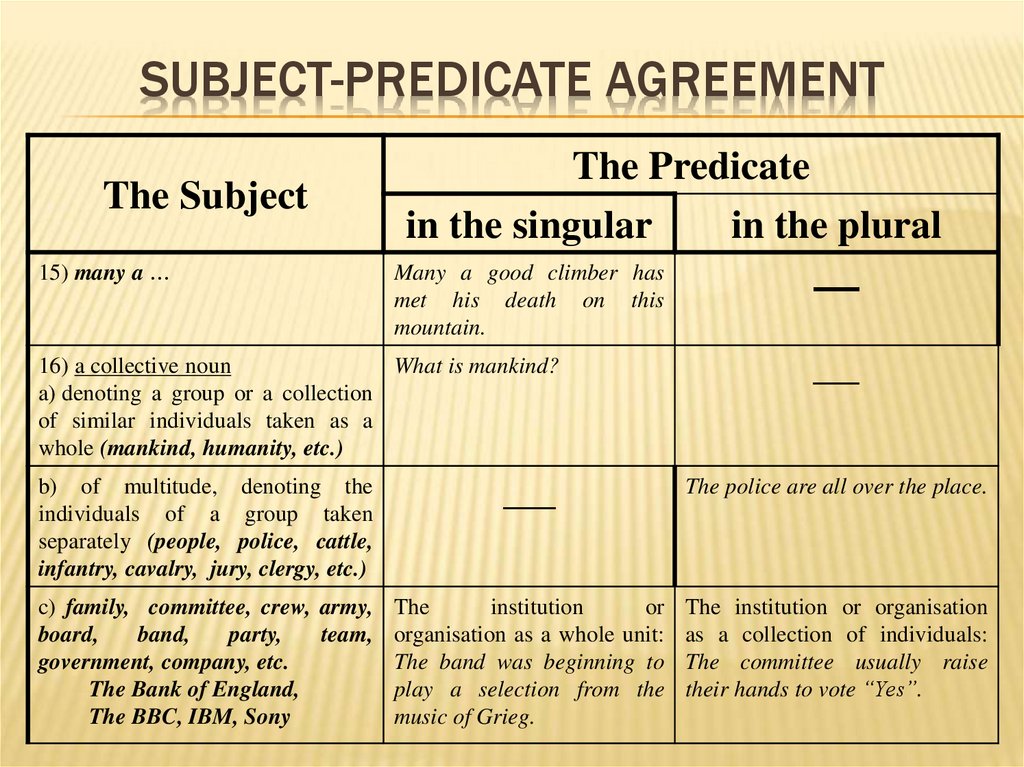
32. SUBJECT-PREDICATE AGREEMENT
The Subject15) many a …
The Predicate
in the singular
in the plural
Many a good climber has
met his death on this
mountain.
16) a collective noun
What is mankind?
a) denoting a group or a collection
of similar individuals taken as a
whole (mankind, humanity, etc.)
—
—
b) of multitude, denoting the
individuals of a group taken
separately (people, police, cattle,
infantry, cavalry, jury, clergy, etc.)
—
The police are all over the place.
c) family, committee, crew, army,
board,
band,
party,
team,
government, company, etc.
The Bank of England,
The BBC, IBM, Sony
The
institution
or
organisation as a whole unit:
The band was beginning to
play a selection from the
music of Grieg.
The institution or organisation
as a collection of individuals:
The committee usually raise
their hands to vote “Yes”.
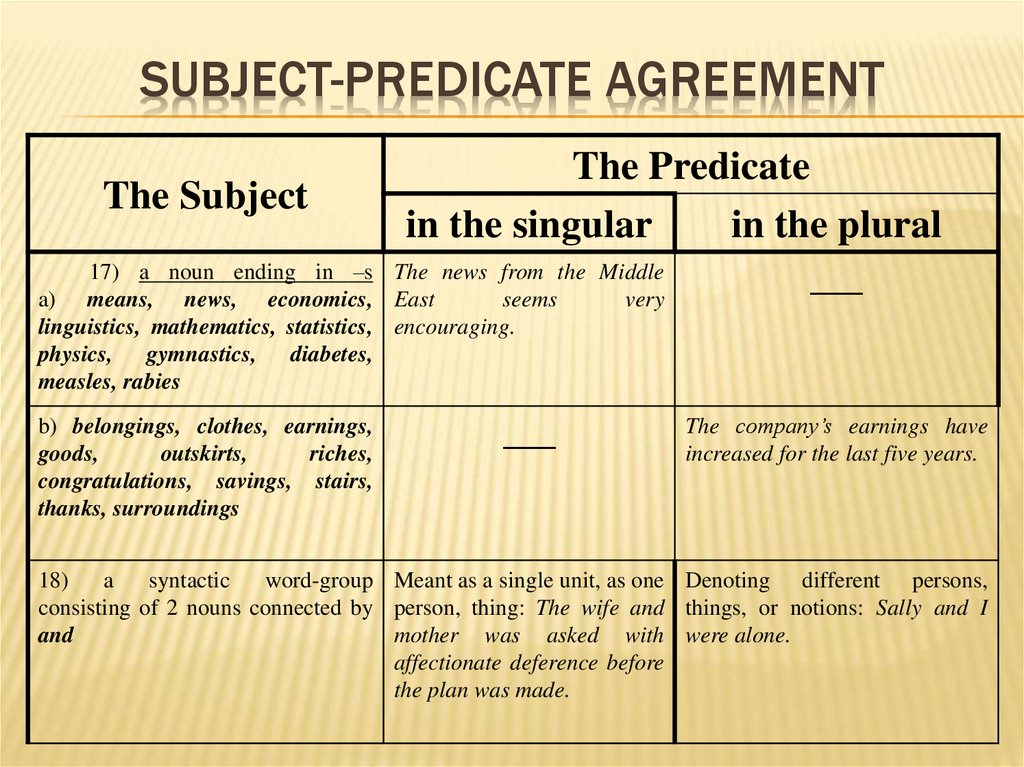
33. SUBJECT-PREDICATE AGREEMENT
The SubjectThe Predicate
in the singular
in the plural
17) a noun ending in –s The news from the Middle
a) means, news, economics, East
seems
very
linguistics, mathematics, statistics, encouraging.
physics, gymnastics,
diabetes,
measles, rabies
b) belongings, clothes, earnings,
goods,
outskirts,
riches,
congratulations, savings, stairs,
thanks, surroundings
—
—
The company’s earnings have
increased for the last five years.
18)
a
syntactic
word-group Meant as a single unit, as one Denoting different persons,
consisting of 2 nouns connected by person, thing: The wife and things, or notions: Sally and I
and
mother was asked with were alone.
affectionate deference before
the plan was made.
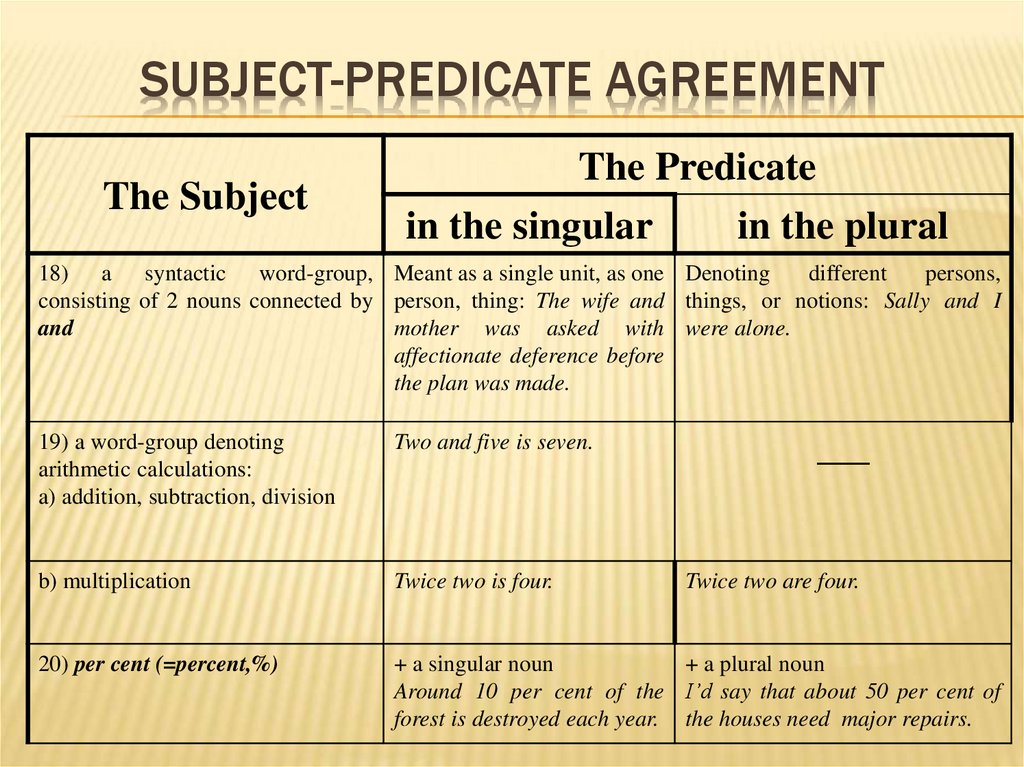
34. SUBJECT-PREDICATE AGREEMENT
The SubjectThe Predicate
in the singular
in the plural
18) a syntactic word-group, Meant as a single unit, as one Denoting
different
persons,
consisting of 2 nouns connected by person, thing: The wife and things, or notions: Sally and I
and
mother was asked with were alone.
affectionate deference before
the plan was made.
—
19) a word-group denoting
arithmetic calculations:
a) addition, subtraction, division
Two and five is seven.
b) multiplication
Twice two is four.
20) per cent (=percent,%)
+ a singular noun
+ a plural noun
Around 10 per cent of the I’d say that about 50 per cent of
forest is destroyed each year. the houses need major repairs.
Twice two are four.
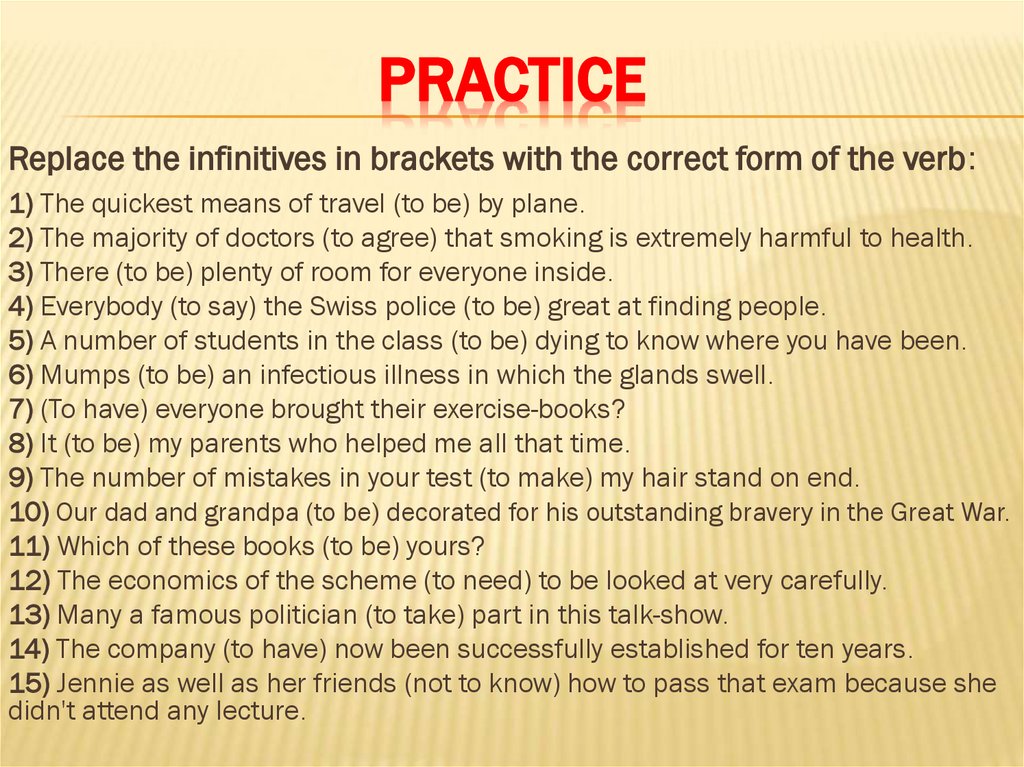
35.
PRACTICEReplace the infinitives in brackets with the correct form of the verb:
1) The quickest means of travel (to be) by plane.
2) The majority of doctors (to agree) that smoking is extremely harmful to health.
3) There (to be) plenty of room for everyone inside.
4) Everybody (to say) the Swiss police (to be) great at finding people.
5) A number of students in the class (to be) dying to know where you have been.
6) Mumps (to be) an infectious illness in which the glands swell.
7) (To have) everyone brought their exercise-books?
8) It (to be) my parents who helped me all that time.
9) The number of mistakes in your test (to make) my hair stand on end.
10) Our dad and grandpa (to be) decorated for his outstanding bravery in the Great War.
11) Which of these books (to be) yours?
12) The economics of the scheme (to need) to be looked at very carefully.
13) Many a famous politician (to take) part in this talk-show.
14) The company (to have) now been successfully established for ten years.
15) Jennie as well as her friends (not to know) how to pass that exam because she
didn't attend any lecture.
36. THE SECONDARY PARTS OF THE SENTENCE
The AttributeThe qualificative relationship can be actualised by
the attributive bond.
The paradigm of these linguistic means is rather
manifold. We find here:
1) adjectives: a new house, a valuable thing;
2) nouns in the Possessive Case: my brother's book;
3) noun-adjunct groups (N + N): world peace, spring
time;
4) prepositional noun-groups: the daughter of my
friend;
37. THE SECONDARY PARTS OF THE SENTENCE
5) pronouns (possessive, demonstrative, indefinite): my joy,such flowers, every morning, a friend of his, little time;
6) infinitives and infinitival groups: an example to follow, a
thing to do;
7) gerunds and participles: (a) walking distance, swimming
suit; (b) a smiling face, a singing bird;
8) numerals: two friends, the first task;
9) words of the category of state: faces alight with
happiness;
10) idiomatic phrases: a love of a child, a jewel of nature,
etc.
38. THE SECONDARY PARTS OF THE SENTENCE
The ObjectObject-object
Types of
Object
Subtypes of
Object
direct
Types of Bond prepositionle
Addressee-object
prepositional
prepositional
prepositionless
prepositional
He knew of
this.
He gave me a He gave a letter
letter.
to me.
ss
Examples
He knew this.
39. THE SECONDARY PARTS OF THE SENTENCE
The Adverbial ModifierThe adverbial modifier (A.m.) is a secondary part of
the sentence which modifies a verb, an adjective or an
adverb.
A.m. denotes the time, place, cause and manner of the
action or process expressed by the verb. When
modifying an adjective, the A.m. characterizes quality or
quantity of a state denoted by the adjective.
The A.m. may be expressed by a single word (an
adverb), a phrase consisting of two or more words
(prepositional phrase), or a clause (modifies the whole
clause it relates to, characterizing the latter denotes –
He was ten when I saw him first.)
40. SEMANTIC TYPES OF A.M.
The A.m. of place and direction may beexpressed by a prepositional phrase, an
adverb, an adverbial phrase or a clause.
41. SEMANTIC TYPES OF A.M.
The A.m. of time may be expressed by anoun (tomorrow), a prepositional phrase
(before the war), a participle II preceded
by when/while (When refused…), a participle
or a participial phrase (Take care crossing the
street), a gerund with a prepositional or a
gerund phrase and clauses of place (You
won’t recognize the house when you come
next time)
42. SEMANTIC TYPES OF A.M.
The A.m. of condition is expressed by a nounor a pronoun preceded by the prepositions and
conjunctions but for, except for, in case, by a
participle
or
an
adjective
with
the
conjunctions if, unless (if necessary,…), by a
gerundial
phrase
introduced
by
the
preposition without, by an adverbial clause of
condition.
43. SEMANTIC TYPES OF A.M.
The A.m. of concession is introduced by theprepositions despite, for all, in spite of, with
all and the conjunction though.
44. SEMANTIC TYPES OF A.M.
The A.m. of cause (reason) may beexpressed by a prepositional phrase: He
couldn’t speak for tears. Because of, due to, on
account of, owing to, thanks to…, by a clause
or by a participial phrase: Wishing to say sth,
he jumped from the chair.
45. SEMANTIC TYPES OF A.M.
The A.m. of degree and measure isexpressed by an adverb or a prepositional
phrase. Intensifier adverbs (nearly, almost,
rather, really) denote a point along a scale of
intensity to which the action or property has
been fulfilled: It’s rather chilly outside.
46. SEMANTIC TYPES OF A.M.
The A.m. of manner is expressed by adverbsor prepositional phrases introduced by the
prepositions by, by means of, with,
without or with the help of + participial phrases
(She ran fast, without looking back), absolute
constructions (She entered, her eyes sad) and
clauses.
47. SEMANTIC TYPES OF A.M.
The A.m. of result (consequence) isexpressed by an infinitive, an infinitive phrase
or an infinitive construction which refers to an
adjective or an adverb preceded by such
adverbs of degree as too, enough (You are
clever enough not to do it), or the
conjunction so…as (She is not so foolish as to
do anything wrong).
48. SEMANTIC TYPES OF A.M.
The A.m. of purpose is rendered by a singleinfinitive, an infinitive phrase (He stood up to
say goodbye), an infinitive construction, a
nominal or gerund phrase with the
preposition for (They came for lunch. He did it
for making me angry) or a clause of purpose.
49. SEMANTIC TYPES OF A.M.
The A.m. of attendant circumstances is rendered by aparticipial (He was sitting smoking cigarettes), gerundial (She
entered without looking at him) or infinitive phrase or by an
absolute construction (I hurried away, her pale face still in my
eyes). This type of A.m. denotes an action or a state which is
relatively independent of the action of the main verb. When
expressed by an infinitive phrase, the modifier denotes an
action which is neither the result nor the purpose of the action
denoted by the main verb (He opened the door to see that all
had gone. – Он открыл дверь и увидел, что все ушли.)
* We have only named some of the semantic types of
adverbial modifiers; there exist a few other types.
50. The Attribute
THE ATTRIBUTEThe attribute is a secondary part of the
sentence.
It refers to a noun (or a word of nominal
nature), forms a nominal phrase with its
headword.
51. The Attribute STRUCTURE
THE ATTRIBUTE STRUCTUREa) a single word-form (synthetic and analytical):
e.g. The sand glittered like whitesugar in the sun.
b) a phrase: e.g. It was a letter from his devoted
friend.
c) a predicative complex (the For-to-Infinitive
Construction and the Gerundial Predicative
Complex): e.g. This is a lesson for you to
remember for the rest of your life.
d) a clause: e.g. He is the man I am particularly
fond of.
52. Attribute CONNECTION WITH THE HEADWORD
ATTRIBUTE CONNECTION WITH THE HEADWORDa) non-detached (close) attributes. Non-detached attributes
form one sense group with their headword and are not
separated form it by commas: The ladies present were
shocked. I haven’t got time to spare.
If attributes form a string with different reference (in which
case their order is fixed) no commas are required: We saw
a large black and white hunting dog there.
b) detached (loose) attributes: And for a moment I
hesitated, unable to start talking.
Detached attributes are separated by commas. They are
loosely connected with the headword and are often optional
from the point of view of structure, although very important
semantically.
53.
POSITION OF ATTRIBUTES IN THE NOMINAL PHRASEa) premodifying (i.e. preceding the noun they
modify): She is a pretty girl.
b) postmodifying (i.e. following the item they
modify): The people involved were reported to the
police. He would not run the risk of being too late.
54.
THE OBJECTThe object is a secondary part of the
sentence.
It completes or restricts the meaning of a verb
or an adjective or a stative:
Lena likes music. I am happy to meet you. She
is afraid of walking alone in the evening.
It can be expressed by: a noun in the common
case, a pronoun in the objective case,
demonstrative, indefinite, reflexive pronouns, a
numeral and also by an infinitive, gerund, a
clause and various predicative complexes.
55.
THE OBJECT STRUCTURE1) a simple object (expressed by a single word-form)
She often reads English newspapers.
2) a phrasal object (expressed by a phrase)
They’ve bought a lot of books.
3) a clausal object (expressed by a clause)
I wonder if they will come in time.
4) a complex object (expressed by a predicative
complex)
We expected him to tell her the truth.
56.
GRAMMATICAL PECULIARITIES1. A direct object follows a transitive verb and completes
or restricts its meaning: She turned her head and saw me.
2. An indirect object denotes the person towards whom
the action of the finite verb is directed: He offered us his
help. The peculiar feature of an indirect object is that it cannot be used
without the direct object. The indirect object has a fixed position in the
sentence – it precedes the direct object: Den gave her the towel.
3. A cognate object is similar in meaning to the verb of
the same root: She sighed a sigh of satisfaction. The
cognate object occupies a place intermediate between an object and an
adverbial modifier, expressing rather adverbial than objective relations: He
laughed a hearty laugh. – He laughed heartily.
57. Follow the lecture
FOLLOW THE LECTUREhttps://www.youtube.com/watch?v=lsyZ-_dSRmI