 pedagogy
Similar presentations:






ЕГЭ-2025 + Методика: Задание 3 Устной части
1.
ЕГЭ-2025 +Методика
Задание 3 УЧ
2.
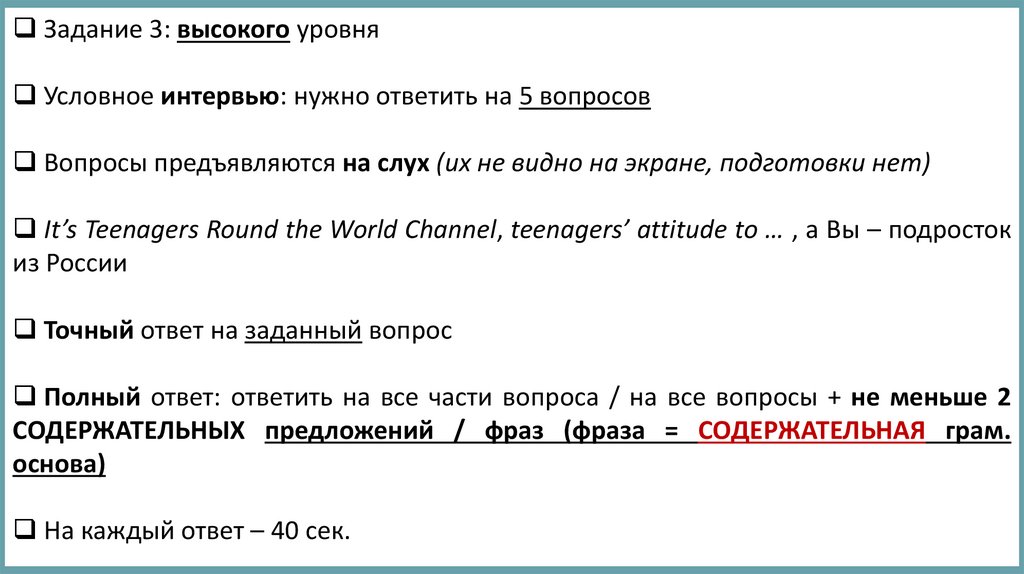
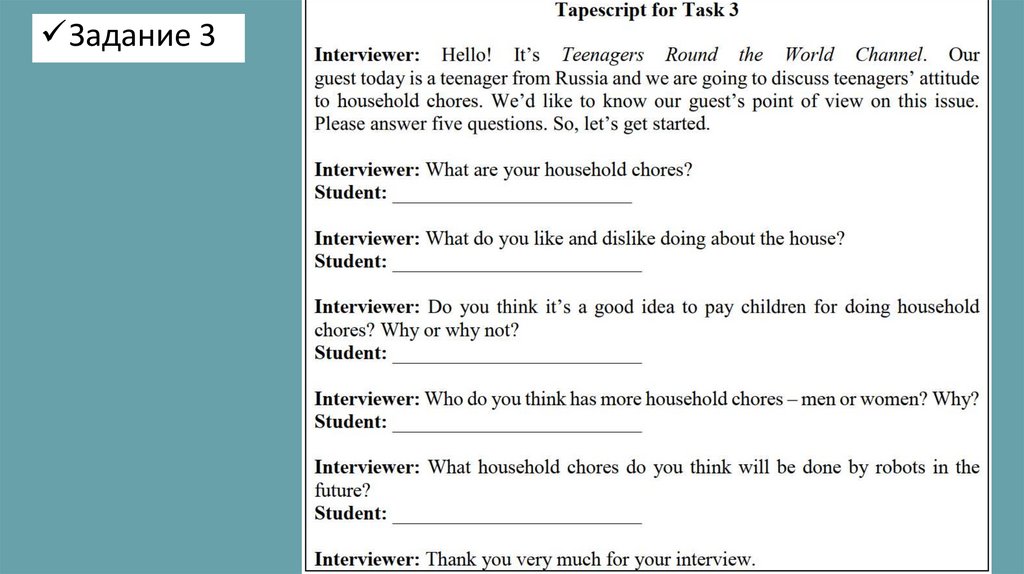
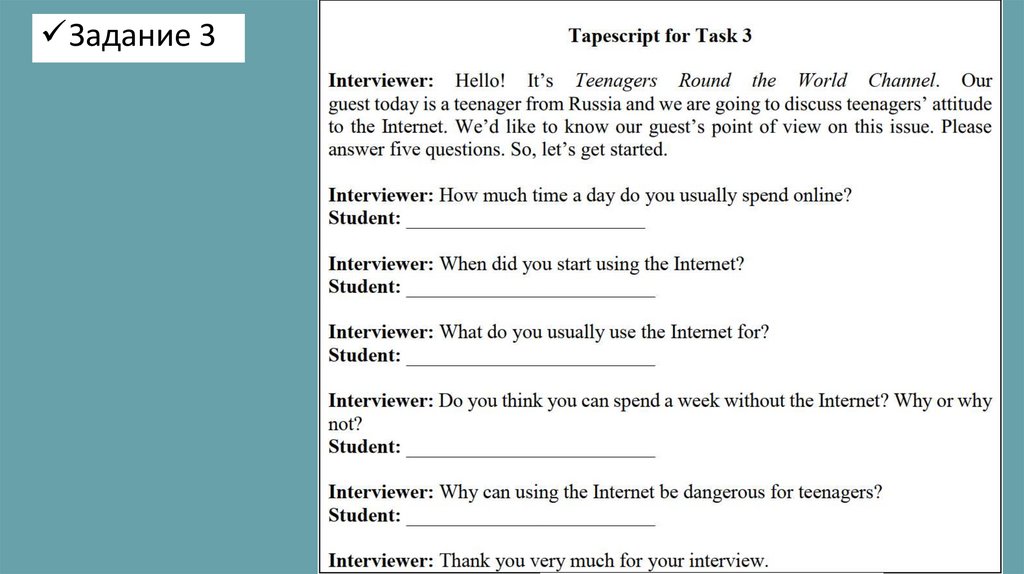
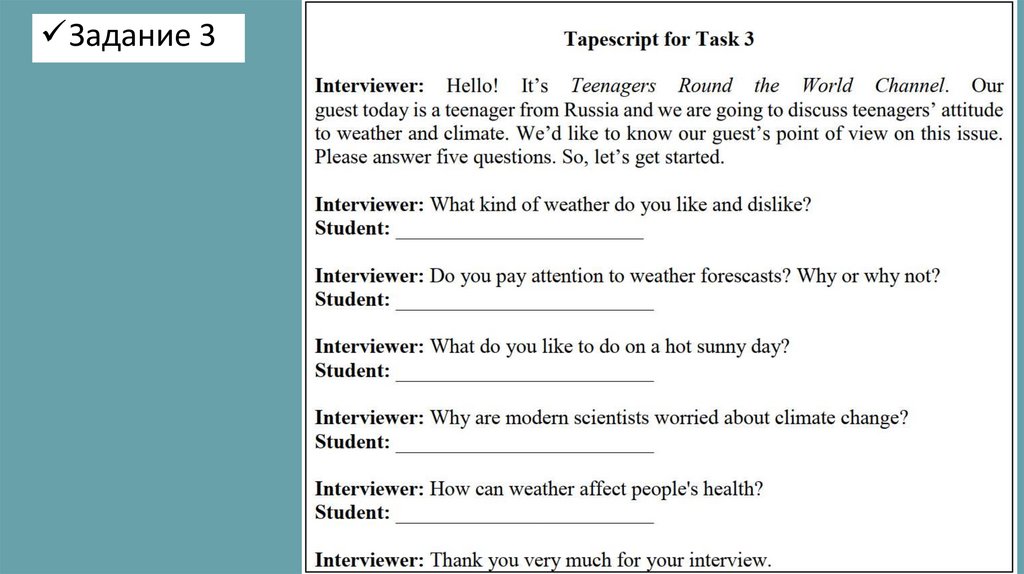
Задание 3: высокого уровняУсловное интервью: нужно ответить на 5 вопросов
Вопросы предъявляются на слух (их не видно на экране, подготовки нет)
It’s Teenagers Round the World Channel, teenagers’ attitude to … , а Вы – подросток
из России
Точный ответ на заданный вопрос
Полный ответ: ответить на все части вопроса / на все вопросы + не меньше 2
СОДЕРЖАТЕЛЬНЫХ предложений / фраз (фраза = СОДЕРЖАТЕЛЬНАЯ грам.
основа)
На каждый ответ – 40 сек.
3.
Задание 34.
5.
Задание 36.
Задание 37.
Задание 38.
Задание 39.
Задание 310.
Задание 311.
Задание 312. 2025:
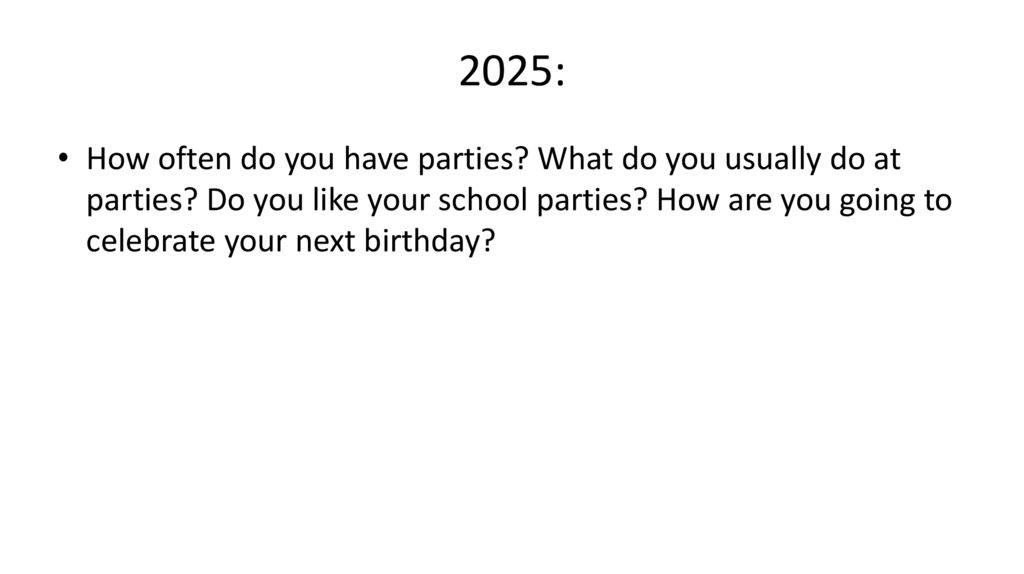
• How often do you have parties? What do you usually do atparties? Do you like your school parties? How are you going to
celebrate your next birthday?
13.
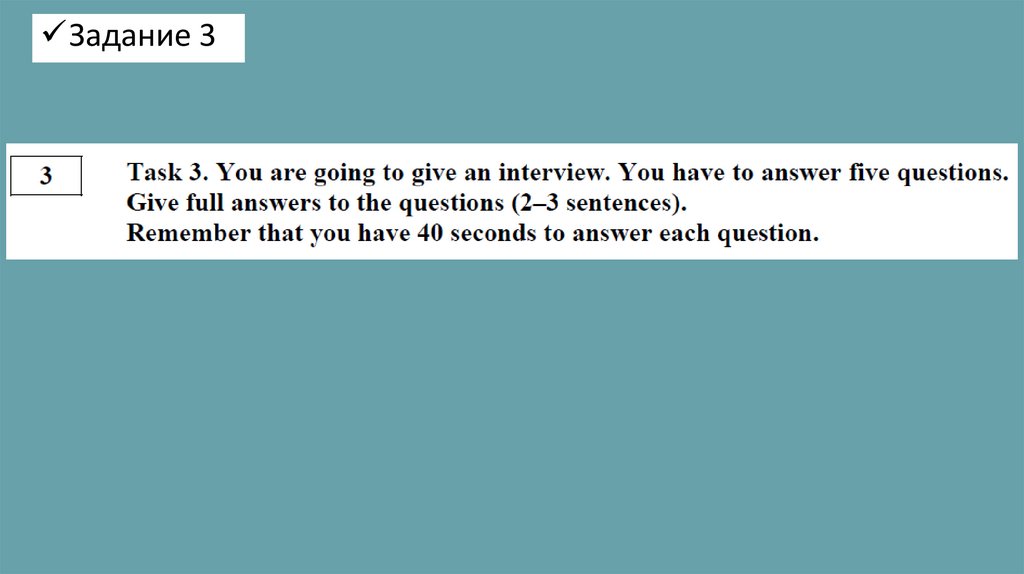
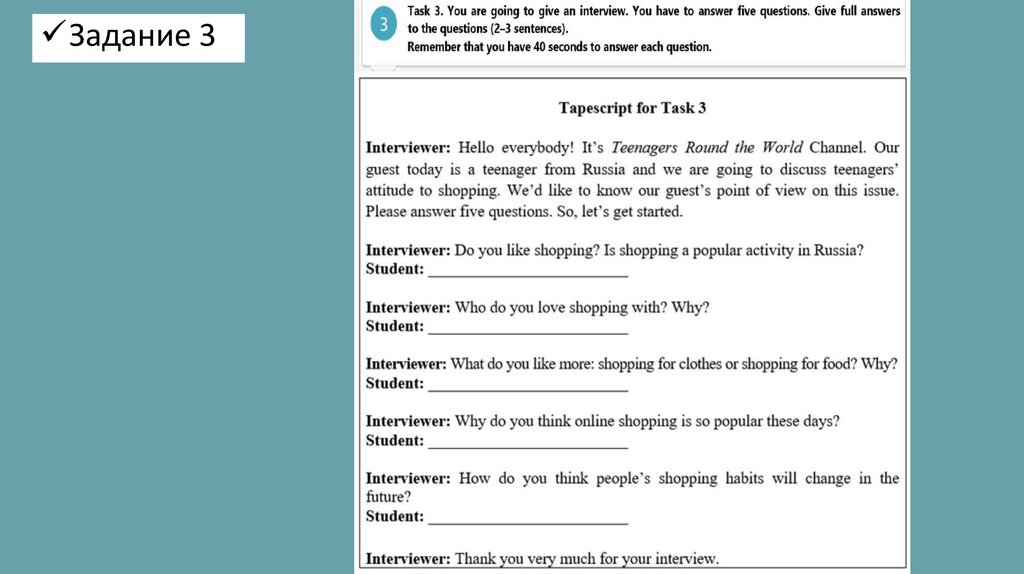
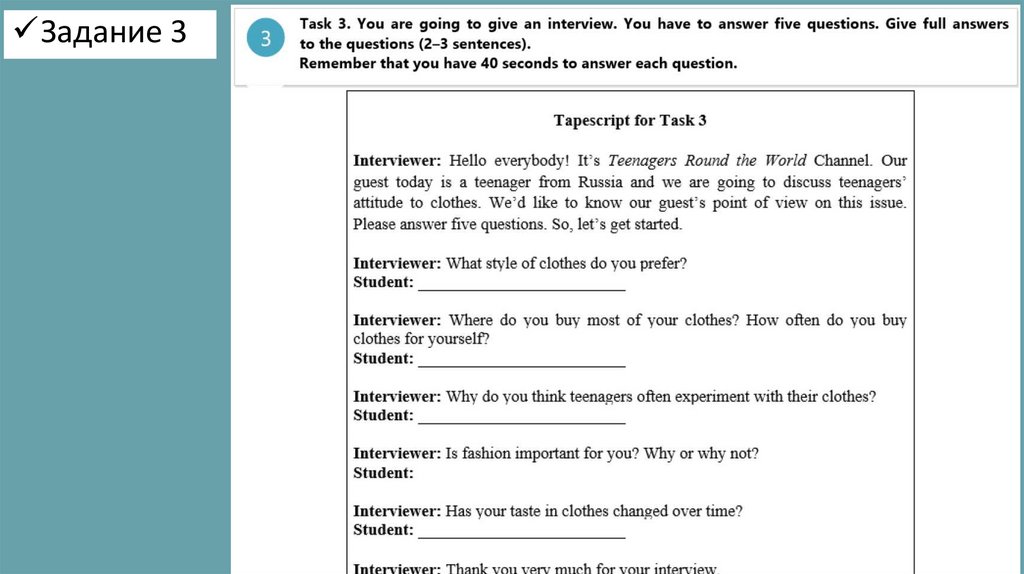
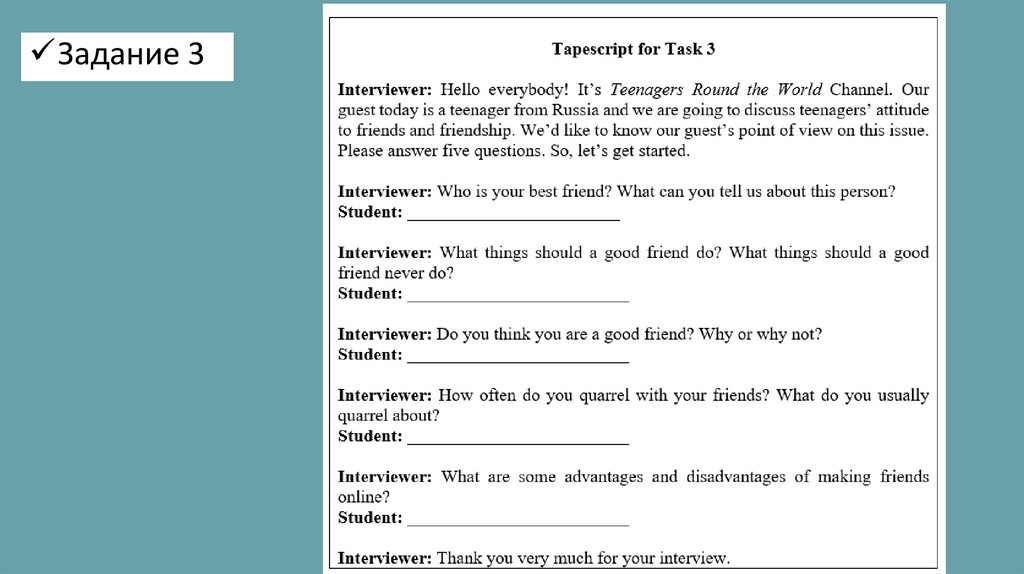
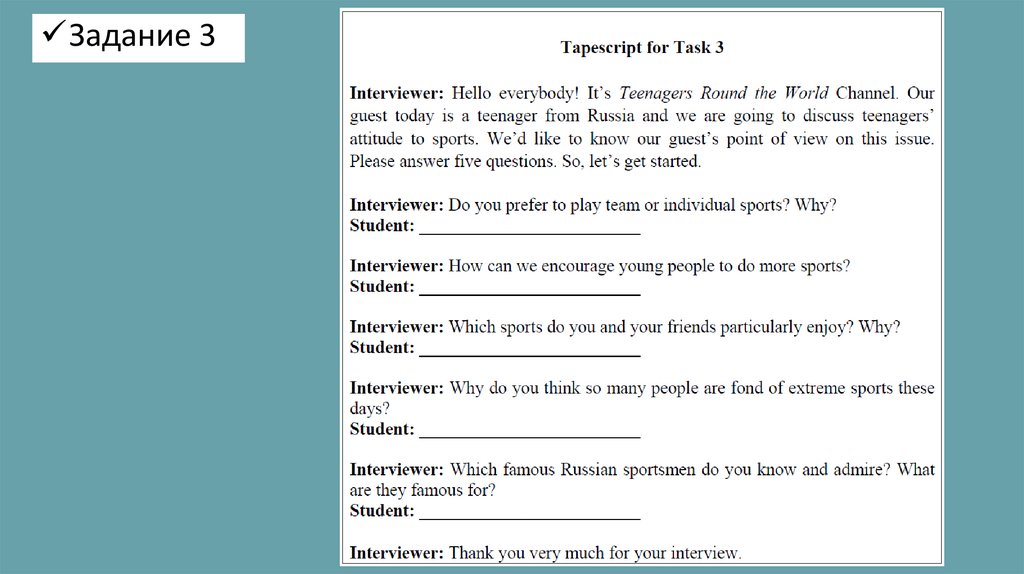
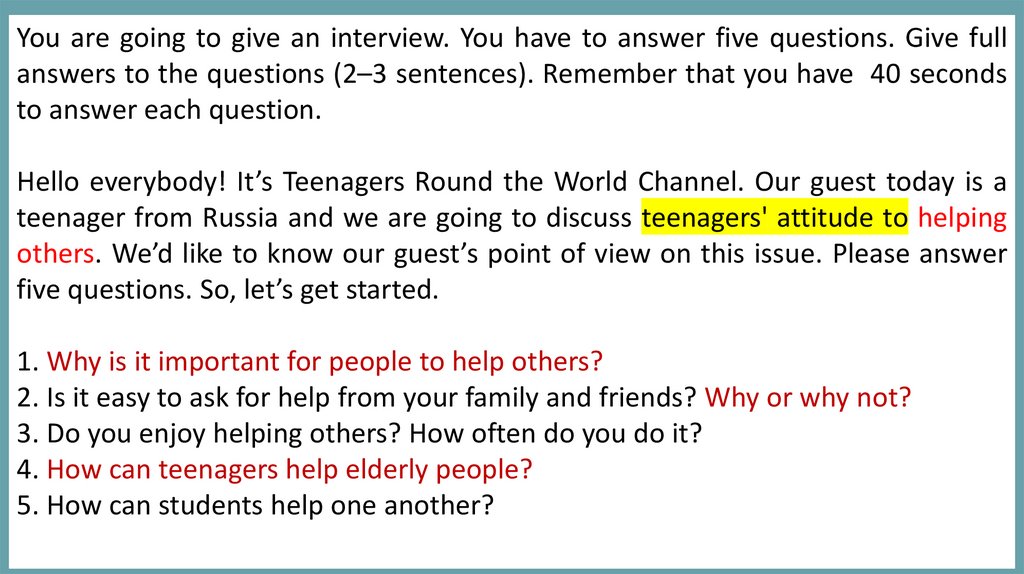
You are going to give an interview. You have to answer five questions. Give fullanswers to the questions (2–3 sentences). Remember that you have 40 seconds
to answer each question.
Hello everybody! It’s Teenagers Round the World Channel. Our guest today is a
teenager from Russia and we are going to discuss teenagers' attitude to helping
others. We’d like to know our guest’s point of view on this issue. Please answer
five questions. So, let’s get started.
1. Why is it important for people to help others?
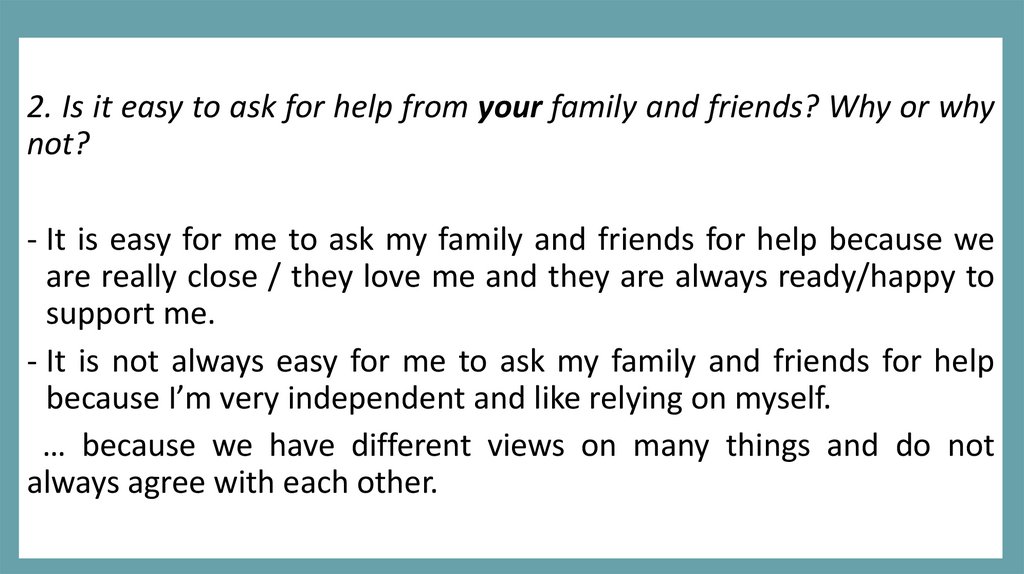
2. Is it easy to ask for help from your family and friends? Why or why not?
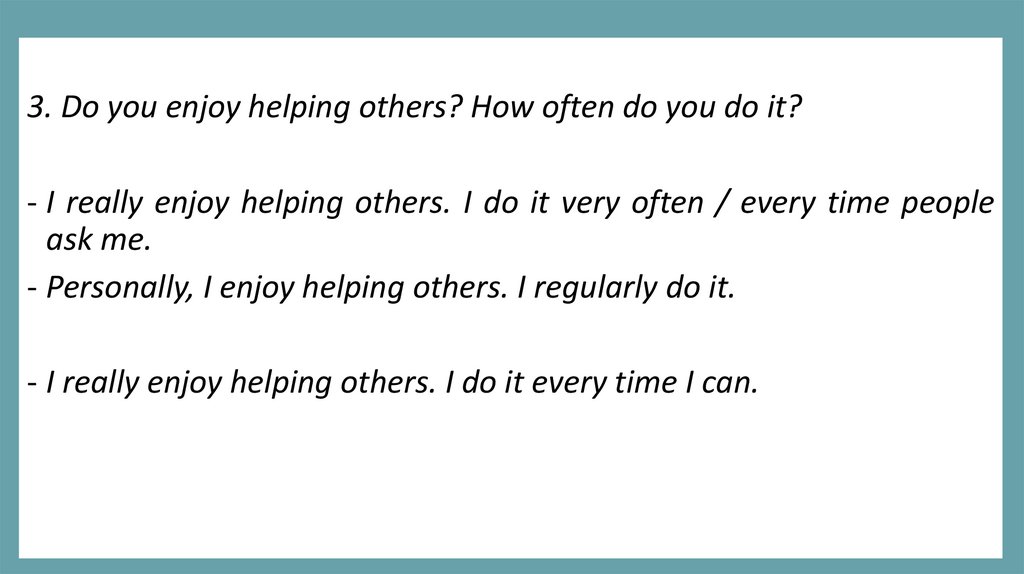
3. Do you enjoy helping others? How often do you do it?
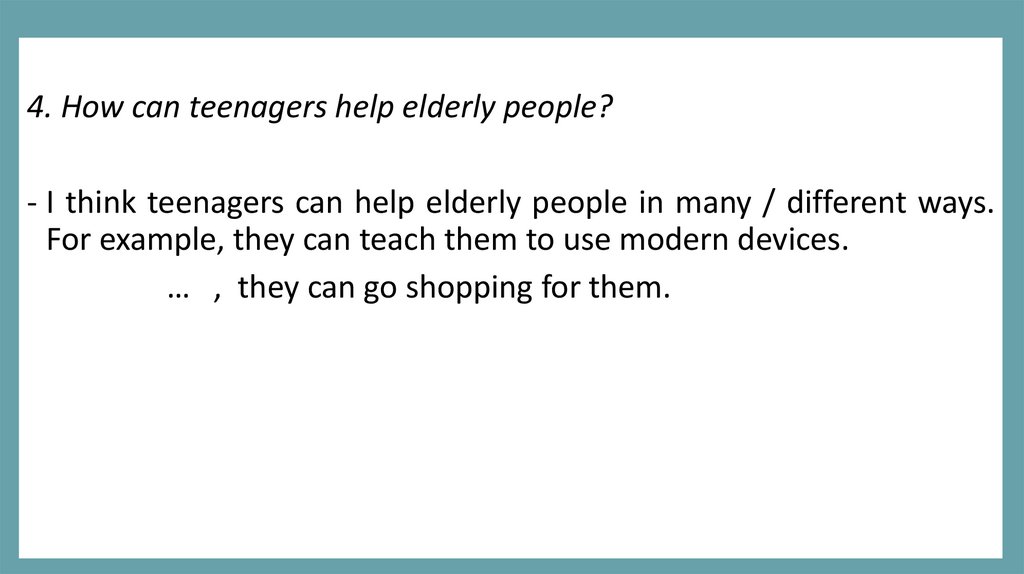
4. How can teenagers help elderly people?
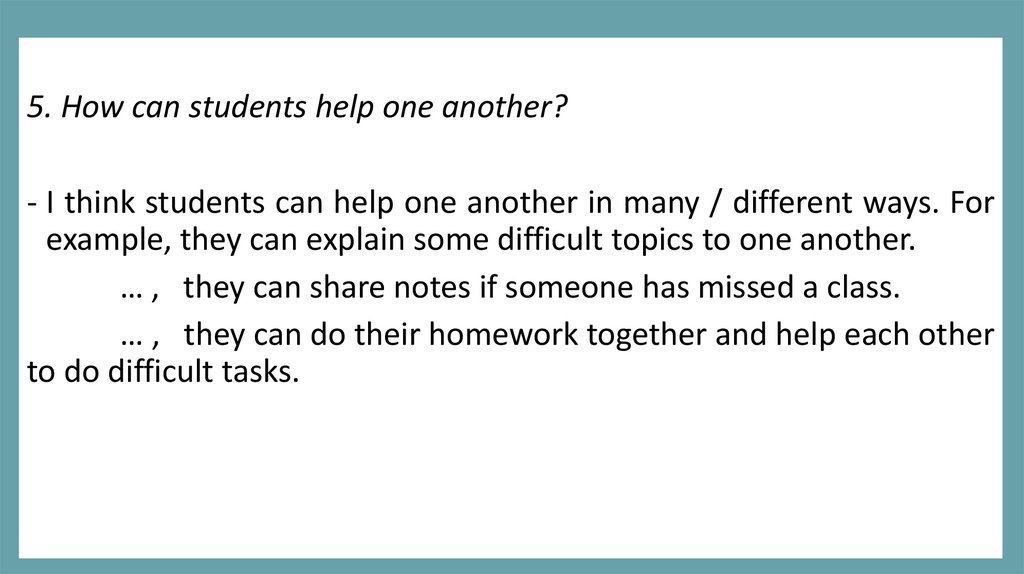
5. How can students help one another?
14.
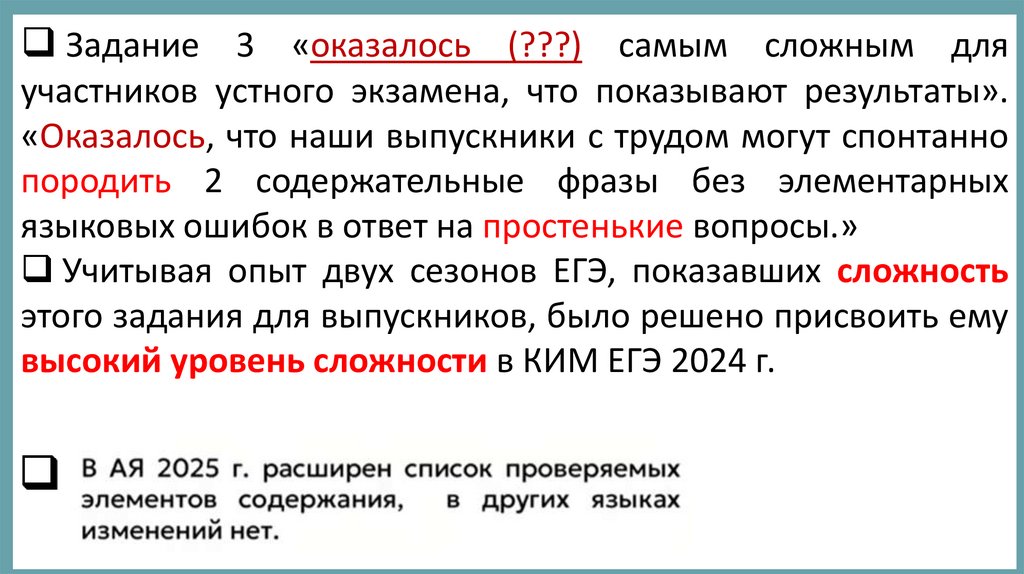
Задание 3 «оказалось (???) самым сложным дляучастников устного экзамена, что показывают результаты».
«Оказалось, что наши выпускники с трудом могут спонтанно
породить 2 содержательные фразы без элементарных
языковых ошибок в ответ на простенькие вопросы.»
Учитывая опыт двух сезонов ЕГЭ, показавших сложность
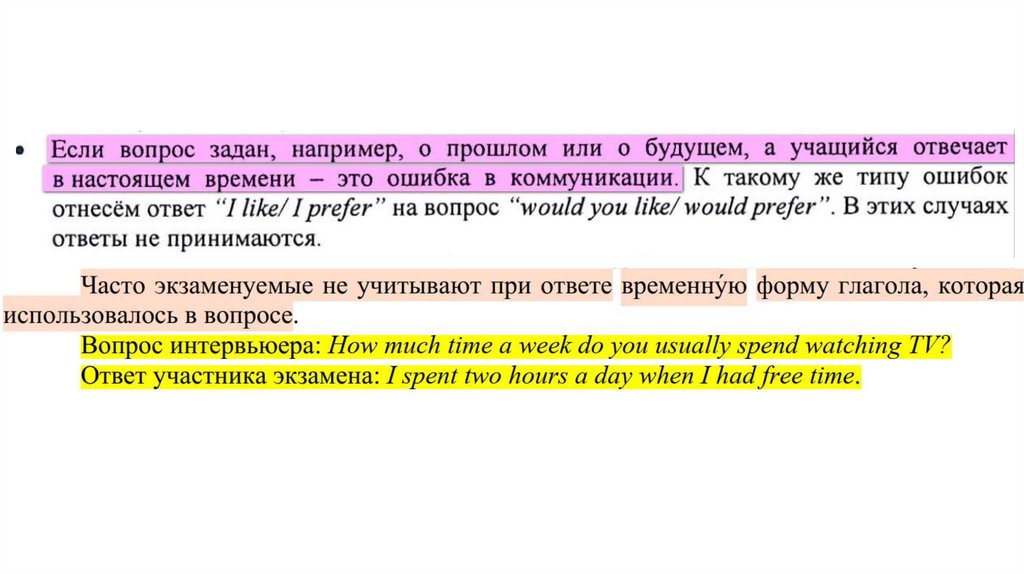
этого задания для выпускников, было решено присвоить ему
высокий уровень сложности в КИМ ЕГЭ 2024 г.
15.
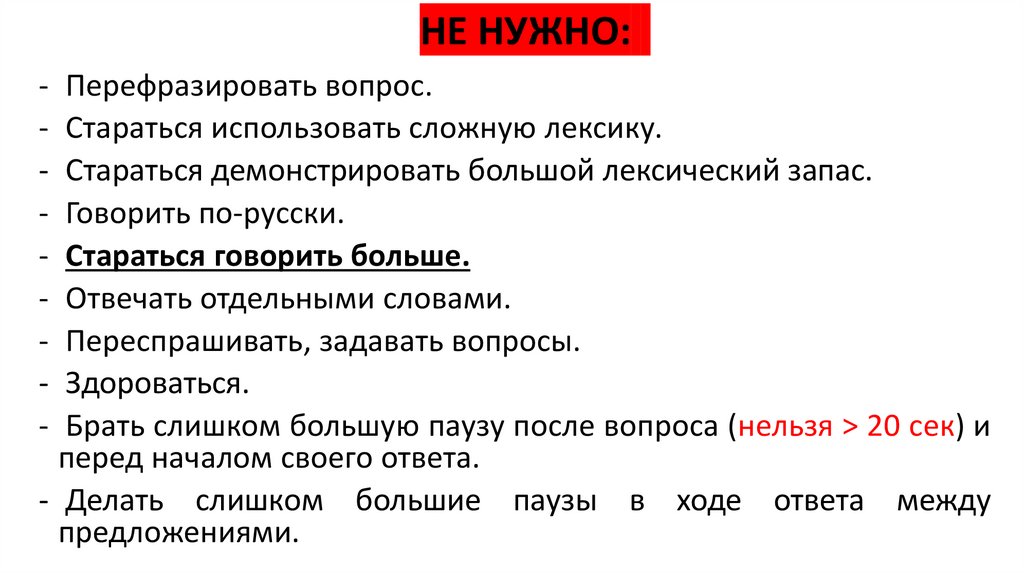
16. НЕ НУЖНО:
- Перефразировать вопрос.- Стараться использовать сложную лексику.
- Стараться демонстрировать большой лексический запас.
- Говорить по-русски.
- Стараться говорить больше.
- Отвечать отдельными словами.
- Переспрашивать, задавать вопросы.
- Здороваться.
- Брать слишком большую паузу после вопроса (нельзя > 20 сек) и
перед началом своего ответа.
- Делать слишком большие паузы в ходе ответа между
предложениями.
17.
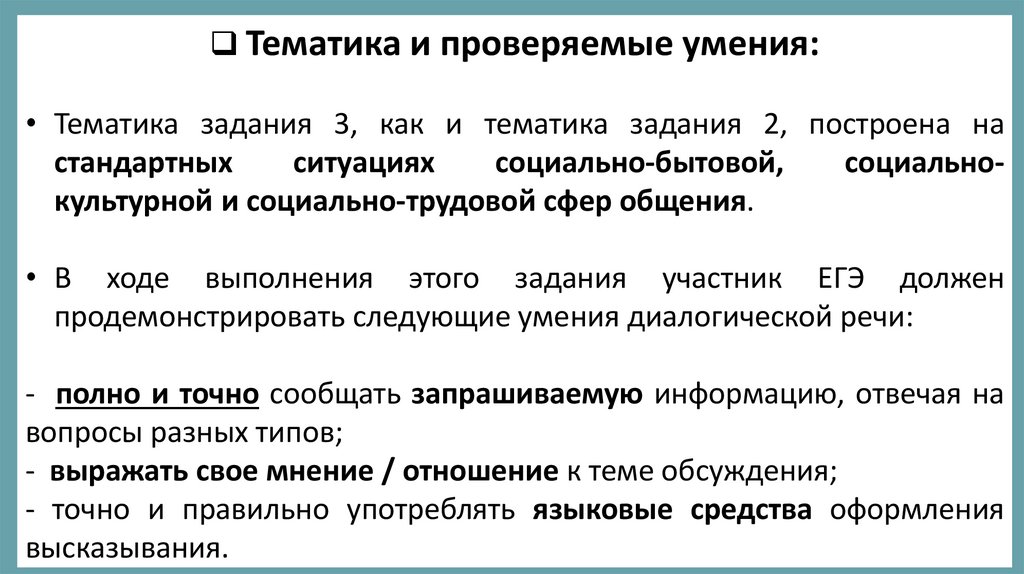
Тематика и проверяемые умения:• Тематика задания 3, как и тематика задания 2, построена на
стандартных
ситуациях
социально-бытовой,
социальнокультурной и социально-трудовой сфер общения.
• В ходе выполнения этого задания участник ЕГЭ должен
продемонстрировать следующие умения диалогической речи:
- полно и точно сообщать запрашиваемую информацию, отвечая на
вопросы разных типов;
- выражать свое мнение / отношение к теме обсуждения;
- точно и правильно употреблять языковые средства оформления
высказывания.
18.
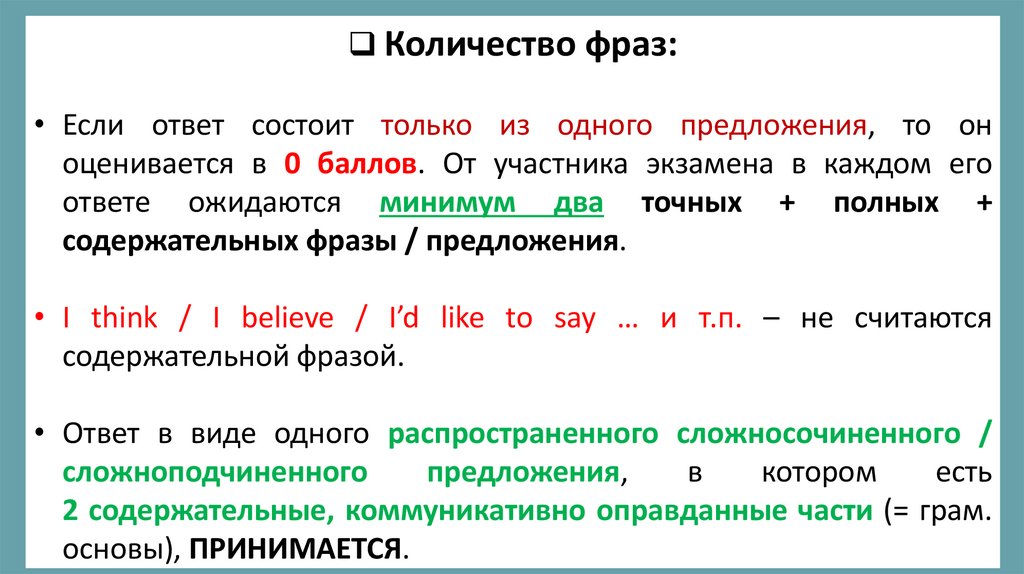
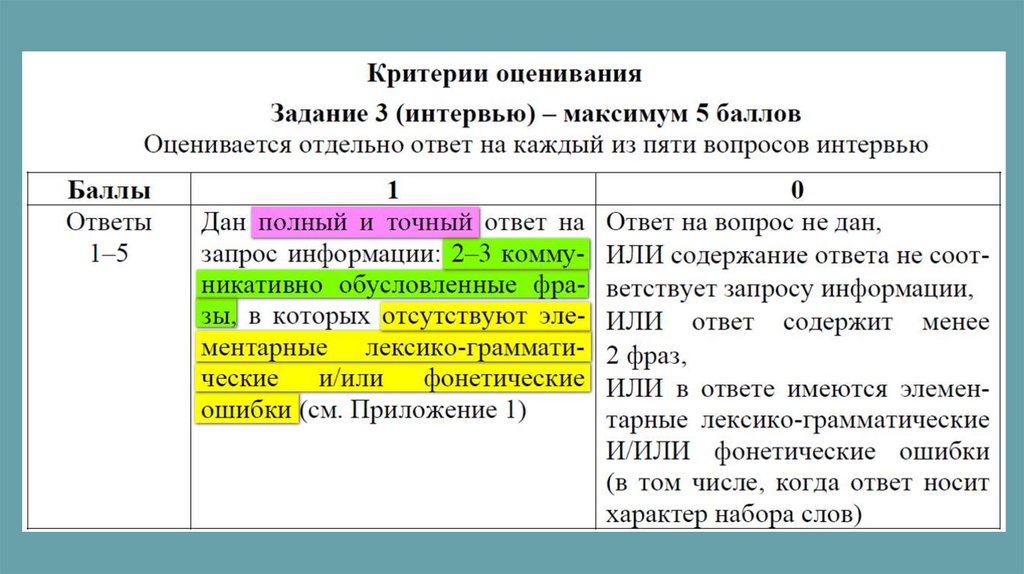
Количество фраз:• Если ответ состоит только из одного предложения, то он
оценивается в 0 баллов. От участника экзамена в каждом его
ответе ожидаются минимум два точных + полных +
содержательных фразы / предложения.
• I think / I believe / I’d like to say … и т.п. – не считаются
содержательной фразой.
• Ответ в виде одного распространенного сложносочиненного /
сложноподчиненного
предложения,
в
котором
есть
2 содержательные, коммуникативно оправданные части (= грам.
основы), ПРИНИМАЕТСЯ.
19.
20.
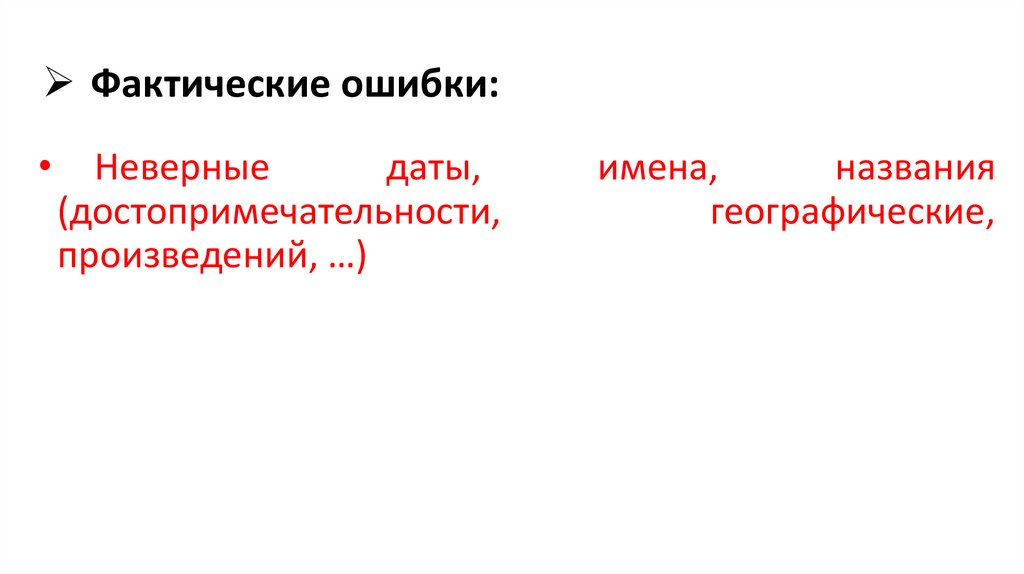
21. Фактические ошибки:
Неверные
даты,
(достопримечательности,
произведений, …)
имена,
названия
географические,
22.
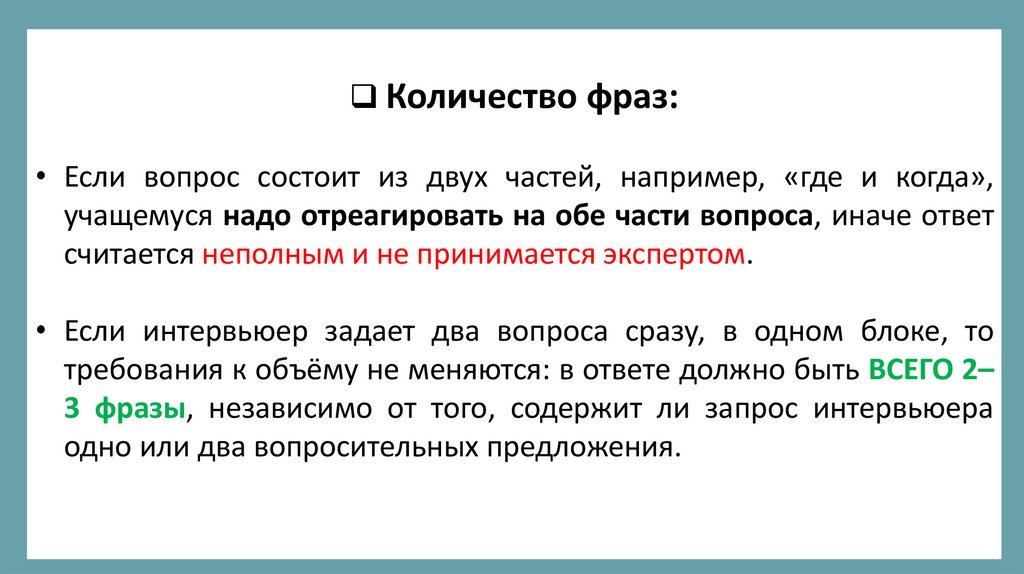
Количество фраз:• Если вопрос состоит из двух частей, например, «где и когда»,
учащемуся надо отреагировать на обе части вопроса, иначе ответ
считается неполным и не принимается экспертом.
• Если интервьюер задает два вопроса сразу, в одном блоке, то
требования к объёму не меняются: в ответе должно быть ВСЕГО 2–
3 фразы, независимо от того, содержит ли запрос интервьюера
одно или два вопросительных предложения.
23.
24.
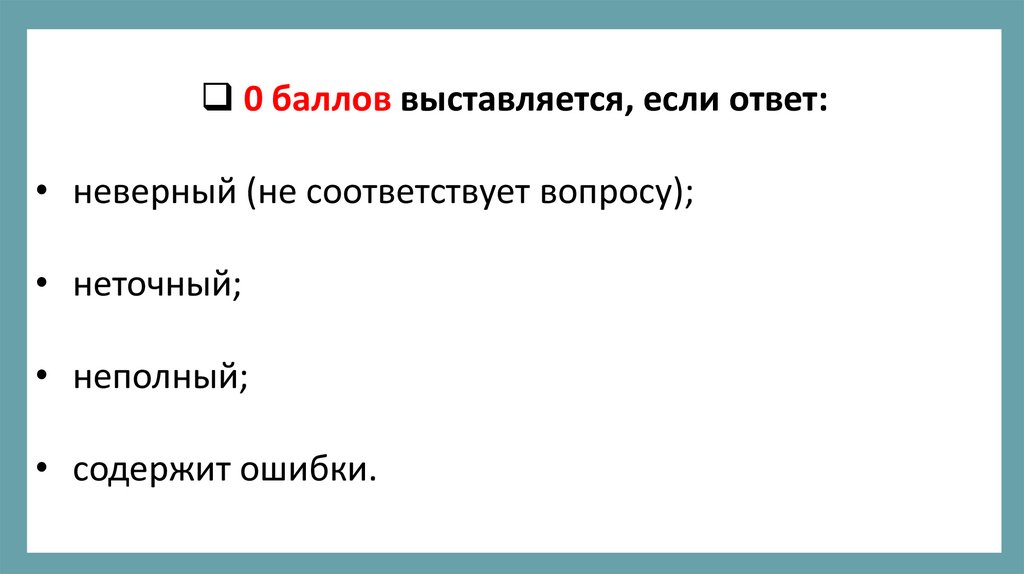
0 баллов выставляется, если ответ:• неверный (не соответствует вопросу);
• неточный;
• неполный;
• содержит ошибки.
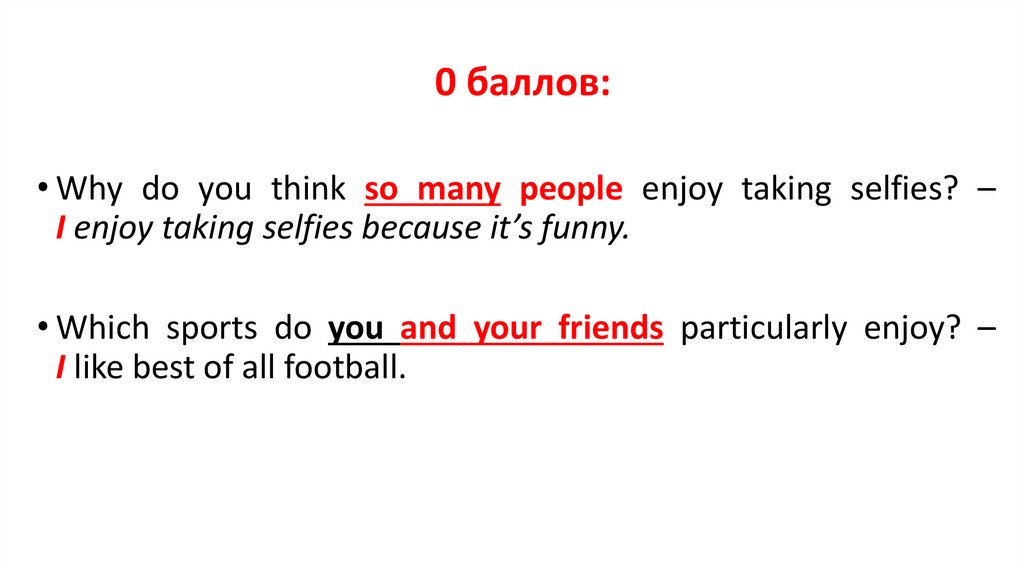
25. 0 баллов:
• Why do you think so many people enjoy taking selfies? –I enjoy taking selfies because it’s funny.
• Which sports do you and your friends particularly enjoy? –
I like best of all football.
26.
27.
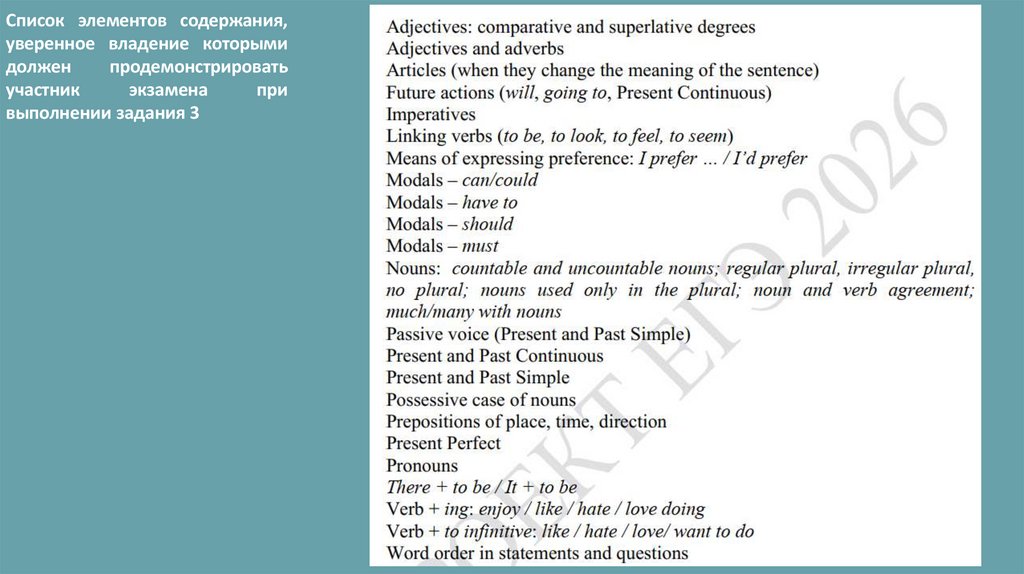
Cписок элементов содержания,уверенное владение которыми
должен
продемонстрировать
участник
экзамена
при
выполнении задания 3
28.
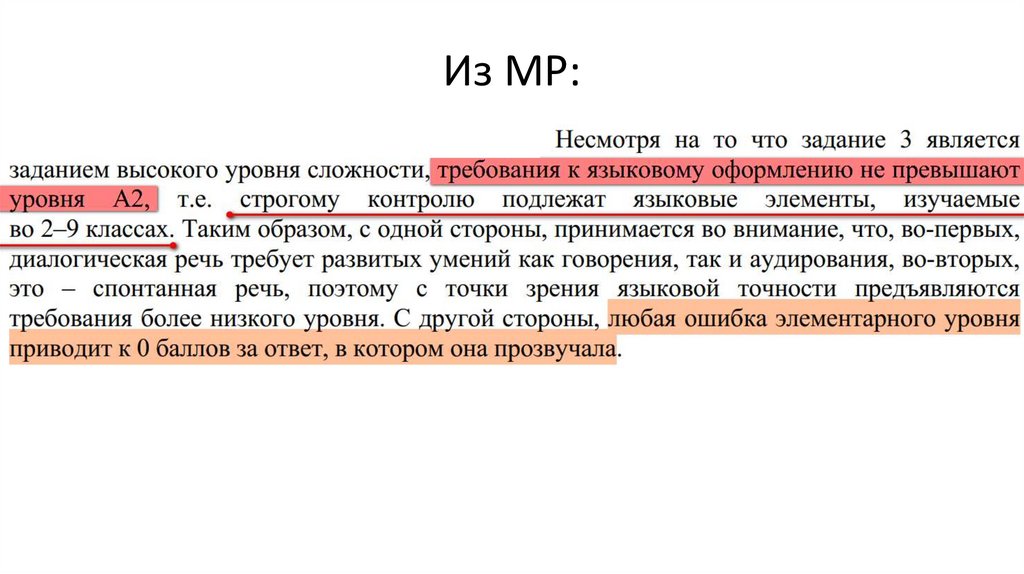
29. Из МР:
30.
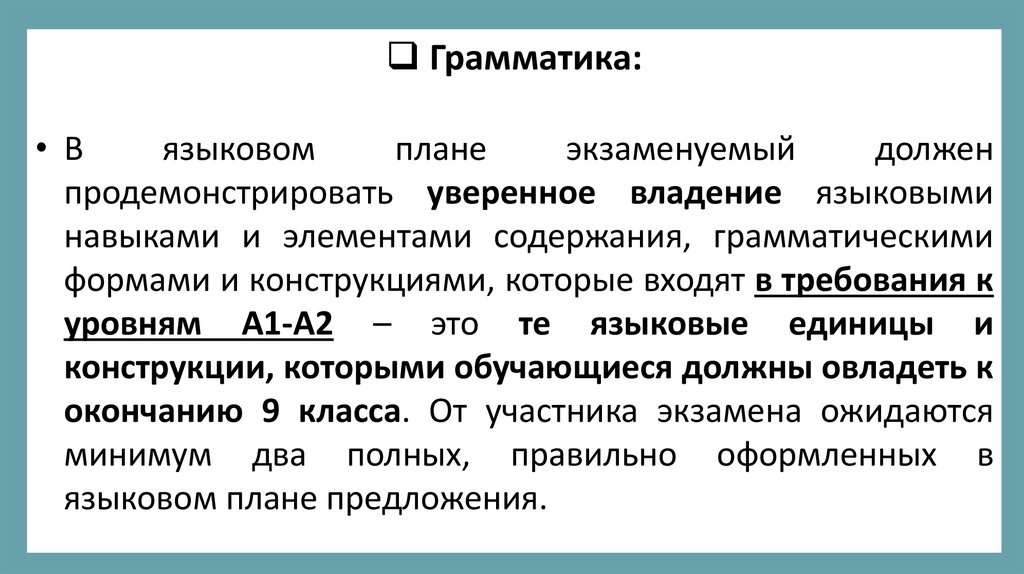
Грамматика:• В
языковом
плане
экзаменуемый
должен
продемонстрировать уверенное владение языковыми
навыками и элементами содержания, грамматическими
формами и конструкциями, которые входят в требования к
уровням А1-А2 – это те языковые единицы и
конструкции, которыми обучающиеся должны овладеть к
окончанию 9 класса. От участника экзамена ожидаются
минимум два полных, правильно оформленных в
языковом плане предложения.
31.
32.
33.
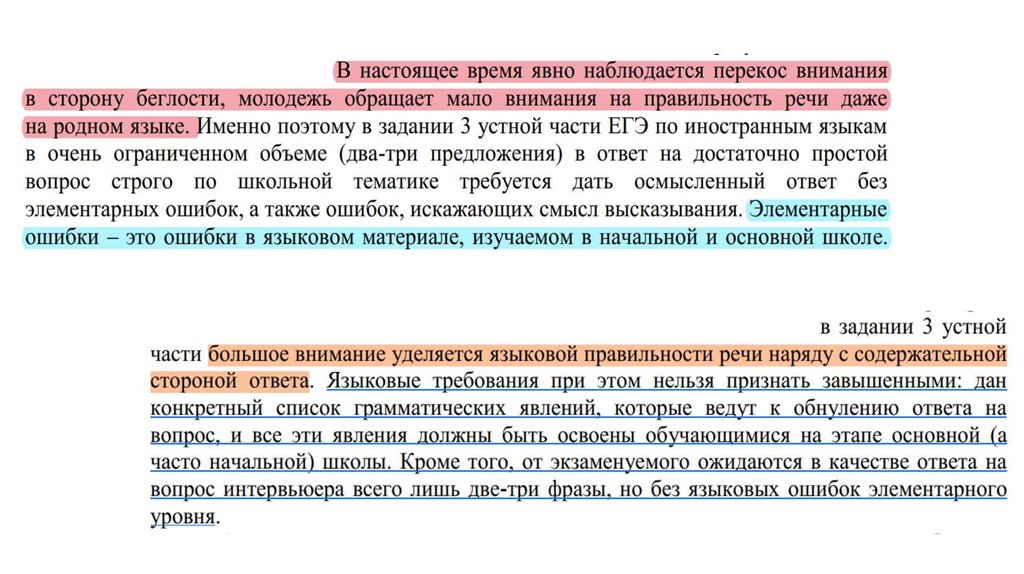
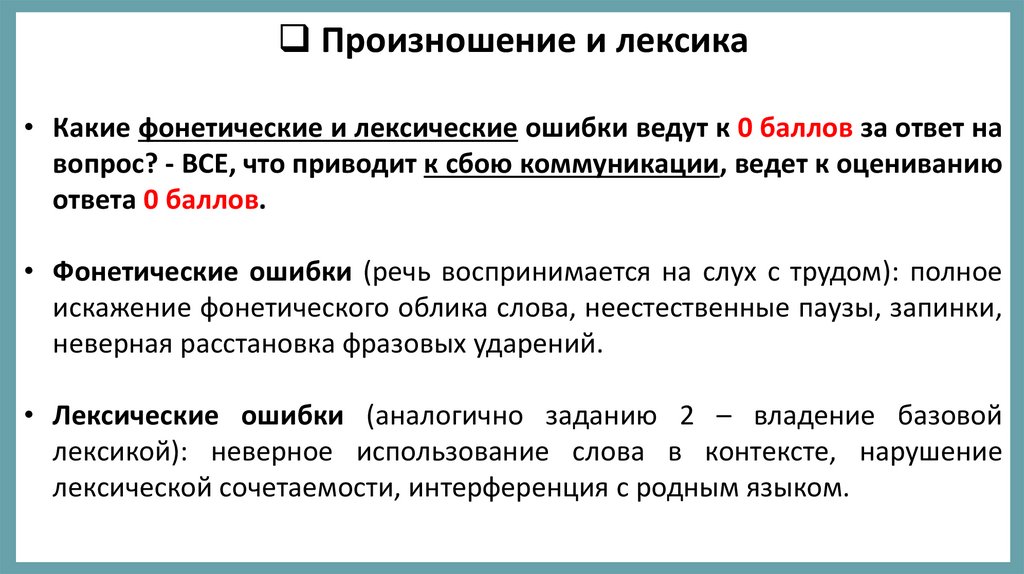
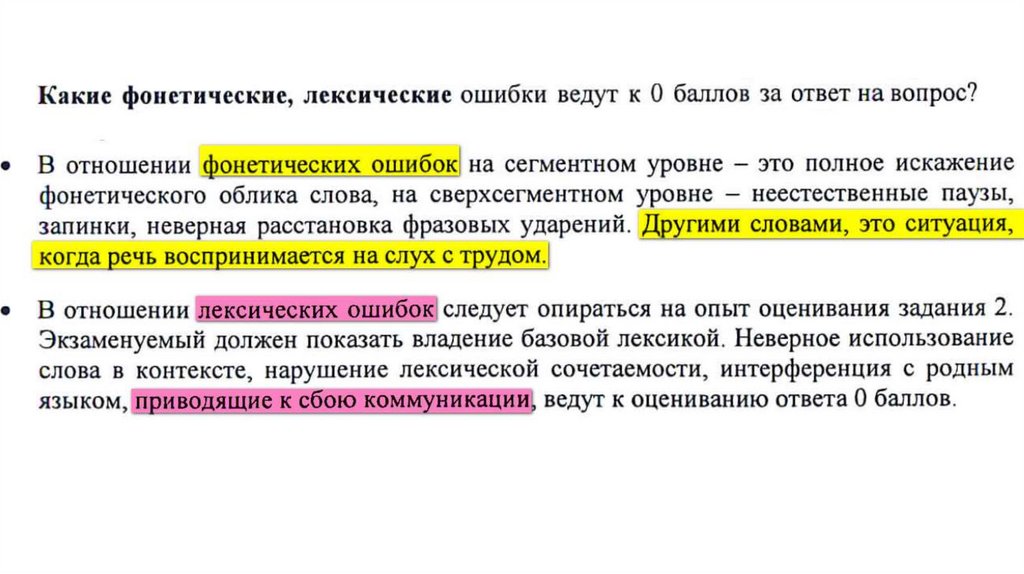
Произношение и лексика• Какие фонетические и лексические ошибки ведут к 0 баллов за ответ на
вопрос? - ВСЕ, что приводит к сбою коммуникации, ведет к оцениванию
ответа 0 баллов.
• Фонетические ошибки (речь воспринимается на слух с трудом): полное
искажение фонетического облика слова, неестественные паузы, запинки,
неверная расстановка фразовых ударений.
• Лексические ошибки (аналогично заданию 2 – владение базовой
лексикой): неверное использование слова в контексте, нарушение
лексической сочетаемости, интерференция с родным языком.
34.
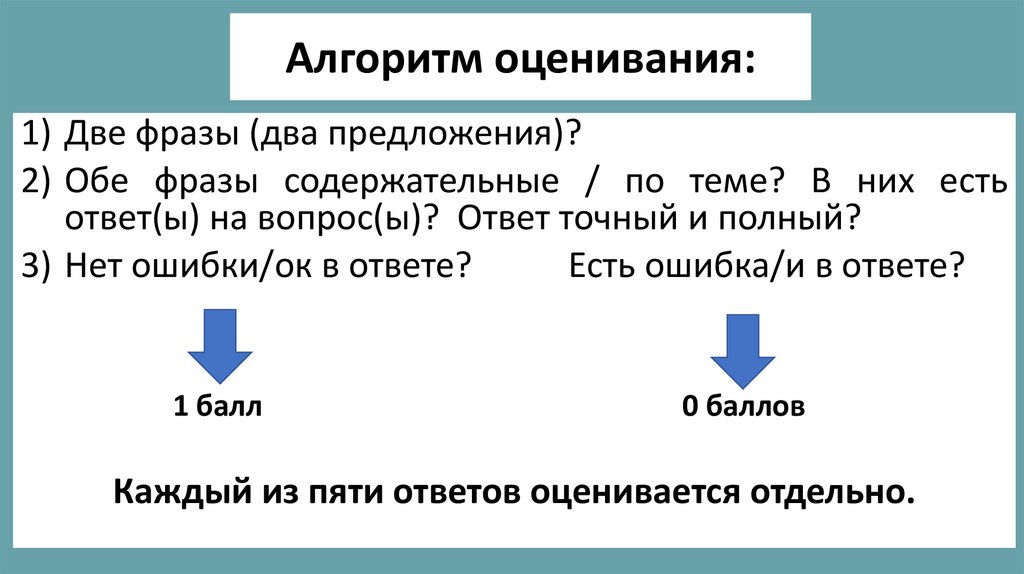
35. Алгоритм оценивания:
1) Две фразы (два предложения)?2) Обе фразы содержательные / по теме? В них есть
ответ(ы) на вопрос(ы)? Ответ точный и полный?
3) Нет ошибки/ок в ответе?
Есть ошибка/и в ответе?
1 балл
0 баллов
Каждый из пяти ответов оценивается отдельно.
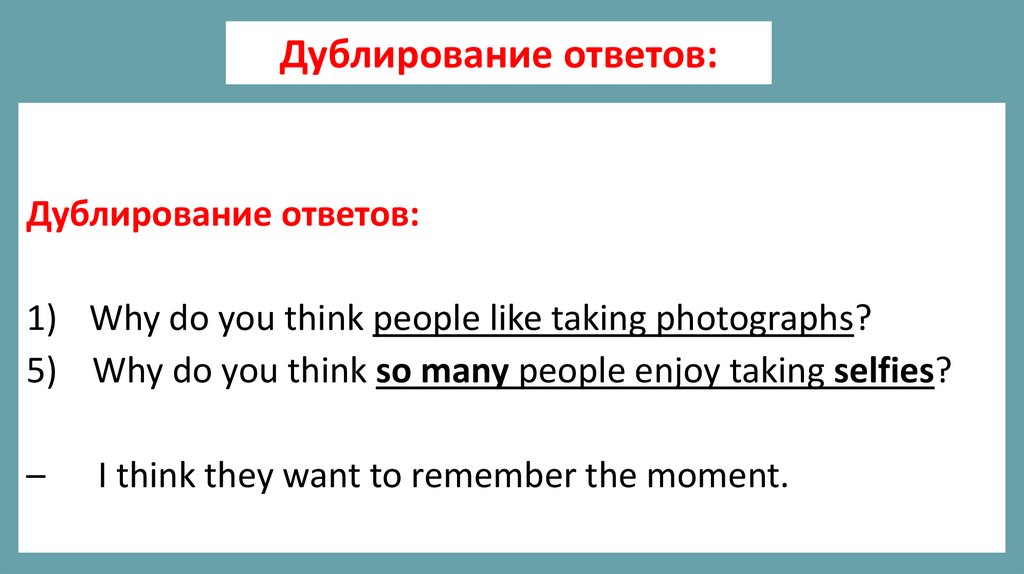
36. Дублирование ответов:
Дублирование ответов:1) Why do you think people like taking photographs?
5) Why do you think so many people enjoy taking selfies?
–
I think they want to remember the moment.
37. Типичные трудности:
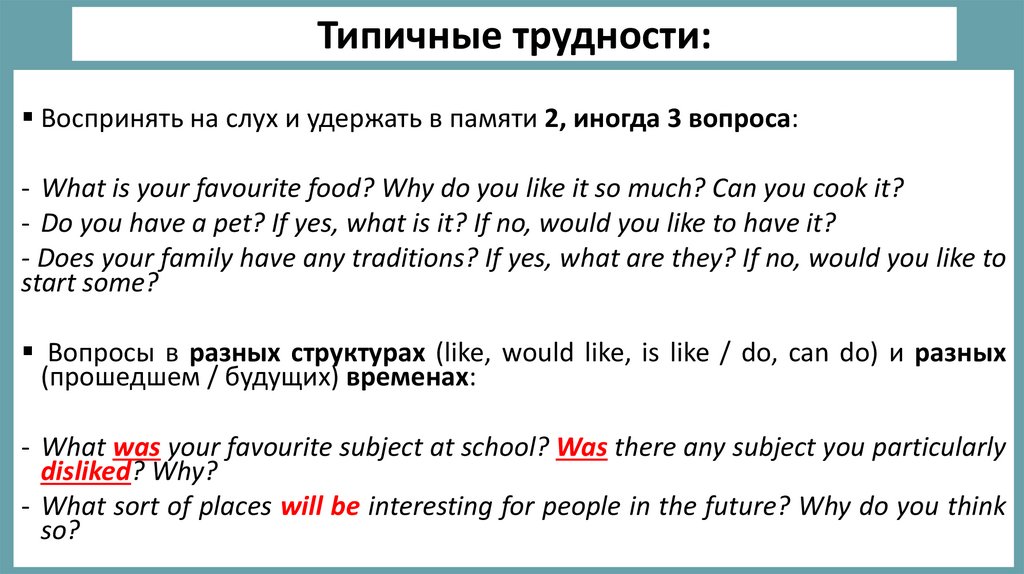
Воспринять на слух и удержать в памяти 2, иногда 3 вопроса:- What is your favourite food? Why do you like it so much? Can you cook it?
- Do you have a pet? If yes, what is it? If no, would you like to have it?
- Does your family have any traditions? If yes, what are they? If no, would you like to
start some?
Вопросы в разных структурах (like, would like, is like / do, can do) и разных
(прошедшем / будущих) временах:
- What was your favourite subject at school? Was there any subject you particularly
disliked? Why?
- What sort of places will be interesting for people in the future? Why do you think
so?
38. Типичные трудности:
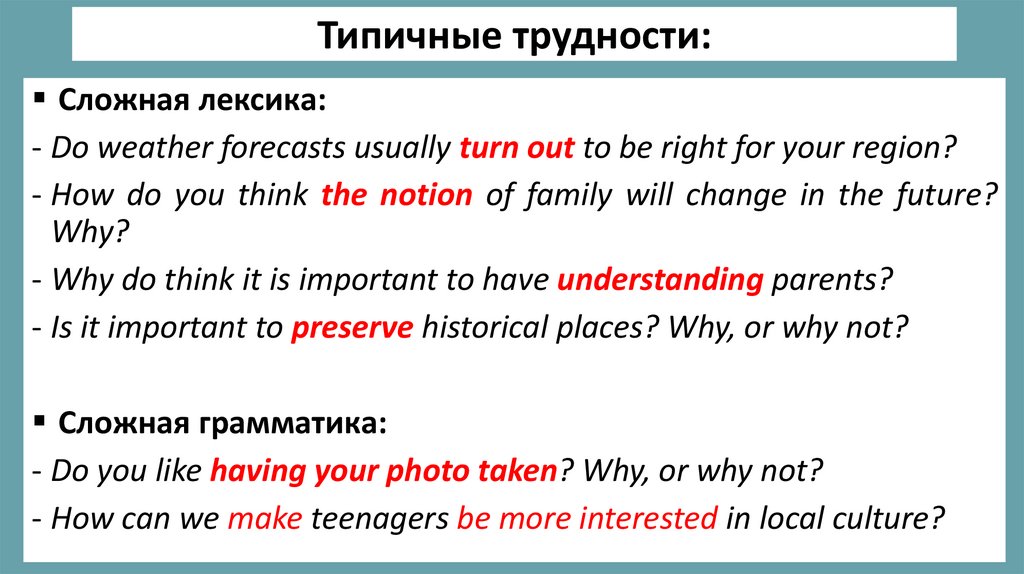
Сложная лексика:- Do weather forecasts usually turn out to be right for your region?
- How do you think the notion of family will change in the future?
Why?
- Why do think it is important to have understanding parents?
- Is it important to preserve historical places? Why, or why not?
Сложная грамматика:
- Do you like having your photo taken? Why, or why not?
- How can we make teenagers be more interested in local culture?
39. Типичные трудности:
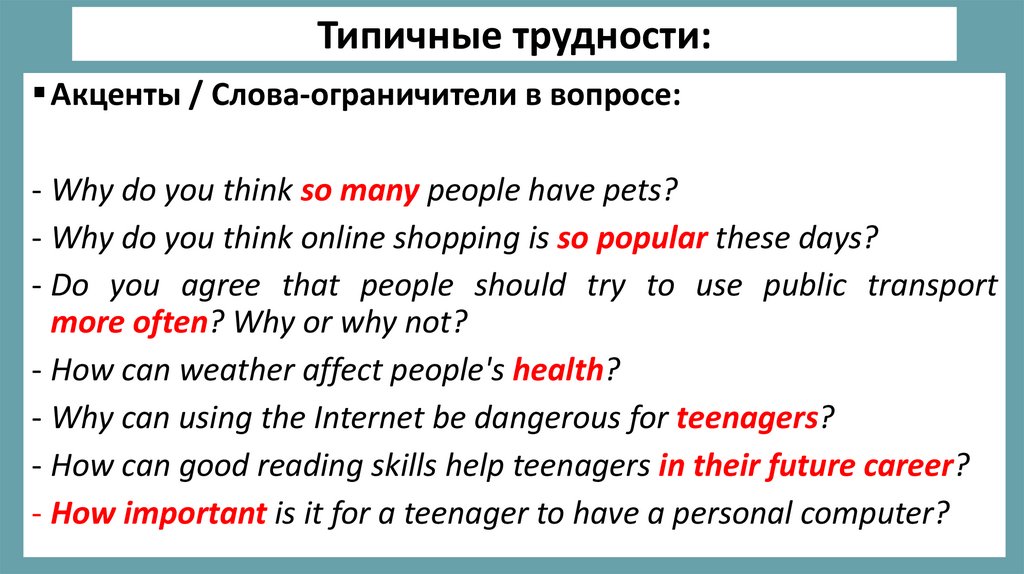
Акценты / Слова-ограничители в вопросе:- Why do you think so many people have pets?
- Why do you think online shopping is so popular these days?
- Do you agree that people should try to use public transport
more often? Why or why not?
- How can weather affect people's health?
- Why can using the Internet be dangerous for teenagers?
- How can good reading skills help teenagers in their future career?
- How important is it for a teenager to have a personal computer?
40. Типичные трудности:
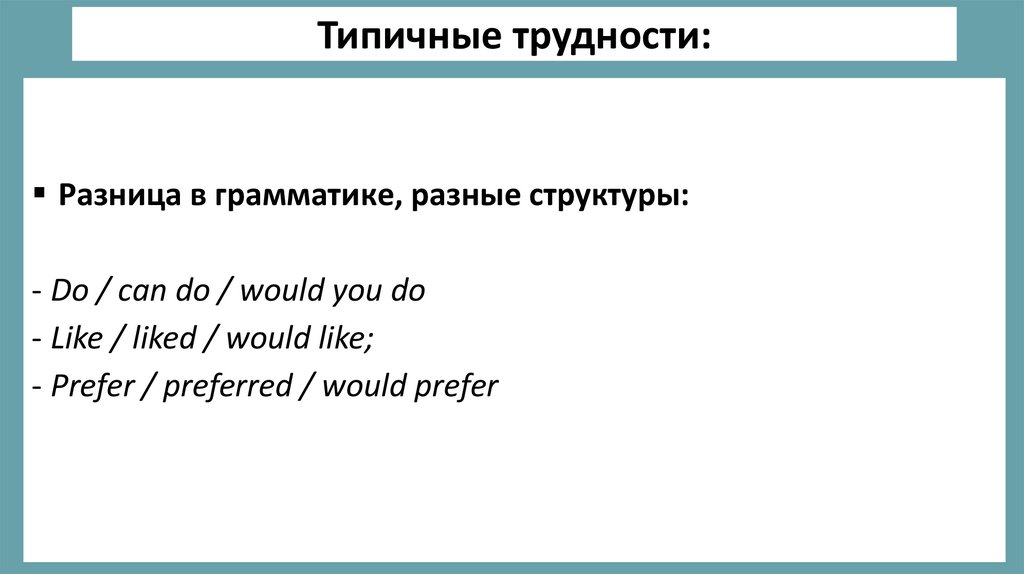
Разница в грамматикe, разные структуры:- Do / can do / would you do
- Like / liked / would like;
- Prefer / preferred / would prefer
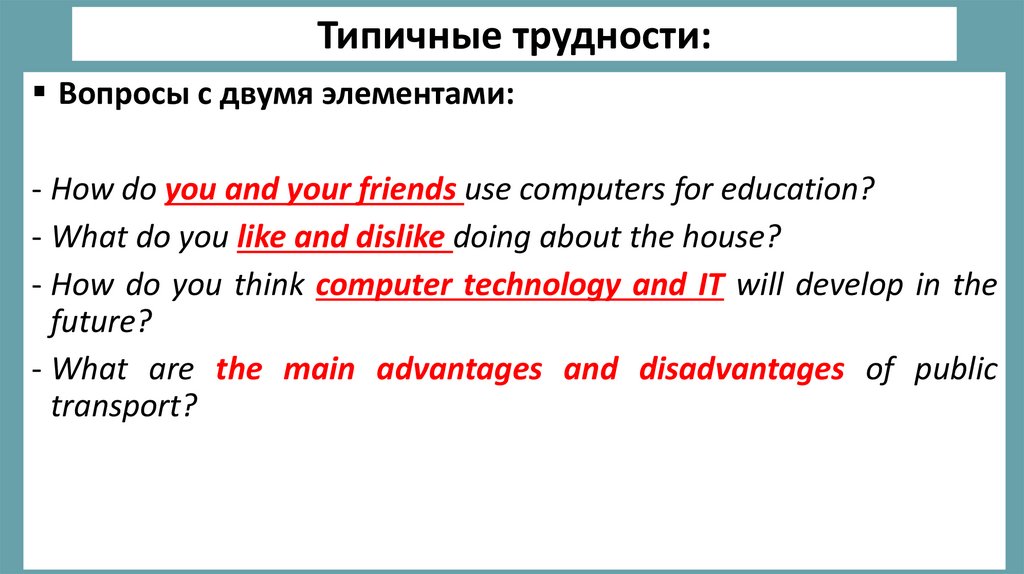
41. Типичные трудности:
Вопросы с двумя элементами:- How do you and your friends use computers for education?
- What do you like and dislike doing about the house?
- How do you think computer technology and IT will develop in the
future?
- What are the main advantages and disadvantages of public
transport?
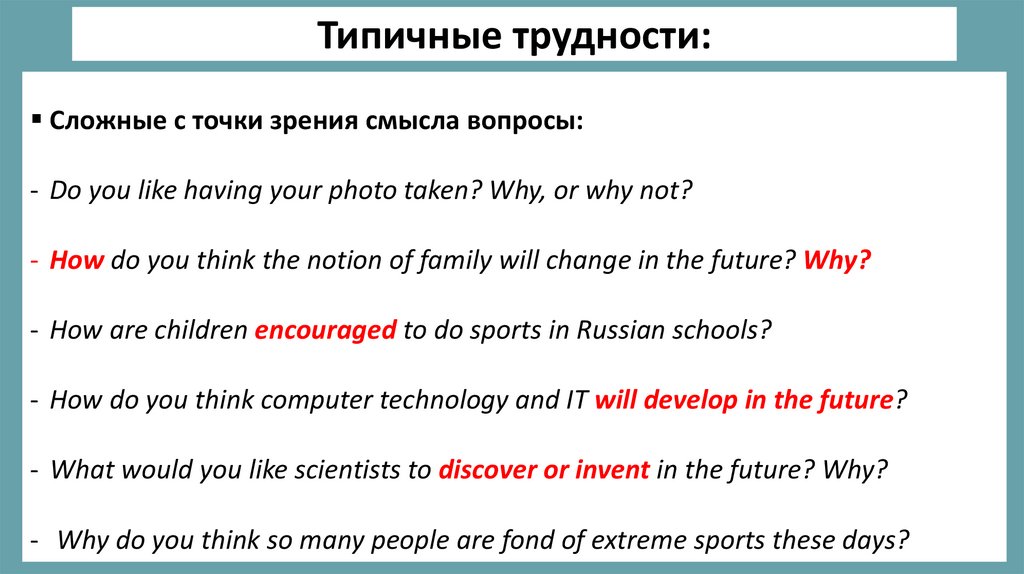
42. Типичные трудности:
Сложные с точки зрения смысла вопросы:- Do you like having your photo taken? Why, or why not?
- How do you think the notion of family will change in the future? Why?
- How are children encouraged to do sports in Russian schools?
- How do you think computer technology and IT will develop in the future?
- What would you like scientists to discover or invent in the future? Why?
- Why do you think so many people are fond of extreme sports these days?
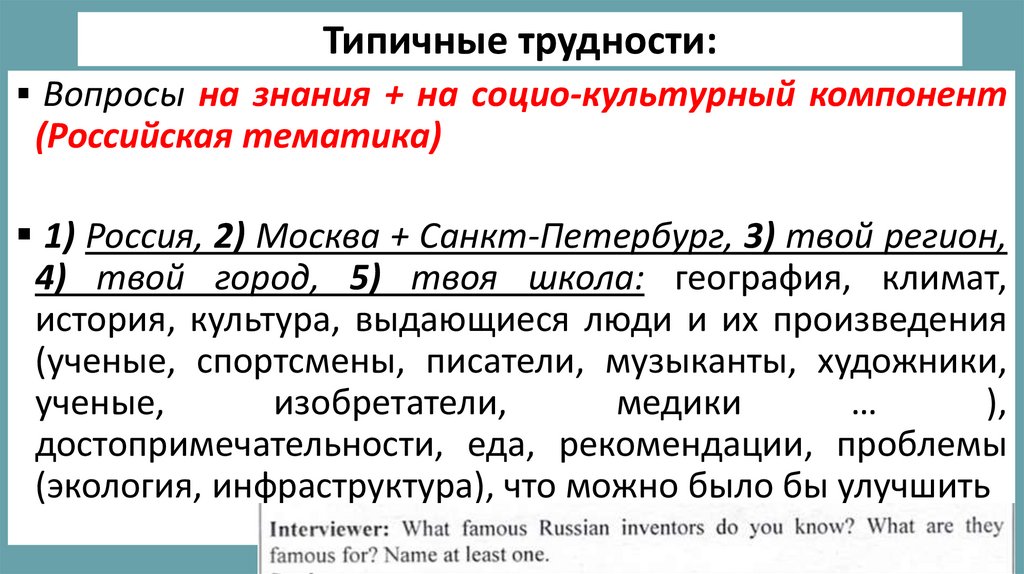
43. Типичные трудности:
Вопросы на знания + на социо-культурный компонент(Российская тематика)
1) Россия, 2) Москва + Санкт-Петербург, 3) твой регион,
4) твой город, 5) твоя школа: география, климат,
история, культура, выдающиеся люди и их произведения
(ученые, спортсмены, писатели, музыканты, художники,
ученые,
изобретатели,
медики
…
),
достопримечательности, еда, рекомендации, проблемы
(экология, инфраструктура), что можно было бы улучшить
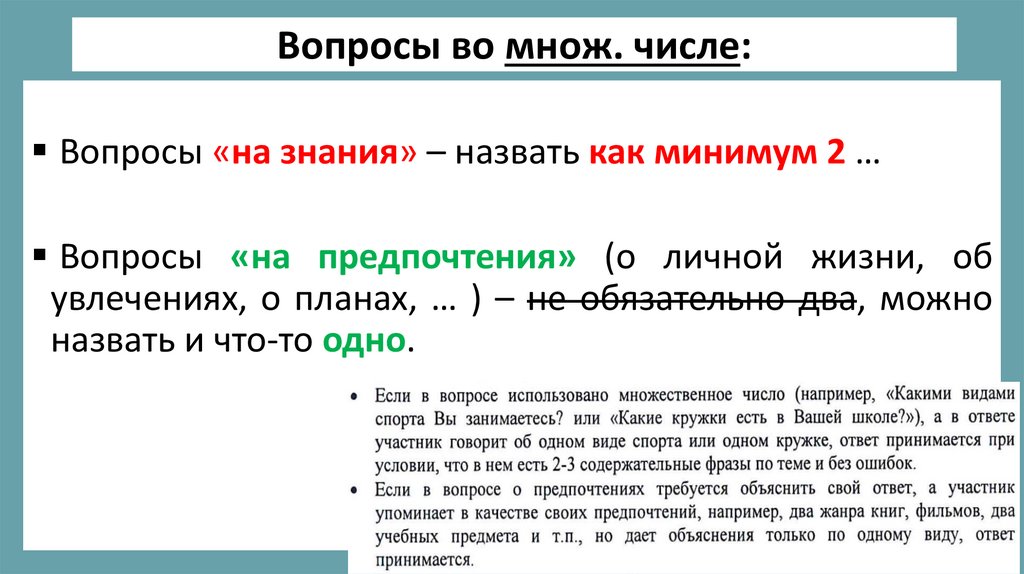
44. Вопросы во множ. числе:
Вопросы «на знания» – назвать как минимум 2 …Вопросы «на предпочтения» (о личной жизни, об
увлечениях, о планах, … ) – не обязательно два, можно
назвать и что-то одно.
45. ?
46. Важно:
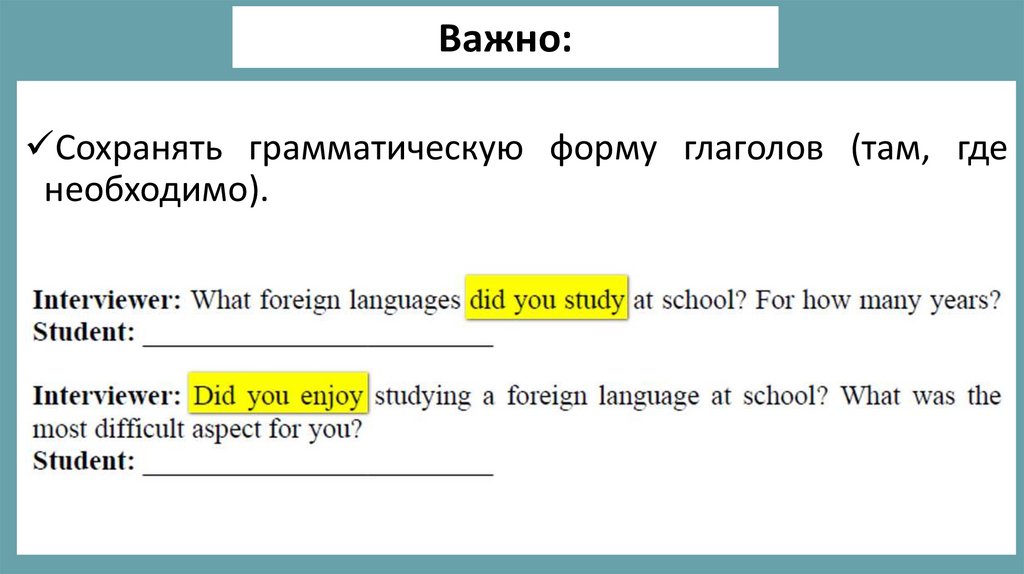
Сохранять грамматическую форму глаголов (там, гденеобходимо).
47. Как услышать и не забыть вопросы?
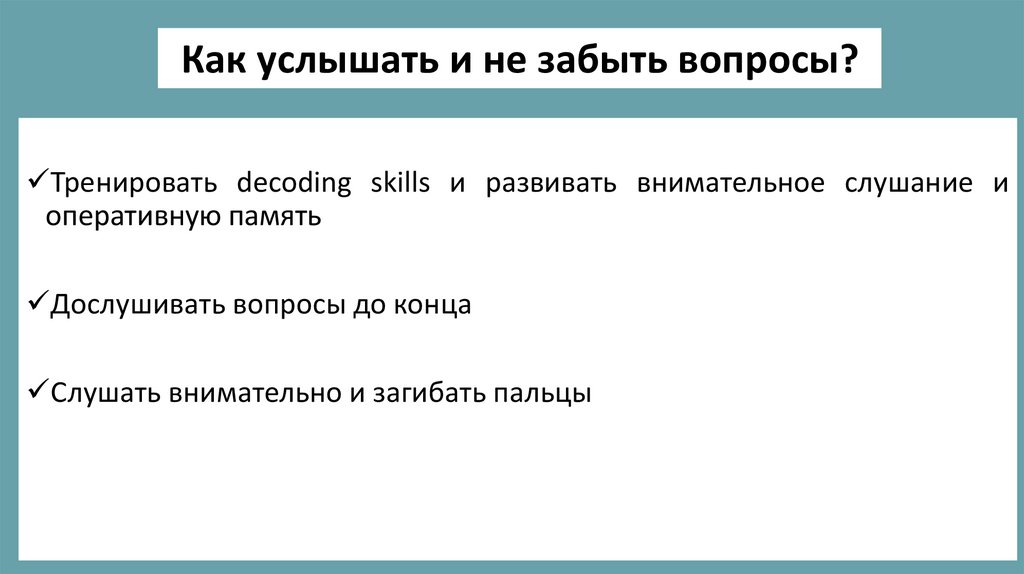
Тренировать decoding skills и развивать внимательное слушание иоперативную память
Дослушивать вопросы до конца
Слушать внимательно и загибать пальцы
48.
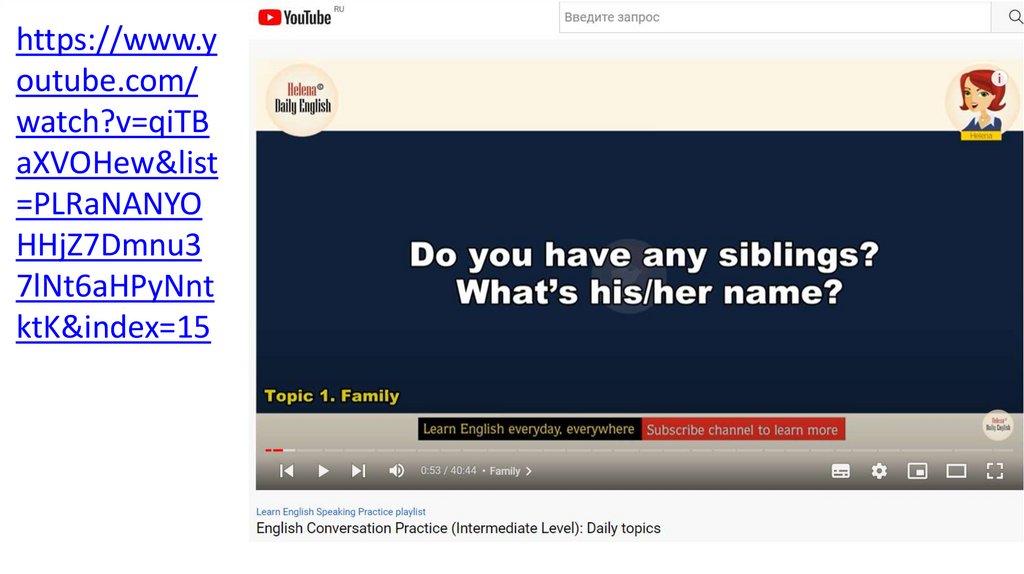
https://www.youtube.com/
watch?v=qiTB
aXVOHew&list
=PLRaNANYO
HHjZ7Dmnu3
7lNt6aHPyNnt
ktK&index=15
49.
50.
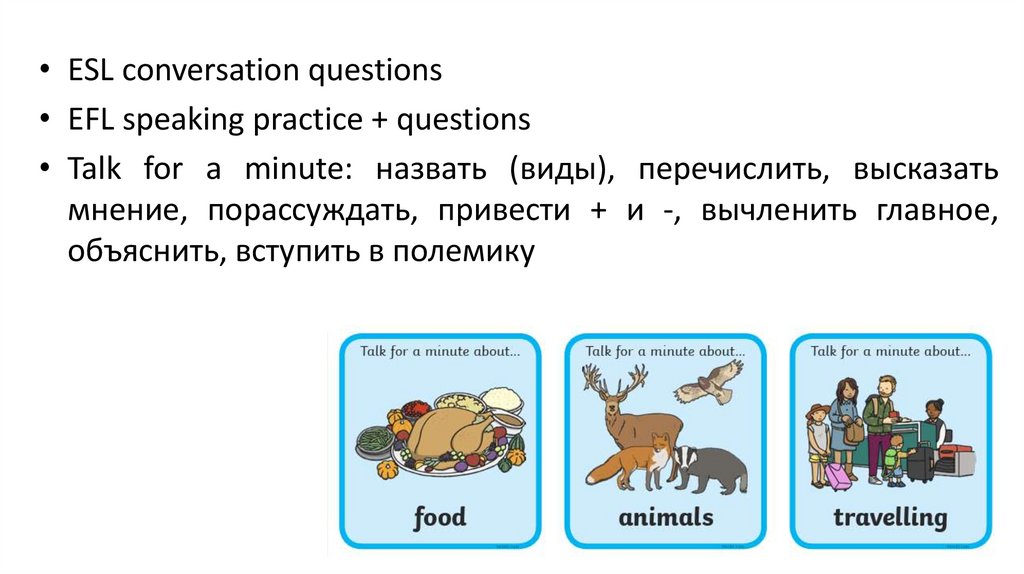
• ESL conversation questions• EFL speaking practice + questions
• Talk for a minute: назвать (виды), перечислить, высказать
мнение, порассуждать, привести + и -, вычленить главное,
объяснить, вступить в полемику
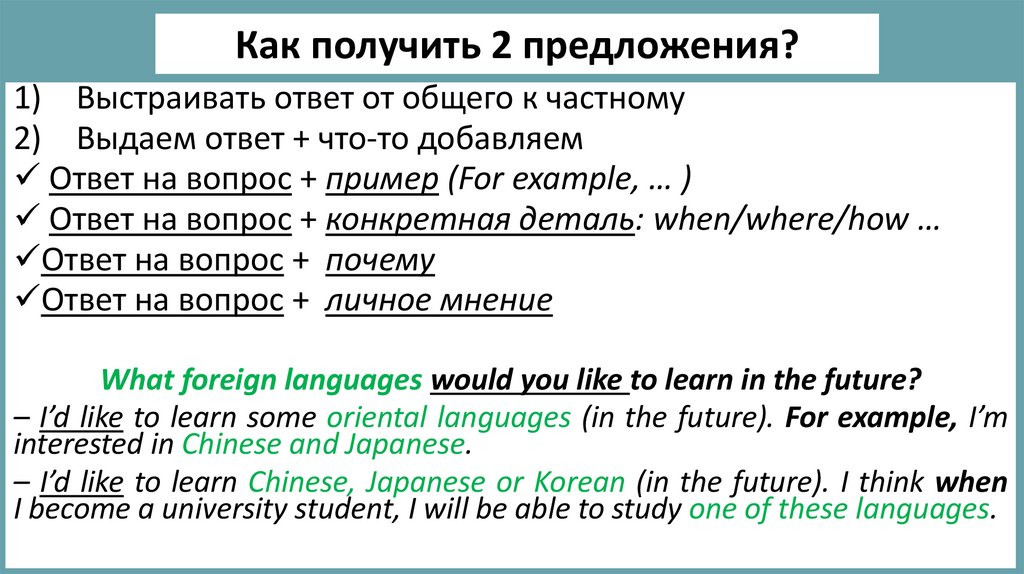
51. Как получить 2 предложения?
1) Выстраивать ответ от общего к частному2) Выдаем ответ + что-то добавляем
Ответ на вопрос + пример (For example, … )
Ответ на вопрос + конкретная деталь: when/where/how …
Ответ на вопрос + почему
Ответ на вопрос + личное мнение
What foreign languages would you like to learn in the future?
– I’d like to learn some oriental languages (in the future). For example, I’m
interested in Chinese and Japanese.
– I’d like to learn Chinese, Japanese or Korean (in the future). I think when
I become a university student, I will be able to study one of these languages.
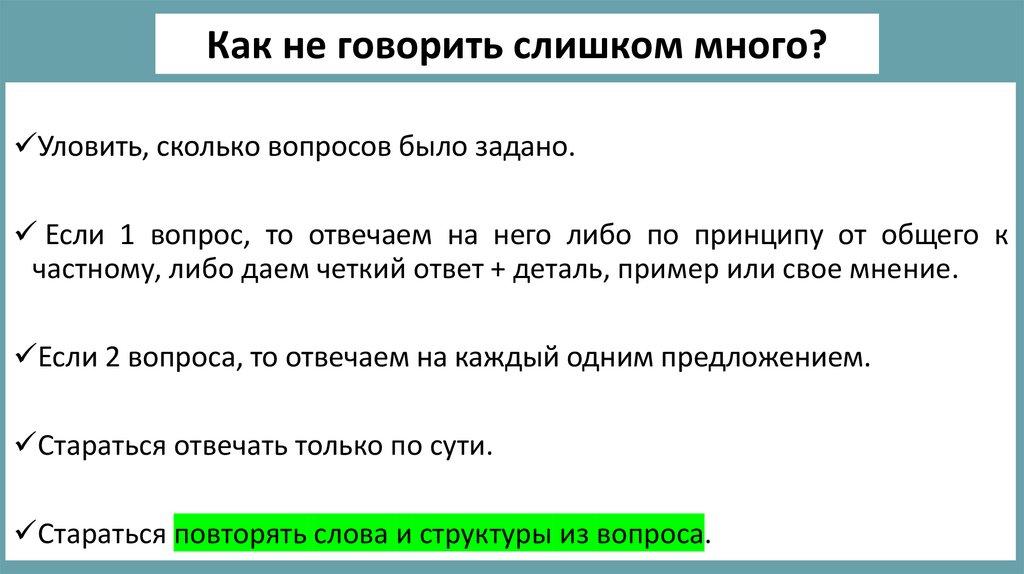
52. Как не говорить слишком много?
Уловить, сколько вопросов было задано.Если 1 вопрос, то отвечаем на него либо по принципу от общего к
частному, либо даем четкий ответ + деталь, пример или свое мнение.
Если 2 вопроса, то отвечаем на каждый одним предложением.
Стараться отвечать только по сути.
Стараться повторять слова и структуры из вопроса.
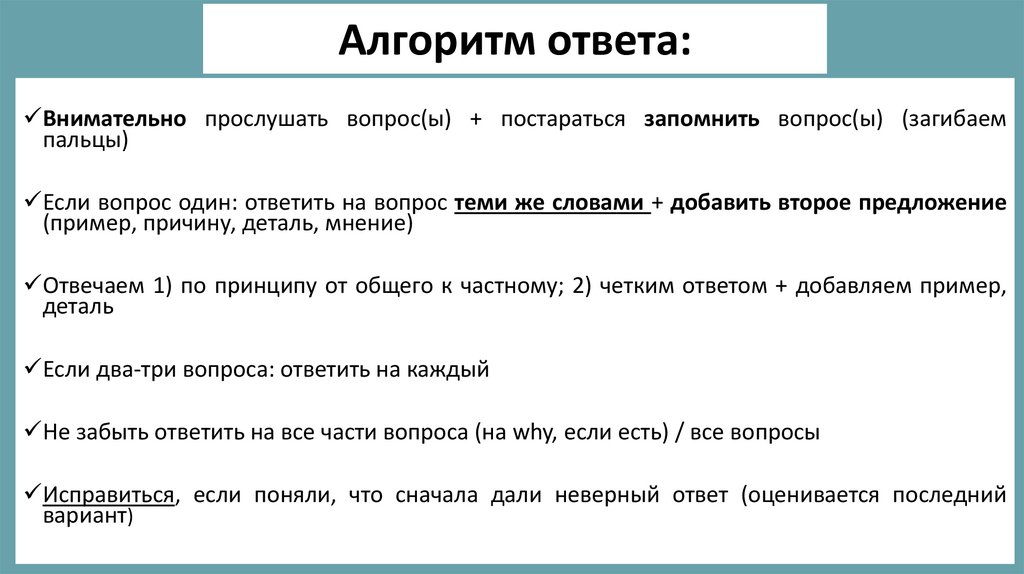
53. Алгоритм ответа:
Внимательно прослушать вопрос(ы) + постараться запомнить вопрос(ы) (загибаемпальцы)
Если вопрос один: ответить на вопрос теми же словами + добавить второе предложение
(пример, причину, деталь, мнение)
Отвечаем 1) по принципу от общего к частному; 2) четким ответом + добавляем пример,
деталь
Если два-три вопроса: ответить на каждый
Не забыть ответить на все части вопроса (на why, если есть) / все вопросы
Исправиться, если поняли, что сначала дали неверный ответ (оценивается последний
вариант)
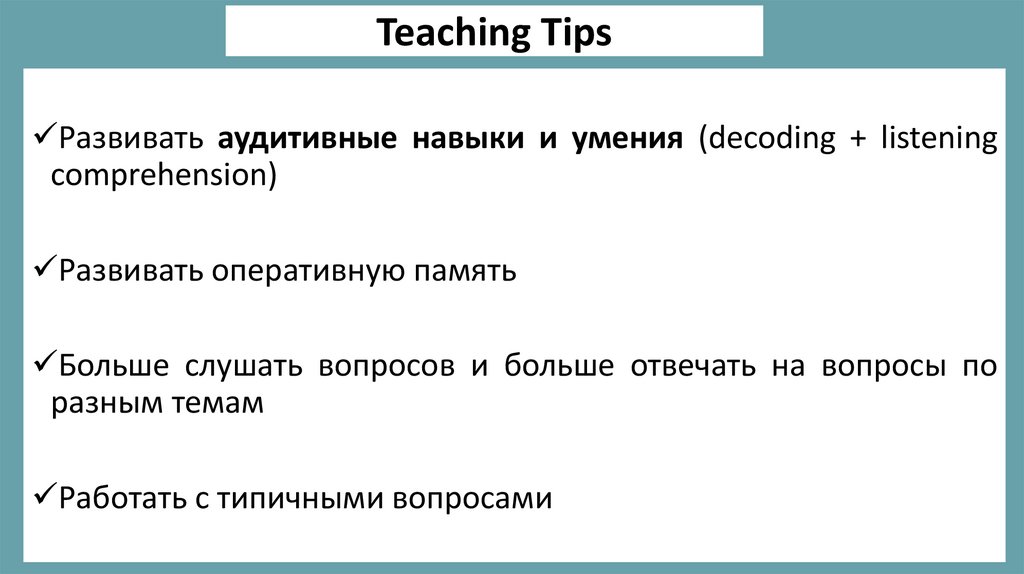
54. Teaching Tips
Развивать аудитивные навыки и умения (decoding + listeningcomprehension)
Развивать оперативную память
Больше слушать вопросов и больше отвечать на вопросы по
разным темам
Работать с типичными вопросами
55.
Примеры ответов на вопросы из задания 3 УЧ56.
57.
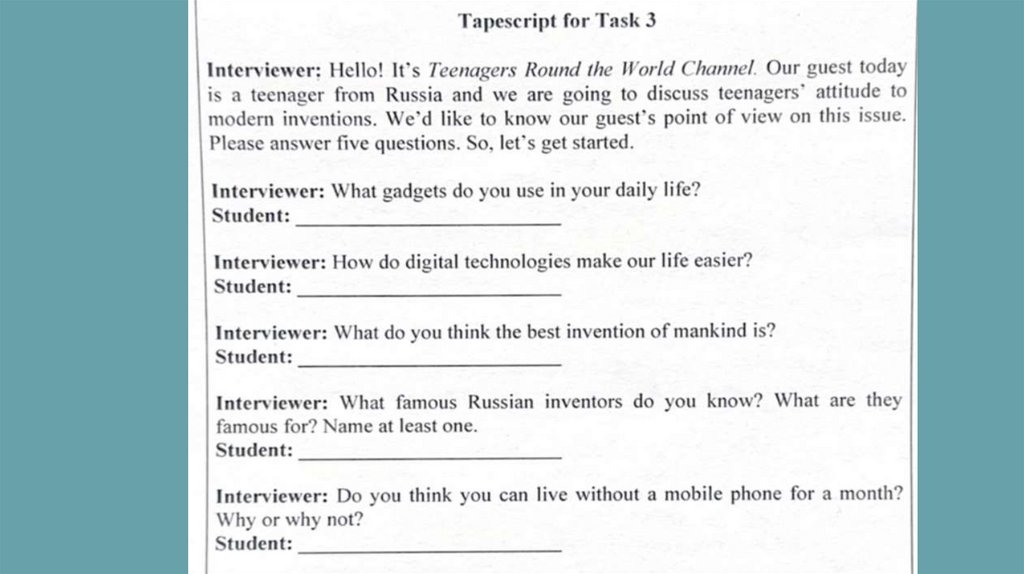
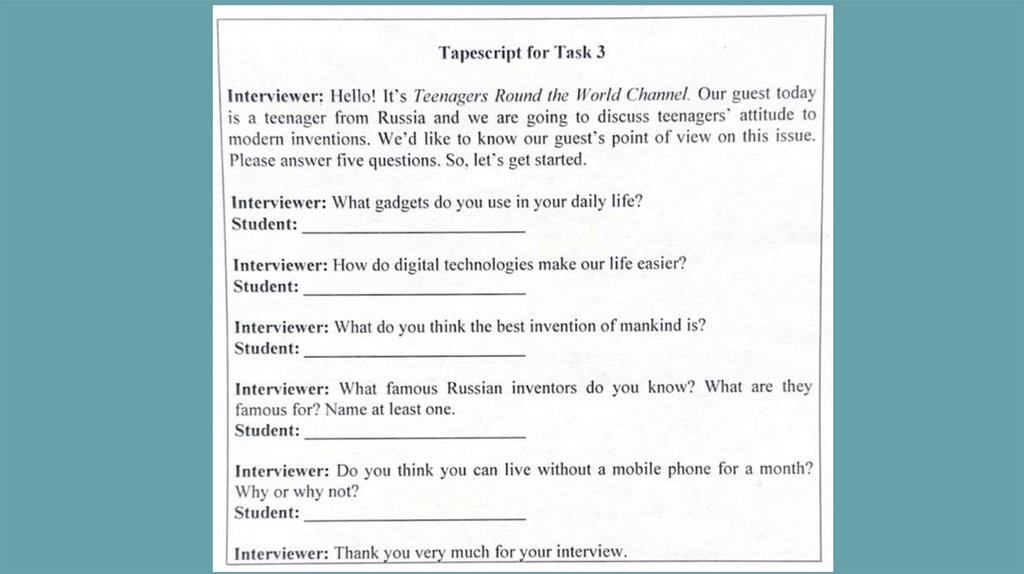
(1) Task 3. You are going to give an interview. You have to answer five questions. Give full answers tothe questions (2-3 sentences). Remember that you have 40 seconds to answers each question.
Interviewer: Hello everybody! It's Teenagers Round the World Channel. Our guest today is a teenager
from Russia and we are going to discuss teenagers' attitude to modern inventions. We'd like to know
our guest's point of view on this issue. Please answer five questions. So, let's get started.
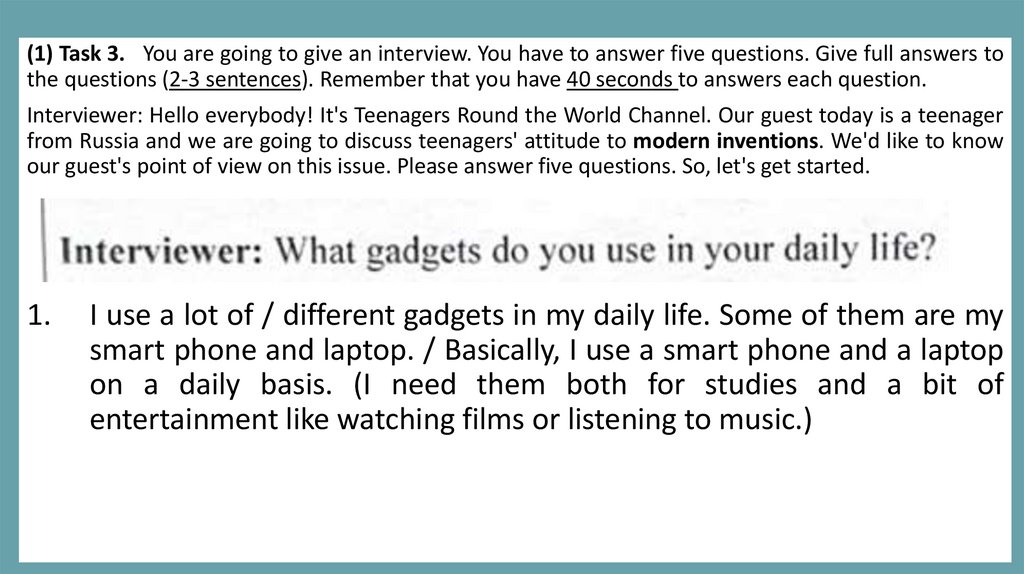
1.
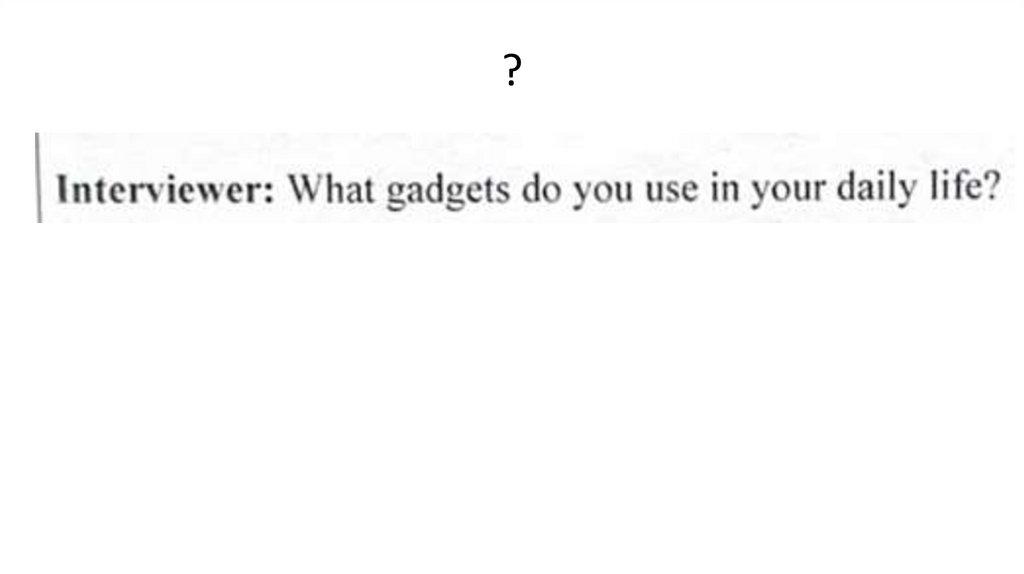
I use a lot of / different gadgets in my daily life. Some of them are my
smart phone and laptop. / Basically, I use a smart phone and a laptop
on a daily basis. (I need them both for studies and a bit of
entertainment like watching films or listening to music.)
58.
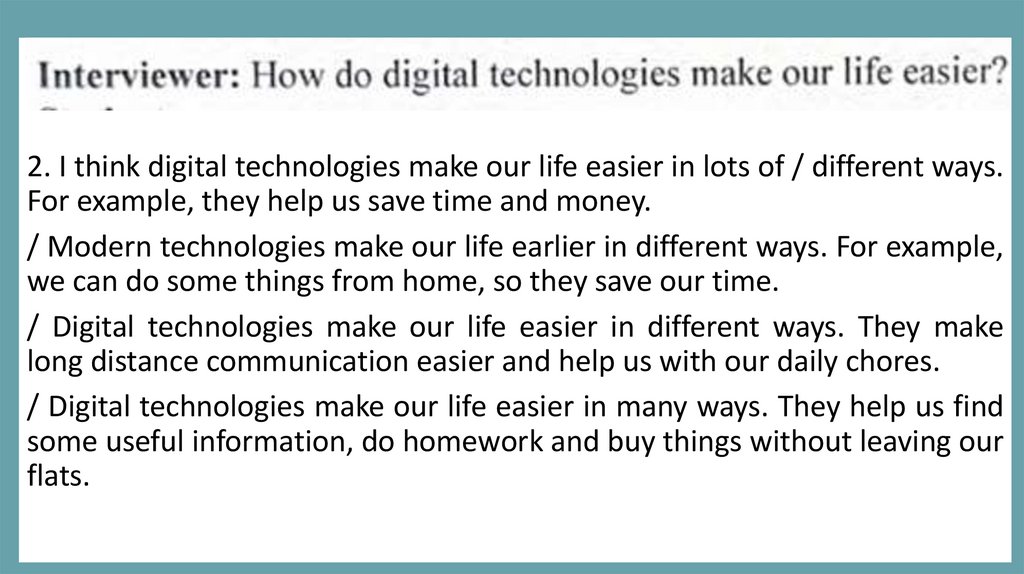
2. I think digital technologies make our life easier in lots of / different ways.For example, they help us save time and money.
/ Modern technologies make our life earlier in different ways. For example,
we can do some things from home, so they save our time.
/ Digital technologies make our life easier in different ways. They make
long distance communication easier and help us with our daily chores.
/ Digital technologies make our life easier in many ways. They help us find
some useful information, do homework and buy things without leaving our
flats.
59.
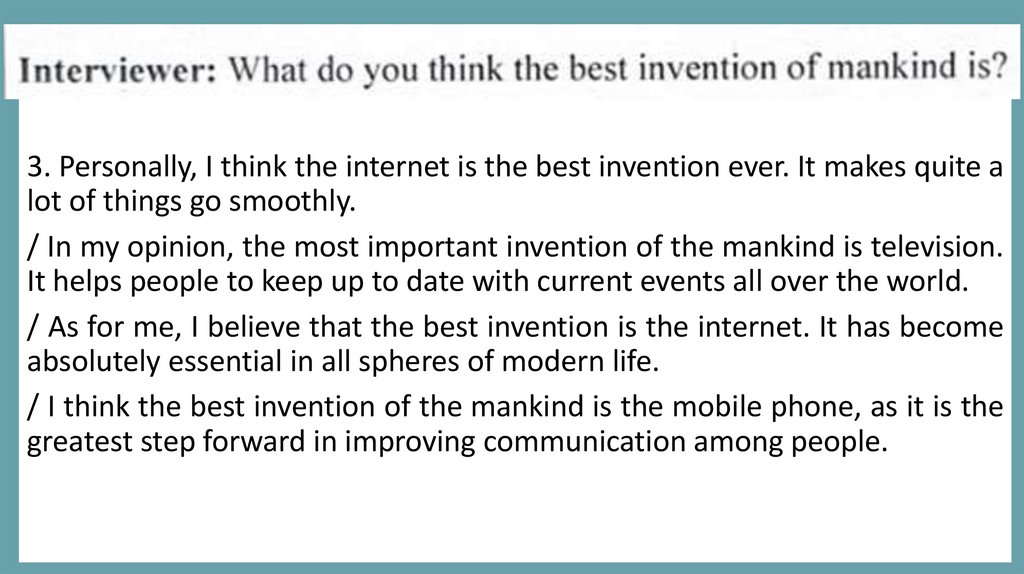
3. Personally, I think the internet is the best invention ever. It makes quite alot of things go smoothly.
/ In my opinion, the most important invention of the mankind is television.
It helps people to keep up to date with current events all over the world.
/ As for me, I believe that the best invention is the internet. It has become
absolutely essential in all spheres of modern life.
/ I think the best invention of the mankind is the mobile phone, as it is the
greatest step forward in improving communication among people.
60.
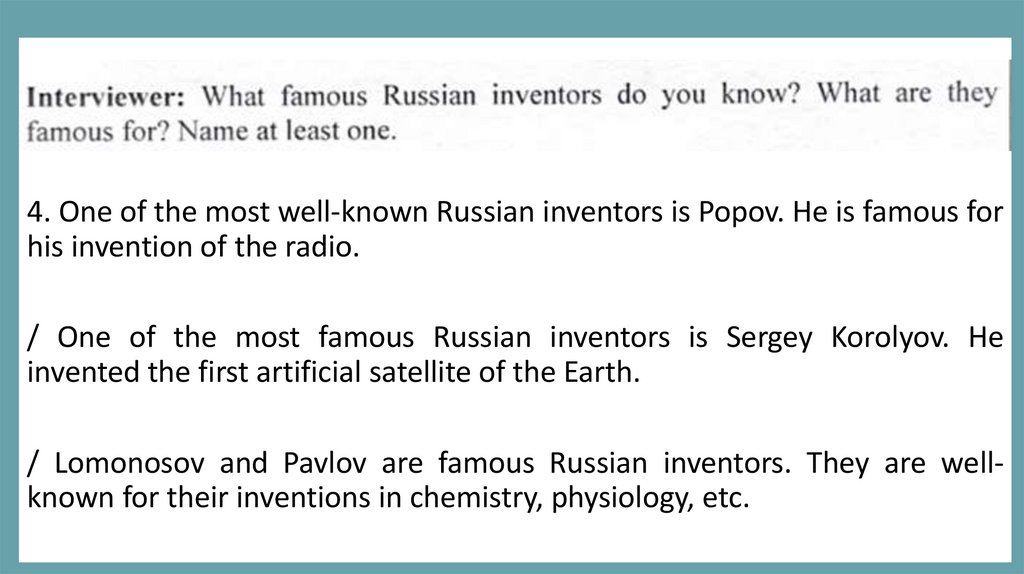
4. One of the most well-known Russian inventors is Popov. He is famous forhis invention of the radio.
/ One of the most famous Russian inventors is Sergey Korolyov. He
invented the first artificial satellite of the Earth.
/ Lomonosov and Pavlov are famous Russian inventors. They are wellknown for their inventions in chemistry, physiology, etc.
61.
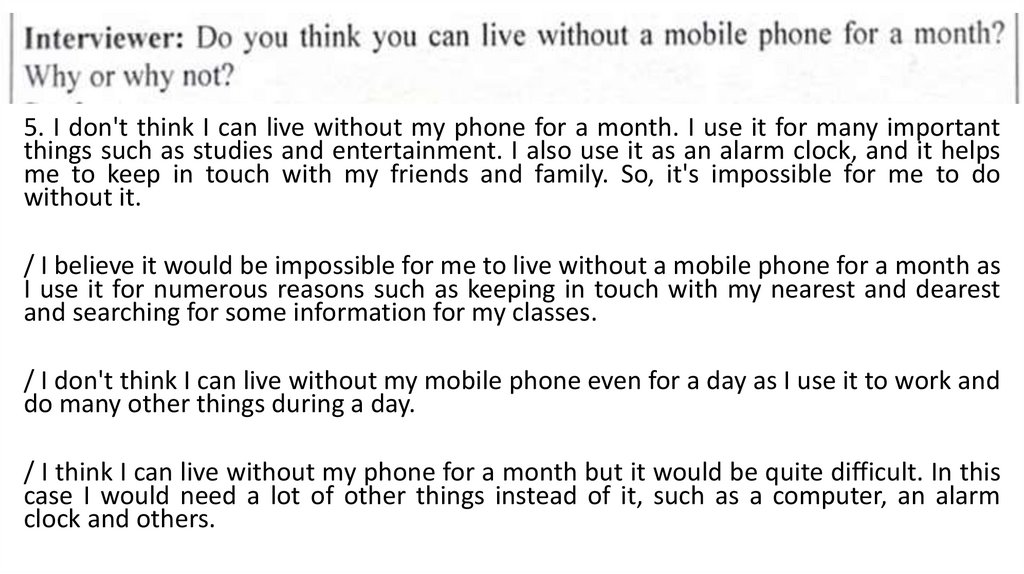
5. I don't think I can live without my phone for a month. I use it for many importantthings such as studies and entertainment. I also use it as an alarm clock, and it helps
me to keep in touch with my friends and family. So, it's impossible for me to do
without it.
/ I believe it would be impossible for me to live without a mobile phone for a month as
I use it for numerous reasons such as keeping in touch with my nearest and dearest
and searching for some information for my classes.
/ I don't think I can live without my mobile phone even for a day as I use it to work and
do many other things during a day.
/ I think I can live without my phone for a month but it would be quite difficult. In this
case I would need a lot of other things instead of it, such as a computer, an alarm
clock and others.
62.
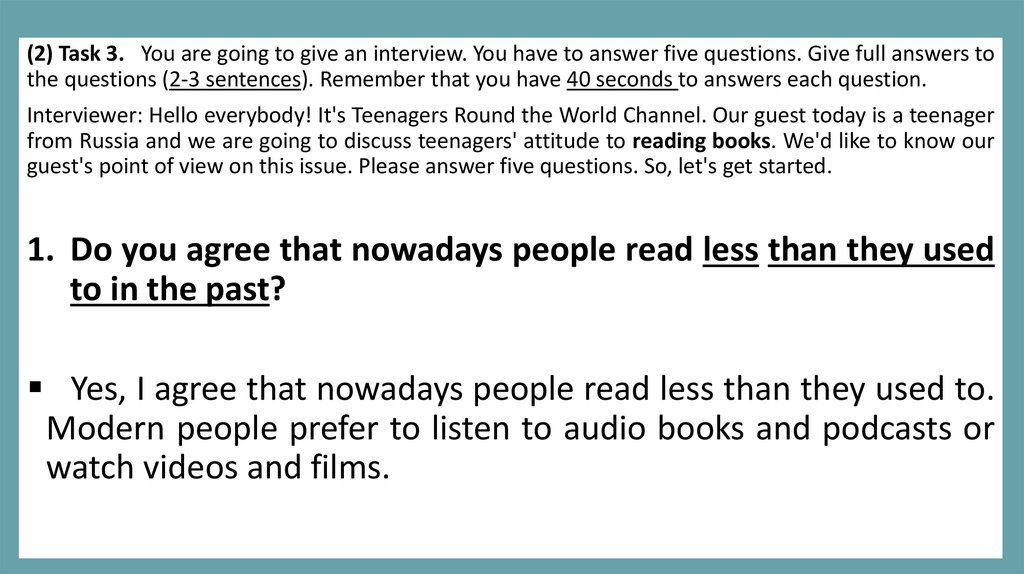
(2) Task 3. You are going to give an interview. You have to answer five questions. Give full answers tothe questions (2-3 sentences). Remember that you have 40 seconds to answers each question.
Interviewer: Hello everybody! It's Teenagers Round the World Channel. Our guest today is a teenager
from Russia and we are going to discuss teenagers' attitude to reading books. We'd like to know our
guest's point of view on this issue. Please answer five questions. So, let's get started.
1. Do you agree that nowadays people read less than they used
to in the past?
Yes, I agree that nowadays people read less than they used to.
Modern people prefer to listen to audio books and podcasts or
watch videos and films.
63.
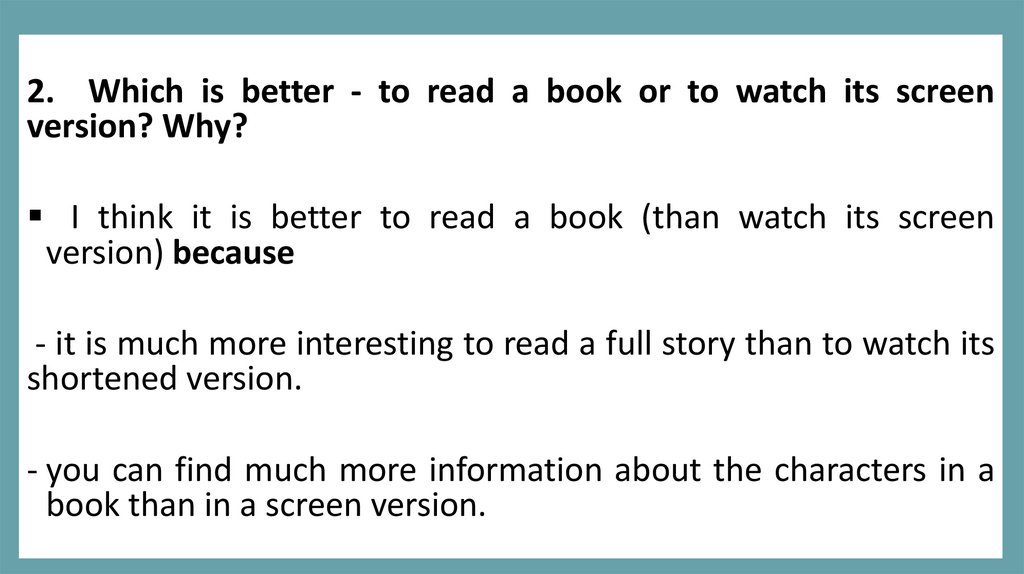
2. Which is better - to read a book or to watch its screenversion? Why?
I think it is better to read a book (than watch its screen
version) because
- it is much more interesting to read a full story than to watch its
shortened version.
- you can find much more information about the characters in a
book than in a screen version.
64.
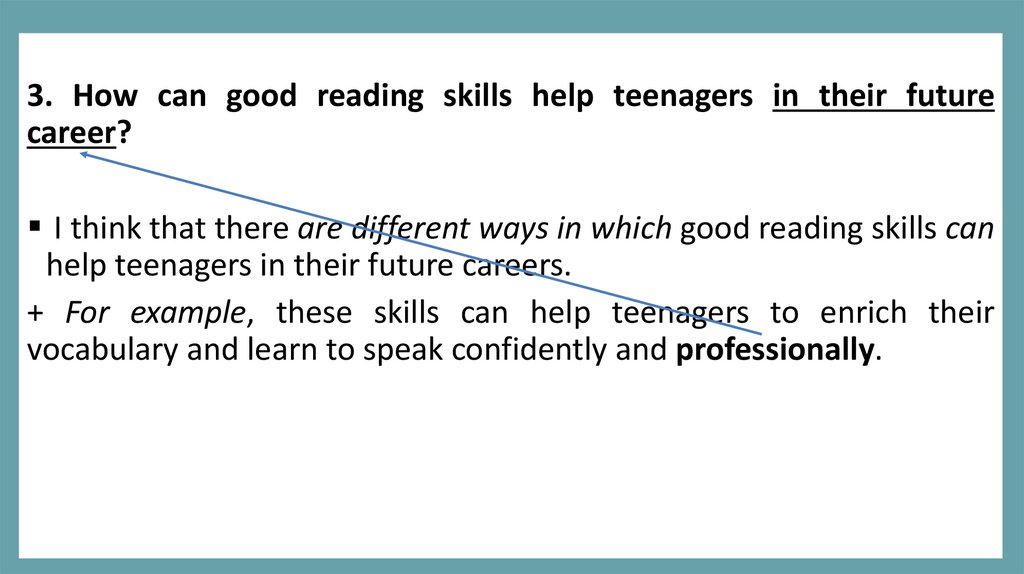
3. How can good reading skills help teenagers in their futurecareer?
I think that there are different ways in which good reading skills can
help teenagers in their future careers.
+ For example, these skills can help teenagers to enrich their
vocabulary and learn to speak confidently and professionally.
65.
4. Who or what can help children shape their reading habits?- I think that different people can help children shape their reading
habits. They are parents (, grandparents, best friends) and favourite
teachers.
66.
5. What are your current reading preferences? Have they changedsince you were a child?
- My reading preferences have changed a lot: when I was a child, I
preferred classical literature. Now I prefer modern literature.
67.
(3) Task 3. You are going to give an interview. You have to answer five questions. Give full answers tothe questions (2-3 sentences). Remember that you have 40 seconds to answers each question.
Interviewer: Hello everybody! It’s Teenagers Round the World Channel. Our guest today is a teenager
from Russia and we are going to discuss online education. Please answer five questions. Let’s get
started.
1. Do you have any experience in studying online?
- Yes, I have some experience in studying online. I have had some
online classes in English.
68.
2. What do you think are the main advantages of studyingonline?
- I think the main advantages of studying online are convenience
and cheapness. It / Online education / getting education online is
much more convenient and affordable than traditional
education.
69.
3. Do you see any disadvantages of online education?- I believe the main disadvantage of learning online is that you
depend on your computer and the Internet. And if there are
some technological problems, you cannot study.
70.
4. What subjects can be studied online with good results?- I suppose languages can be studied online with good results
because modern online platforms offer a lot of opportunities for
learning languages.
71.
5. Would you prefer to study at university online? Or do youthink traditional offline education is still better? Why?
- Yes, I would prefer to study at university online. I don’t think
that traditional offline education is better than online education
because it is less convenient and more expensive.
72.
(4) Task 3. You are going to give an interview. You have to answer five questions. Give full answers tothe questions (2-3 sentences). Remember that you have 40 seconds to answers each question.
Interviewer: Hello everybody! It’s Teenagers Round the World Channel. Our guest today is a teenager
from Russia and we are going to discuss science. Please answer five questions. Let’s get started.
1. What sciences did you study at school? Which of them did
you like?
- I studied Physics, Chemistry, Biology, Geography, Civics and
History. I especially liked Biology and Geography.
73.
2. What Russian scientists do you admire? What are theirinventions?
- I admire Alexander Popov, he designed the first radio receiver. I
also admire Alexander Prokhorov who invented the laser.
74.
3. What invention can’t you imagine your life without?- I guess I cannot imagine my life without a cell phone. My cell
phone makes my life much more convenient and interesting.
75.
4. What invention has had a negative impact on our life?- I think TV has had a negative impact on our life because there is
a lot of negative news and propaganda on TV.
76.
5. What would you like scientists to invent in the future?- I would like scientists to develop a cure for cancer. I hope in the
future they will invent something that will stop people from dying
from this dangerous disease.
77.
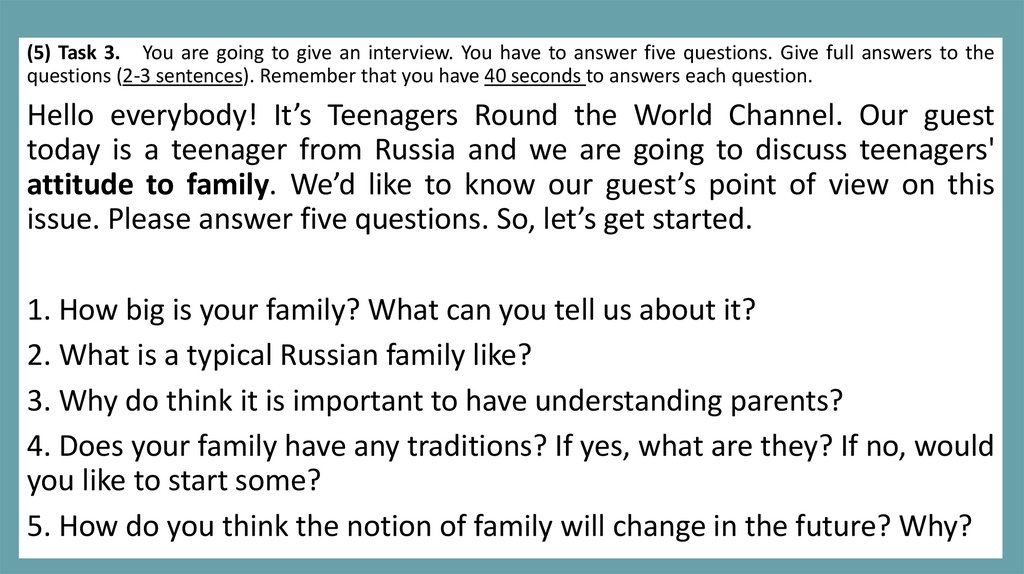
(5) Task 3. You are going to give an interview. You have to answer five questions. Give full answers to thequestions (2-3 sentences). Remember that you have 40 seconds to answers each question.
Hello everybody! It’s Teenagers Round the World Channel. Our guest
today is a teenager from Russia and we are going to discuss teenagers'
attitude to family. We’d like to know our guest’s point of view on this
issue. Please answer five questions. So, let’s get started.
1. How big is your family? What can you tell us about it?
2. What is a typical Russian family like?
3. Why do think it is important to have understanding parents?
4. Does your family have any traditions? If yes, what are they? If no, would
you like to start some?
5. How do you think the notion of family will change in the future? Why?
78.
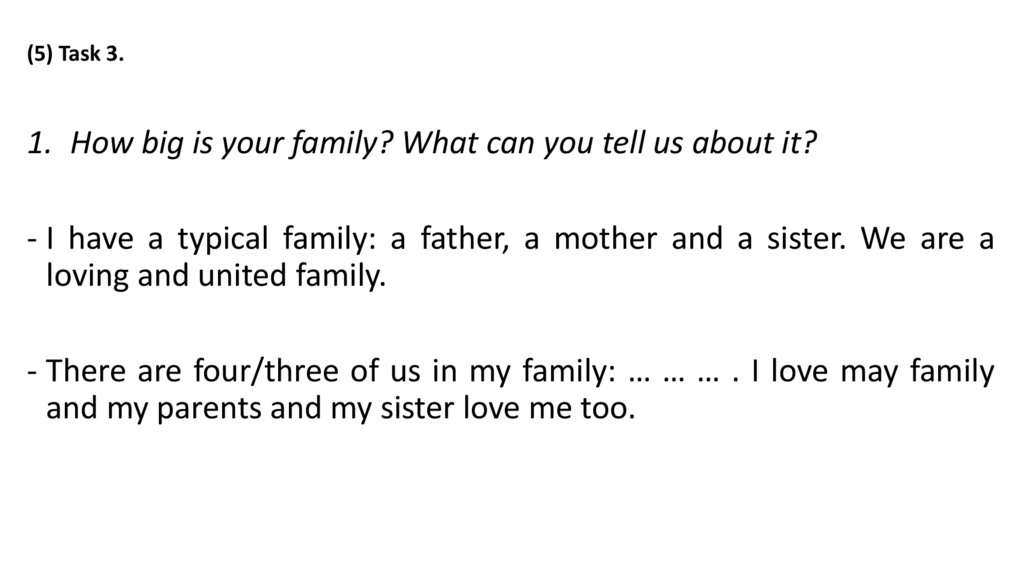
(5) Task 3.1. How big is your family? What can you tell us about it?
- I have a typical family: a father, a mother and a sister. We are a
loving and united family.
- There are four/three of us in my family: … … … . I love may family
and my parents and my sister love me too.
79.
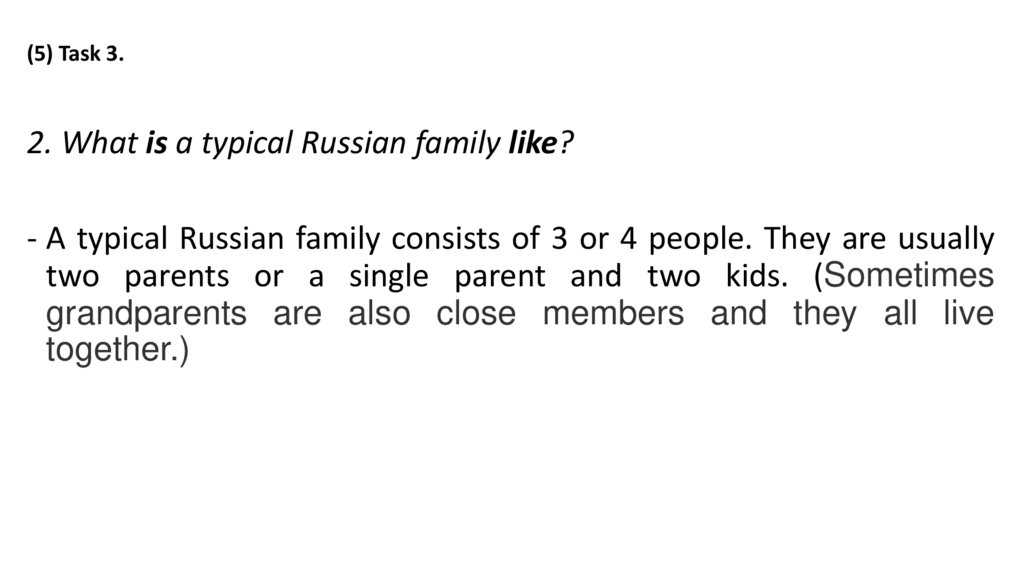
(5) Task 3.2. What is a typical Russian family like?
- A typical Russian family consists of 3 or 4 people. They are usually
two parents or a single parent and two kids. (Sometimes
grandparents are also close members and they all live
together.)
80.
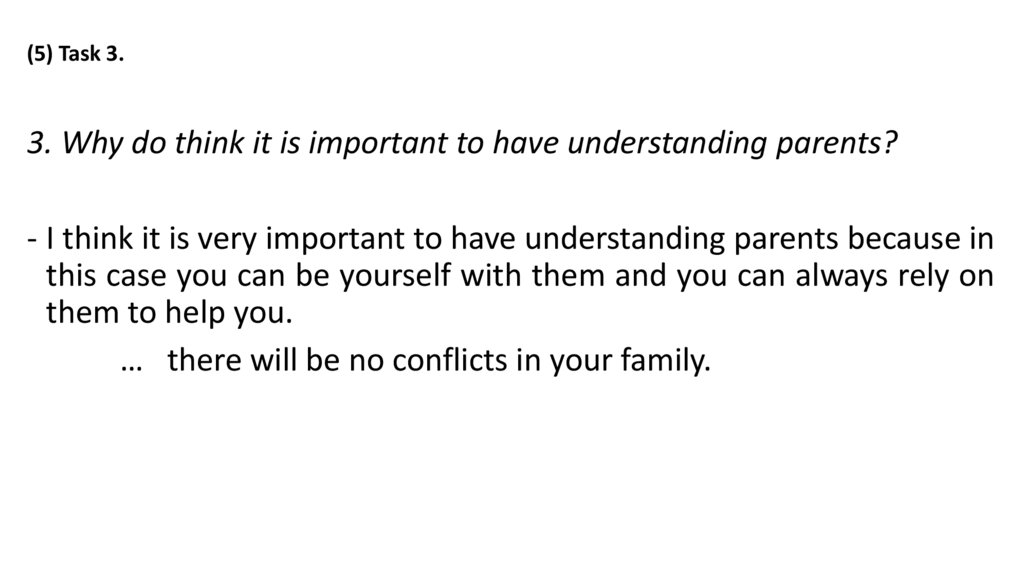
(5) Task 3.3. Why do think it is important to have understanding parents?
- I think it is very important to have understanding parents because in
this case you can be yourself with them and you can always rely on
them to help you.
… there will be no conflicts in your family.
81.
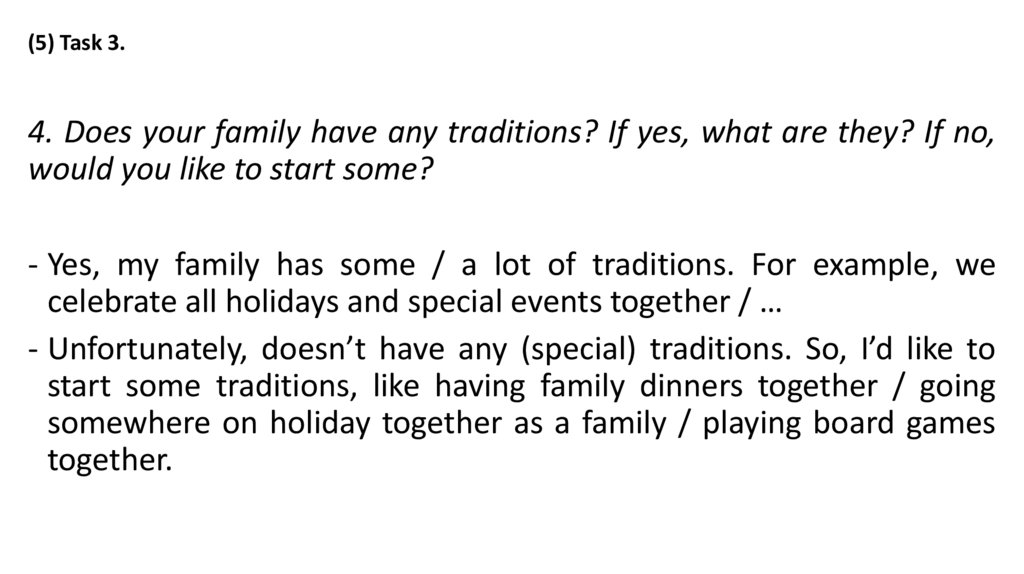
(5) Task 3.4. Does your family have any traditions? If yes, what are they? If no,
would you like to start some?
- Yes, my family has some / a lot of traditions. For example, we
celebrate all holidays and special events together / …
- Unfortunately, doesn’t have any (special) traditions. So, I’d like to
start some traditions, like having family dinners together / going
somewhere on holiday together as a family / playing board games
together.
82.
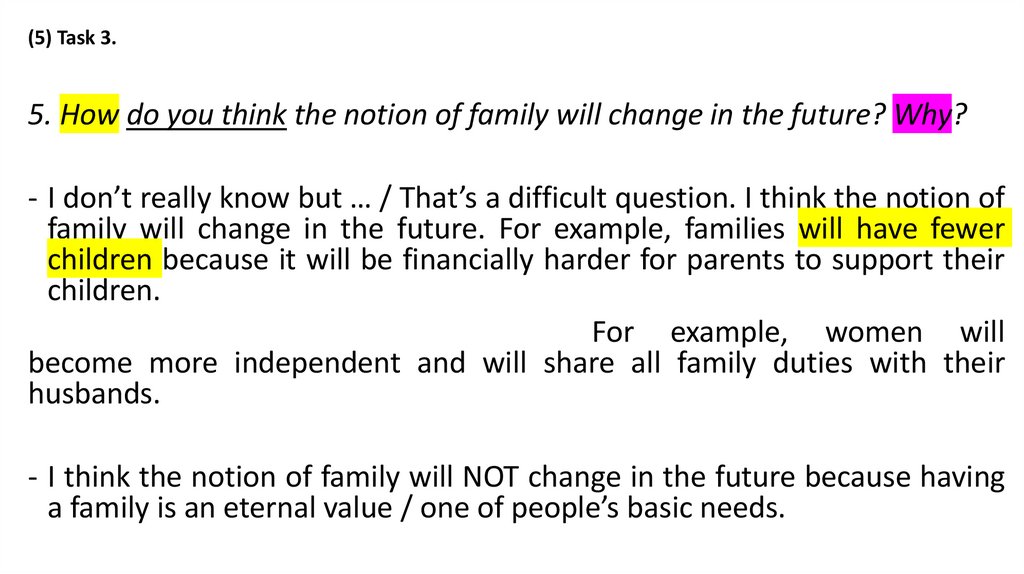
(5) Task 3.5. How do you think the notion of family will change in the future? Why?
- I don’t really know but … / That’s a difficult question. I think the notion of
family will change in the future. For example, families will have fewer
children because it will be financially harder for parents to support their
children.
For example, women will
become more independent and will share all family duties with their
husbands.
- I think the notion of family will NOT change in the future because having
a family is an eternal value / one of people’s basic needs.
83.
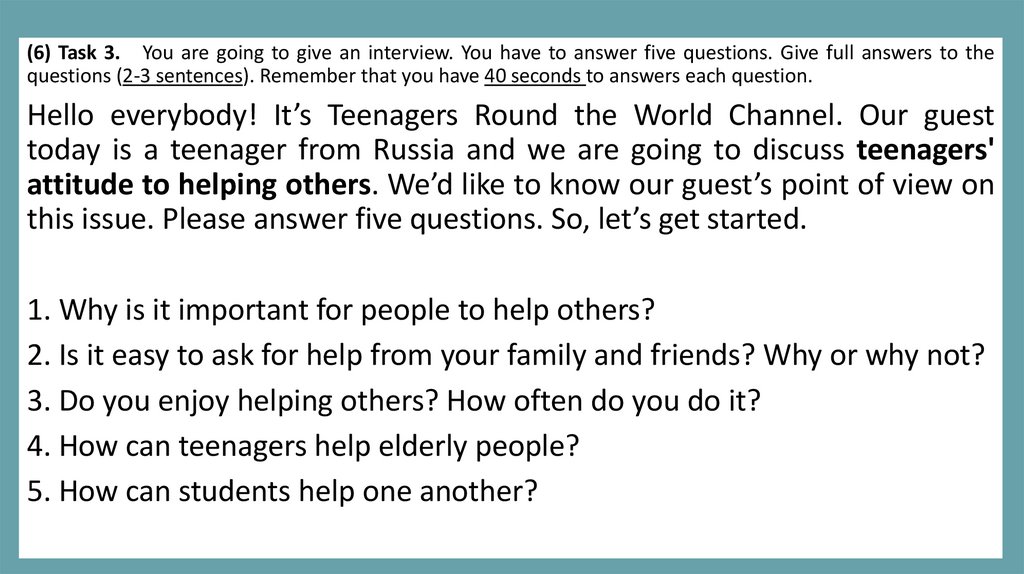
(6) Task 3. You are going to give an interview. You have to answer five questions. Give full answers to thequestions (2-3 sentences). Remember that you have 40 seconds to answers each question.
Hello everybody! It’s Teenagers Round the World Channel. Our guest
today is a teenager from Russia and we are going to discuss teenagers'
attitude to helping others. We’d like to know our guest’s point of view on
this issue. Please answer five questions. So, let’s get started.
1. Why is it important for people to help others?
2. Is it easy to ask for help from your family and friends? Why or why not?
3. Do you enjoy helping others? How often do you do it?
4. How can teenagers help elderly people?
5. How can students help one another?
84.
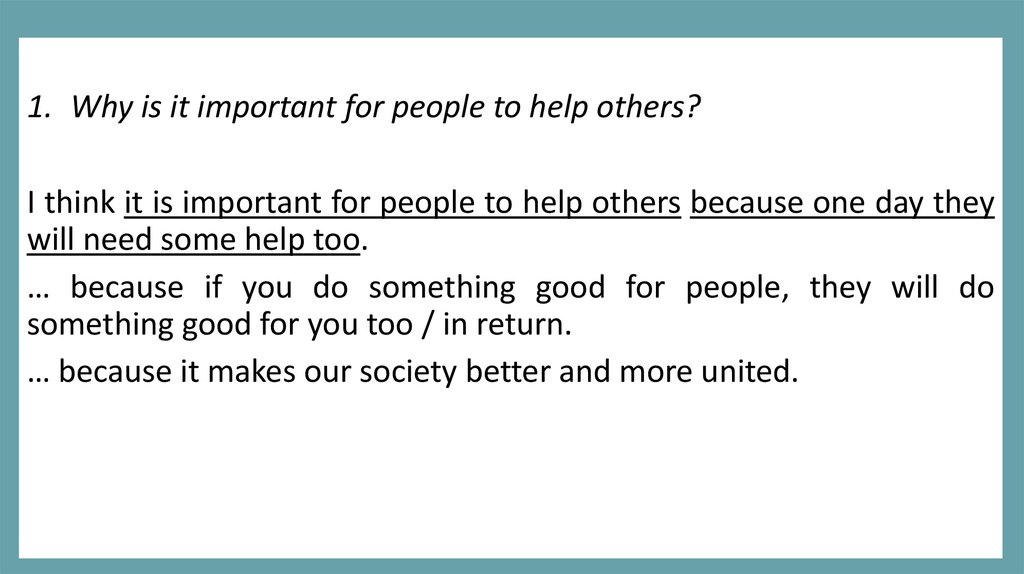
1. Why is it important for people to help others?I think it is important for people to help others because one day they
will need some help too.
… because if you do something good for people, they will do
something good for you too / in return.
… because it makes our society better and more united.
85.
2. Is it easy to ask for help from your family and friends? Why or whynot?
- It is easy for me to ask my family and friends for help because we
are really close / they love me and they are always ready/happy to
support me.
- It is not always easy for me to ask my family and friends for help
because I’m very independent and like relying on myself.
… because we have different views on many things and do not
always agree with each other.
86.
3. Do you enjoy helping others? How often do you do it?- I really enjoy helping others. I do it very often / every time people
ask me.
- Personally, I enjoy helping others. I regularly do it.
- I really enjoy helping others. I do it every time I can.
87.
4. How can teenagers help elderly people?- I think teenagers can help elderly people in many / different ways.
For example, they can teach them to use modern devices.
… , they can go shopping for them.
88.
5. How can students help one another?- I think students can help one another in many / different ways. For
example, they can explain some difficult topics to one another.
… , they can share notes if someone has missed a class.
… , they can do their homework together and help each other
to do difficult tasks.
89.
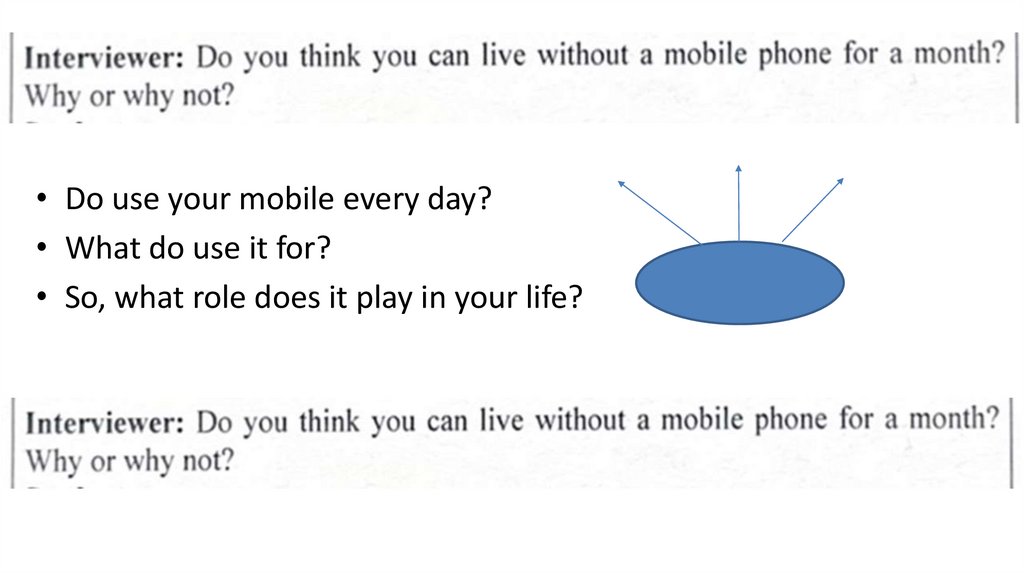
• Do use your mobile every day?• What do use it for?
• So, what role does it play in your life?