 economics
Similar presentations:








Module 2 and Module 3: Business in theory & Marketing and Advertising
1.
Module 2: Business in theoryMultinationals
Micro-multinationals
Privatization
Nationalization
2. Lesson objectives
By the end of the lesson you will be able to:• Define and compare key economic concepts: multinationals, micromultinationals, privatisation and nationalization by using accurate
terminology.
• Analyze the advantages and disadvantages of these concepts through
real-world examples, such as case studies from global companies.
• Discuss their impacts on economies, employment and governance in
group debates.
3.
WARM-UP ACTIVITY: English Idioms1)
The lights are on, but nobody`s home
Don’t try discussing anything intelligent with Marta. The lights are on but nobody’s home, I’m afraid
Once Mark starts playing video games there is no use in talking to him. The lights are on but nobody’s
home
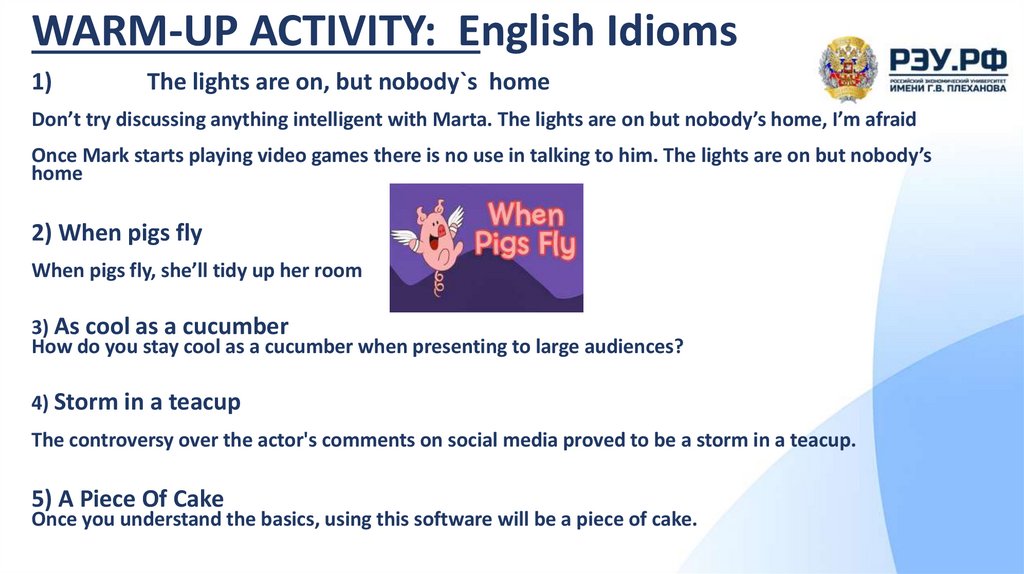
2) When pigs fly
When pigs fly, she’ll tidy up her room
3) As cool as a cucumber
How do you stay cool as a cucumber when presenting to large audiences?
4) Storm in a teacup
The controversy over the actor's comments on social media proved to be a storm in a teacup.
5) A Piece Of Cake
Once you understand the basics, using this software will be a piece of cake.
4.
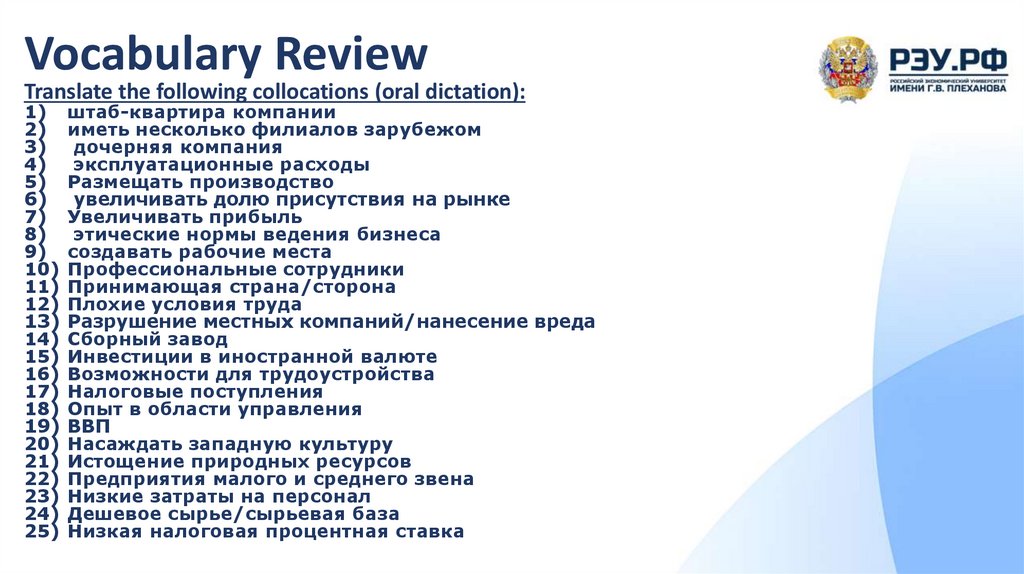
Vocabulary ReviewTranslate the following collocations (oral dictation):
1) штаб-квартира компании
2) иметь несколько филиалов зарубежом
3) дочерняя компания
4) эксплуатационные расходы
5) Размещать производство
6) увеличивать долю присутствия на рынке
7) Увеличивать прибыль
8) этические нормы ведения бизнеса
9) создавать рабочие места
10) Профессиональные сотрудники
11) Принимающая страна/сторона
12) Плохие условия труда
13) Разрушение местных компаний/нанесение вреда
14) Сборный завод
15) Инвестиции в иностранной валюте
16) Возможности для трудоустройства
17) Налоговые поступления
18) Опыт в области управления
19) ВВП
20) Насаждать западную культуру
21) Истощение природных ресурсов
22) Предприятия малого и среднего звена
23) Низкие затраты на персонал
24) Дешевое сырье/сырьевая база
25) Низкая налоговая процентная ставка
5.
Reviewing home assignmentComparative analysis of multinationals and micro-multinationals:
Analyzing multinationals (large MNCs) and micro-multinationals (small, global
SMEs with <250 employees).
Compare them across
SIZE
OPERATIONS
AGILITY/Flexibility
GLOBAL ACCESS
using real examples like MNC vs. a tech startup like Buffer (micro-multinational).
6.
Lead-inKey Questions :
• What do you understand by the terms "privatisation" and "nationalisation"? Can
you give an example from your country or another place?
• Have you heard of any companies or industries in Russia (or elsewhere) that were
privatised in the 1990s? What do you think happened to them?
• Why might a government decide to nationalise a key industry, like energy or
transport? What benefits or risks come to mind?
• In what situations could privatising state-owned assets, such as factories or banks,
be a good idea? What problems might arise?
7.
Reading Task 1 - Gist UnderstandingText Title: Public Enterprises
Text Type: Academic
Skimming Task (3 mins)
Reading comprehension
8.
Language FocusTopic-related vocabulary words
refer to public services
to provide services
to be funded by …
To be run on a commercial /profit-making basis
Remaining nationalized industry
to privatize/to nationalize a business
a government-owned company
To increase revenue
To increase efficiency
To carry out privatization
To keep revenue of key industries
To rescue /purchase financial institutions
9.
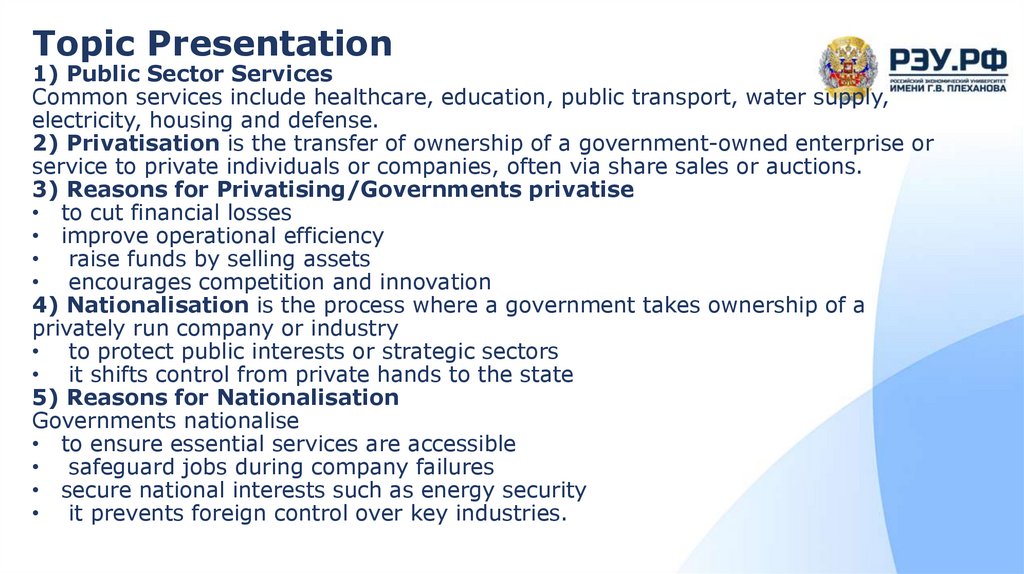
Topic Presentation1) Public Sector Services
Common services include healthcare, education, public transport, water supply,
electricity, housing and defense.
2) Privatisation is the transfer of ownership of a government-owned enterprise or
service to private individuals or companies, often via share sales or auctions.
3) Reasons for Privatising/Governments privatise
• to cut financial losses
• improve operational efficiency
• raise funds by selling assets
• encourages competition and innovation
4) Nationalisation is the process where a government takes ownership of a
privately run company or industry
• to protect public interests or strategic sectors
• it shifts control from private hands to the state
5) Reasons for Nationalisation
Governments nationalise
• to ensure essential services are accessible
• safeguard jobs during company failures
• secure national interests such as energy security
• it prevents foreign control over key industries.
10.
Free Practice & ProductionCase analysis: Royal Mail IPO in 2013
The article is named/is headlined
The name/headline of the article is
2)
The article under consideration is taken from……
3)
The article gives a general overview about …..
4)
The article is divided into 3 parts
The first one touches upon the problem of…..
The second one raises the problem of……
The third one emphasizes that……..
5)
As for me I would like to stress that
to point out that
to mention that
to stress that
to pay attention to the fact that
6)
The article leaves hope that…(prediction)
It becomes obvious that……
7)
I would like to sum up….
In conclusion I would like to say that….
to conclude…../to summarize……
First/Firstly
Second/Secondly
Third/Thirdly
8)
From my point of view, I find this article of a great value/informative/meaningful/
interesting
1)
11.
Review, Feedback & ReflectionComparing analysis of the groups’ decisions and reasons. Correction the
mistakes.
Home assignment :
1) Topic-related vocabulary words (get prepared for the oral dictation)
2) Write a short essay on the public sector. Include these points:
. definition of a public enterprise;
. examples of state-owned companies in your country and the UK;
. definition of privatisation and nationalisation, with examples of each.
12.
Module 3: Marketing and Advertising13.
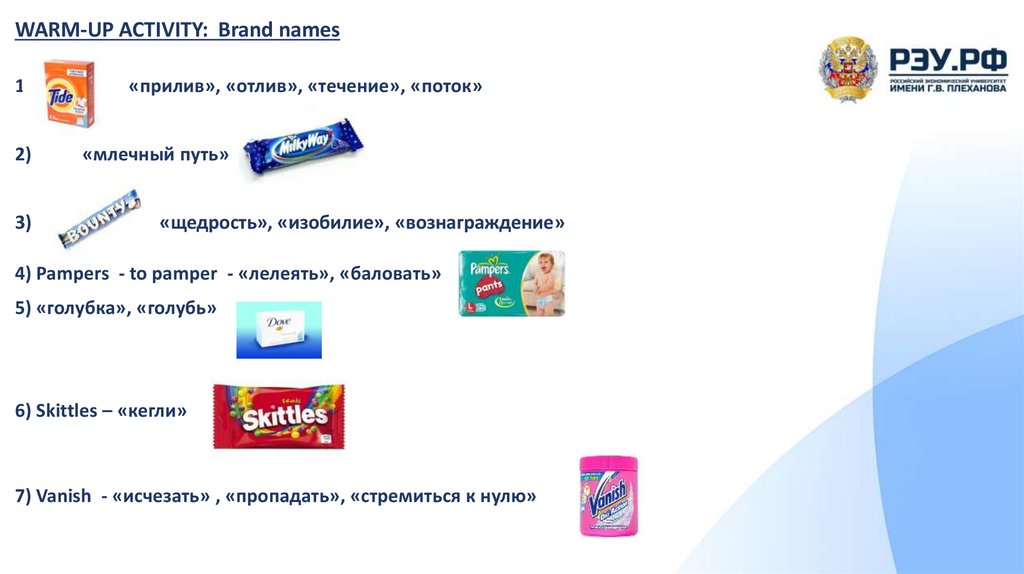
WARM-UP ACTIVITY: Brand names1)
–
2)
«млечный путь»
3)
«прилив», «отлив», «течение», «поток»
«щедрость», «изобилие», «вознаграждение»
4) Pampers - to pamper - «лелеять», «баловать»
5) «голубка», «голубь»
6) Skittles – «кегли»
7) Vanish - «исчезать» , «пропадать», «стремиться к нулю»
14.
Vocabulary reviewThe government plans to provide services such as water and electricity to all
citizens.
The national health system is to be funded by taxpayers and the state budget.
Some state-owned enterprises are tied to social goals, while others are run
on a commercial, profit-making basis.
The remaining nationalized industry will be subject to reform and potential
privatization in the coming years.
The government decided to privatize the railway network to attract private
investment.
A government-owned company often has different objectives than a private
firm, such as broader public interest.
Privatization can help the state increase revenue by selling assets to private
investors.
One argument for privatization is that competition can increase efficiency
and reduce costs
The cabinet approved plans to carry out privatization of several utilities over
the next five years.
The policy aims to keep revenue of key industries like energy and rail under
state control while allowing competition elsewhere
During the crisis, the government had to rescue several financial institutions
by purchasing shares and injecting capital.
15.
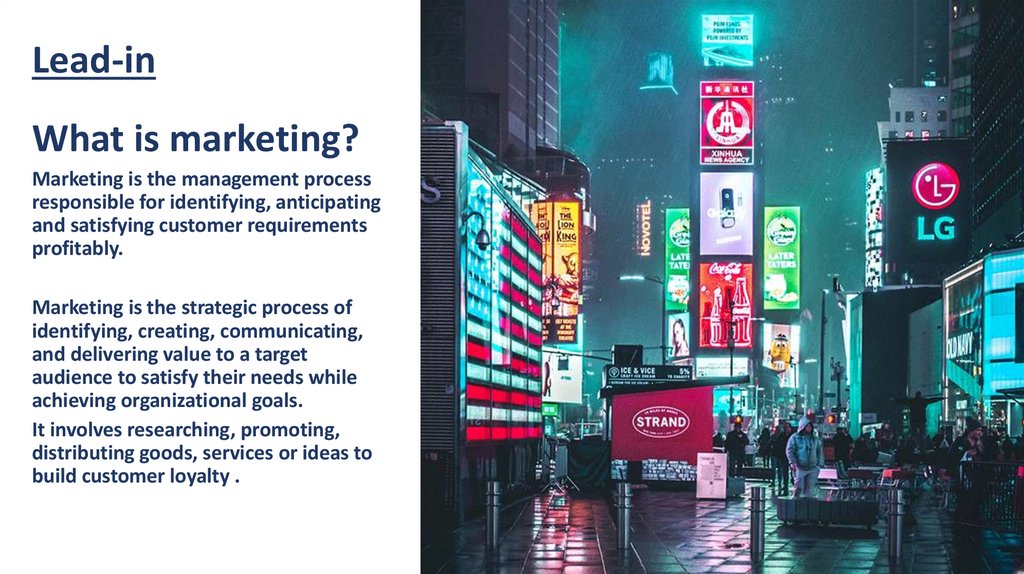
Lead-inWhat is marketing?
Marketing is the management process
responsible for identifying, anticipating
and satisfying customer requirements
profitably.
Marketing is the strategic process of
identifying, creating, communicating,
and delivering value to a target
audience to satisfy their needs while
achieving organizational goals.
It involves researching, promoting,
distributing goods, services or ideas to
build customer loyalty .
16.
Reading Task 1 - Gist UnderstandingReading the text “The Role of Marketing”. (BCP)
Comprehension tasks/Q-A session
17.
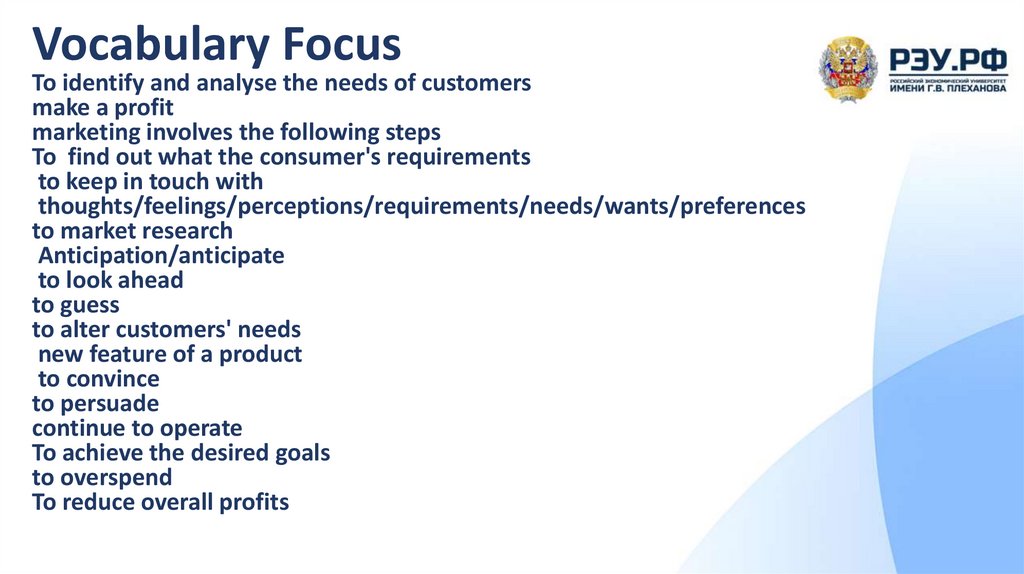
Vocabulary FocusTo identify and analyse the needs of customers
make a profit
marketing involves the following steps
To find out what the consumer's requirements
to keep in touch with
thoughts/feelings/perceptions/requirements/needs/wants/preferences
to market research
Anticipation/anticipate
to look ahead
to guess
to alter customers' needs
new feature of a product
to convince
to persuade
continue to operate
To achieve the desired goals
to overspend
To reduce overall profits
18.
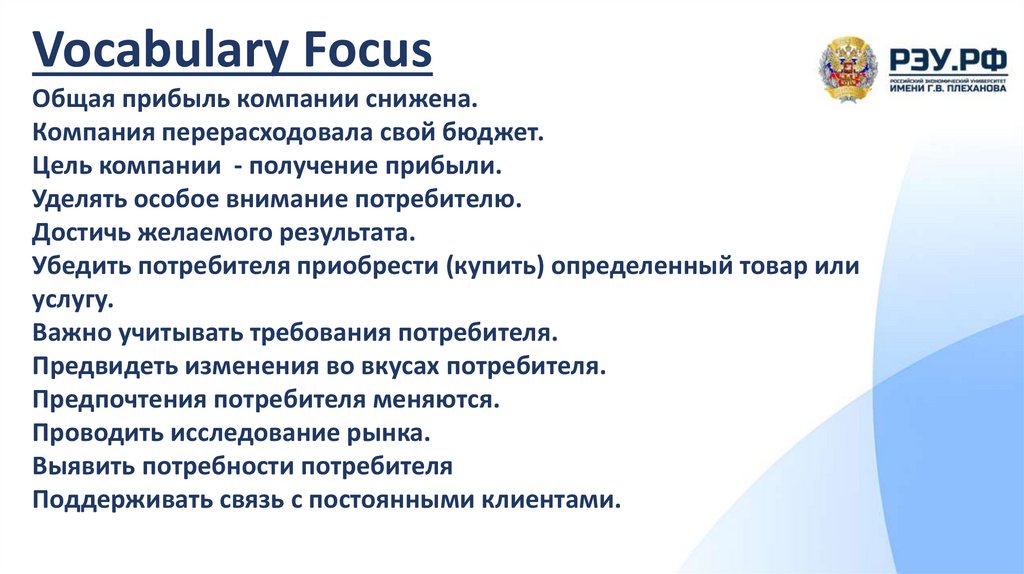
Vocabulary FocusОбщая прибыль компании снижена.
Компания перерасходовала свой бюджет.
Цель компании - получение прибыли.
Уделять особое внимание потребителю.
Достичь желаемого результата.
Убедить потребителя приобрести (купить) определенный товар или
услугу.
Важно учитывать требования потребителя.
Предвидеть изменения во вкусах потребителя.
Предпочтения потребителя меняются.
Проводить исследование рынка.
Выявить потребности потребителя
Поддерживать связь с постоянными клиентами.
19.
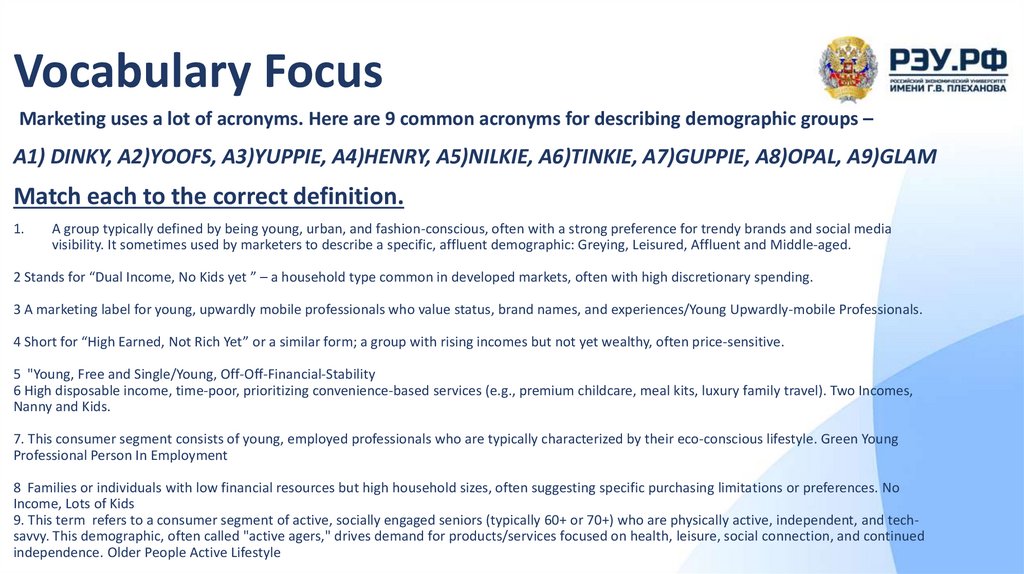
Vocabulary FocusMarketing uses a lot of acronyms. Here are 9 common acronyms for describing demographic groups –
A1) DINKY, A2)YOOFS, A3)YUPPIE, A4)HENRY, A5)NILKIE, A6)TINKIE, A7)GUPPIE, A8)OPAL, A9)GLAM
Match each to the correct definition.
1.
A group typically defined by being young, urban, and fashion-conscious, often with a strong preference for trendy brands and social media
visibility. It sometimes used by marketers to describe a specific, affluent demographic: Greying, Leisured, Affluent and Middle-aged.
2 Stands for “Dual Income, No Kids yet ” – a household type common in developed markets, often with high discretionary spending.
3 A marketing label for young, upwardly mobile professionals who value status, brand names, and experiences/Young Upwardly-mobile Professionals.
4 Short for “High Earned, Not Rich Yet” or a similar form; a group with rising incomes but not yet wealthy, often price-sensitive.
5 "Young, Free and Single/Young, Off-Off-Financial-Stability
6 High disposable income, time-poor, prioritizing convenience-based services (e.g., premium childcare, meal kits, luxury family travel). Two Incomes,
Nanny and Kids.
7. This consumer segment consists of young, employed professionals who are typically characterized by their eco-conscious lifestyle. Green Young
Professional Person In Employment
8 Families or individuals with low financial resources but high household sizes, often suggesting specific purchasing limitations or preferences. No
Income, Lots of Kids
9. This term refers to a consumer segment of active, socially engaged seniors (typically 60+ or 70+) who are physically active, independent, and techsavvy. This demographic, often called "active agers," drives demand for products/services focused on health, leisure, social connection, and continued
independence. Older People Active Lifestyle
20.
Vocabulary FocusAnswers –
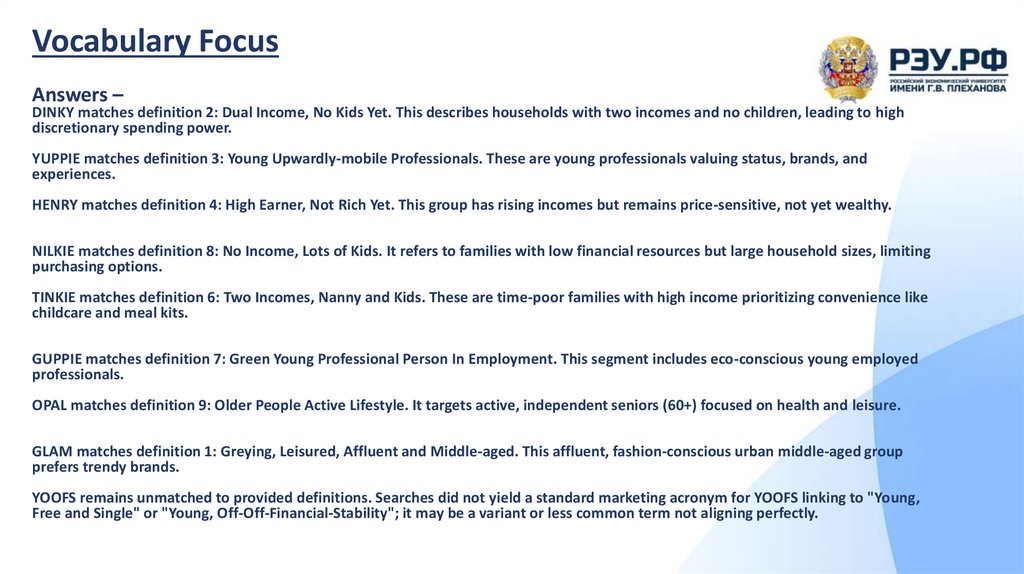
DINKY matches definition 2: Dual Income, No Kids Yet. This describes households with two incomes and no children, leading to high
discretionary spending power.
YUPPIE matches definition 3: Young Upwardly-mobile Professionals. These are young professionals valuing status, brands, and
experiences.
HENRY matches definition 4: High Earner, Not Rich Yet. This group has rising incomes but remains price-sensitive, not yet wealthy.
NILKIE matches definition 8: No Income, Lots of Kids. It refers to families with low financial resources but large household sizes, limiting
purchasing options.
TINKIE matches definition 6: Two Incomes, Nanny and Kids. These are time-poor families with high income prioritizing convenience like
childcare and meal kits.
GUPPIE matches definition 7: Green Young Professional Person In Employment. This segment includes eco-conscious young employed
professionals.
OPAL matches definition 9: Older People Active Lifestyle. It targets active, independent seniors (60+) focused on health and leisure.
GLAM matches definition 1: Greying, Leisured, Affluent and Middle-aged. This affluent, fashion-conscious urban middle-aged group
prefers trendy brands.
YOOFS remains unmatched to provided definitions. Searches did not yield a standard marketing acronym for YOOFS linking to "Young,
Free and Single" or "Young, Off-Off-Financial-Stability"; it may be a variant or less common term not aligning perfectly.
21.
Free Practice & ProductionMarket segmentation - is a picture of the typical consumer needs.
Identify the potential segment using the following products
• Luxury brand cars
• Maternity clothing
• Aftershaving products
Home assignment
22.
4Ps in MARKETING/MARKETING MIXLead-in
DEFINITION - The 4 key decisions that must be taken into
consideration towards the effective marketing of a product
The marketing mix is made up of four decisions - PRODUCT,
PRICE, PLACE and PROMOTION.
23.
4Ps in MARKETING/MARKETING MIXPRODUCT – the end result of the production process, is sold on the market to
satisfy needs of customers.
valuable
quality
size
design
performance
appearance
packaging, etc…
24.
4Ps in MARKETING/MARKETING MIXPRICE – the amount paid by customers for a product
a) generates a revenue/ provides a profit
b) cost-plus pricing strategy – the cost of production + distribution +
overheads
c) a profit mark-up (is added)
d) potential customers should be ready to pay for the product
e) take extra care of the price that competitors’ products are sold at.
25.
4Ps in MARKETING/MARKETING MIXPLACE - WHERE and HOW a product will be sold
a) the right place
b) the right time
c) in the right quantity
d) correct distribution channels
e) byer behavior
f) the size of the business +costs
26.
4Ps in MARKETING/MARKETING MIXPROMOTION - the communication process between actual and potential
customers (inform + persuade to buy)
- increases awareness of products
- creates image
- advertising/branding
- direct selling
- sales-promotion offers
- personal selling/ direct mail
- trade fairs
- sponsorship/ PR
27.
4Ps in MARKETING/MARKETING MIXPROMOTION
Objectives 1) to improve/create/reinforce a company’s image
2) to launch a new product
3) to increase awareness
4) to remind of an existing product
5) to attract new customers
6) to correct misleading reports
28.
Vocabulary focus / GLOSSARYto determine
to market
to adjust
to appeal to /to be aimed at
to generate a profit
value/valuable/added value
to generate a revenue
to provide a profit
cost-plus pricing strategy
overheads
a profit mark-up
to take into consideration
products are sold at the price
buyer behaviour
to launch a new product
29.
Vocabulary focus / GLOSSARYсвязи с общественностью
спецпредложение/специальная акция
улучшить репутацию/имидж компании
повысить популярность существующего брэнда компании
повысить продажи
достичь нужного кол-ва товара
потребительское поведение
приносить доход компании/обеспечивать получение дохода
ценообразование по принципу «издержки плюс»
рассчитать накладные расходы
надбавка на прибыль
продаваться по конкурентной цене
продукция продаётся на мировом рынке
продукция обращена к потенциальному потребителю
повысить осведомлённость потребителя
внедрить/запустить/представить новый продукт
продукт продается по конкурентоспособной цене
прямые продажи
прямая рассылка
усилить имидж компании
исправить искаженные
сведения/отчеты о компании
30.
4Ps in MARKETING/MARKETING MIXHome assignment –
The task spotlights the Price/Product/Place/promotion
element, showing how ______ (the company) uses
dynamic strategies to balance accessibility and premium
positioning.