
 electronics
Similar presentations:







Calculation of a simple linear electric DC circuits
1.
Annotation for the lectureCalculation of a simple linear electric DC circuits
In the lecture, the formulas for the equivalent transformations in electrical circuits are
given. For such equivalent transformations as series and parallel connections, from the
delta to the star and vice versa. Also, the replacement of several parallel branches
containing the voltage and the current sources with one equivalent branch is considered.
Ohm’s law for the branch and for the unbranched closed circuit with one loop is
considered.
The definition of the principle of superposition and the steps for its application are
given. An example of using the principle of superposition for calculating currents is
given.
2. Theory of Electrical Circuits for IT specialty
Lecture 2Calculation of a simple linear electric DC circuits
Senior lecturer of the Department of Radioengineering, Electronics and Telecommunications
Kreslina Svetlana Yuryevna
s.kreslina@iitu.edu.kz
3.
List of references:1 John Bird. Electrical Circuit Theory and Technology – Sixth edition 2017. – 844 p.
2 Fundamentals of Electric Circuits / Charles K. Alexander, Matthew N. O. Sadiku. – 5th edition – 2013.
– 995 p.
3 Introductory Circuit Analysis / Robert L. Boylestad. – 13th edition 2015. – 1224 p.
Internet sources:
4 Kazakhstan National Electronic Library http://kazneb.kz/
5 Online course https://www.coursera.org/learn/linear-circuits-dcanalysis
6 Online course https://www.coursera.org/learn/linear-circuits-ac-analysis
7 Online course https://www.coursera.org/learn/electrodynamics-solutions-maxwells-equations
8 Free online courses from 140 leading universities in the world https://www.edx.org/
9 https://www.twirpx.com/files/science/tek/toe/?ft=lecture
10 http://www.toehelp.ru/theory/toe/contents.html
11 Publisher-independent global publication citation database and research analytics platform
https://clarivate.com/webofsciencegroup/solutions/web-of-science/
12 National Open University of Russia INTUIT https://www.intuit.ru/
4. Lecture sections:
2.1 The equivalent transformations in electrical circuits2.2 Ohm’s Law
2.3 The principle of superposition
5.
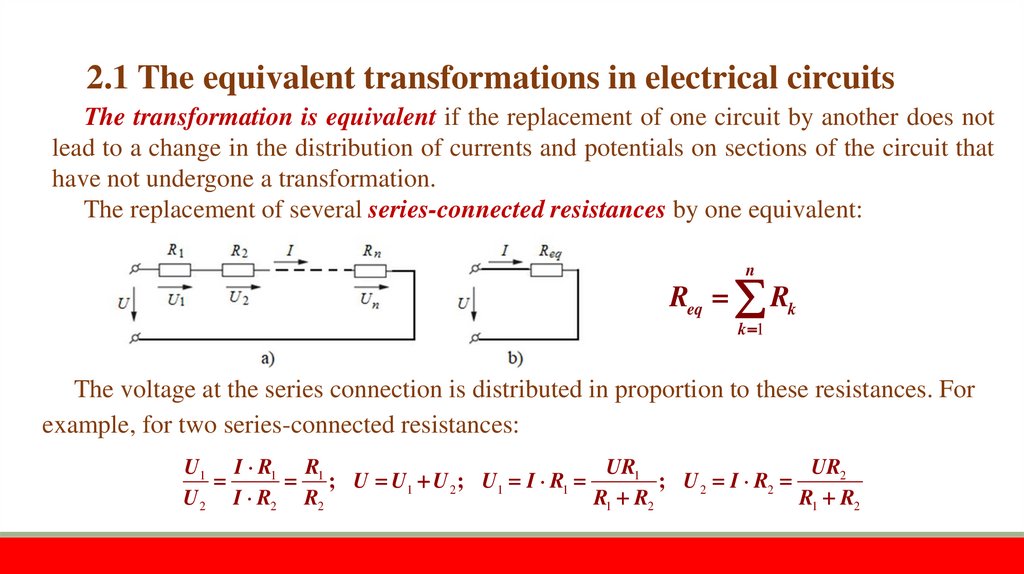
2.1 The equivalent transformations in electrical circuitsThe transformation is equivalent if the replacement of one circuit by another does not
lead to a change in the distribution of currents and potentials on sections of the circuit that
have not undergone a transformation.
The replacement of several series-connected resistances by one equivalent:
n
Req Rk
k 1
The voltage at the series connection is distributed in proportion to these resistances. For
example, for two series-connected resistances:
U1 I R1 R1
UR1
UR2
; U U1 U 2 ; U1 I R1
; U 2 I R2
U 2 I R2 R2
R1 R2
R1 R2
6.
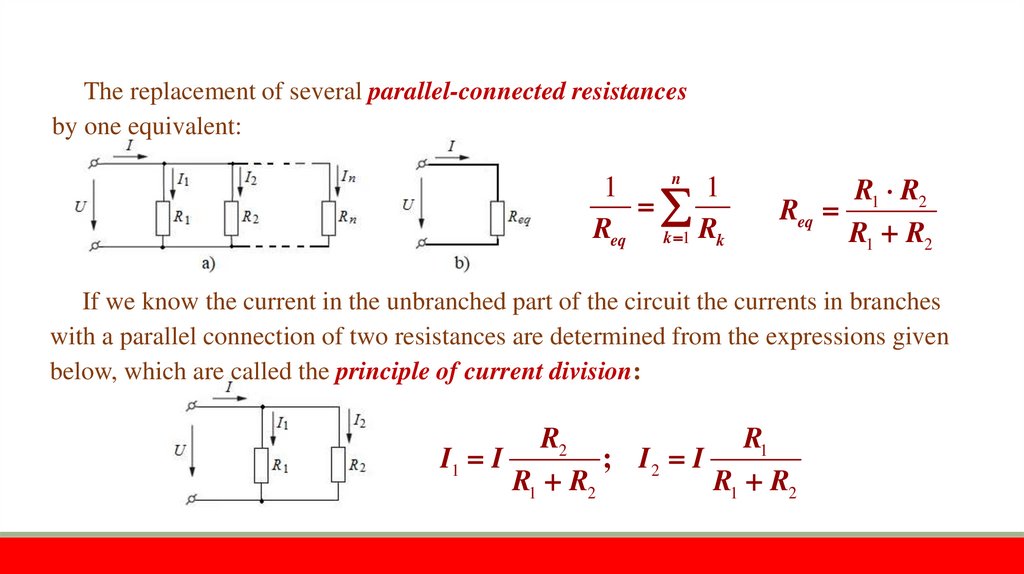
The replacement of several parallel-connected resistancesby one equivalent:
n
1
1
Req k 1 Rk
R1 R2
Req
R1 R2
If we know the current in the unbranched part of the circuit the currents in branches
with a parallel connection of two resistances are determined from the expressions given
below, which are called the principle of current division:
R2
R1
I1 I
; I2 I
R1 R2
R1 R2
7.
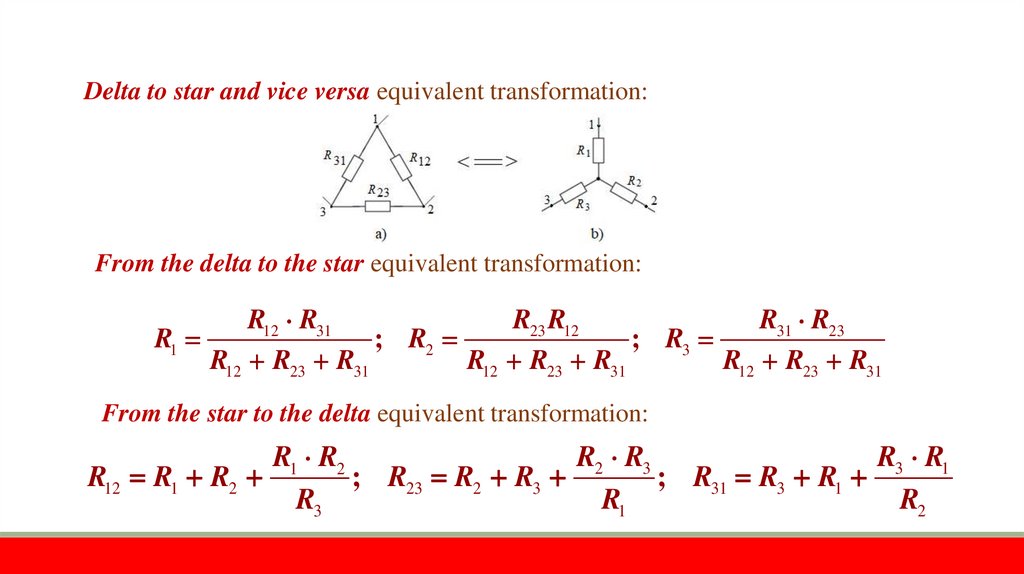
Delta to star and vice versa equivalent transformation:From the delta to the star equivalent transformation:
R12 R31
R23 R12
R31 R23
R1
; R2
; R3
R12 R23 R31
R12 R23 R31
R12 R23 R31
From the star to the delta equivalent transformation:
R2 R3
R3 R1
R1 R2
R12 R1 R2
; R23 R2 R3
; R31 R3 R1
R3
R1
R2
8.
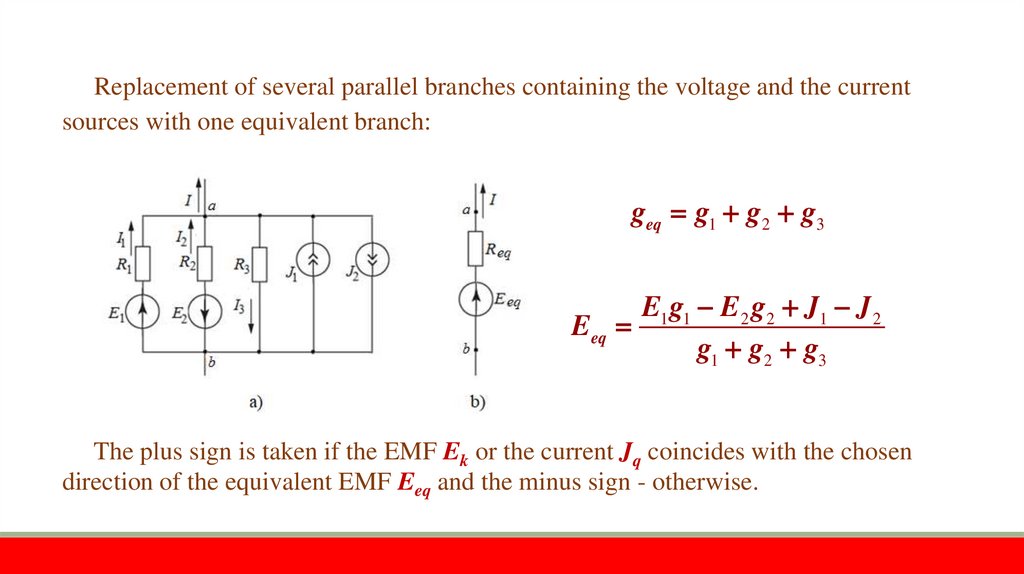
Replacement of several parallel branches containing the voltage and the currentsources with one equivalent branch:
geq g1 g2 g3
E1 g1 E2 g2 J1 J 2
Eeq
g1 g2 g3
The plus sign is taken if the EMF Ek or the current Jq coincides with the chosen
direction of the equivalent EMF Eeq and the minus sign - otherwise.
9.
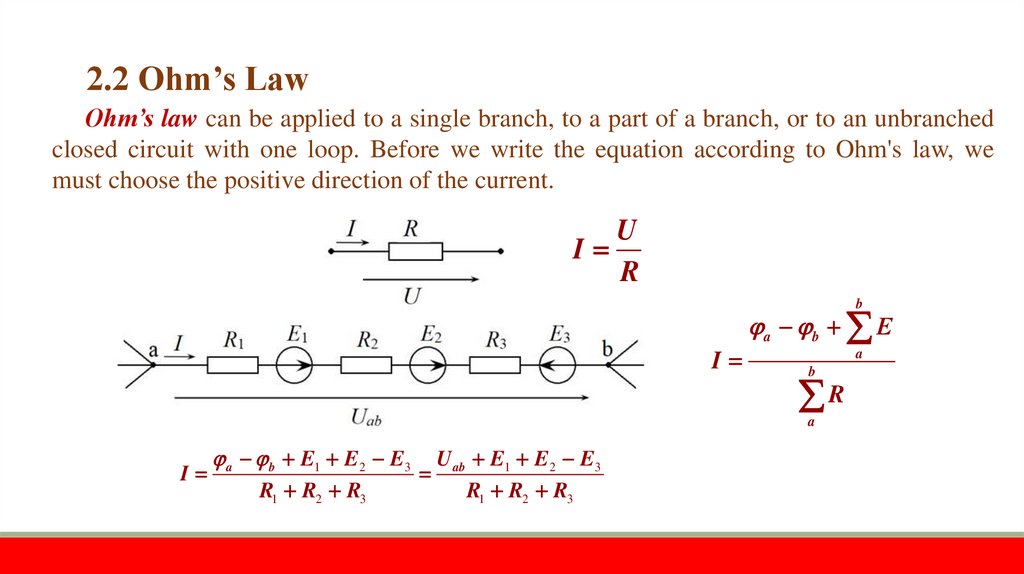
2.2 Ohm’s LawOhm’s law can be applied to a single branch, to a part of a branch, or to an unbranched
closed circuit with one loop. Before we write the equation according to Ohm's law, we
must choose the positive direction of the current.
U
I
R
b
I
a b Е
a
b
R
a
I
a b E1 E2 E3 U ab E1 E2 E3
R1 R2 R3
R1 R2 R3
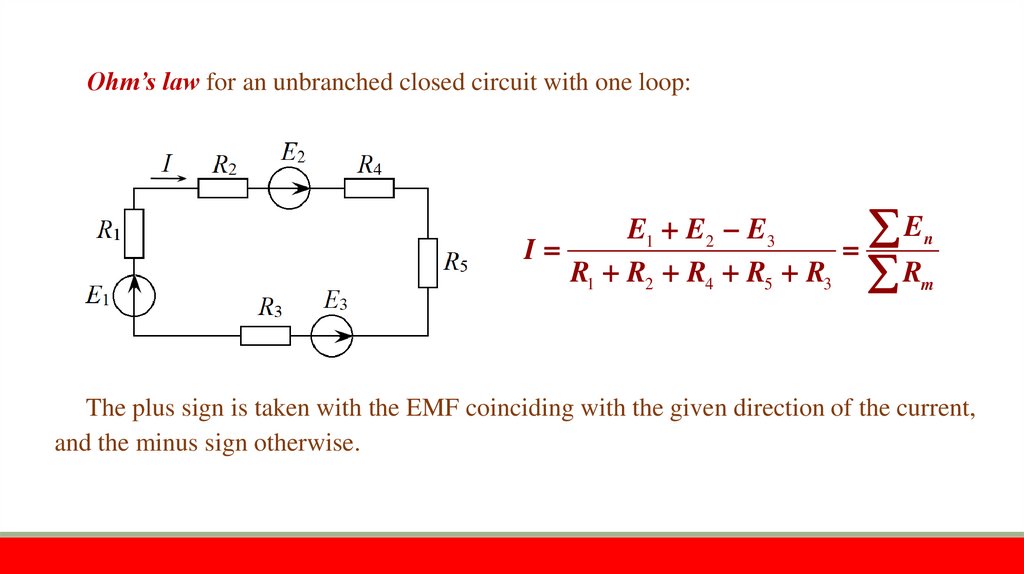
10.
Ohm’s law for an unbranched closed circuit with one loop:En
E1 E2 E3
I
R1 R2 R4 R5 R3 Rm
The plus sign is taken with the EMF coinciding with the given direction of the current,
and the minus sign otherwise.
11.
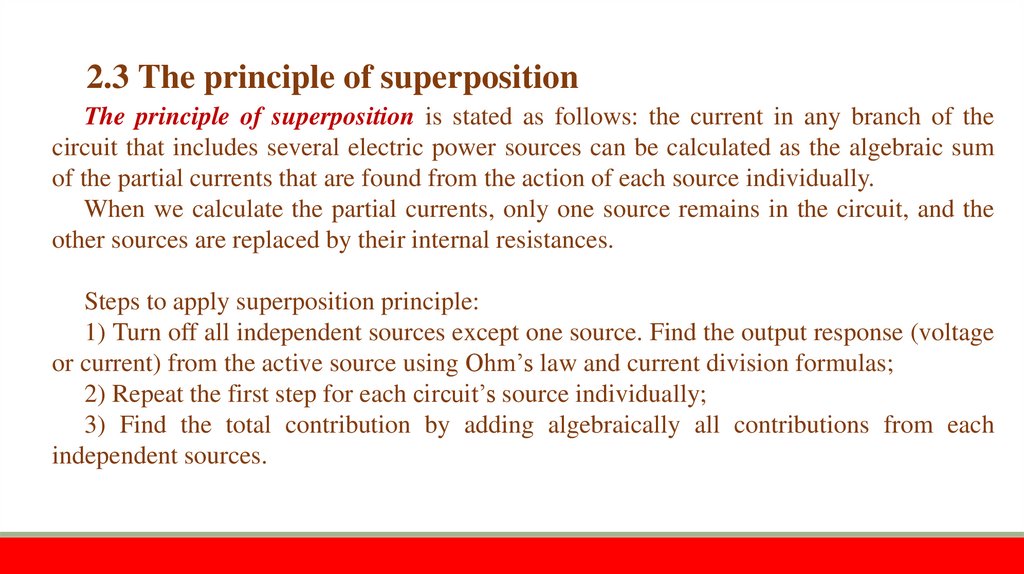
2.3 The principle of superpositionThe principle of superposition is stated as follows: the current in any branch of the
circuit that includes several electric power sources can be calculated as the algebraic sum
of the partial currents that are found from the action of each source individually.
When we calculate the partial currents, only one source remains in the circuit, and the
other sources are replaced by their internal resistances.
Steps to apply superposition principle:
1) Turn off all independent sources except one source. Find the output response (voltage
or current) from the active source using Ohm’s law and current division formulas;
2) Repeat the first step for each circuit’s source individually;
3) Find the total contribution by adding algebraically all contributions from each
independent sources.
12.
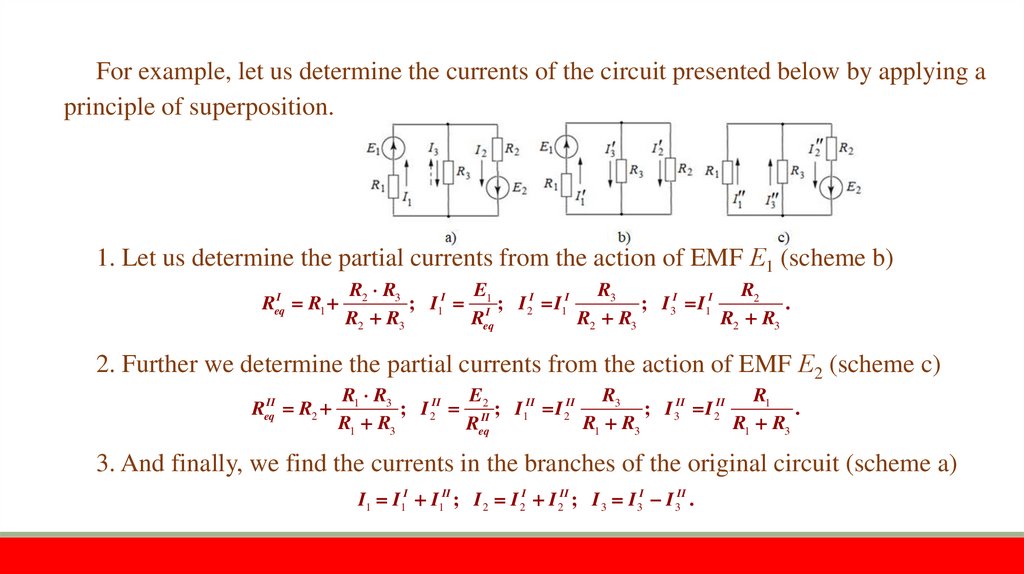
For example, let us determine the currents of the circuit presented below by applying aprinciple of superposition.
1. Let us determine the partial currents from the action of EMF Е1 (scheme b)
ReqI R1
R2 R3
R3
E
R2
; I1I I1 ; I 2I I1I
; I 3I I1I
.
R2 R3
R2 R3
R2 R3
Req
2. Further we determine the partial currents from the action of EMF Е2 (scheme c)
ReqII R2
R1 R3
R3
E
R1
; I 2II II2 ; I1II I 2II
; I 3II I 2II
.
R1 R3
R1 R3
R1 R3
Req
3. And finally, we find the currents in the branches of the original circuit (scheme a)
I1 I1I I1II ; I 2 I 2I I 2II ; I 3 I 3I I 3II .
13.
1.2.
3.
4.
5.
6.
7.
8.
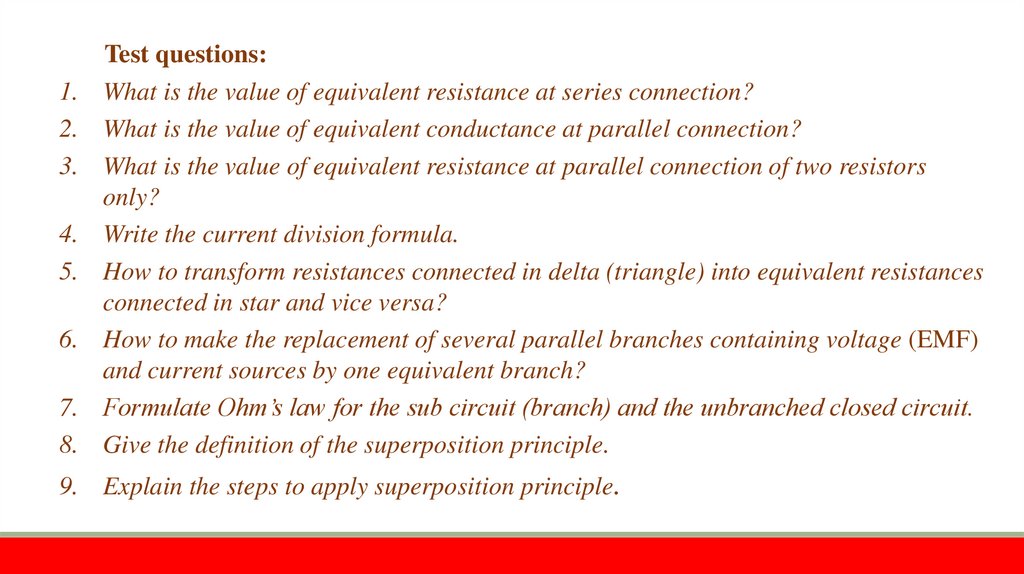
Test questions:
What is the value of equivalent resistance at series connection?
What is the value of equivalent conductance at parallel connection?
What is the value of equivalent resistance at parallel connection of two resistors
only?
Write the current division formula.
How to transform resistances connected in delta (triangle) into equivalent resistances
connected in star and vice versa?
How to make the replacement of several parallel branches containing voltage (EMF)
and current sources by one equivalent branch?
Formulate Ohm’s law for the sub circuit (branch) and the unbranched closed circuit.
Give the definition of the superposition principle.
9. Explain the steps to apply superposition principle.
14.
Thank Youfor your attention