 english
Similar presentations:

How to Be a Modern Parent and Study Listening Skills
1. Modern young family. An ideal family. Is it difficult to be a parent?
2. Vocabulary A2
Juggling /ˈdʒʌɡ.lɪŋ/ жонглированиеHovering /ˈhɒv(ə)rɪŋ/ нависающий
To flip /flɪp/переключаться; переворачивать
Helicopter parent /ˌhel.ɪˌkɒp.tə ˈpeə.rənt/ гиперопекающий родитель
at one's disposal /dɪˈspəʊ.zəl/в чьем-л. распоряжении
To evolve /ɪˈvɒlv/ развиваться
Authority /ɔːˈθɒr.ə.ti/ авторитет
Self-reliant /ˌself.rɪˈlaɪ.ənt/ полагающийся на свои
собственные силы
Self-esteem /ˌself.ɪˈstiːm/ чувство собственного достоинства;
уважение к себе
Authoritative /ɔːˈθɒr.ɪ.tə.tɪv/ авторитетный; влиятельный
Authoritarian /ˌɔː.θɒr.ɪˈteə.ri.ən/ Авторитарный
Supportive /səˈpɔː.tɪv/ поддерживающий
Independently /ˌɪn.dɪˈpen.dənt.li/ Независимо
Approach /əˈprəʊtʃ/ подход
Consistent |kənˈsɪst(ə)nt| последовательный
Firm /fɜːm/ твердый, строгий
To tackle /ˈtæk.əl/ справляться с, решать
To calibrate |ˈkælɪbreɪt| настраивать, калибровать
Expectations /ˌek.spekˈteɪ.ʃən/ ожидания
3. Reading A2
How to Be a Modern ParentWe all want to be the best parents we can be for our children, but there is often conflicting advice on how to raise a
kid who is confident, kind and successful. Throughout the circus act of parenting, it’s important to focus on balancing
priorities, juggling responsibilities and quickly flipping between the needs of your children, other family members and
yourself. Modern parents have the entire internet at their disposal and don’t follow any single authority. It’s hard to
know whom or what to trust. Here, we’ll talk about how to help your child grow up to be a person you really like without
losing yourself in the process.
Good news: There is no one right way to raise a child.
Research tells us that to raise a self-reliant child with high self-esteem, it is more effective to be authoritative than
authoritarian. You want your child to listen, respect and trust you rather than fear you. You want to be supportive, but
not a hovering, helicopter parent.
All of these things are easy to set as goals, but hard to achieve. How do you find the right balance?
As your child develops, the challenges will change, and your thinking may evolve, but your approach should be
consistent, firm and loving. Help your child learn through experience that making an effort builds confidence and helps
you learn to tackle challenges. Calibrate your expectations about what your child is capable of doing independently,
whether you have an infant learning to sleep through the night, a toddler helping to put toys away, or an older child
resolving conflicts.
Remember, there is no one right way to raise a child. Do your best, trust yourself and enjoy the company of the
small person in your life.
4.
1. Vocabulary Match2. True / False
Match the words from the text with their
meanings.
Read the text carefully and write True or False.
1.Conflicting
1.There is only one correct way to raise a child.
2.Priorities
2.Parents should try to be supportive but not
controlling.
3.Supportive
3.Children learn confidence by trying new things.
4.Independent
4.Parenting is easy and does not need balance.
5.Self-reliant
a. Able to do things without help
b. Helping and encouraging
c. Different ideas that do not agree
d. Things that are most important
e. Able to take care of yourself
5.
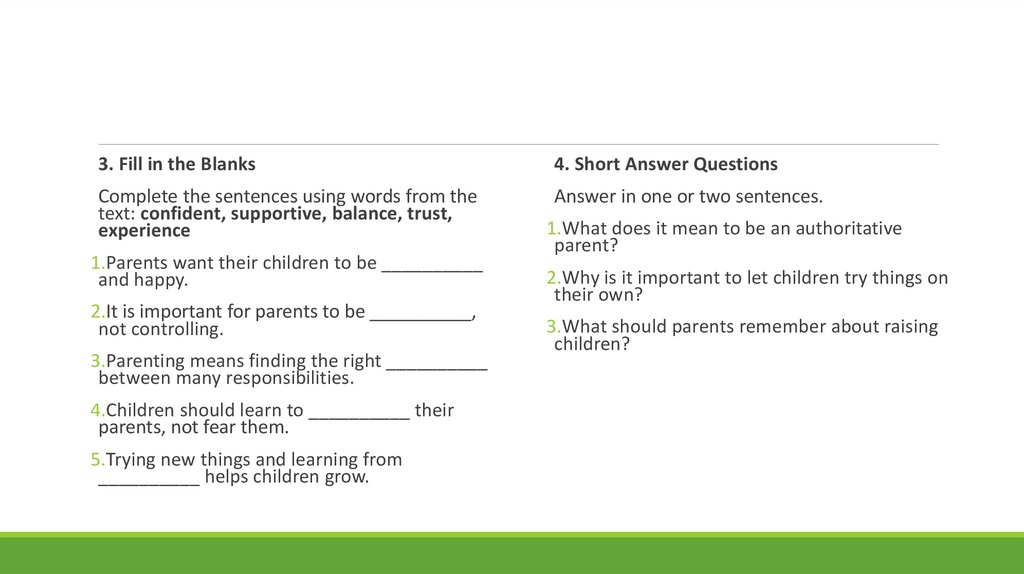
3. Fill in the Blanks4. Short Answer Questions
Complete the sentences using words from the
text: confident, supportive, balance, trust,
experience
Answer in one or two sentences.
1.Parents want their children to be __________
and happy.
2.It is important for parents to be __________,
not controlling.
3.Parenting means finding the right __________
between many responsibilities.
4.Children should learn to __________ their
parents, not fear them.
5.Trying new things and learning from
__________ helps children grow.
1.What does it mean to be an authoritative
parent?
2.Why is it important to let children try things on
their own?
3.What should parents remember about raising
children?
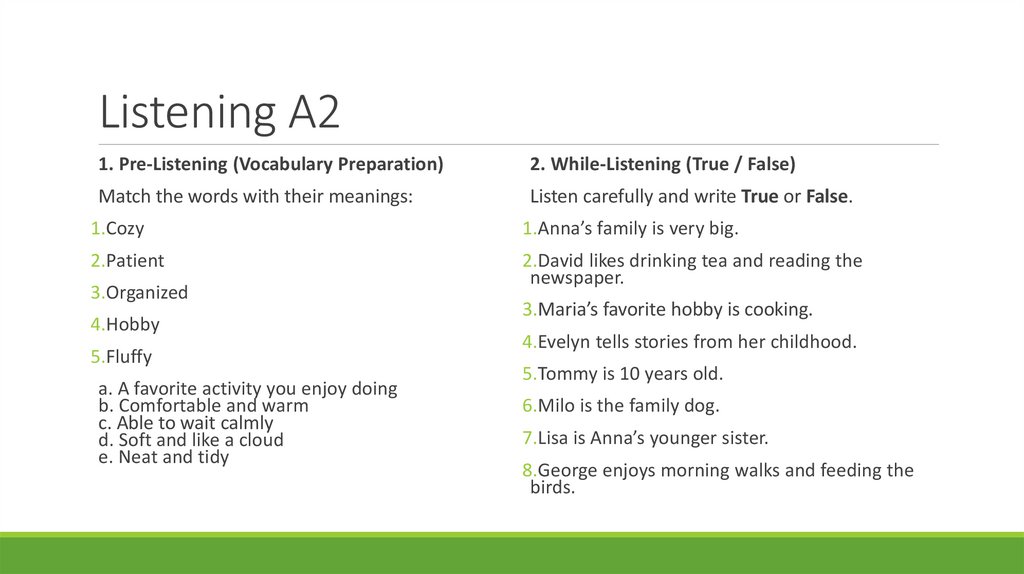
6. Listening A2
1. Pre-Listening (Vocabulary Preparation)2. While-Listening (True / False)
Match the words with their meanings:
Listen carefully and write True or False.
1.Cozy
1.Anna’s family is very big.
2.Patient
2.David likes drinking tea and reading the
newspaper.
3.Organized
4.Hobby
5.Fluffy
a. A favorite activity you enjoy doing
b. Comfortable and warm
c. Able to wait calmly
d. Soft and like a cloud
e. Neat and tidy
3.Maria’s favorite hobby is cooking.
4.Evelyn tells stories from her childhood.
5.Tommy is 10 years old.
6.Milo is the family dog.
7.Lisa is Anna’s younger sister.
8.George enjoys morning walks and feeding the
birds.
7.
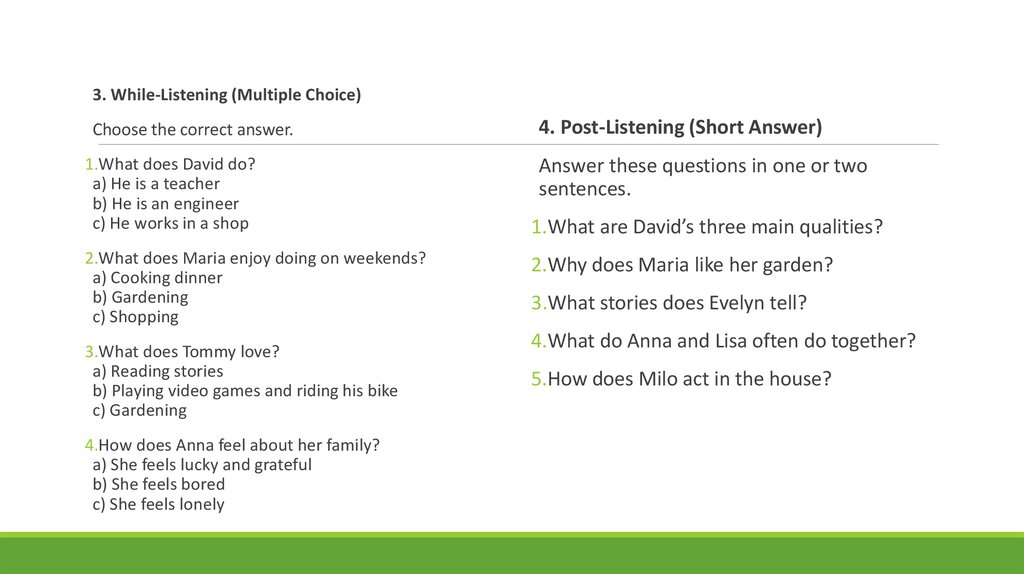
3. While-Listening (Multiple Choice)Choose the correct answer.
4. Post-Listening (Short Answer)
1.What does David do?
a) He is a teacher
b) He is an engineer
c) He works in a shop
Answer these questions in one or two
sentences.
2.What does Maria enjoy doing on weekends?
a) Cooking dinner
b) Gardening
c) Shopping
3.What does Tommy love?
a) Reading stories
b) Playing video games and riding his bike
c) Gardening
4.How does Anna feel about her family?
a) She feels lucky and grateful
b) She feels bored
c) She feels lonely
1.What are David’s three main qualities?
2.Why does Maria like her garden?
3.What stories does Evelyn tell?
4.What do Anna and Lisa often do together?
5.How does Milo act in the house?
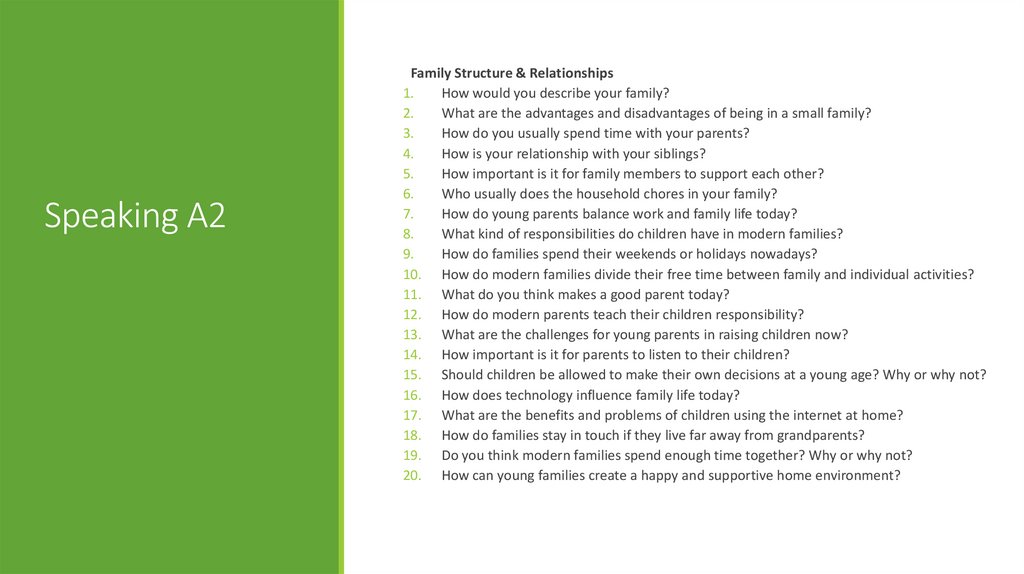
8. Speaking A2
Family Structure & Relationships1.
How would you describe your family?
2.
What are the advantages and disadvantages of being in a small family?
3.
How do you usually spend time with your parents?
4.
How is your relationship with your siblings?
5.
How important is it for family members to support each other?
6.
Who usually does the household chores in your family?
7.
How do young parents balance work and family life today?
8.
What kind of responsibilities do children have in modern families?
9.
How do families spend their weekends or holidays nowadays?
10. How do modern families divide their free time between family and individual activities?
11. What do you think makes a good parent today?
12. How do modern parents teach their children responsibility?
13. What are the challenges for young parents in raising children now?
14. How important is it for parents to listen to their children?
15. Should children be allowed to make their own decisions at a young age? Why or why not?
16. How does technology influence family life today?
17. What are the benefits and problems of children using the internet at home?
18. How do families stay in touch if they live far away from grandparents?
19. Do you think modern families spend enough time together? Why or why not?
20. How can young families create a happy and supportive home environment?
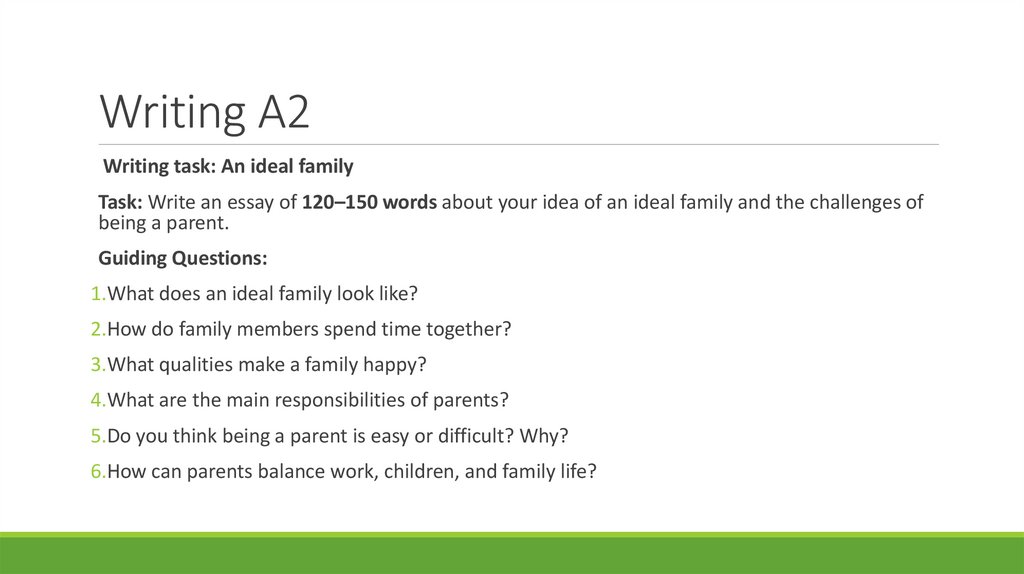
9. Writing A2
Writing task: An ideal familyTask: Write an essay of 120–150 words about your idea of an ideal family and the challenges of
being a parent.
Guiding Questions:
1.What does an ideal family look like?
2.How do family members spend time together?
3.What qualities make a family happy?
4.What are the main responsibilities of parents?
5.Do you think being a parent is easy or difficult? Why?
6.How can parents balance work, children, and family life?
10.
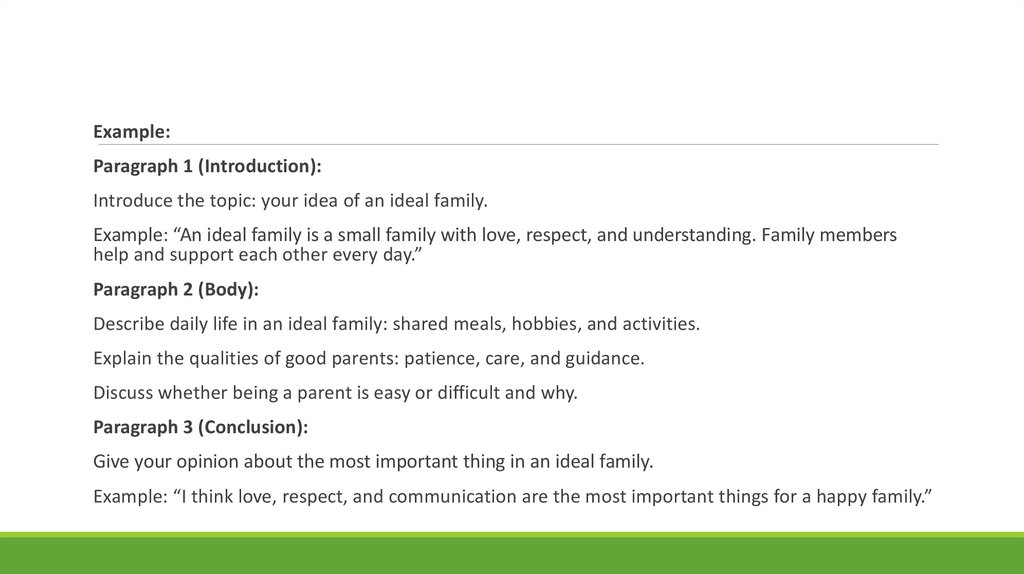
Example:Paragraph 1 (Introduction):
Introduce the topic: your idea of an ideal family.
Example: “An ideal family is a small family with love, respect, and understanding. Family members
help and support each other every day.”
Paragraph 2 (Body):
Describe daily life in an ideal family: shared meals, hobbies, and activities.
Explain the qualities of good parents: patience, care, and guidance.
Discuss whether being a parent is easy or difficult and why.
Paragraph 3 (Conclusion):
Give your opinion about the most important thing in an ideal family.
Example: “I think love, respect, and communication are the most important things for a happy family.”
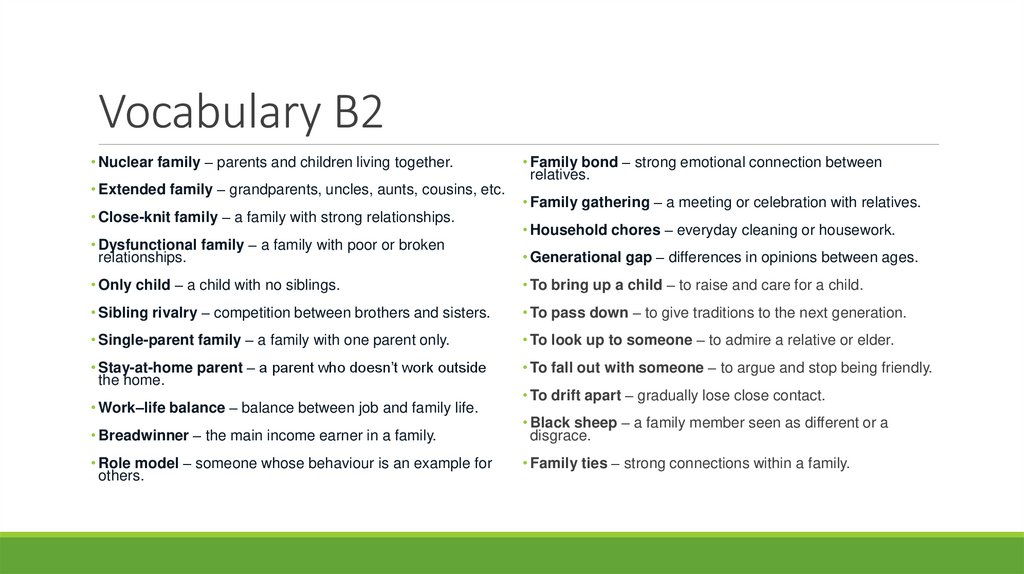
11. Vocabulary B2
• Nuclear family – parents and children living together.• Extended family – grandparents, uncles, aunts, cousins, etc.
• Close-knit family – a family with strong relationships.
• Dysfunctional family – a family with poor or broken
relationships.
• Family bond – strong emotional connection between
relatives.
• Family gathering – a meeting or celebration with relatives.
• Household chores – everyday cleaning or housework.
• Generational gap – differences in opinions between ages.
• Only child – a child with no siblings.
• To bring up a child – to raise and care for a child.
• Sibling rivalry – competition between brothers and sisters.
• To pass down – to give traditions to the next generation.
• Single-parent family – a family with one parent only.
• To look up to someone – to admire a relative or elder.
• Stay-at-home parent – a parent who doesn’t work outside
the home.
• To fall out with someone – to argue and stop being friendly.
• Work–life balance – balance between job and family life.
• To drift apart – gradually lose close contact.
• Breadwinner – the main income earner in a family.
• Black sheep – a family member seen as different or a
disgrace.
• Role model – someone whose behaviour is an example for
others.
• Family ties – strong connections within a family.
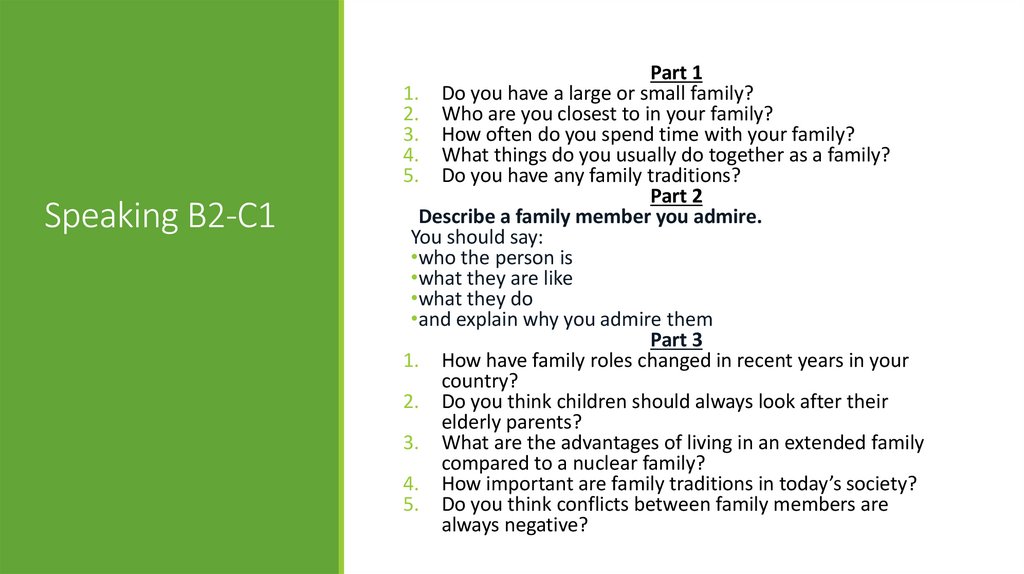
12. Speaking B2-C1
Part 11. Do you have a large or small family?
2. Who are you closest to in your family?
3. How often do you spend time with your family?
4. What things do you usually do together as a family?
5. Do you have any family traditions?
Part 2
Describe a family member you admire.
You should say:
•who the person is
•what they are like
•what they do
•and explain why you admire them
Part 3
1. How have family roles changed in recent years in your
country?
2. Do you think children should always look after their
elderly parents?
3. What are the advantages of living in an extended family
compared to a nuclear family?
4. How important are family traditions in today’s society?
5. Do you think conflicts between family members are
always negative?
13. Listening B2-C1
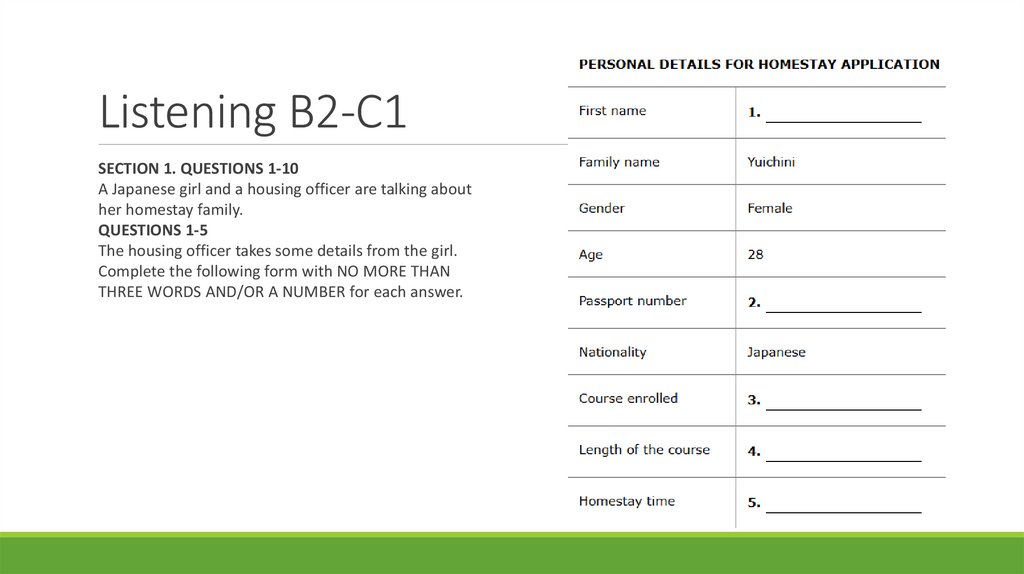
SECTION 1. QUESTIONS 1-10A Japanese girl and a housing officer are talking about
her homestay family.
QUESTIONS 1-5
The housing officer takes some details from the girl.
Complete the following form with NO MORE THAN
THREE WORDS AND/OR A NUMBER for each answer.
14.
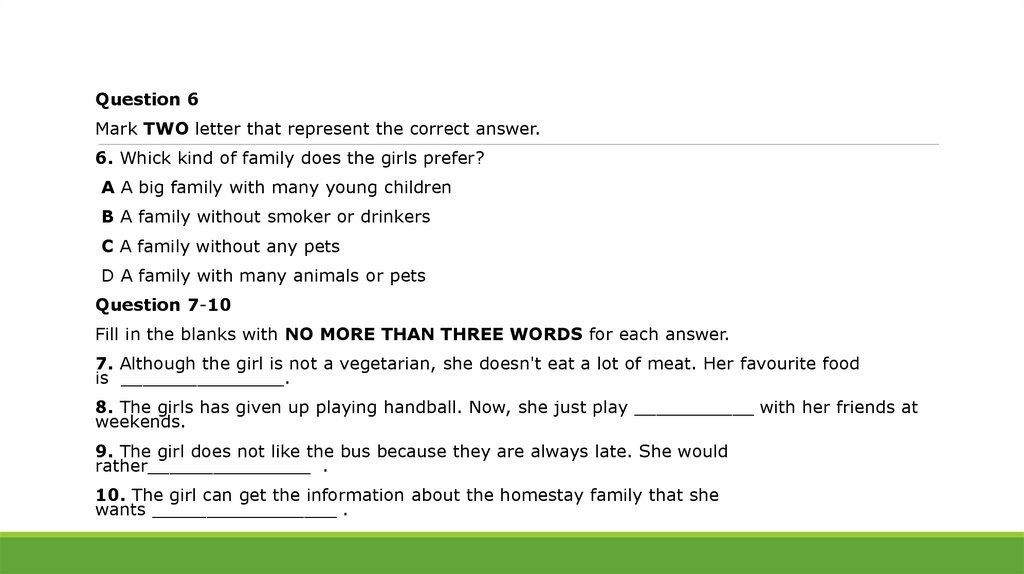
Question 6Mark TWO letter that represent the correct answer.
6. Whick kind of family does the girls prefer?
A A big family with many young children
В A family without smoker or drinkers
С A family without any pets
D A family with many animals or pets
Question 7-10
Fill in the blanks with NO MORE THAN THREE WORDS for each answer.
7. Although the girl is not a vegetarian, she doesn't eat a lot of meat. Her favourite food
is _______________.
8. The girls has given up playing handball. Now, she just play ___________ with her friends at
weekends.
9. The girl does not like the bus because they are always late. She would
rather_______________ .
10. The girl can get the information about the homestay family that she
wants _________________ .
15.
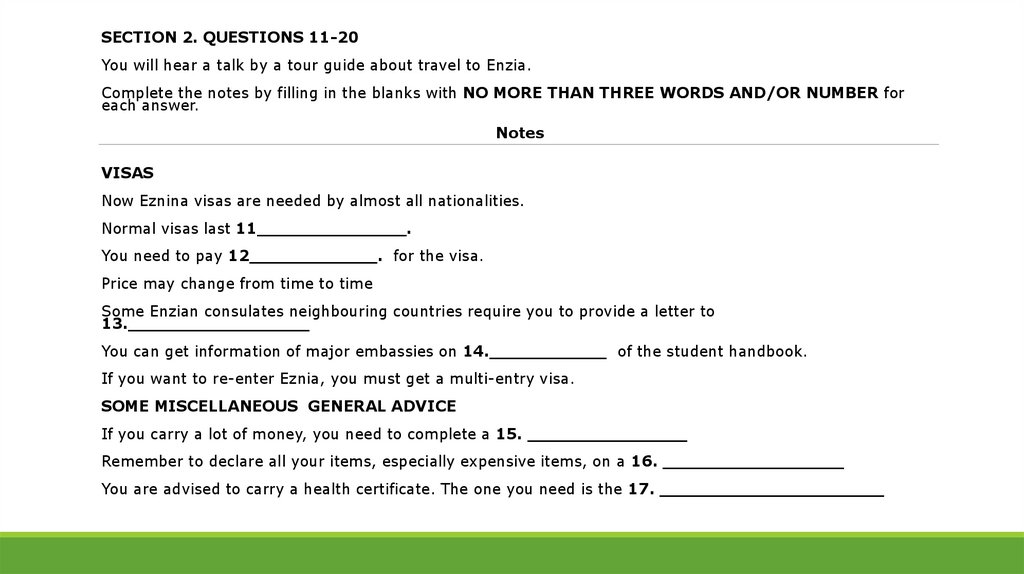
SECTION 2. QUESTIONS 11-20You will hear a talk by a tour guide about travel to Enzia.
Complete the notes by filling in the blanks with NO MORE THAN THREE WORDS AND/OR NUMBER for
each answer.
Notes
VISAS
Now Eznina visas are needed by almost all nationalities.
Normal visas last 11______________.
You need to pay 12____________. for the visa.
Price may change from time to time
Some Enzian consulates neighbouring countries require you to provide a letter to
13._________________
You can get information of major embassies on 14.___________ of the student handbook.
If you want to re-enter Eznia, you must get a multi-entry visa.
SOME MISCELLANEOUS GENERAL ADVICE
If you carry a lot of money, you need to complete a 15. _______________
Remember to declare all your items, especially expensive items, on a 16. _________________
You are advised to carry a health certificate. The one you need is the 17. _____________________
16.
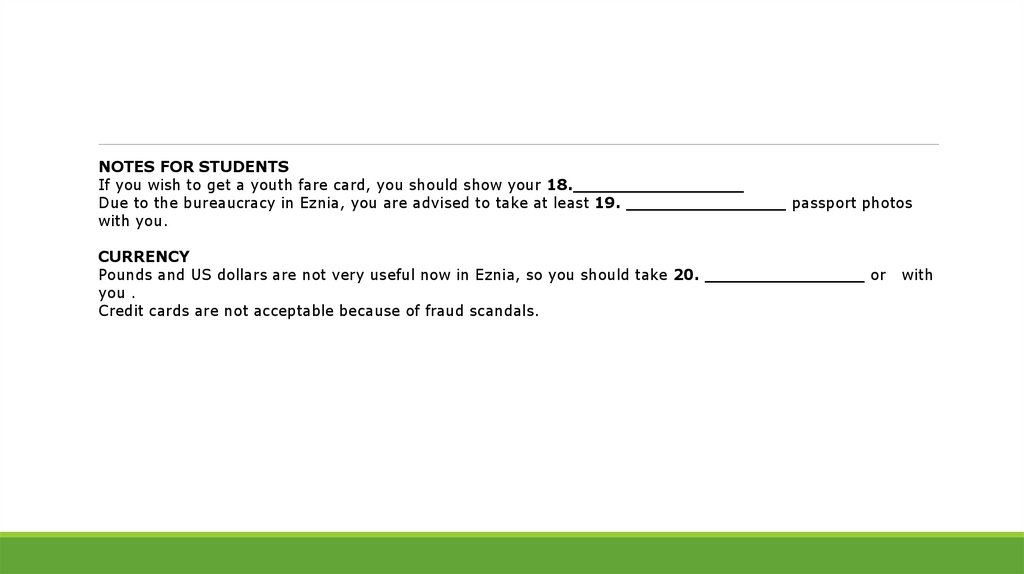
NOTES FOR STUDENTSIf you wish to get a youth fare card, you should show your 18.________________
Due to the bureaucracy in Eznia, you are advised to take at least 19. _______________ passport photos
with you.
CURRENCY
Pounds and US dollars are not very useful now in Eznia, so you should take 20. _______________ or
you .
Credit cards are not acceptable because of fraud scandals.
with
17. Writing B2
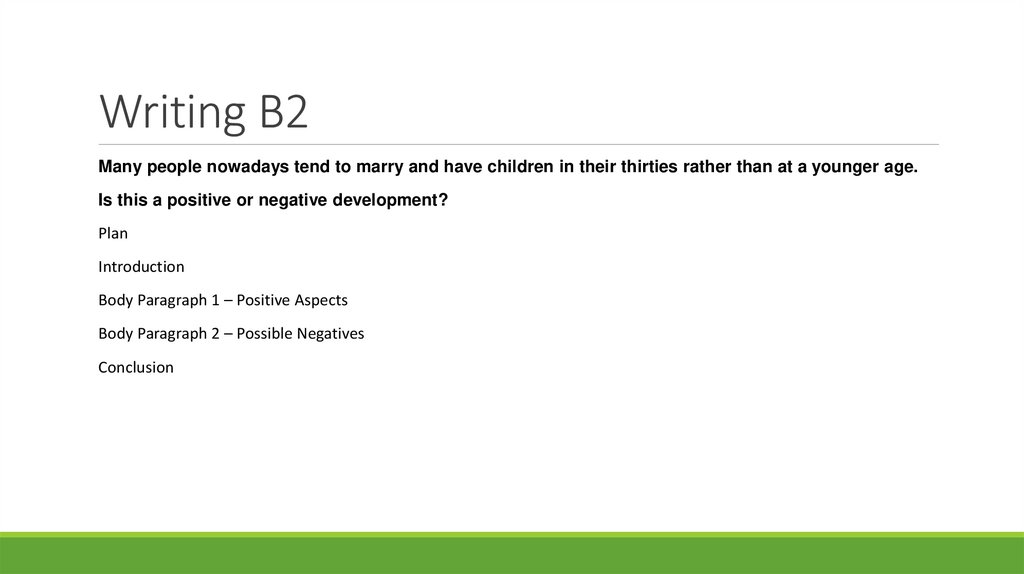
Many people nowadays tend to marry and have children in their thirties rather than at a younger age.Is this a positive or negative development?
Plan
Introduction
Body Paragraph 1 – Positive Aspects
Body Paragraph 2 – Possible Negatives
Conclusion
18.
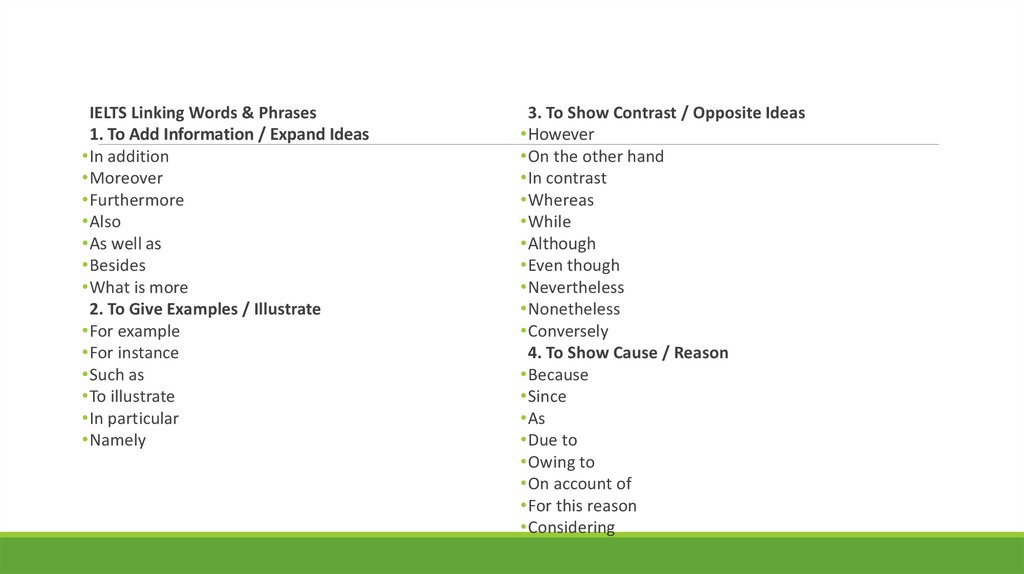
IELTS Linking Words & Phrases1. To Add Information / Expand Ideas
•In addition
•Moreover
•Furthermore
•Also
•As well as
•Besides
•What is more
2. To Give Examples / Illustrate
•For example
•For instance
•Such as
•To illustrate
•In particular
•Namely
3. To Show Contrast / Opposite Ideas
•However
•On the other hand
•In contrast
•Whereas
•While
•Although
•Even though
•Nevertheless
•Nonetheless
•Conversely
4. To Show Cause / Reason
•Because
•Since
•As
•Due to
•Owing to
•On account of
•For this reason
•Considering