 pedagogy
Similar presentations:






Teaching Demonstration – Challenges and Strategies for Success
1. ENGLISH FOR ACADEMIC COMMUNICATION
Week 11 – Chapter 11Academic Talk (1): Teaching Demonstration –
Challenges and Strategies
Lecturer: Maria Dewi Rosari, M.Pd.
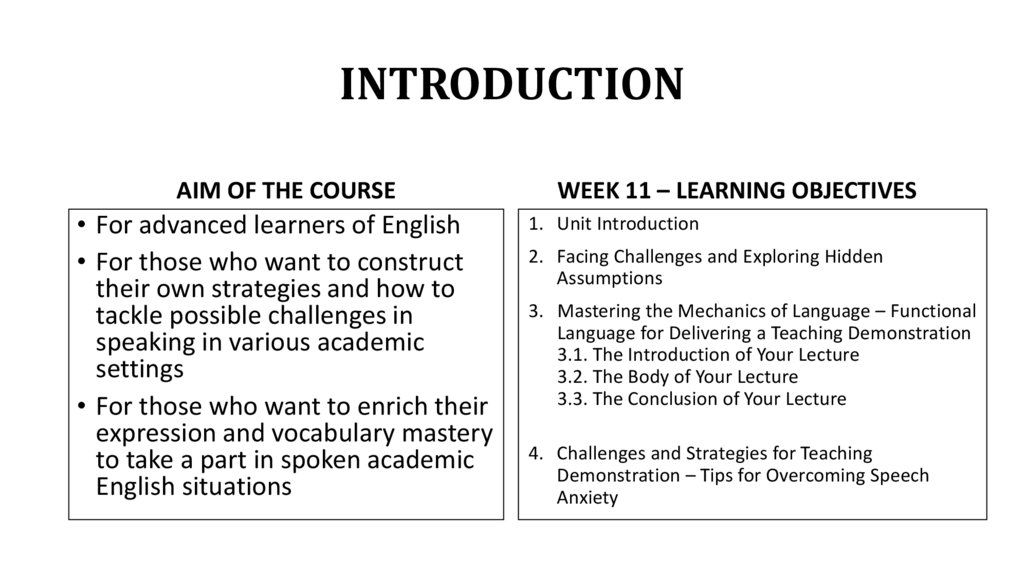
2. INTRODUCTION
AIM OF THE COURSE• For advanced learners of English
• For those who want to construct
their own strategies and how to
tackle possible challenges in
speaking in various academic
settings
• For those who want to enrich their
expression and vocabulary mastery
to take a part in spoken academic
English situations
WEEK 11 – LEARNING OBJECTIVES
1. Unit Introduction
2. Facing Challenges and Exploring Hidden
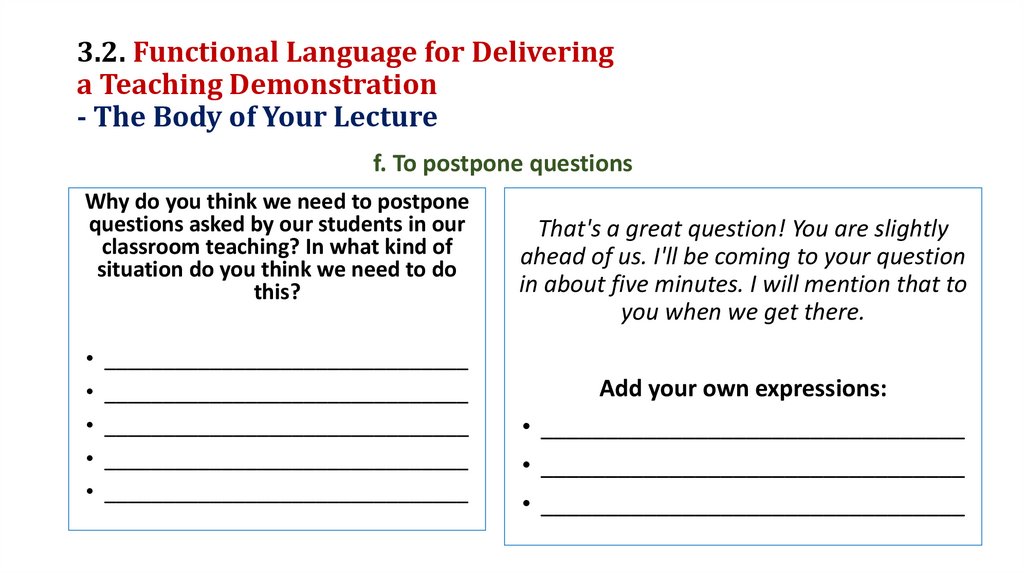
Assumptions
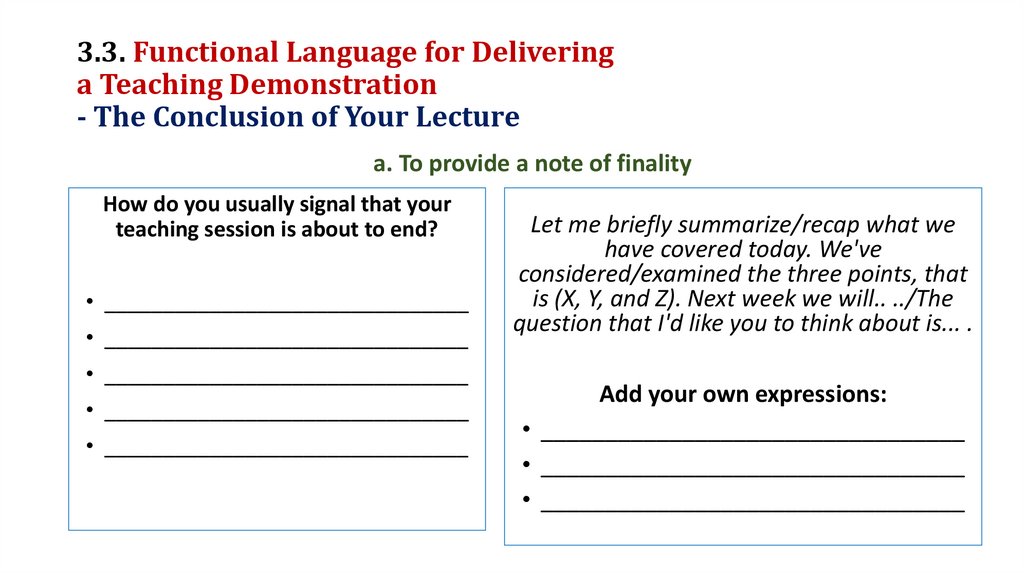
3. Mastering the Mechanics of Language – Functional
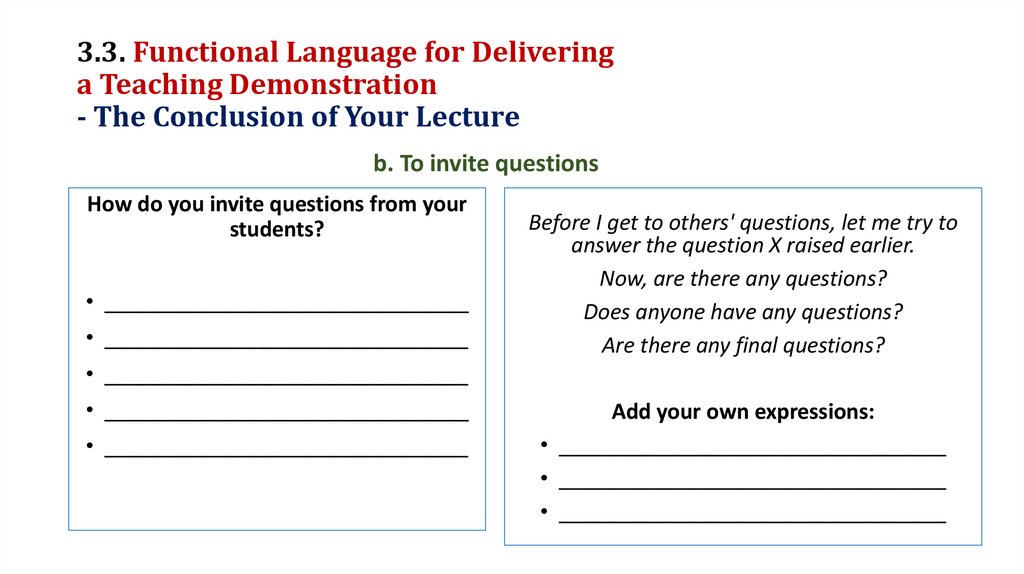
Language for Delivering a Teaching Demonstration
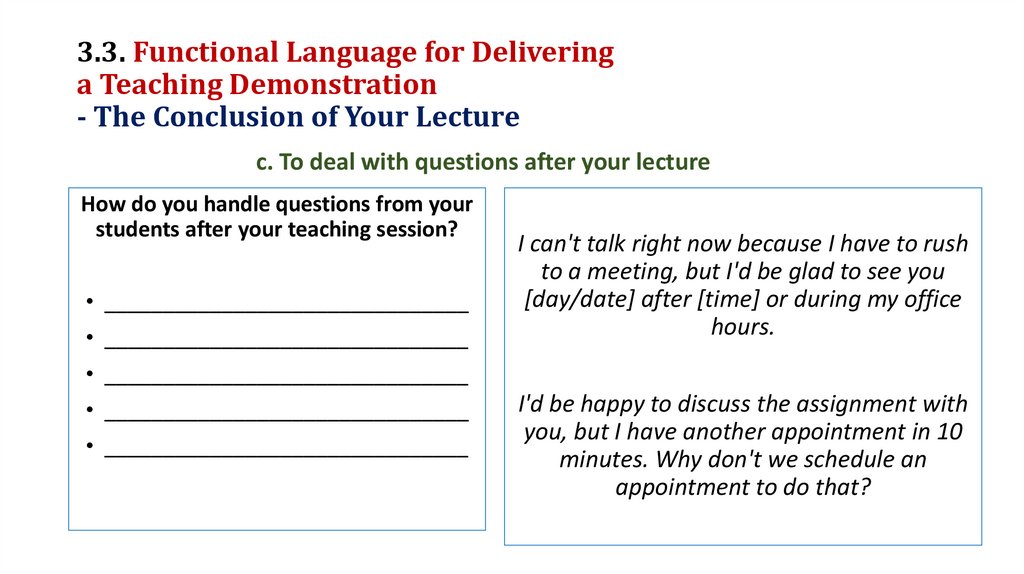
3.1. The Introduction of Your Lecture
3.2. The Body of Your Lecture
3.3. The Conclusion of Your Lecture
4. Challenges and Strategies for Teaching
Demonstration – Tips for Overcoming Speech
Anxiety
3. ICE BREAKING
ICE BREAKINGWhat can be the most challenging moment for a
teacher when teaching in a classroom? Is it the
students? Is it the material? Is it the delivery of
the material? Or something else?
_______________________________________
_______________________________________
_______________________________________
_______________________________________
_______________________________________
4. 1. Unit Introduction
• The final unit (lecture 11 and 12) introduces you to speaking situations atconferences, job talks, and interviews.
• This unit builds on the abilities to express opinions and respond to questions in
interpersonal, group, and teaching settings that you have developed in previous
units.
• These abilities are highly applicable to presenting at conferences, delivering
research talks, giving teaching demonstrations, and speaking during job
interviews.
• The recurring key components in this lecture 11, which include Facing Challenges
and Exploring Hidden Assumptions, Mastering the Mechanics of Language, and
Strategies for Success, are designed with the main focus on developing your
confidence and competence in communicating with mixed, diverse, or unknown
audience members in fielding challenging/unanticipated questions.
5. 1. Unit Introduction (cont.)
• The Strategies for Success section includes questions and tips forcontrolling speech anxiety.
• The time is now to start preparing and practicing the delivery of the
types of talks mentioned in this unit.
• Finally, don't take rejections personally; treat every challenge as an
opportunity for learning and for personal and professional growth!
6. 2. Facing Challenges and Exploring Hidden Assumptions
Diagnostic questions: Explore these questions on your own if you use this material for selfstudy. In a classroom, share your thoughts about these questions with a speaking partnerand be prepared to share your discussion with the class.
1. Share with your speaking partner(s) how you feel about your ability to answer questions
during question-and-answer sessions in teaching. What challenges have you
encountered, or would you anticipate encountering? What cross-cultural factors might
come into play in this context? Together, brainstorm strategies that you can use when
fielding questions.
Challenges:
Strategies:
7. 2. Facing Challenges and Exploring Hidden Assumptions (cont.)
2. Fielding Challenging Teaching Situations: Building on the previous lectures, where youexplored how you would handle situations and challenging questions that you may
encounter in your teaching, explore with your speaker partner(s) some strategies that
you can use to handle the following challenging issues. Be sure to consider both the
strategies (i.e., how would you deal with the situation?) and language (i.e., what
would you say exactly?) that you can use when handling each of the following
situations. Work in pairs and write down what you would say for each situation.
Situation 1: Those who like to shake their heads negatively about whatever you or other
students are saying
What would you do?
What would you say?
8. 2. Facing Challenges and Exploring Hidden Assumptions (cont.)
Situation 2: Those who like to ask a hostile questionWhat would you do?
What would you say?
Situation 3: Those who like to ask a personal/confidential question
What would you do?
What would you say?
9. 2. Facing Challenges and Exploring Hidden Assumptions (cont.)
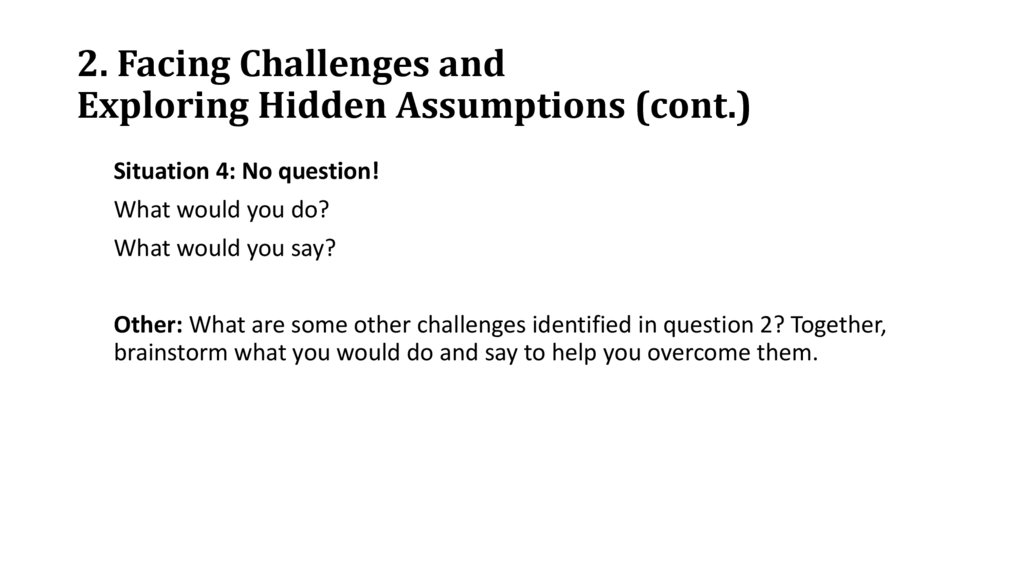
Situation 4: No question!What would you do?
What would you say?
Other: What are some other challenges identified in question 2? Together,
brainstorm what you would do and say to help you overcome them.
10. 3. Mastering the Mechanics of Language – Functional Language for Delivering a Teaching Demonstration
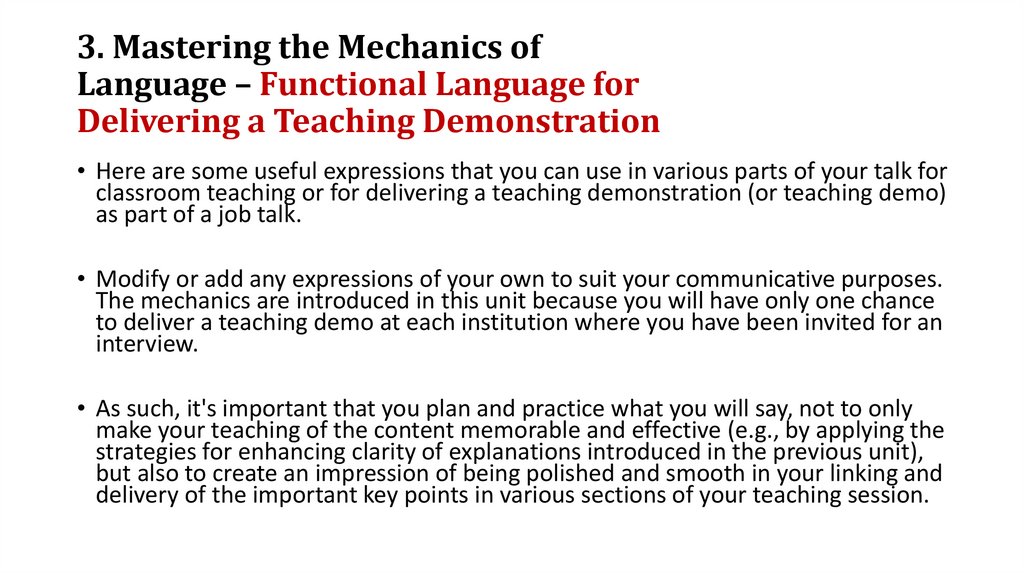
• Here are some useful expressions that you can use in various parts of your talk forclassroom teaching or for delivering a teaching demonstration (or teaching demo)
as part of a job talk.
• Modify or add any expressions of your own to suit your communicative purposes.
The mechanics are introduced in this unit because you will have only one chance
to deliver a teaching demo at each institution where you have been invited for an
interview.
• As such, it's important that you plan and practice what you will say, not to only
make your teaching of the content memorable and effective (e.g., by applying the
strategies for enhancing clarity of explanations introduced in the previous unit),
but also to create an impression of being polished and smooth in your linking and
delivery of the important key points in various sections of your teaching session.
11. 3.1. Functional Language for Delivering a Teaching Demonstration - The Introduction of Your Lecture
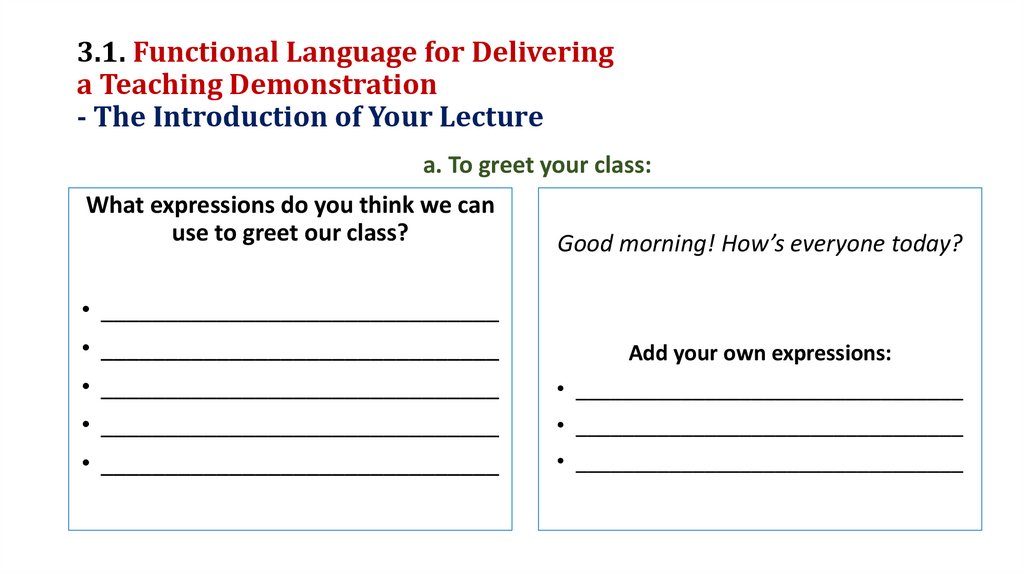
a. To greet your class:What expressions do you think we can
use to greet our class?
• _______________________________
• _______________________________
• _______________________________
• _______________________________
• _______________________________
Good morning! How’s everyone today?
Add your own expressions:
• _________________________________
• _________________________________
• _________________________________
12. 3.1. Functional Language for Delivering a Teaching Demonstration - The Introduction of Your Lecture
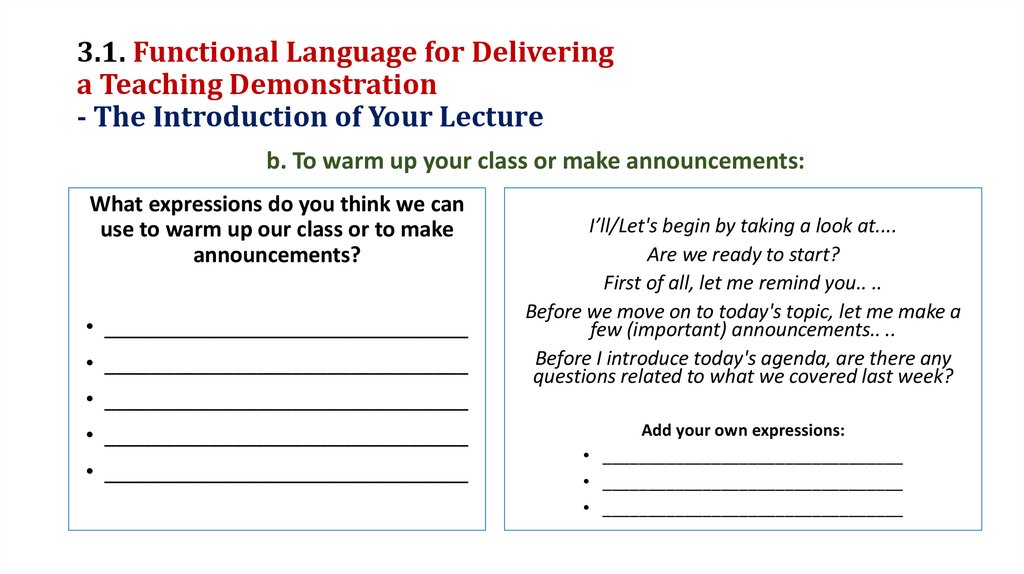
b. To warm up your class or make announcements:What expressions do you think we can
use to warm up our class or to make
announcements?
• _______________________________
• _______________________________
• _______________________________
• _______________________________
• _______________________________
I’ll/Let's begin by taking a look at....
Are we ready to start?
First of all, let me remind you.. ..
Before we move on to today's topic, let me make a
few (important) announcements.. ..
Before I introduce today's agenda, are there any
questions related to what we covered last week?
Add your own expressions:
• _________________________________
• _________________________________
• _________________________________
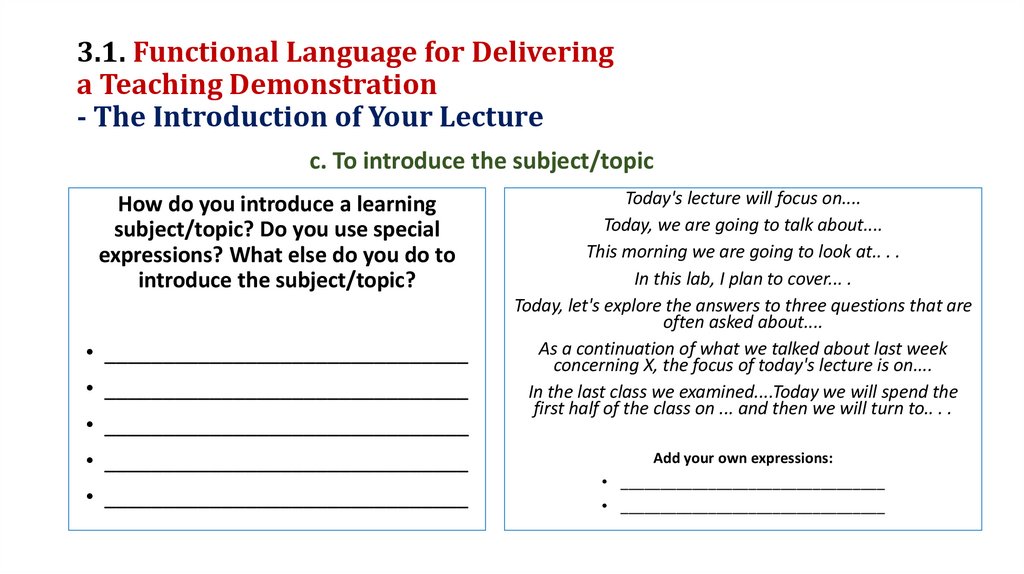
13. 3.1. Functional Language for Delivering a Teaching Demonstration - The Introduction of Your Lecture
c. To introduce the subject/topicHow do you introduce a learning
subject/topic? Do you use special
expressions? What else do you do to
introduce the subject/topic?
• _______________________________
• _______________________________
• _______________________________
• _______________________________
• _______________________________
Today's lecture will focus on....
Today, we are going to talk about....
This morning we are going to look at.. . .
In this lab, I plan to cover... .
Today, let's explore the answers to three questions that are
often asked about....
As a continuation of what we talked about last week
concerning X, the focus of today's lecture is on....
In the last class we examined....Today we will spend the
first half of the class on ... and then we will turn to.. . .
Add your own expressions:
• _________________________________
• _________________________________
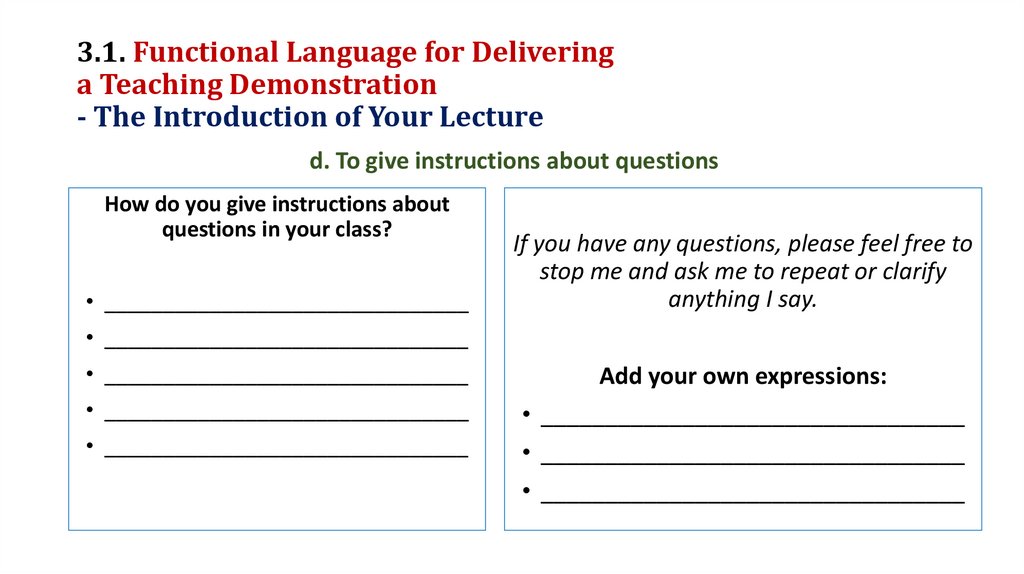
14. 3.1. Functional Language for Delivering a Teaching Demonstration - The Introduction of Your Lecture
d. To give instructions about questionsHow do you give instructions about
questions in your class?
• _______________________________
If you have any questions, please feel free to
stop me and ask me to repeat or clarify
anything I say.
• _______________________________
• _______________________________
• _______________________________
• _______________________________
Add your own expressions:
• _________________________________
• _________________________________
• _________________________________
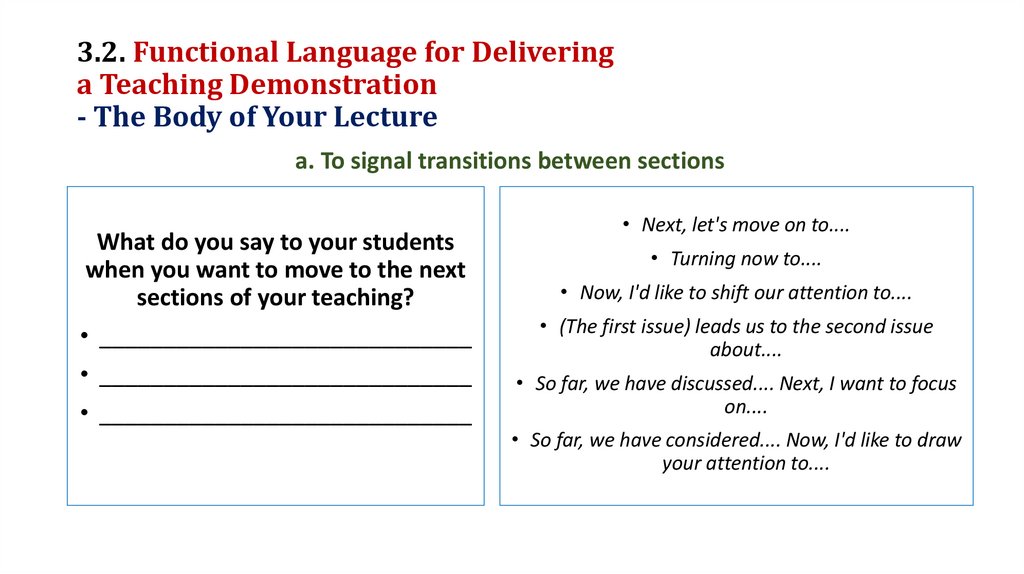
15. 3.2. Functional Language for Delivering a Teaching Demonstration - The Body of Your Lecture
a. To signal transitions between sectionsWhat do you say to your students
when you want to move to the next
sections of your teaching?
• _____________________________
• _____________________________
• _____________________________
• Next, let's move on to....
• Turning now to....
• Now, I'd like to shift our attention to....
• (The first issue) leads us to the second issue
about....
• So far, we have discussed.... Next, I want to focus
on....
• So far, we have considered.... Now, I'd like to draw
your attention to....
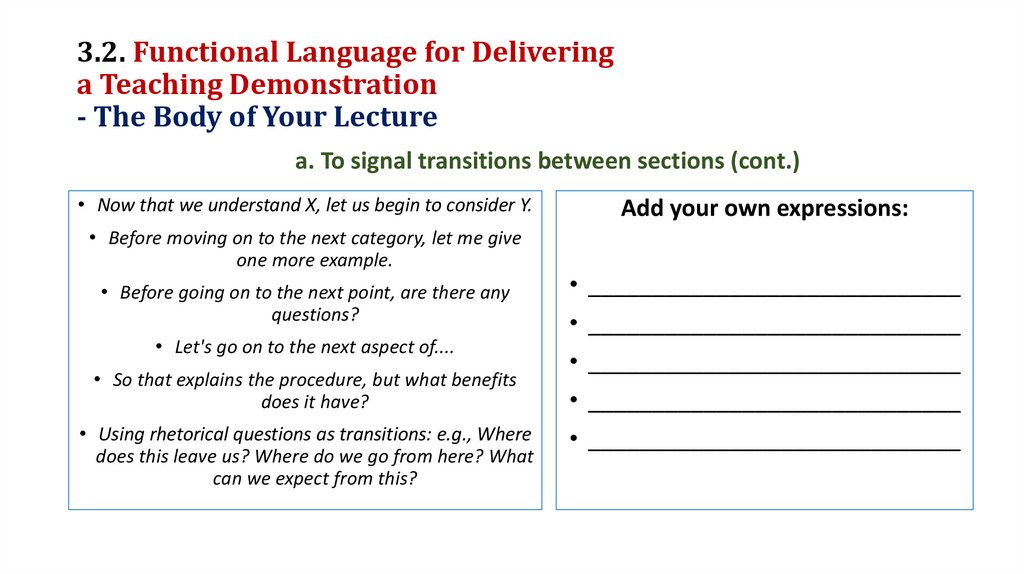
16. 3.2. Functional Language for Delivering a Teaching Demonstration - The Body of Your Lecture
a. To signal transitions between sections (cont.)• Now that we understand X, let us begin to consider Y.
• Before moving on to the next category, let me give
one more example.
• Before going on to the next point, are there any
questions?
• Let's go on to the next aspect of....
• So that explains the procedure, but what benefits
does it have?
• Using rhetorical questions as transitions: e.g., Where
does this leave us? Where do we go from here? What
can we expect from this?
Add your own expressions:
• _____________________________
• _____________________________
• _____________________________
• _____________________________
• _____________________________
17. 3.2. Functional Language for Delivering a Teaching Demonstration - The Body of Your Lecture
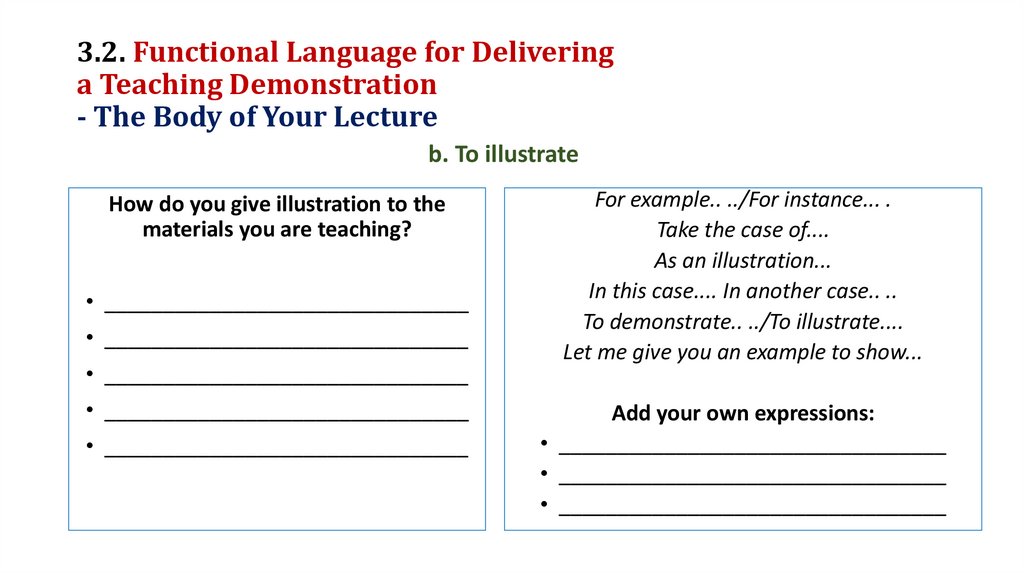
b. To illustrateHow do you give illustration to the
materials you are teaching?
• _______________________________
• _______________________________
• _______________________________
• _______________________________
• _______________________________
For example.. ../For instance... .
Take the case of....
As an illustration...
In this case.... In another case.. ..
To demonstrate.. ../To illustrate....
Let me give you an example to show...
Add your own expressions:
• _________________________________
• _________________________________
• _________________________________
18. 3.2. Functional Language for Delivering a Teaching Demonstration - The Body of Your Lecture
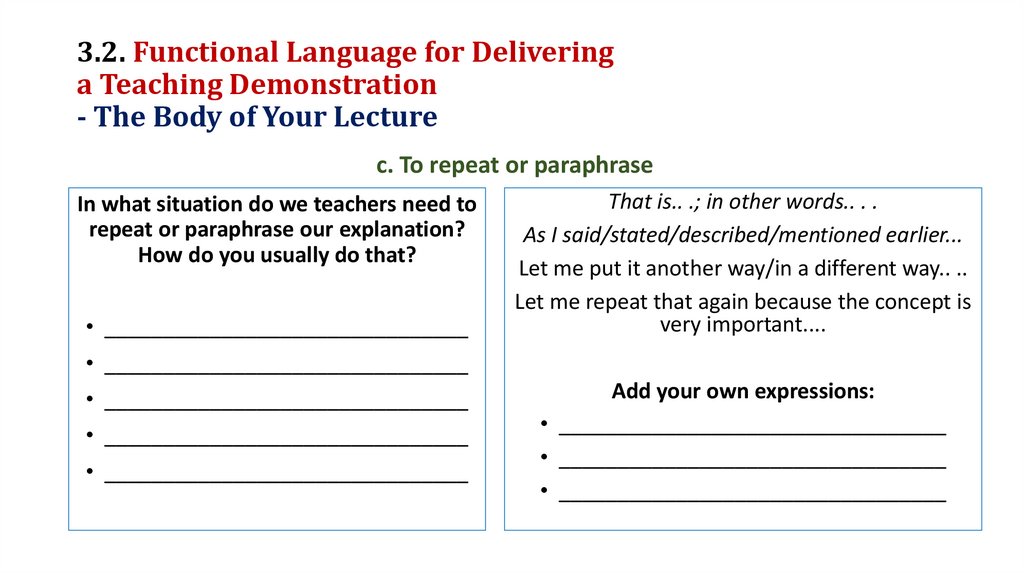
c. To repeat or paraphraseIn what situation do we teachers need to
repeat or paraphrase our explanation?
How do you usually do that?
• _______________________________
That is.. .; in other words.. . .
As I said/stated/described/mentioned earlier...
Let me put it another way/in a different way.. ..
Let me repeat that again because the concept is
very important....
• _______________________________
• _______________________________
• _______________________________
• _______________________________
Add your own expressions:
• _________________________________
• _________________________________
• _________________________________
19. 3.2. Functional Language for Delivering a Teaching Demonstration - The Body of Your Lecture
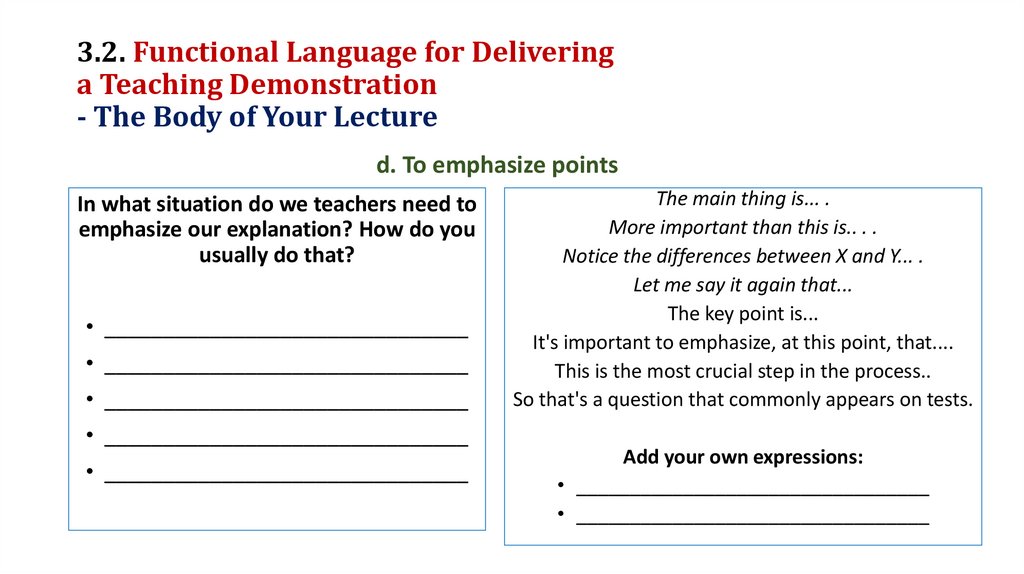
d. To emphasize pointsIn what situation do we teachers need to
emphasize our explanation? How do you
usually do that?
• _______________________________
• _______________________________
• _______________________________
• _______________________________
• _______________________________
The main thing is... .
More important than this is.. . .
Notice the differences between X and Y... .
Let me say it again that...
The key point is...
It's important to emphasize, at this point, that....
This is the most crucial step in the process..
So that's a question that commonly appears on tests.
Add your own expressions:
• _________________________________
• _________________________________
20. 3.2. Functional Language for Delivering a Teaching Demonstration - The Body of Your Lecture
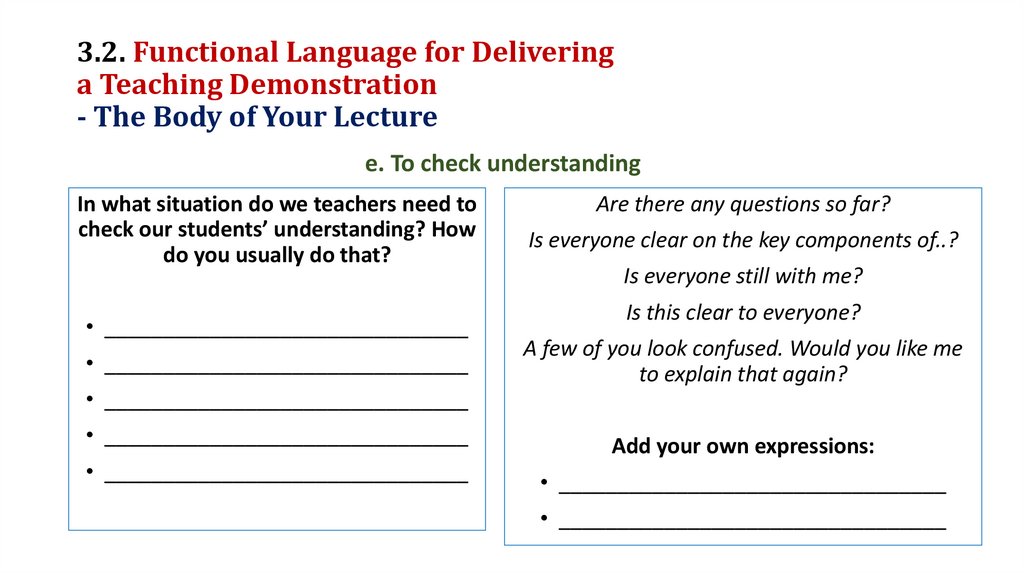
e. To check understandingIn what situation do we teachers need to
check our students’ understanding? How
do you usually do that?
• _______________________________
• _______________________________
• _______________________________
• _______________________________
• _______________________________
Are there any questions so far?
Is everyone clear on the key components of..?
Is everyone still with me?
Is this clear to everyone?
A few of you look confused. Would you like me
to explain that again?
Add your own expressions:
• _________________________________
• _________________________________
21. 3.2. Functional Language for Delivering a Teaching Demonstration - The Body of Your Lecture
f. To postpone questionsWhy do you think we need to postpone
questions asked by our students in our
classroom teaching? In what kind of
situation do you think we need to do
this?
• _______________________________
• _______________________________
• _______________________________
• _______________________________
• _______________________________
That's a great question! You are slightly
ahead of us. I'll be coming to your question
in about five minutes. I will mention that to
you when we get there.
Add your own expressions:
• _________________________________
• _________________________________
• _________________________________
22. 3.3. Functional Language for Delivering a Teaching Demonstration - The Conclusion of Your Lecture
a. To provide a note of finalityHow do you usually signal that your
teaching session is about to end?
• _______________________________
• _______________________________
• _______________________________
• _______________________________
• _______________________________
Let me briefly summarize/recap what we
have covered today. We've
considered/examined the three points, that
is (X, Y, and Z). Next week we will.. ../The
question that I'd like you to think about is... .
Add your own expressions:
• _________________________________
• _________________________________
• _________________________________
23. 3.3. Functional Language for Delivering a Teaching Demonstration - The Conclusion of Your Lecture
b. To invite questionsHow do you invite questions from your
students?
• _______________________________
• _______________________________
Before I get to others' questions, let me try to
answer the question X raised earlier.
Now, are there any questions?
Does anyone have any questions?
Are there any final questions?
• _______________________________
• _______________________________
• _______________________________
Add your own expressions:
• _________________________________
• _________________________________
• _________________________________
24. 3.3. Functional Language for Delivering a Teaching Demonstration - The Conclusion of Your Lecture
c. To deal with questions after your lectureHow do you handle questions from your
students after your teaching session?
• _______________________________
• _______________________________
I can't talk right now because I have to rush
to a meeting, but I'd be glad to see you
[day/date] after [time] or during my office
hours.
• _______________________________
• _______________________________
• _______________________________
I'd be happy to discuss the assignment with
you, but I have another appointment in 10
minutes. Why don't we schedule an
appointment to do that?
25. 3.3. Functional Language for Delivering a Teaching Demonstration - The Conclusion of Your Lecture
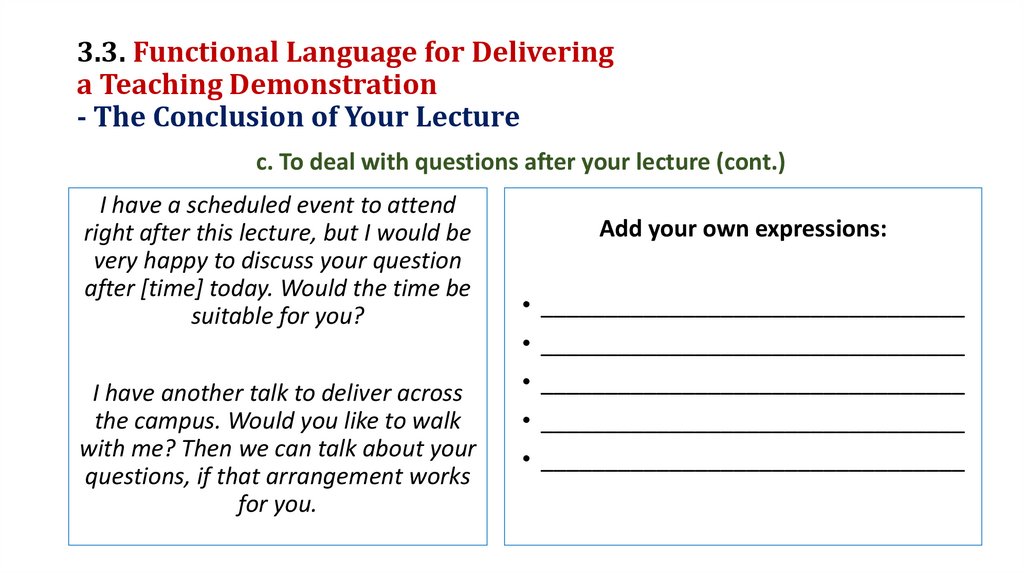
c. To deal with questions after your lecture (cont.)I have a scheduled event to attend
right after this lecture, but I would be
very happy to discuss your question
after [time] today. Would the time be
suitable for you?
I have another talk to deliver across
the campus. Would you like to walk
with me? Then we can talk about your
questions, if that arrangement works
for you.
Add your own expressions:
• _________________________________
• _________________________________
• _________________________________
• _________________________________
• _________________________________
26. 4. Challenges and Strategies for Teaching Demonstration – Tips for Overcoming Speech Anxiety
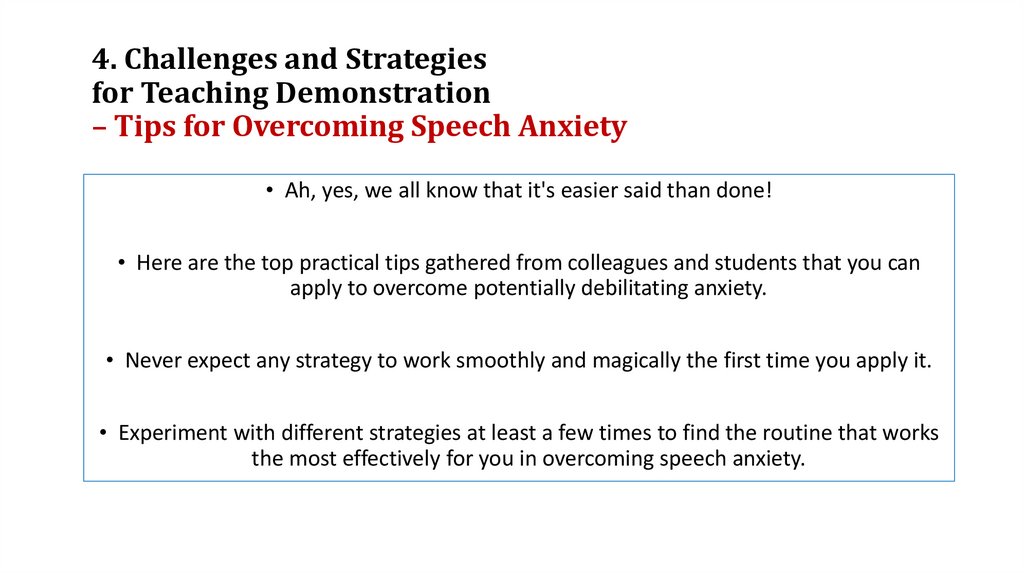
• Ah, yes, we all know that it's easier said than done!• Here are the top practical tips gathered from colleagues and students that you can
apply to overcome potentially debilitating anxiety.
• Never expect any strategy to work smoothly and magically the first time you apply it.
• Experiment with different strategies at least a few times to find the routine that works
the most effectively for you in overcoming speech anxiety.
27. 4. Challenges and Strategies for Teaching Demonstration – Tips for Overcoming Speech Anxiety (cont.)
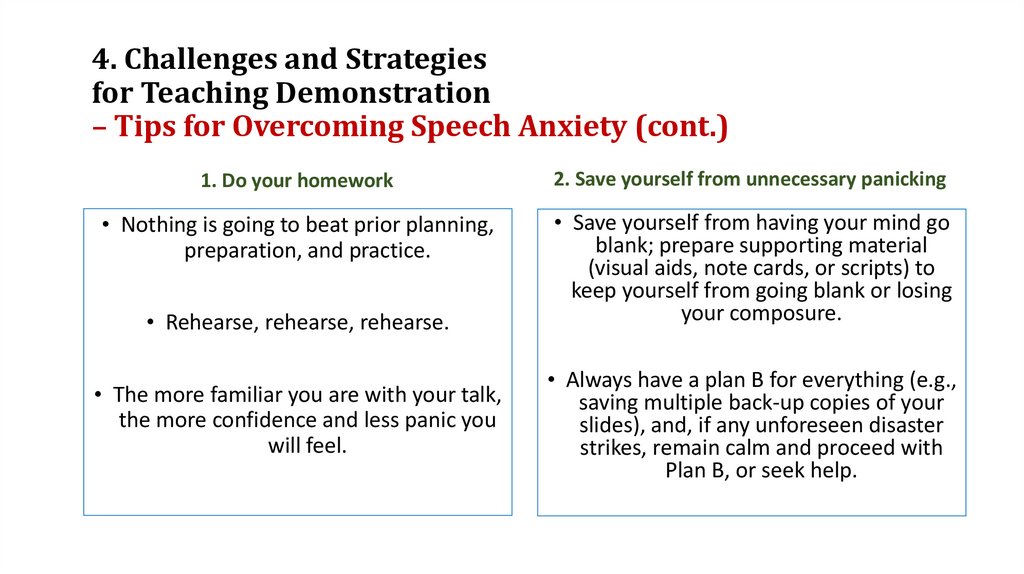
1. Do your homework2. Save yourself from unnecessary panicking
• Nothing is going to beat prior planning,
preparation, and practice.
• Save yourself from having your mind go
blank; prepare supporting material
(visual aids, note cards, or scripts) to
keep yourself from going blank or losing
your composure.
• Rehearse, rehearse, rehearse.
• The more familiar you are with your talk,
the more confidence and less panic you
will feel.
• Always have a plan B for everything (e.g.,
saving multiple back-up copies of your
slides), and, if any unforeseen disaster
strikes, remain calm and proceed with
Plan B, or seek help.
28. 4. Challenges and Strategies for Teaching Demonstration – Tips for Overcoming Speech Anxiety (cont.)
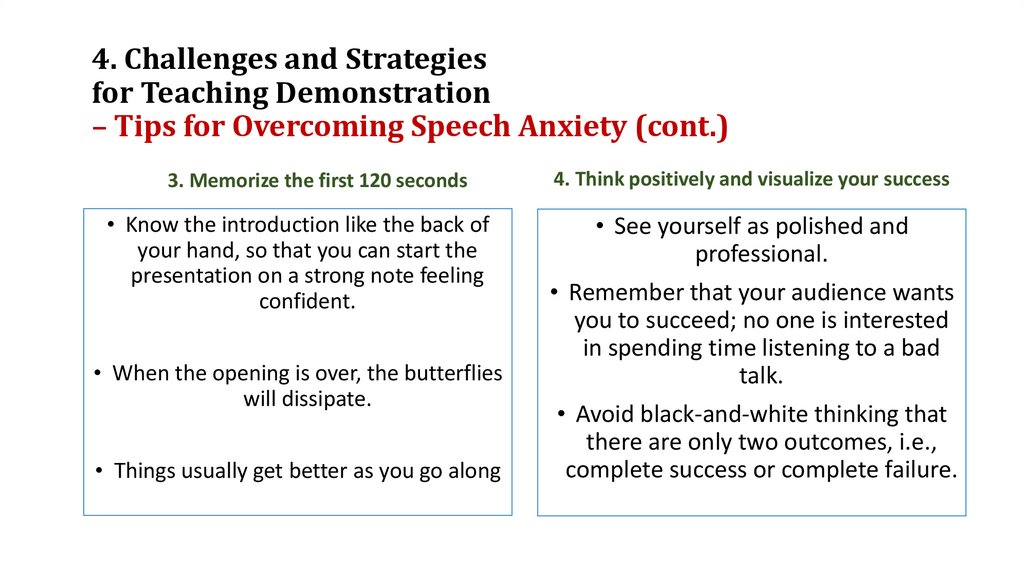
3. Memorize the first 120 seconds• Know the introduction like the back of
your hand, so that you can start the
presentation on a strong note feeling
confident.
• When the opening is over, the butterflies
will dissipate.
• Things usually get better as you go along
4. Think positively and visualize your success
• See yourself as polished and
professional.
• Remember that your audience wants
you to succeed; no one is interested
in spending time listening to a bad
talk.
• Avoid black-and-white thinking that
there are only two outcomes, i.e.,
complete success or complete failure.
29. 4. Challenges and Strategies for Teaching Demonstration – Tips for Overcoming Speech Anxiety (cont.)
5. Check out the location6. Dress professionally and comfortably
• if possible (it's not always possible if the
conference location is overseas, for
example), and arrive early.
• so that you don't find yourself
adjusting what you are wearing every
two minutes.
30. 4. Challenges and Strategies for Teaching Demonstration – Tips for Overcoming Speech Anxiety (cont.)
7. Get your “gears” ready8. Make the butterflies work for you
• Before your talk, drink some water for
dry mouth.
• If there is no water anywhere, try gently
chewing your tongue to create saliva.
• Finally, exercise your mouth muscles,
much like the warm-up you would do
before a sports game or exercise.
• Recognize that a modest amount of
nervousness, the so-called
"facilitative anxiety," can help you to
convey your message with energy
and enthusiasm.
31. 4. Challenges and Strategies for Teaching Demonstration – Tips for Overcoming Speech Anxiety (cont.)
9. Take a few deep breaths• Try slowing down your heart rate by
breathing in through the nose
(expanding the diaphragm, with relaxed
shoulders), holding your breath for five
seconds (tightening your stomach
muscle, fists and toes), and then
exhaling through your mouth (releasing
all tension).
• Repeat this at least a few times.
10. Gain experience.
• Experience builds confidence.
• Listen to others present and pursue
opportunities to speak or present.
• Practice where you can, when you can, and
try to respond to what people say to you.
• Any practice is good - whether you speak to
someone who is a native English speaker or
not.
32. 4. Challenges and Strategies for Teaching Demonstration – Tips for Overcoming Speech Anxiety (cont.)
Add your own tips here:• Do you have any other personal tips to
share?
• Have you asked others about their tips?
• You might also consider asking other
presenters whom you admire about their
tips for overcoming speech anxiety.
• __________________________________
• __________________________________
• __________________________________
• __________________________________
• __________________________________
33. REFERENCES
MAIN REFERENCE OF LECTURE 11:Huang, L. S. (2010). Academic communication skills: Conversation strategies for international
graduate students. New York: University Press of America. Page 87 – 92, 97 – 98