 history
Similar presentations:






History of Russia: Introduction
1. History of Russia: Introduction Lyudmila Olegovna Igumnova lyudmila_igum@mail.ru
2. Some problems of Russian history
Historical pendulum: oscillation betweenconservatism and liberalism
Oscillation between reform and revolution
State building and state collapse
The tensions between nations and empire etc.
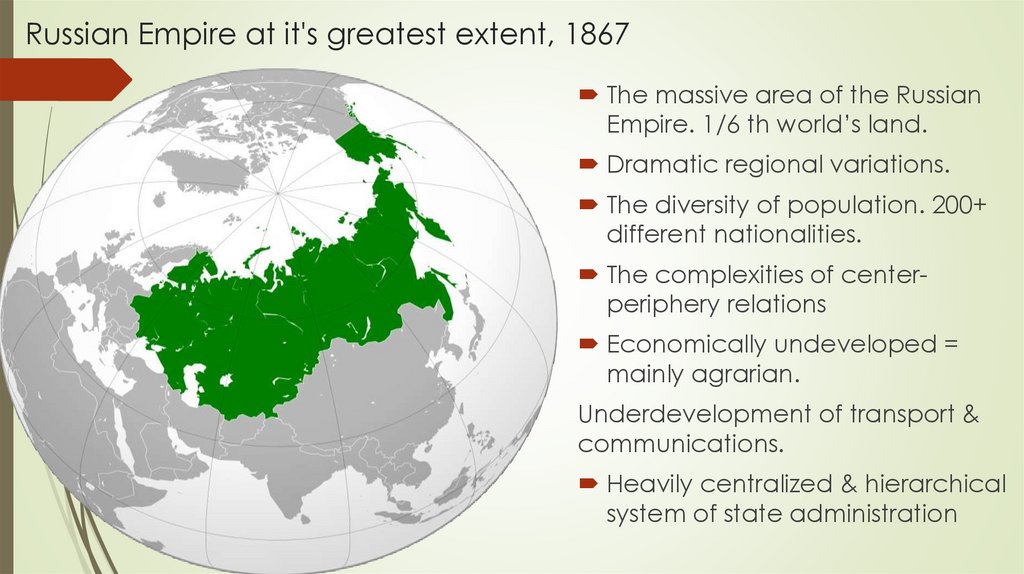
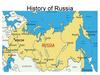
3. Russian Empire at it's greatest extent, 1867
Russian Empire at it's greatest extent, 1867The massive area of the Russian
Empire. 1/6 th world’s land.
Dramatic regional variations.
The diversity of population. 200+
different nationalities.
The complexities of centerperiphery relations
Economically undeveloped =
mainly agrarian.
Underdevelopment of transport &
communications.
Heavily centralized & hierarchical
system of state administration
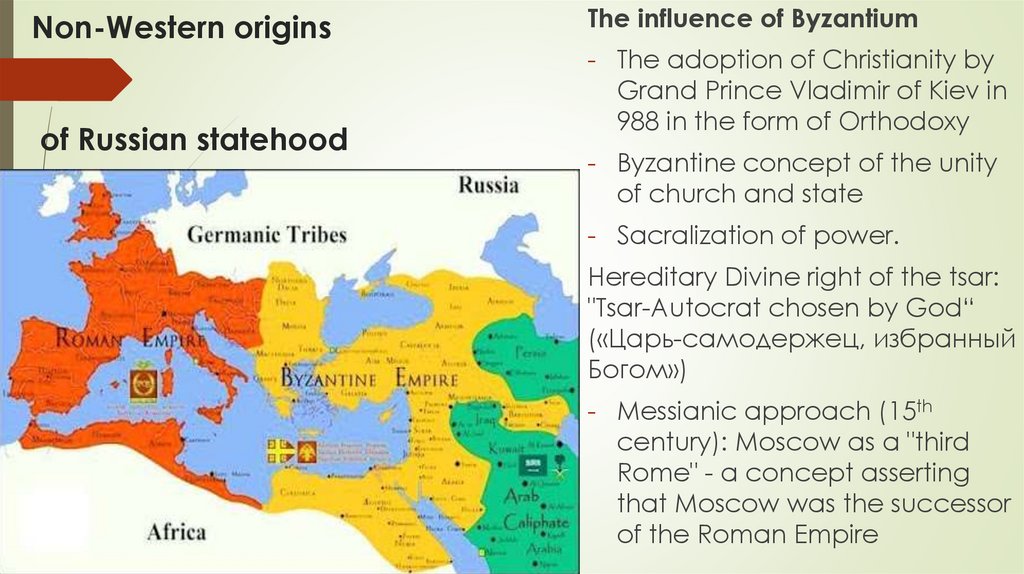
4. Non-Western origins of Russian statehood
The influence of Byzantium- The adoption of Christianity by
Grand Prince Vladimir of Kiev in
988 in the form of Orthodoxy
- Byzantine concept of the unity
of church and state
- Sacralization of power.
Hereditary Divine right of the tsar:
"Tsar-Autocrat chosen by God“
(«Царь-самодержец, избранный
Богом»)
- Messianic approach (15th
century): Moscow as a "third
Rome" - a concept asserting
that Moscow was the successor
of the Roman Empire
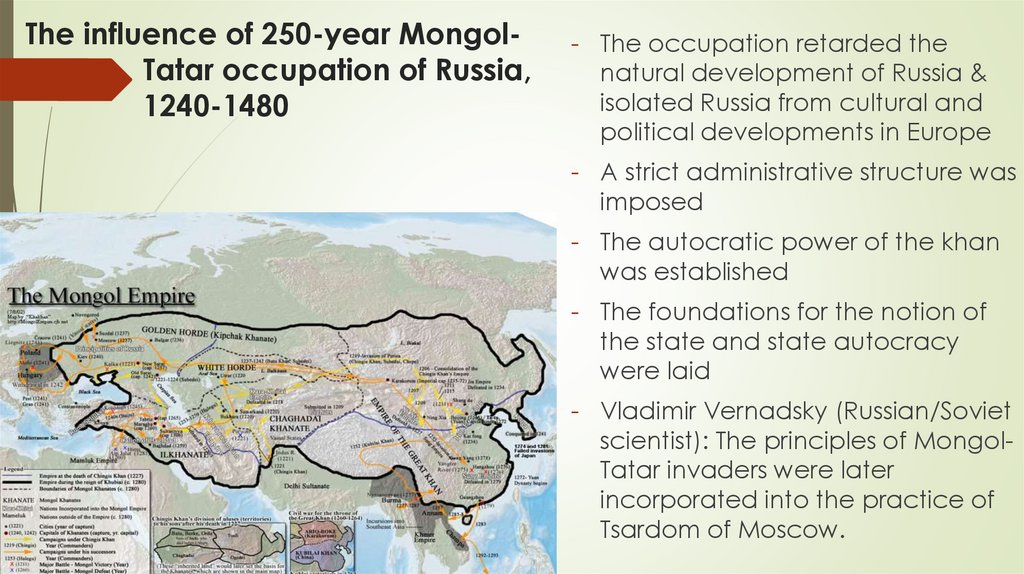
5. The influence of 250-year Mongol- Tatar occupation of Russia, 1240-1480
The influence of 250-year MongolTatar occupation of Russia,1240-1480
- The occupation retarded the
natural development of Russia &
isolated Russia from cultural and
political developments in Europe
- A strict administrative structure was
imposed
- The autocratic power of the khan
was established
- The foundations for the notion of
the state and state autocracy
were laid
- Vladimir Vernadsky (Russian/Soviet
scientist): The principles of MongolTatar invaders were later
incorporated into the practice of
Tsardom of Moscow.
6. Other features of the Russian political system
Concept of the state: thestate meant the sovereign
(gosudar, the tsar).
The tsar emerged as the sole
proprietor of all the territory
& all the subjects in his
principality.
Russia’s political order was defined as
‘autocracy’ (самодержавие).
Personal power of the tsar was
unconstrained by law.
The Fundamental Laws of the Russian
Empire, 1906, Article 4.: "The All-Russian
Emperor is an autocratic and unlimited
monarch. Obedience to his supreme
power not only from fear but also from
conscience is ordained by God Himself“
Императору Всероссийскому
принадлежит Верховная Самодержавная
власть. Повиноваться власти Его, не только
за страх, но и за совесть, Сам Бог
повелевает.
The Russian nobility supported this system
of personal authority vested in the tsar
because it was through this system that
they were awarded ranks and estates.
7. Serfdom крепостное право
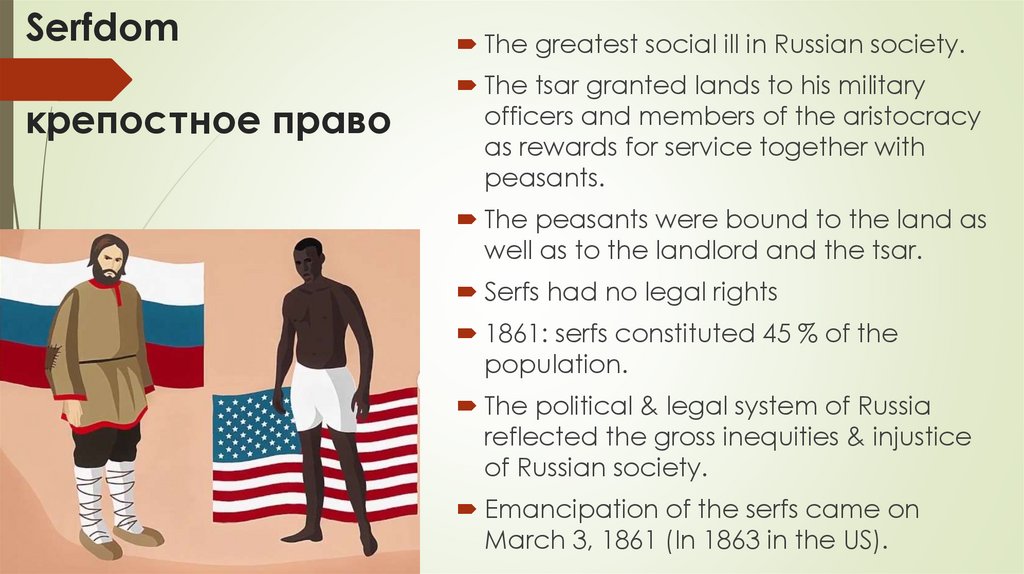
The greatest social ill in Russian society.The tsar granted lands to his military
officers and members of the aristocracy
as rewards for service together with
peasants.
The peasants were bound to the land as
well as to the landlord and the tsar.
Serfs had no legal rights
1861: serfs constituted 45 % of the
population.
The political & legal system of Russia
reflected the gross inequities & injustice
of Russian society.
Emancipation of the serfs came on
March 3, 1861 (In 1863 in the US).
8. 2 tendencies in the Russian history
A conservative trend, preservation of the tradition-ladensystem (Nicholas I (1825-1855), Alexander III (1881-1894)
etc).
Reforms, modernization & westernization of the system
(Peter the Great (1692-1725), Alexander I (1801-1825),
Alexander II (1855-1881) etc.)
The Westernizers and the Slavophiles
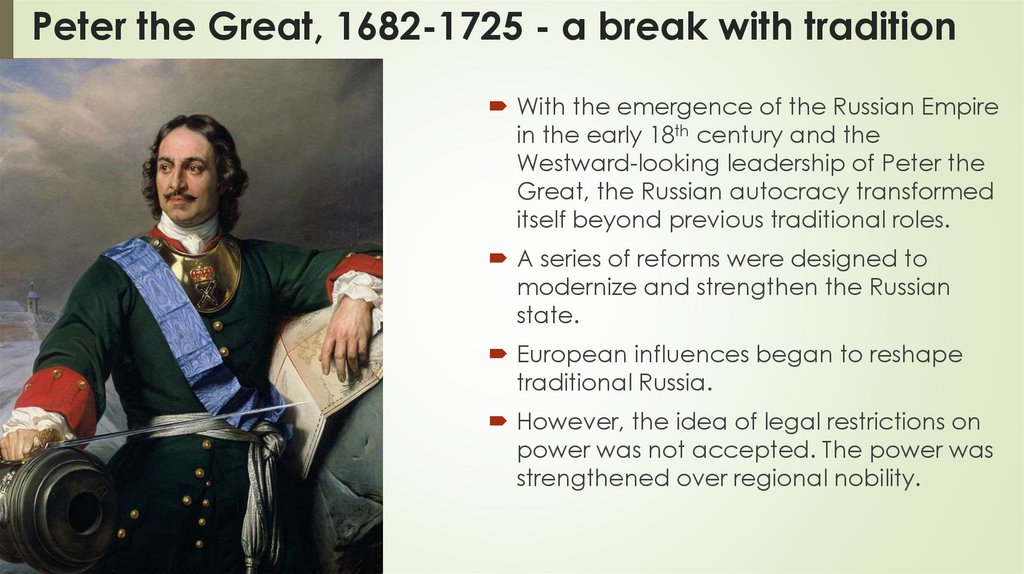
9. Peter the Great, 1682-1725 - a break with tradition
With the emergence of the Russian Empirein the early 18th century and the
Westward-looking leadership of Peter the
Great, the Russian autocracy transformed
itself beyond previous traditional roles.
A series of reforms were designed to
modernize and strengthen the Russian
state.
European influences began to reshape
traditional Russia.
However, the idea of legal restrictions on
power was not accepted. The power was
strengthened over regional nobility.
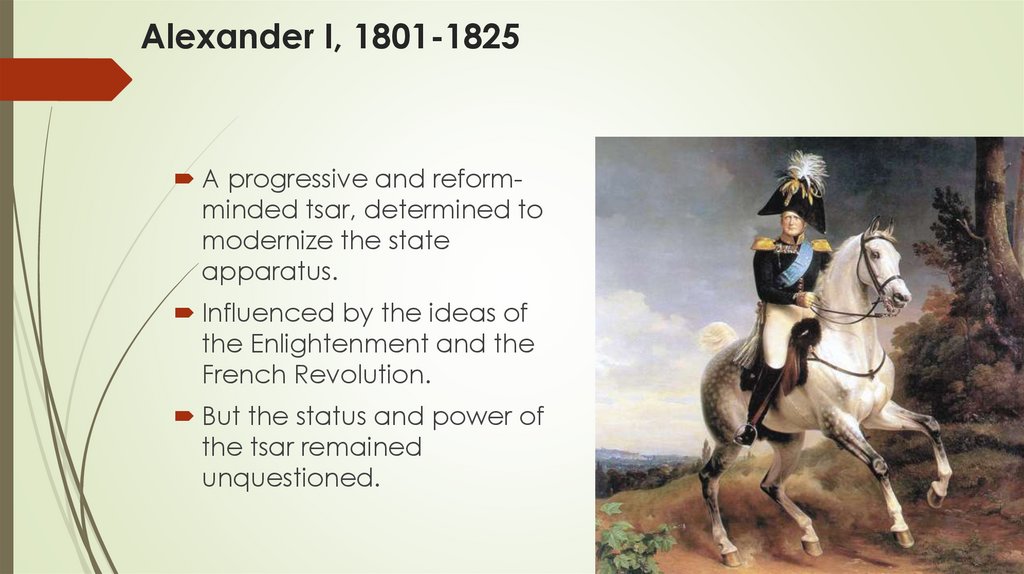
10. Alexander I, 1801-1825
A progressive and reformminded tsar, determined tomodernize the state
apparatus.
Influenced by the ideas of
the Enlightenment and the
French Revolution.
But the status and power of
the tsar remained
unquestioned.
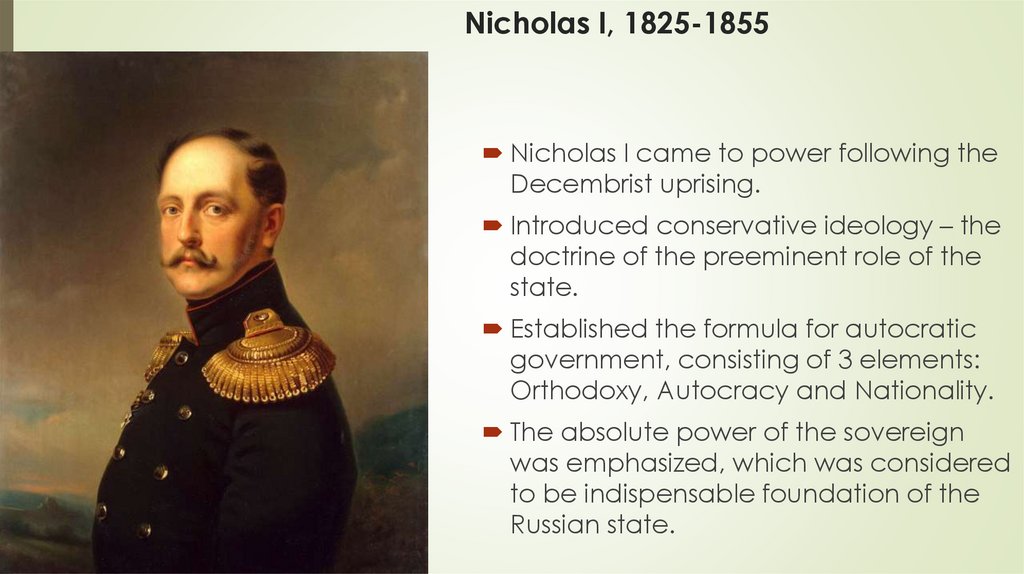
11. Nicholas I, 1825-1855
Nicholas I came to power following theDecembrist uprising.
Introduced conservative ideology – the
doctrine of the preeminent role of the
state.
Established the formula for autocratic
government, consisting of 3 elements:
Orthodoxy, Autocracy and Nationality.
The absolute power of the sovereign
was emphasized, which was considered
to be indispensable foundation of the
Russian state.
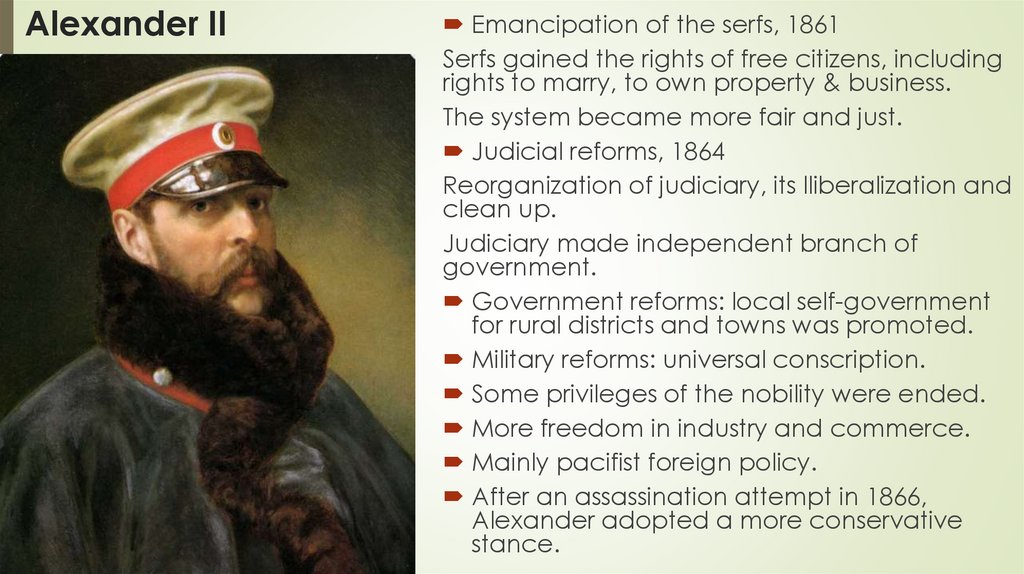
12. Alexander II
Emancipation of the serfs, 1861Serfs gained the rights of free citizens, including
rights to marry, to own property & business.
The system became more fair and just.
Judicial reforms, 1864
Reorganization of judiciary, its lliberalization and
clean up.
Judiciary made independent branch of
government.
Government reforms: local self-government
for rural districts and towns was promoted.
Military reforms: universal conscription.
Some privileges of the nobility were ended.
More freedom in industry and commerce.
Mainly pacifist foreign policy.
After an assassination attempt in 1866,
Alexander adopted a more conservative
stance.
13. The Westernizers and the Slavophiles
By the 19th century, the conflict between the Western ideas andthe indigenous Slavic mores was manifested in two opposing
schools of thought.
The Westernizers promoted industrialization, secularization, rule of
law, and the rise of a middle class.
They viewed adherence to rule of law as an essential characteristic of
civilized states.
In order to establish a modern political system, create a society based
on the rule of law, Russia, according to them, must make a break with
the past and overcome its traditional approaches.
The Slavophiles rejected new ideas and chose instead to preserve
the uniqueness of Russian society.
They idealized the Russian peasant commune, rural life, Orthodoxy,
autocratic rule of the tsar, glorified the historic mission of Orthodoxy
and Russia, resisted reforms.
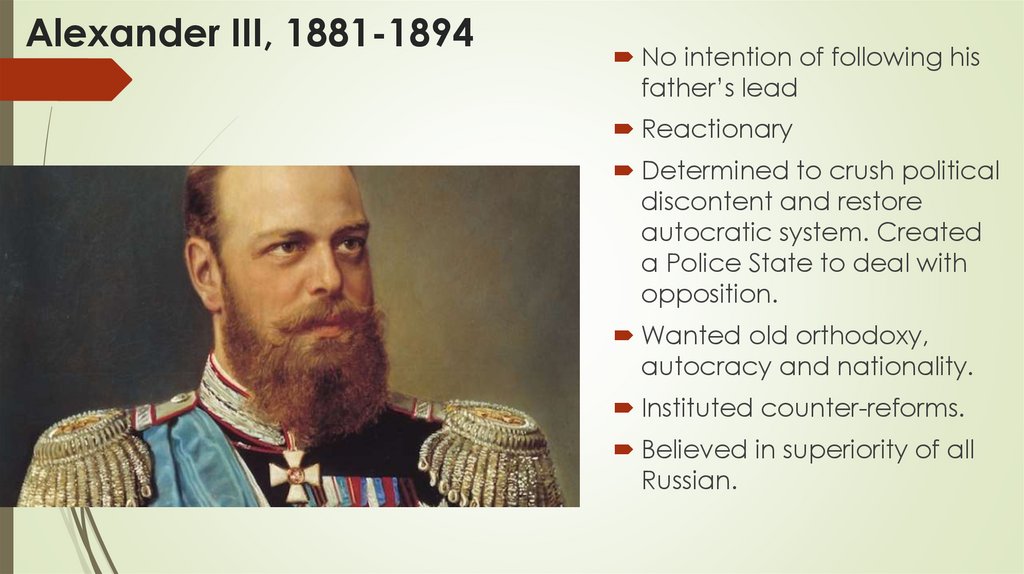
14. Alexander III, 1881-1894
No intention of following hisfather’s lead
Reactionary
Determined to crush political
discontent and restore
autocratic system. Created
a Police State to deal with
opposition.
Wanted old orthodoxy,
autocracy and nationality.
Instituted counter-reforms.
Believed in superiority of all
Russian.
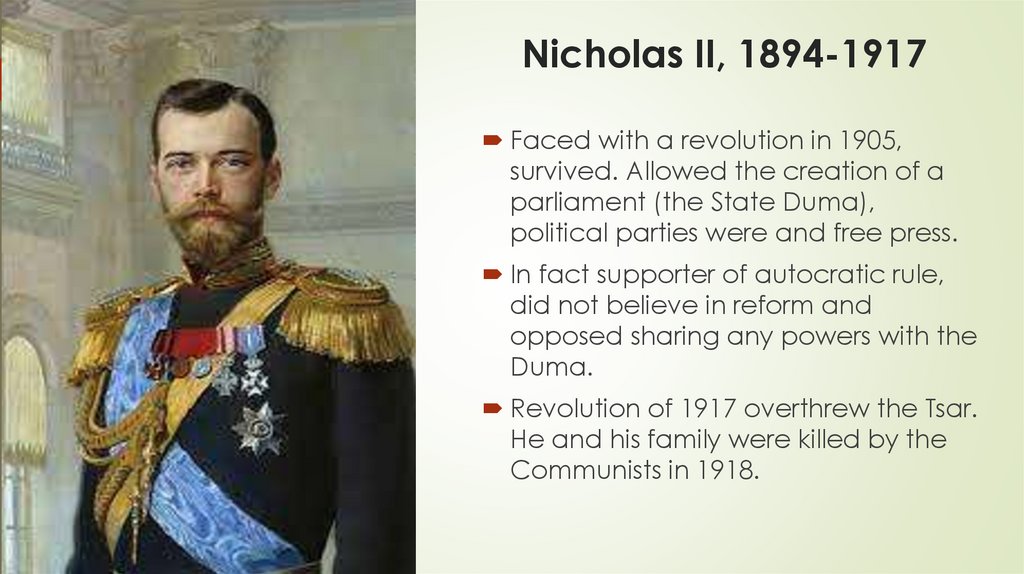
15. Nicholas II, 1894-1917
Faced with a revolution in 1905,survived. Allowed the creation of a
parliament (the State Duma),
political parties were and free press.
In fact supporter of autocratic rule,
did not believe in reform and
opposed sharing any powers with the
Duma.
Revolution of 1917 overthrew the Tsar.
He and his family were killed by the
Communists in 1918.