
 informatics
Similar presentations:





Stack and Queue
1. Stack and Queue
SOF105SOF105 Data Structure
2. Vision and Mission
• VisionXiamen University Malaysia aspires to become a university with a distinct
global outlook, featuring first-class teaching and research, and embracing
cultural diversity.
• Mission
To nurture young talents with dignity and wisdom, turning them into fine
citizens of the region who will contribute to the prosperity of the people and
social progress of Malaysia, China and Southeast Asia.
SOF105 Data Structure
3. Stack Overview
• Stack ADT• Basic operations of stack
• Pushing, popping etc.
• Implementations of stacks using
• array
• linked list
SOF105 Data Structure
4. Introduction to the Stack ADT
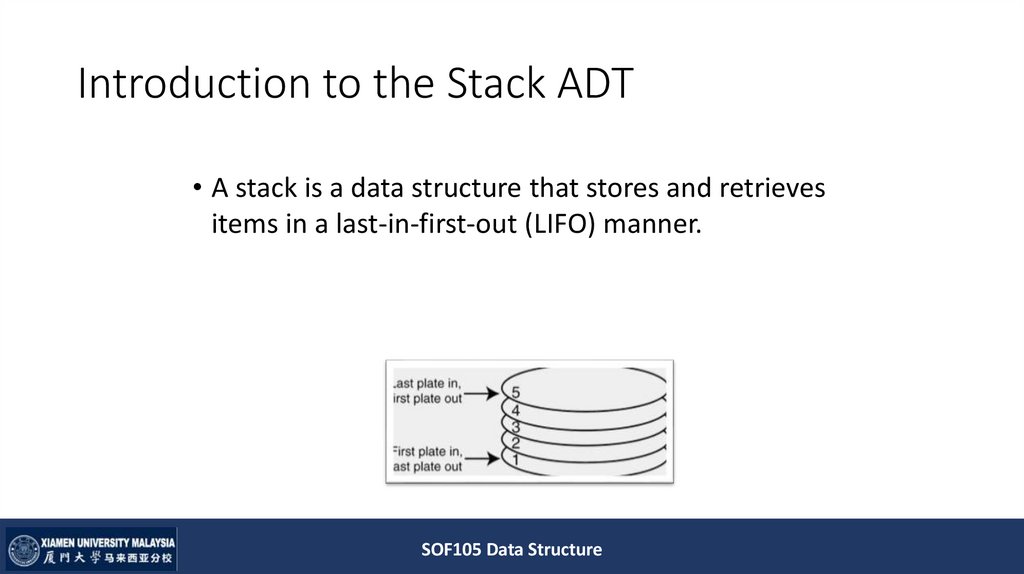
• A stack is a data structure that stores and retrievesitems in a last-in-first-out (LIFO) manner.
SOF105 Data Structure
5. Applications of Stacks
• Computer systems use stacks during a program’s execution to storefunction return addresses, local variables, etc.
• Some calculators use stacks for performing mathematical operations.
SOF105 Data Structure
6. Static and Dynamic Stacks
• Static Stacks• Fixed size
• Can be implemented with an array
• Dynamic Stacks
• Grow in size as needed
• Can be implemented with a linked list
SOF105 Data Structure
7. The Stack ADT
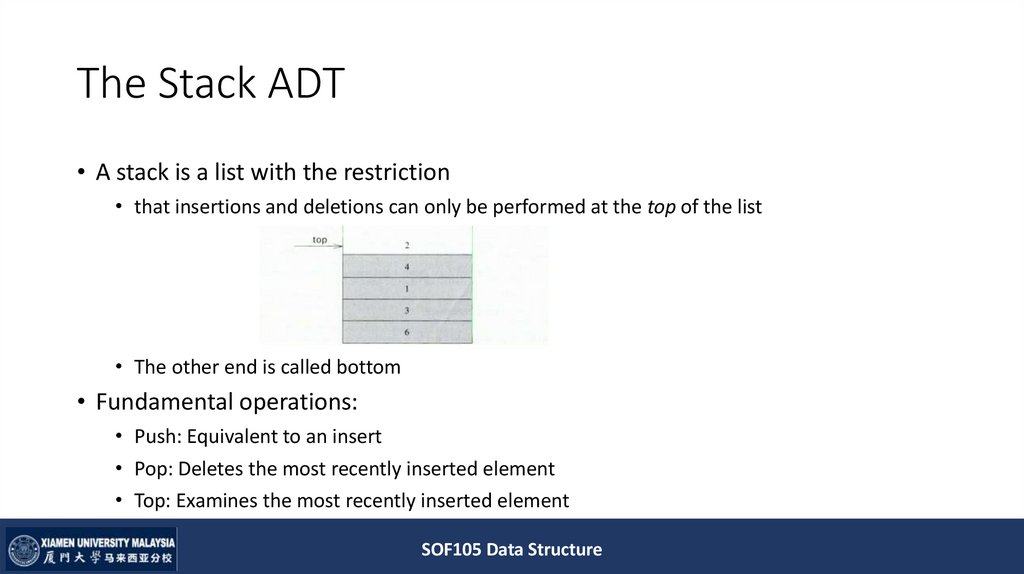
• A stack is a list with the restriction• that insertions and deletions can only be performed at the top of the list
• The other end is called bottom
• Fundamental operations:
• Push: Equivalent to an insert
• Pop: Deletes the most recently inserted element
• Top: Examines the most recently inserted element
SOF105 Data Structure
8. Stack Operations
• Push• causes a value to be stored in (pushed onto) the stack
• Pop
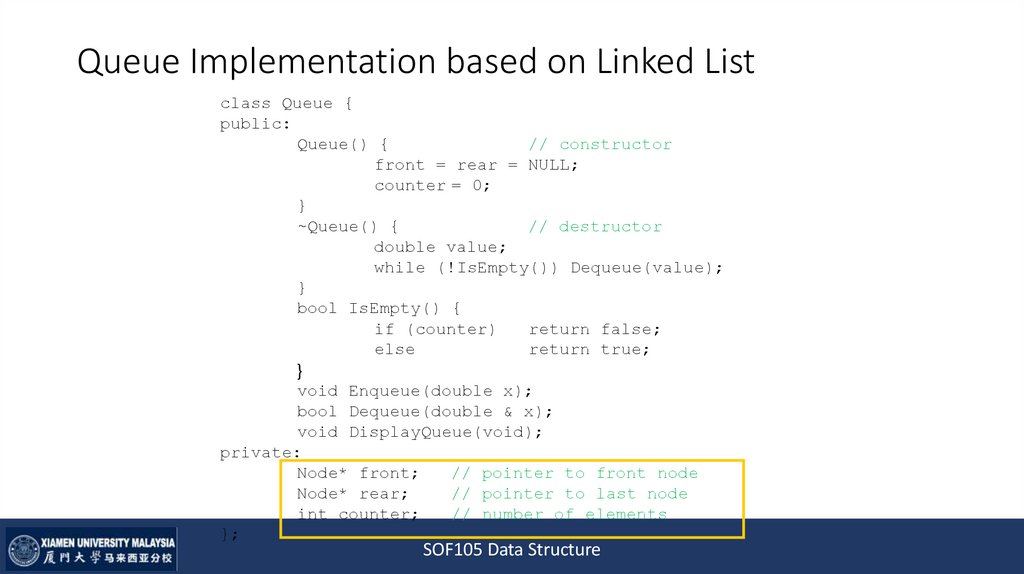
• retrieves and removes a value from the stack
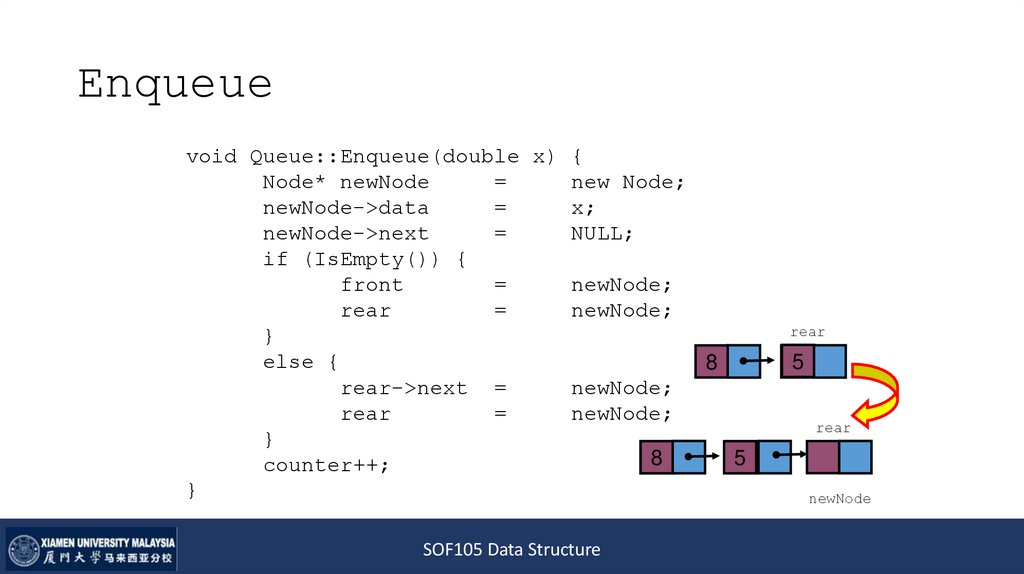
SOF105 Data Structure
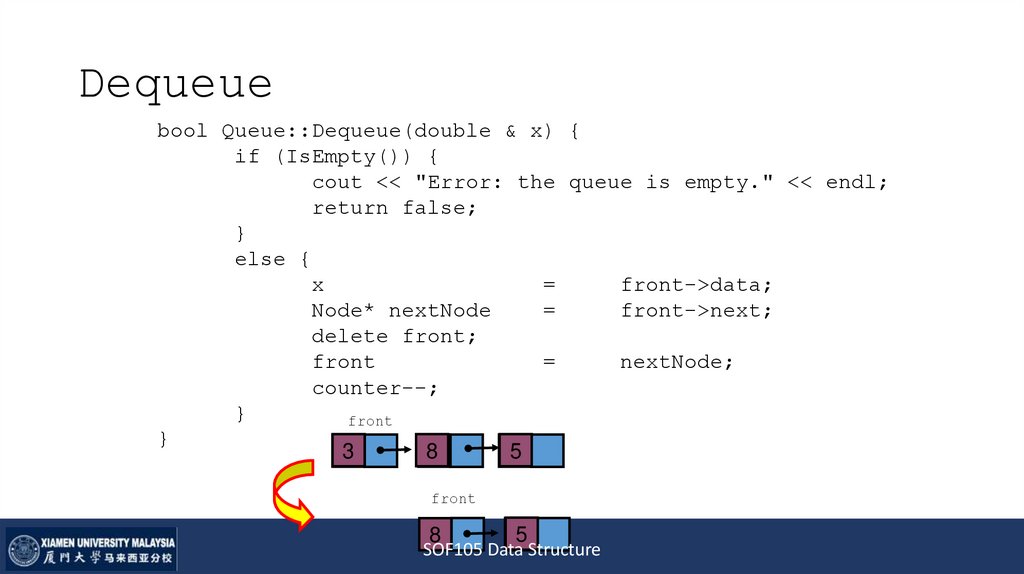
9. The Push Operation
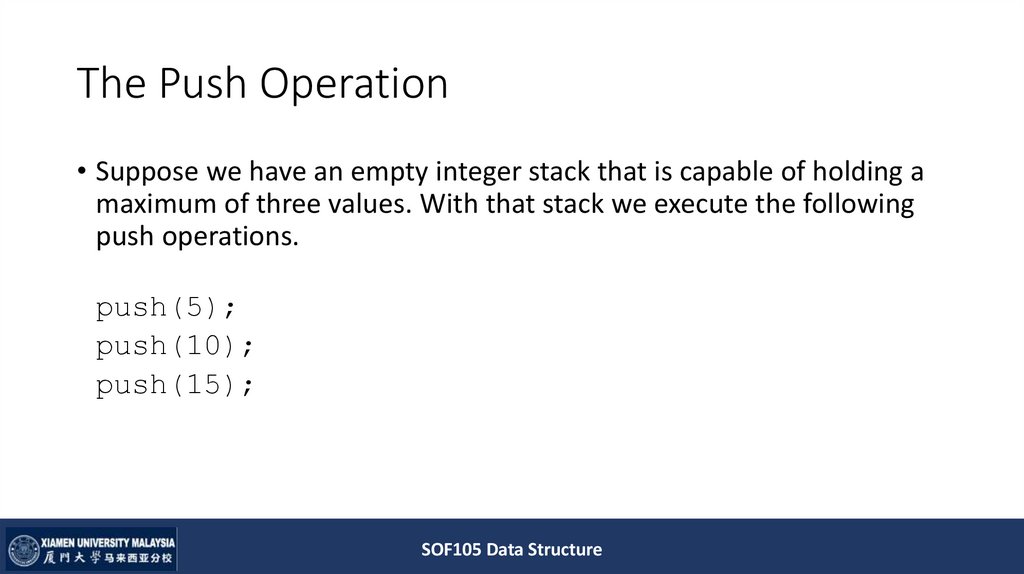
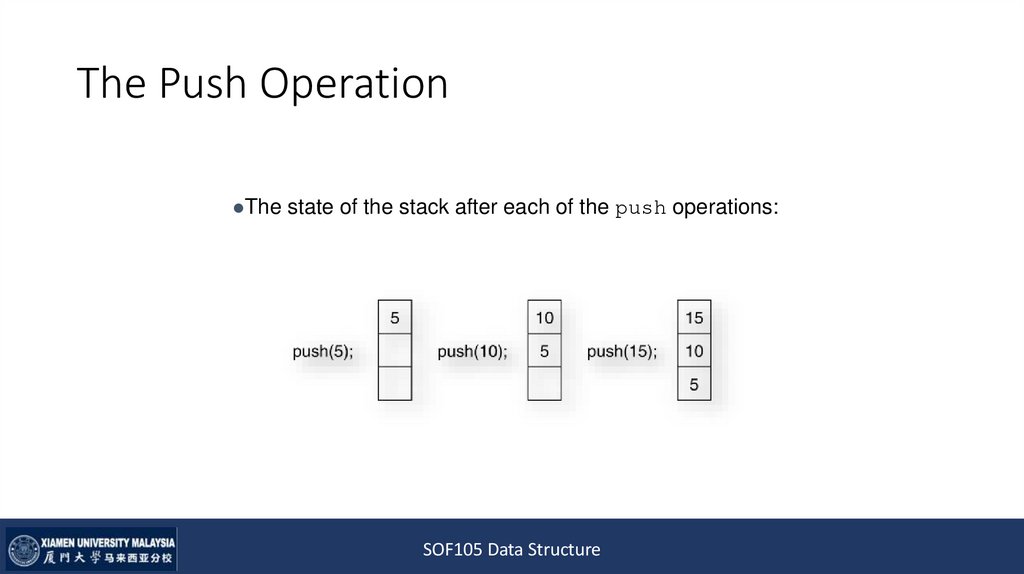
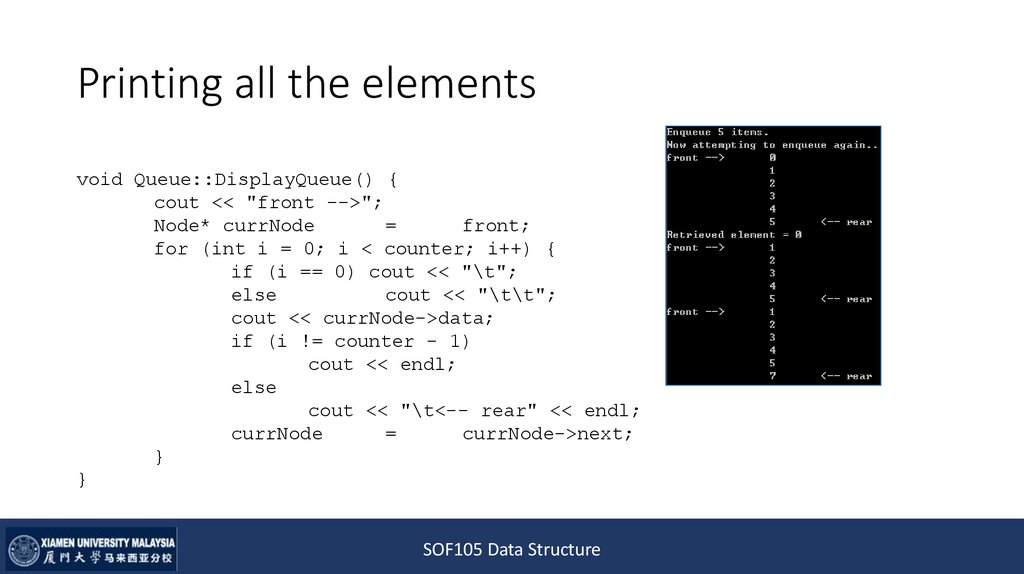
• Suppose we have an empty integer stack that is capable of holding amaximum of three values. With that stack we execute the following
push operations.
push(5);
push(10);
push(15);
SOF105 Data Structure
10. The Push Operation
The state of the stack after each of the push operations:SOF105 Data Structure
11. The Pop Operation
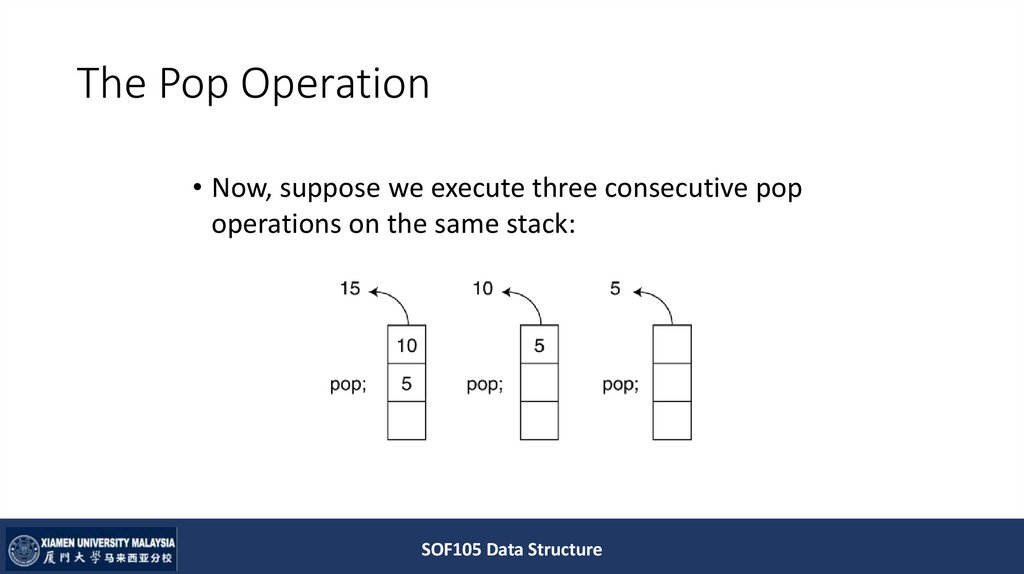
• Now, suppose we execute three consecutive popoperations on the same stack:
SOF105 Data Structure
12. Stack ADT
• Stacks are less flexiblebut are more efficient and easy to implement
• Stacks are known as LIFO (Last In, First Out) lists.
• The last element inserted will be the first to be retrieved
SOF105 Data Structure
13. Push and Pop
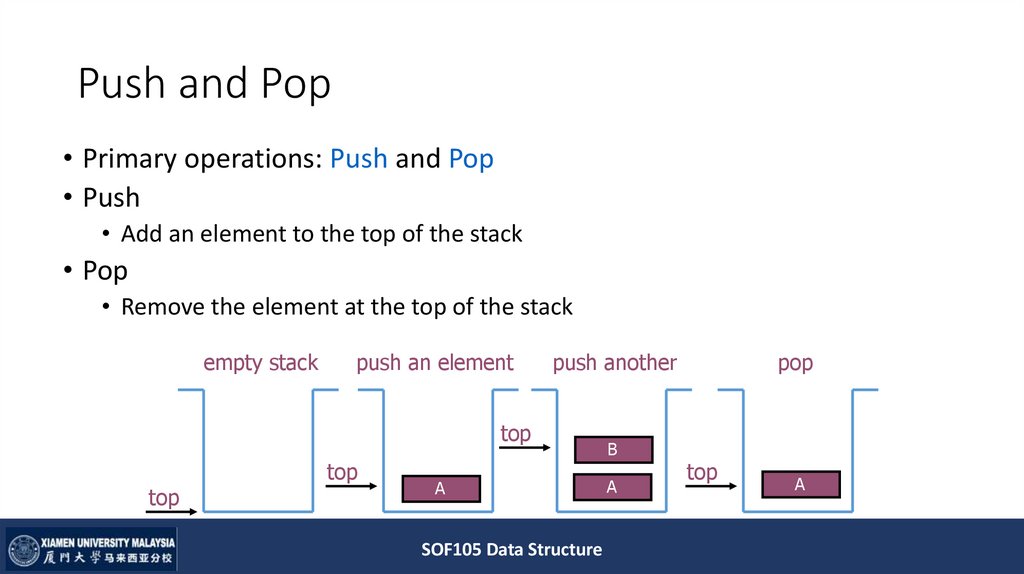
• Primary operations: Push and Pop• Push
• Add an element to the top of the stack
• Pop
• Remove the element at the top of the stack
empty stack
push an element
push another
top
top
top
A
SOF105 Data Structure
B
A
pop
top
A
14. Implementation of Stacks
• Any list implementation could be used to implement a stack• Arrays (static: the size of stack is given initially)
• Linked lists (dynamic: never become full)
• We will explore implementations based on array and linked list
• Let’s see how to use an array to implement a stack first
SOF105 Data Structure
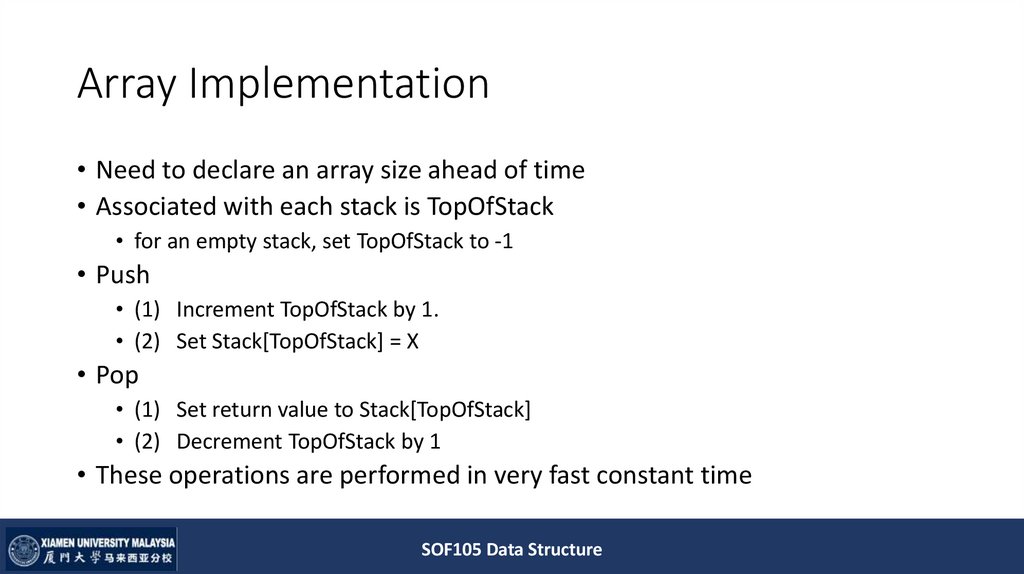
15. Array Implementation
• Need to declare an array size ahead of time• Associated with each stack is TopOfStack
• for an empty stack, set TopOfStack to -1
• Push
• (1) Increment TopOfStack by 1.
• (2) Set Stack[TopOfStack] = X
• Pop
• (1) Set return value to Stack[TopOfStack]
• (2) Decrement TopOfStack by 1
• These operations are performed in very fast constant time
SOF105 Data Structure
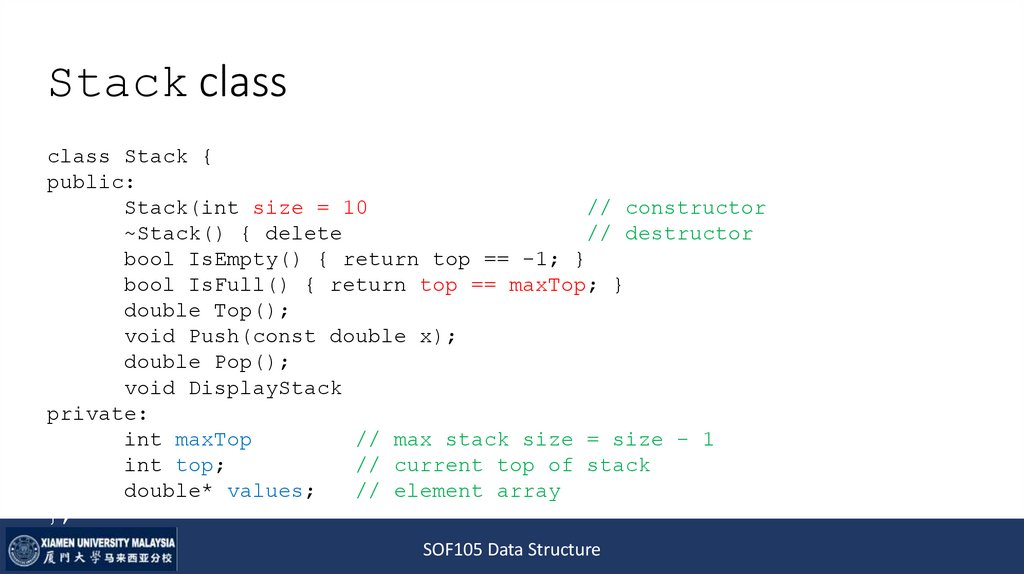
16. Stack class
class Stack {public:
Stack(int size = 10);
// constructor
~Stack() { delete [] values; }
// destructor
bool IsEmpty() { return top == -1; }
bool IsFull() { return top == maxTop; }
double Top();
void Push(const double x);
double Pop();
void DisplayStack();
private:
int maxTop;
// max stack size = size - 1
int top;
// current top of stack
double* values;
// element array
};
SOF105 Data Structure
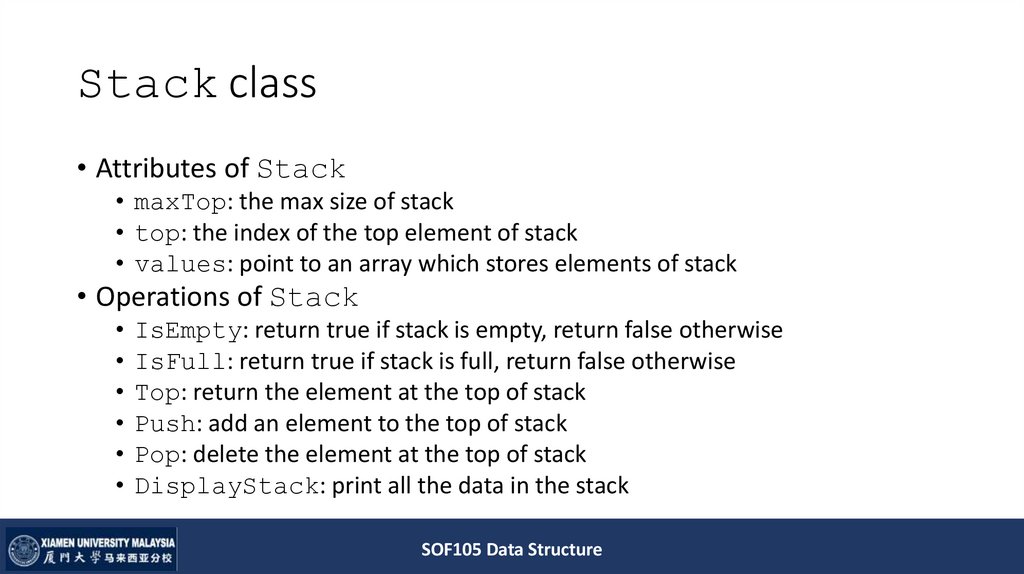
17. Stack class
• Attributes of Stack• maxTop: the max size of stack
• top: the index of the top element of stack
• values: point to an array which stores elements of stack
• Operations of Stack
• IsEmpty: return true if stack is empty, return false otherwise
• IsFull: return true if stack is full, return false otherwise
• Top: return the element at the top of stack
• Push: add an element to the top of stack
• Pop: delete the element at the top of stack
• DisplayStack: print all the data in the stack
SOF105 Data Structure
18. Create Stack
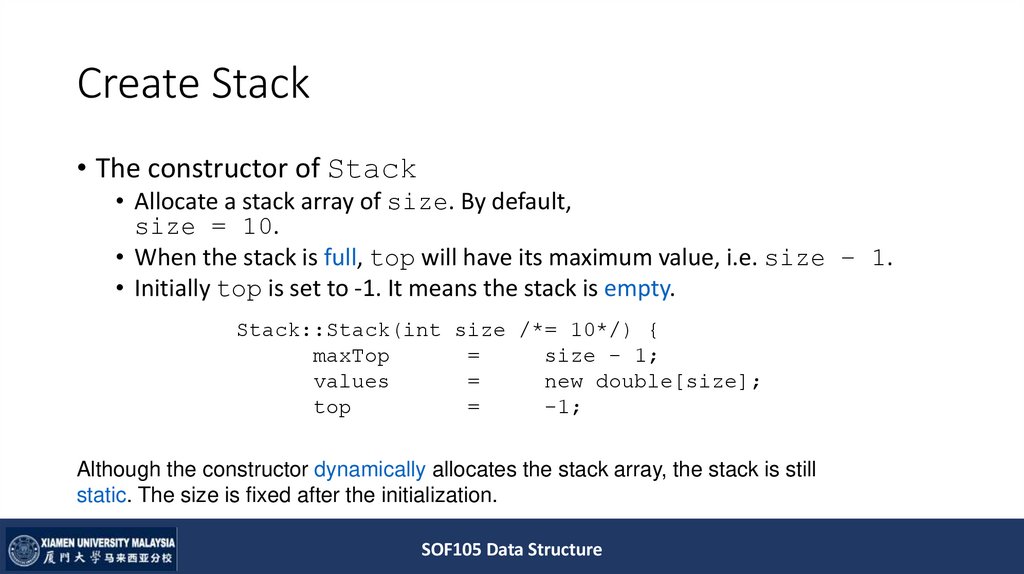
• The constructor of Stack• Allocate a stack array of size. By default,
size = 10.
• When the stack is full, top will have its maximum value, i.e. size – 1.
• Initially top is set to -1. It means the stack is empty.
Stack::Stack(int size /*= 10*/) {
maxTop
=
size - 1;
values
=
new double[size];
top
=
-1;
}
Although the constructor dynamically allocates the stack array, the stack is still
static. The size is fixed after the initialization.
SOF105 Data Structure
19. Push Stack
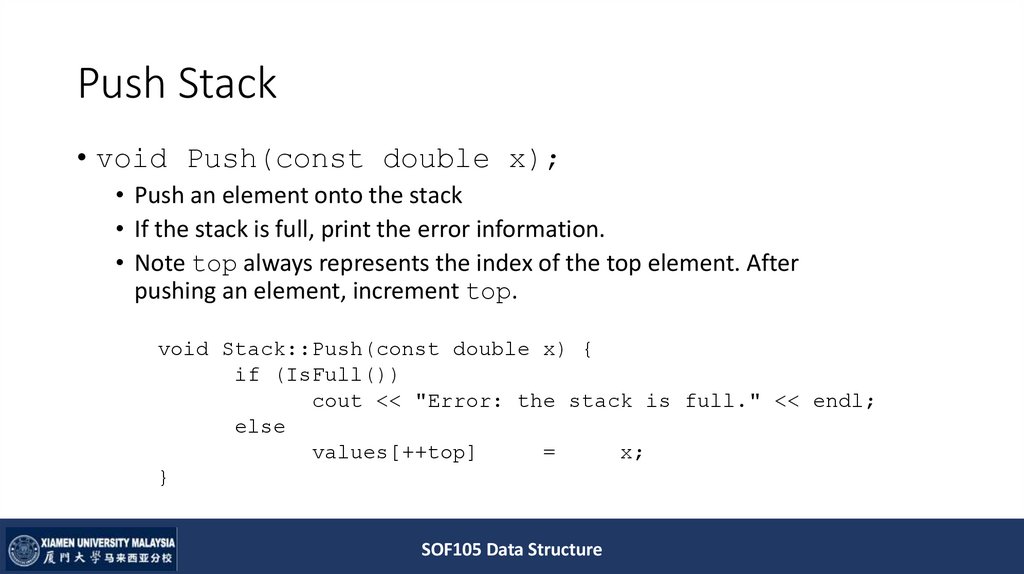
• void Push(const double x);• Push an element onto the stack
• If the stack is full, print the error information.
• Note top always represents the index of the top element. After
pushing an element, increment top.
void Stack::Push(const double x) {
if (IsFull())
cout << "Error: the stack is full." << endl;
else
values[++top]
=
x;
}
SOF105 Data Structure
20. Pop Stack
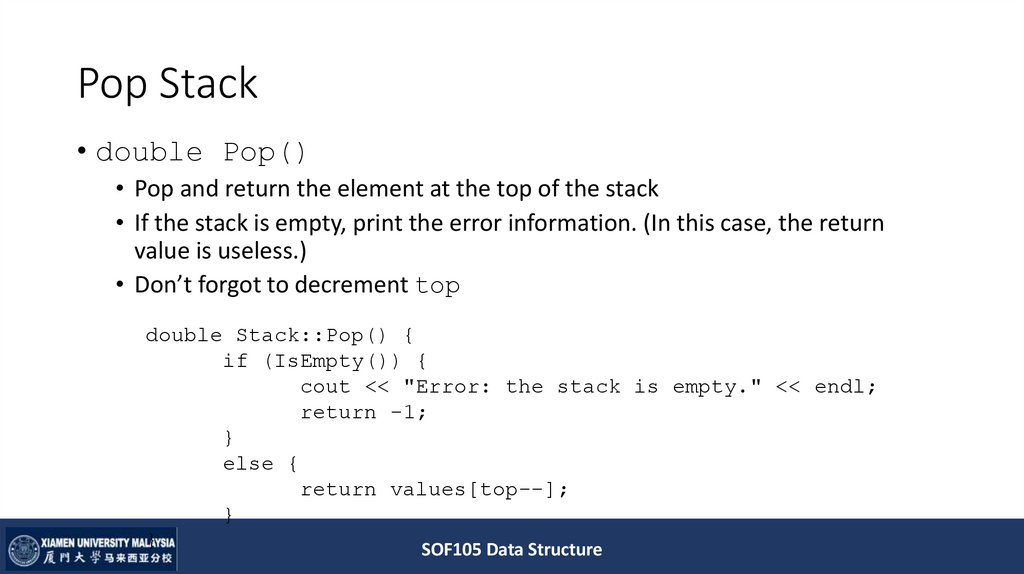
• double Pop()• Pop and return the element at the top of the stack
• If the stack is empty, print the error information. (In this case, the return
value is useless.)
• Don’t forgot to decrement top
double Stack::Pop() {
if (IsEmpty()) {
cout << "Error: the stack is empty." << endl;
return -1;
}
else {
return values[top--];
}
}
SOF105 Data Structure
21. Stack Top
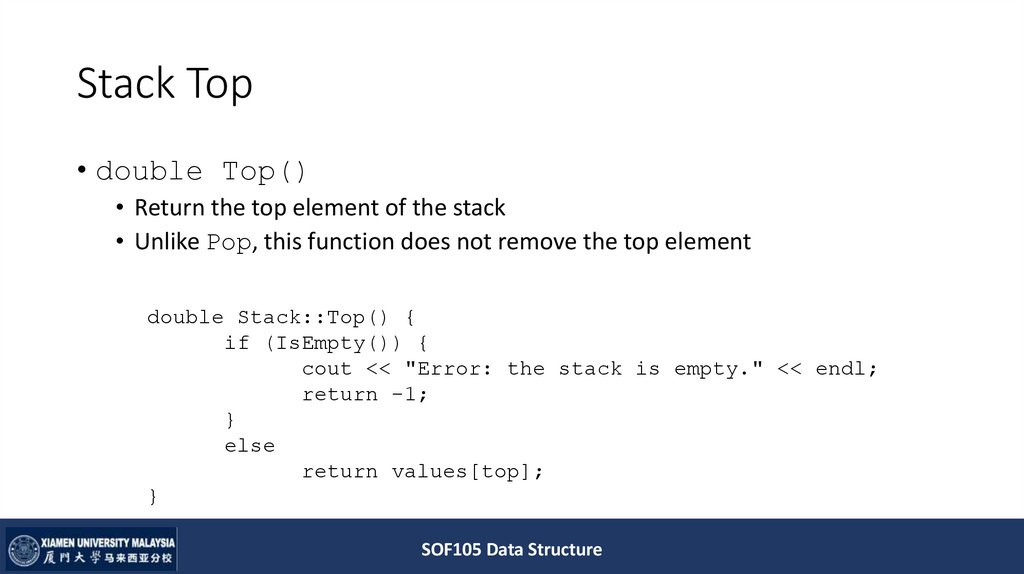
• double Top()• Return the top element of the stack
• Unlike Pop, this function does not remove the top element
double Stack::Top() {
if (IsEmpty()) {
cout << "Error: the stack is empty." << endl;
return -1;
}
else
return values[top];
}
SOF105 Data Structure
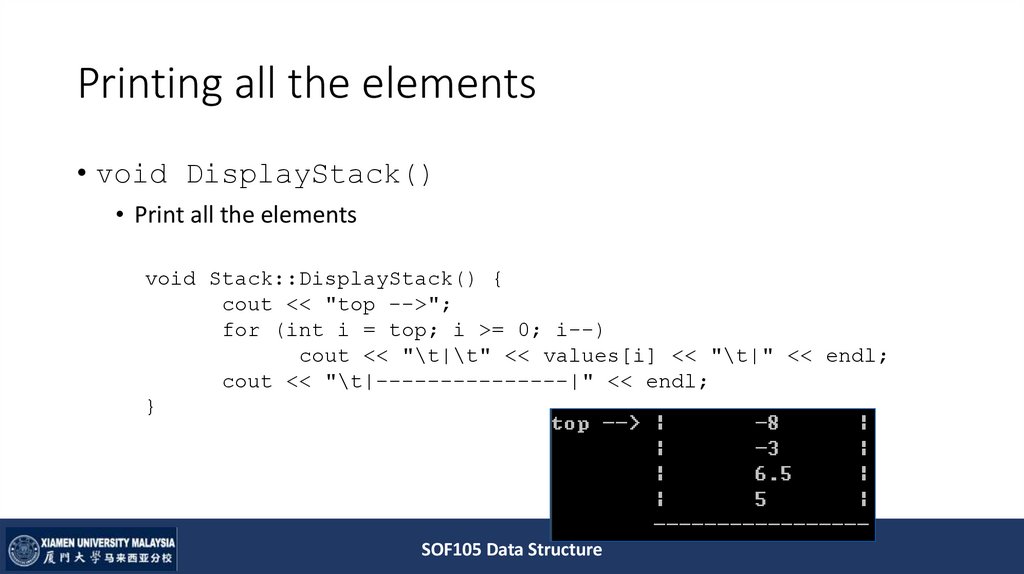
22. Printing all the elements
• void DisplayStack()• Print all the elements
void Stack::DisplayStack() {
cout << "top -->";
for (int i = top; i >= 0; i--)
cout << "\t|\t" << values[i] << "\t|" << endl;
cout << "\t|---------------|" << endl;
}
SOF105 Data Structure
23. Using Stack
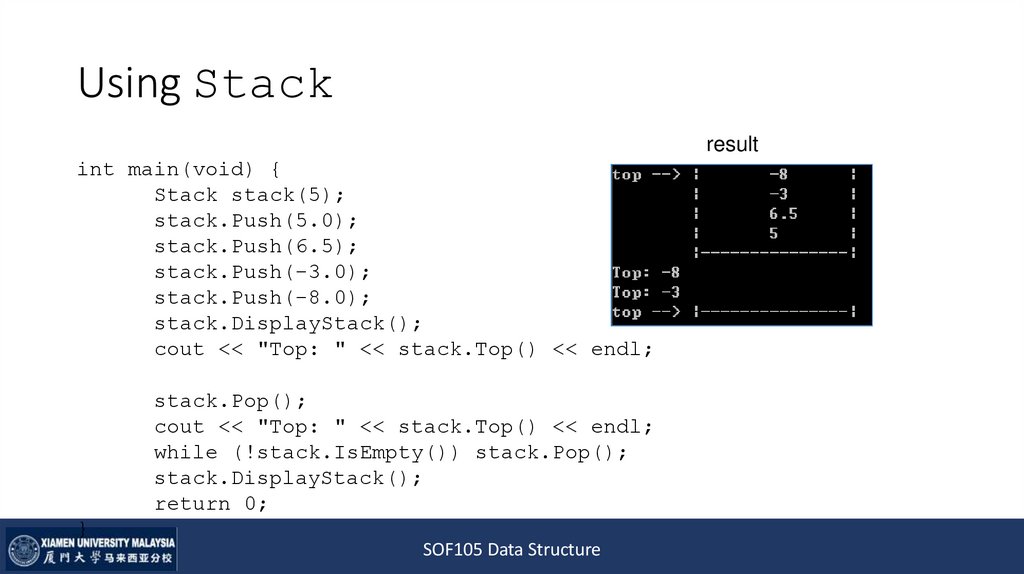
resultint main(void) {
Stack stack(5);
stack.Push(5.0);
stack.Push(6.5);
stack.Push(-3.0);
stack.Push(-8.0);
stack.DisplayStack();
cout << "Top: " << stack.Top() << endl;
stack.Pop();
cout << "Top: " << stack.Top() << endl;
while (!stack.IsEmpty()) stack.Pop();
stack.DisplayStack();
return 0;
}
SOF105 Data Structure
24.
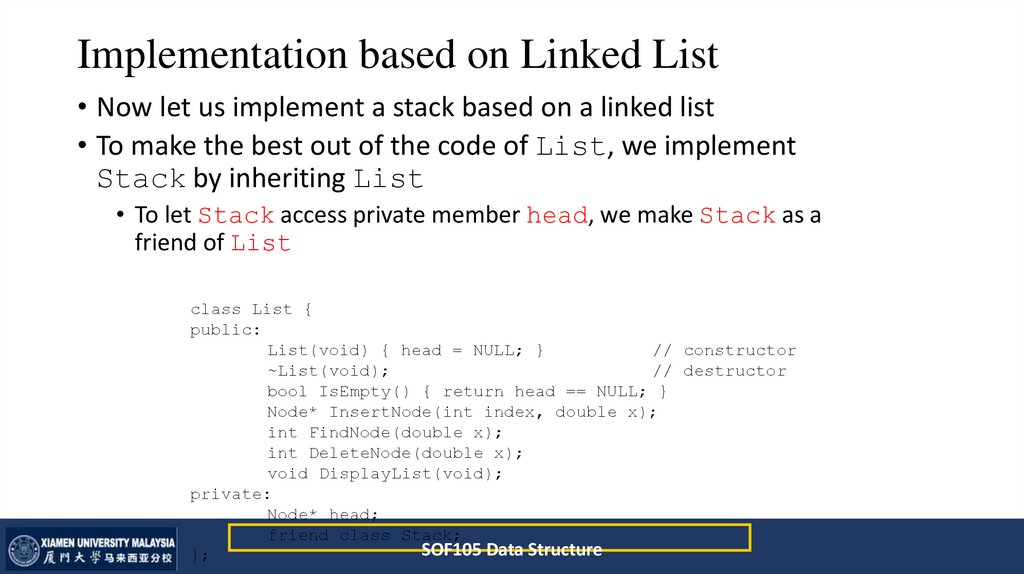
Implementation based on Linked List• Now let us implement a stack based on a linked list
• To make the best out of the code of List, we implement
Stack by inheriting List
• To let Stack access private member head, we make Stack as a
friend of List
class List {
public:
List(void) { head = NULL; }
// constructor
~List(void);
// destructor
bool IsEmpty() { return head == NULL; }
Node* InsertNode(int index, double x);
int FindNode(double x);
int DeleteNode(double x);
void DisplayList(void);
private:
Node* head;
friend class Stack;
SOF105 Data Structure
};
25. Implementation based on Linked List
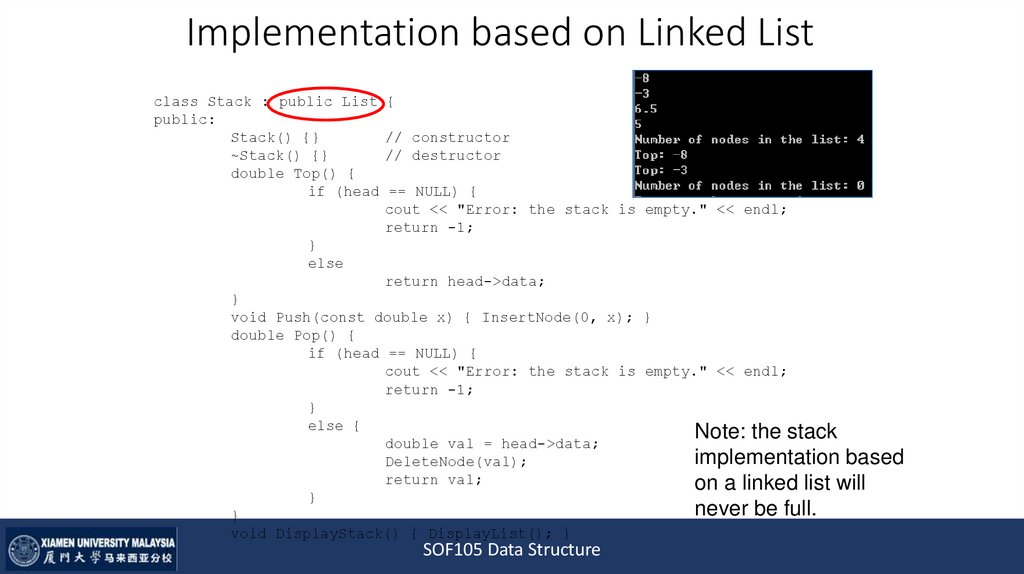
class Stack : public List {public:
Stack() {}
// constructor
~Stack() {}
// destructor
double Top() {
if (head == NULL) {
cout << "Error: the stack is empty." << endl;
return -1;
}
else
return head->data;
}
void Push(const double x) { InsertNode(0, x); }
double Pop() {
if (head == NULL) {
cout << "Error: the stack is empty." << endl;
return -1;
}
else {
Note: the stack
double val = head->data;
implementation based
DeleteNode(val);
return val;
on a linked list will
}
never be full.
}
void DisplayStack() { DisplayList(); }
};
SOF105 Data Structure
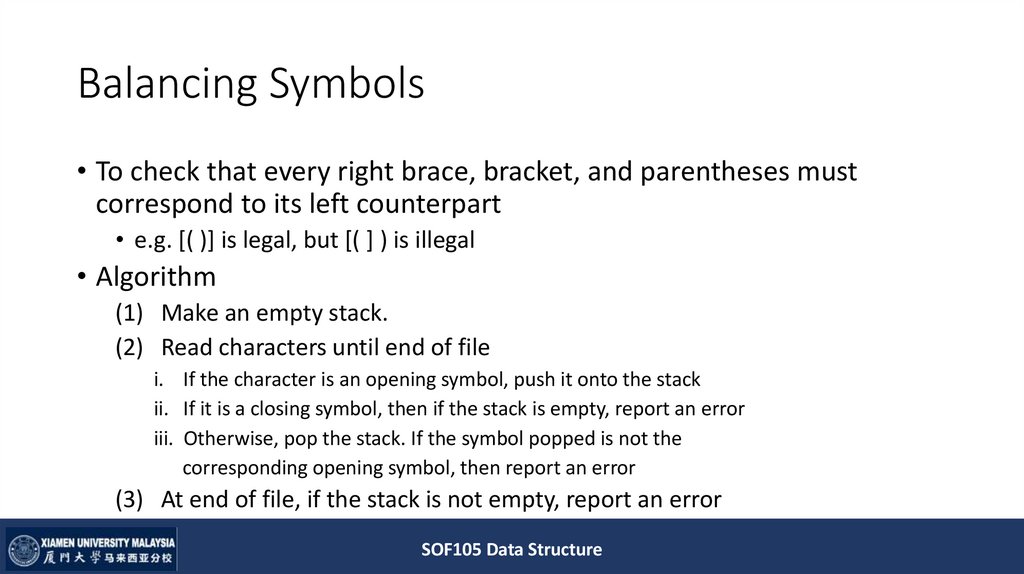
26. Balancing Symbols
• To check that every right brace, bracket, and parentheses mustcorrespond to its left counterpart
• e.g. [( )] is legal, but [( ] ) is illegal
• Algorithm
(1) Make an empty stack.
(2) Read characters until end of file
i. If the character is an opening symbol, push it onto the stack
ii. If it is a closing symbol, then if the stack is empty, report an error
iii. Otherwise, pop the stack. If the symbol popped is not the
corresponding opening symbol, then report an error
(3) At end of file, if the stack is not empty, report an error
SOF105 Data Structure
27. Queue Overview
• Queue ADT• Basic operations of queue
• Enqueuing, dequeuing etc.
• Implementation of queue
• Array
• Linked list
SOF105 Data Structure
28. Queue ADT
• Like a stack, a queue is also a list. However, with a queue, insertion isdone at one end, while deletion is performed at the other end.
• Accessing the elements of queues follows a First In, First Out (FIFO)
order.
• Like customers standing in a check-out line in a store, the first customer in is
the first customer served.
SOF105 Data Structure
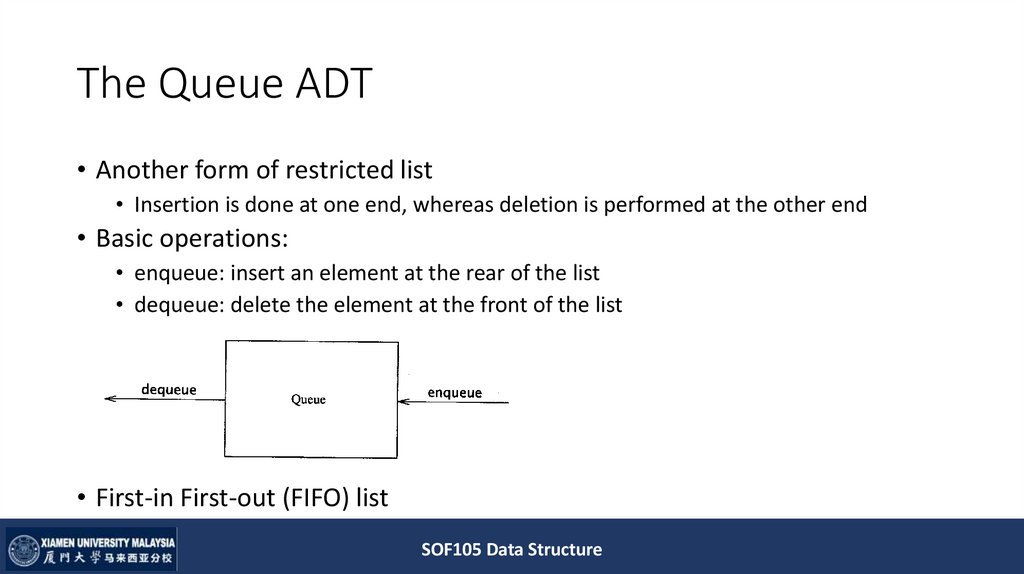
29. The Queue ADT
• Another form of restricted list• Insertion is done at one end, whereas deletion is performed at the other end
• Basic operations:
• enqueue: insert an element at the rear of the list
• dequeue: delete the element at the front of the list
• First-in First-out (FIFO) list
SOF105 Data Structure
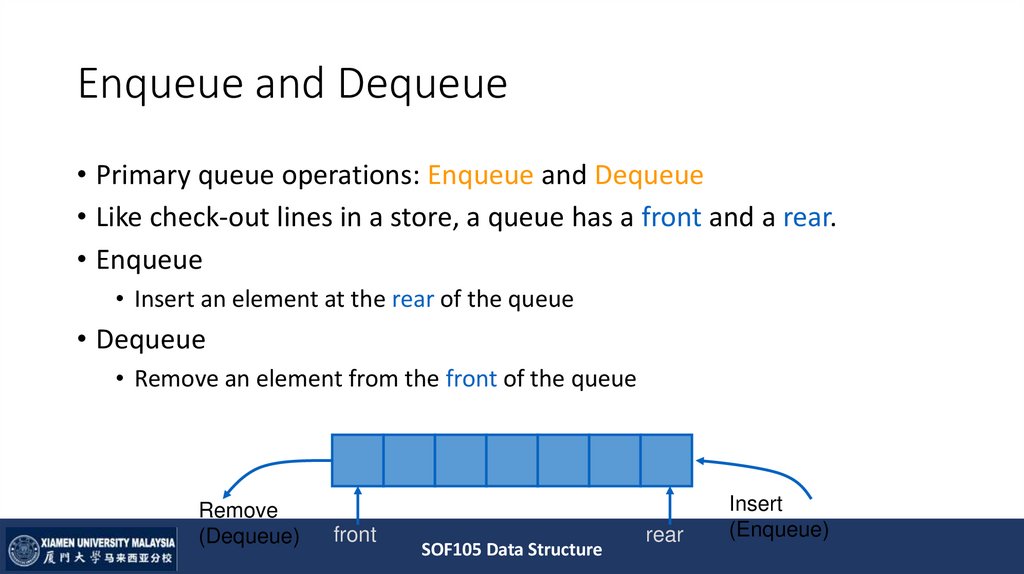
30. Enqueue and Dequeue
• Primary queue operations: Enqueue and Dequeue• Like check-out lines in a store, a queue has a front and a rear.
• Enqueue
• Insert an element at the rear of the queue
• Dequeue
• Remove an element from the front of the queue
Remove
(Dequeue)
front
SOF105 Data Structure
rear
Insert
(Enqueue)
31. Implementation of Queue
• Just as stacks can be implemented as arrays or linked lists, so withqueues.
• Dynamic queues have the same advantages over static queues as
dynamic stacks have over static stacks
SOF105 Data Structure
32. Queue Implementation of Array
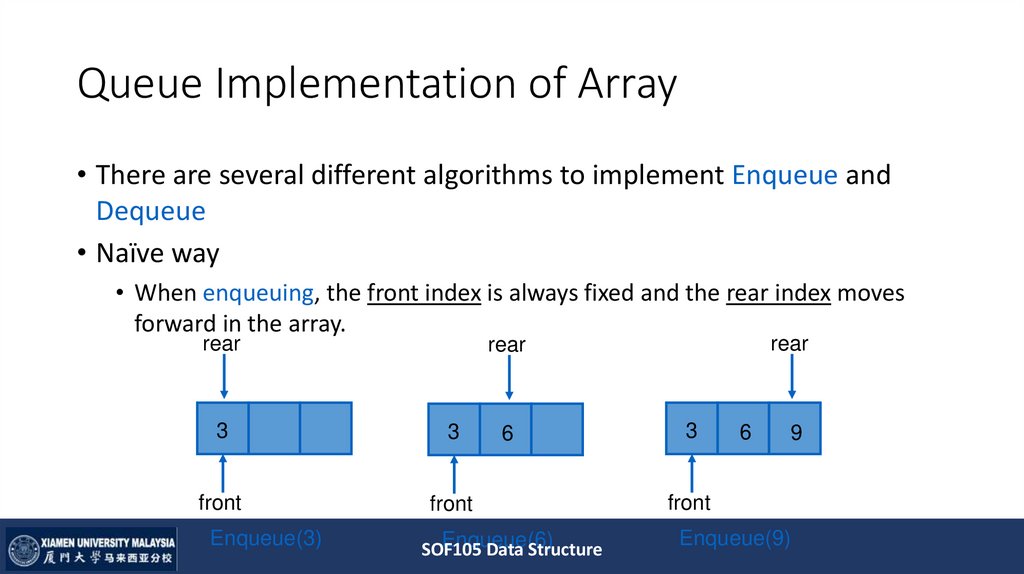
• There are several different algorithms to implement Enqueue andDequeue
• Naïve way
• When enqueuing, the front index is always fixed and the rear index moves
forward in the array.
rear
rear
rear
3
3
front
front
front
Enqueue(3)
Enqueue(6)
SOF105
Data Structure
Enqueue(9)
6
3
6
9
33. Queue Implementation of Array
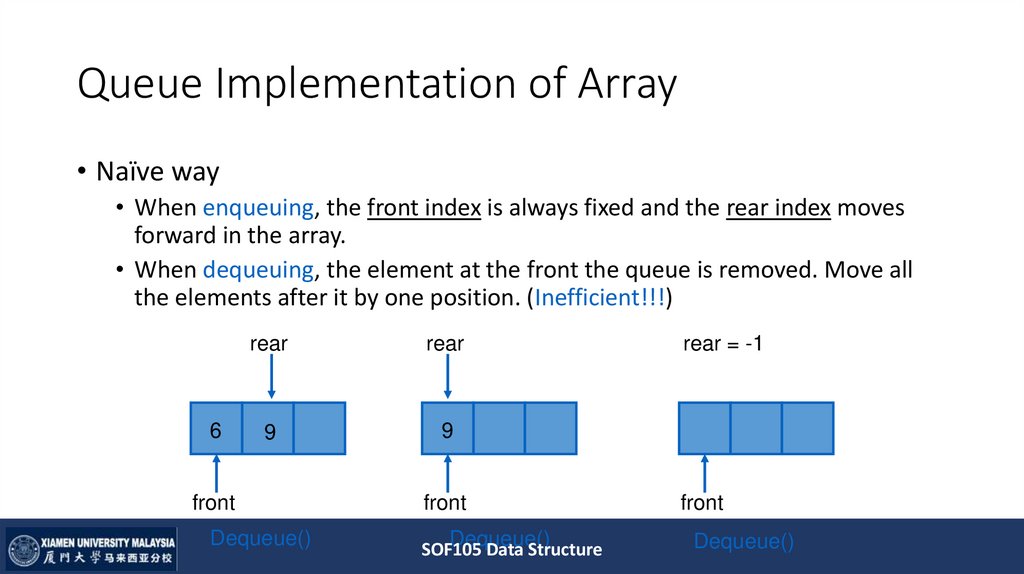
• Naïve way• When enqueuing, the front index is always fixed and the rear index moves
forward in the array.
• When dequeuing, the element at the front the queue is removed. Move all
the elements after it by one position. (Inefficient!!!)
6
rear
rear
9
9
front
Dequeue()
front
Dequeue()
SOF105 Data Structure
rear = -1
front
Dequeue()
34. Queue Implementation of Array
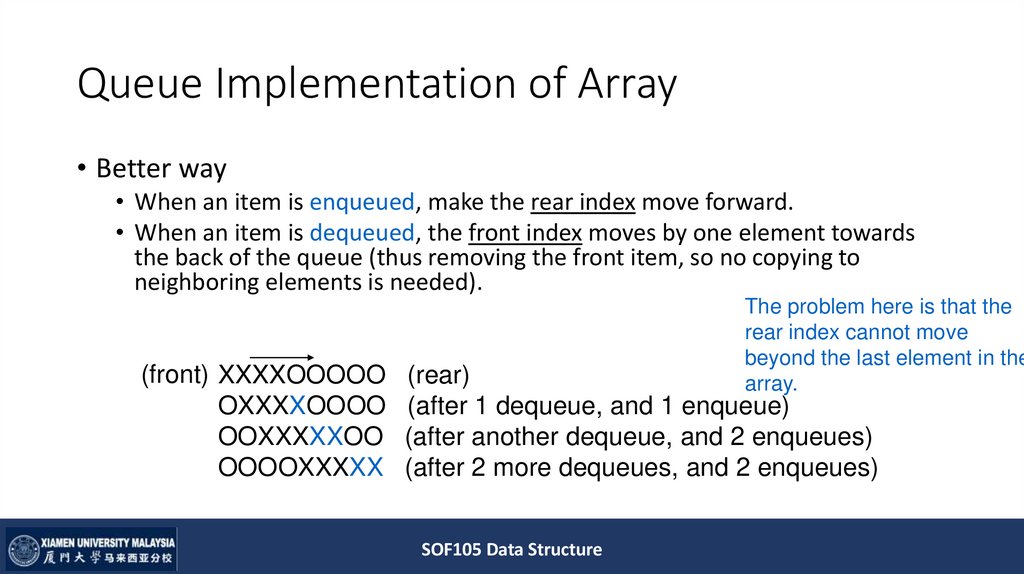
• Better way• When an item is enqueued, make the rear index move forward.
• When an item is dequeued, the front index moves by one element towards
the back of the queue (thus removing the front item, so no copying to
neighboring elements is needed).
(front) XXXXOOOOO
OXXXXOOOO
OOXXXXXOO
OOOOXXXXX
The problem here is that the
rear index cannot move
beyond the last element in the
array.
(rear)
(after 1 dequeue, and 1 enqueue)
(after another dequeue, and 2 enqueues)
(after 2 more dequeues, and 2 enqueues)
SOF105 Data Structure
35. Implementation using Circular Array
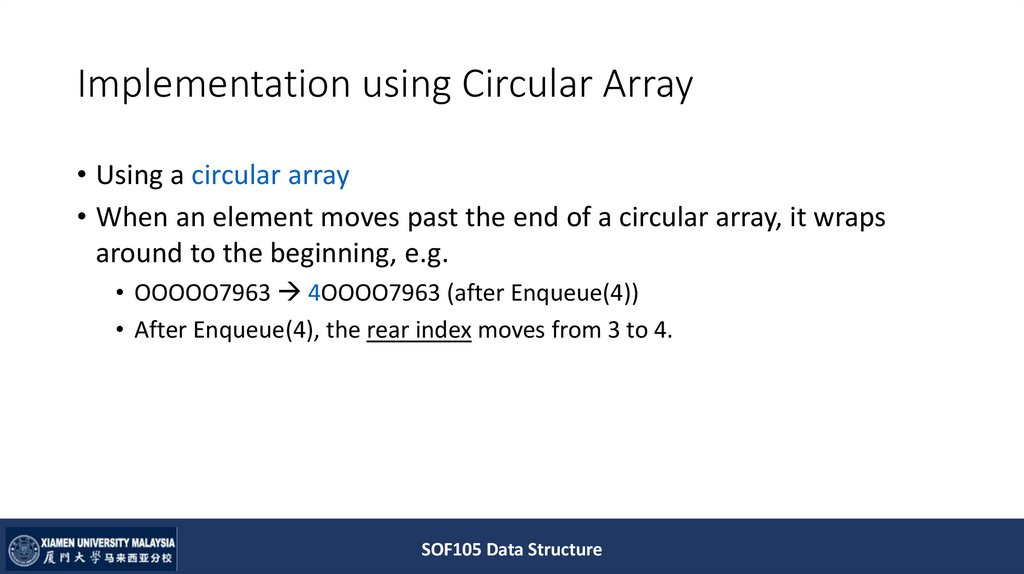
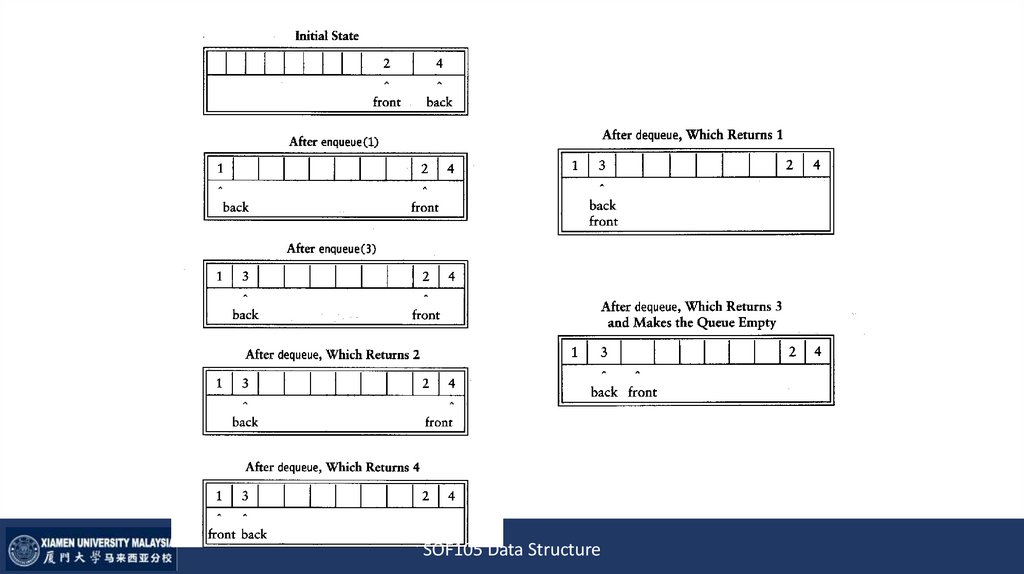
• Using a circular array• When an element moves past the end of a circular array, it wraps
around to the beginning, e.g.
• OOOOO7963 4OOOO7963 (after Enqueue(4))
• After Enqueue(4), the rear index moves from 3 to 4.
SOF105 Data Structure
36.
SOF105 Data Structure37. Empty or Full?
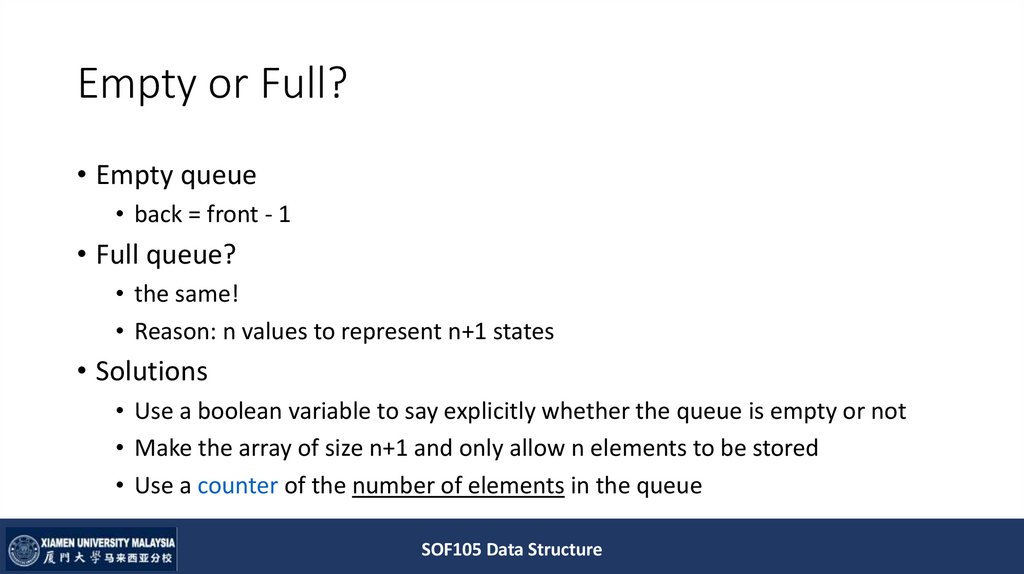
• Empty queue• back = front - 1
• Full queue?
• the same!
• Reason: n values to represent n+1 states
• Solutions
• Use a boolean variable to say explicitly whether the queue is empty or not
• Make the array of size n+1 and only allow n elements to be stored
• Use a counter of the number of elements in the queue
SOF105 Data Structure
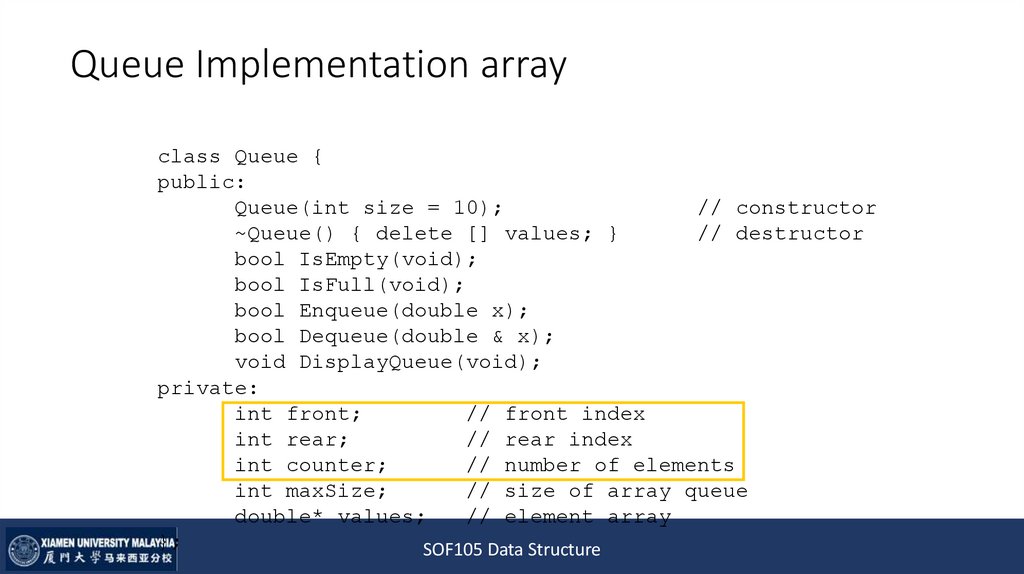
38. Queue Implementation array
class Queue {public:
Queue(int size = 10);
// constructor
~Queue() { delete [] values; }
// destructor
bool IsEmpty(void);
bool IsFull(void);
bool Enqueue(double x);
bool Dequeue(double & x);
void DisplayQueue(void);
private:
int front;
// front index
int rear;
// rear index
int counter;
// number of elements
int maxSize;
// size of array queue
double* values;
// element array
};
SOF105 Data Structure
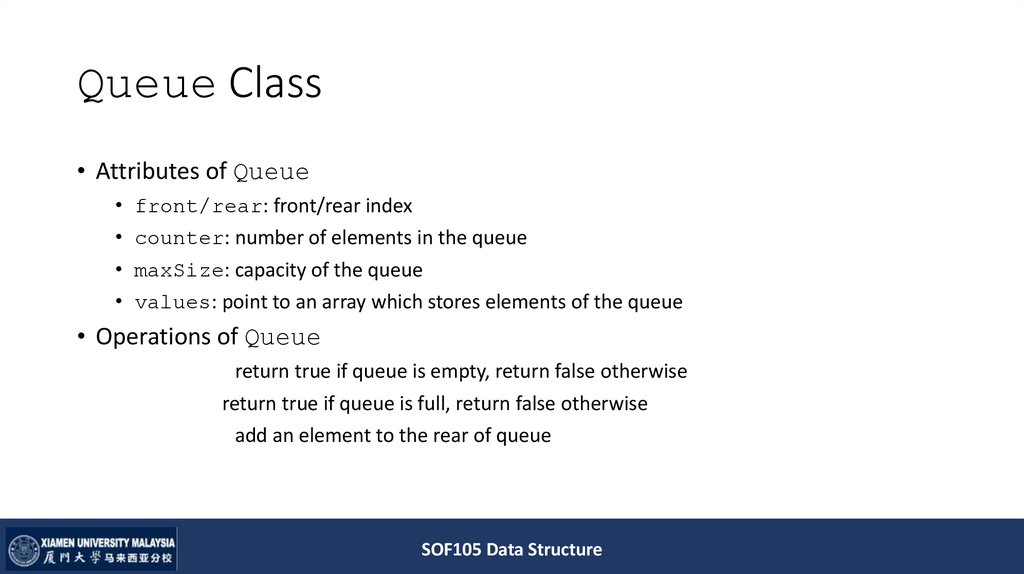
39. Queue Class
• Attributes of Queue• front/rear: front/rear index
• counter: number of elements in the queue
• maxSize: capacity of the queue
• values: point to an array which stores elements of the queue
• Operations of Queue
• IsEmpty: return true if queue is empty, return false otherwise
• IsFull: return true if queue is full, return false otherwise
• Enqueue: add an element to the rear of queue
• Dequeue: delete the element at the front of queue
• DisplayQueue: print all the data
SOF105 Data Structure
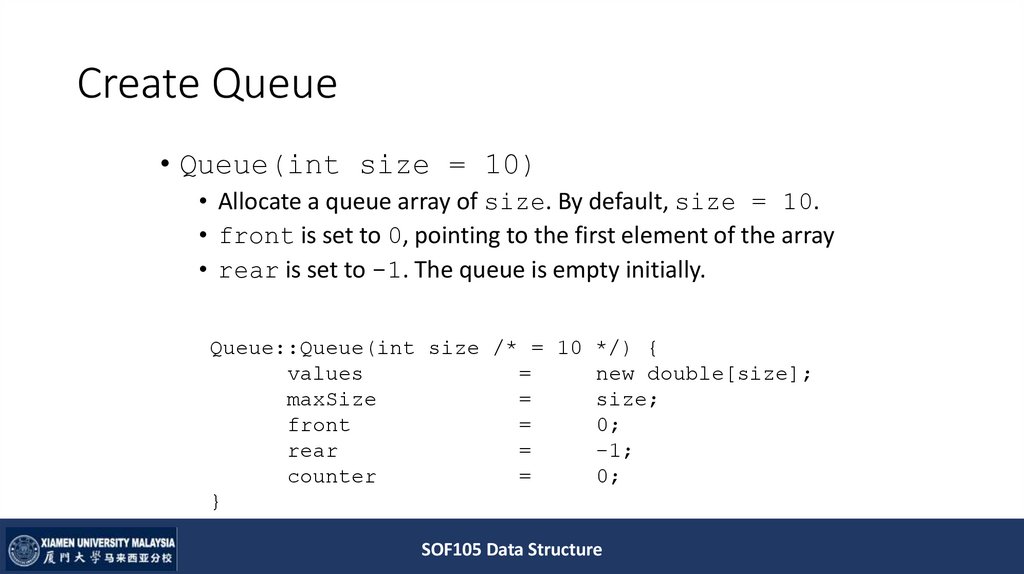
40. Create Queue
• Queue(int size = 10)• Allocate a queue array of size. By default, size = 10.
• front is set to 0, pointing to the first element of the array
• rear is set to -1. The queue is empty initially.
Queue::Queue(int size /* = 10 */) {
values
=
new double[size];
maxSize
=
size;
front
=
0;
rear
=
-1;
counter
=
0;
}
SOF105 Data Structure
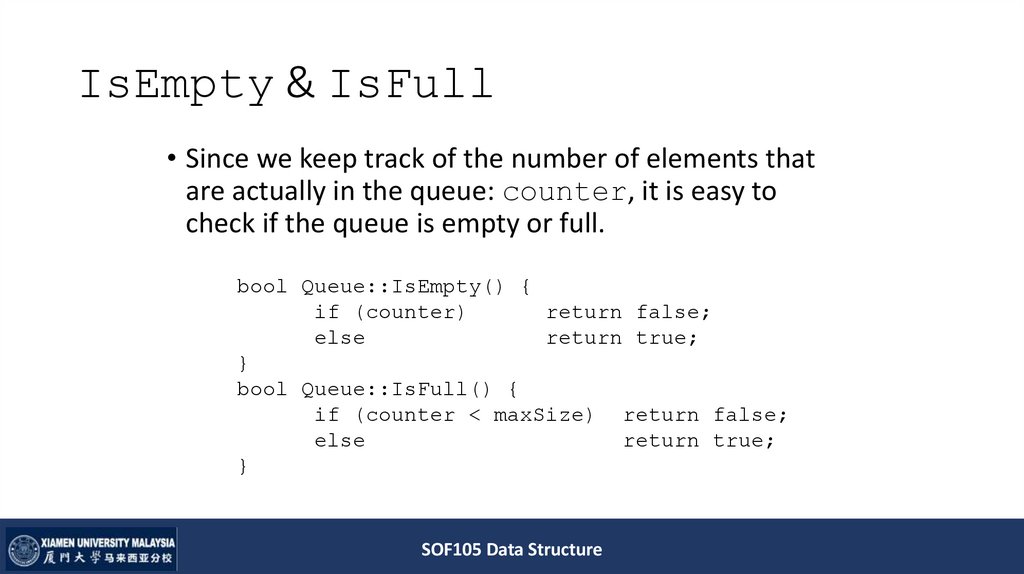
41. IsEmpty & IsFull
IsEmpty & IsFull• Since we keep track of the number of elements that
are actually in the queue: counter, it is easy to
check if the queue is empty or full.
bool Queue::IsEmpty() {
if (counter)
return false;
else
return true;
}
bool Queue::IsFull() {
if (counter < maxSize) return false;
else
return true;
}
SOF105 Data Structure
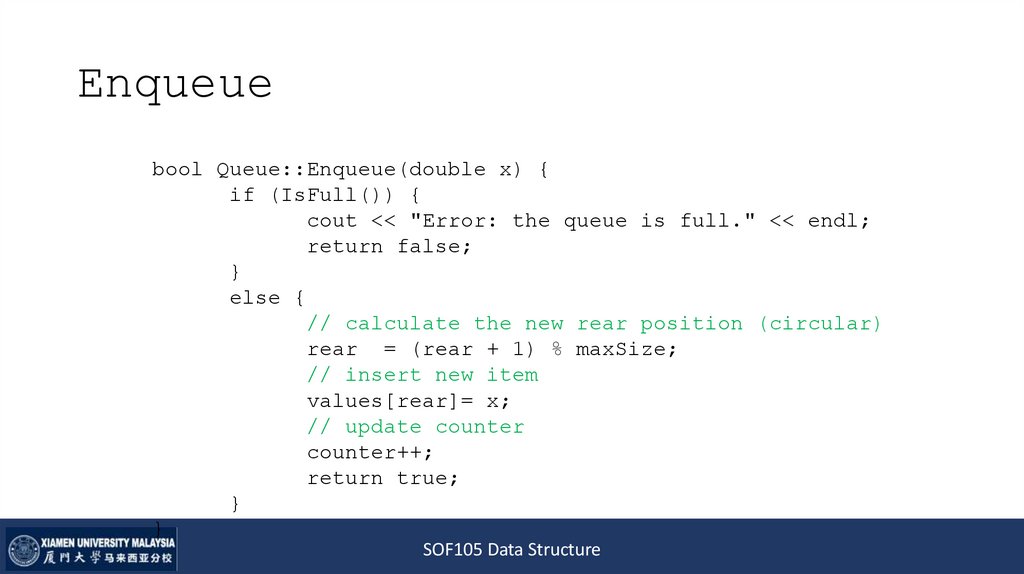
42. Enqueue
bool Queue::Enqueue(double x) {if (IsFull()) {
cout << "Error: the queue is full." << endl;
return false;
}
else {
// calculate the new rear position (circular)
rear = (rear + 1) % maxSize;
// insert new item
values[rear]= x;
// update counter
counter++;
return true;
}
}
SOF105 Data Structure
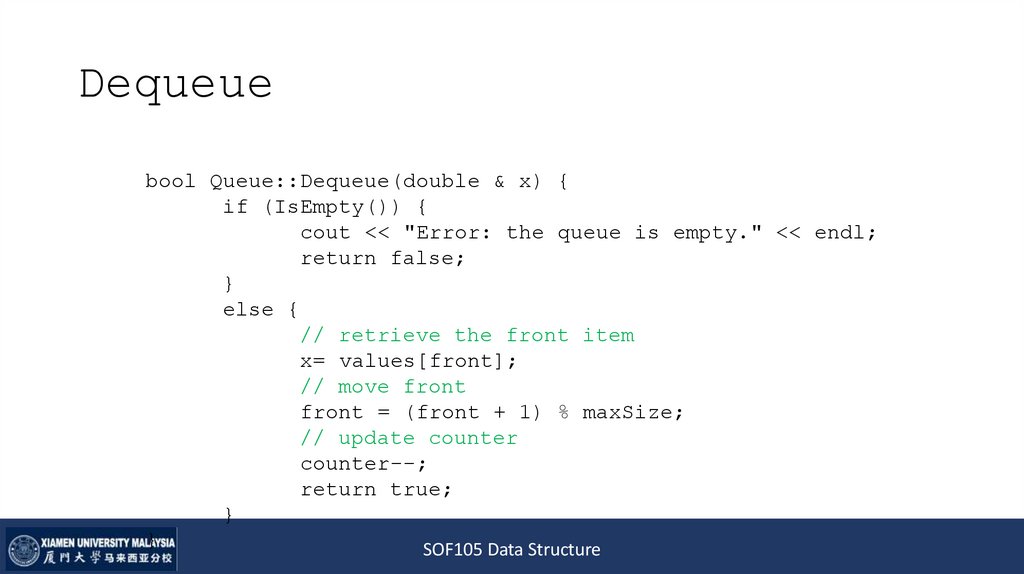
43. Dequeue
bool Queue::Dequeue(double & x) {if (IsEmpty()) {
cout << "Error: the queue is empty." << endl;
return false;
}
else {
// retrieve the front item
x= values[front];
// move front
front = (front + 1) % maxSize;
// update counter
counter--;
return true;
}
}
SOF105 Data Structure
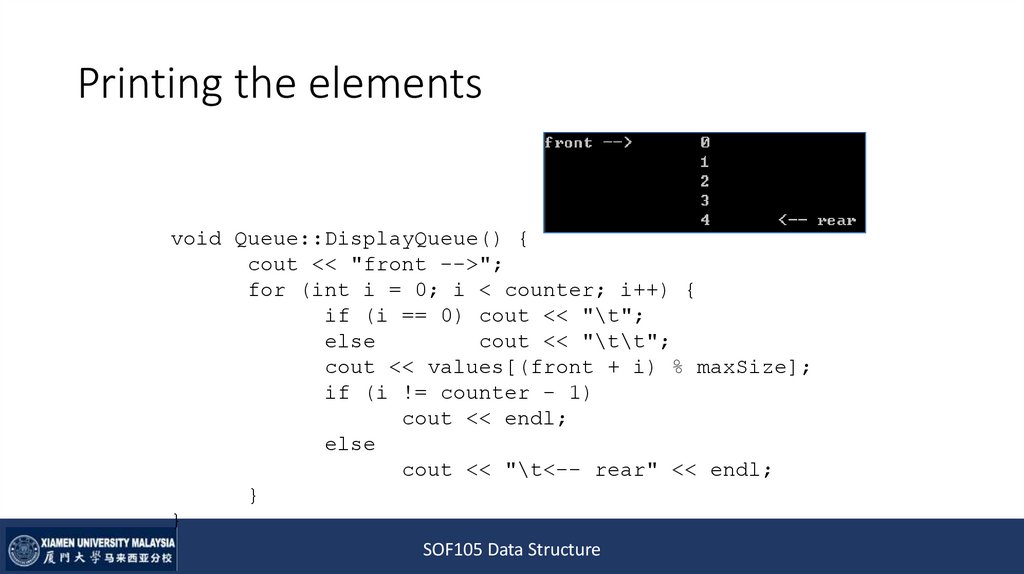
44. Printing the elements
void Queue::DisplayQueue() {cout << "front -->";
for (int i = 0; i < counter; i++) {
if (i == 0) cout << "\t";
else
cout << "\t\t";
cout << values[(front + i) % maxSize];
if (i != counter - 1)
cout << endl;
else
cout << "\t<-- rear" << endl;
}
}
SOF105 Data Structure
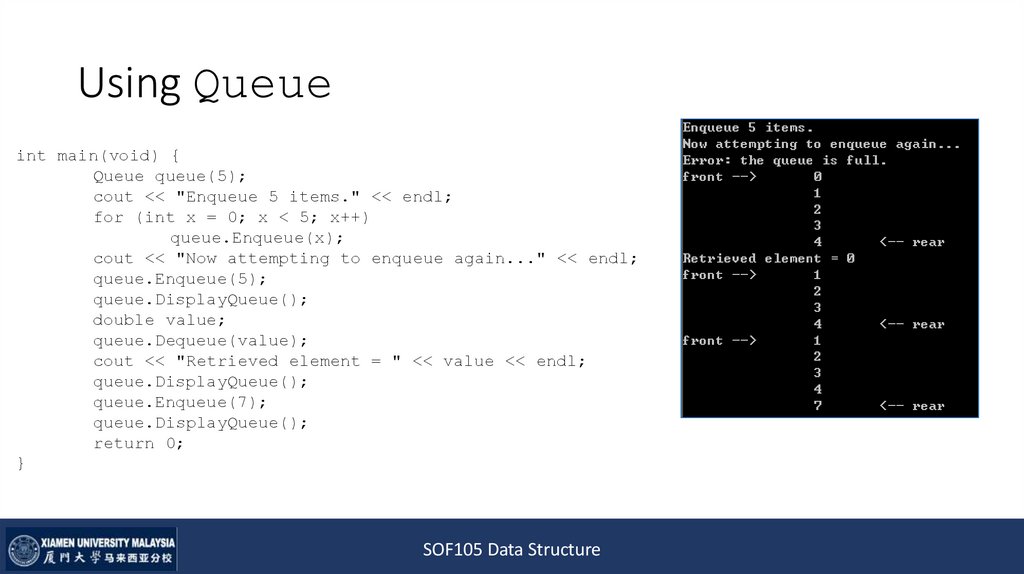
45. Using Queue
int main(void) {Queue queue(5);
cout << "Enqueue 5 items." << endl;
for (int x = 0; x < 5; x++)
queue.Enqueue(x);
cout << "Now attempting to enqueue again..." << endl;
queue.Enqueue(5);
queue.DisplayQueue();
double value;
queue.Dequeue(value);
cout << "Retrieved element = " << value << endl;
queue.DisplayQueue();
queue.Enqueue(7);
queue.DisplayQueue();
return 0;
}
SOF105 Data Structure
46. Queue Implementation based on Linked List
class Queue {public:
Queue() {
// constructor
front = rear = NULL;
counter = 0;
}
~Queue() {
// destructor
double value;
while (!IsEmpty()) Dequeue(value);
}
bool IsEmpty() {
if (counter)
return false;
else
return true;
}
void Enqueue(double x);
bool Dequeue(double & x);
void DisplayQueue(void);
private:
Node* front;
// pointer to front node
Node* rear;
// pointer to last node
int counter;
// number of elements
};
SOF105 Data Structure
47. Enqueue
void Queue::Enqueue(double x) {Node* newNode
=
new Node;
newNode->data
=
x;
newNode->next
=
NULL;
if (IsEmpty()) {
front
=
newNode;
rear
=
newNode;
}
else {
8
rear->next =
newNode;
rear
=
newNode;
}
8
5
counter++;
}
SOF105 Data Structure
rear
5
rear
newNode
48. Dequeue
bool Queue::Dequeue(double & x) {if (IsEmpty()) {
cout << "Error: the queue is empty." << endl;
return false;
}
else {
x
=
front->data;
Node* nextNode
=
front->next;
delete front;
front
=
nextNode;
counter--;
}
front
}
3
8
5
front
8
5
SOF105 Data Structure
49. Printing all the elements
void Queue::DisplayQueue() {cout << "front -->";
Node* currNode
=
front;
for (int i = 0; i < counter; i++) {
if (i == 0) cout << "\t";
else
cout << "\t\t";
cout << currNode->data;
if (i != counter - 1)
cout << endl;
else
cout << "\t<-- rear" << endl;
currNode
=
currNode->next;
}
}
SOF105 Data Structure
50. Result
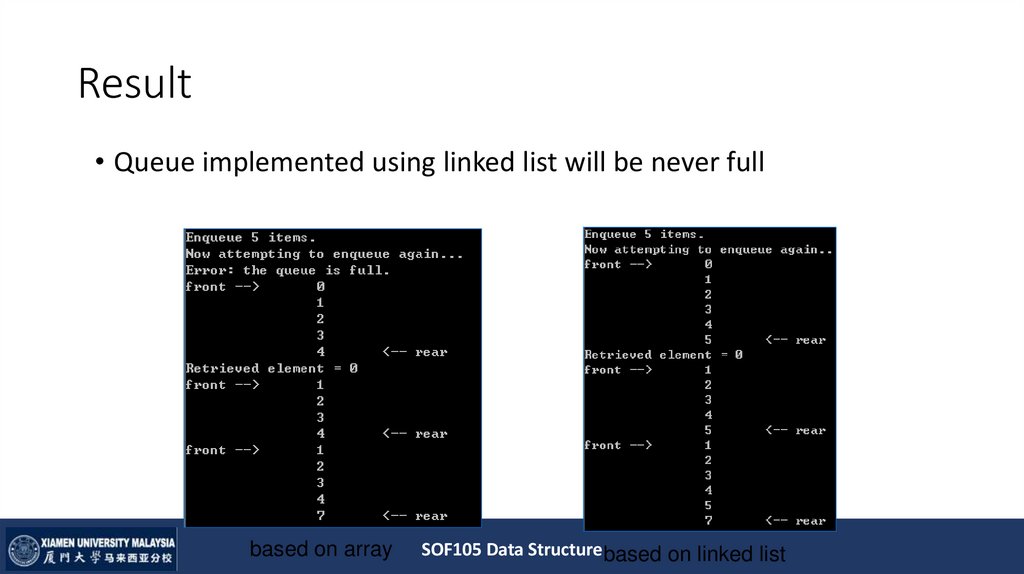
• Queue implemented using linked list will be never fullbased on array
SOF105 Data Structure based on linked list