 mechanics
Similar presentations:





Work, Energy and Power
1.
EE007-4-0 Mechanics For EngineersTopic 12 : Work, Energy and Power
EE007-4-0 Mechanics For Engineers
Work, Energy and Power
SLIDE 1
2. TOPIC LEARNING OUTCOMES
At the end of this topic, you should be able to:1. define work, energy and power
2. understands mechanical energy and how to calculate it.
3. relate work and energy with power
4. calculate power and also work done by weight, external forces and friction
EE007-4-0 Mechanics For Engineers
Work, Energy and Power
SLIDE 2
3. Contents & Structure
Contents & Structure• Work
• Energy
• Power
EE007-4-0 Mechanics For Engineers
Work, Energy and Power
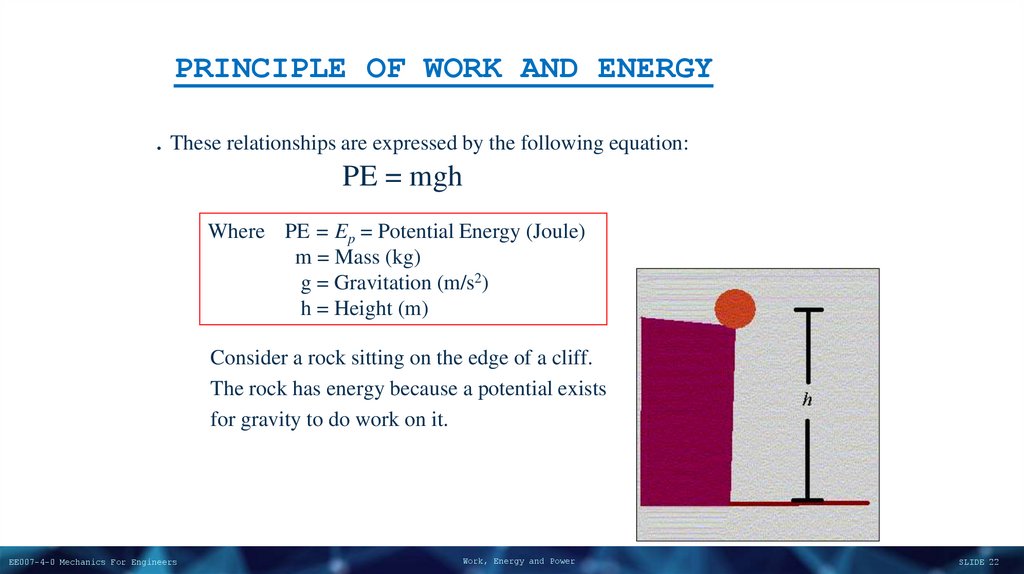
SLIDE 3
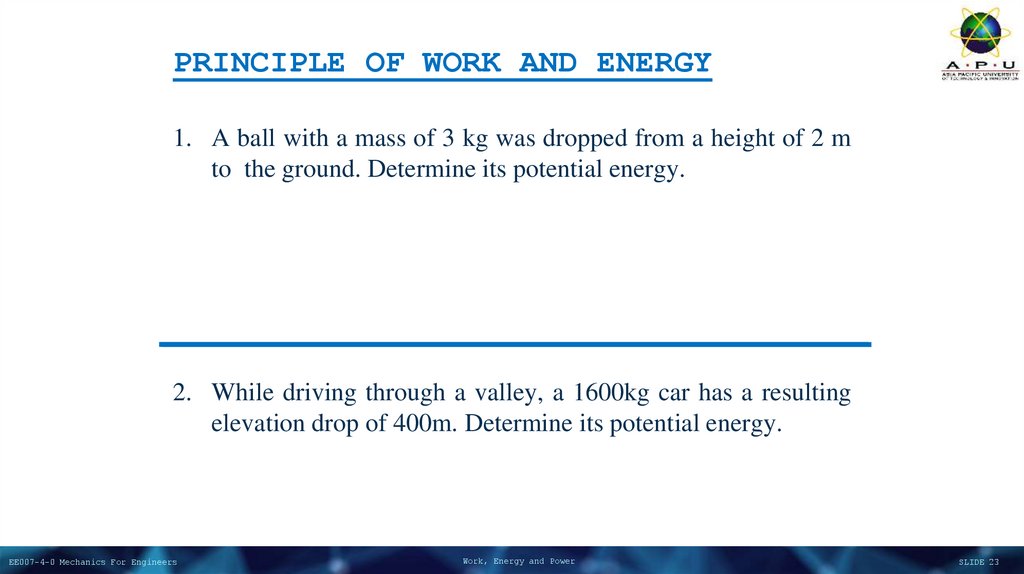
4. Recap From Last Lesson
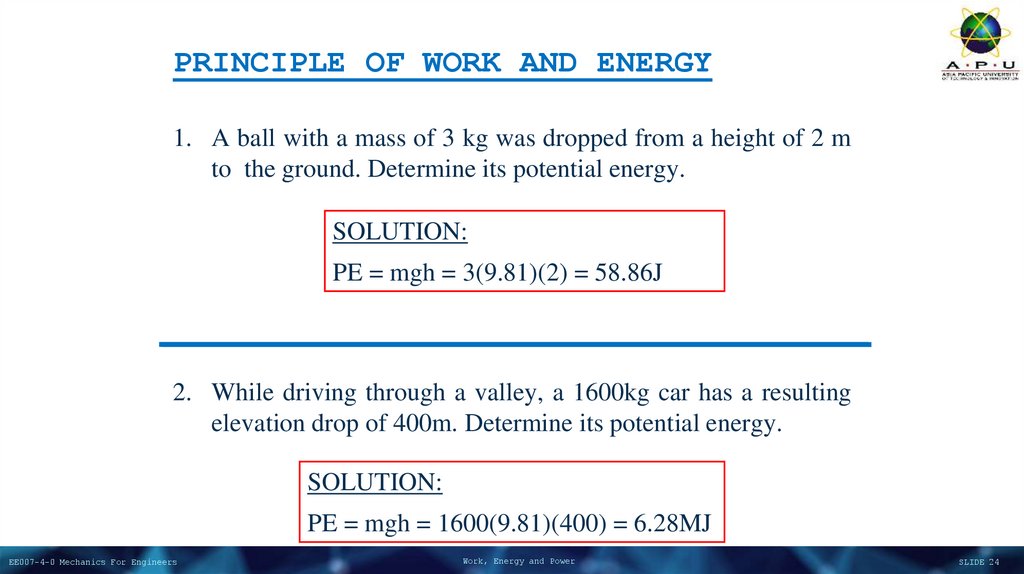
• Angular MotionEE007-4-0 Mechanics For Engineers
Work, Energy and Power
SLIDE 4
5. WORK OF A FORCE
Teaching ContentsWORK OF A FORCE
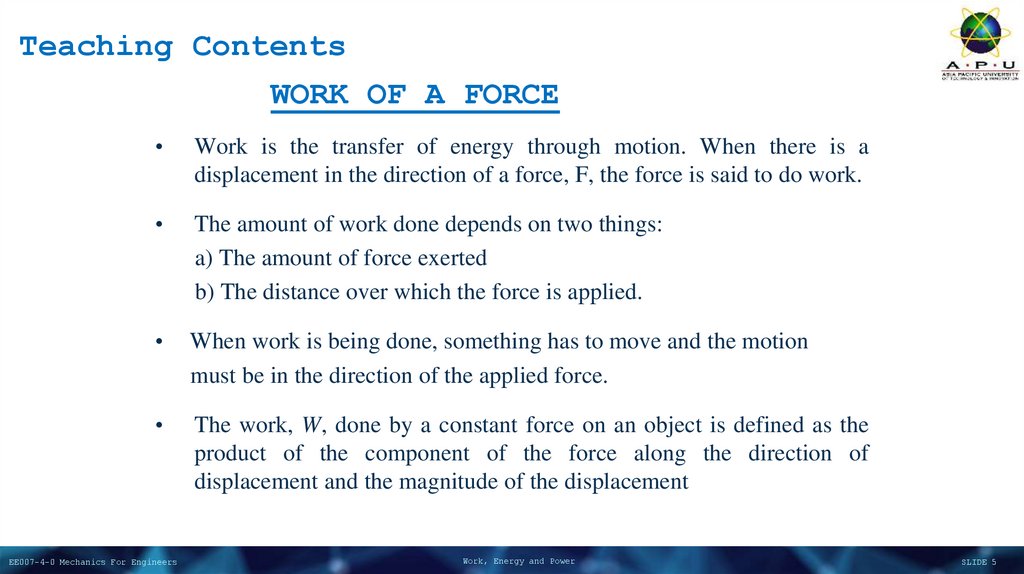
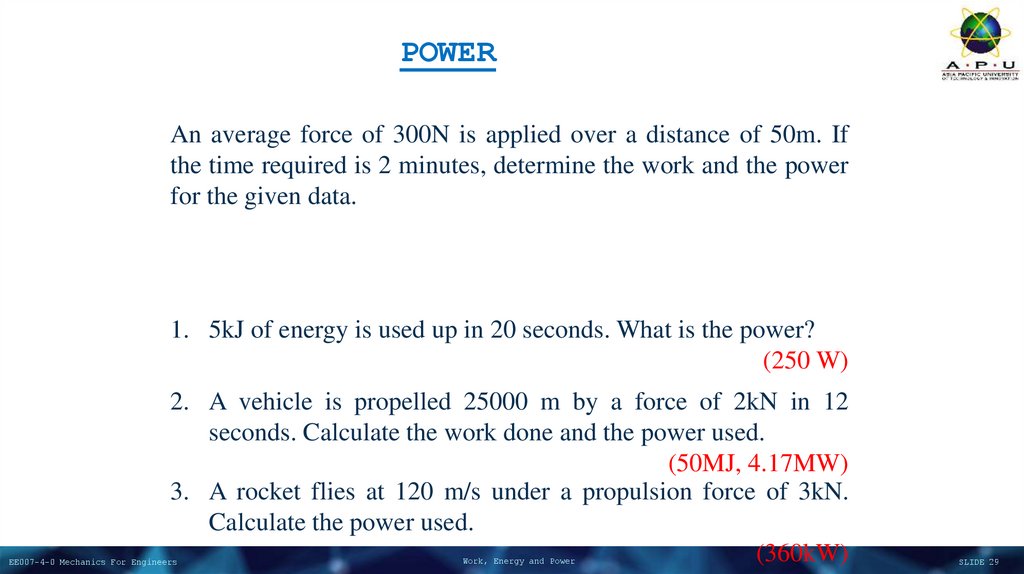
Work is the transfer of energy through motion. When there is a
displacement in the direction of a force, F, the force is said to do work.
The amount of work done depends on two things:
a) The amount of force exerted
b) The distance over which the force is applied.
When work is being done, something has to move and the motion
must be in the direction of the applied force.
The work, W, done by a constant force on an object is defined as the
product of the component of the force along the direction of
displacement and the magnitude of the displacement
EE007-4-0 Mechanics For Engineers
Work, Energy and Power
SLIDE 5
6. WORK OF A FORCE
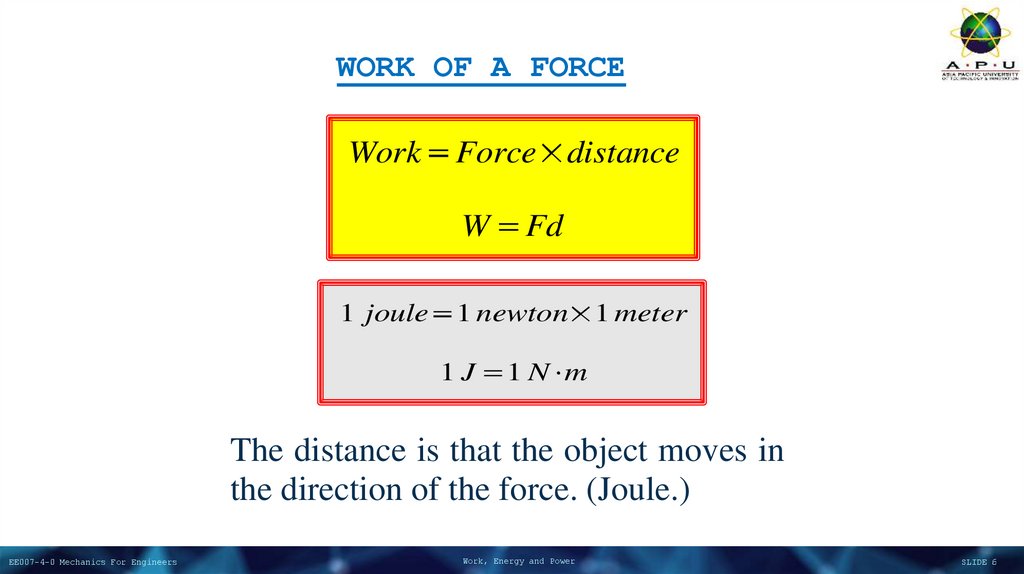
WorkForce distance
W
1 joule
Fd
1 newton 1 meter
1J
1N m
The distance is that the object moves in
the direction of the force. (Joule.)
EE007-4-0 Mechanics For Engineers
Work, Energy and Power
SLIDE 6
7.
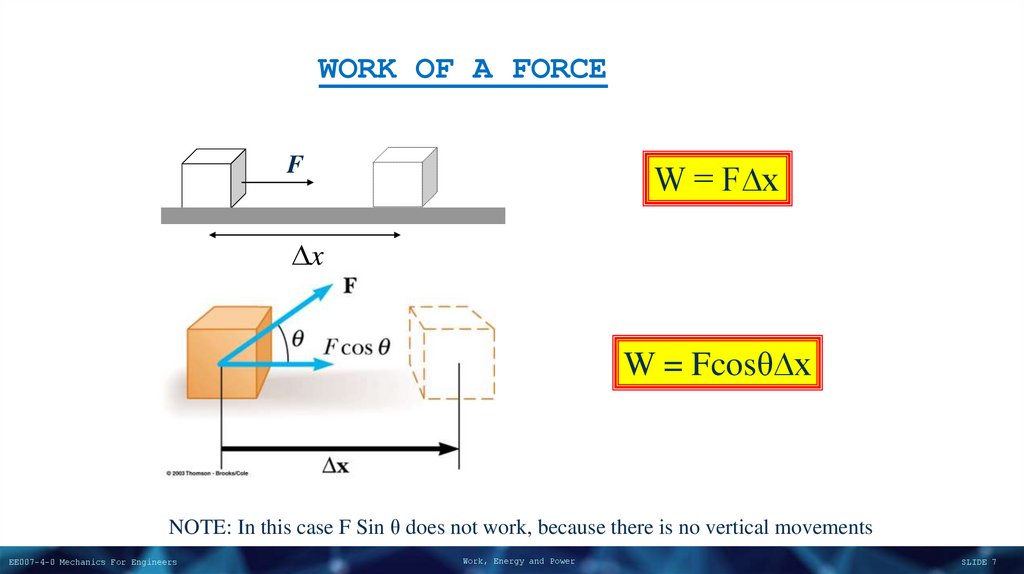
WORK OF A FORCEF
W = F∆x
x
W = Fcosθ∆x
NOTE: In this case F Sin θ does not work, because there is no vertical movements
EE007-4-0 Mechanics For Engineers
Work, Energy and Power
SLIDE 7
8. WORK OF A FORCE
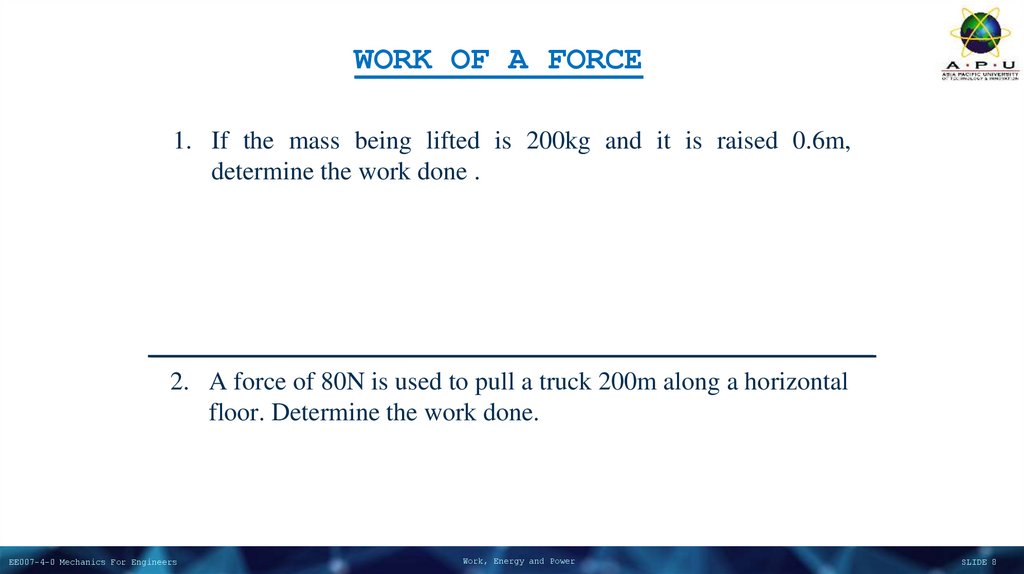
1. If the mass being lifted is 200kg and it is raised 0.6m,determine the work done .
2. A force of 80N is used to pull a truck 200m along a horizontal
floor. Determine the work done.
EE007-4-0 Mechanics For Engineers
Work, Energy and Power
SLIDE 8
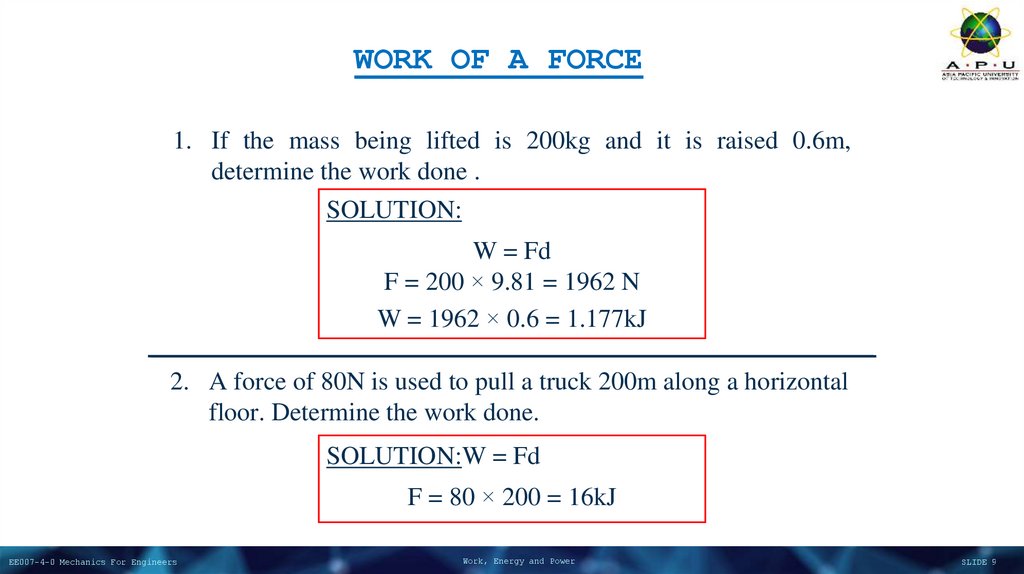
9. WORK OF A FORCE
1. If the mass being lifted is 200kg and it is raised 0.6m,determine the work done .
SOLUTION:
W = Fd
F = 200 × 9.81 = 1962 N
W = 1962 × 0.6 = 1.177kJ
2. A force of 80N is used to pull a truck 200m along a horizontal
floor. Determine the work done.
SOLUTION:W = Fd
F = 80 × 200 = 16kJ
EE007-4-0 Mechanics For Engineers
Work, Energy and Power
SLIDE 9
10.
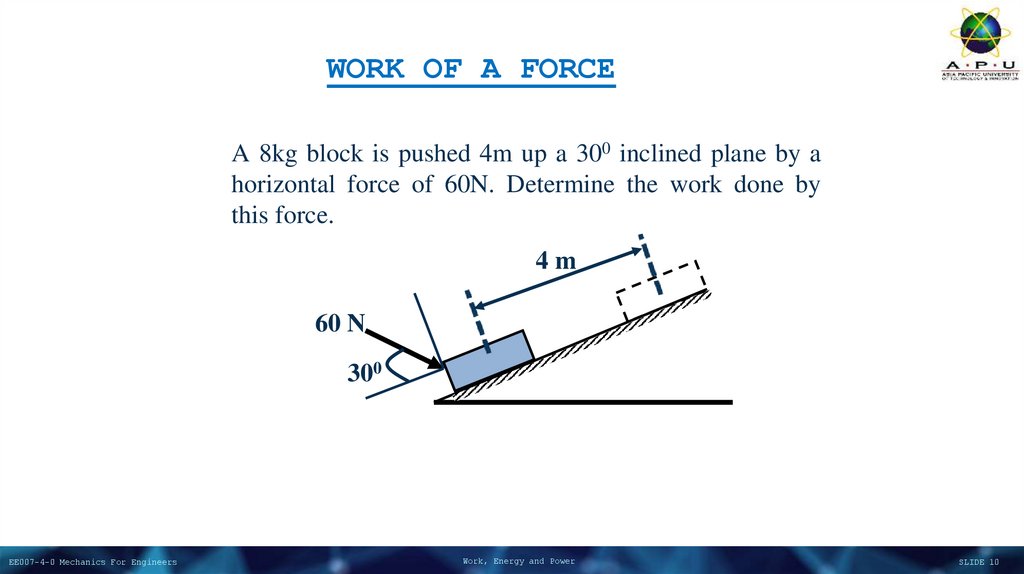
WORK OF A FORCEA 8kg block is pushed 4m up a 300 inclined plane by a
horizontal force of 60N. Determine the work done by
this force.
4m
60 N
300
EE007-4-0 Mechanics For Engineers
Work, Energy and Power
SLIDE 10
11.
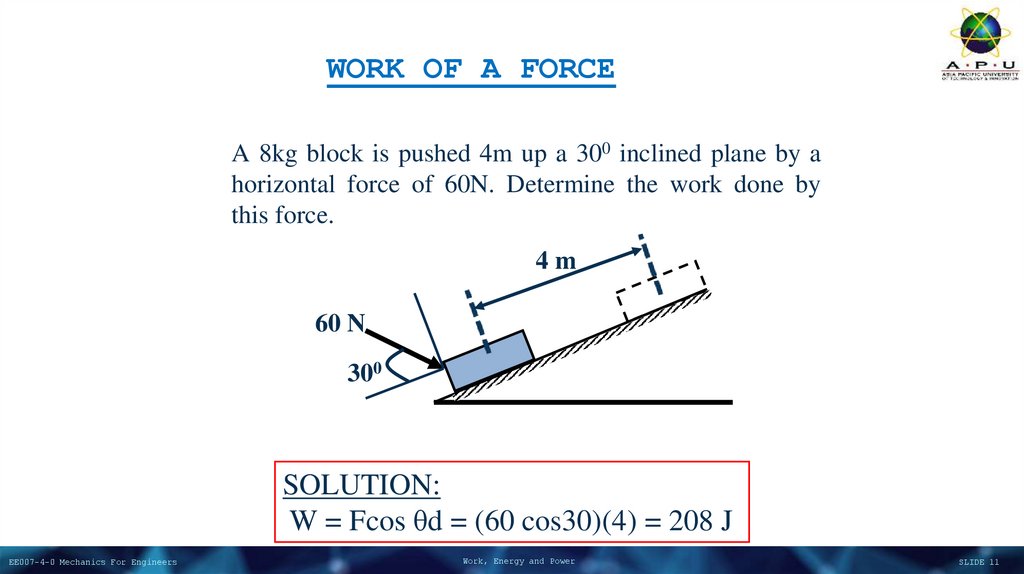
WORK OF A FORCEA 8kg block is pushed 4m up a 300 inclined plane by a
horizontal force of 60N. Determine the work done by
this force.
4m
60 N
300
SOLUTION:
W = Fcos θd = (60 cos30)(4) = 208 J
EE007-4-0 Mechanics For Engineers
Work, Energy and Power
SLIDE 11
12. PRINCIPLE OF WORK AND ENERGY
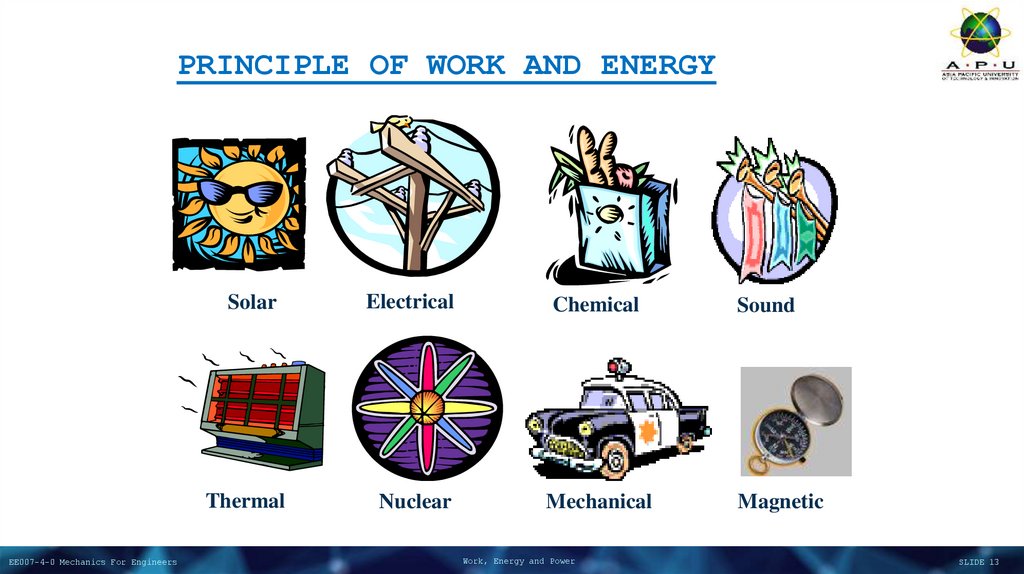
• Energy is defined as the capacity to do work. Energy cannot bedestroyed, it can only be transferred.
• Examples of types of energy include:
– Chemical
– Solar
– Nuclear
– Electrical
– Thermal (heat)
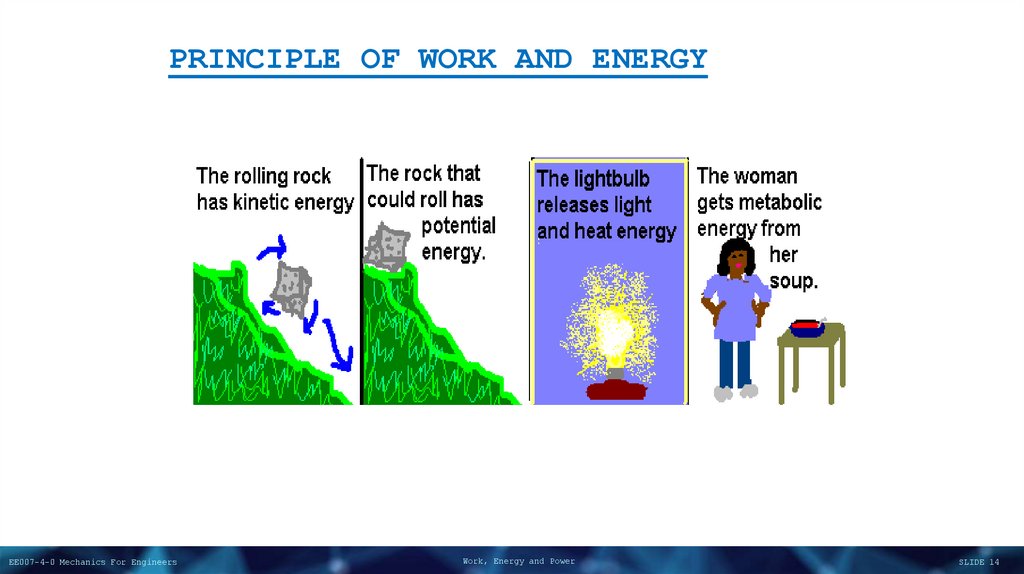
• Mechanical energy can be classified into:
– Kinetic
– Potential
EE007-4-0 Mechanics For Engineers
Work, Energy and Power
SLIDE 12
13. PRINCIPLE OF WORK AND ENERGY
EE007-4-0 Mechanics For EngineersSolar
Electrical
Chemical
Sound
Thermal
Nuclear
Mechanical
Magnetic
Work, Energy and Power
SLIDE 13
14.
PRINCIPLE OF WORK AND ENERGYEE007-4-0 Mechanics For Engineers
Work, Energy and Power
SLIDE 14
15.
PRINCIPLE OF WORK AND ENERGYKINETIC ENERGY
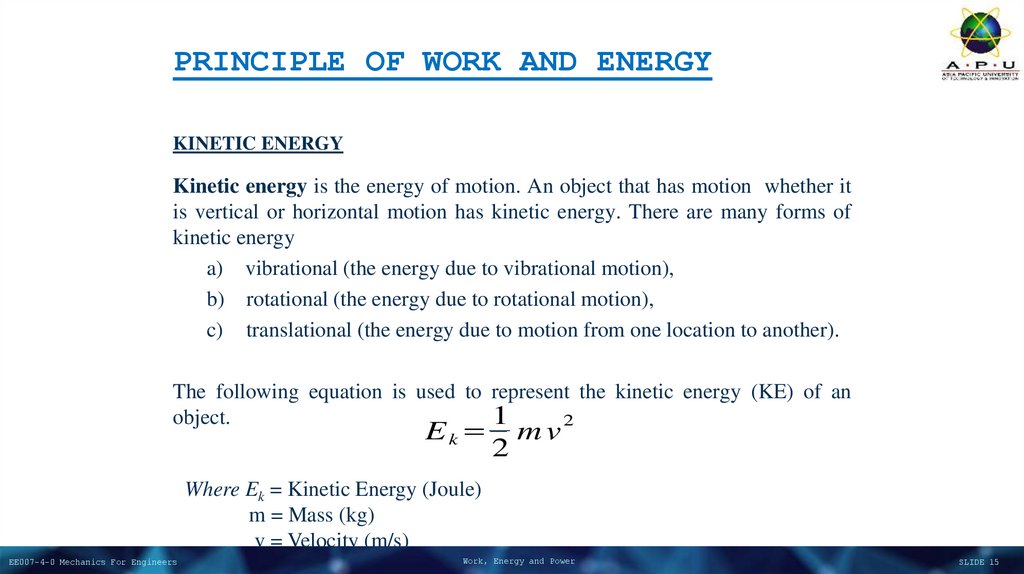
Kinetic energy is the energy of motion. An object that has motion whether it
is vertical or horizontal motion has kinetic energy. There are many forms of
kinetic energy
a) vibrational (the energy due to vibrational motion),
b) rotational (the energy due to rotational motion),
c) translational (the energy due to motion from one location to another).
The following equation is used to represent the kinetic energy (KE) of an
1
object.
2
Ek
2
mv
Where Ek = Kinetic Energy (Joule)
m = Mass (kg)
v = Velocity (m/s)
EE007-4-0 Mechanics For Engineers
Work, Energy and Power
SLIDE 15
16.
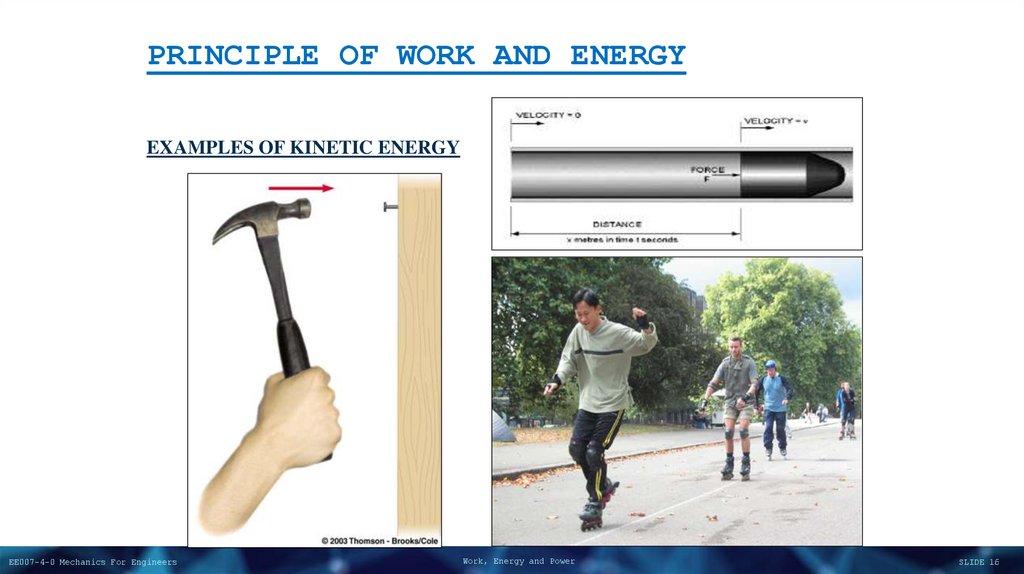
PRINCIPLE OF WORK AND ENERGYEXAMPLES OF KINETIC ENERGY
EE007-4-0 Mechanics For Engineers
Work, Energy and Power
SLIDE 16
17.
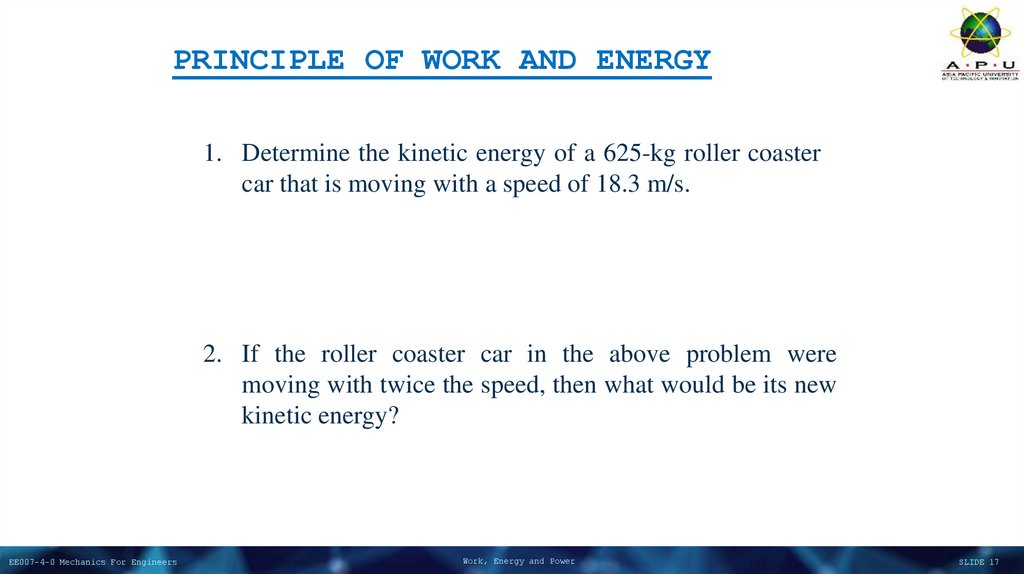
PRINCIPLE OF WORK AND ENERGY1. Determine the kinetic energy of a 625-kg roller coaster
car that is moving with a speed of 18.3 m/s.
2. If the roller coaster car in the above problem were
moving with twice the speed, then what would be its new
kinetic energy?
EE007-4-0 Mechanics For Engineers
Work, Energy and Power
SLIDE 17
18.
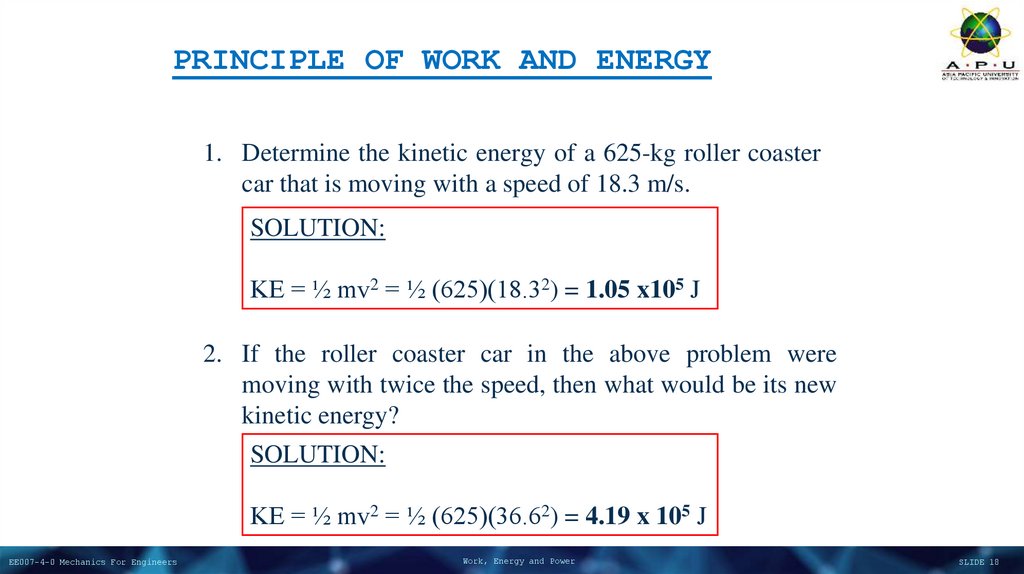
PRINCIPLE OF WORK AND ENERGY1. Determine the kinetic energy of a 625-kg roller coaster
car that is moving with a speed of 18.3 m/s.
SOLUTION:
KE = ½ mv2 = ½ (625)(18.32) = 1.05 x10⁵ J
2. If the roller coaster car in the above problem were
moving with twice the speed, then what would be its new
kinetic energy?
SOLUTION:
KE = ½ mv2 = ½ (625)(36.62) = 4.19 x 10⁵ J
EE007-4-0 Mechanics For Engineers
Work, Energy and Power
SLIDE 18
19.
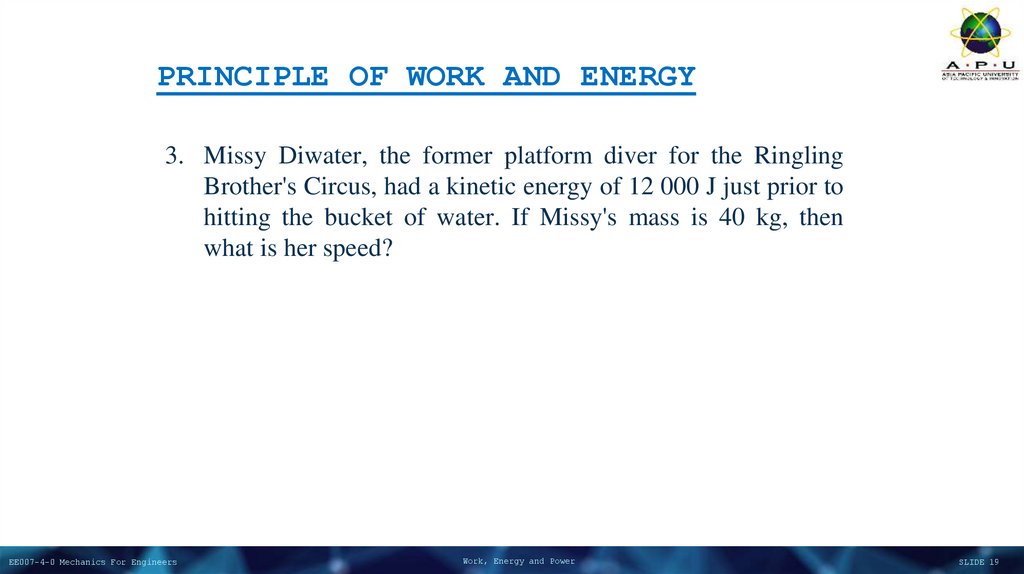
PRINCIPLE OF WORK AND ENERGY3. Missy Diwater, the former platform diver for the Ringling
Brother's Circus, had a kinetic energy of 12 000 J just prior to
hitting the bucket of water. If Missy's mass is 40 kg, then
what is her speed?
EE007-4-0 Mechanics For Engineers
Work, Energy and Power
SLIDE 19
20.
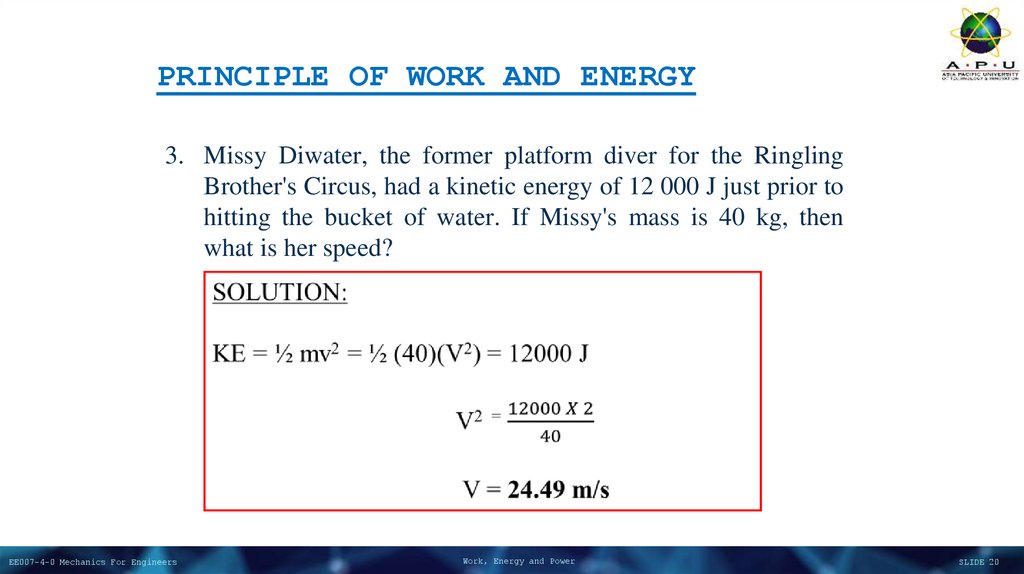
PRINCIPLE OF WORK AND ENERGY3. Missy Diwater, the former platform diver for the Ringling
Brother's Circus, had a kinetic energy of 12 000 J just prior to
hitting the bucket of water. If Missy's mass is 40 kg, then
what is her speed?
EE007-4-0 Mechanics For Engineers
Work, Energy and Power
SLIDE 20
21.
PRINCIPLE OF WORK AND ENERGYPOTENTIAL ENERGY
• The stored energy of position is referred to as potential energy. Potential
energy is the stored energy of position possessed by an object.
• For example:
a) Wound up clock (work done on spring)
b) Brick held up in the air (gravitational)
• Gravitational potential energy is the energy stored in an object as the result
of its vertical position or height.
• There is a direct relation between gravitational potential energy and the
mass of an object. More massive objects have greater gravitational
potential energy. There is also a direct relation between gravitational
potential energy and the height of an object. The higher that an object is
elevated, the greater the gravitational potential energy
EE007-4-0 Mechanics For Engineers
Work, Energy and Power
SLIDE 21
22.
PRINCIPLE OF WORK AND ENERGY. These relationships are expressed by the following equation:
PE = mgh
Where PE = Ep = Potential Energy (Joule)
m = Mass (kg)
g = Gravitation (m/s2)
h = Height (m)
Consider a rock sitting on the edge of a cliff.
The rock has energy because a potential exists
for gravity to do work on it.
EE007-4-0 Mechanics For Engineers
Work, Energy and Power
SLIDE 22
23.
PRINCIPLE OF WORK AND ENERGY1. A ball with a mass of 3 kg was dropped from a height of 2 m
to the ground. Determine its potential energy.
2. While driving through a valley, a 1600kg car has a resulting
elevation drop of 400m. Determine its potential energy.
EE007-4-0 Mechanics For Engineers
Work, Energy and Power
SLIDE 23
24.
PRINCIPLE OF WORK AND ENERGY1. A ball with a mass of 3 kg was dropped from a height of 2 m
to the ground. Determine its potential energy.
SOLUTION:
PE = mgh = 3(9.81)(2) = 58.86J
2. While driving through a valley, a 1600kg car has a resulting
elevation drop of 400m. Determine its potential energy.
SOLUTION:
PE = mgh = 1600(9.81)(400) = 6.28MJ
EE007-4-0 Mechanics For Engineers
Work, Energy and Power
SLIDE 24
25. CONSERVATON OF ENERGY
• Energy is never created nor destroyed.• Whenever a force does work, energy changes form.
• Examples:
– A falling object has potential energy changing to kinetic
energy.
– A sliding object (subject to friction) has kinetic energy
changing to thermal energy.
• When a particle moves under the action of conservative
forces, the sum of kinetic energy and potential energy remains
constant.
(KE)1 + (PE)1 = (KE)2 + (PE)2
EE007-4-0 Mechanics For Engineers
Work, Energy and Power
SLIDE 25
26.
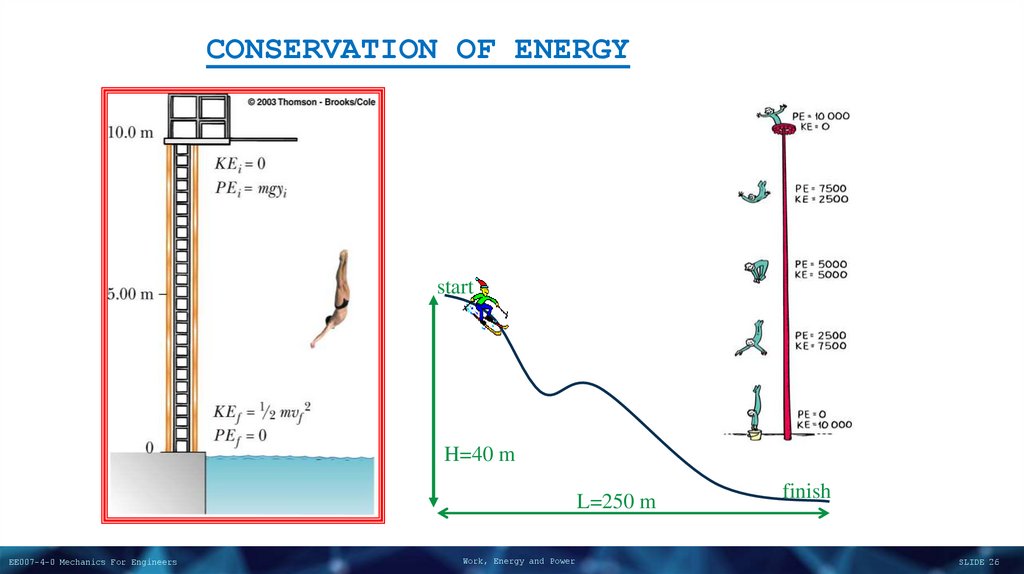
CONSERVATION OF ENERGYstart
H=40 m
L=250 m
EE007-4-0 Mechanics For Engineers
Work, Energy and Power
finish
SLIDE 26
27.
CONSERVATION OF ENERGY1. An object of 20kg mass is dropped onto a surface from a
height of 50m. Calculate the energy and the velocity just
before it hits the surface.
(9810J, 31.3m/s)
EE007-4-0 Mechanics For Engineers
Work, Energy and Power
SLIDE 27
28. POWER
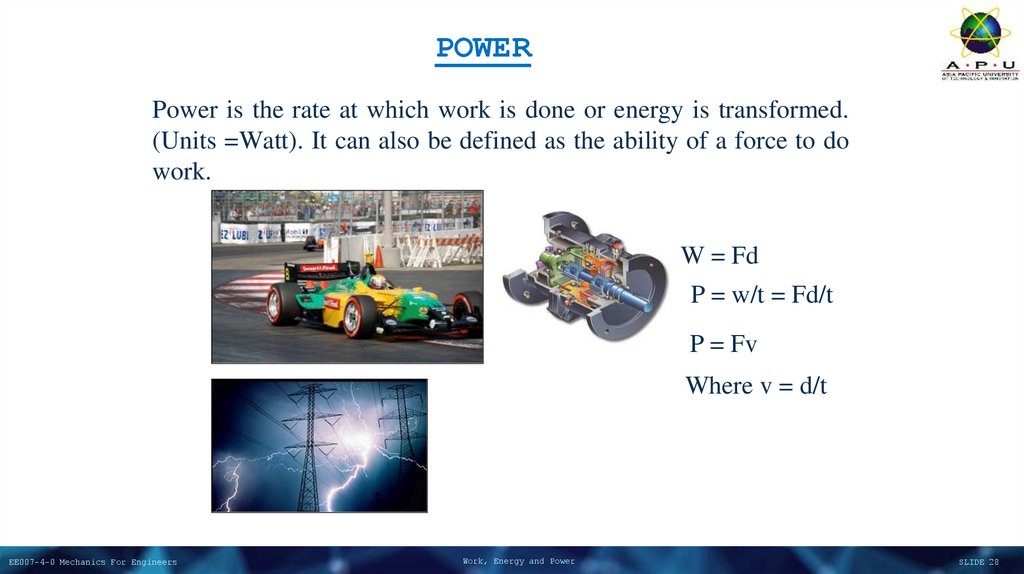
Power is the rate at which work is done or energy is transformed.(Units =Watt). It can also be defined as the ability of a force to do
work.
W = Fd
P = w/t = Fd/t
P = Fv
Where v = d/t
EE007-4-0 Mechanics For Engineers
Work, Energy and Power
SLIDE 28
29. POWER
An average force of 300N is applied over a distance of 50m. Ifthe time required is 2 minutes, determine the work and the power
for the given data.
1. 5kJ of energy is used up in 20 seconds. What is the power?
(250 W)
2. A vehicle is propelled 25000 m by a force of 2kN in 12
seconds. Calculate the work done and the power used.
(50MJ, 4.17MW)
3. A rocket flies at 120 m/s under a propulsion force of 3kN.
Calculate the power used.
(360kW)
EE007-4-0 Mechanics For Engineers
Work, Energy and Power
SLIDE 29
30. POWER
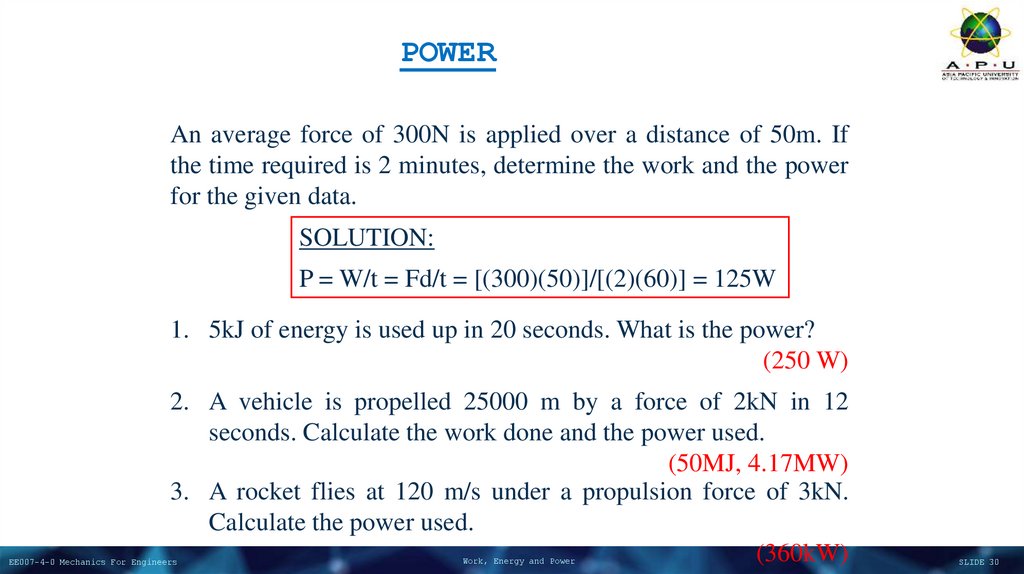
An average force of 300N is applied over a distance of 50m. Ifthe time required is 2 minutes, determine the work and the power
for the given data.
SOLUTION:
P = W/t = Fd/t = [(300)(50)]/[(2)(60)] = 125W
1. 5kJ of energy is used up in 20 seconds. What is the power?
(250 W)
2. A vehicle is propelled 25000 m by a force of 2kN in 12
seconds. Calculate the work done and the power used.
(50MJ, 4.17MW)
3. A rocket flies at 120 m/s under a propulsion force of 3kN.
Calculate the power used.
(360kW)
EE007-4-0 Mechanics For Engineers
Work, Energy and Power
SLIDE 30
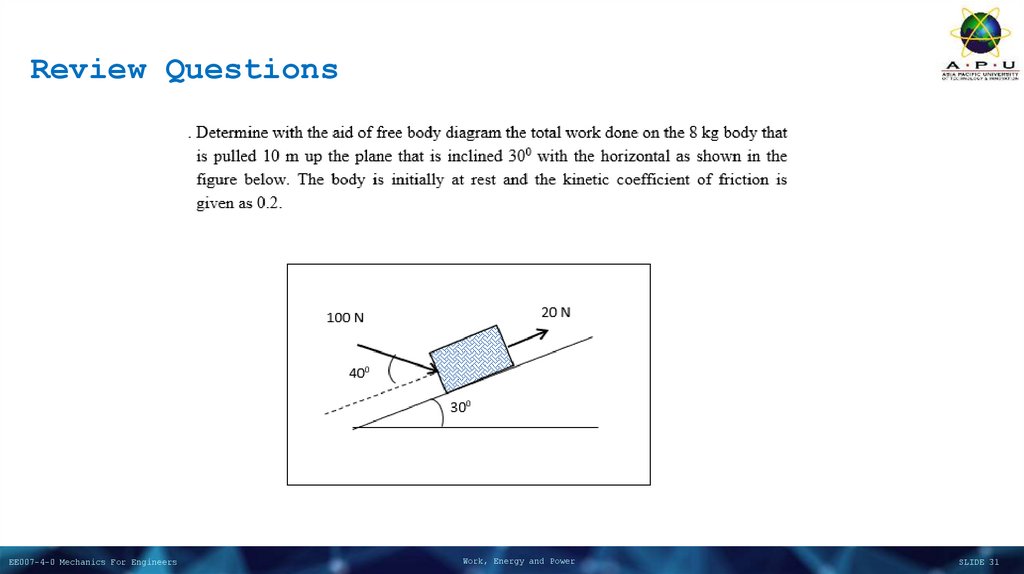
31. Review Questions
EE007-4-0 Mechanics For EngineersWork, Energy and Power
SLIDE 31
32. Summary / Recap of Main Points
• Formula for work, energy and power• Solving for work done by external force, frictional force and weight by drawing
free body diagram
EE007-4-0 Mechanics For Engineers
Work, Energy and Power
SLIDE 32
33. What To Expect Next Week
In Class• Revision
EE007-4-0 Mechanics For Engineers
Preparation for Class
• Nil
Work, Energy and Power
SLIDE 33