 marketing
Similar presentations:







Clarify client’s problem. Define target behaviors
1.
Assessment & Case FormulationCognitions, feelings, &
behaviors
2.
Goals of AssessmentClarify client’s problem
Define target behaviors
Determine cognitive processes, content
Functional analysis (ABC, along with cognitions)
Formulate treatment goals
Define treatment plan
Monitor progress
3.
Characteristics of CognitiveBehavioral AssessmentIndividualized
Present focus
Directly samples relevant behaviors,
thoughts
Narrow focus on discrete behaviors
Integrated with therapy
– Assessment continues throughout
treatment
4.
Target BehaviorsNarrow in scope – break down the problem
Specifically defined – define precisely so that it can
be assessed
Measurable – Quantifiable
–
–
–
–
Frequency (# of times)
Duration (length of time, latency before beginning behavior,
interval between responses)
Intensity (strength of behavior)
Amount of By-Product (number of by-products of engaging)
Appropriate and Adaptive
5.
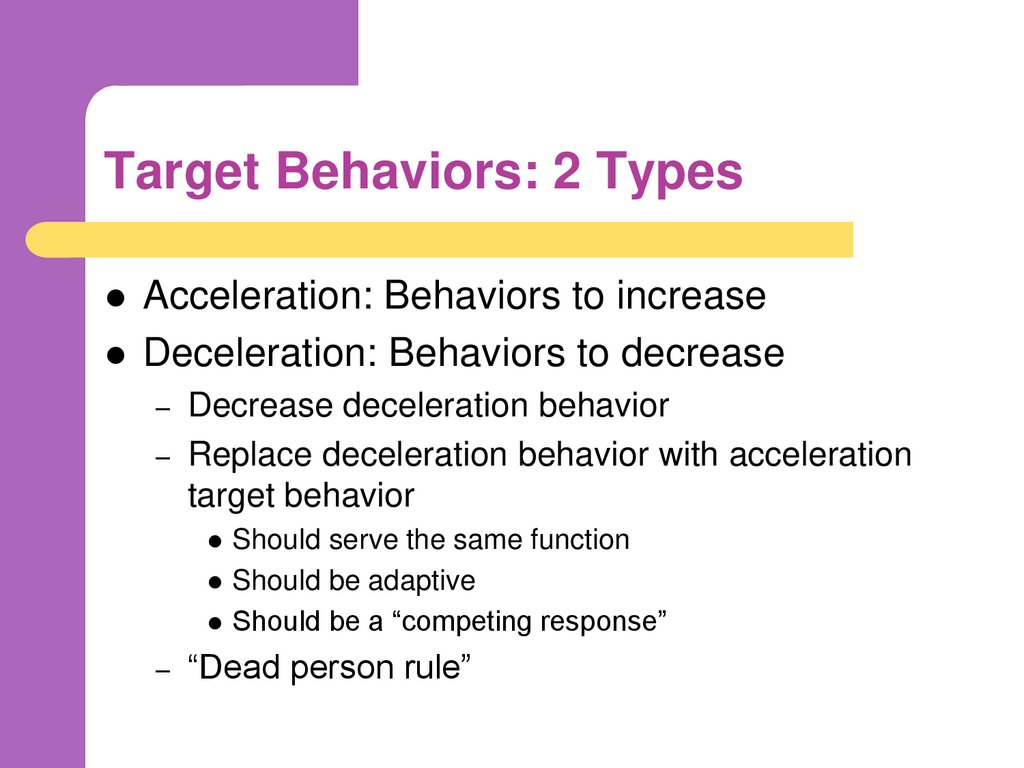
Target Behaviors: 2 TypesAcceleration: Behaviors to increase
Deceleration: Behaviors to decrease
– Decrease deceleration behavior
– Replace deceleration behavior with acceleration
target behavior
Should serve the same function
Should be adaptive
Should be a “competing response”
– “Dead person rule”
6.
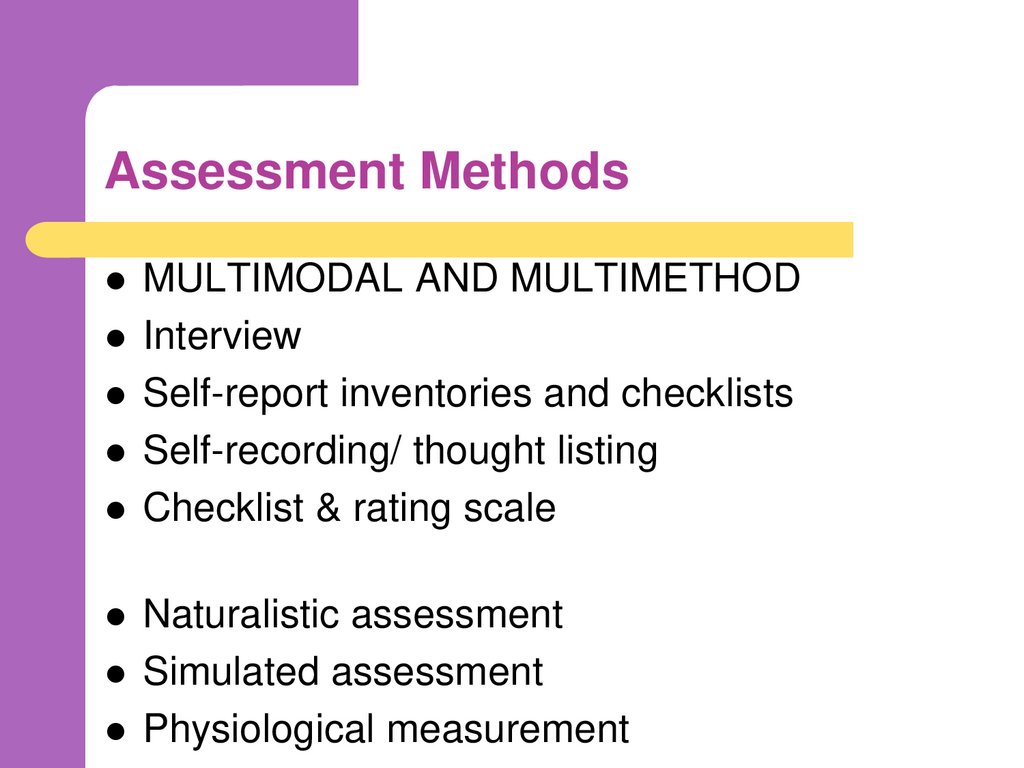
Assessment MethodsMULTIMODAL AND MULTIMETHOD
Interview
Self-report inventories and checklists
Self-recording/ thought listing
Checklist & rating scale
Naturalistic assessment
Simulated assessment
Physiological measurement
7.
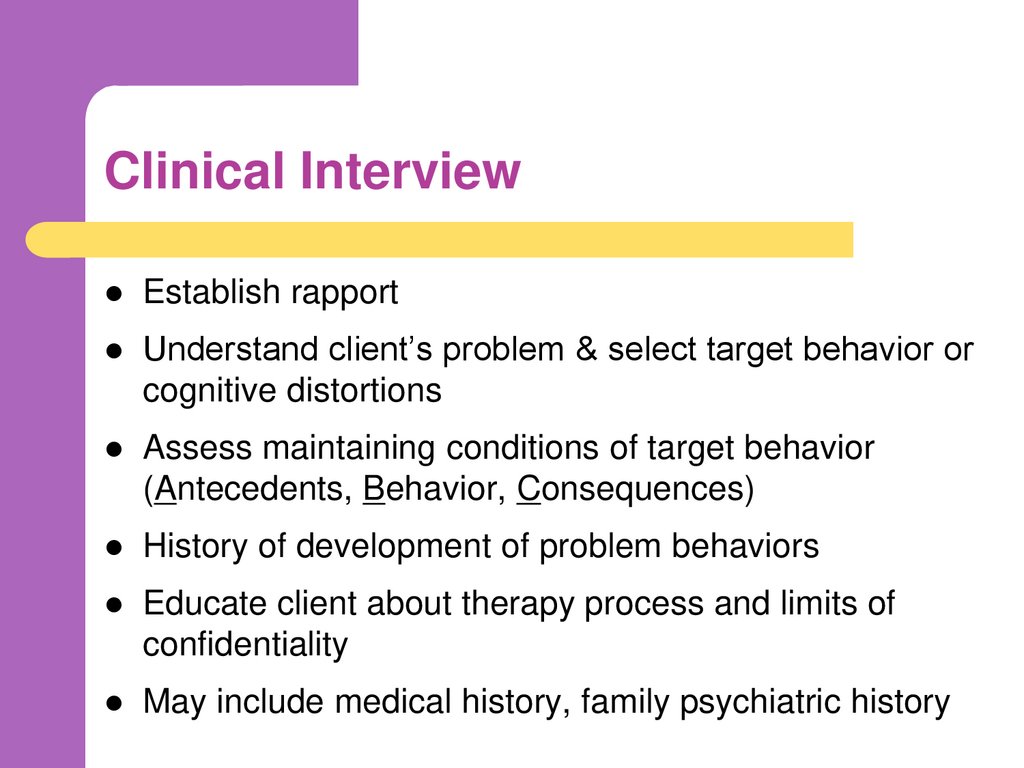
Clinical InterviewEstablish rapport
Understand client’s problem & select target behavior or
cognitive distortions
Assess maintaining conditions of target behavior
(Antecedents, Behavior, Consequences)
History of development of problem behaviors
Educate client about therapy process and limits of
confidentiality
May include medical history, family psychiatric history
8.
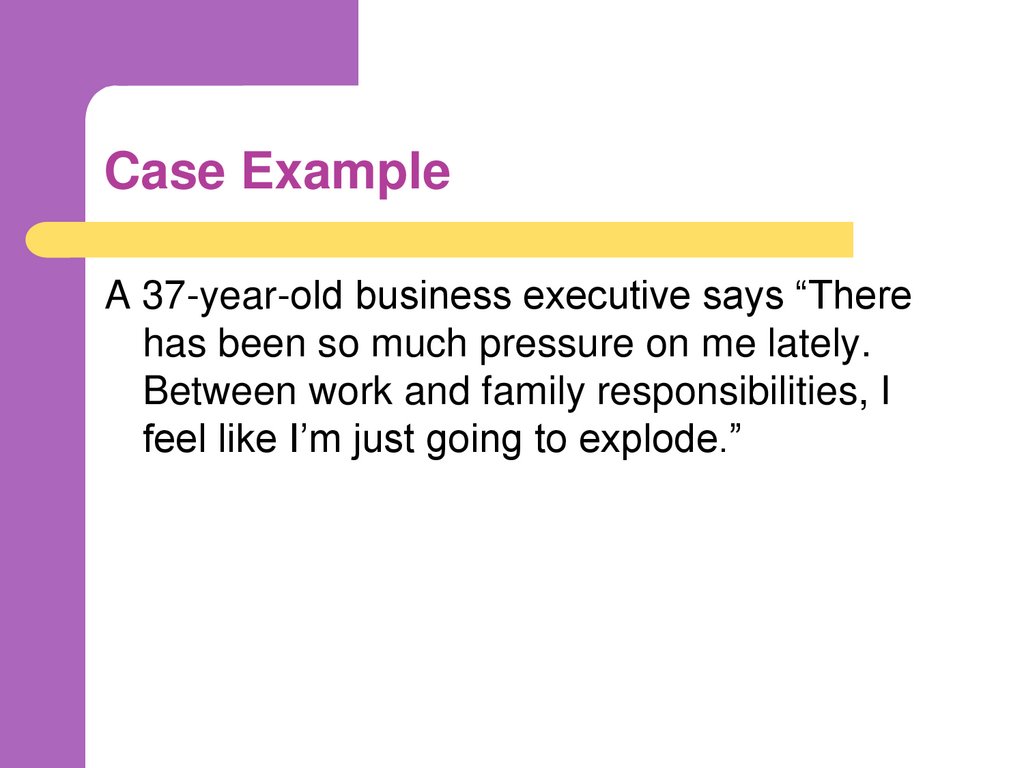
Case ExampleA 37-year-old business executive says “There
has been so much pressure on me lately.
Between work and family responsibilities, I
feel like I’m just going to explode.”
9.
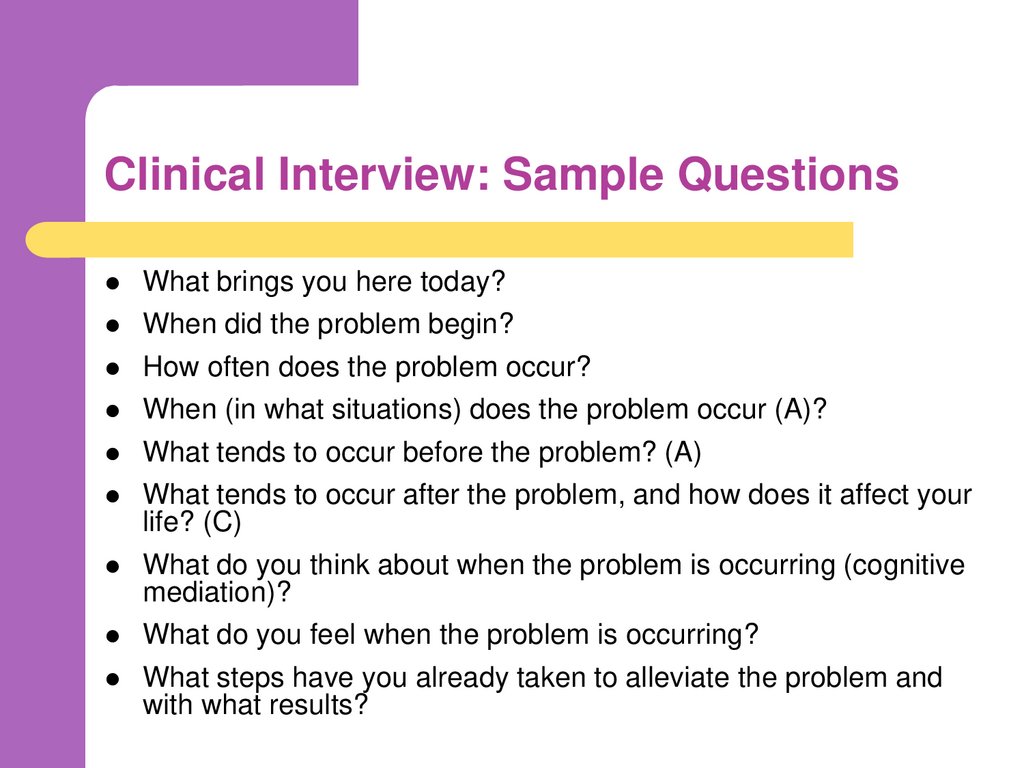
Clinical Interview: Sample QuestionsWhat brings you here today?
When did the problem begin?
How often does the problem occur?
When (in what situations) does the problem occur (A)?
What tends to occur before the problem? (A)
What tends to occur after the problem, and how does it affect your
life? (C)
What do you think about when the problem is occurring (cognitive
mediation)?
What do you feel when the problem is occurring?
What steps have you already taken to alleviate the problem and
with what results?
10.
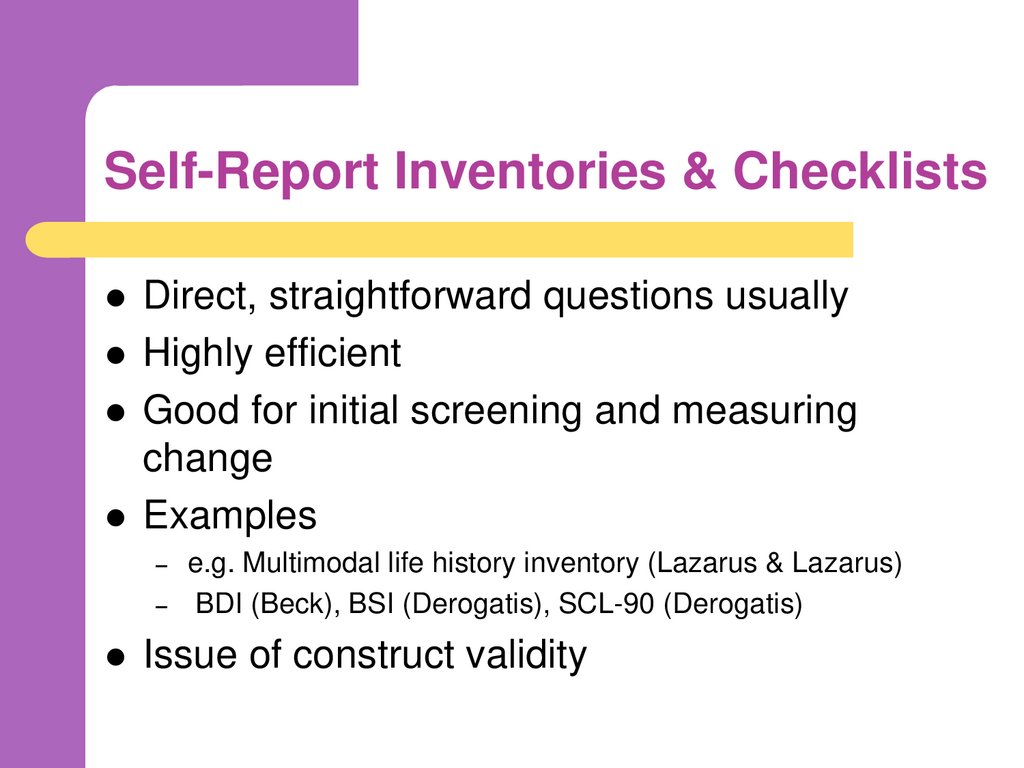
Self-Report Inventories & ChecklistsDirect, straightforward questions usually
Highly efficient
Good for initial screening and measuring
change
Examples
–
–
e.g. Multimodal life history inventory (Lazarus & Lazarus)
BDI (Beck), BSI (Derogatis), SCL-90 (Derogatis)
Issue of construct validity
11.
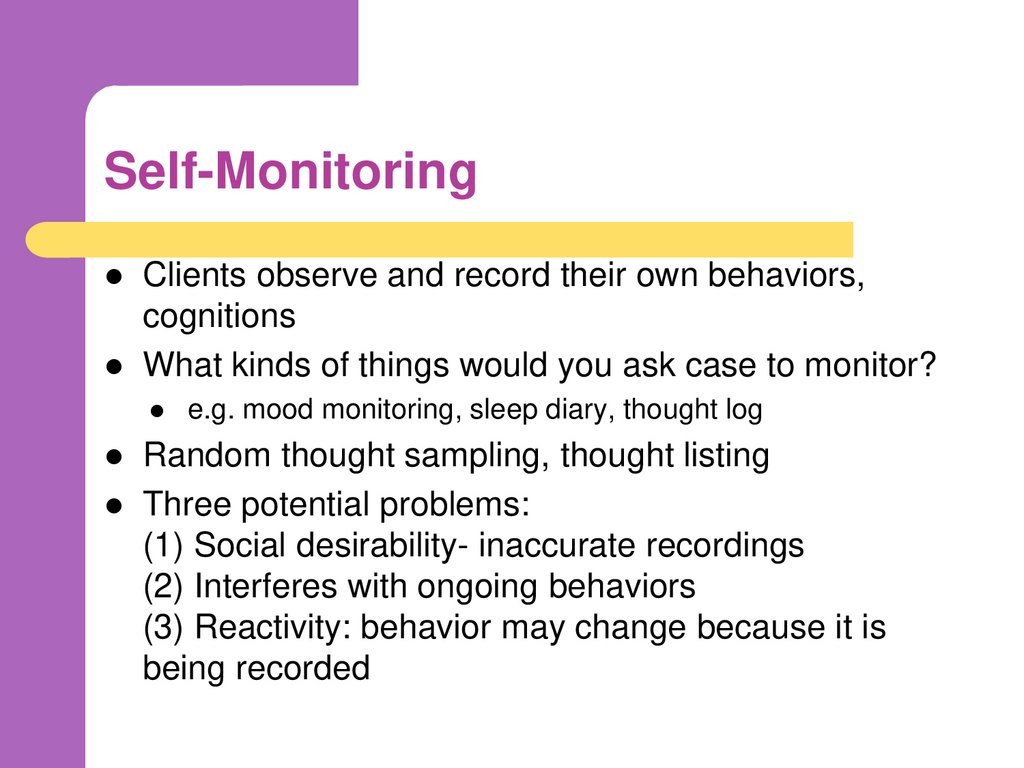
Self-MonitoringClients observe and record their own behaviors,
cognitions
What kinds of things would you ask case to monitor?
e.g. mood monitoring, sleep diary, thought log
Random thought sampling, thought listing
Three potential problems:
(1) Social desirability- inaccurate recordings
(2) Interferes with ongoing behaviors
(3) Reactivity: behavior may change because it is
being recorded
12.
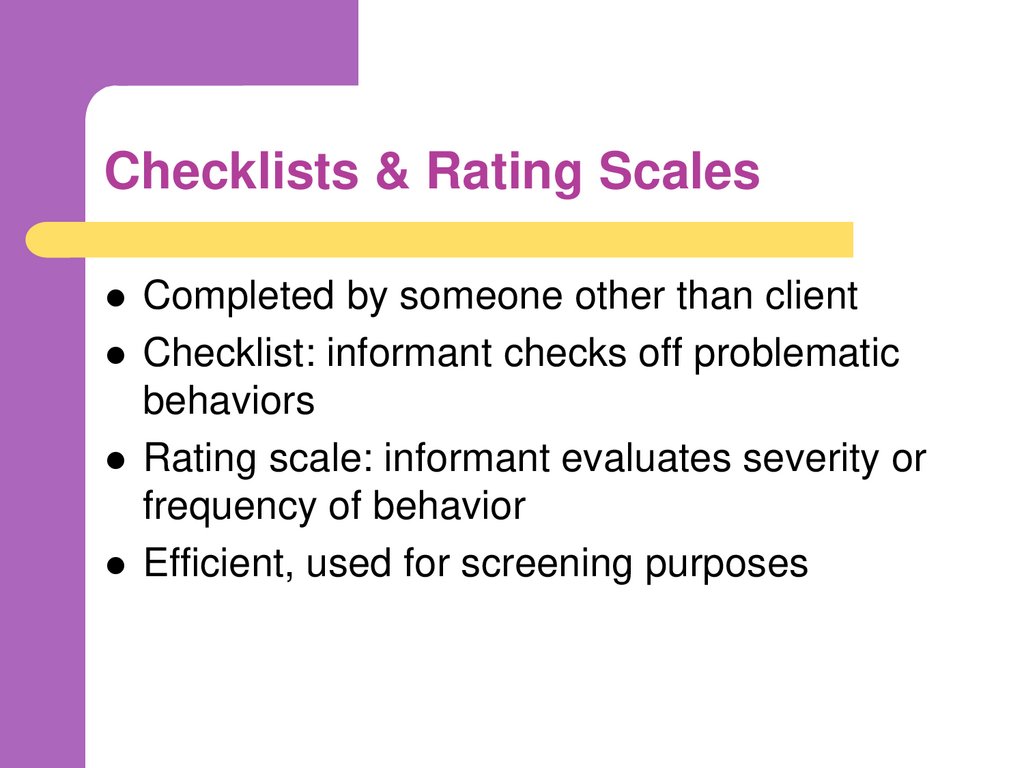
Checklists & Rating ScalesCompleted by someone other than client
Checklist: informant checks off problematic
behaviors
Rating scale: informant evaluates severity or
frequency of behavior
Efficient, used for screening purposes
13.
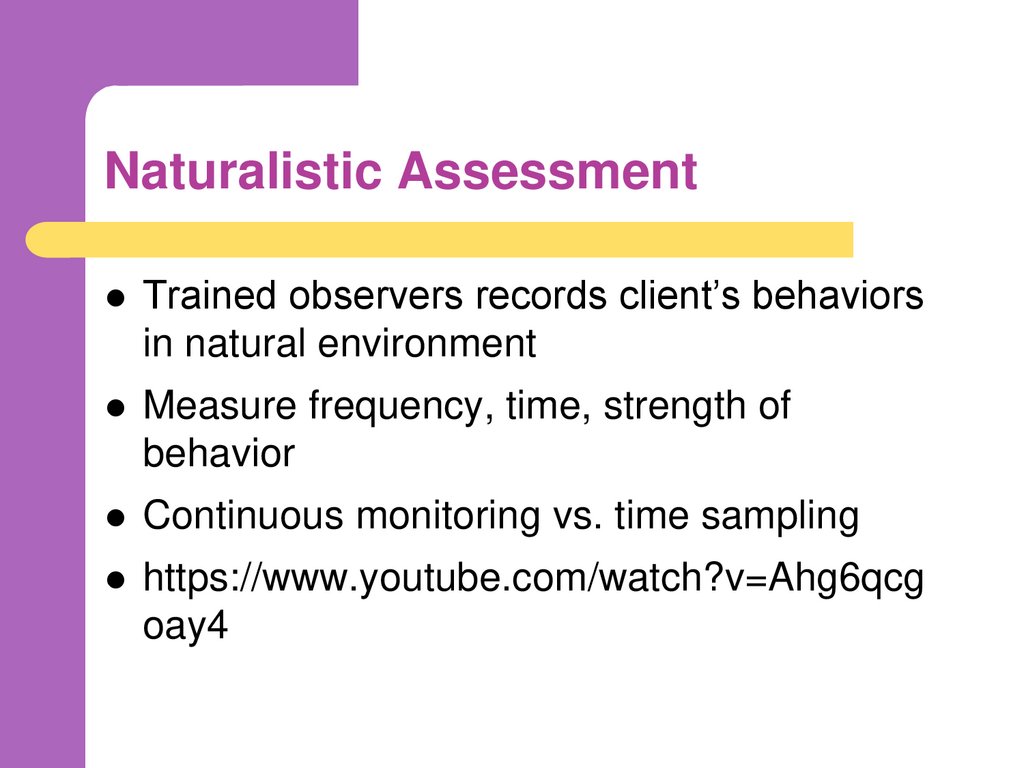
Naturalistic AssessmentTrained observers records client’s behaviors
in natural environment
Measure frequency, time, strength of
behavior
Continuous monitoring vs. time sampling
https://www.youtube.com/watch?v=Ahg6qcg
oay4
14.
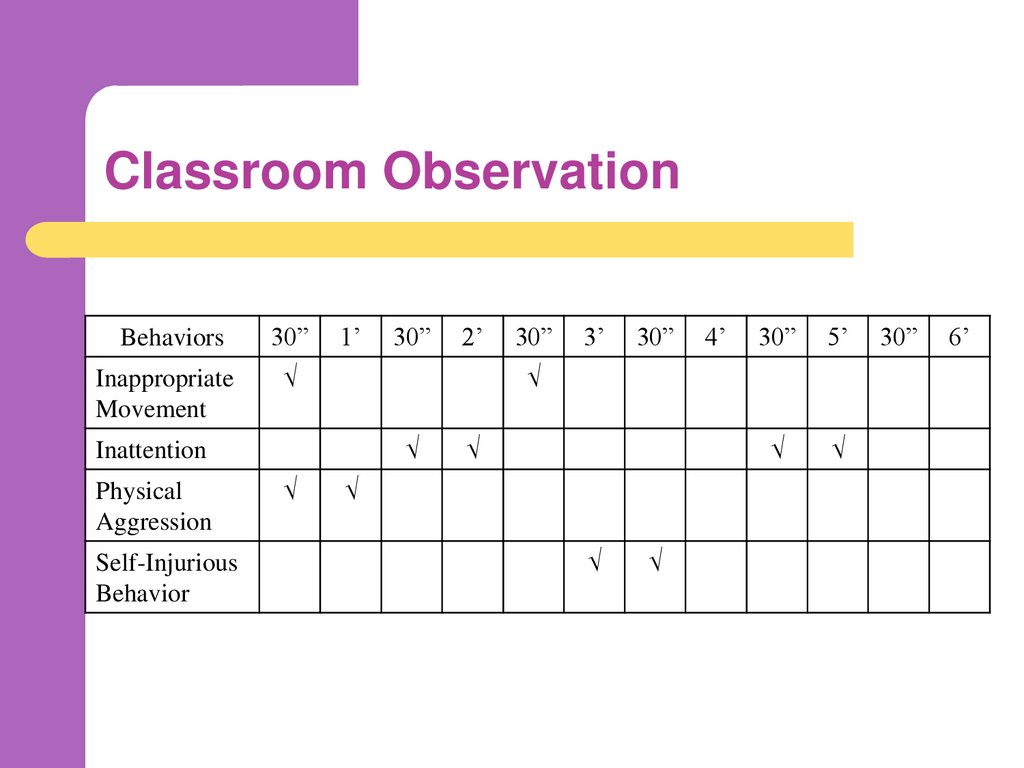
Classroom ObservationBehaviors
30”
Inappropriate
Movement
√
1’
√
Self-Injurious
Behavior
√
2’
30”
3’
30”
4’
30”
5’
√
√
√
Inattention
Physical
Aggression
30”
√
√
√
√
30”
6’
15.
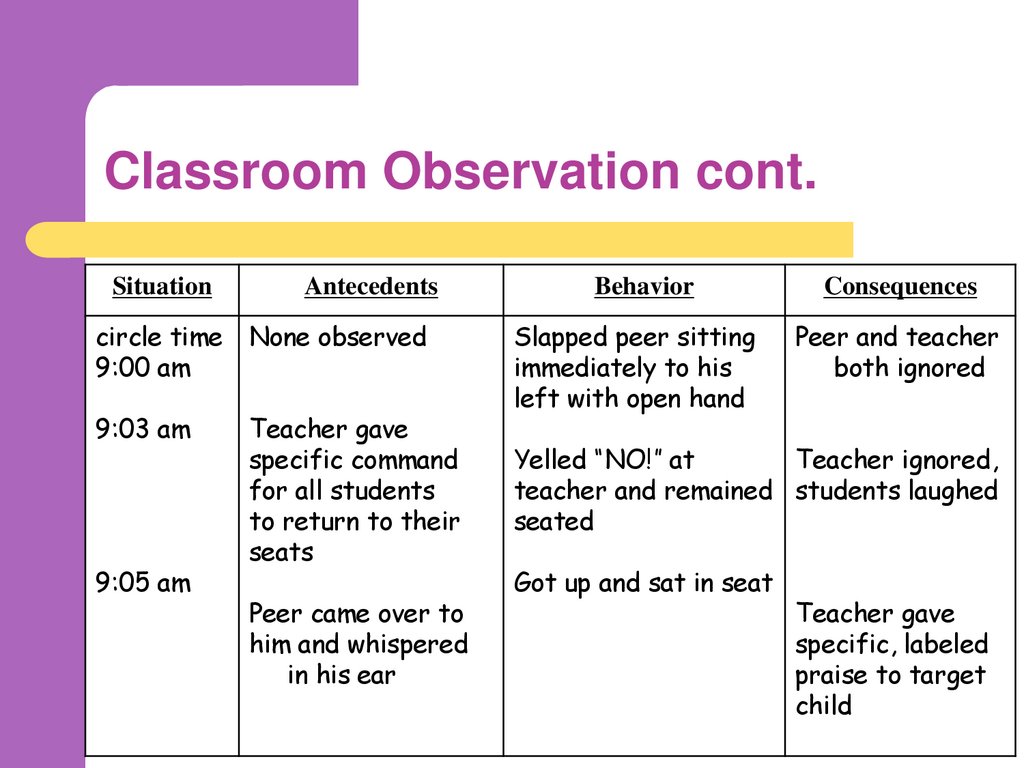
Classroom Observation cont.Situation
Antecedents
circle time
9:00 am
None observed
9:03 am
Teacher gave
specific command
for all students
to return to their
seats
9:05 am
Peer came over to
him and whispered
in his ear
Behavior
Consequences
Slapped peer sitting
immediately to his
left with open hand
Peer and teacher
both ignored
Yelled “NO!” at
Teacher ignored,
teacher and remained students laughed
seated
Got up and sat in seat
Teacher gave
specific, labeled
praise to target
child
16.
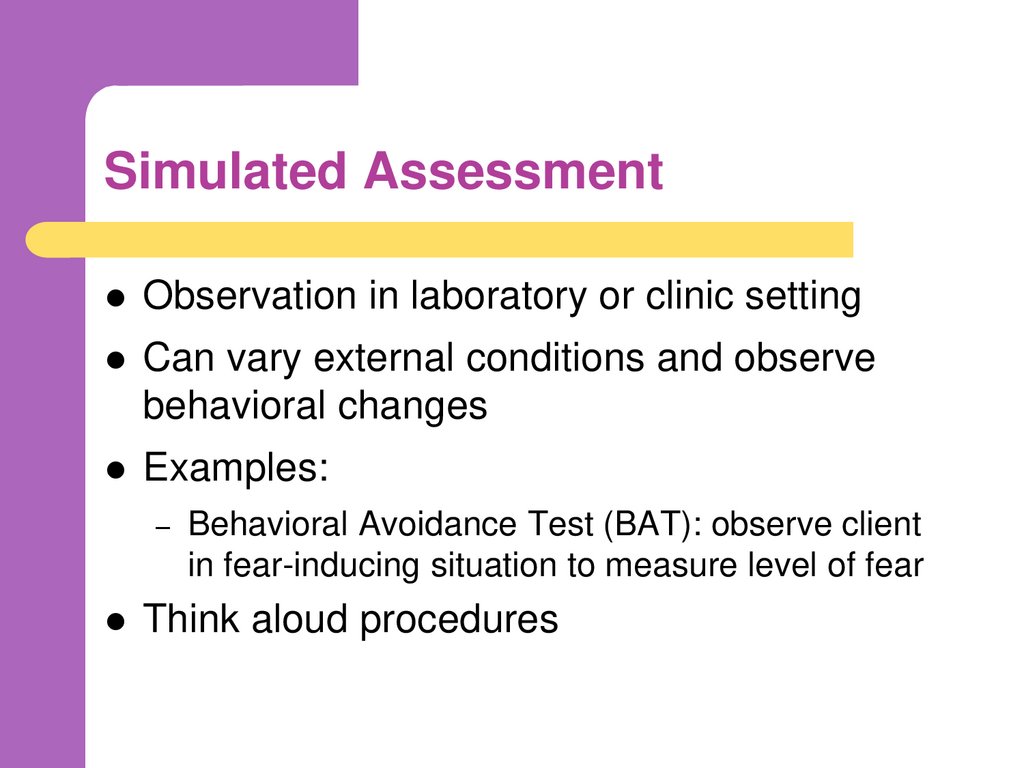
Simulated AssessmentObservation in laboratory or clinic setting
Can vary external conditions and observe
behavioral changes
Examples:
– Behavioral Avoidance Test (BAT): observe client
in fear-inducing situation to measure level of fear
Think aloud procedures
17.
Parent- Child Interaction Therapy(PCIT) Coding
http://www.youtube.com/watch?v=rxmHBR16
-ao
http://www.youtube.com/watch?v=rnrPEpMc
xqs
http://www.youtube.com/watch?v=reuHPfAAiM
18.
Role PlayingEnact problem situations to provide therapist
with samples of typical behavior
Helpful for assessing interpersonal difficulties
19.
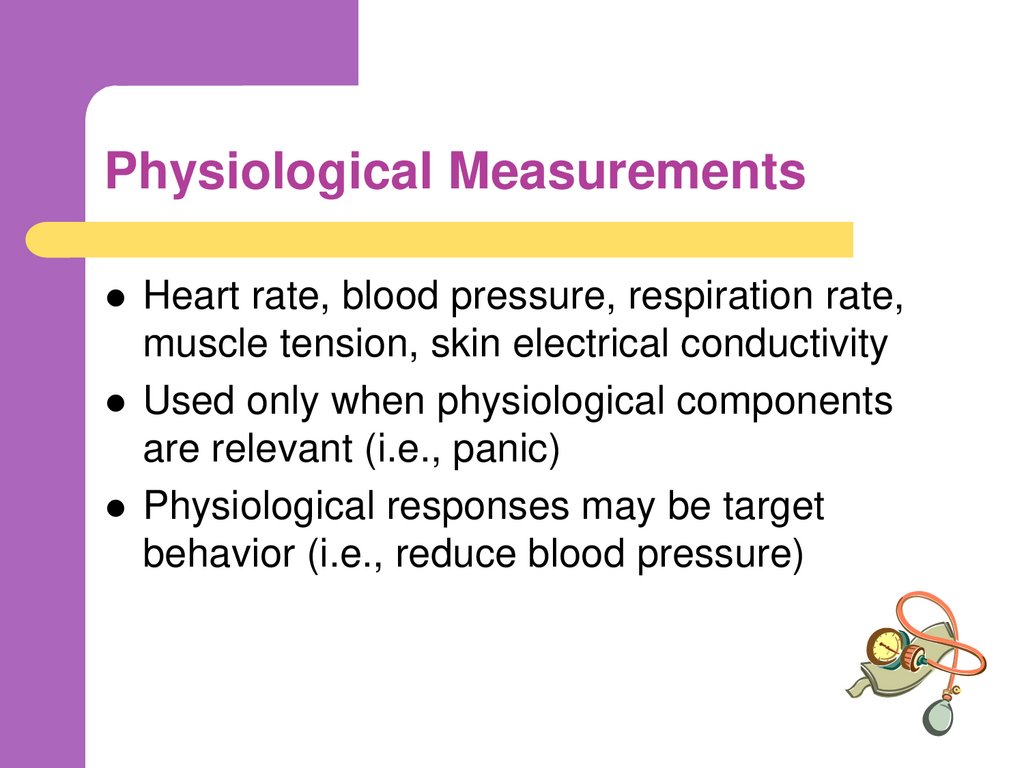
Physiological MeasurementsHeart rate, blood pressure, respiration rate,
muscle tension, skin electrical conductivity
Used only when physiological components
are relevant (i.e., panic)
Physiological responses may be target
behavior (i.e., reduce blood pressure)
20.
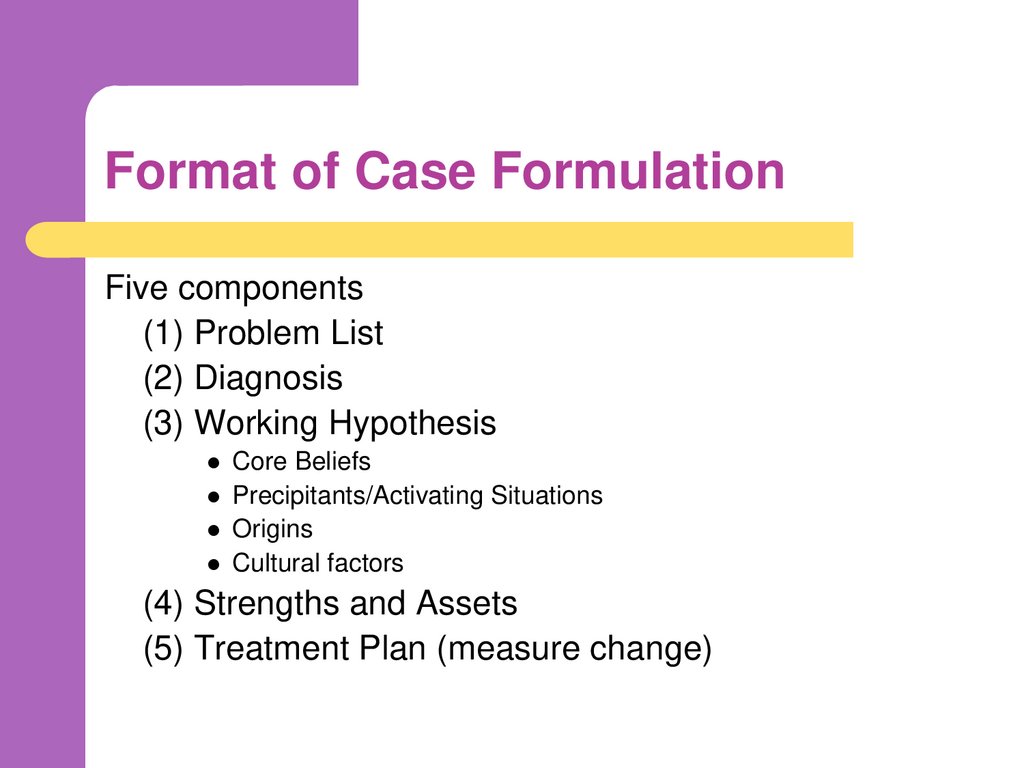
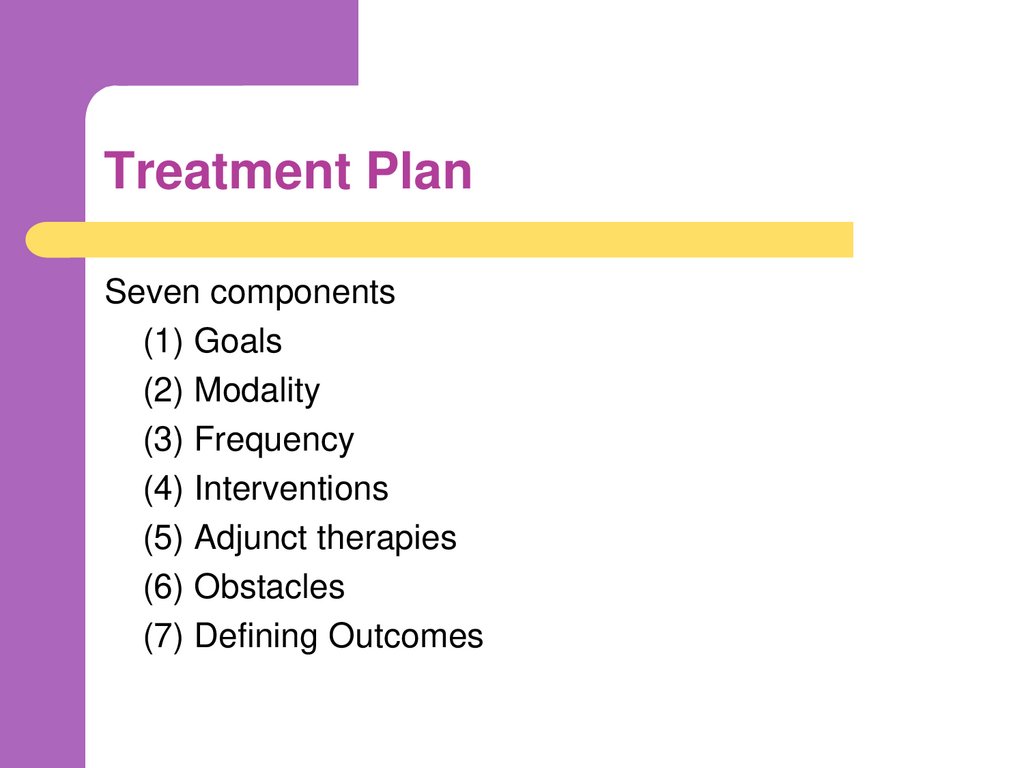
Format of Case FormulationFive components
(1) Problem List
(2) Diagnosis
(3) Working Hypothesis
Core Beliefs
Precipitants/Activating Situations
Origins
Cultural factors
(4) Strengths and Assets
(5) Treatment Plan (measure change)
21.
Treatment PlanSeven components
(1) Goals
(2) Modality
(3) Frequency
(4) Interventions
(5) Adjunct therapies
(6) Obstacles
(7) Defining Outcomes
22.
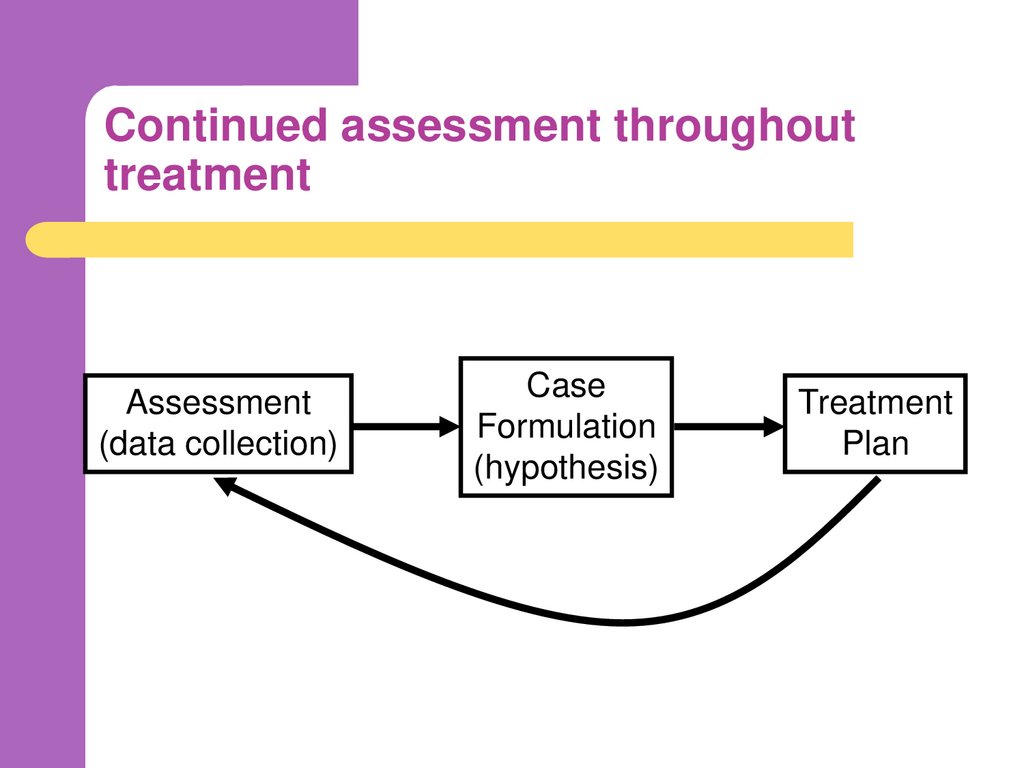
Continued assessment throughouttreatment
Assessment
(data collection)
Case
Formulation
(hypothesis)
Treatment
Plan
23.
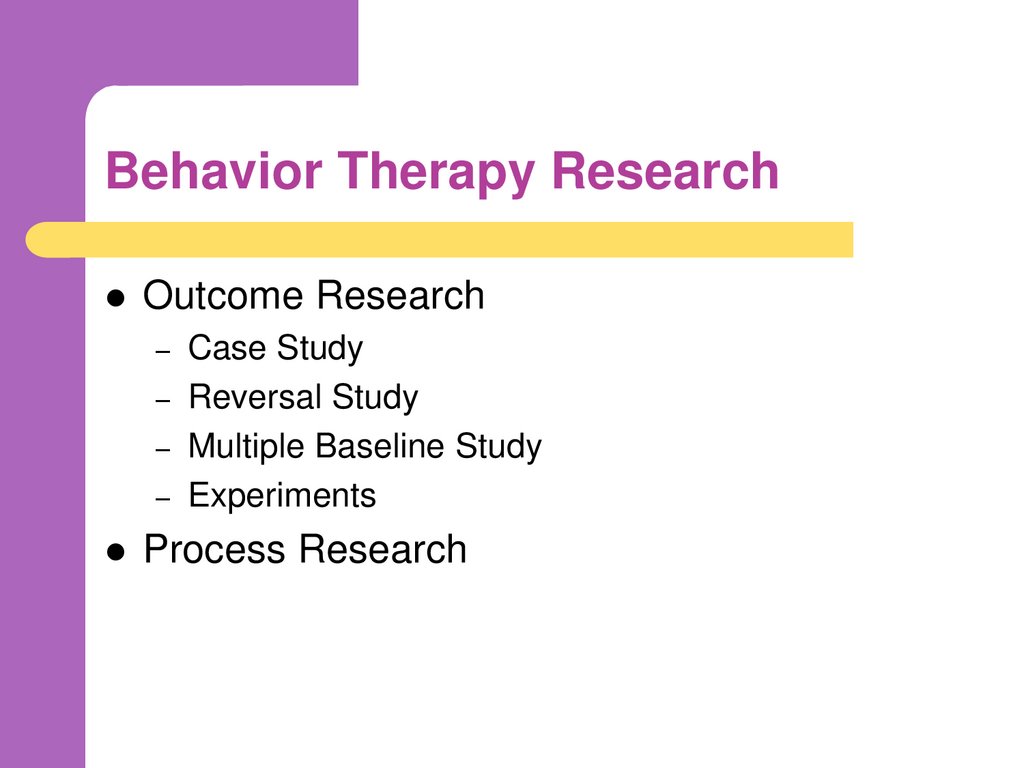
Behavior Therapy ResearchOutcome Research
– Case Study
– Reversal Study
– Multiple Baseline Study
– Experiments
Process Research
24.
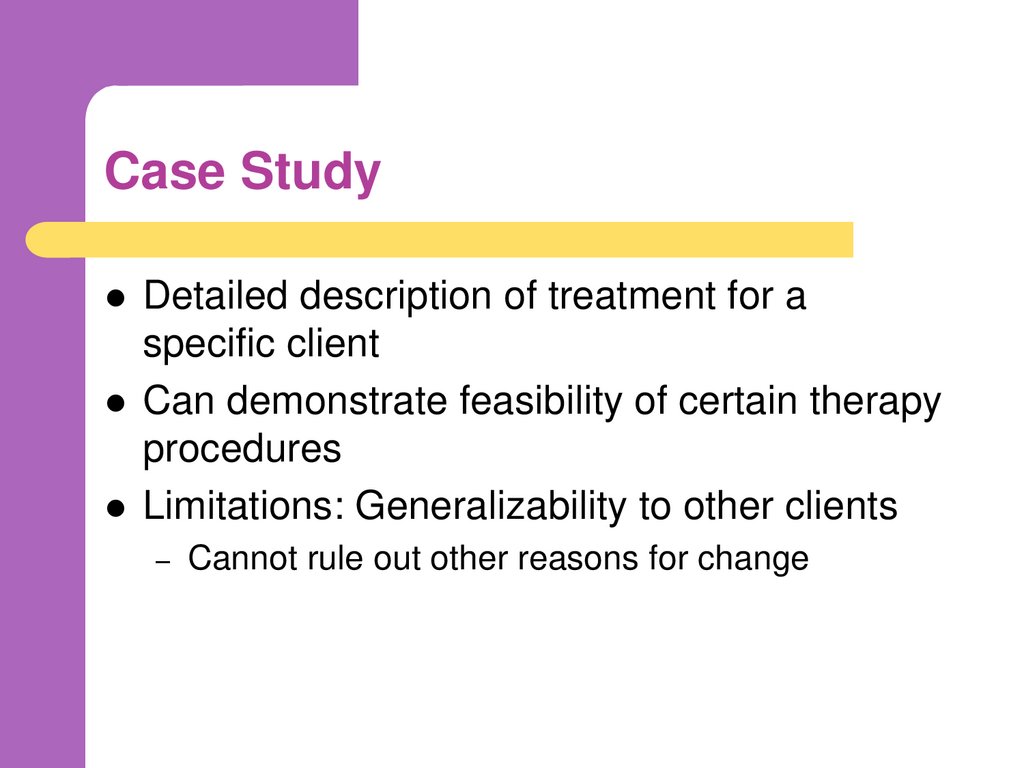
Case StudyDetailed description of treatment for a
specific client
Can demonstrate feasibility of certain therapy
procedures
Limitations: Generalizability to other clients
– Cannot rule out other reasons for change
25.
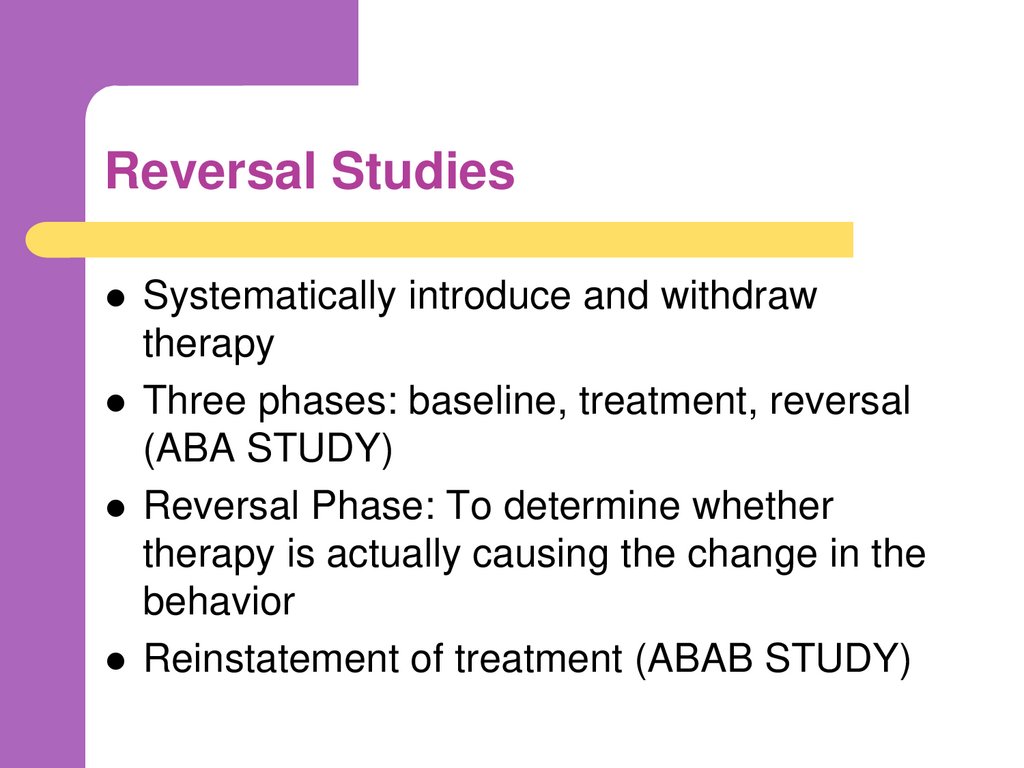
Reversal StudiesSystematically introduce and withdraw
therapy
Three phases: baseline, treatment, reversal
(ABA STUDY)
Reversal Phase: To determine whether
therapy is actually causing the change in the
behavior
Reinstatement of treatment (ABAB STUDY)
26.
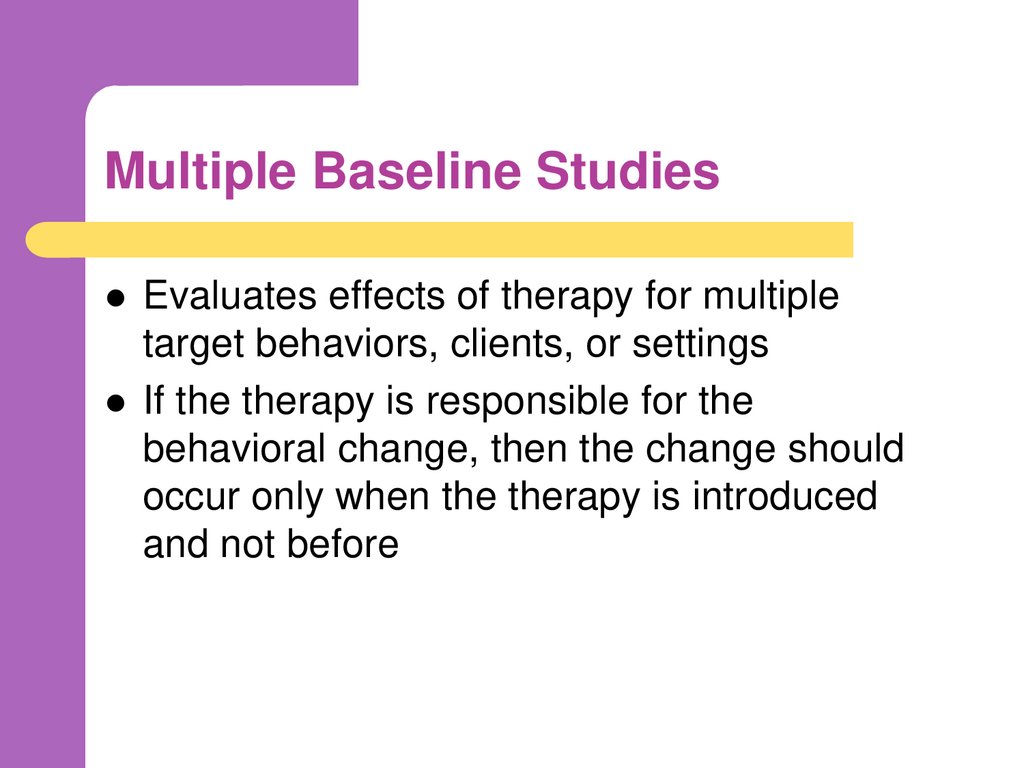
Multiple Baseline StudiesEvaluates effects of therapy for multiple
target behaviors, clients, or settings
If the therapy is responsible for the
behavioral change, then the change should
occur only when the therapy is introduced
and not before
27.
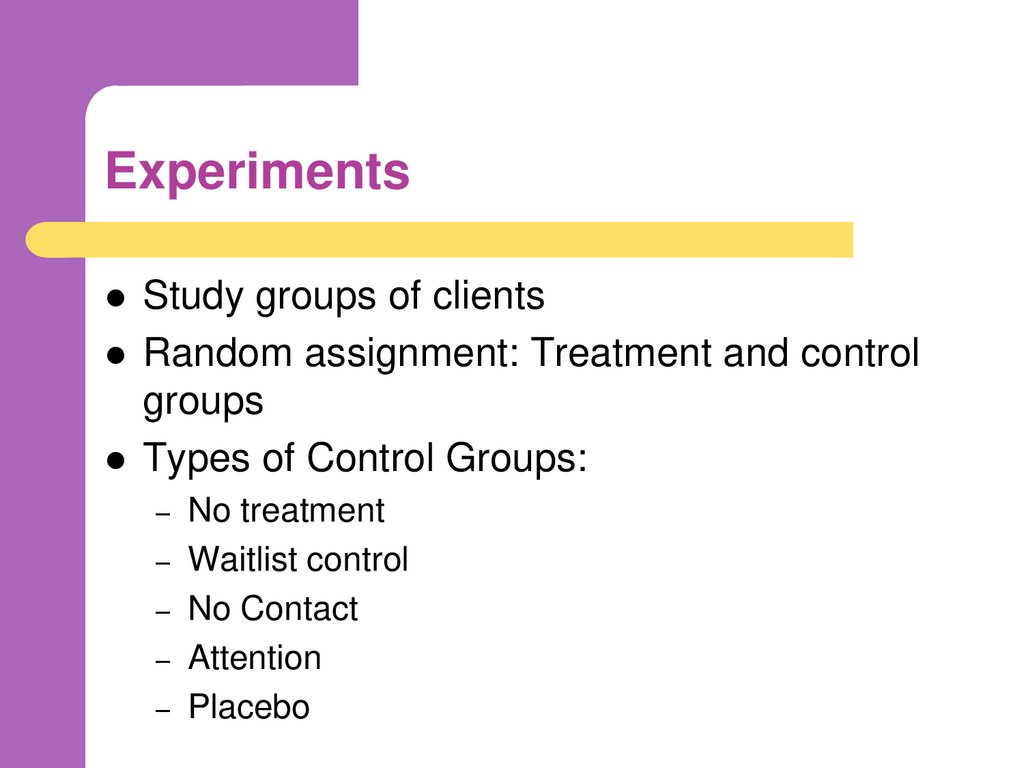
ExperimentsStudy groups of clients
Random assignment: Treatment and control
groups
Types of Control Groups:
– No treatment
– Waitlist control
– No Contact
– Attention
– Placebo
28.
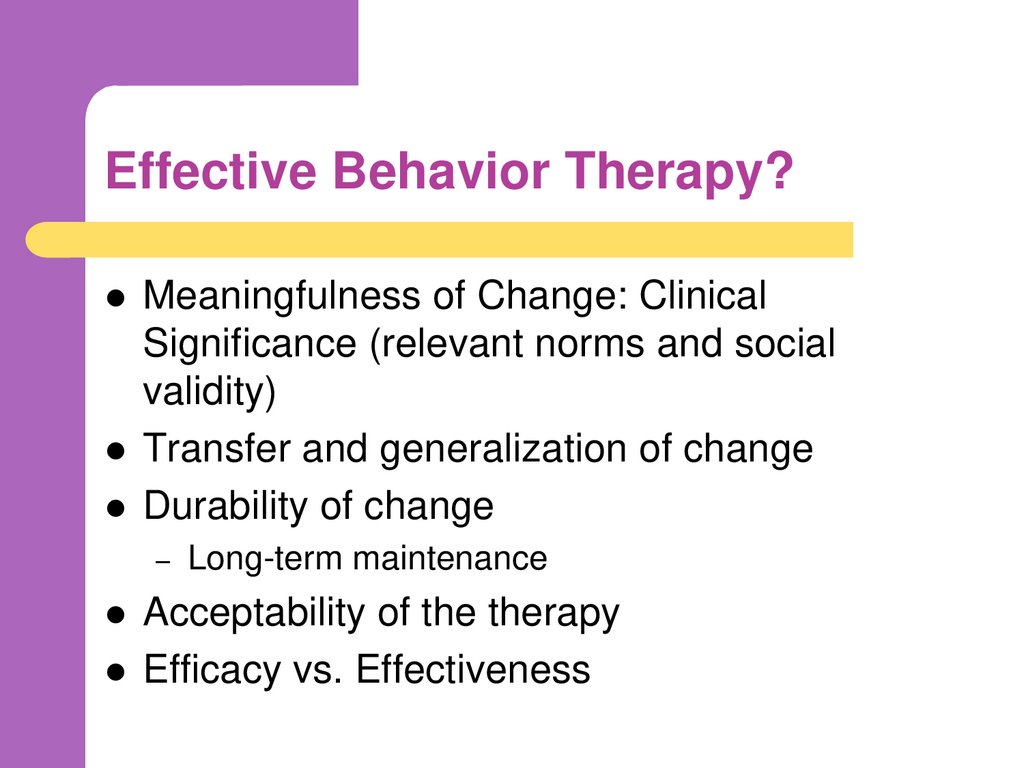
Effective Behavior Therapy?Meaningfulness of Change: Clinical
Significance (relevant norms and social
validity)
Transfer and generalization of change
Durability of change
– Long-term maintenance
Acceptability of the therapy
Efficacy vs. Effectiveness