 literature
Similar presentations:
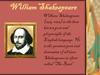
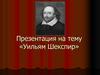


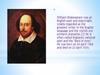

A Lecture on William Shakespeare and the Globe Theatre
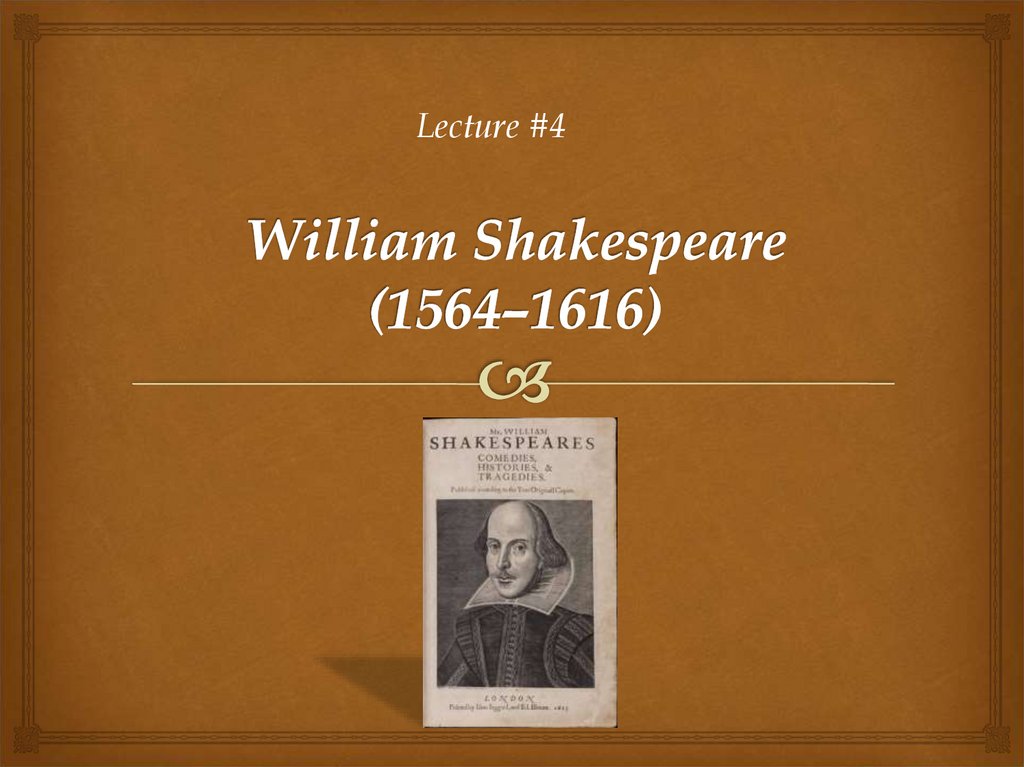
1. William Shakespeare (1564–1616)
Lecture #42.
3.
4.
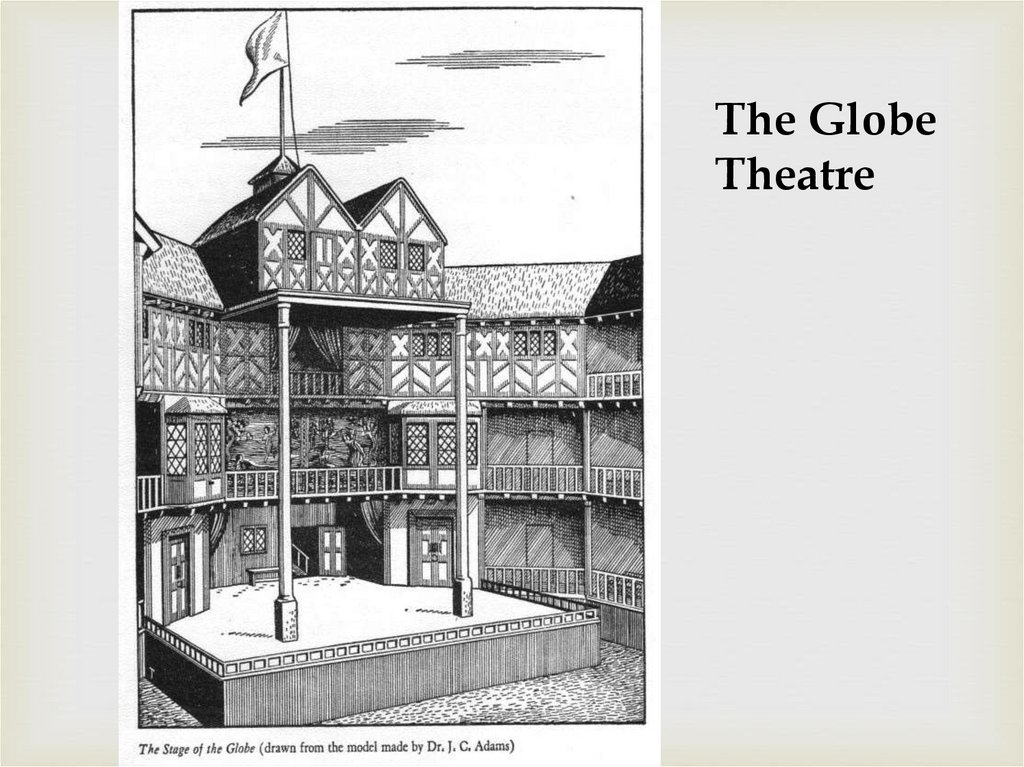
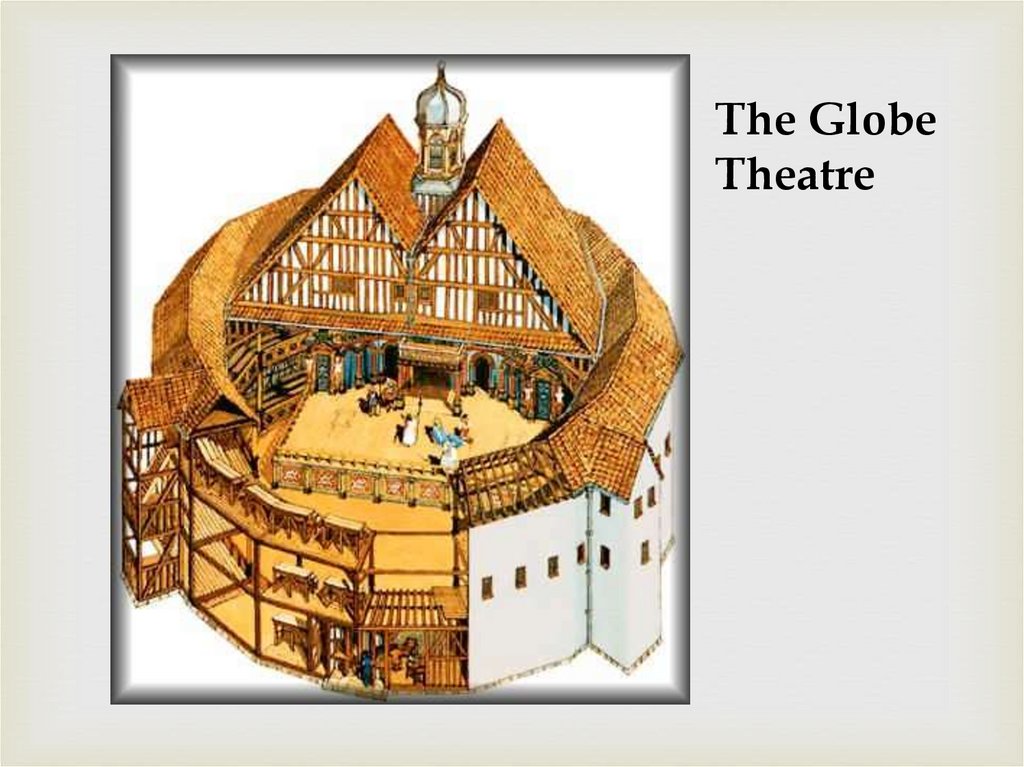
The GlobeTheatre
5.
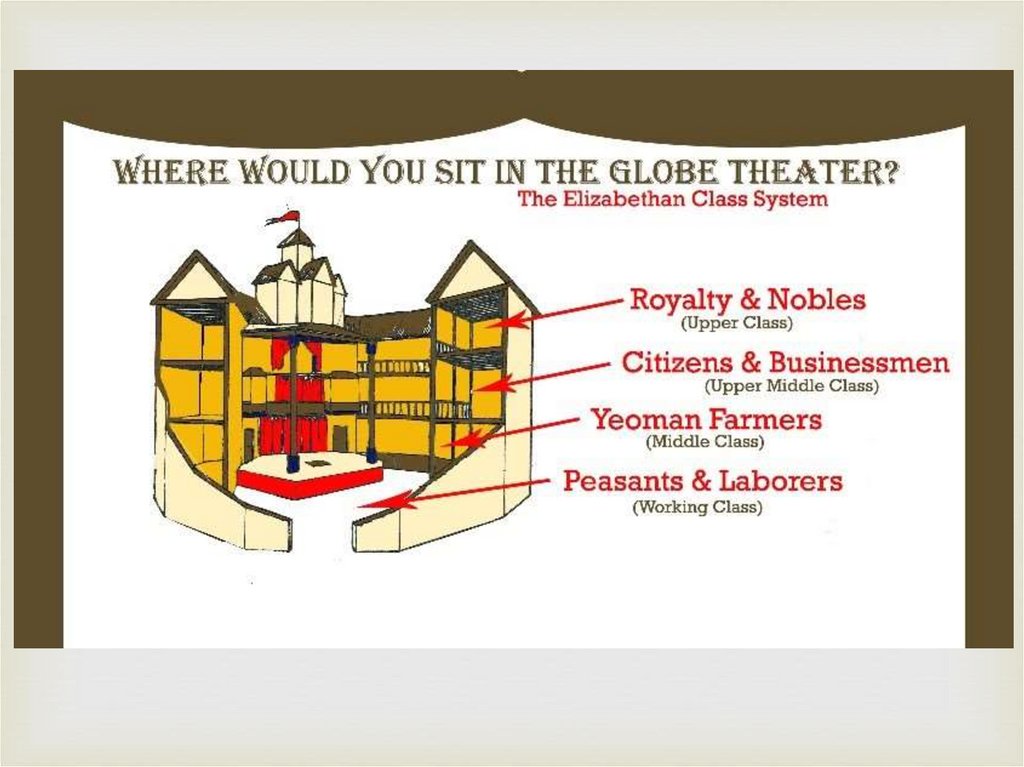
The GlobeTheatre
6.
7. Historical Background
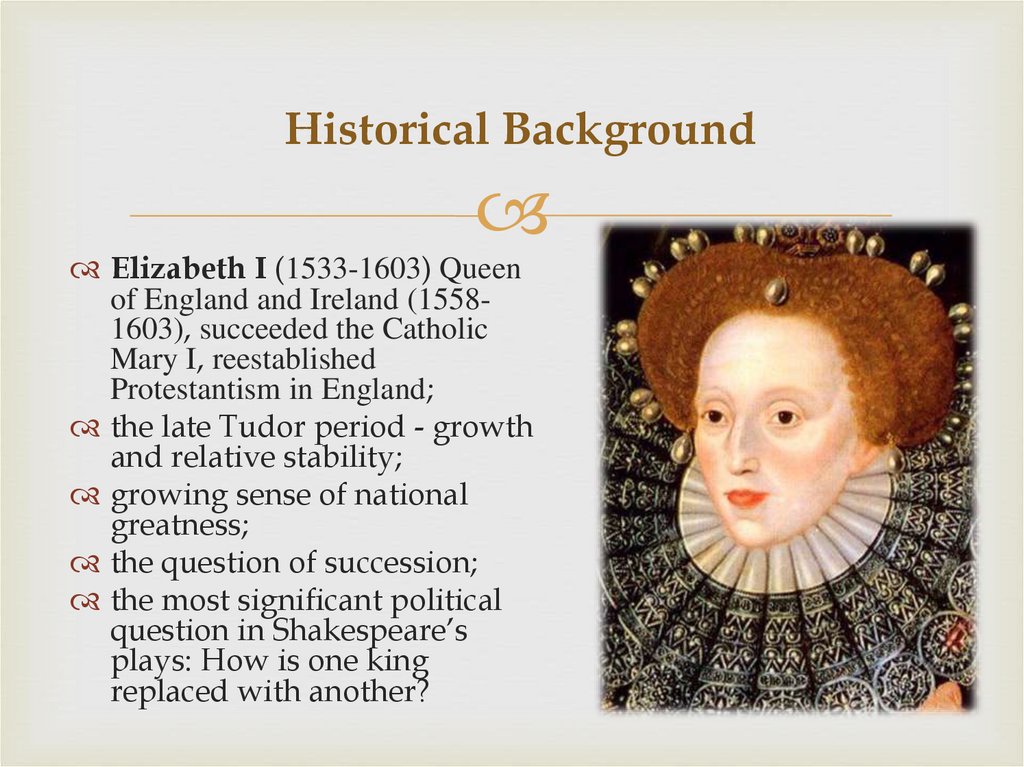
Elizabeth I (1533-1603) Queenof England and Ireland (15581603), succeeded the Catholic
Mary I, reestablished
Protestantism in England;
the late Tudor period - growth
and relative stability;
growing sense of national
greatness;
the question of succession;
the most significant political
question in Shakespeare’s
plays: How is one king
replaced with another?
8. William Shakespeare (1564–1616)
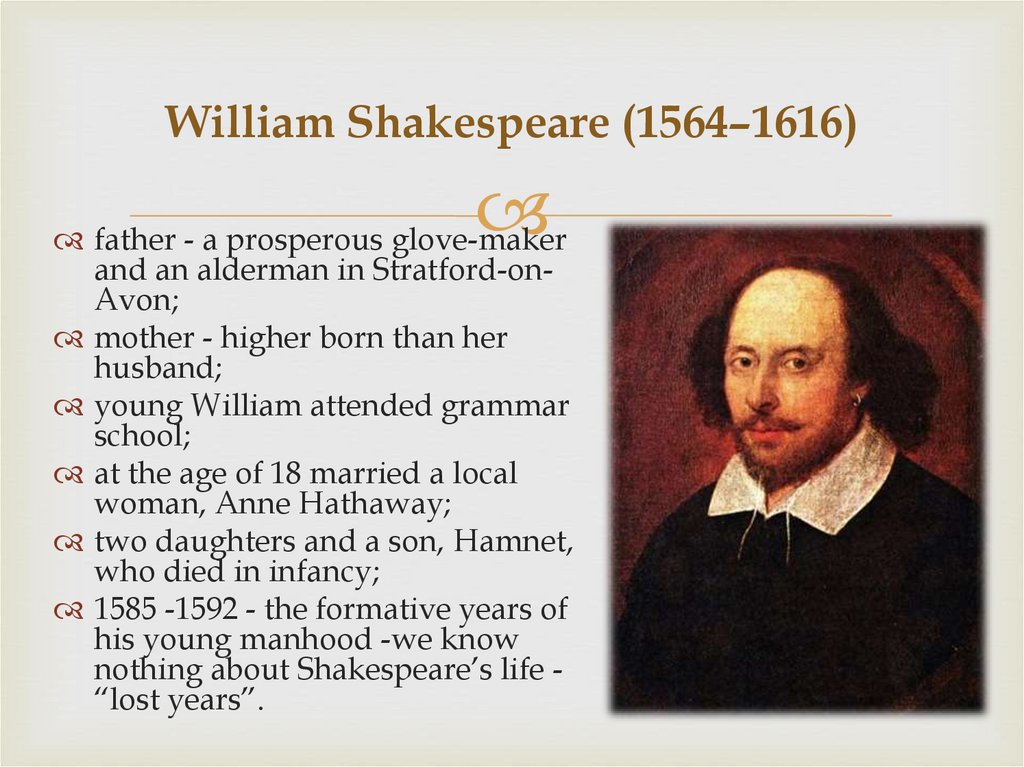
father - a prosperous glove-makerand an alderman in Stratford-onAvon;
mother - higher born than her
husband;
young William attended grammar
school;
at the age of 18 married a local
woman, Anne Hathaway;
two daughters and a son, Hamnet,
who died in infancy;
1585 -1592 - the formative years of
his young manhood -we know
nothing about Shakespeare’s life “lost years”.
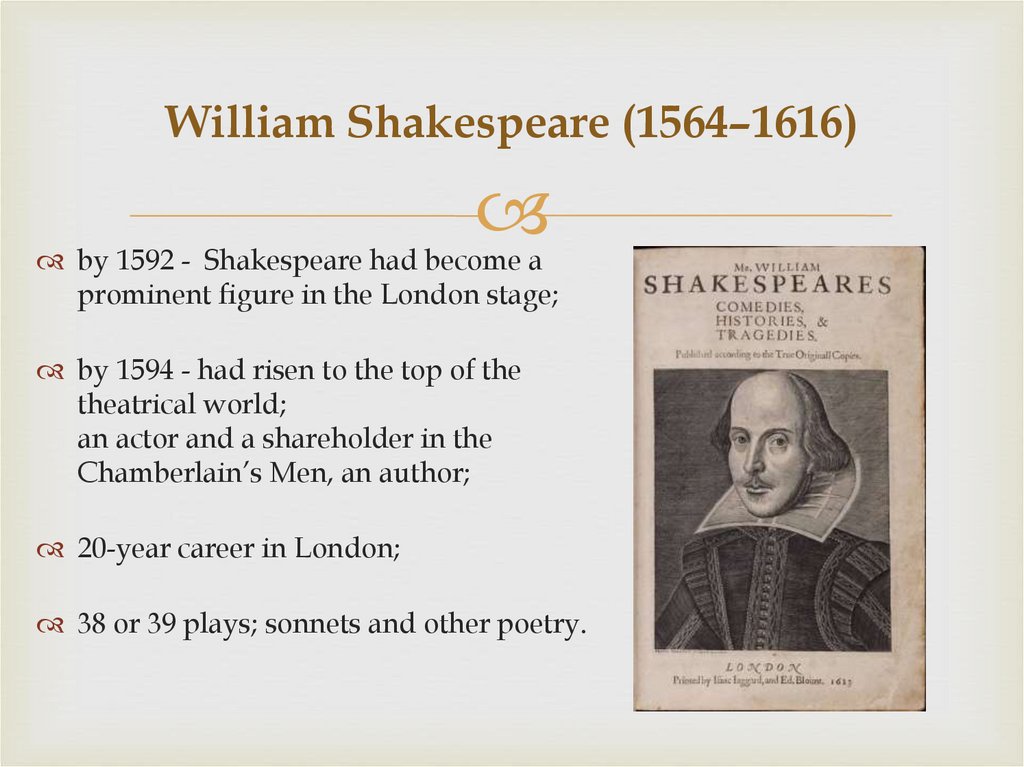
9. William Shakespeare (1564–1616)
by 1592 - Shakespeare had become aprominent figure in the London stage;
by 1594 - had risen to the top of the
theatrical world;
an actor and a shareholder in the
Chamberlain’s Men, an author;
20-year career in London;
38 or 39 plays; sonnets and other poetry.
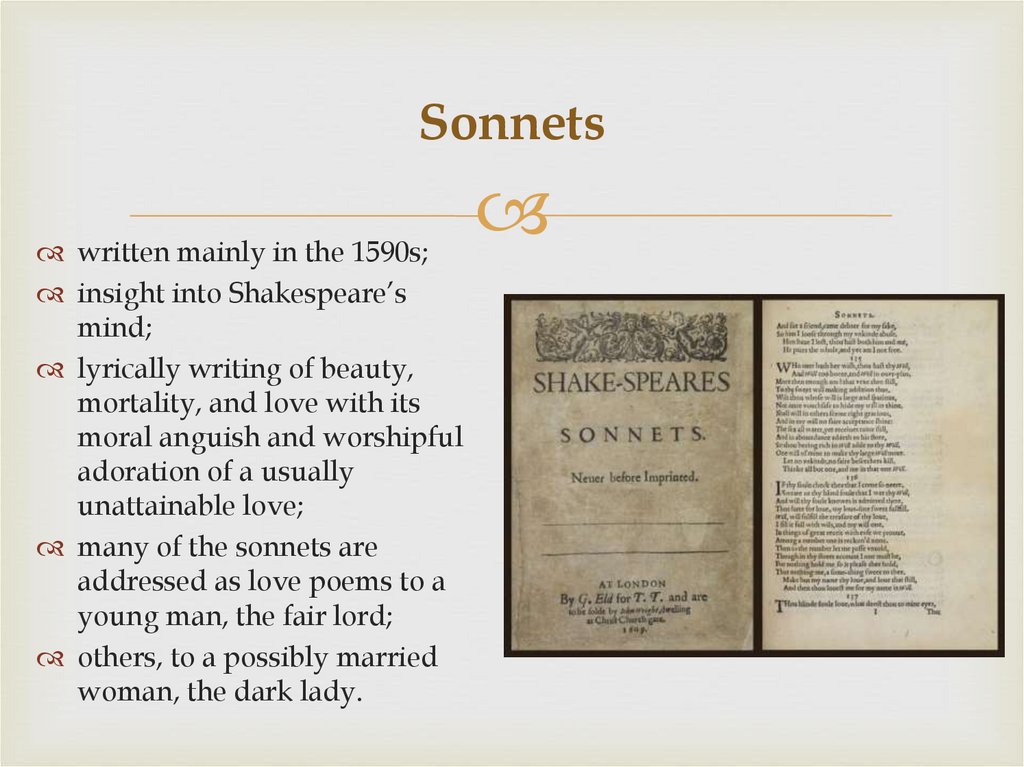
10. Sonnets
written mainly in the 1590s;insight into Shakespeare’s
mind;
lyrically writing of beauty,
mortality, and love with its
moral anguish and worshipful
adoration of a usually
unattainable love;
many of the sonnets are
addressed as love poems to a
young man, the fair lord;
others, to a possibly married
woman, the dark lady.
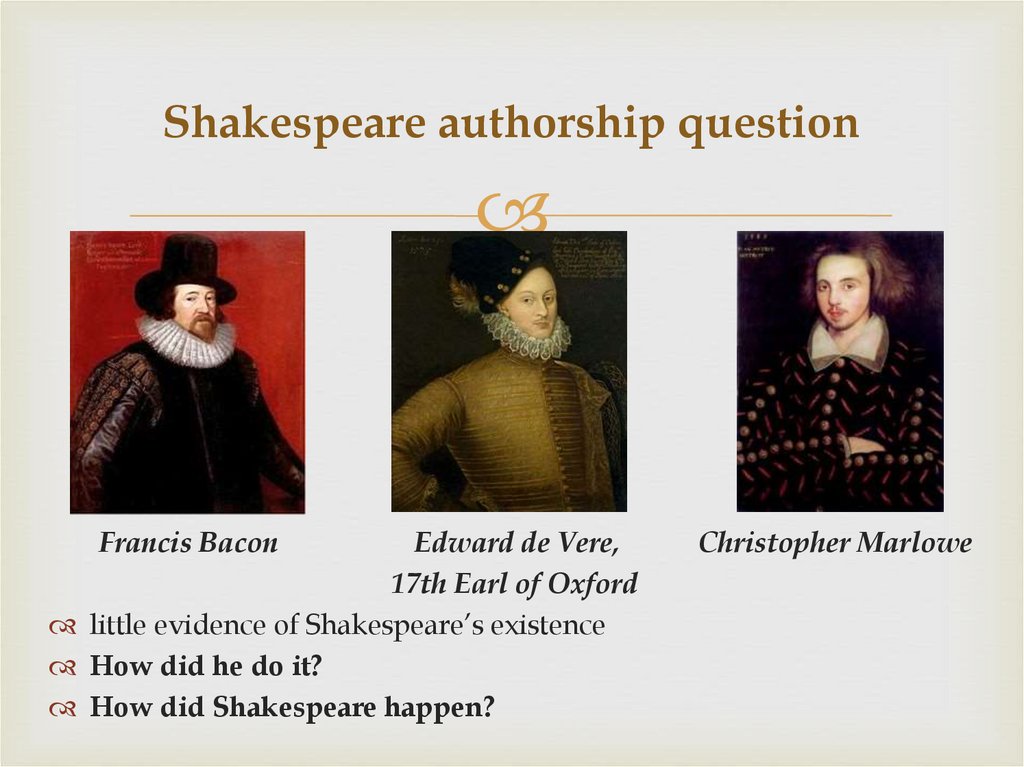
11. Shakespeare authorship question
Francis BaconEdward de Vere,
17th Earl of Oxford
little evidence of Shakespeare’s existence
How did he do it?
How did Shakespeare happen?
Christopher Marlowe
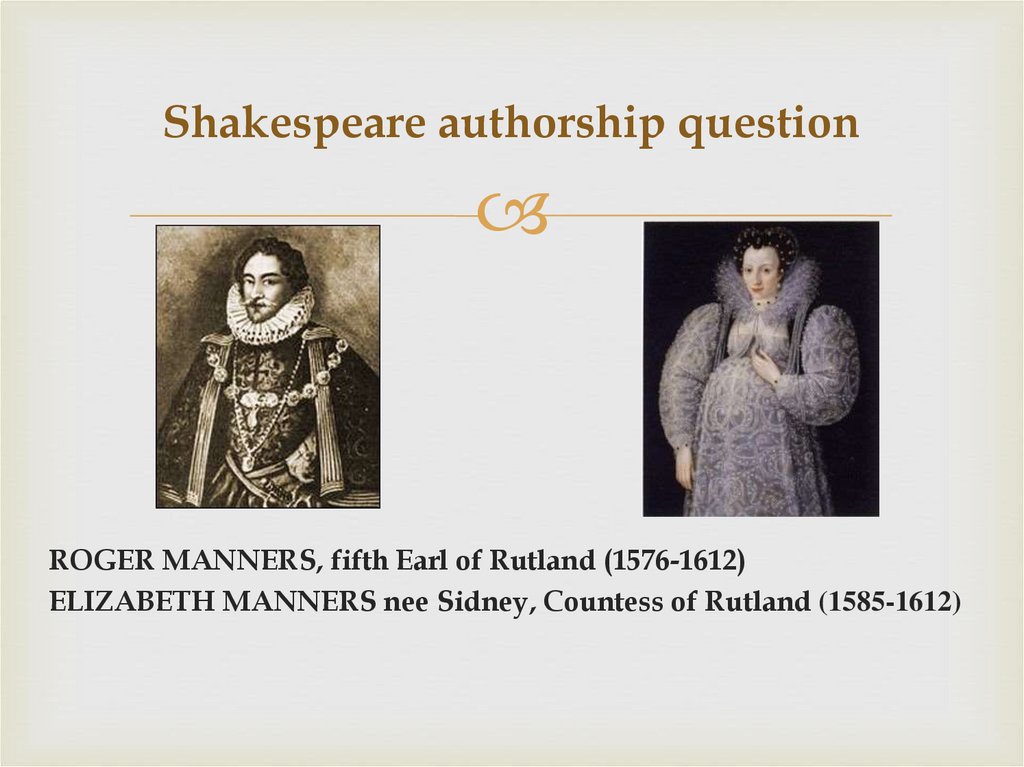
12. Shakespeare authorship question
ROGER MANNERS, fifth Earl of Rutland (1576-1612)ELIZABETH MANNERS nee Sidney, Countess of Rutland (1585-1612)
13. Declaration of Reasonable Doubt
Mark Twain (1835-1910): "All the rest of [Shakespeare's] vast history, asfurnished by the biographers, is built up, course upon course, of
guesses, inferences, theories, conjectures — an Eiffel Tower of
artificialities rising sky-high from a very flat and very thin foundation
of inconsequential facts"
Henry James (1843-1913): "I am 'sort of' haunted by the conviction that
the divine William is the biggest and most successful fraud ever
practiced on a patient world."
Sigmund Freud (1856-1939): "I no longer believe that ... the actor from
Stratford was the author of the works that have been ascribed to him.”
Also: Walt Whitman, Sir Charlie Chaplin, William James, John
Galsworthy, Ralf Waldo Emerson and others.
14. Shakespeare’s plays
histories,comedies,
tragedies,
Roman plays,
problem plays,
romances.
15. History Plays
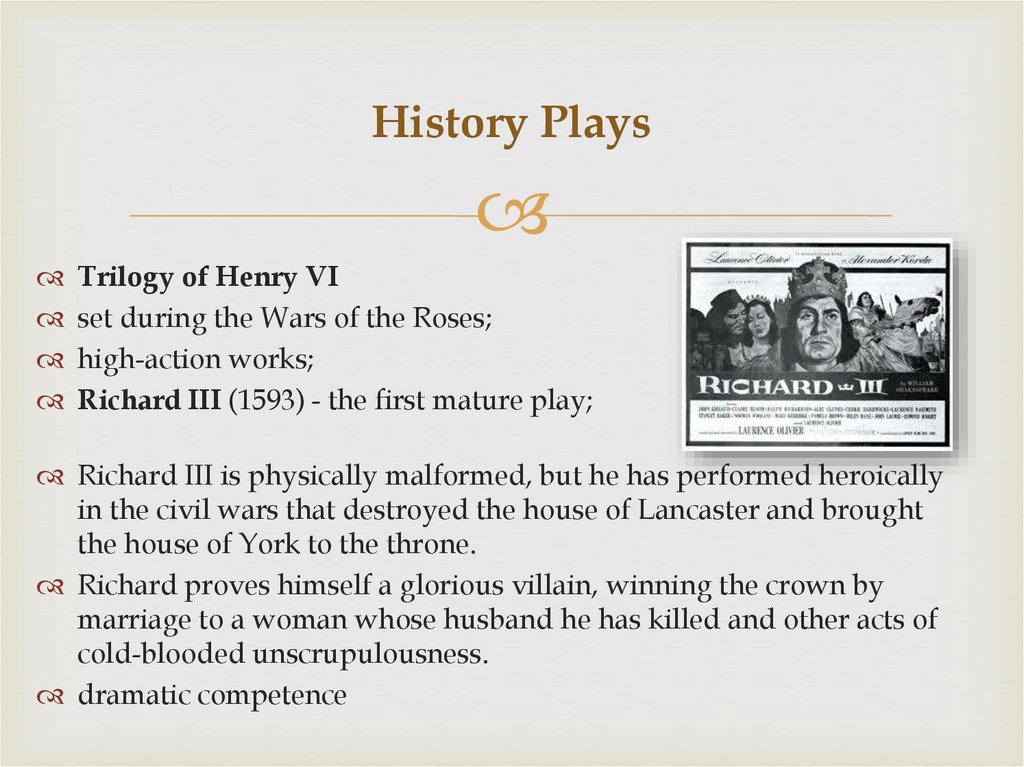
Trilogy of Henry VIset during the Wars of the Roses;
high-action works;
Richard III (1593) - the first mature play;
Richard III is physically malformed, but he has performed heroically
in the civil wars that destroyed the house of Lancaster and brought
the house of York to the throne.
Richard proves himself a glorious villain, winning the crown by
marriage to a woman whose husband he has killed and other acts of
cold-blooded unscrupulousness.
dramatic competence
16. The Taming of the Shrew (1594)
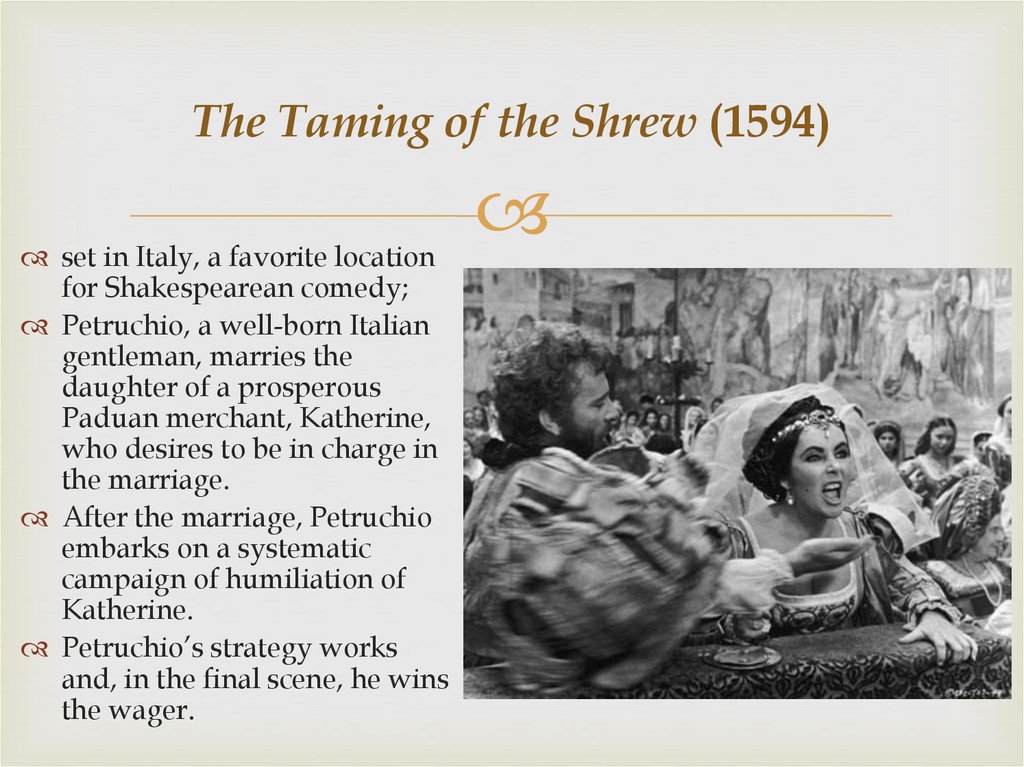
set in Italy, a favorite locationfor Shakespearean comedy;
Petruchio, a well-born Italian
gentleman, marries the
daughter of a prosperous
Paduan merchant, Katherine,
who desires to be in charge in
the marriage.
After the marriage, Petruchio
embarks on a systematic
campaign of humiliation of
Katherine.
Petruchio’s strategy works
and, in the final scene, he wins
the wager.
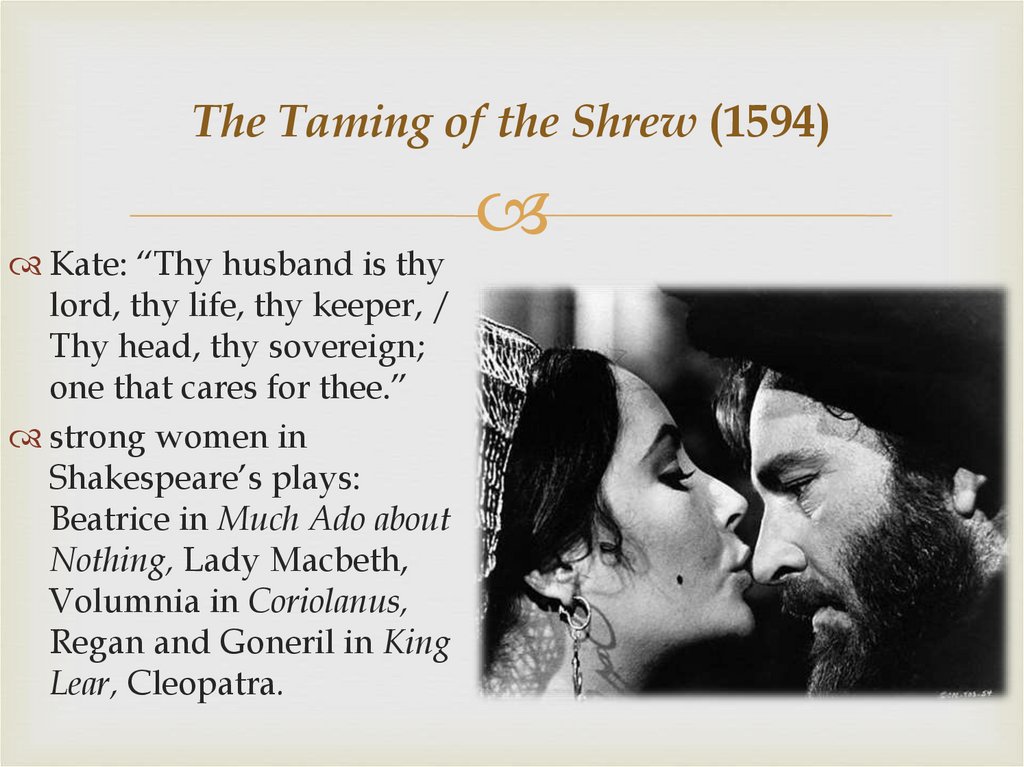
17. The Taming of the Shrew (1594)
Kate: “Thy husband is thylord, thy life, thy keeper, /
Thy head, thy sovereign;
one that cares for thee.”
strong women in
Shakespeare’s plays:
Beatrice in Much Ado about
Nothing, Lady Macbeth,
Volumnia in Coriolanus,
Regan and Goneril in King
Lear, Cleopatra.
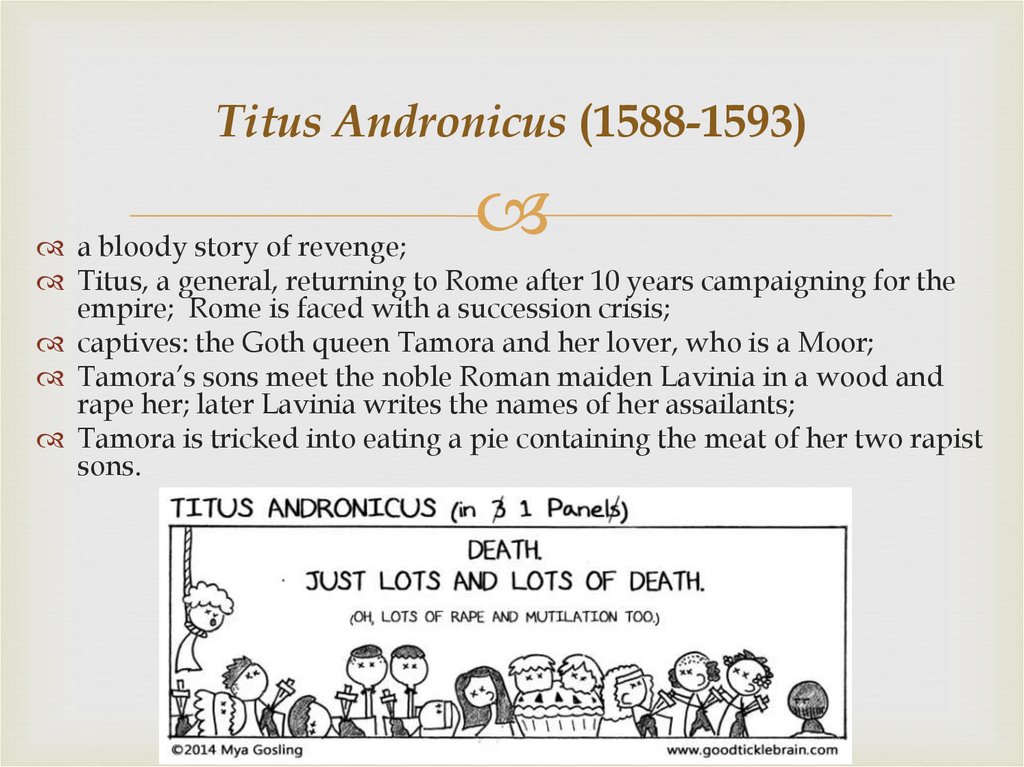
18. Titus Andronicus (1588-1593)
a bloody story of revenge;Titus, a general, returning to Rome after 10 years campaigning for the
empire; Rome is faced with a succession crisis;
captives: the Goth queen Tamora and her lover, who is a Moor;
Tamora’s sons meet the noble Roman maiden Lavinia in a wood and
rape her; later Lavinia writes the names of her assailants;
Tamora is tricked into eating a pie containing the meat of her two rapist
sons.
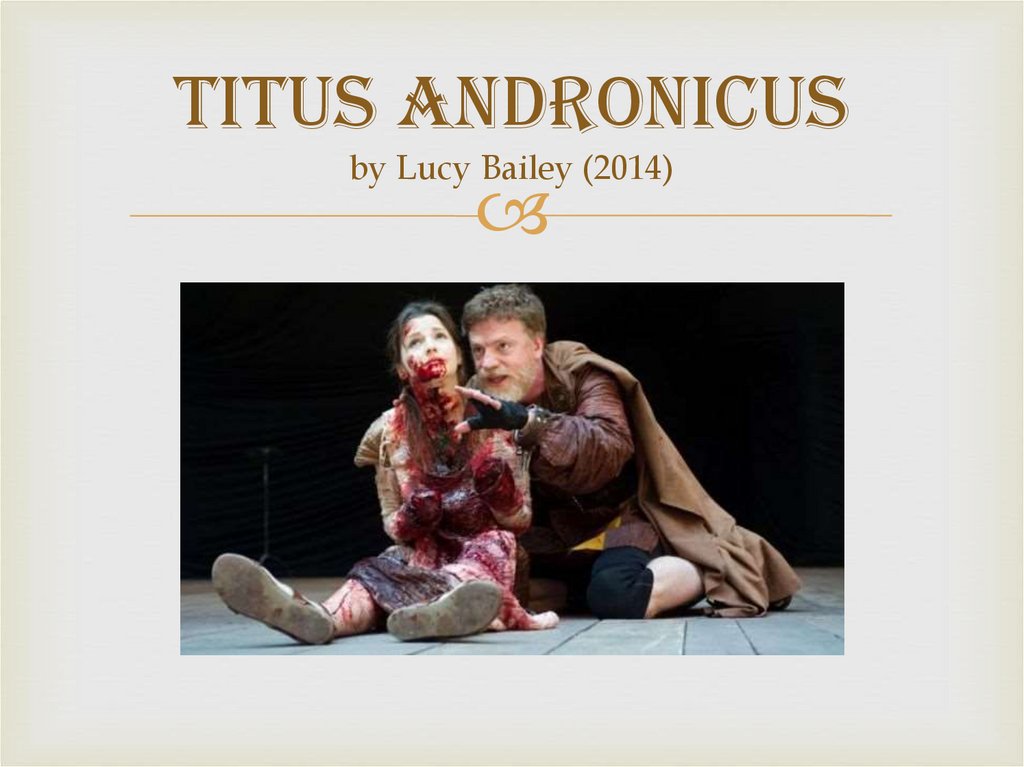
19. Titus Andronicus by Lucy Bailey (2014)
20. Shakespeare’s development
later work: interested in the process by which the tragedyunfolds;
Aristotle: the necessary and the probable;
the climactic effect of catharsis
Titus is an exploration of just how far the dramatic art could go.
Shakespeare’s world was a violent one, and this work perhaps
draws on the appetite of its audience for blood.
Shakespeare never stayed in the same genre, moving toward
what is perhaps his greatest achievement, the tragedies.
21. Shakespeare’s Retirement– another mystery?
In 1610, at the height of his career and while he wasstill in his 50s, Shakespeare decided to retire from
writing and to live out the remainder of his life as a
prosperous member of the gentry in Stratford. He
died in 1616 of disease, possibly syphilis or typhus.
Why????
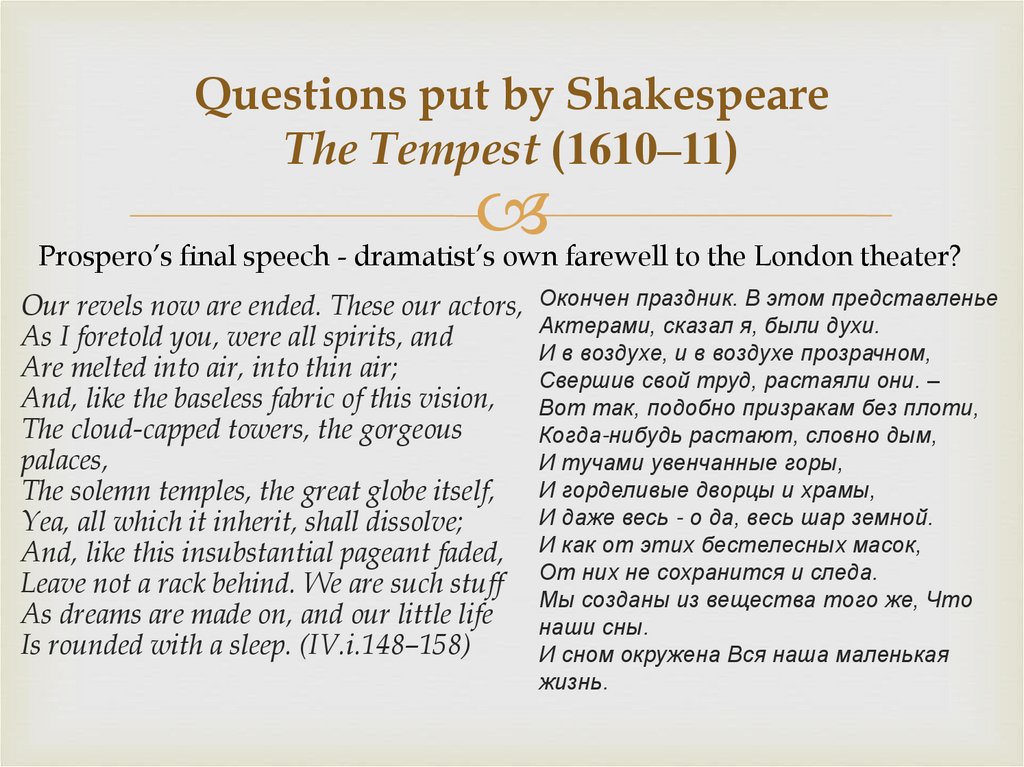
22. Questions put by Shakespeare The Tempest (1610–11)
Prospero’s final speech - dramatist’s own farewell to the London theater?Our revels now are ended. These our actors, Окончен праздник. В этом представленье
Актерами, сказал я, были духи.
As I foretold you, were all spirits, and
И в воздухе, и в воздухе прозрачном,
Are melted into air, into thin air;
Свершив свой труд, растаяли они. –
And, like the baseless fabric of this vision, Вот так, подобно призракам без плоти,
The cloud-capped towers, the gorgeous
Когда-нибудь растают, словно дым,
palaces,
И тучами увенчанные горы,
И горделивые дворцы и храмы,
The solemn temples, the great globe itself,
И даже весь - о да, весь шар земной.
Yea, all which it inherit, shall dissolve;
And, like this insubstantial pageant faded, И как от этих бестелесных масок,
Leave not a rack behind. We are such stuff От них не сохранится и следа.
Мы созданы из вещества того же, Что
As dreams are made on, and our little life
наши сны.
Is rounded with a sleep. (IV.i.148–158)
И сном окружена Вся наша маленькая
жизнь.
23. Questions put by Shakespeare The Tempest (1610–11)
All life is drama and all drama ends; All drama is fictionand we, too, are just figments;
Prospero and Shakespeare: What is the worth of
knowledge or power when one is faced with death?
Prospero and Shakespeare: withdraw to contemplate their
final days.
Prospero, a supreme ruler with magical powers, makes
this decision from strength of mind, not terror, as Faustus
did.
thoughts of death: Will he die well and at peace?
Shakespeare himself speaking to us, explaining why he
will write no more plays.
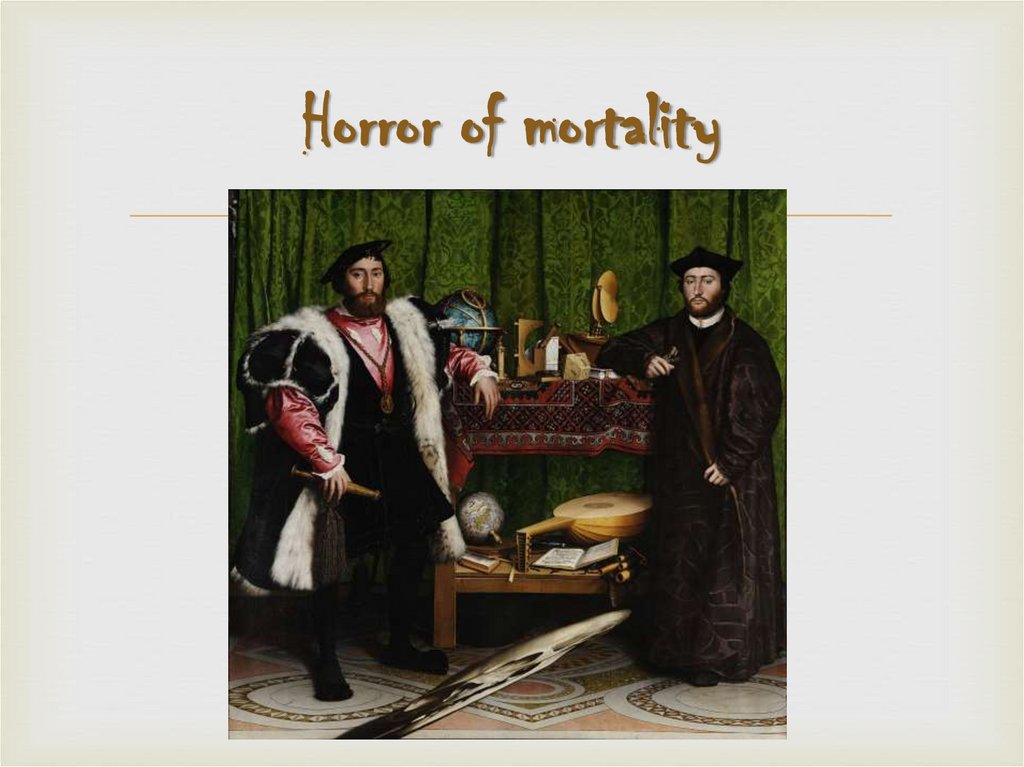
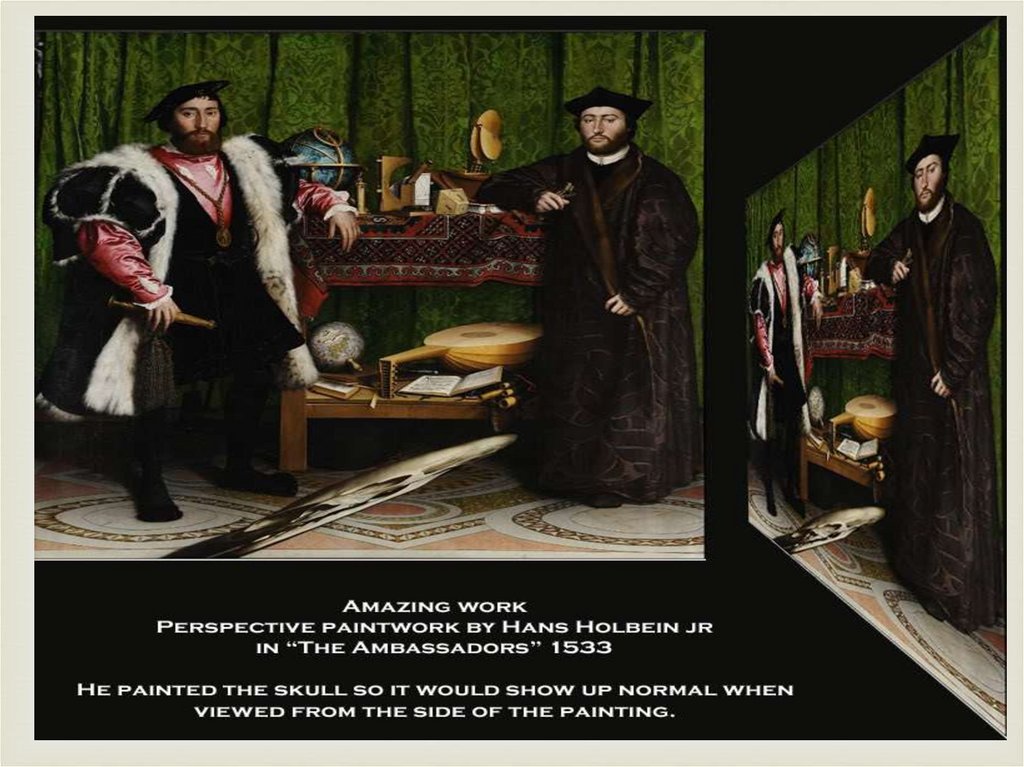
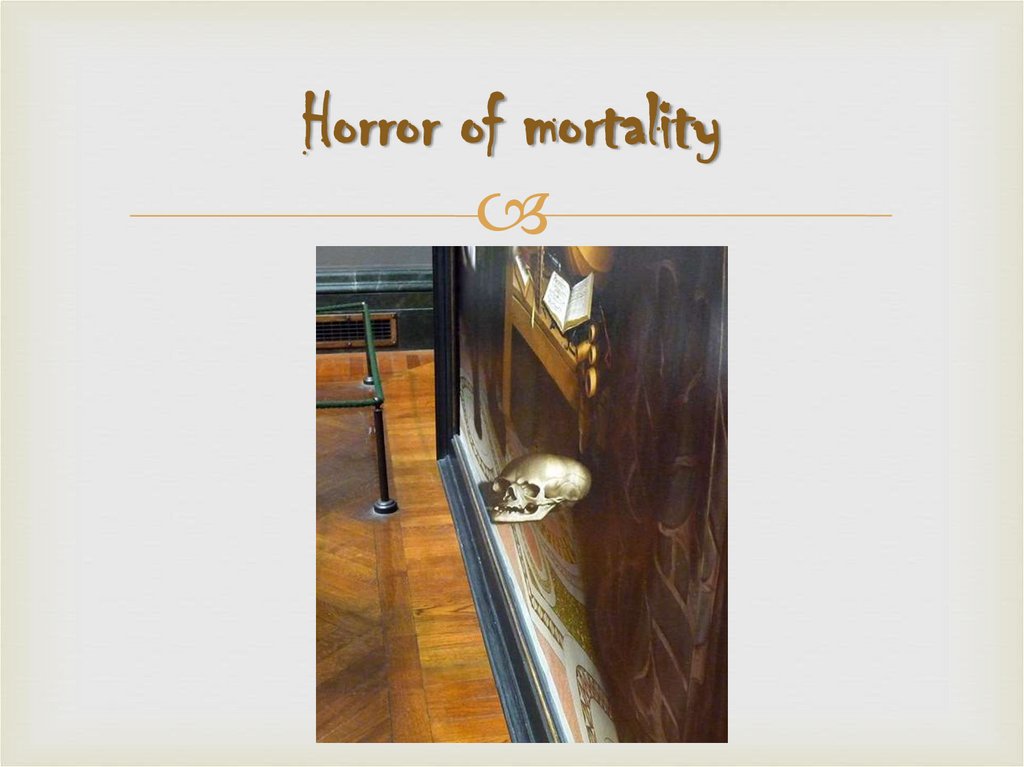
24. Horror of mortality
Measure for Measure (1603 or 1604)The young man Claudio has been condemned to death by Angelo, the
ruler of Vienna.
The only thing that will save him is if his sister, Isabella, will sleep
with Angelo.
Claudio urges his sister to prostitute herself by describing the sheer
horror of mortality.
comedy - all will end well;
but Claudio’s lines hang ominously in the mind even after the curtain
has fallen.
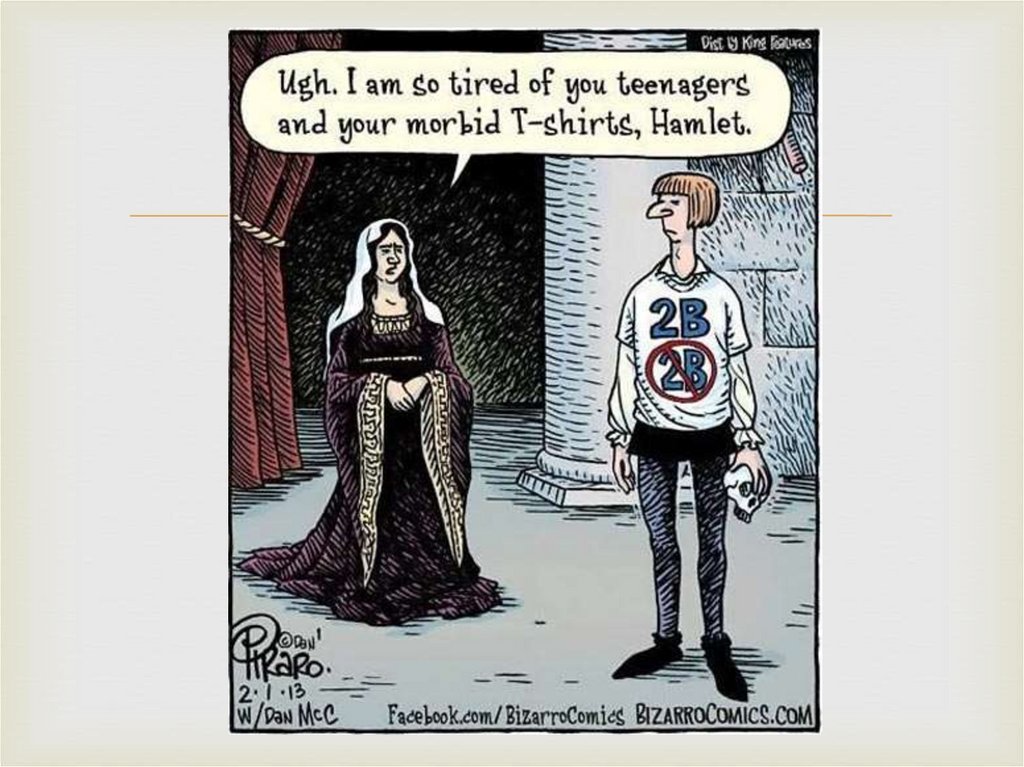
Hamlet – quotes the same question in “To be or not to be”
25. Horror of mortality
26. Horror of mortality
27. Horror of mortality
28. The relevant dilemmas of conscience in Roman plays
Julius Caesar:Can assassination, even in a good cause, ever be justified?
Can one do the right thing for the wrong reason or the wrong
thing for the right reason?
Coriolanus:
Where does morality stand when great affairs of state are at
stake?
How dishonest must a great ruler be in the interest of
preserving the well-being of his country?
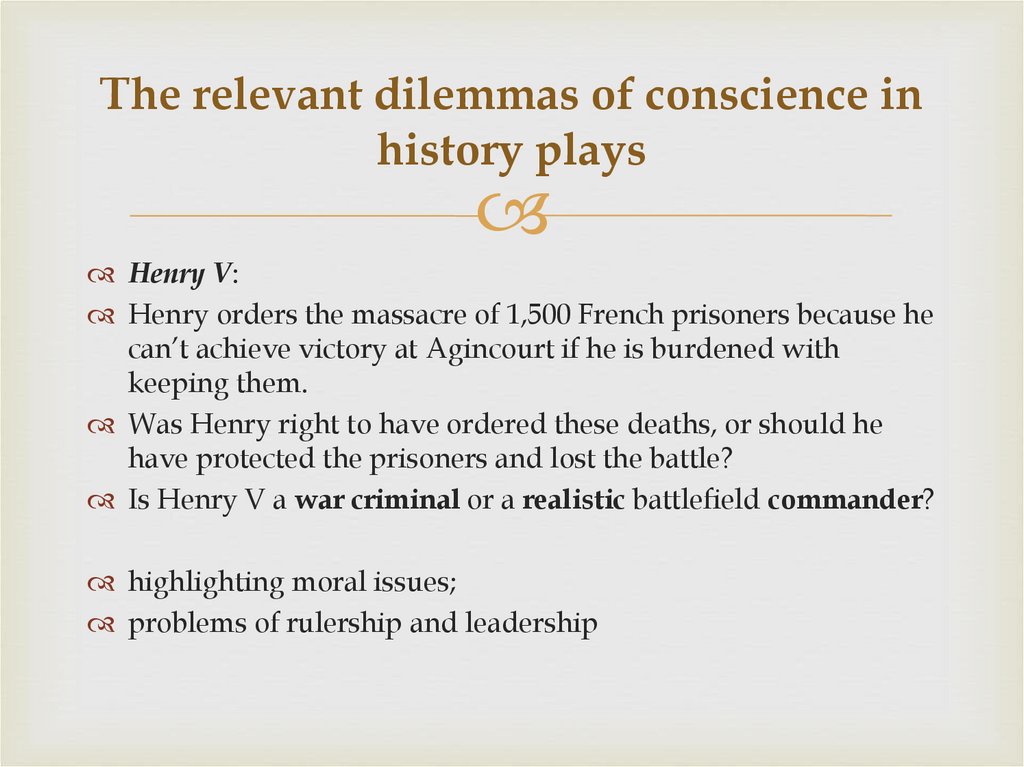
29. The relevant dilemmas of conscience in history plays
Henry V:Henry orders the massacre of 1,500 French prisoners because he
can’t achieve victory at Agincourt if he is burdened with
keeping them.
Was Henry right to have ordered these deaths, or should he
have protected the prisoners and lost the battle?
Is Henry V a war criminal or a realistic battlefield commander?
highlighting moral issues;
problems of rulership and leadership
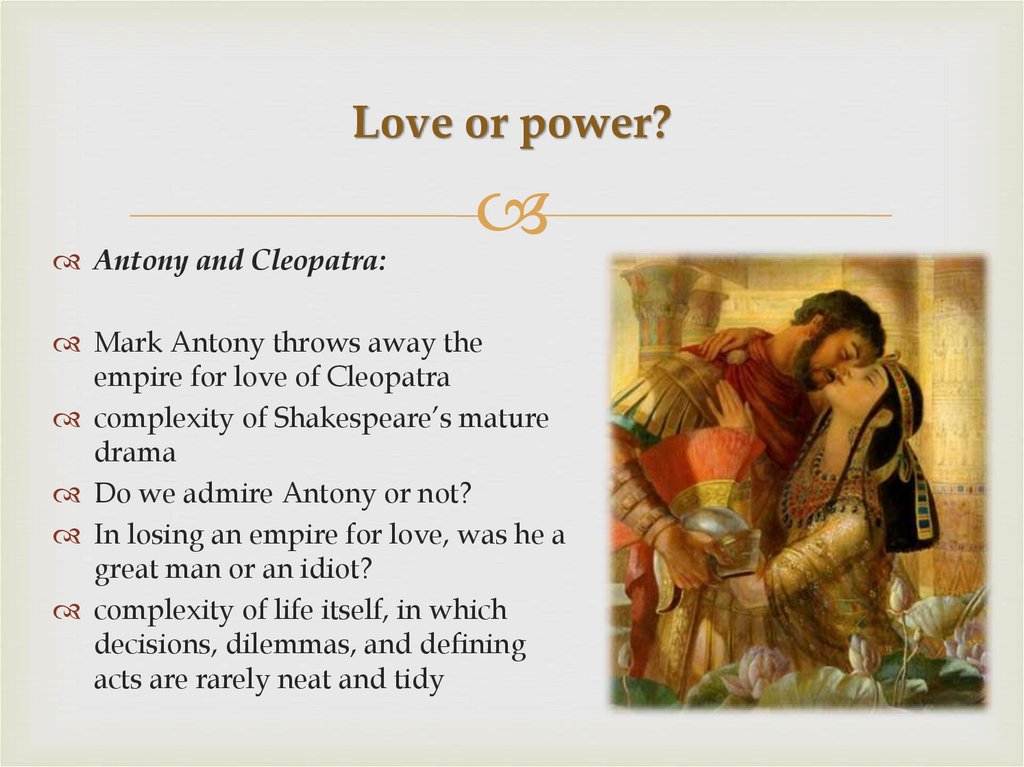
30. Love or power?
Antony and Cleopatra:Mark Antony throws away the
empire for love of Cleopatra
complexity of Shakespeare’s mature
drama
Do we admire Antony or not?
In losing an empire for love, was he a
great man or an idiot?
complexity of life itself, in which
decisions, dilemmas, and defining
acts are rarely neat and tidy
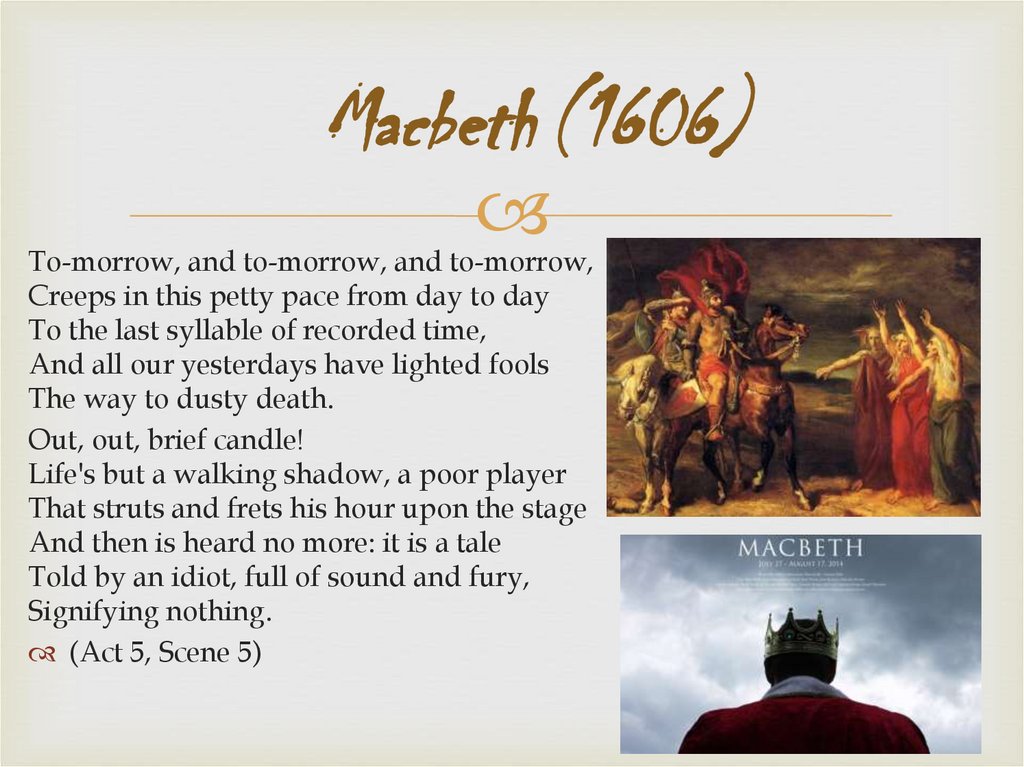
31. Macbeth (1606)
To-morrow, and to-morrow, and to-morrow,Creeps in this petty pace from day to day
To the last syllable of recorded time,
And all our yesterdays have lighted fools
The way to dusty death.
Out, out, brief candle!
Life's but a walking shadow, a poor player
That struts and frets his hour upon the stage
And then is heard no more: it is a tale
Told by an idiot, full of sound and fury,
Signifying nothing.
(Act 5, Scene 5)
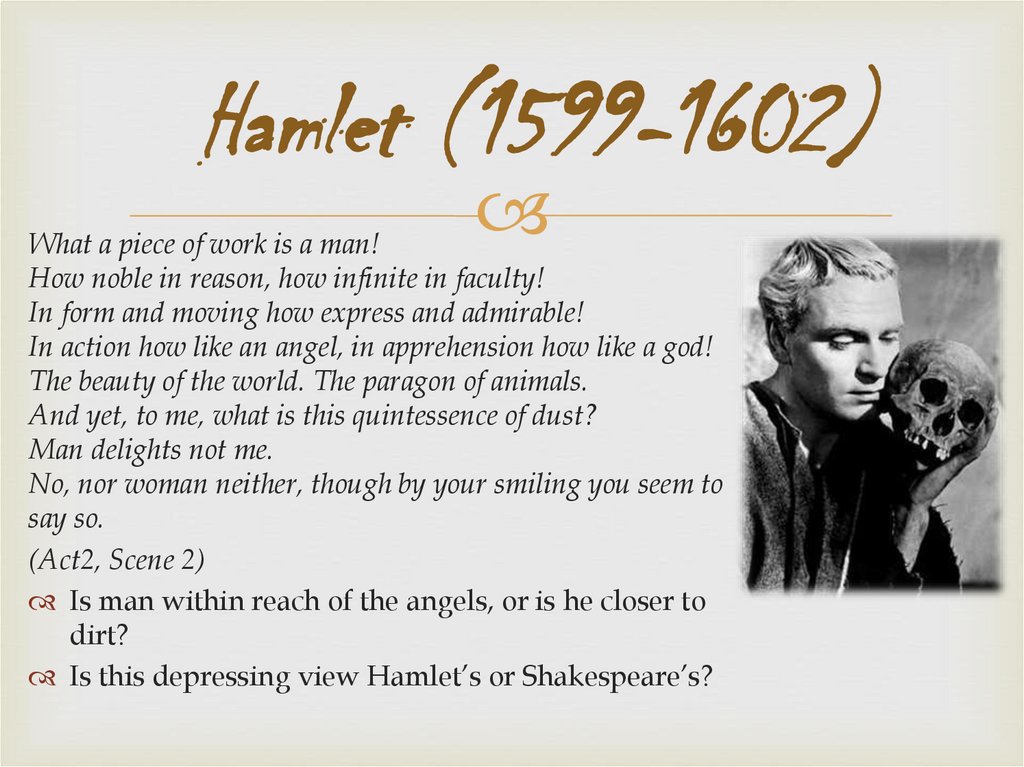
32. Hamlet (1599-1602)
What a piece of work is a man!How noble in reason, how infinite in faculty!
In form and moving how express and admirable!
In action how like an angel, in apprehension how like a god!
The beauty of the world. The paragon of animals.
And yet, to me, what is this quintessence of dust?
Man delights not me.
No, nor woman neither, though by your smiling you seem to
say so.
(Act2, Scene 2)
Is man within reach of the angels, or is he closer to
dirt?
Is this depressing view Hamlet’s or Shakespeare’s?
33.
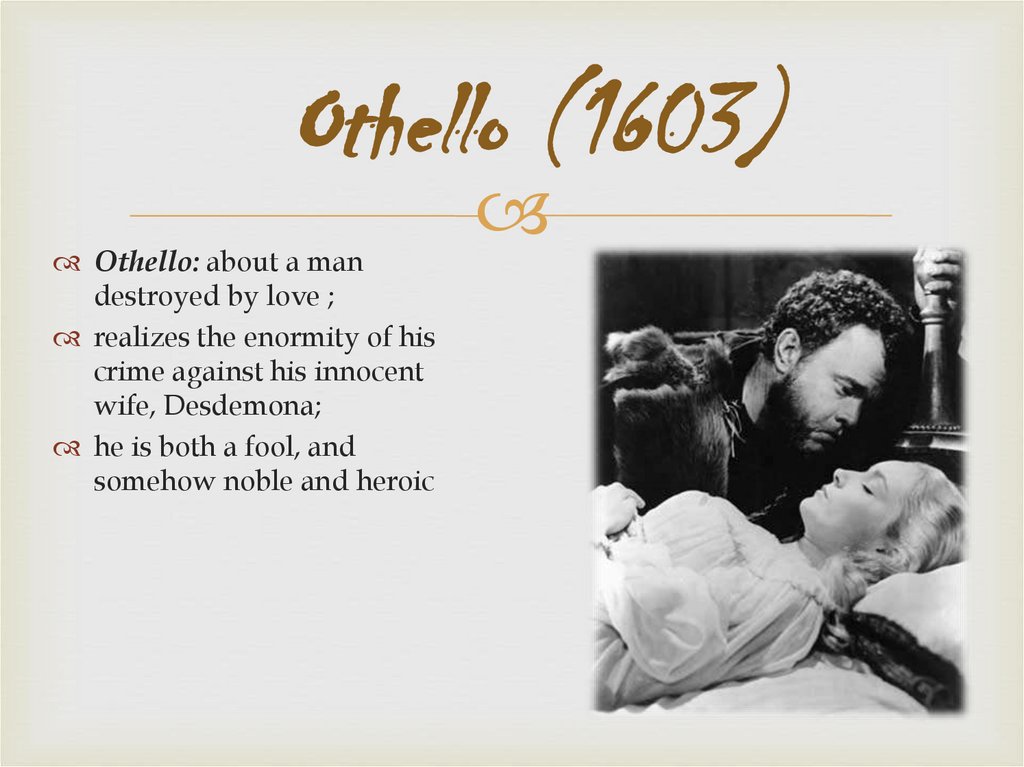
34. Othello (1603)
Othello: about a mandestroyed by love ;
realizes the enormity of his
crime against his innocent
wife, Desdemona;
he is both a fool, and
somehow noble and heroic