
 pedagogy
Similar presentations:








Using Drama and Role-Playing to Enhance Expressive Features in Student Speech
1.
Using Drama and Role-Playingto Enhance Expressive Features
in Student Speech
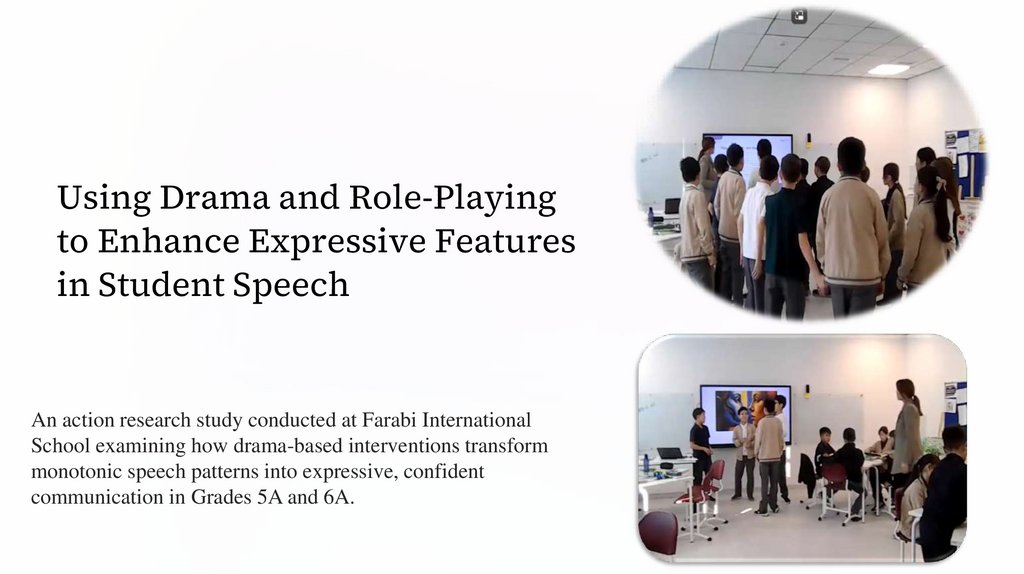
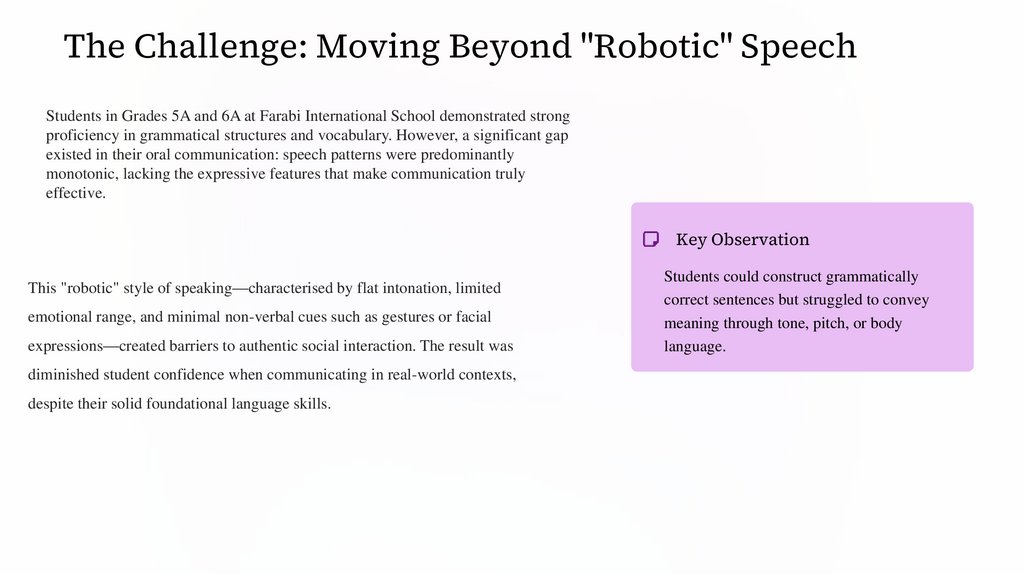
An action research study conducted at Farabi International
School examining how drama-based interventions transform
monotonic speech patterns into expressive, confident
communication in Grades 5A and 6A.
2.
The Challenge: Moving Beyond "Robotic" SpeechStudents in Grades 5A and 6A at Farabi International School demonstrated strong
proficiency in grammatical structures and vocabulary. However, a significant gap
existed in their oral communication: speech patterns were predominantly
monotonic, lacking the expressive features that make communication truly
effective.
Key Observation
This "robotic" style of speaking—characterised by flat intonation, limited
emotional range, and minimal non-verbal cues such as gestures or facial
expressions—created barriers to authentic social interaction. The result was
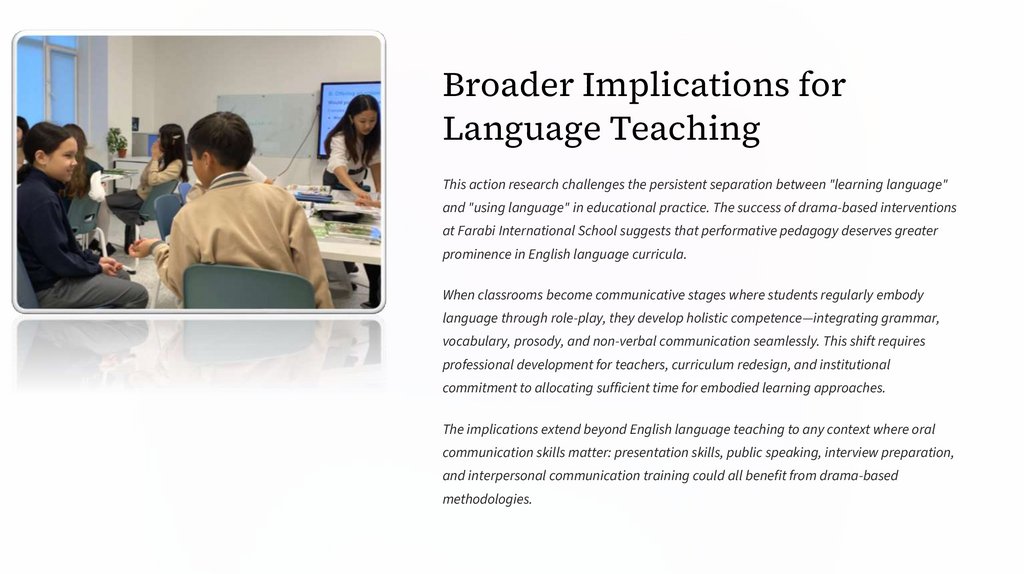
diminished student confidence when communicating in real-world contexts,
despite their solid foundational language skills.
Students could construct grammatically
correct sentences but struggled to convey
meaning through tone, pitch, or body
language.
3.
Understanding Prosody: The Science Behind ExpressiveSpeech
Intonation
Stress & Rhythm
Pitch Variation
The rise and fall of pitch that distinguishes
The emphasis placed on particular words or
Changes in vocal frequency that carry
questions from statements and conveys
syllables that highlights important
significant emotional and pragmatic
emotional states beyond literal word
information and creates natural speech
meaning, often more impactful than the
choices.
patterns.
words themselves.
Research consistently demonstrates that prosody—the collective term for these expressive features—carries as much communicative weight as vocabulary
and grammar. When students speak monotonically, they lose access to crucial channels of meaning-making that native speakers employ instinctively.
4.
Why Traditional Methods FallShort
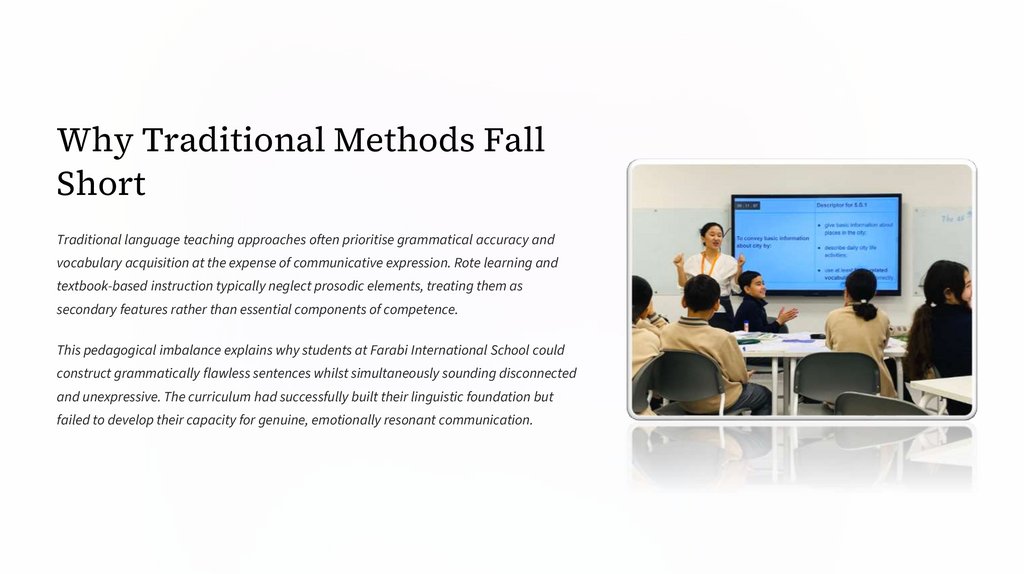
Traditional language teaching approaches often prioritise grammatical accuracy and
vocabulary acquisition at the expense of communicative expression. Rote learning and
textbook-based instruction typically neglect prosodic elements, treating them as
secondary features rather than essential components of competence.
This pedagogical imbalance explains why students at Farabi International School could
construct grammatically flawless sentences whilst simultaneously sounding disconnected
and unexpressive. The curriculum had successfully built their linguistic foundation but
failed to develop their capacity for genuine, emotionally resonant communication.
5.
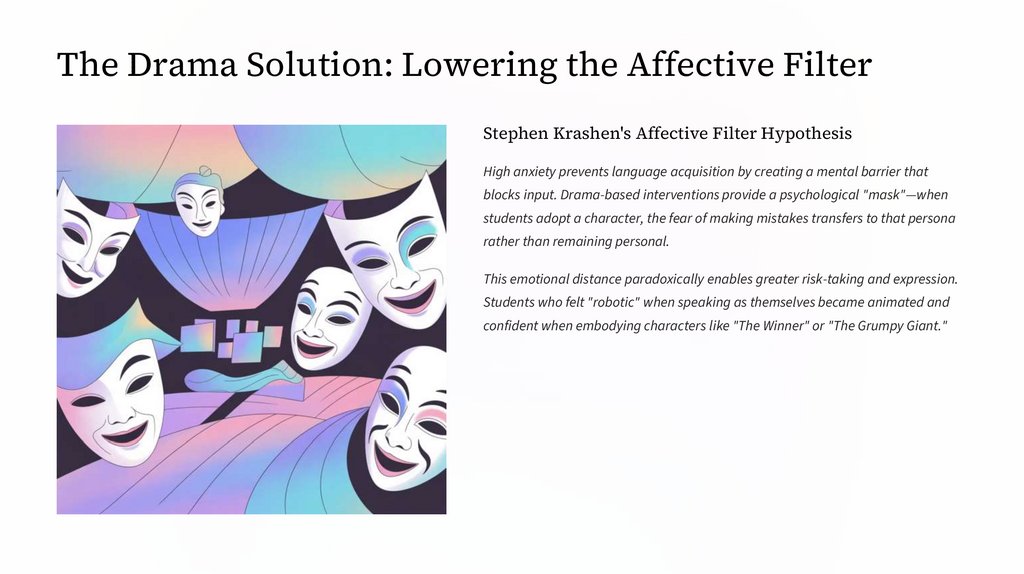
The Drama Solution: Lowering the Affective FilterStephen Krashen's Affective Filter Hypothesis
High anxiety prevents language acquisition by creating a mental barrier that
blocks input. Drama-based interventions provide a psychological "mask"—when
students adopt a character, the fear of making mistakes transfers to that persona
rather than remaining personal.
This emotional distance paradoxically enables greater risk-taking and expression.
Students who felt "robotic" when speaking as themselves became animated and
confident when embodying characters like "The Winner" or "The Grumpy Giant."
6.
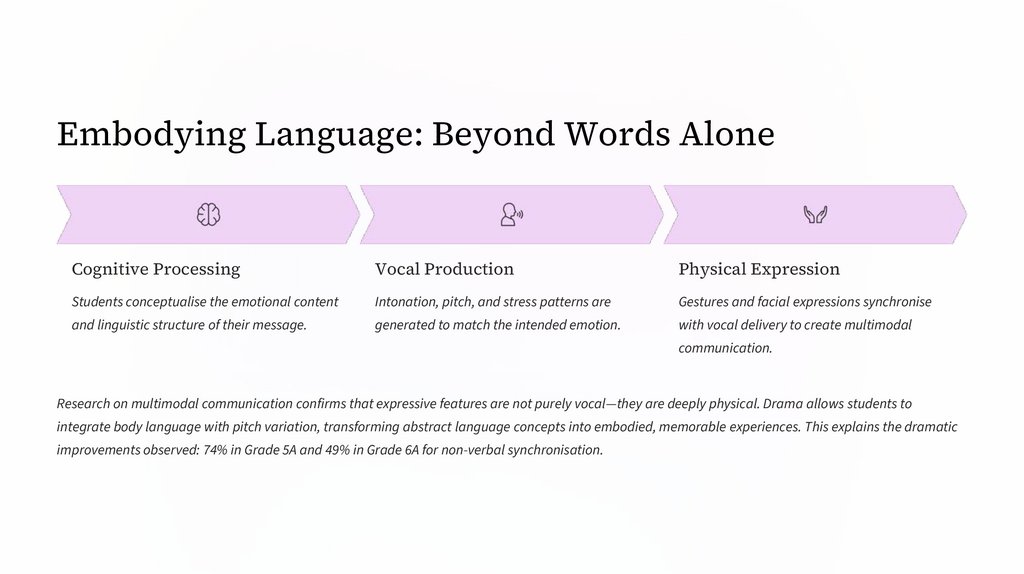
Embodying Language: Beyond Words AloneCognitive Processing
Vocal Production
Physical Expression
Students conceptualise the emotional content
Intonation, pitch, and stress patterns are
Gestures and facial expressions synchronise
and linguistic structure of their message.
generated to match the intended emotion.
with vocal delivery to create multimodal
communication.
Research on multimodal communication confirms that expressive features are not purely vocal—they are deeply physical. Drama allows students to
integrate body language with pitch variation, transforming abstract language concepts into embodied, memorable experiences. This explains the dramatic
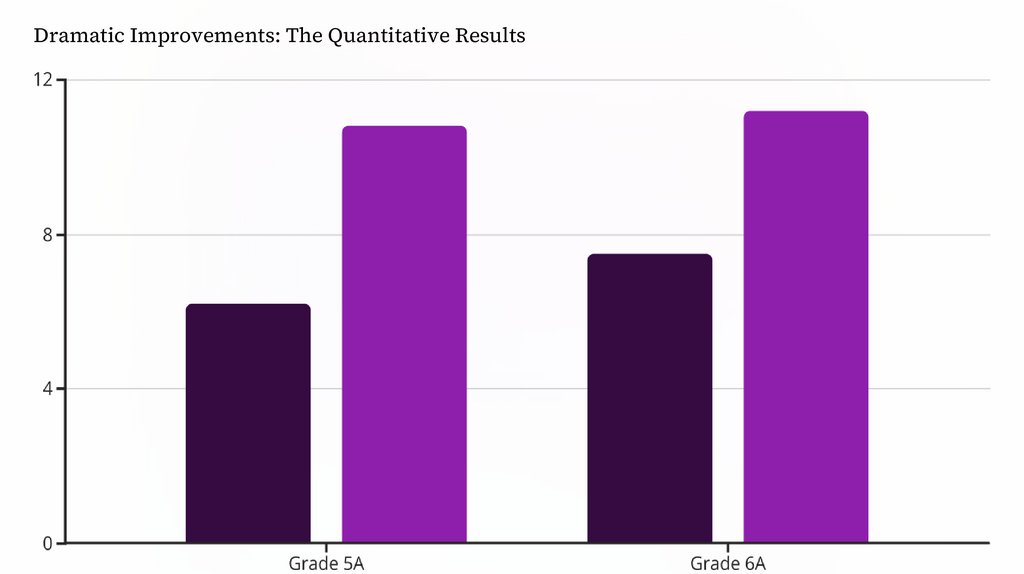
improvements observed: 74% in Grade 5A and 49% in Grade 6A for non-verbal synchronisation.
7.
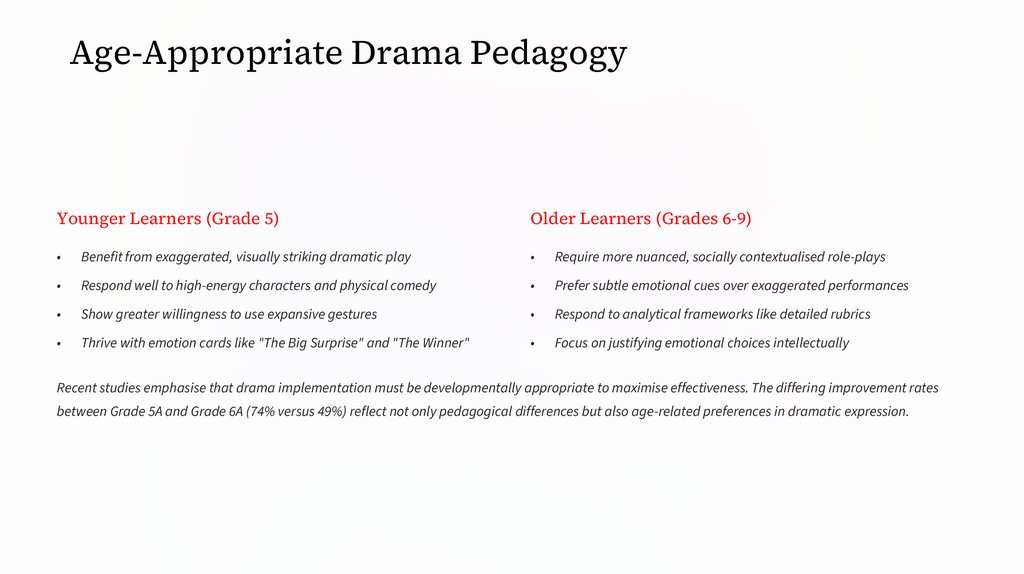
Age-Appropriate Drama PedagogyYounger Learners (Grade 5)
Older Learners (Grades 6-9)
Benefit from exaggerated, visually striking dramatic play
Require more nuanced, socially contextualised role-plays
Respond well to high-energy characters and physical comedy
Prefer subtle emotional cues over exaggerated performances
Show greater willingness to use expansive gestures
Respond to analytical frameworks like detailed rubrics
Thrive with emotion cards like "The Big Surprise" and "The Winner"
Focus on justifying emotional choices intellectually
Recent studies emphasise that drama implementation must be developmentally appropriate to maximise effectiveness. The differing improvement rates
between Grade 5A and Grade 6A (74% versus 49%) reflect not only pedagogical differences but also age-related preferences in dramatic expression.
8.
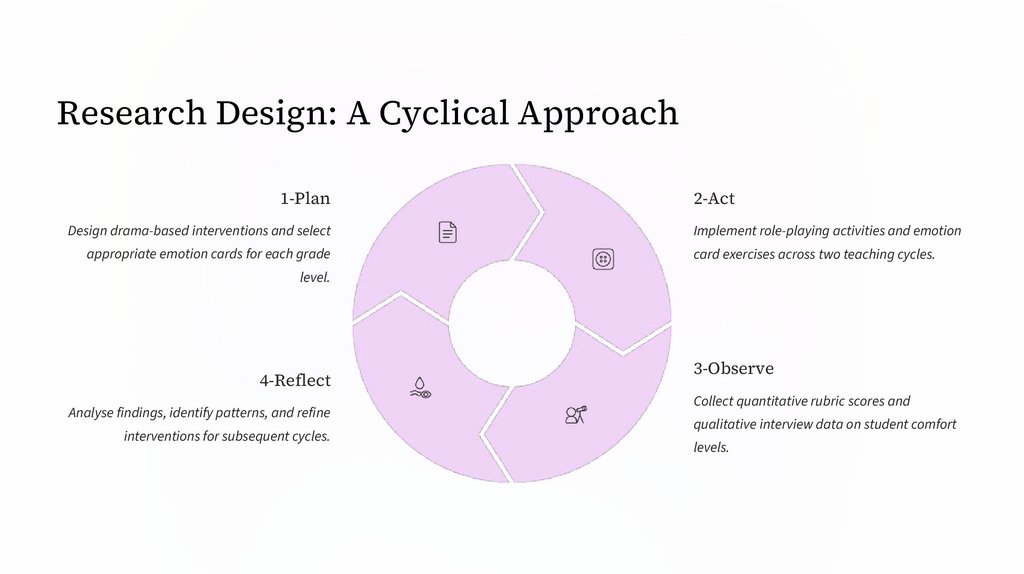
Research Design: A Cyclical Approach1-Plan
Design drama-based interventions and select
appropriate emotion cards for each grade
2-Act
Implement role-playing activities and emotion
card exercises across two teaching cycles.
level.
4-Reflect
Analyse findings, identify patterns, and refine
interventions for subsequent cycles.
3-Observe
Collect quantitative rubric scores and
qualitative interview data on student comfort
levels.
9.
Participants and ContextGrade 5A
Grade 6A
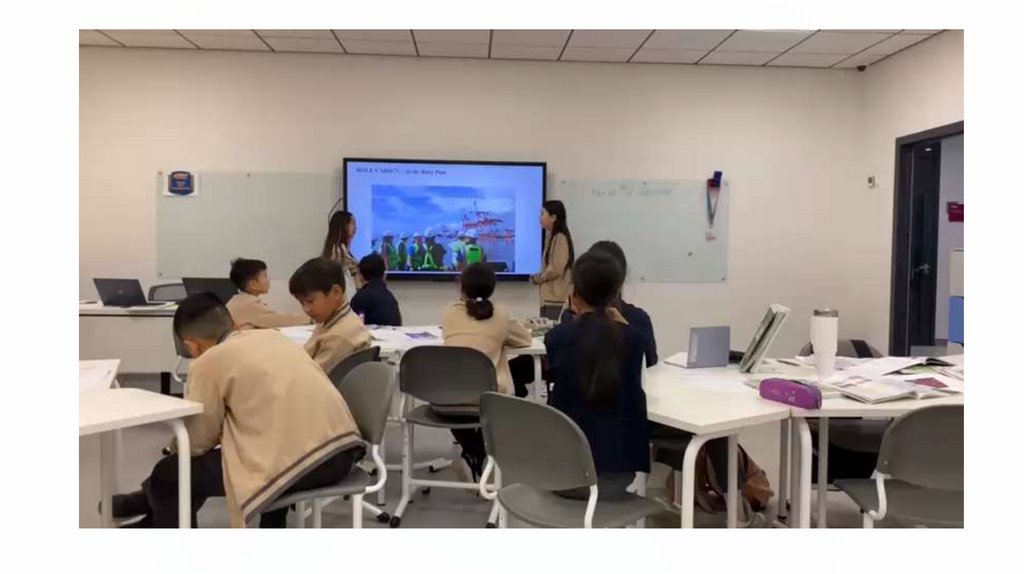
15 students taught by Teacher A (Zhazira)
14 students taught by Teacher B (Altyngul)
Characterised by enthusiasm for physical performance and
Demonstrated preference for more subtle, socially nuanced dramatic
exaggerated character work.
expression.
Both classes at Farabi International School had similar baseline grammatical proficiency but exhibited the characteristic monotonic speech patterns
identified in the problem statement. The mixed-methods action research design allowed for both statistical measurement and rich qualitative insights into
student experiences.
10.
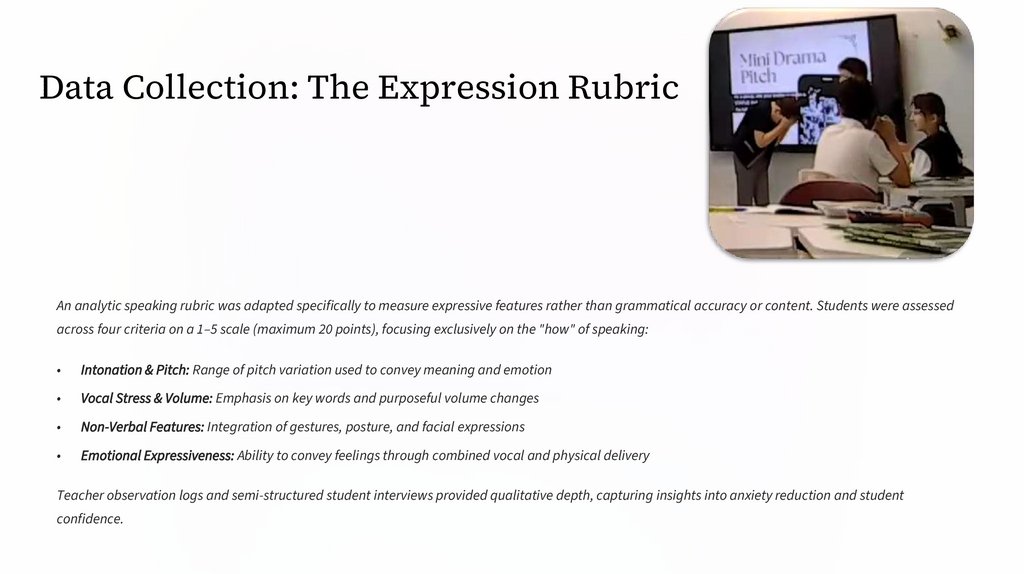
Data Collection: The Expression RubricAn analytic speaking rubric was adapted specifically to measure expressive features rather than grammatical accuracy or content. Students were assessed
across four criteria on a 1–5 scale (maximum 20 points), focusing exclusively on the "how" of speaking:
Intonation & Pitch: Range of pitch variation used to convey meaning and emotion
Vocal Stress & Volume: Emphasis on key words and purposeful volume changes
Non-Verbal Features: Integration of gestures, posture, and facial expressions
Emotional Expressiveness: Ability to convey feelings through combined vocal and physical delivery
Teacher observation logs and semi-structured student interviews provided qualitative depth, capturing insights into anxiety reduction and student
confidence.
11.
Dramatic Improvements: The Quantitative Results12.
13.
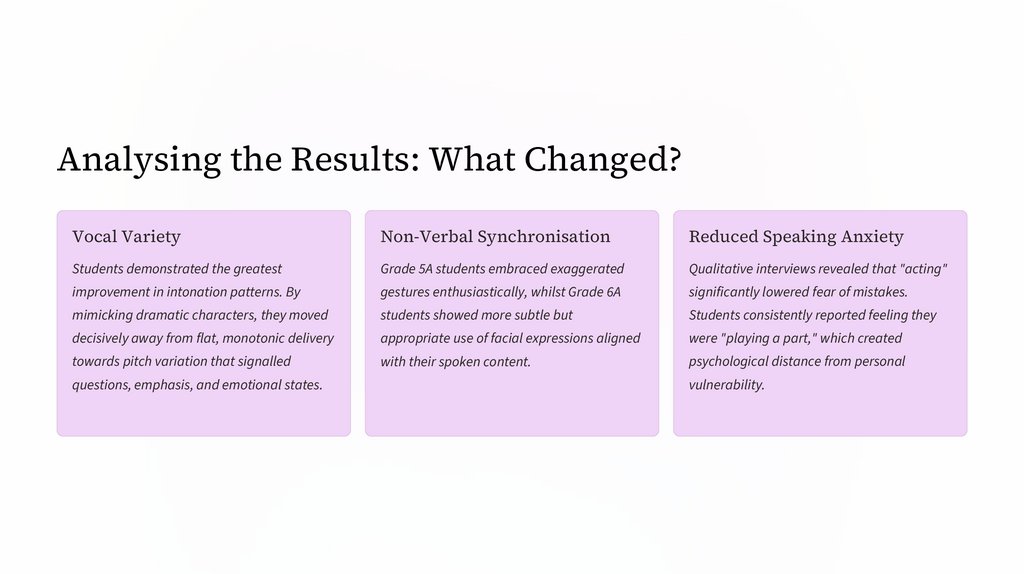
Analysing the Results: What Changed?Vocal Variety
Non-Verbal Synchronisation
Reduced Speaking Anxiety
Students demonstrated the greatest
Grade 5A students embraced exaggerated
Qualitative interviews revealed that "acting"
improvement in intonation patterns. By
gestures enthusiastically, whilst Grade 6A
significantly lowered fear of mistakes.
mimicking dramatic characters, they moved
students showed more subtle but
Students consistently reported feeling they
decisively away from flat, monotonic delivery
appropriate use of facial expressions aligned
were "playing a part," which created
towards pitch variation that signalled
with their spoken content.
psychological distance from personal
questions, emphasis, and emotional states.
vulnerability.
14.
15.
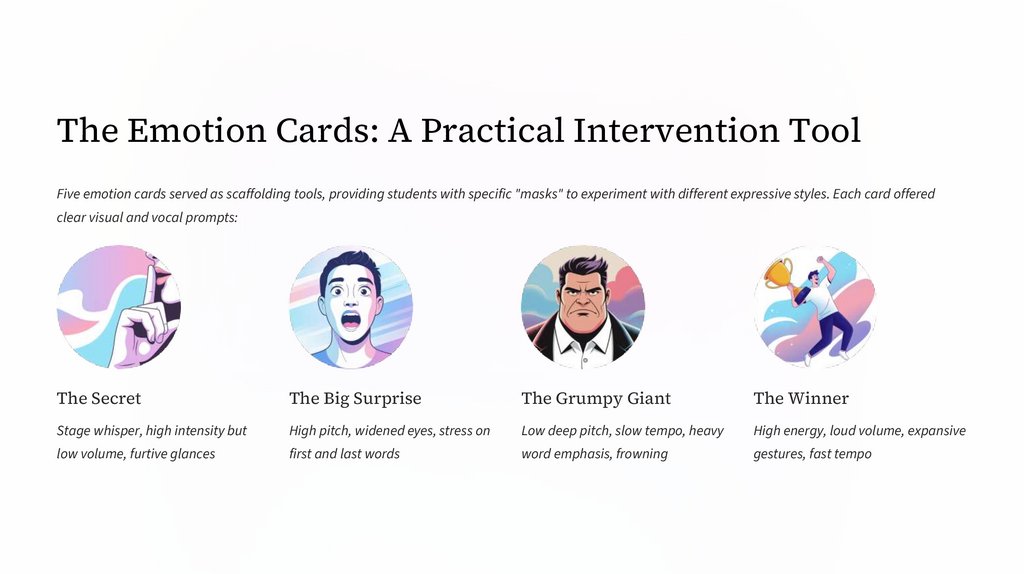
The Emotion Cards: A Practical Intervention ToolFive emotion cards served as scaffolding tools, providing students with specific "masks" to experiment with different expressive styles. Each card offered
clear visual and vocal prompts:
The Secret
The Big Surprise
The Grumpy Giant
The Winner
Stage whisper, high intensity but
High pitch, widened eyes, stress on
Low deep pitch, slow tempo, heavy
High energy, loud volume, expansive
low volume, furtive glances
first and last words
word emphasis, frowning
gestures, fast tempo
16.
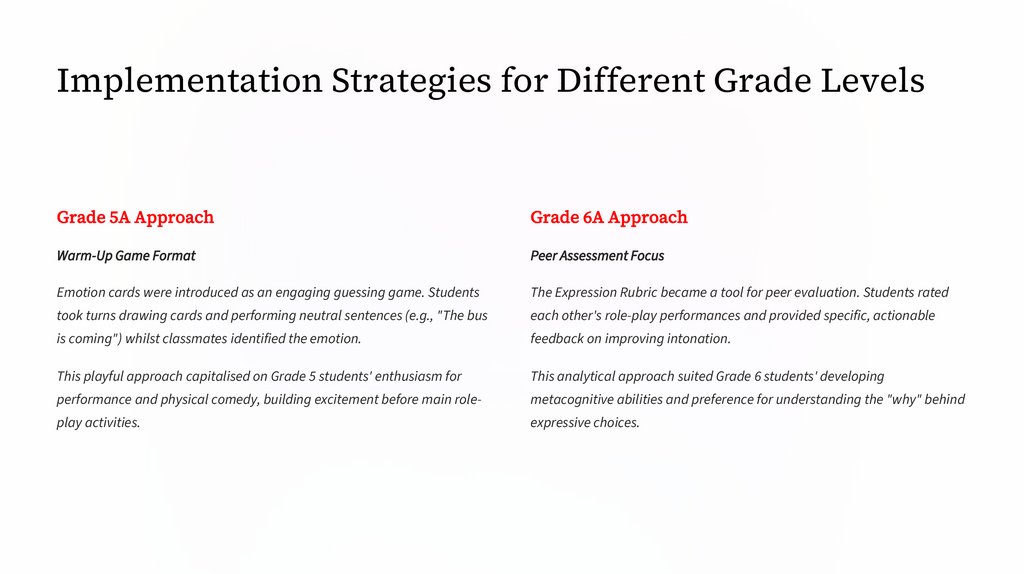
Implementation Strategies for Different Grade LevelsGrade 5A Approach
Grade 6A Approach
Warm-Up Game Format
Peer Assessment Focus
Emotion cards were introduced as an engaging guessing game. Students
The Expression Rubric became a tool for peer evaluation. Students rated
took turns drawing cards and performing neutral sentences (e.g., "The bus
each other's role-play performances and provided specific, actionable
is coming") whilst classmates identified the emotion.
feedback on improving intonation.
This playful approach capitalised on Grade 5 students' enthusiasm for
This analytical approach suited Grade 6 students' developing
performance and physical comedy, building excitement before main role-
metacognitive abilities and preference for understanding the "why" behind
play activities.
expressive choices.
17.
From Linguistic to Communicative CompetenceTraditional Focus: Linguistic Competence
Grammar accuracy, vocabulary breadth, pronunciation correctness—essential but insufficient for real communication
Integrated Approach: Communicative Competence
Grammar + vocabulary + prosody + body language = authentic, engaging, context-appropriate expression
The research findings strongly suggest that expressive features cannot be treated as optional "add-ons" to be addressed after students master grammar.
Instead, prosody and non-verbal communication must be woven throughout language instruction from the earliest stages. Performative pedagogy—treating
the classroom as a "communicative stage"—offers a practical framework for achieving this integration at Farabi International School.
18.
Practical Recommendations for Educators01
02
03
Integrate Emotion Drills
Enable Self-Assessment Through
Recording
Start Small and Build Gradually
activities, not just special drama lessons. Have
Allow students to video-record role-plays so they
sad) before introducing subtle distinctions
students practice saying vocabulary sentences or
can observe their own body language, pitch
(nervous vs. excited). Scaffold complexity as
grammar patterns with different expressive
variation, and facial expressions. Self-reflection
students gain confidence.
features.
builds metacognitive awareness of expressive
Use emotion cards during regular speaking
features.
Begin with simple emotion contrasts (happy vs.
19.
Acknowledging LimitationsTime Constraints
Physical Space Requirements
Limited Generalisability
Drama-based activities require significantly
The classroom layouts occasionally
With only two classes (15 and 14 students),
more lesson time than traditional
restricted the movement necessary for
findings may not transfer to all contexts.
instruction. At Farabi International School,
dynamic role-playing. More spacious or
Further research across multiple schools
this sometimes conflicted with heavy
flexible learning environments would
and grade levels would strengthen
curriculum requirements and assessment
enhance the effectiveness of embodied
confidence in these approaches.
schedules, limiting the frequency of
language practice.
interventions.
20.
Broader Implications forLanguage Teaching
This action research challenges the persistent separation between "learning language"
and "using language" in educational practice. The success of drama-based interventions
at Farabi International School suggests that performative pedagogy deserves greater
prominence in English language curricula.
When classrooms become communicative stages where students regularly embody
language through role-play, they develop holistic competence—integrating grammar,
vocabulary, prosody, and non-verbal communication seamlessly. This shift requires
professional development for teachers, curriculum redesign, and institutional
commitment to allocating sufficient time for embodied learning approaches.
The implications extend beyond English language teaching to any context where oral
communication skills matter: presentation skills, public speaking, interview preparation,
and interpersonal communication training could all benefit from drama-based
methodologies.
21.
Key Takeaways for Action ResearchersFocus on the "How" Not Just the "What"
The Affective Filter Is Real and Manageable
Assessing expressive features requires different tools than grammar
Drama's psychological "mask" genuinely reduces speaking anxiety.
tests. Develop rubrics that measure prosody, body language, and
Students consistently reported feeling braver when playing
emotional expressiveness as distinct competencies.
characters, validating Krashen's theoretical framework.
Differentiation Matters Across Age Groups
Small Interventions Yield Significant Results
Younger learners thrive with exaggerated, energetic drama whilst
Even simple tools like emotion cards can produce measurable
older students prefer subtle, socially nuanced performance. Tailor
improvements. You don't need elaborate theatrical productions—
interventions to developmental stages.
targeted, consistent practice transforms speech patterns.
22.
Conclusion: Bridging Accuracy and ExpressionThe use of drama and role-playing successfully enhanced expressive features in student speech across Grades 5A and 6A at Farabi International School. By
deliberately focusing on the "how" of speaking—intonation, stress, volume, and body language—rather than exclusively on grammatical accuracy, students
became more engaging and confident communicators.
The intervention demonstrated that even small-scale dramatic techniques can bridge the critical gap between accurate speech and expressive, natural
communication. Students who began the study speaking in monotonic, "robotic" patterns concluded it with the vocal variety and non-verbal expressiveness
characteristic of competent speakers.
This research affirms that communicative competence requires explicit attention to prosodic features integrated throughout language instruction. Dramabased pedagogy offers not merely an engaging teaching method but a theoretically grounded, empirically validated approach to developing holistic
language abilities. For educators at Farabi International School and beyond, the message is clear: transform your classroom into a stage, and watch your
students' voices come alive.
23.
References•Baldwin, P. (2012). With drama in mind: Real learning in imagined worlds (2nd ed.). Continuum. (Focuses on how drama creates
"imagined worlds" that foster real communicative gains).
•Chun, D. M. (2002). Discourse intonation in L2: From theory and research to practice. John Benjamins Publishing. (Provides the linguistic
basis for teaching prosody and intonation in English).
•Doff, A. (1988). Teach English: A training course for teachers. Cambridge University Press. (Foundational for the use of role-play and
simulation in the EFL classroom).
•Kao, S. M., & O'Neill, C. (1998). Words into worlds: Learning a second language through process drama. Ablex Publishing. (The primary
text for understanding how drama moves language from abstract rules to lived experience).
•Krashen, S. D. (1982). Principles and practice in second language acquisition. Pergamon Press. (Source of the Affective Filter
Hypothesis, explaining how drama reduces speaking anxiety).
•Maley, A., & Duff, A. (2005). Drama techniques: A resource book of communication activities for language teachers (3rd ed.). Cambridge
University Press. (A practical guide for activities like "Emotion Cards" and vocal drills).
•Richards, J. C., & Rogers, T. S. (2014). Approaches and methods in language teaching (3rd ed.). Cambridge University Press.
(Contextualizes drama within Communicative Language Teaching (CLT) and Total Physical Response (TPR)).
•Wessels, C. (1987). Drama (Resource books for teachers). Oxford University Press. (Explores the integration of non-verbal cues and vocal
expression in language learning).