
 finance
Similar presentations:






ASB-2512 Investment Banking
1. ASB-2512 Investment Banking
Lecturer: Saidgozi Saydumarov2. Textbook
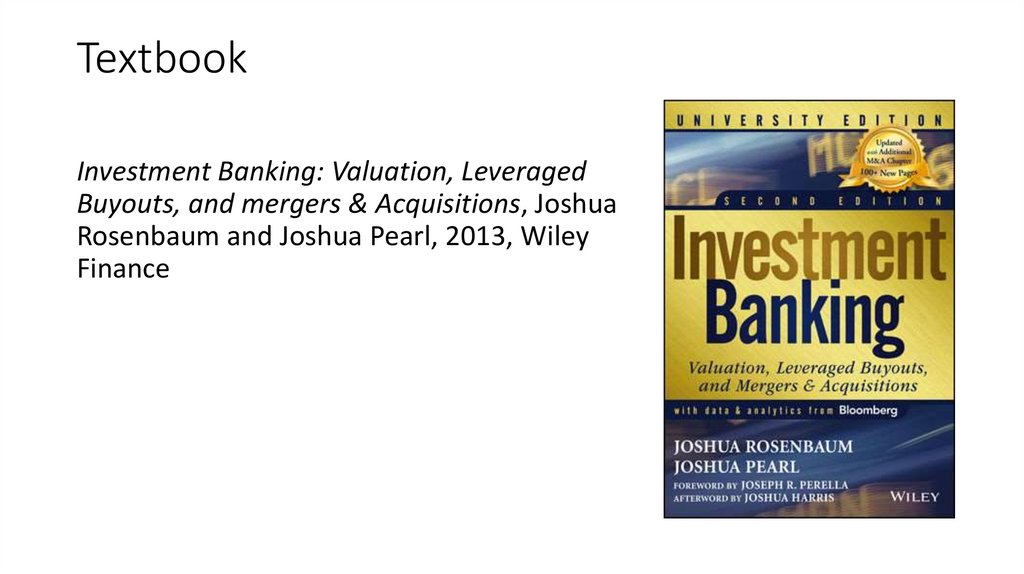
Investment Banking: Valuation, LeveragedBuyouts, and mergers & Acquisitions, Joshua
Rosenbaum and Joshua Pearl, 2013, Wiley
Finance
3. Assessment
• Group Assignment (40%)• Final Examination (60%)
4. Contacting the Lecturer
Lecturer: Saidgozi SaydumarovEmail: ssaydumarov@mdis.uz
Telegram channel (for quick communication and materials):
https://t.me/invban
5. Module Outline
• Lecture 1: Introduction to Investment Banking• Lecture 2: Bank Valuation – Balance Sheet and P&L Analysis
• Lecture 3: Underwriting (Equity and Debt)
• Lecture 4: Mock Assignment
• Lecture 5: Tools of Valuation – Comparable Companies Analysis
• Lecture 6: Tools of Valuation – Precedent Transaction Analysis
• Lecture 7: Tools of Valuation – Discounted Cash Flow Analysis
• Lecture 8: Mergers and Acquisitions
• Lecture 9: Leveraged Buyouts
• Lecture 10: Exam Revision
6. Investment Banks
An investment bank is a financial institution that performs complexfinancial transactions like underwriting, raising capital, trading
securities, restructuring companies and managing corporate mergers
and acquisitions.
Biggest investment banks include
7. Investment Banking Functions
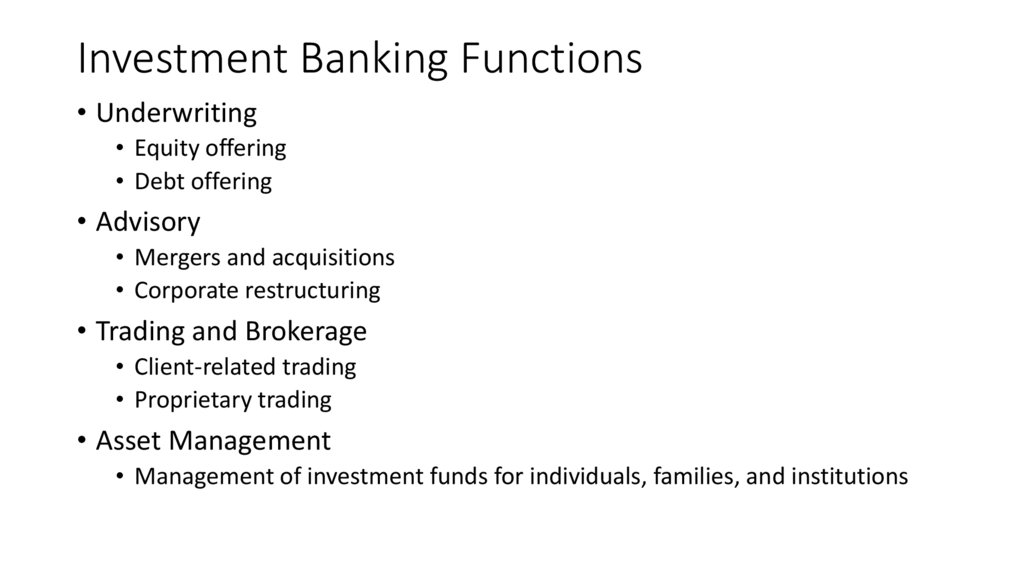
• Underwriting• Equity offering
• Debt offering
• Advisory
• Mergers and acquisitions
• Corporate restructuring
• Trading and Brokerage
• Client-related trading
• Proprietary trading
• Asset Management
• Management of investment funds for individuals, families, and institutions
8. Underwriting
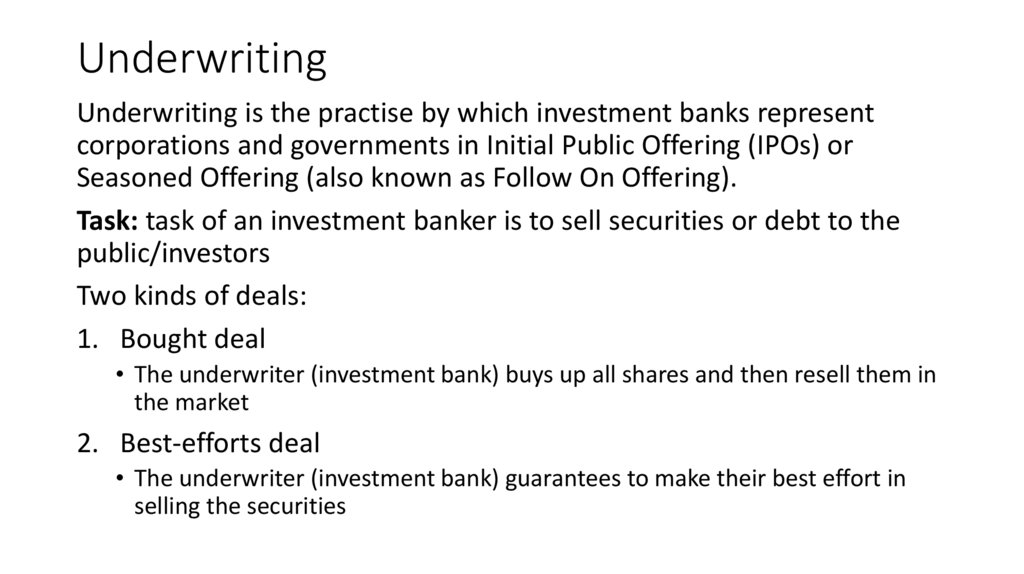
Underwriting is the practise by which investment banks representcorporations and governments in Initial Public Offering (IPOs) or
Seasoned Offering (also known as Follow On Offering).
Task: task of an investment banker is to sell securities or debt to the
public/investors
Two kinds of deals:
1. Bought deal
• The underwriter (investment bank) buys up all shares and then resell them in
the market
2. Best-efforts deal
• The underwriter (investment bank) guarantees to make their best effort in
selling the securities
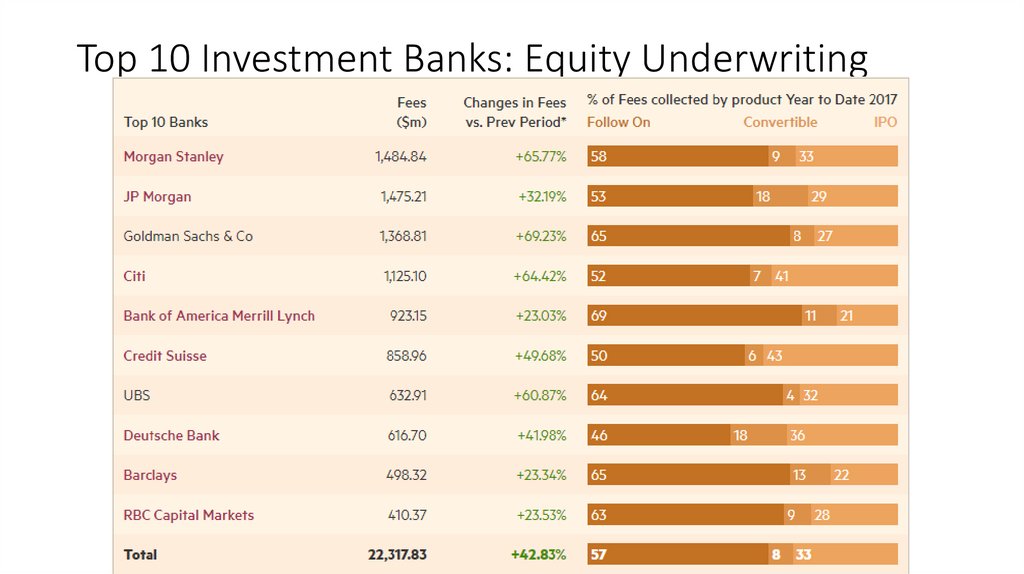
9. Top 10 Investment Banks: Equity Underwriting
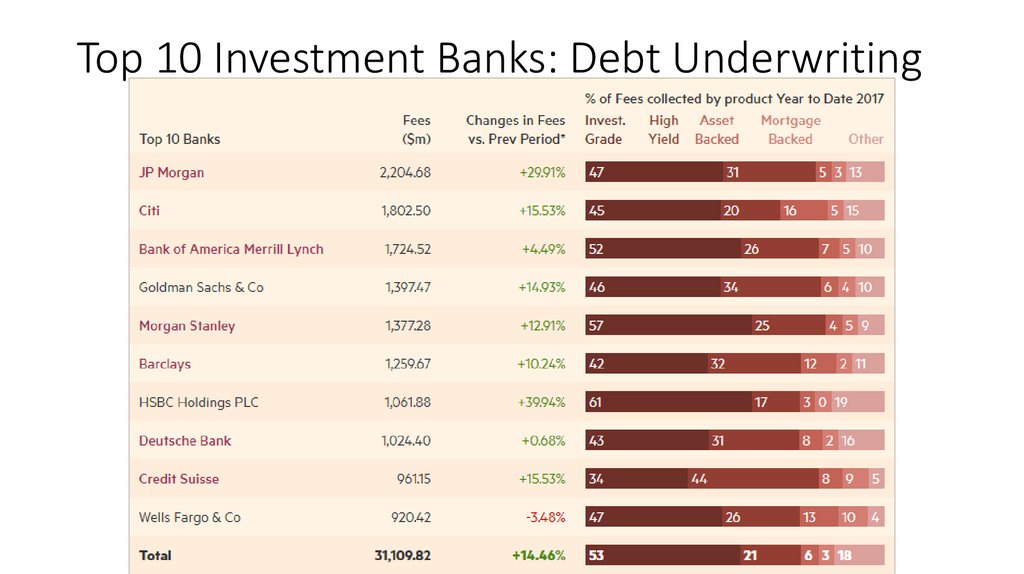
10. Top 10 Investment Banks: Debt Underwriting
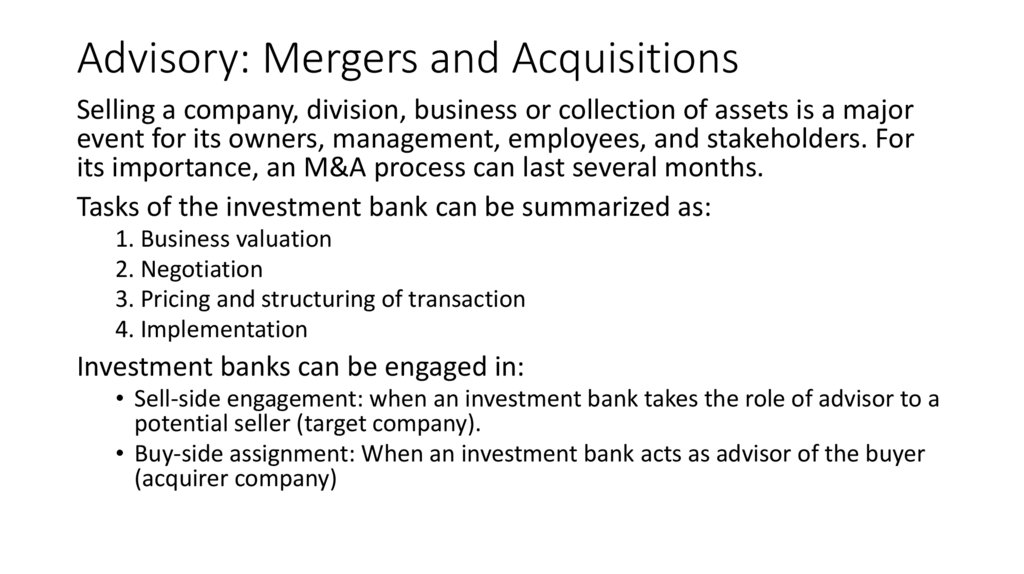
11. Advisory: Mergers and Acquisitions
Selling a company, division, business or collection of assets is a majorevent for its owners, management, employees, and stakeholders. For
its importance, an M&A process can last several months.
Tasks of the investment bank can be summarized as:
1. Business valuation
2. Negotiation
3. Pricing and structuring of transaction
4. Implementation
Investment banks can be engaged in:
• Sell-side engagement: when an investment bank takes the role of advisor to a
potential seller (target company).
• Buy-side assignment: When an investment bank acts as advisor of the buyer
(acquirer company)
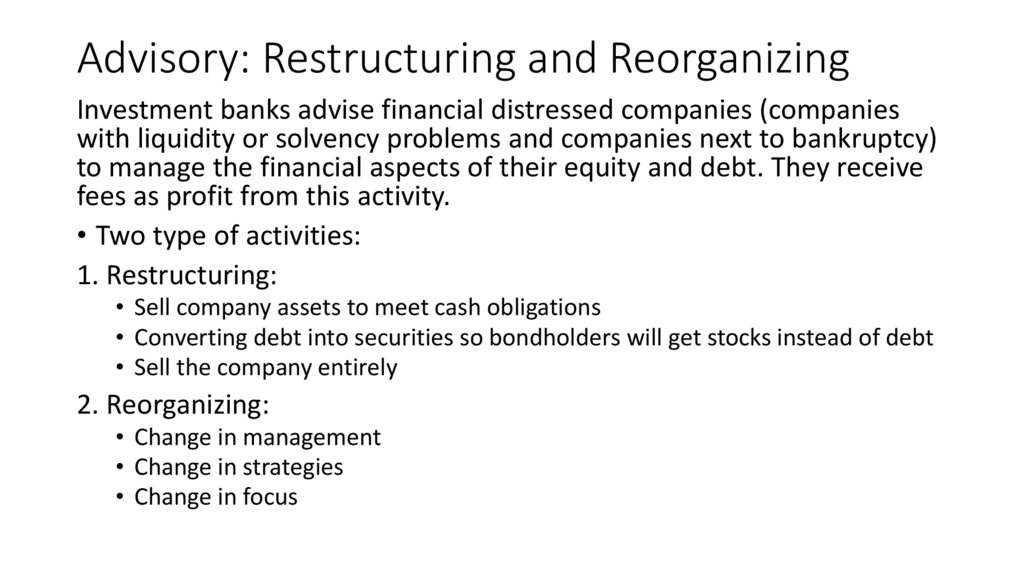
12. Advisory: Restructuring and Reorganizing
Investment banks advise financial distressed companies (companieswith liquidity or solvency problems and companies next to bankruptcy)
to manage the financial aspects of their equity and debt. They receive
fees as profit from this activity.
• Two type of activities:
1. Restructuring:
• Sell company assets to meet cash obligations
• Converting debt into securities so bondholders will get stocks instead of debt
• Sell the company entirely
2. Reorganizing:
• Change in management
• Change in strategies
• Change in focus
13. Trading and brokerage
Investment banks offer trading and brokering services to their clients orfor themselves (although recently proprietary trading has been
restricted by the Volker rule). This consists of buying and selling
securities (equity, commodities, currencies…) to generate profits.
14. Trader vs Broker
What is the difference between a trader and a broker?• A trader buys or sells securities either for themself or on behalf of
another person or institution.
• A broker plays the function of finding a counterpart for a trader that
wants to buy or sell securities
Hence, while a trader buys or sells securities to realise profits, a broker
is facilitating that transaction (getting a fee as result) by finding other
people willing to trade
15. Asset management
Asset management is the professional management of varioussecurities (stocks, bonds, etc.) and other assets (e.g., real estate), to
meet specified investment goals for the benefit of investors.
Investors may be
• institutions (insurance companies, pension funds, corporations etc.)
• or private investors (both directly via investment contracts and more
commonly via investment funds e.g., mutual funds).
The investment management division of an investment bank is
generally divided into separate groups, often known as private wealth
management and private client services.