 english
Similar presentations:








Basics of English Grammar: Questions, Alternative Questions & Tag Questions
1. Basics of English grammar. Questions. Types of questions. Intonation in questions. Part II
Basicsof
English
grammar.
Questions. Types of
questions. Intonation
in
questions.
OUTLINE
Part II
• Questions to the subject.
• Alternative questions.
• Tag questions.
2. REVISION
• Name 4 main communicative types of sentences.• What types of interrogative sentences are distinguished in
English?
• Describe the basic word order pattern in general and pronominal
questions.
• What are the peculiarities of suggestive questions?
3. Pronominal questions.
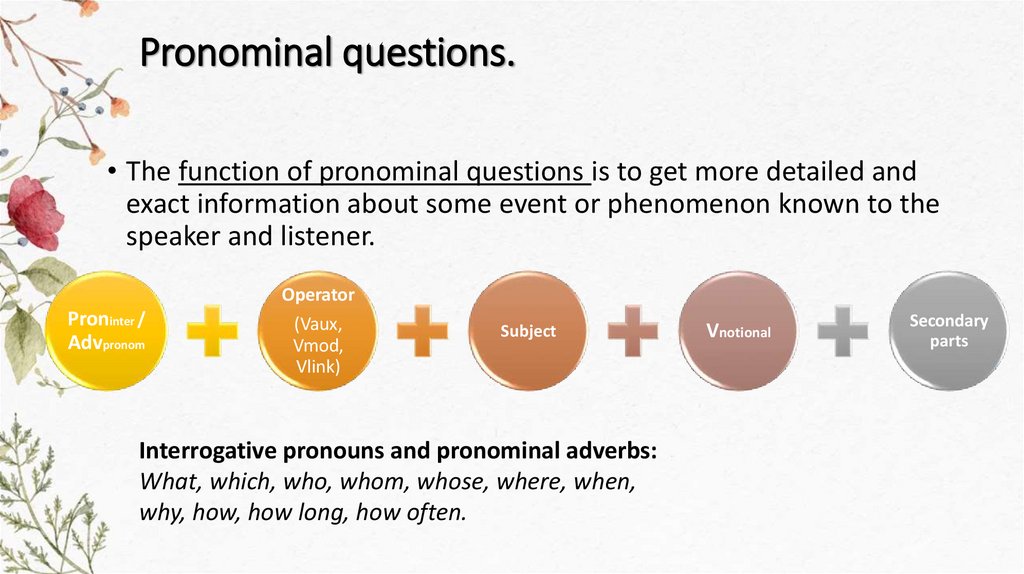
• The function of pronominal questions is to get more detailed andexact information about some event or phenomenon known to the
speaker and listener.
Operator
Proninter /
Advpronom
(Vaux,
Vmod,
Vlink)
Subject
Interrogative pronouns and pronominal adverbs:
What, which, who, whom, whose, where, when,
why, how, how long, how often.
Vnotional
Secondary
parts
4. Pronominal questions.
• Pronominal words may have various syntactical functions in thesentence, depending on the information the speaker wants to obtain:
• Who came first? (subject)
• What makes you think so? (subject)
• Whose team has won the match? (attribute)
• Which story did you like best? (attribute)
• Who is that man? (predicative)
• What are you doing there? (object)
• When are you going to come back? (adverbial modifier of time)
• How can I get to your place? (adverbial modifier of manner)
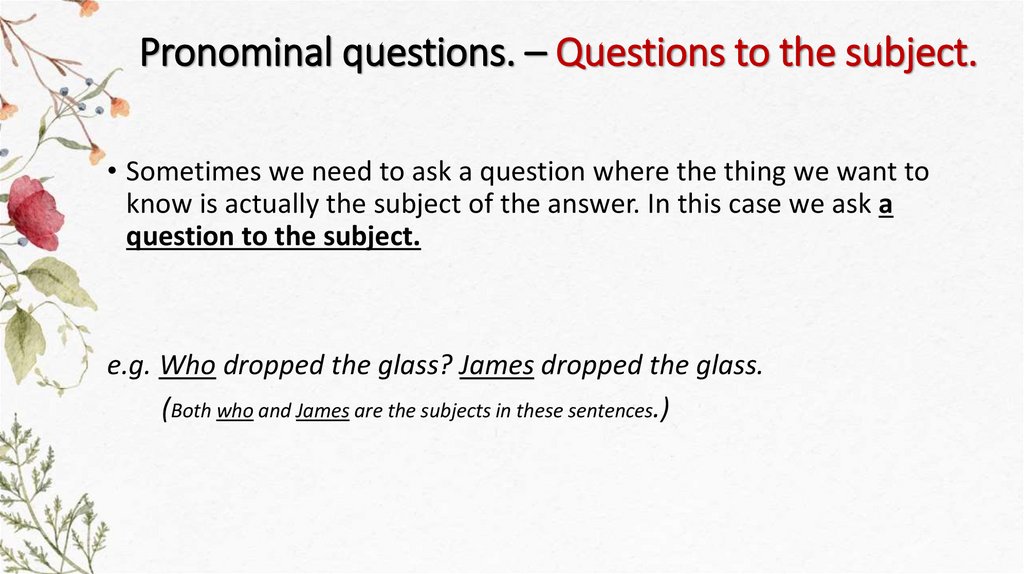
5. Pronominal questions. – Questions to the subject.
• Sometimes we need to ask a question where the thing we want toknow is actually the subject of the answer. In this case we ask a
question to the subject.
e.g. Who dropped the glass? James dropped the glass.
(Both who and James are the subjects in these sentences.)
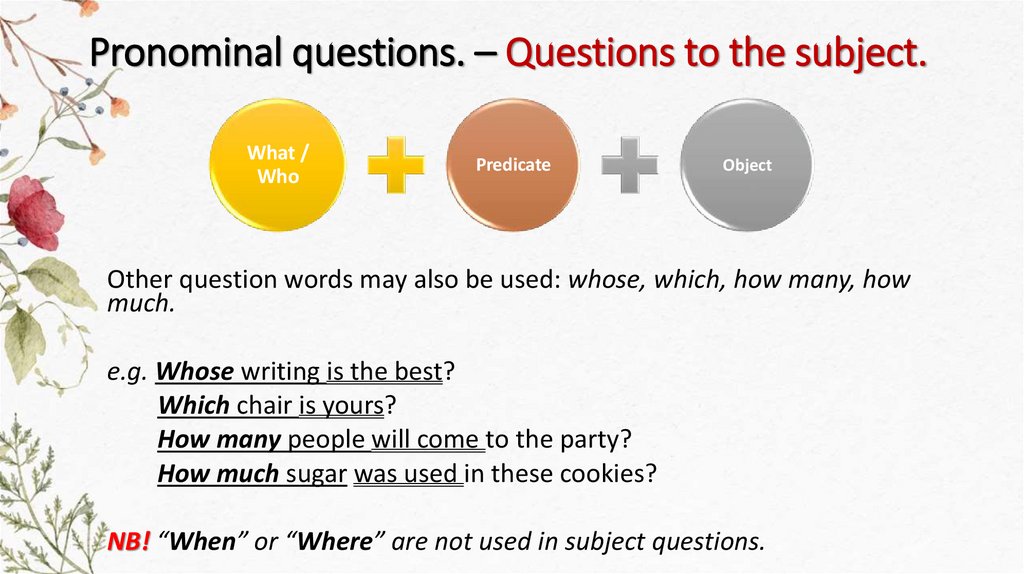
6. Pronominal questions. – Questions to the subject.
What /Who
Predicate
Object
Other question words may also be used: whose, which, how many, how
much.
e.g. Whose writing is the best?
Which chair is yours?
How many people will come to the party?
How much sugar was used in these cookies?
NB! “When” or “Where” are not used in subject questions.
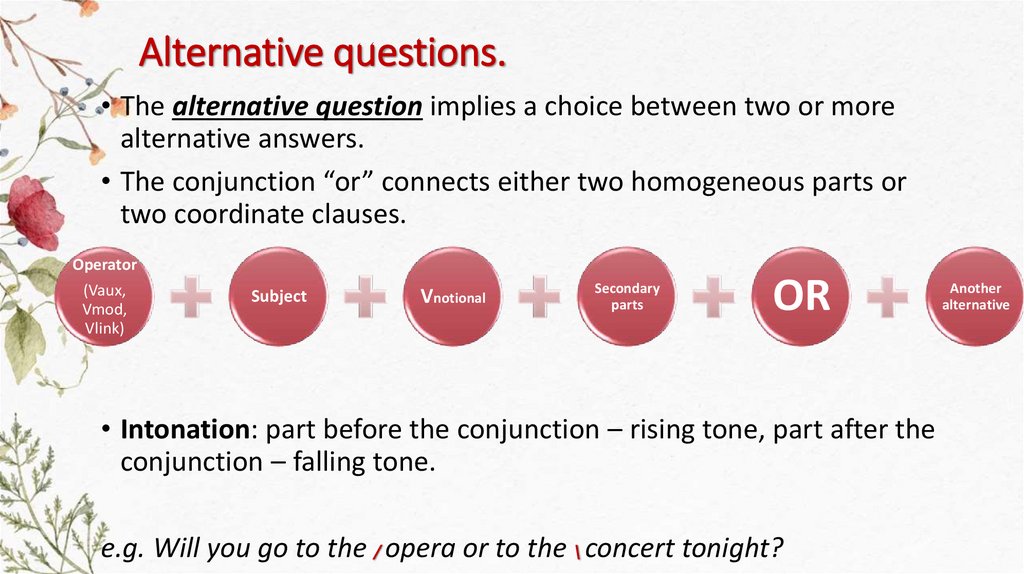
7. Alternative questions.
• The alternative question implies a choice between two or morealternative answers.
• The conjunction “or” connects either two homogeneous parts or
two coordinate clauses.
Operator
(Vaux,
Vmod,
Vlink)
Subject
Vnotional
Secondary
parts
OR
• Intonation: part before the conjunction – rising tone, part after the
conjunction – falling tone.
e.g. Will you go to the / opera or to the \ concert tonight?
Another
alternative
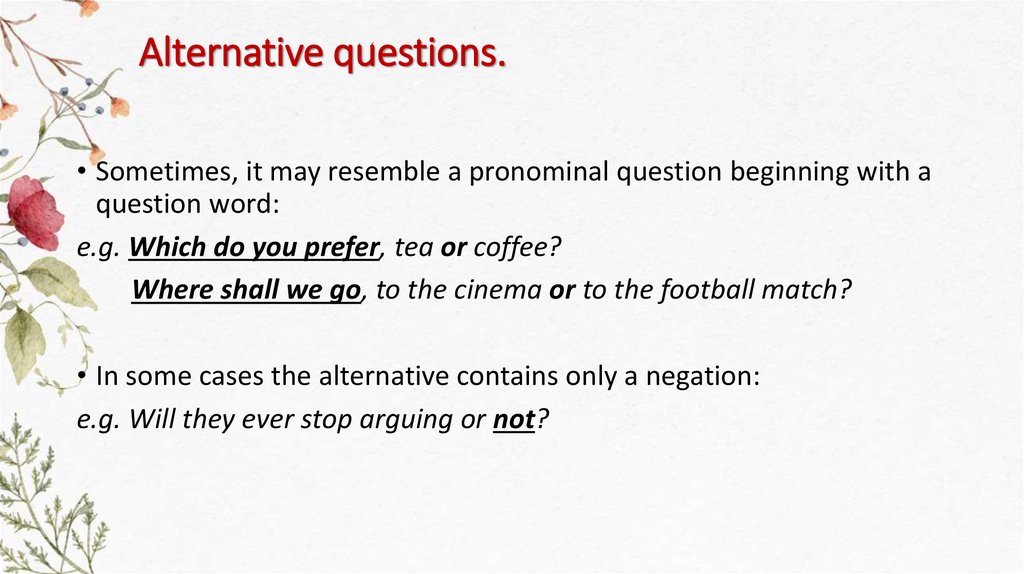
8. Alternative questions.
• Sometimes, it may resemble a pronominal question beginning with aquestion word:
e.g. Which do you prefer, tea or coffee?
Where shall we go, to the cinema or to the football match?
• In some cases the alternative contains only a negation:
e.g. Will they ever stop arguing or not?
9. Tag questions.
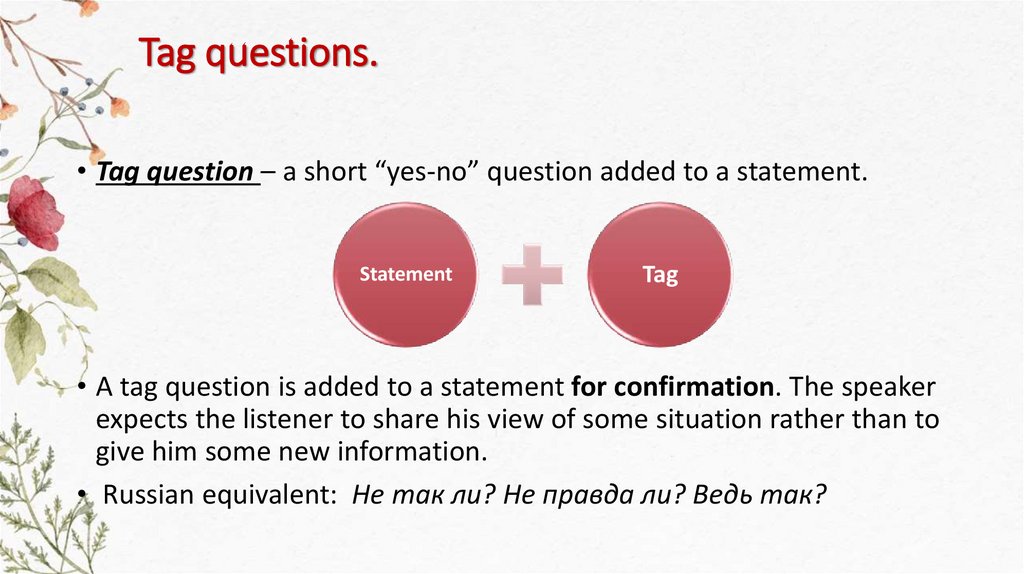
• Tag question – a short “yes-no” question added to a statement.Statement
Tag
• A tag question is added to a statement for confirmation. The speaker
expects the listener to share his view of some situation rather than to
give him some new information.
• Russian equivalent: Не так ли? Не правда ли? Ведь так?
10. Tag questions.
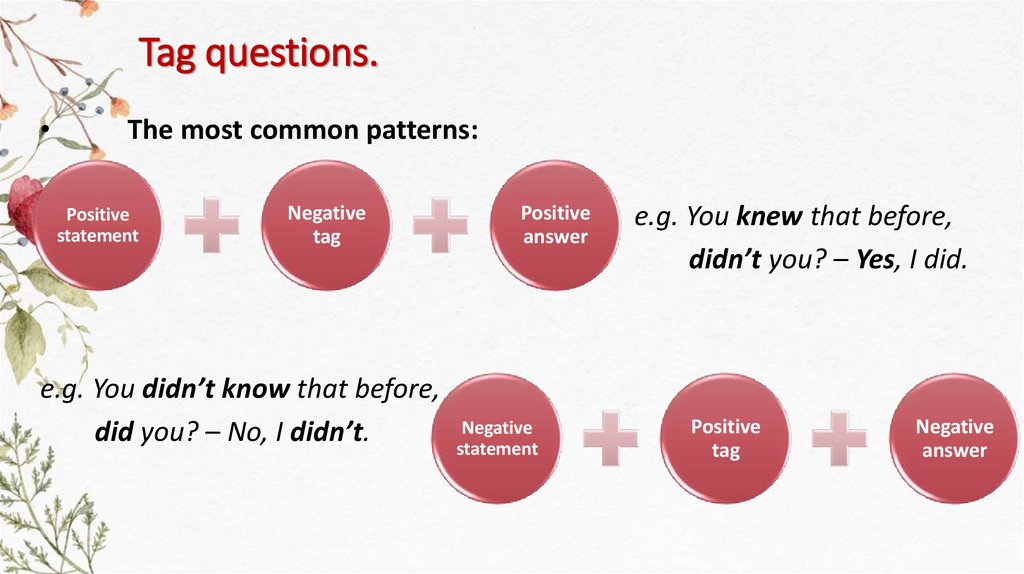
The most common patterns:
Positive
statement
Negative
tag
Positive
answer
e.g. You didn’t know that before,
Negative
did you? – No, I didn’t.
statement
e.g. You knew that before,
didn’t you? – Yes, I did.
Positive
tag
Negative
answer
11. Tag questions.
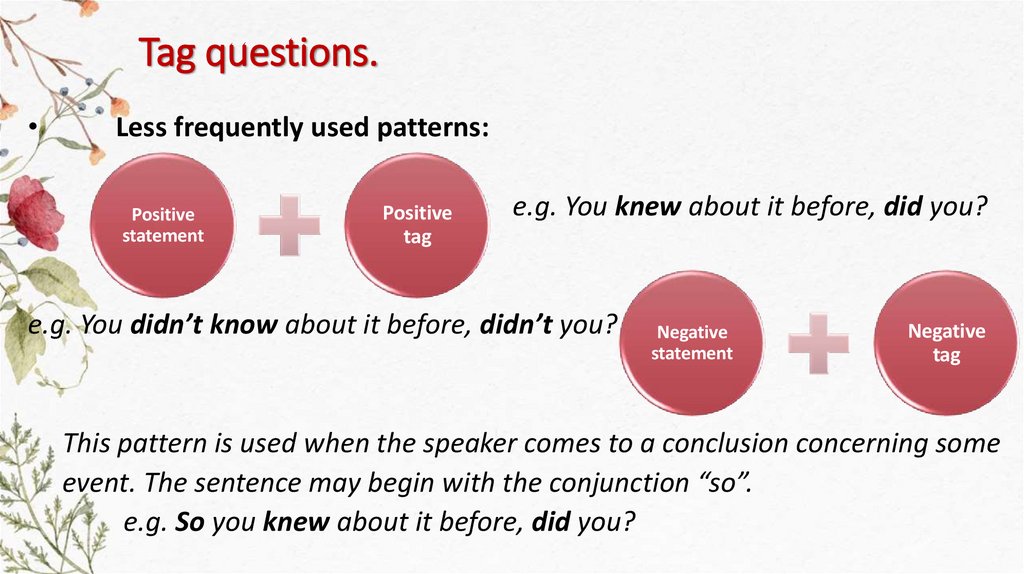
Less frequently used patterns:
Positive
statement
Positive
tag
e.g. You knew about it before, did you?
e.g. You didn’t know about it before, didn’t you?
Negative
statement
Negative
tag
This pattern is used when the speaker comes to a conclusion concerning some
event. The sentence may begin with the conjunction “so”.
e.g. So you knew about it before, did you?
12. Tag questions.
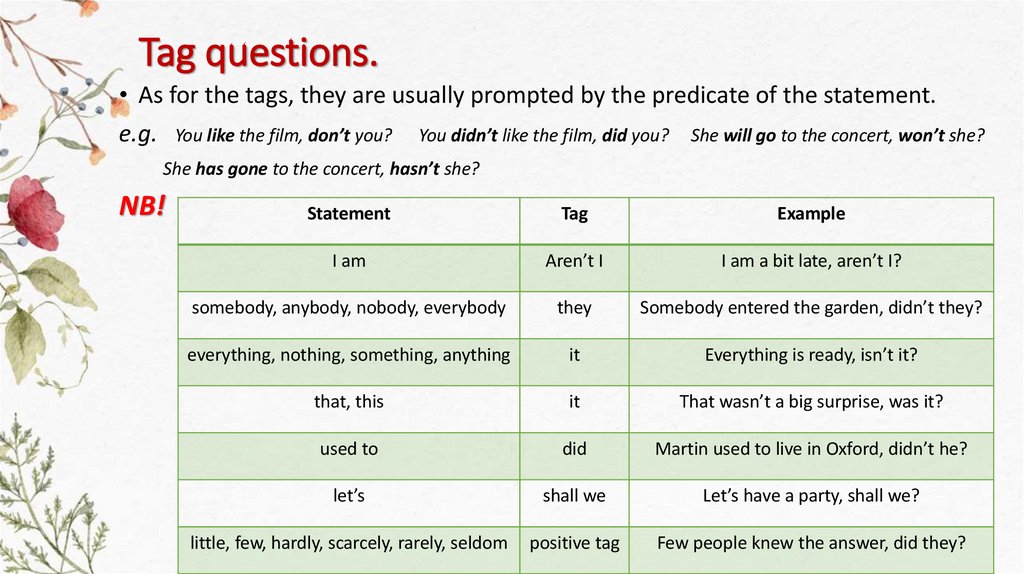
• As for the tags, they are usually prompted by the predicate of the statement.e.g. You like the film, don’t you? You didn’t like the film, did you? She will go to the concert, won’t she?
She has gone to the concert, hasn’t she?
NB!
Statement
Tag
Example
I am
Aren’t I
I am a bit late, aren’t I?
somebody, anybody, nobody, everybody
they
Somebody entered the garden, didn’t they?
everything, nothing, something, anything
it
Everything is ready, isn’t it?
that, this
it
That wasn’t a big surprise, was it?
used to
did
Martin used to live in Oxford, didn’t he?
let’s
shall we
Let’s have a party, shall we?
little, few, hardly, scarcely, rarely, seldom
positive tag
Few people knew the answer, did they?
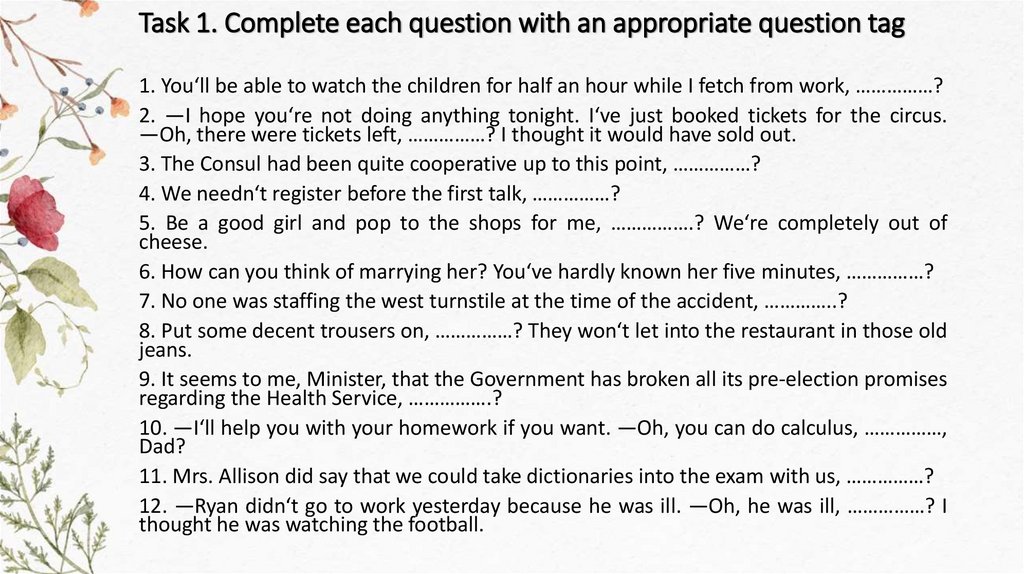
13. Task 1. Complete each question with an appropriate question tag
1. You‘ll be able to watch the children for half an hour while I fetch from work, ……………?2. ―I hope you‘re not doing anything tonight. I‘ve just booked tickets for the circus.
―Oh, there were tickets left, ……………? I thought it would have sold out.
3. The Consul had been quite cooperative up to this point, ……………?
4. We needn‘t register before the first talk, ……………?
5. Be a good girl and pop to the shops for me, …………….? We‘re completely out of
cheese.
6. How can you think of marrying her? You‘ve hardly known her five minutes, ……………?
7. No one was staffing the west turnstile at the time of the accident, …………..?
8. Put some decent trousers on, ……………? They won‘t let into the restaurant in those old
jeans.
9. It seems to me, Minister, that the Government has broken all its pre-election promises
regarding the Health Service, …………….?
10. ―I‘ll help you with your homework if you want. ―Oh, you can do calculus, ……………,
Dad?
11. Mrs. Allison did say that we could take dictionaries into the exam with us, ……………?
12. ―Ryan didn‘t go to work yesterday because he was ill. ―Oh, he was ill, ……………? I
thought he was watching the football.
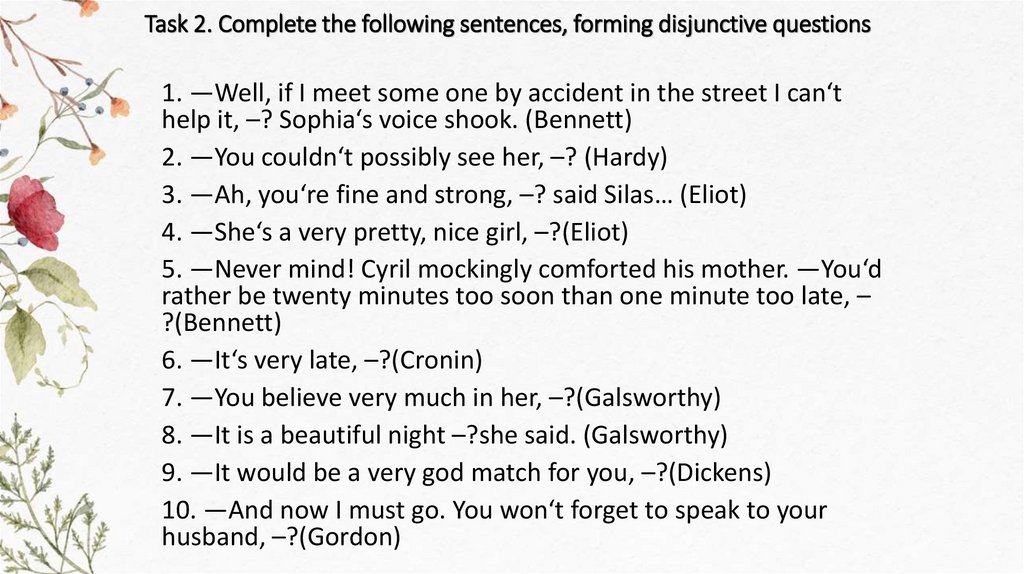
14. Task 2. Complete the following sentences, forming disjunctive questions
1. ―Well, if I meet some one by accident in the street I can‘thelp it, –? Sophia‘s voice shook. (Bennett)
2. ―You couldn‘t possibly see her, –? (Hardy)
3. ―Ah, you‘re fine and strong, –? said Silas… (Eliot)
4. ―She‘s a very pretty, nice girl, –?(Eliot)
5. ―Never mind! Cyril mockingly comforted his mother. ―You‘d
rather be twenty minutes too soon than one minute too late, –
?(Bennett)
6. ―It‘s very late, –?(Cronin)
7. ―You believe very much in her, –?(Galsworthy)
8. ―It is a beautiful night –?she said. (Galsworthy)
9. ―It would be a very god match for you, –?(Dickens)
10. ―And now I must go. You won‘t forget to speak to your
husband, –?(Gordon)