
Similar presentations:









PHY6001_Consultation_Presentation Презентация консультация перед экзаменом
1. PHY6001 PHYSICS Consultation Session
Exam structure, formulas,
and problem-solving
method
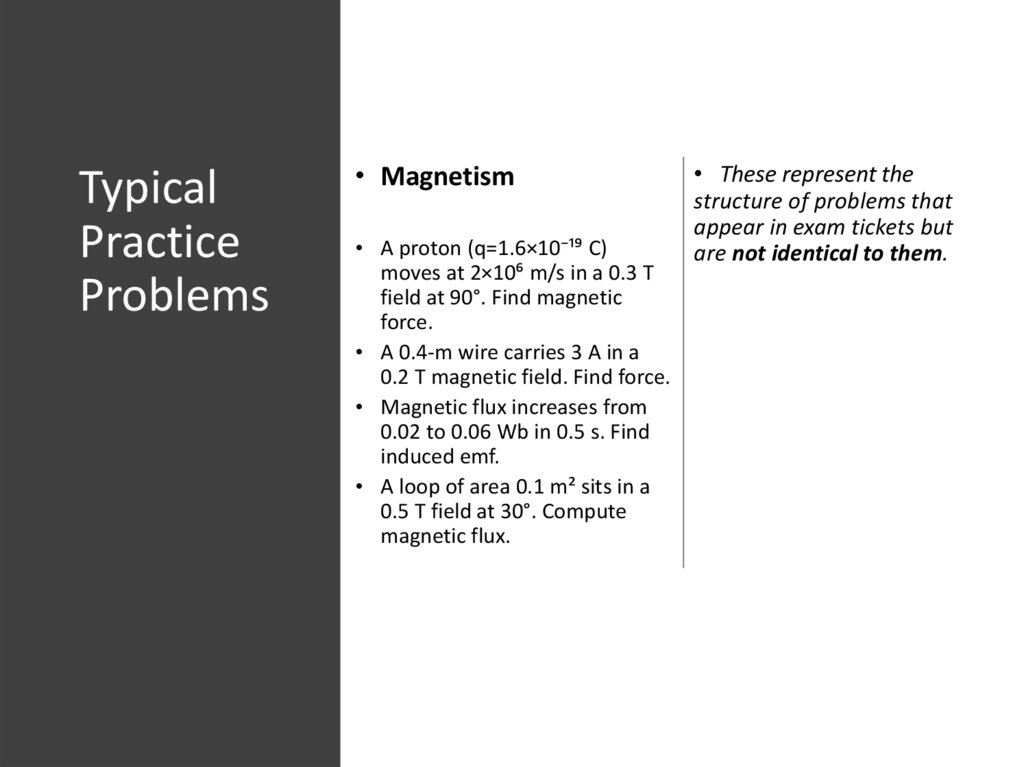
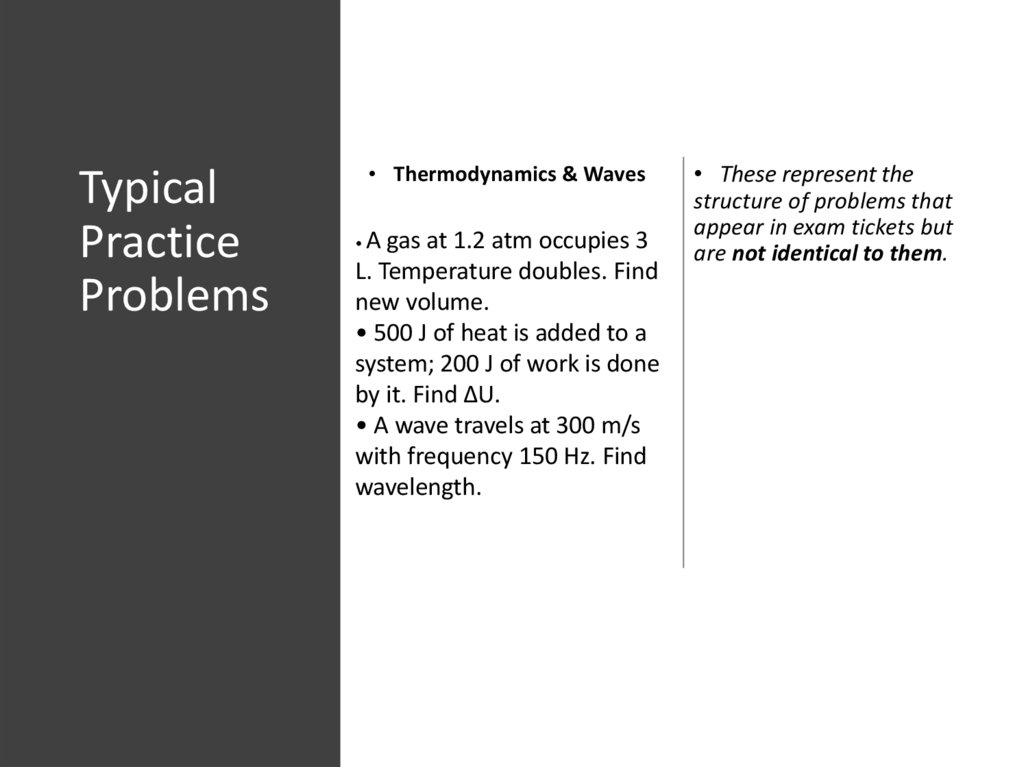
30 typical practice
problems
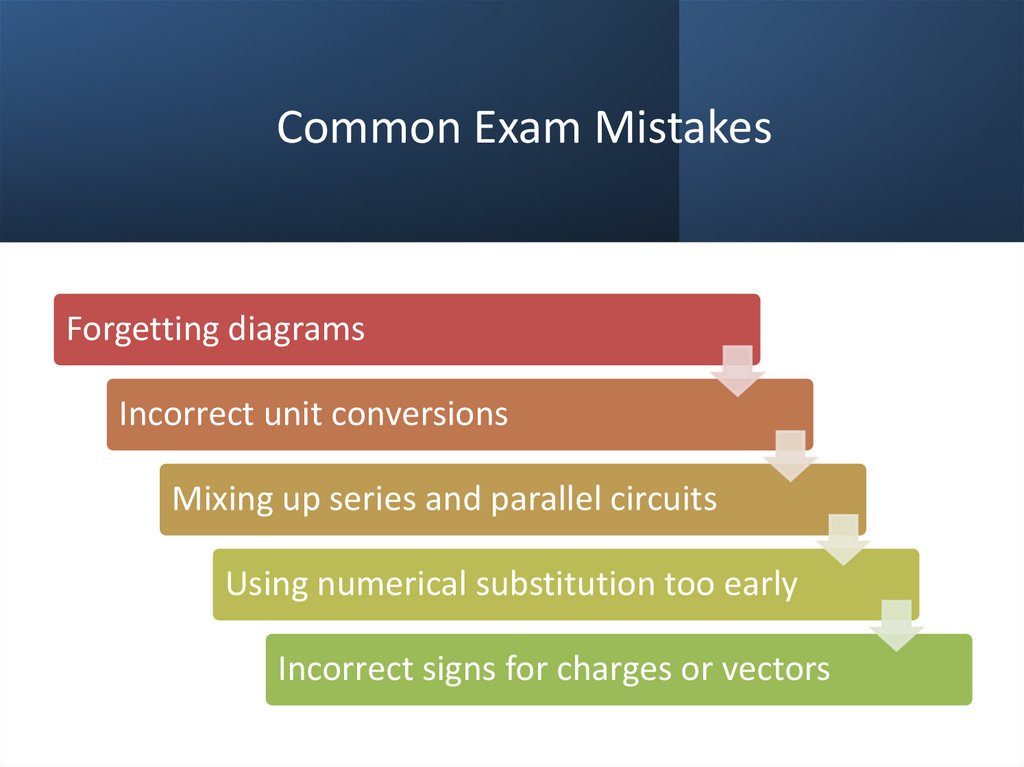
Common exam mistakes
Prepared by:
Aigerim Shapiyeva
Assistant Professor
Department of Radio Engineering, Electronics and
Telecommunications (RET)
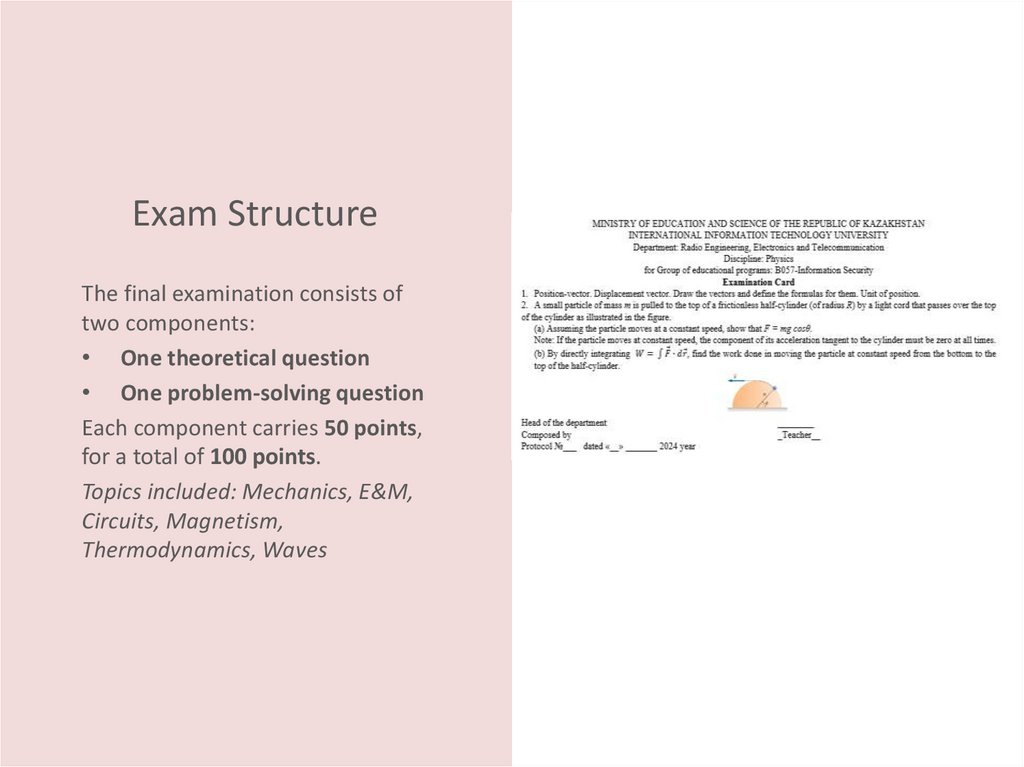
2. Exam Structure
The final examination consists oftwo components:
• One theoretical question
• One problem-solving question
Each component carries 50 points,
for a total of 100 points.
Topics included: Mechanics, E&M,
Circuits, Magnetism,
Thermodynamics, Waves
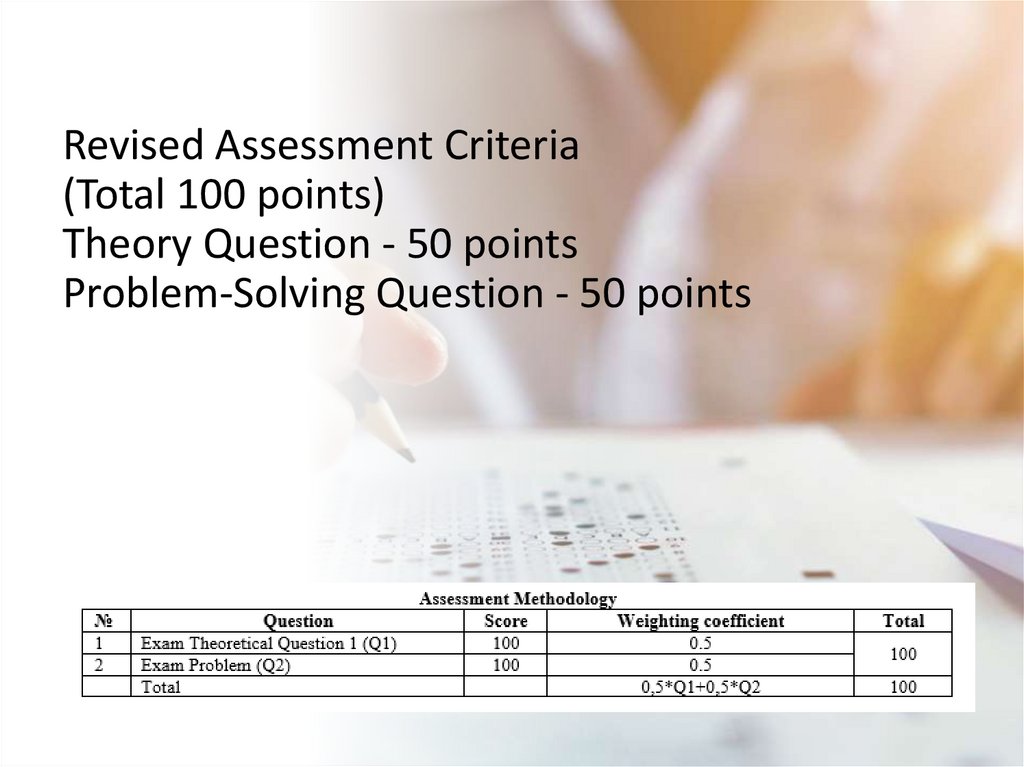
3. Revised Assessment Criteria (Total 100 points) Theory Question - 50 points Problem-Solving Question - 50 points
4. Theory Question 50 points
A theory question shoulddemonstrate:
• Understanding of the
concept
• Ability to explain physical
meaning
• Knowledge of formulas
(symbolic)
• Ability to present ideas
clearly
• Correct terminology
5. Problem-Solving Question 50 points
Students must show:• Correct physics model
• Clean symbolic work
• Clear steps
• Correct numerical
solution
• Proper units
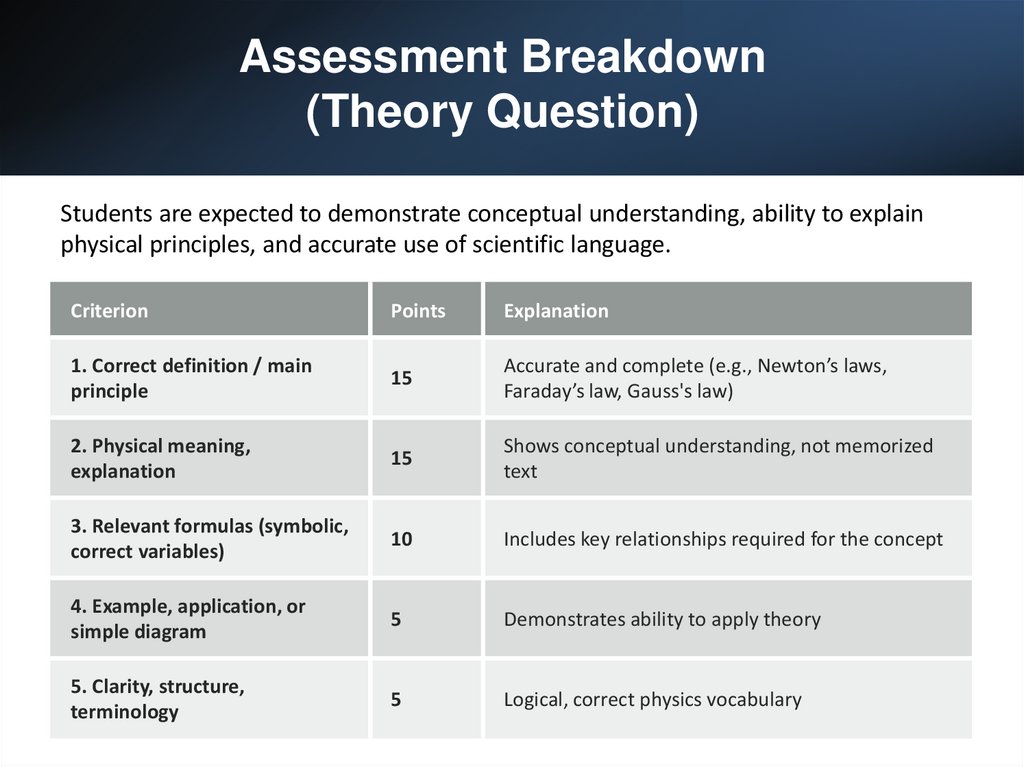
6. Assessment Breakdown (Theory Question)
Students are expected to demonstrate conceptual understanding, ability to explainphysical principles, and accurate use of scientific language.
Criterion
Points
Explanation
1. Correct definition / main
principle
15
Accurate and complete (e.g., Newton’s laws,
Faraday’s law, Gauss's law)
2. Physical meaning,
explanation
15
Shows conceptual understanding, not memorized
text
3. Relevant formulas (symbolic,
correct variables)
10
Includes key relationships required for the concept
4. Example, application, or
simple diagram
5
Demonstrates ability to apply theory
5. Clarity, structure,
terminology
5
Logical, correct physics vocabulary
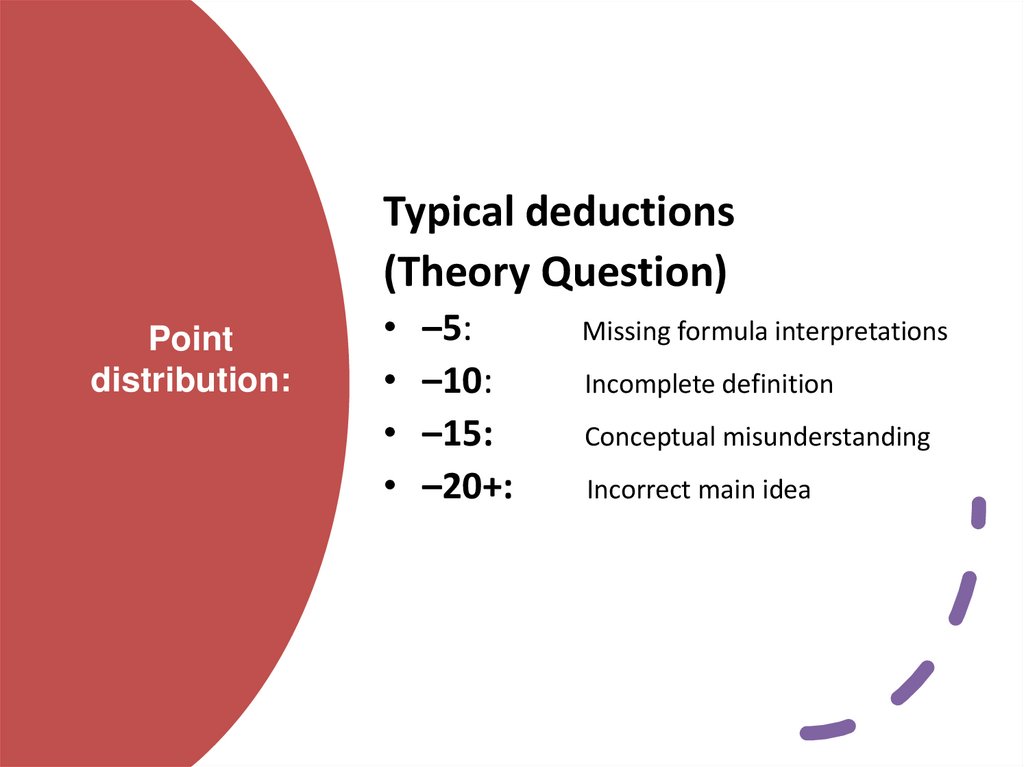
7. Point distribution:
Typical deductions(Theory Question)
Point
distribution:
• –5:
• –10:
• –15:
• –20+:
Missing formula interpretations
Incomplete definition
Conceptual misunderstanding
Incorrect main idea
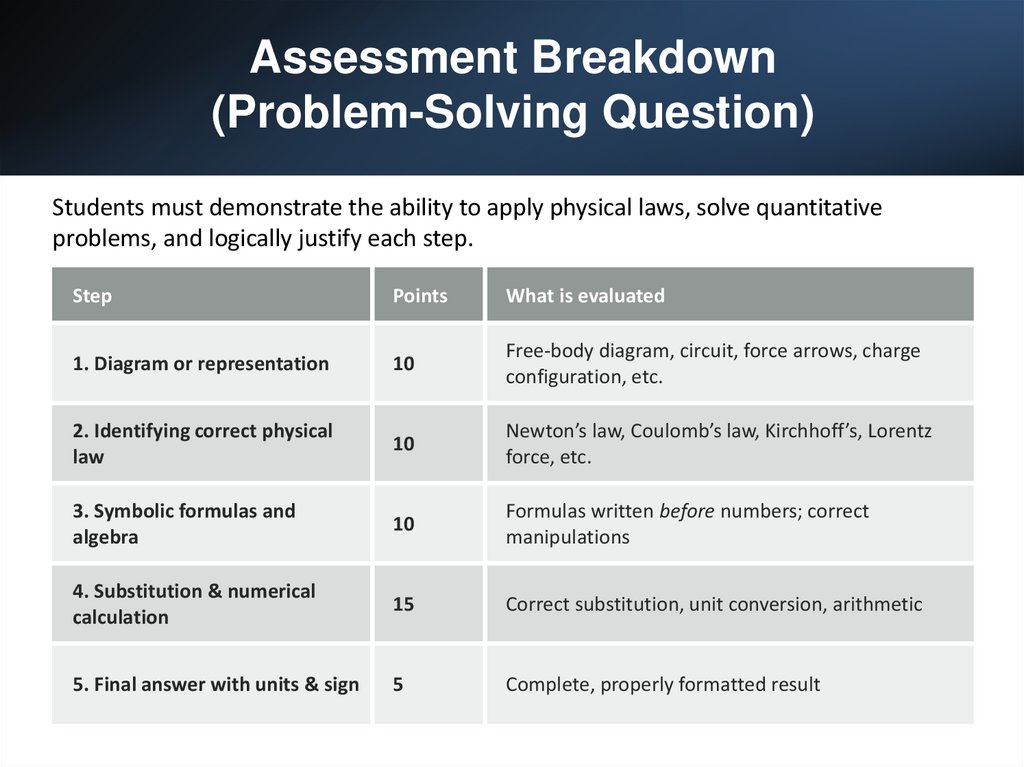
8. Assessment Breakdown (Problem-Solving Question)
Students must demonstrate the ability to apply physical laws, solve quantitativeproblems, and logically justify each step.
Step
Points
What is evaluated
1. Diagram or representation
10
Free-body diagram, circuit, force arrows, charge
configuration, etc.
2. Identifying correct physical
law
10
Newton’s law, Coulomb’s law, Kirchhoff’s, Lorentz
force, etc.
3. Symbolic formulas and
algebra
10
Formulas written before numbers; correct
manipulations
4. Substitution & numerical
calculation
15
Correct substitution, unit conversion, arithmetic
5. Final answer with units & sign
5
Complete, properly formatted result
9. Point distribution:
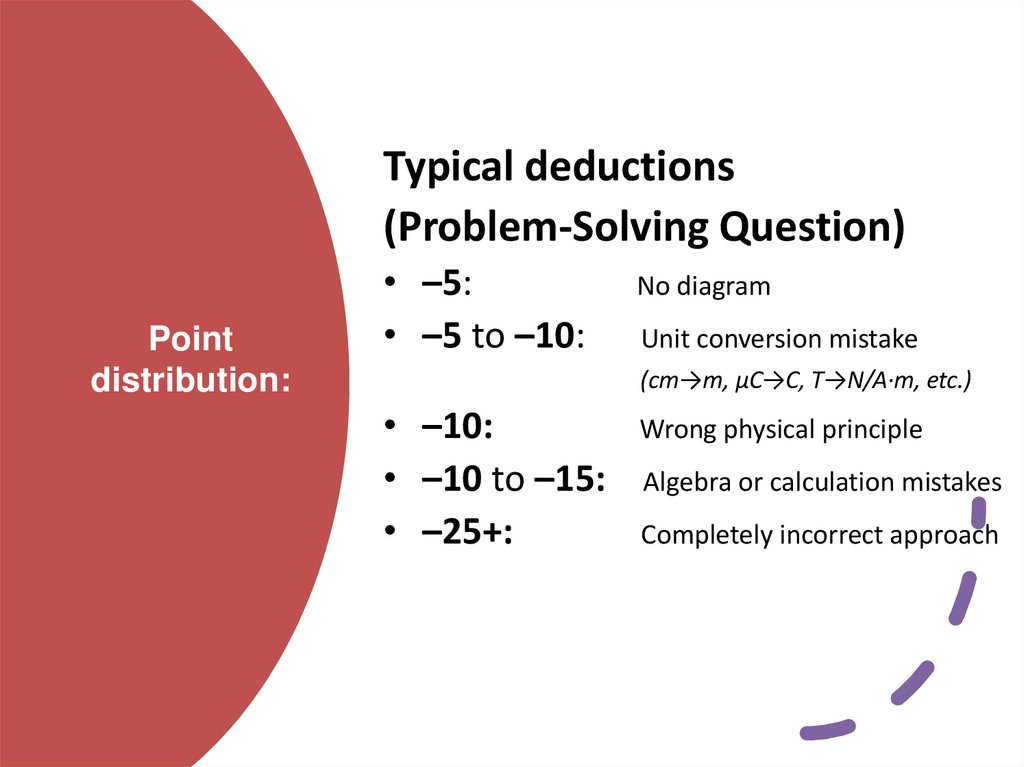
Typical deductions(Problem-Solving Question)
Point
distribution:
• –5:
• –5 to –10:
No diagram
Unit conversion mistake
(cm→m, μC→C, T→N/A·m, etc.)
• –10:
• –10 to –15:
• –25+:
Wrong physical principle
Algebra or calculation mistakes
Completely incorrect approach
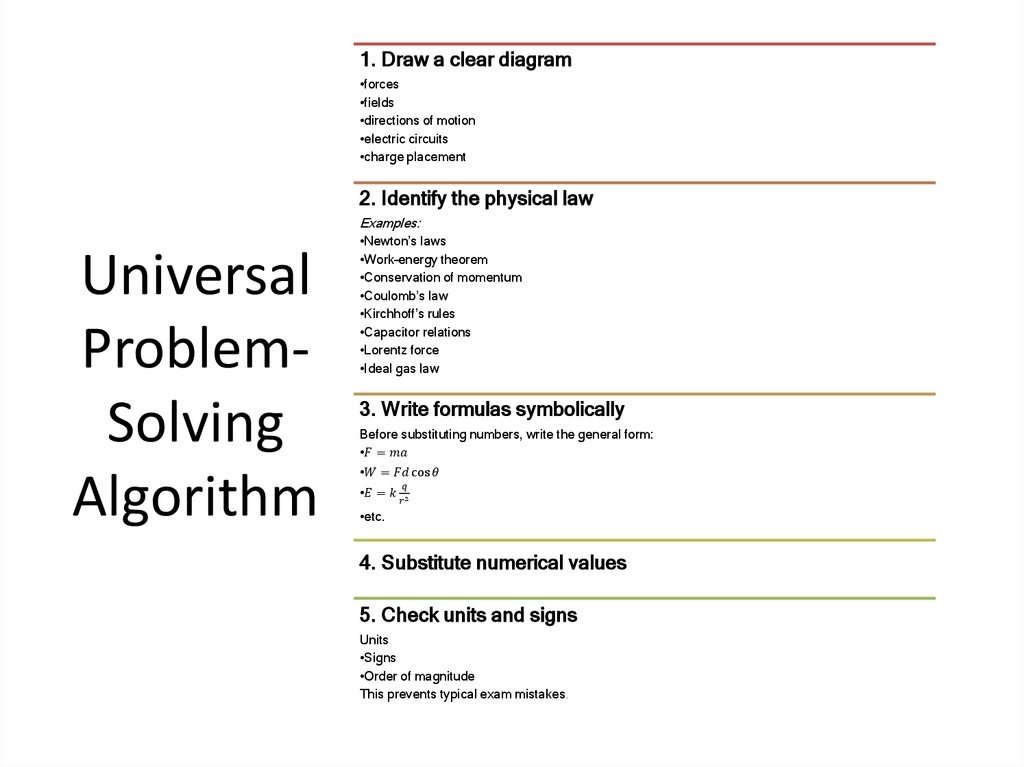
10. Universal Problem-Solving Algorithm
1. Draw a clear diagram•forces
•fields
•directions of motion
•electric circuits
•charge placement
2. Identify the physical law
Examples:
Universal
ProblemSolving
Algorithm
•Newton’s laws
•Work–energy theorem
•Conservation of momentum
•Coulomb’s law
•Kirchhoff’s rules
•Capacitor relations
•Lorentz force
•Ideal gas law
3. Write formulas symbolically
Before substituting numbers, write the general form:
•