







 management
Similar presentations:









Developing accountability at work
1. Adopting Accountability Mindset
Developing accountability skills forpersonal and professional growth
2. Learning Objectives
Understand the importance of accountability topersonal and professional growth
Learn how to take ownership and be responsible
for one's actions and decisions
Develop transparency and accept the
consequences of one's actions
Practice self-reflection and seek feedback to
improve accountability skills
3. Agenda:
Defining Accountability and its importanceMain components of accountability
Steps to improve accountability skill
4.
Can you recall a time when taking responsibility led to a positive outcome in your life\work?5. What is Accountability? (share your ideas)
Let’s see casesfor deeper
understanding:
6.
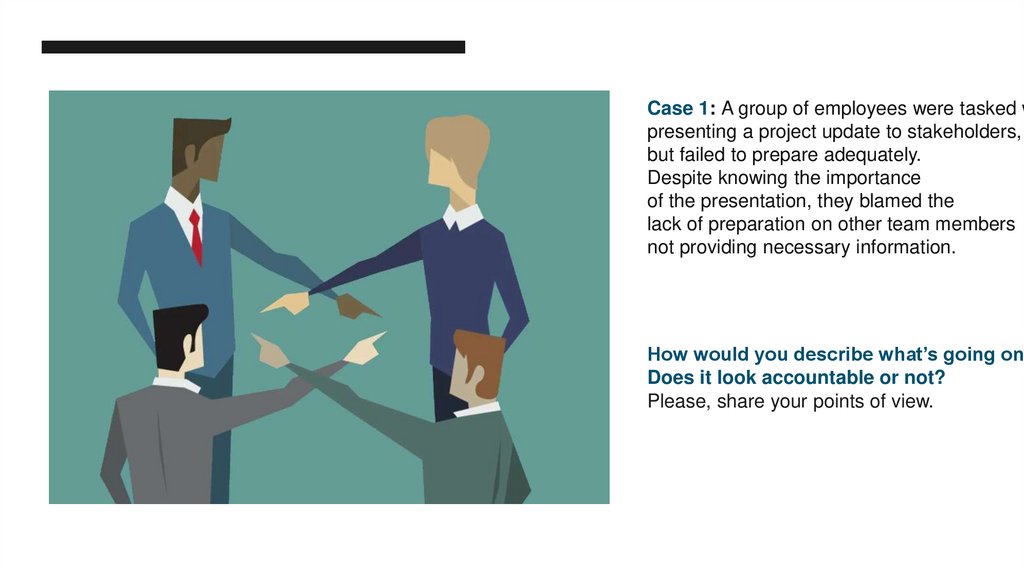
Case 1: A group of employees were tasked wpresenting a project update to stakeholders,
but failed to prepare adequately.
Despite knowing the importance
of the presentation, they blamed the
lack of preparation on other team members
not providing necessary information.
How would you describe what’s going on?
Does it look accountable or not?
Please, share your points of view.
7.
8.
Case 2: A team member consistently misseddeadlines, causing delays in project delivery.
When confronted, they refused to acknowledge
the impact of their actions on the team’s
performance did not make any effort
to change their behavior.
Does it look accountable or not?
Please, share your points of view.
9. The impact of ignoring consequences of not meeting deadlines
Missed Opportunities to Build Trustand Credibility
Damage to Reputation Brand (both
professional and personal)
Negative Impact on Team Morale,
Productivity, and Results
10.
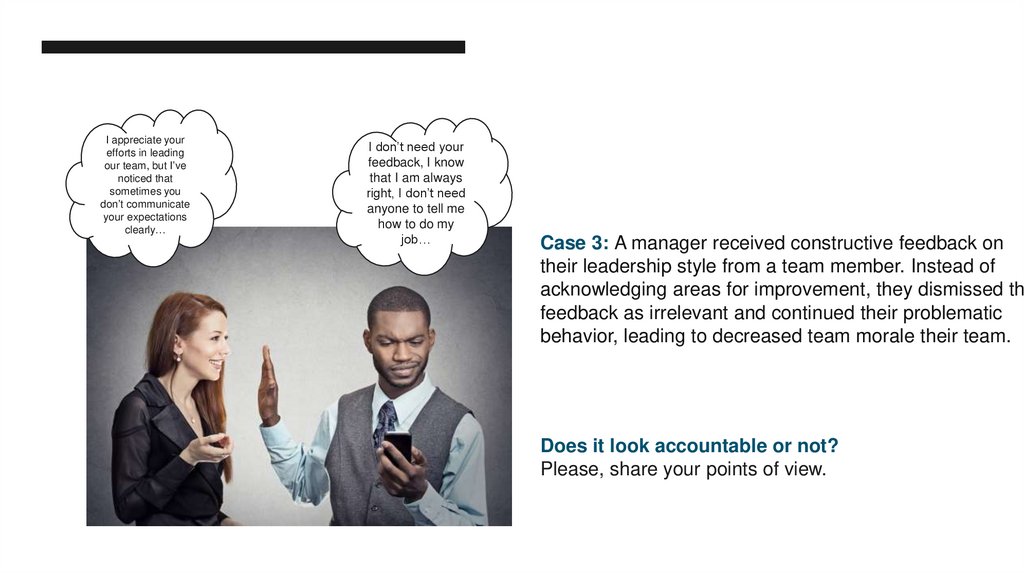
I appreciate yourefforts in leading
our team, but I’ve
noticed that
sometimes you
don’t communicate
your expectations
clearly…
I don’t need your
feedback, I know
that I am always
right, I don’t need
anyone to tell me
how to do my
job…
Case 3: A manager received constructive feedback on
their leadership style from a team member. Instead of
acknowledging areas for improvement, they dismissed the
feedback as irrelevant and continued their problematic
behavior, leading to decreased team morale their team.
Does it look accountable or not?
Please, share your points of view.
11. Accepting Feedback
Accepting feedback is essential forpersonal and professional growth.
Feedback helps individuals understand
their strengths and weaknesses.
Feedback can be used to identify
areas for improvement and set goals.
Accepting feedback shows a
willingness to learn and improve.
12. What is Accountability?
Accountabilitymeans taking
responsibility for
own and one's
actions,
decisions, and the
consequences
that follow; honest
and ethical
conduct towards
others.
13. Importance of Accountability
Building TrustAccountability is essential for building trust between individuals, teams, and
organizations. When people are accountable, they are more likely to be reliable,
transparent, and trustworthy.
Fostering Teamwork
Accountability fosters teamwork by encouraging people to work together towards a
common goal. When people are accountable to each other, they are more likely to
collaborate, share feedback, and support each other.
Promoting Transparency and Ethical Behavior
Accountability promotes transparency and ethical behavior by ensuring that
people are responsible for their actions and decisions. This helps to prevent
unethical behavior, such as fraud, corruption, and conflicts of interest.
A part of our Identity and Personal Brand (What kind of person I want to be and
how do I want to be perceived by others?)
14. What barriers prevent people from taking accountability?
What barriersprevent
people from
taking
accountability
?
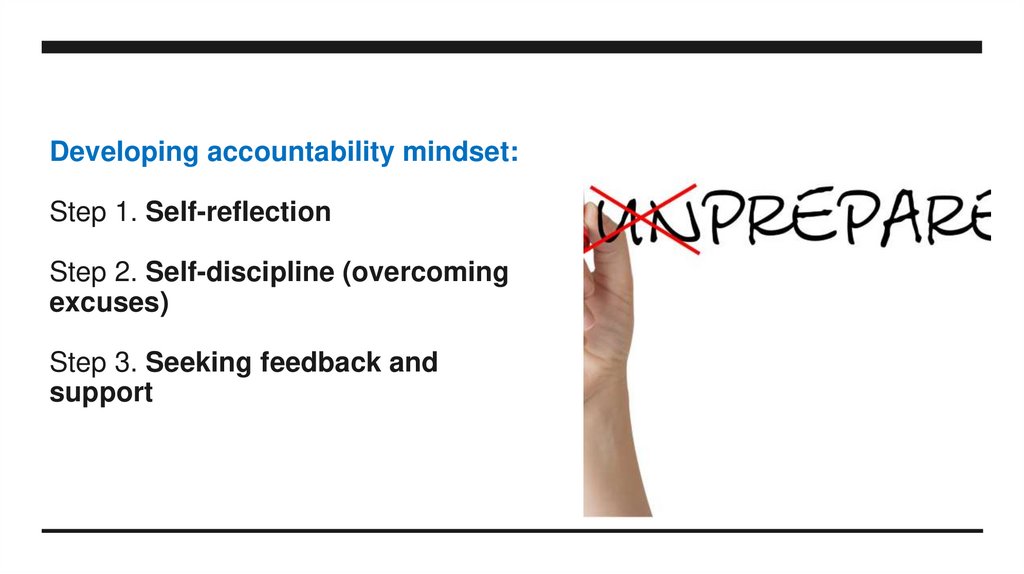
15. Developing accountability mindset: Step 1. Self-reflection Step 2. Self-discipline (overcoming excuses) Step 3. Seeking
feedback andsupport
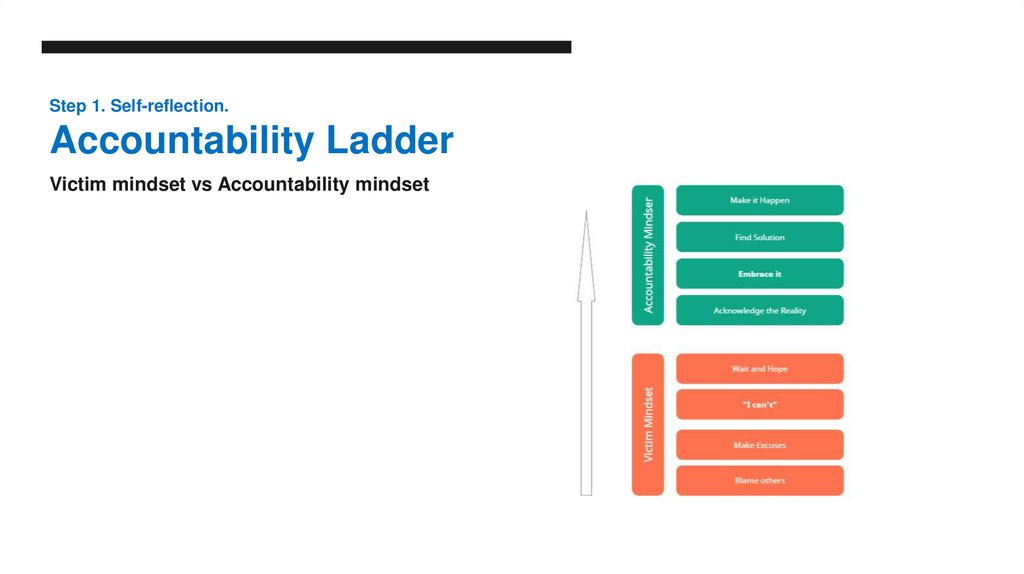
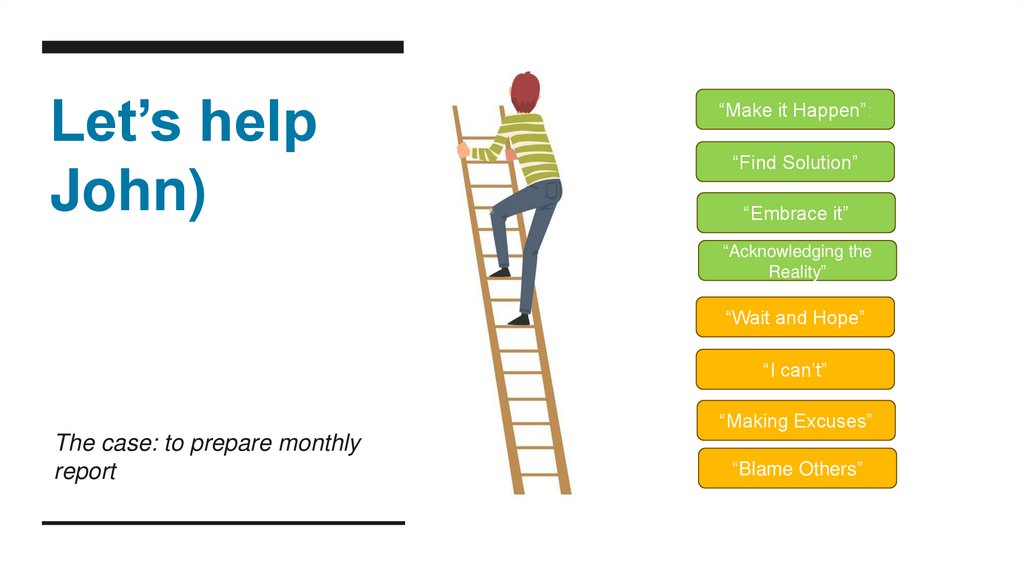
16. Step 1. Self-reflection. Accountability Ladder
Victim mindset vs Accountability mindset17. Let’s help John)
“Make it Happen”:“Find Solution”
“Embrace it”
“Acknowledging the
Reality”
“Wait and Hope”
“I can’t”
“Making Excuses”
The case: to prepare monthly
report
“Blame Others”
18. Exercise. Reflection on accountability ladder, individual task (6 min): 1. Think back of an important task you needed to
accomplish over the last week?Where would you honestly place yourself on
that ladder? Is that within accountability
mindset zone?
2. What do you need to do next to for the next
level?
3. Who may help you?
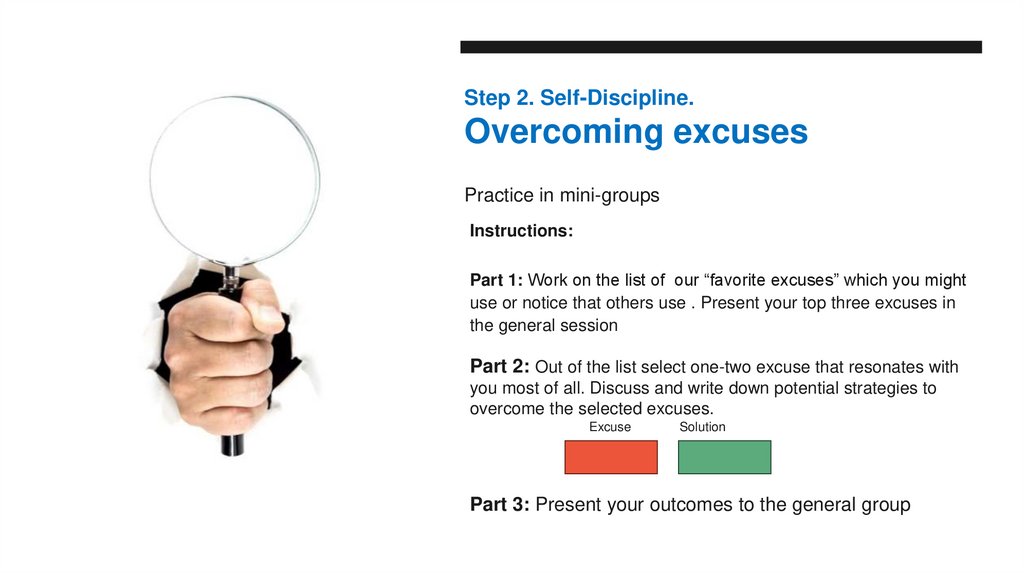
19. Step 2. Self-Discipline. Overcoming excuses
Practice in mini-groupsInstructions:
Part 1: Work on the list of our “favorite excuses” which you might
use or notice that others use . Present your top three excuses in
the general session
Part 2: Out of the list select one-two excuse that resonates with
you most of all. Discuss and write down potential strategies to
overcome the selected excuses.
Excuse
Solution
Part 3: Present your outcomes to the general group
20. How to stop making excuses at work?
Step 3. Seeking Feedback andSupport
1. Create a Personal Board of Advisors
Build a diverse network of 3-5 trusted individuals who can
provide
different perspectives - a mentor, a peer, a direct report,
and someone outside your field. Schedule regular checkins with
each person to discuss your progress,
challenges, and blind spots.
2. Ask Specific, Action-Oriented Questions
Instead of asking "How am I doing?", pose targeted
questions like:
•"What one thing could I do differently to improve X?"
•"When have you seen me miss the mark, and what was
the impact?"
•"What strength should I leverage more?"
3. Practice the 24-Hour Rule
When receiving difficult feedback, thank the person and wait 24
hours before responding substantively. This allows you to:
•Process emotional reactions privately
•Identify valid points within the feedback
•Develop thoughtful questions or action plans
•Demonstrate maturity and openness to growth
4. Close the Feedback Loop
After receiving feedback and implementing changes:
•Follow up with the feedback giver to share what you've done
•Ask if they've noticed improvements
•Request additional suggestions
•Thank them for their investment in your growth
21. Step 3. Seeking Feedback and Support
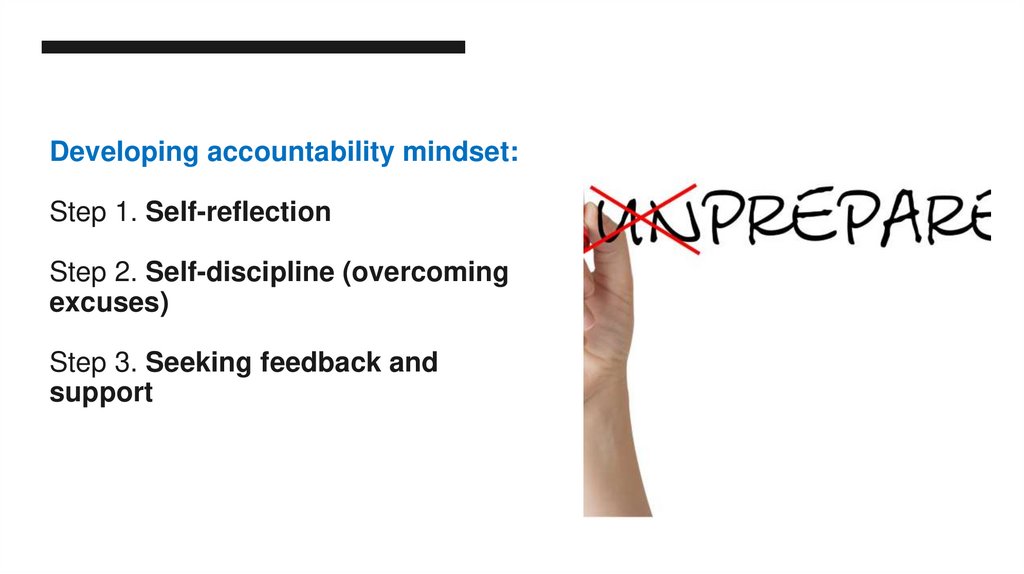
Developing accountability mindset:Step 1. Self-reflection
Step 2. Self-discipline (overcoming
excuses)
Step 3. Seeking feedback and
support
22. Developing accountability mindset: Step 1. Self-reflection Step 2. Self-discipline (overcoming excuses) Step 3. Seeking
Conclusion:If you were to write a letter to
future self, what would you say
to ensure you remain
accountable?
23. Conclusion: If you were to write a letter to future self, what would you say to ensure you remain accountable?
Summary:Defining Accountability and its importance
Main components of accountability
Steps to improve accountability skill