 education
Similar presentations:







Project. Strategic Communication Model
1.
StrategicCommunication Model
Project
Diana Shakirova, Ekaterina Makhanova, Olesya Godunova, Ksenia Benevskaya
BA students, Linguistics, Department of World Culture
2025
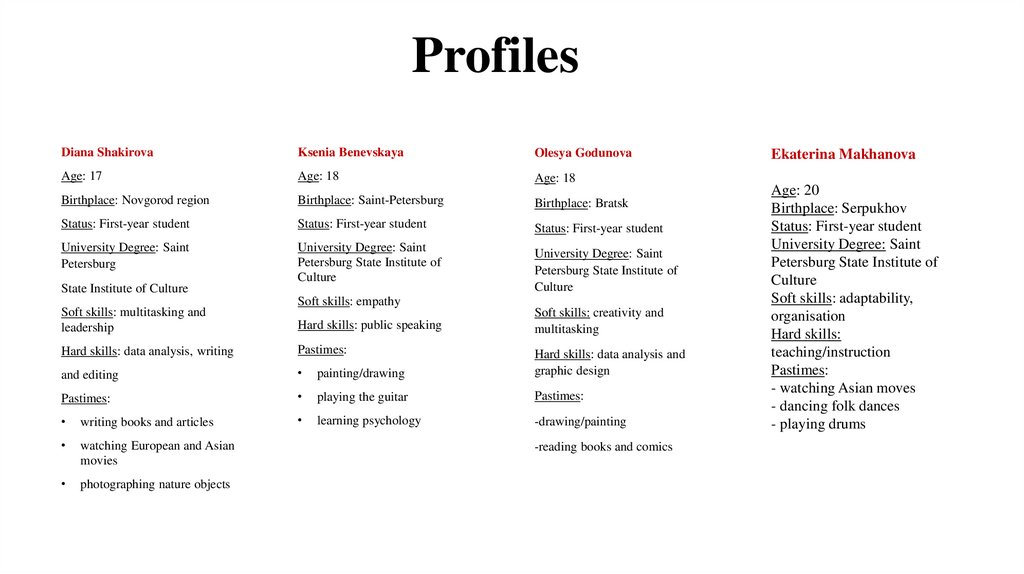
2. Profiles
Diana ShakirovaKsenia Benevskaya
Olesya Godunova
Age: 17
Age: 18
Age: 18
Birthplace: Novgorod region
Birthplace: Saint-Petersburg
Birthplace: Bratsk
Status: First-year student
Status: First-year student
Status: First-year student
University Degree: Saint
Petersburg
University Degree: Saint
Petersburg State Institute of
Culture
State Institute of Culture
Soft skills: multitasking and
leadership
Soft skills: empathy
Hard skills: public speaking
University Degree: Saint
Petersburg State Institute of
Culture
Soft skills: creativity and
multitasking
Hard skills: data analysis, writing
Pastimes:
and editing
painting/drawing
Hard skills: data analysis and
graphic design
Pastimes:
playing the guitar
Pastimes:
writing books and articles
learning psychology
-drawing/painting
watching European and Asian
movies
photographing nature objects
-reading books and comics
Ekaterina Makhanova
Age: 20
Birthplace: Serpukhov
Status: First-year student
University Degree: Saint
Petersburg State Institute of
Culture
Soft skills: adaptability,
organisation
Hard skills:
teaching/instruction
Pastimes:
- watching Asian moves
- dancing folk dances
- playing drums
3. Objective
To implement the stages of theStrategic communication model
by using the additional
materials and resources to
create a message that builds on
the knowledge acquired.
4. Project relevance
• Good communication builds trust and better relationships withstakeholders.
• Identifying communication issues can improve teamwork and
efficiency.
• Strong communication strategies support the achievement of
organizational goals.
• Addressing these problems prepares organizations to handle
challenges and grow successfully.
5. Project outline
• Step 1. Define the context of the current situation, your target audiences and yourobjectives.
• Step 2. Consider your media and timing options. Select the communication
medium that is most appropriate and effective for your message and the best time
for the message to arrive.
• Step 3. Use that knowledge to select and organize specific information and
compose your message.
• Step 4. Deliver the message with a confident, personal style.
• Step 5. Evaluate feedback for continued growth and success.
6. Step 1. Define the context of the current situation, your target audiences and your objectives
Important issue.• Achieving proficiency in communication, identifying major communication perspectives.
• Operating efficiently in professional community relying on expertise and skills in communication.
External Climate.
Communication course have been run both in this country and overseas. They are vital for success in
an interpreter’s/ teacher’s career.
Internal Climate.
The ultimate goal of the program is to achieve efficient communication in a multi-cultural
environment.
7. Target Audience
Facts about the audience.BA students, specializing in linguistics, aged between 17 and 21, both male and female, with female students
prevailing.
Audience: Culture.
The University course operates in a semi-formal, goal-oriented environment typical of academia, but not
intensely competitive. The challenging course impacts the behavior and teaching methods of both students and
the lecturer.
Types of Audience.
• Direct Audience: colleagues and our trainer comprising a team.
• Indirect Audience: colleagues and trainers from other classes.
• A Decision- Maker: our lecturer.
Audience: Positive attitude.
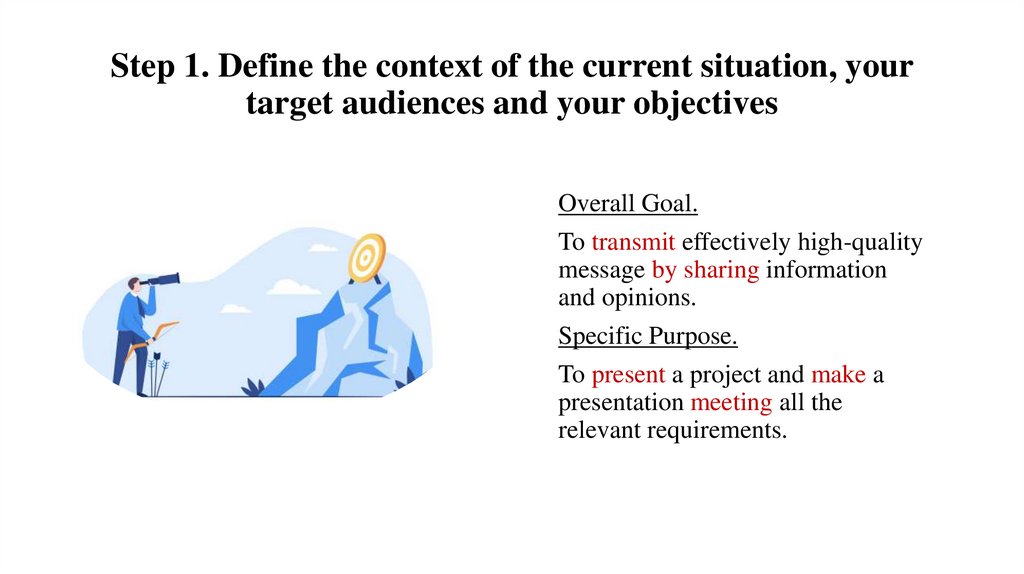
8. Step 1. Define the context of the current situation, your target audiences and your objectives
Overall Goal.To transmit effectively high-quality
message by sharing information
and opinions.
Specific Purpose.
To present a project and make a
presentation meeting all the
relevant requirements.
9. Goals and Objectives
• To realize strategiccommunication model.
• To provide a high quality
message concerning a
current topic.
10. Step 2. Media and Timing Options
Media: Oral Presentation supportedby Visuals.
Timing: 20-30 minutes.
The timing options are limited by our
schedule.
11. Step 3. Select and organize specific information and compose your message
Sources.• Primary: Lectures.
• Secondary: Internet Materials, Articles.
Structure: Traditional (Introduction+Body+Conclusion).
Visuals: Word Chart.
BILL = Big Idea a Little Later. Indirect approach.
Direct Approach: Exposure.
12. Composing the Message
• Level of formality: semi-formal.• Core vocabulary, and relevant specialist
terms.
• Simple, compressed sentences, mostly
Active Voice, emphatic structures.
• Linking the elements of the presentation.
13. Step 4. Delivering the Message
Professional communication/ in businessAcademic Presentation
14. Goals
• To understand what is the professionalcommunication and why it is important for
business.
• To learn different ways of the communication
and how to use them.
• To acquire the skills to become better in the
communication, and also how you can resolve
conflicts, considering ethics and cultural
differences.
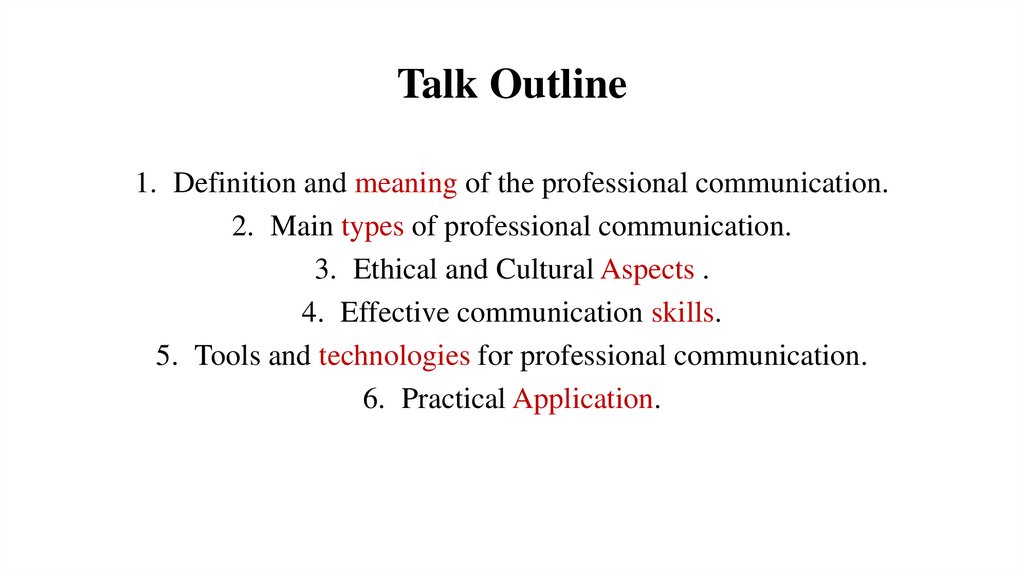
15. Talk Outline
1. Definition and meaning of the professional communication.2. Main types of professional communication.
3. Ethical and Cultural Aspects .
4. Effective communication skills.
5. Tools and technologies for professional communication.
6. Practical Application.
16. The Issue Addressed:
How to increase the efficiency of the professionalcommunication in business, considering its various
forms, ethical norms and modern technologies?
17. Definition and meaning of the professional communication
Effective communication skills are fundamental to success in manyaspects of life. Many jobs require strong communication skills and
people with good communication skills usually enjoy better
interpersonal relationships with friends and family.
18. Importance and impact of the professional communication in the working area and business
It helps people get more done by reducing mistakes and
misunderstandings. When instructions are clear, everyone knows what to
do, and tasks get finished faster.
Communicating well also helps coworkers build strong relationships.
When people trust and cooperate, they can solve problems better and
come up with more creative ideas.
19. The Impact of Professional Communication in the Workplace
• Increased productivity and efficiency• Better teamwork and unity
• Resolving conflicts and solving problems effectively
• Creating a positive work environment
• Building strong relationships with clients and maintaining a
professional reputation
• Clear sharing of information and instructions
• Encouraging innovation and sharing of ideas
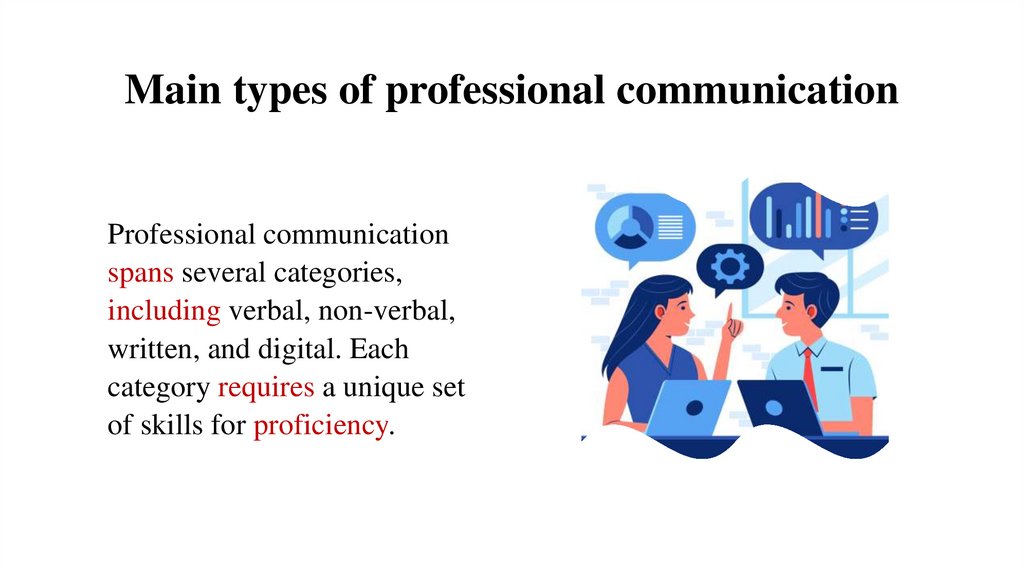
20. Main types of professional communication
Professional communicationspans several categories,
including verbal, non-verbal,
written, and digital. Each
category requires a unique set
of skills for proficiency.
21. Examples of types of the professional communication
1. Verbal Communication: When you present at a meeting, your goal is to conveyyour message clearly.
2. Non-Verbal Communication: A firm handshake can convey confidence.
3. Written Communication: A well-structured email can facilitate efficient decisionmaking.
4. Digital Communication: Professionalism in instant messaging ensures your
messages are interpreted correctly.
22. Ethical and Cultural Aspects
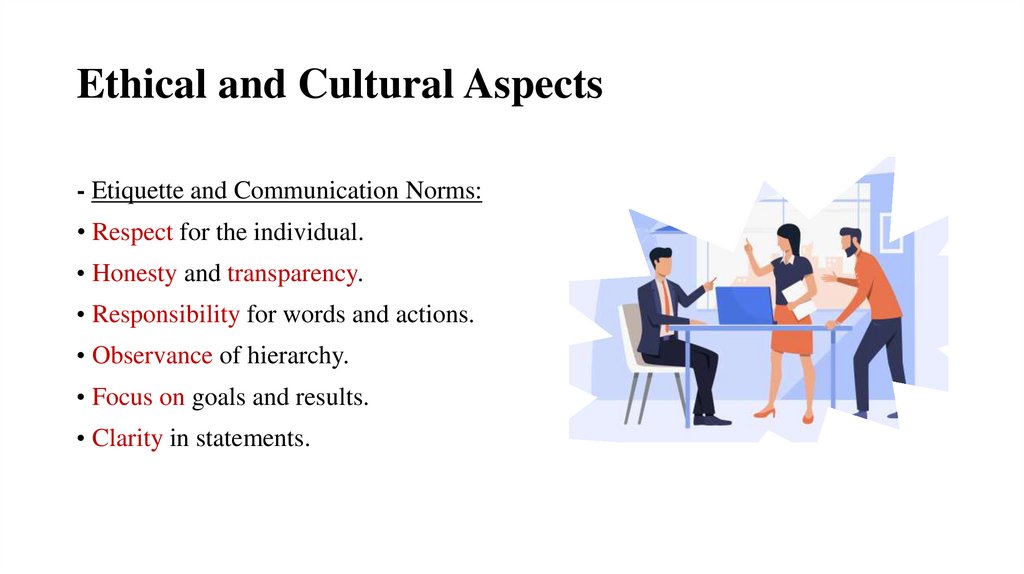
- Etiquette and Communication Norms:• Respect for the individual.
• Honesty and transparency.
• Responsibility for words and actions.
• Observance of hierarchy.
• Focus on goals and results.
• Clarity in statements.
23. Intercultural Communication Barriers
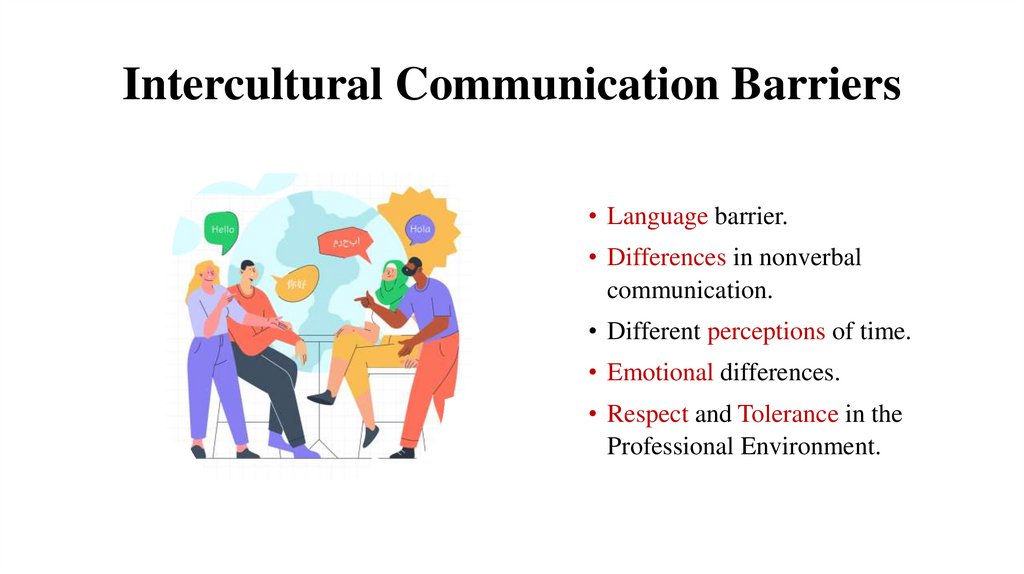
• Language barrier.• Differences in nonverbal
communication.
• Different perceptions of time.
• Emotional differences.
• Respect and Tolerance in the
Professional Environment.
24. Respect and Tolerance in the Professional Environment
Respect and tolerance are crucial for a productive workplace andhealthy team relationships. Respect values employees' dignity, accepts
diverse beliefs, and ensures fair motivation. Professional tolerance
involves patience, accepting values, and adhering to universal rights. A
tolerant atmosphere requires collective effort and respect for colleagues'
experiences and beliefs.
25. Effective communication skills
- Active listening: involves understanding and responding thoughtfully to the speaker's message,enhancing collaboration, preventing misunderstandings, and building lasting relationships.
- Clear spoken communication: successful communicators improve language skills, tailor messages,
master non-verbal communication, and enhance digital skills, while also being competent in their
area of expertise and valuing listening and interaction.
- Feedback and its meaning: regularly seeking feedback on communication skills can reveal blind
spots and areas for growth, allowing for continuous improvement through constructive criticism
and the implementation of changes.
- Conflict management: effective communication and conflict resolution are crucial for leaders to
maintain a healthy working environment, addressing issues like incomplete information, cultural
differences, and unrealistic expectations.
26. Tools and technologies for professional communication
Modern communication platforms:•Business emails
•Meetings
•Presentations
•Verbal communication
There are three main roles during remote meetings: hosting, attending
and presenting.
27. Practical Application
One of the best examples of Professional Communication can be found in a wellconducted business meeting. In such a setting, each participant speaks clearly,listens attentively, and respects others’ viewpoints.
Tips for improving professional communication skills:
• Active listening.
• Empathy and respect.
Feedback.
Nonverbal communication.
Learning and practice.
Conflict management.
28. Role of communication in teams and projects
Effective communication is crucial in teams and projects,facilitating information exchange, coordinating actions, and
supporting decision-making. It aids in understanding tasks,
preventing conflicts, fostering trust, and resolving conflicts
through dialogue. Effective communication also manages
expectations and resolves conflicts.
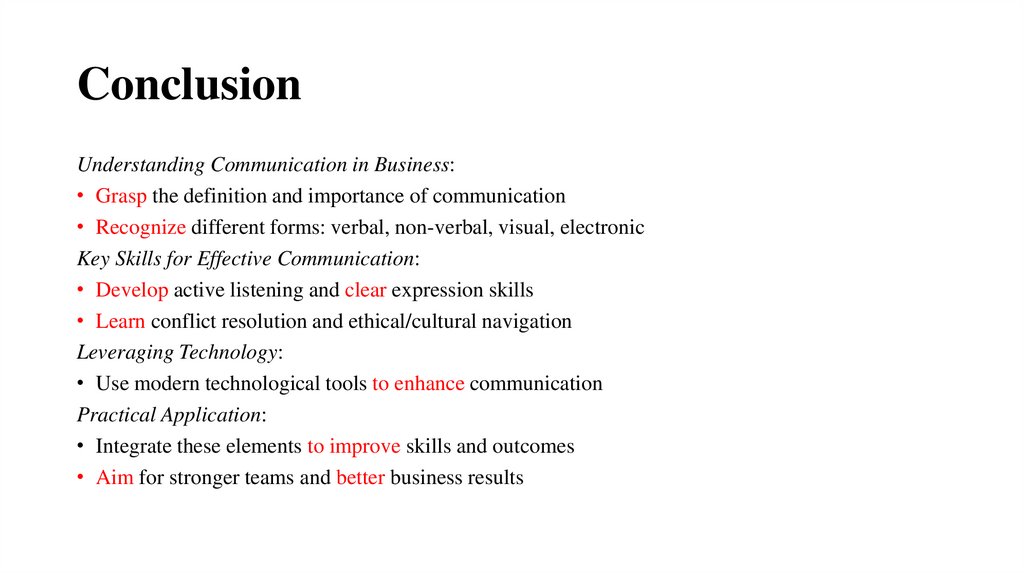
29. Conclusion
Understanding Communication in Business:• Grasp the definition and importance of communication
• Recognize different forms: verbal, non-verbal, visual, electronic
Key Skills for Effective Communication:
• Develop active listening and clear expression skills
• Learn conflict resolution and ethical/cultural navigation
Leveraging Technology:
• Use modern technological tools to enhance communication
Practical Application:
• Integrate these elements to improve skills and outcomes
• Aim for stronger teams and better business results
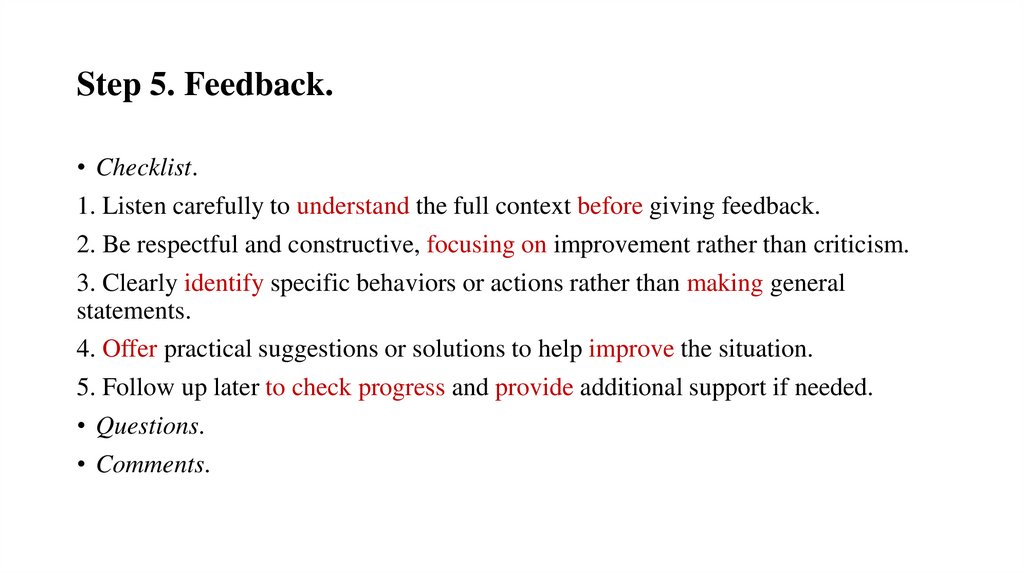
30. Step 5. Feedback.
• Checklist.1. Listen carefully to understand the full context before giving feedback.
2. Be respectful and constructive, focusing on improvement rather than criticism.
3. Clearly identify specific behaviors or actions rather than making general
statements.
4. Offer practical suggestions or solutions to help improve the situation.
5. Follow up later to check progress and provide additional support if needed.
• Questions.
• Comments.
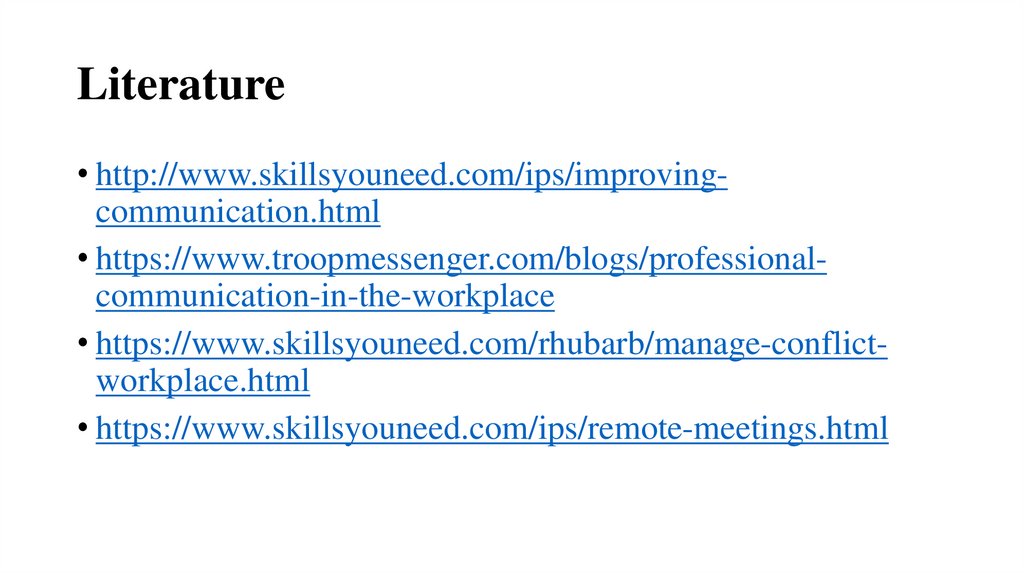
31. Literature
• http://www.skillsyouneed.com/ips/improvingcommunication.html• https://www.troopmessenger.com/blogs/professionalcommunication-in-the-workplace
• https://www.skillsyouneed.com/rhubarb/manage-conflictworkplace.html
• https://www.skillsyouneed.com/ips/remote-meetings.html