 lingvistics
Similar presentations:




Constructed languages. The Naʼvi language
1. Kostyuchenko Irene
Constructed languagesThe Naʼvi language
KOSTYUCHENKO IRENE
2. Constructed languages can be divided into: Engineered languages (engelangs). Auxiliary languages (auxlangs). Artistic languages
A constructed language or a conlang is isa language that was devised by an
individual or group, instead of evolving
naturally.
Constructed languages can be divided into:
Engineered languages (engelangs).
Auxiliary languages (auxlangs).
Artistic languages (artlangs).
3. Avatar
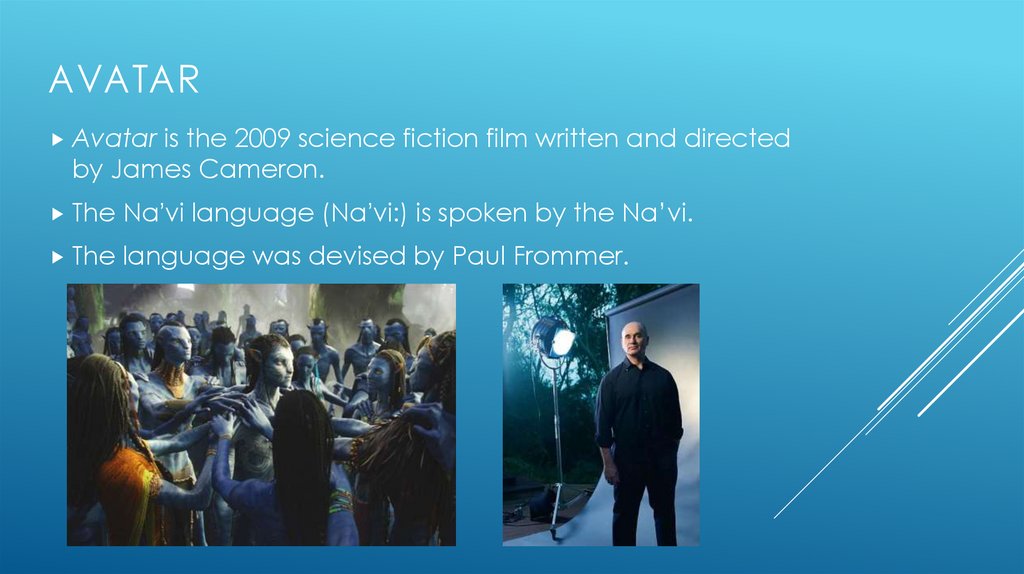
AVATARAvatar is the 2009 science fiction film written and directed
by James Cameron.
The Naʼvi language (Naʼvi:) is spoken by the Na’vi.
The language was devised by Paul Frommer.
4. Phonology and orthography
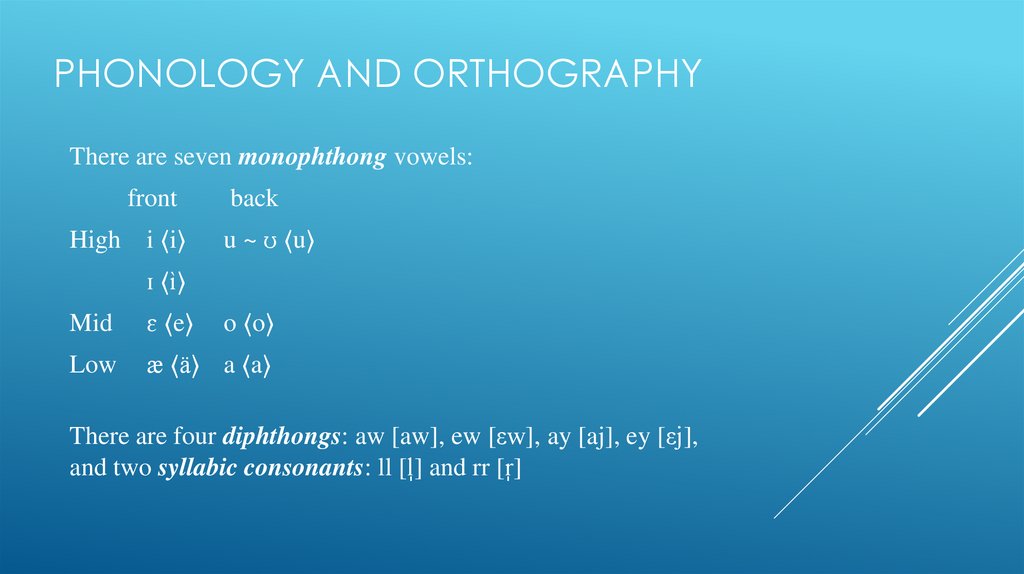
PHONOLOGY AND ORTHOGRAPHYThere are seven monophthong vowels:
front
High i ⟨i⟩
back
u ~ ʊ ⟨u⟩
ɪ ⟨ì⟩
Mid
ɛ ⟨e⟩
Low
æ ⟨ä⟩ a ⟨a⟩
o ⟨o⟩
There are four diphthongs: aw [aw], ew [εw], ay [aj], ey [εj],
and two syllabic consonants: ll [l̩ ] and rr [r̩]
5. Phonology and orthography
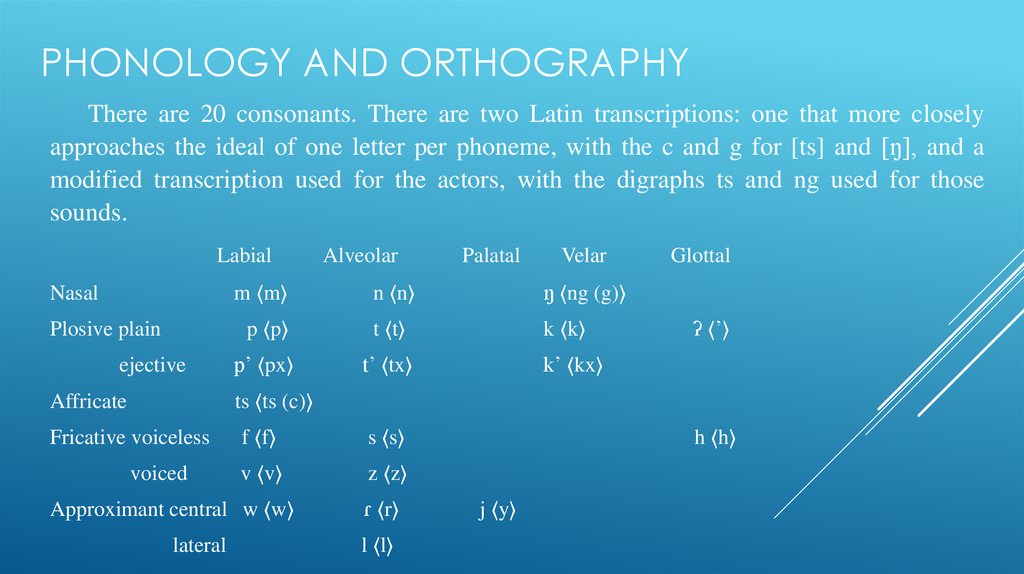
PHONOLOGY AND ORTHOGRAPHYThere are 20 consonants. There are two Latin transcriptions: one that more closely
approaches the ideal of one letter per phoneme, with the c and g for [ts] and [ŋ], and a
modified transcription used for the actors, with the digraphs ts and ng used for those
sounds.
Labial
Alveolar
Palatal
Velar
Nasal
m ⟨m⟩
n ⟨n⟩
ŋ ⟨ng (g)⟩
Plosive plain
p ⟨p⟩
t ⟨t⟩
k ⟨k⟩
pʼ ⟨px⟩
tʼ ⟨tx⟩
kʼ ⟨kx⟩
ejective
Affricate
ts ⟨ts (c)⟩
Fricative voiceless
f ⟨f⟩
s ⟨s⟩
v ⟨v⟩
z ⟨z⟩
Approximant central w ⟨w⟩
ɾ ⟨r⟩
voiced
lateral
l ⟨l⟩
Glottal
ʔ ⟨ʼ⟩
h ⟨h⟩
j ⟨y⟩
6. Phonology and orthography
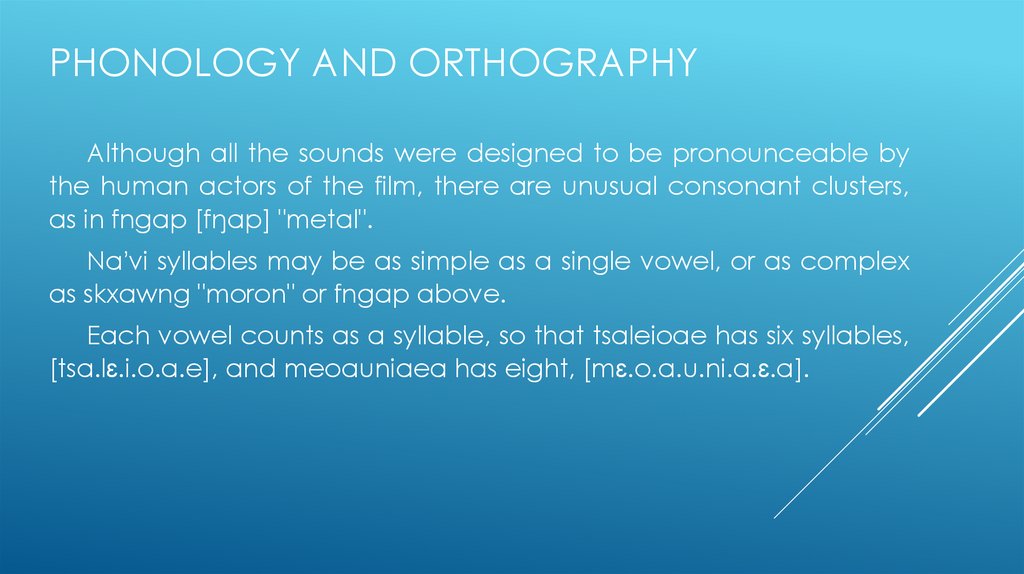
PHONOLOGY AND ORTHOGRAPHYAlthough all the sounds were designed to be pronounceable by
the human actors of the film, there are unusual consonant clusters,
as in fngap [fŋap] "metal".
Naʼvi syllables may be as simple as a single vowel, or as complex
as skxawng "moron" or fngap above.
Each vowel counts as a syllable, so that tsaleioae has six syllables,
[tsa.lɛ.i.o.a.e], and meoauniaea has eight, [mɛ.o.a.u.ni.a.ɛ.a].
7. Grammar
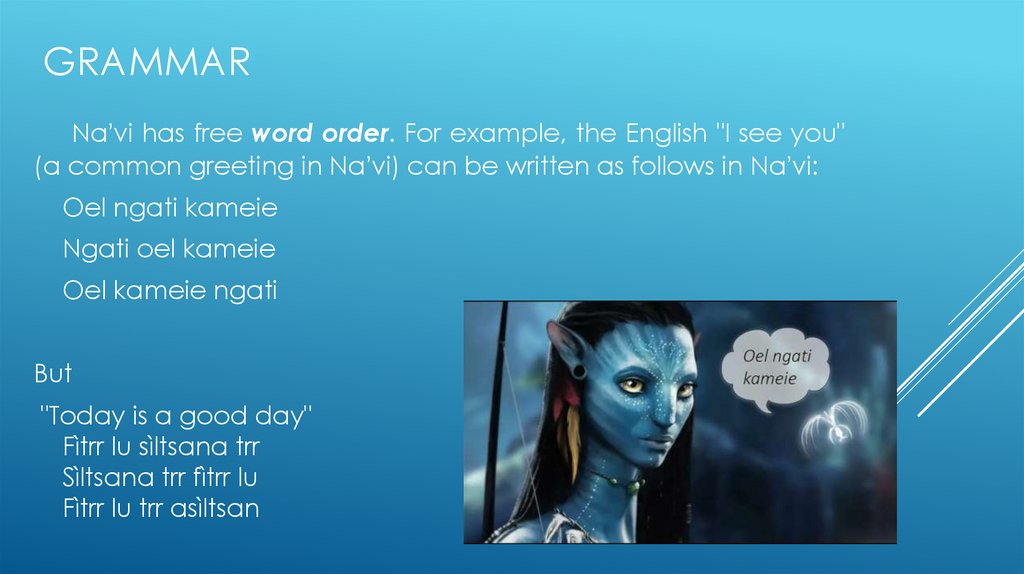
GRAMMARNaʼvi has free word order. For example, the English "I see you"
(a common greeting in Naʼvi) can be written as follows in Naʼvi:
Oel ngati kameie
Ngati oel kameie
Oel kameie ngati
But
"Today is a good day"
Fìtrr lu sìltsana trr
Sìltsana trr fìtrr lu
Fìtrr lu trr asìltsan
8. Grammar Nouns
GRAMMARNOUNS
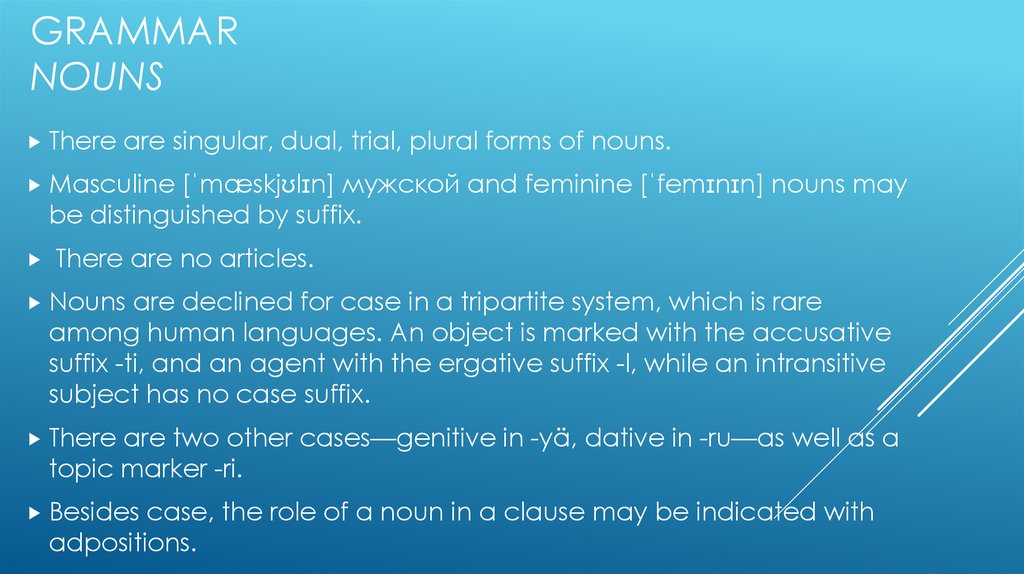
There are singular, dual, trial, plural forms of nouns.
Masculine [ˈmæskjʊlɪn] мужской and feminine [ˈfemɪnɪn] nouns may
be distinguished by suffix.
There are no articles.
Nouns are declined for case in a tripartite system, which is rare
among human languages. An object is marked with the accusative
suffix -ti, and an agent with the ergative suffix -l, while an intransitive
subject has no case suffix.
There are two other cases—genitive in -yä, dative in -ru—as well as a
topic marker -ri.
Besides case, the role of a noun in a clause may be indicated with
adpositions.
9.
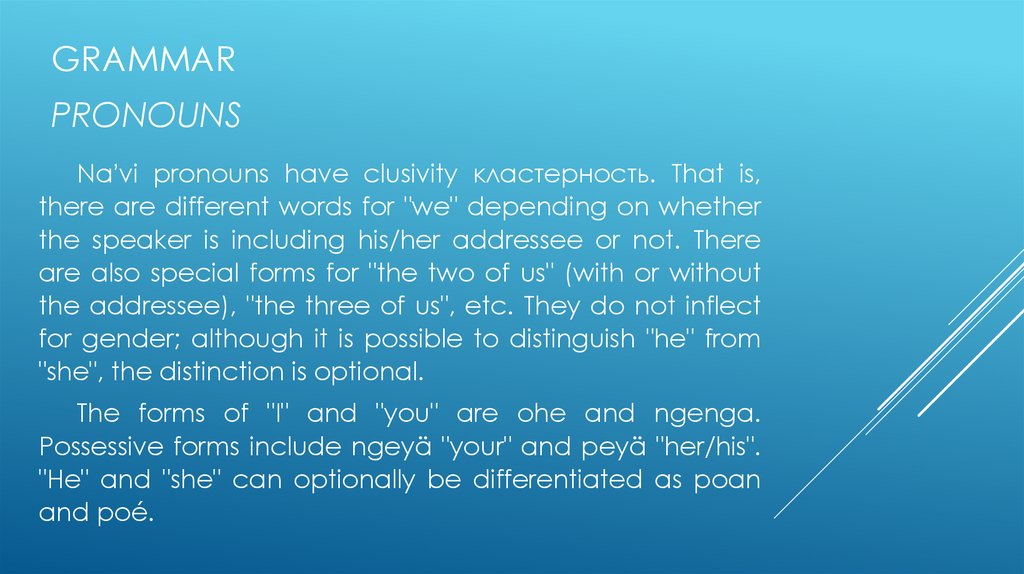
GRAMMARPRONOUNS
Naʼvi pronouns have clusivity кластерность. That is,
there are different words for "we" depending on whether
the speaker is including his/her addressee or not. There
are also special forms for "the two of us" (with or without
the addressee), "the three of us", etc. They do not inflect
for gender; although it is possible to distinguish "he" from
"she", the distinction is optional.
The forms of "I" and "you" are ohe and ngenga.
Possessive forms include ngeyä "your" and peyä "her/his".
"He" and "she" can optionally be differentiated as poan
and poé.
10. Grammar Adjectives
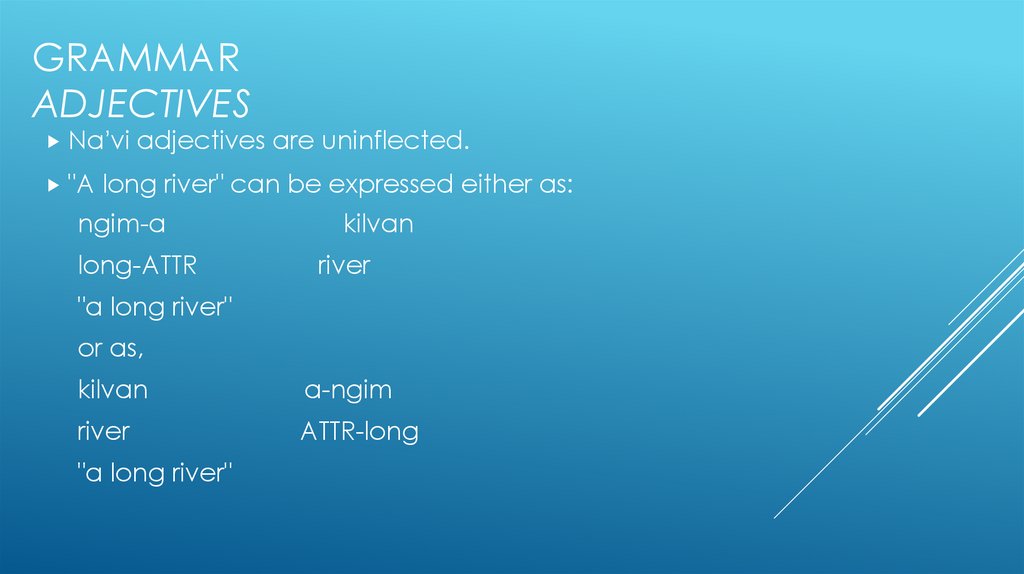
GRAMMARADJECTIVES
Naʼvi adjectives are uninflected.
"A long river" can be expressed either as:
ngim-a
long-ATTR
kilvan
river
"a long river"
or as,
kilvan
a-ngim
river
ATTR-long
"a long river"
11. Grammar Numbers
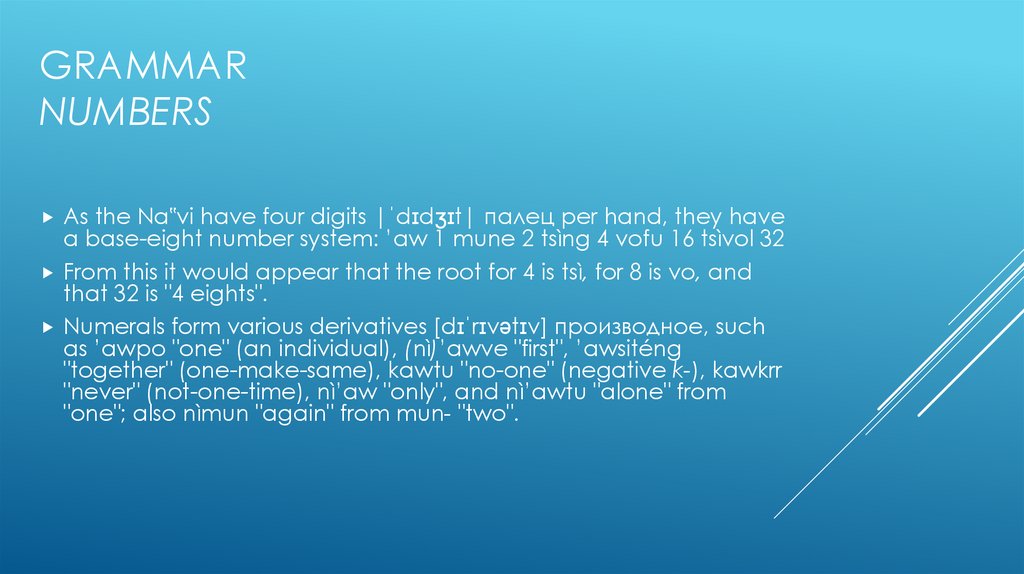
GRAMMARNUMBERS
As the Na‟vi have four digits |ˈdɪdʒɪt| палец per hand, they have
a base-eight number system: ’aw 1 mune 2 tsìng 4 vofu 16 tsìvol 32
From this it would appear that the root for 4 is tsì, for 8 is vo, and
that 32 is "4 eights".
Numerals form various derivatives [dɪˈrɪvətɪv] производное, such
as ’awpo "one" (an individual), (nì)’awve "first", ’awsiténg
"together" (one-make-same), kawtu "no-one" (negative k-), kawkrr
"never" (not-one-time), nì’aw "only", and nì’awtu "alone" from
"one"; also nìmun "again" from mun- "two".
12. Grammar Verbs
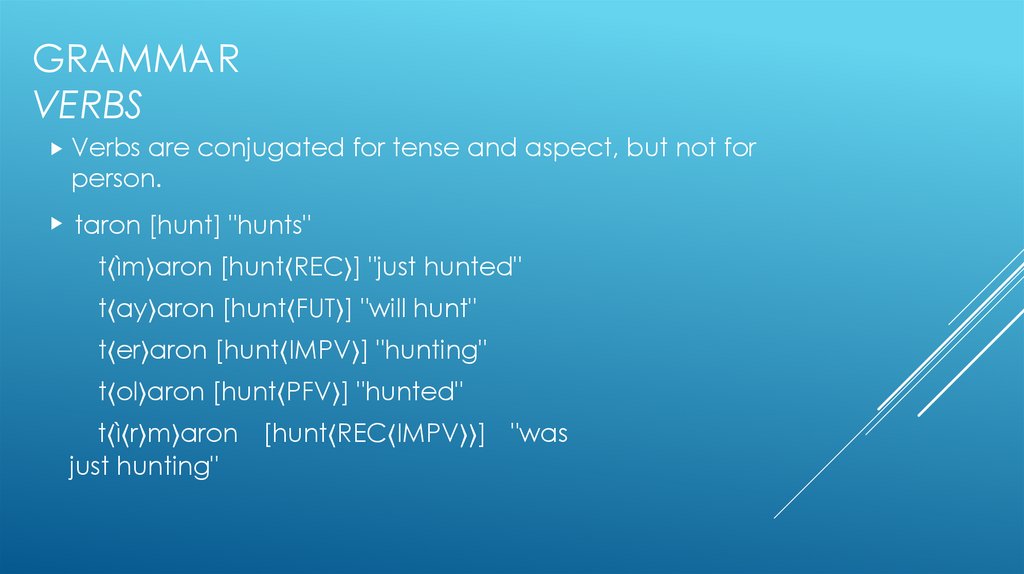
GRAMMARVERBS
Verbs are conjugated for tense and aspect, but not for
person.
taron [hunt] "hunts"
t⟨ìm⟩aron [hunt⟨REC⟩] "just hunted"
t⟨ay⟩aron [hunt⟨FUT⟩] "will hunt"
t⟨er⟩aron [hunt⟨IMPV⟩] "hunting"
t⟨ol⟩aron [hunt⟨PFV⟩] "hunted"
t⟨ì⟨r⟩m⟩aron [hunt⟨REC⟨IMPV⟩⟩] "was
just hunting"
13. Lexicon
LEXICONThe Naʼvi language has over 2,600 words. Additionally,
the community of speakers is working with Dr. Frommer
to further develop the language/
Na’vi is not a natural language, but there are many
resources for the fans of Avatar who want to learn the
vocabulary, syntax, and grammar of Na’vi.
14. THANK YOU FOR YOUR ATTENTION! Irayo!
THANK YOU FOR YOUR ATTENTION!IRAYO!