 english
 music
musicSimilar presentations:





Examples of Assimilations in Eminem – Lose Yourself
1. Examples of Assimilations in Eminem – Lose Yourself
Zakhar BlinovDenis Kazakov
BLT25-01
2. How Eminem uses assimilation
Eminem, as a masterful lyricist, intentionally usesthese common features of connected speech to fit
more words into a rapid rhythm making the lyrics
sound natural, dynamic, and dense with layered
rhymes.
• Rapid speech: Assimilation is common in rapid
speech, which is characteristic of Eminem's fastpaced rapping style.
• Lyrical flow: This allows him to maintain a
consistent rhythm and flow throughout his verses.
• Sound-based rhymes: By altering sounds, he can
create complex and layered rhymes that go beyond
simple word matching.
3. Voicing Assimilation
Lyric: “There’s vomit on his sweater already, mom’s spaghetti.”Focus: “mom’s spaghetti”
Process: The voiced /z/ in “mom’s” occurs before the voiceless /s/ in “spaghetti.” In rapid
speech, the /z/ may undergo devoicing to [s] to match the following segment.
Result: [mamz spəˈɡɛti] → [mams spəˈɡɛti]
4. Elision and Assimilation Combination
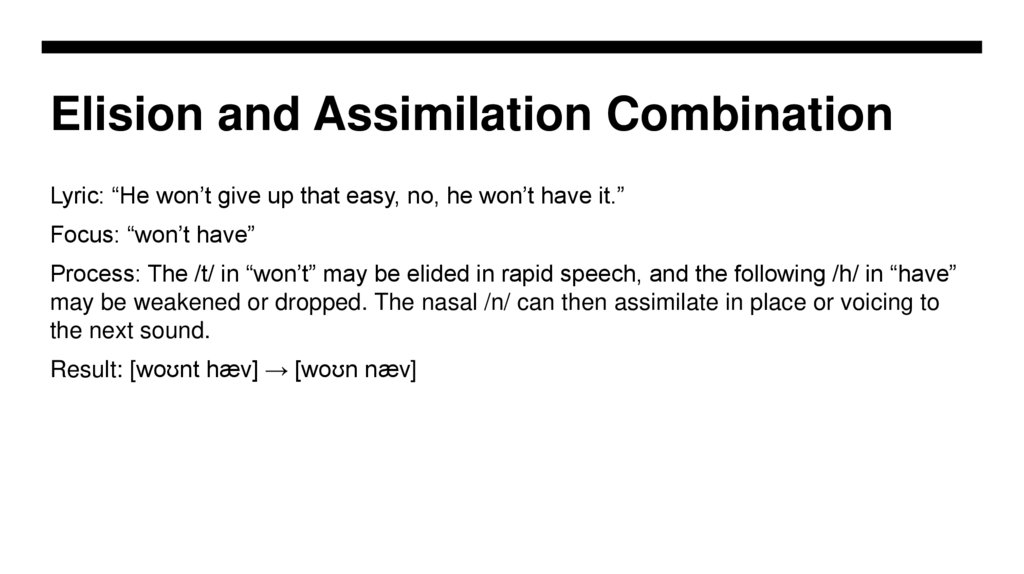
Lyric: “He won’t give up that easy, no, he won’t have it.”Focus: “won’t have”
Process: The /t/ in “won’t” may be elided in rapid speech, and the following /h/ in “have”
may be weakened or dropped. The nasal /n/ can then assimilate in place or voicing to
the next sound.
Result: [woʊnt hæv] → [woʊn næv]
5. Place Assimilation
Lyric: “He’s nervous, but on the surface he looks calm and ready.”Focus: “looks calm”
Process: The /k/ in “looks” and the following /k/ in “calm” share the same place of
articulation (velar). In fast or connected speech, the alveolar /s/ at the end of “looks” may
shift slightly toward a velar articulation under the influence of the following /k/.
Result: [lʊks kɑːm] → [lʊk̚kɑːm]
6. Intermediate assimilation
Lyric: “When he goes back to his mobile home, that’s when it’s back to the lab again.”Focus: “back to his”
Process: The stop consonant /k/ in "back" followed by the alveolar stop /t/ in "to" can sometimes show
nasalization if the preceding vowel is followed by a nasal sound, but a clearer
intermediate assimilation is the frequent realization of the alveolar stop /t/ in “to” as a flap [ɾ] when it is
between vowels (or a vowel and an unstressed syllable final /l/ or /r/ sound). Flapping changes the
manner of articulation from a stop to a quick tap.
Result: [bæk tuː hɪz] → [bæk ɾuː hɪz]