
 english
Similar presentations:










The History of Gasoline Cars and Comparison with Electric Cars
1. WEEK 9 MODULE 4 THE IMPACT OF TECHNOLOGY ON TRANSPORTATION
LESSON 3READING
2. Study the new vocabulary:
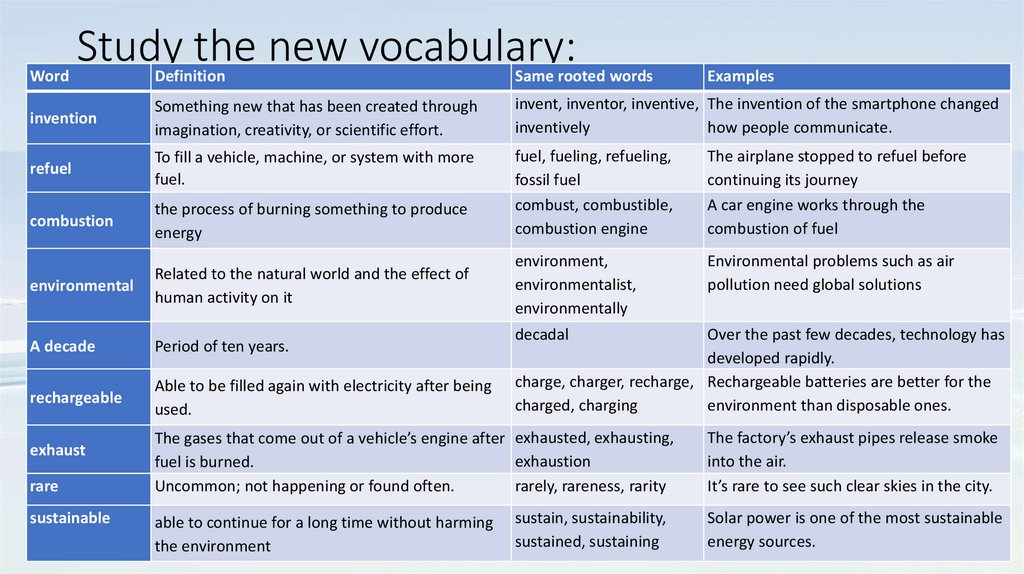
WordStudy the new vocabulary:
Definition
Same rooted words
invention
Something new that has been created through
imagination, creativity, or scientific effort.
invent, inventor, inventive, The invention of the smartphone changed
inventively
how people communicate.
refuel
To fill a vehicle, machine, or system with more
fuel.
combustion
the process of burning something to produce
energy
fuel, fueling, refueling,
fossil fuel
combust, combustible,
combustion engine
The airplane stopped to refuel before
continuing its journey
A car engine works through the
combustion of fuel
environmental
Related to the natural world and the effect of
human activity on it
environment,
environmentalist,
environmentally
Environmental problems such as air
pollution need global solutions
A decade
Period of ten years.
rechargeable
Able to be filled again with electricity after being
used.
exhaust
rare
sustainable
Examples
decadal
Over the past few decades, technology has
developed rapidly.
charge, charger, recharge, Rechargeable batteries are better for the
charged, charging
environment than disposable ones.
The gases that come out of a vehicle’s engine after exhausted, exhausting,
exhaustion
fuel is burned.
Uncommon; not happening or found often.
rarely, rareness, rarity
The factory’s exhaust pipes release smoke
into the air.
It’s rare to see such clear skies in the city.
sustain, sustainability,
sustained, sustaining
Solar power is one of the most sustainable
energy sources.
able to continue for a long time without harming
the environment
3. Read the text and answer the following questions:
1. What are the reasons why gasoline cars became so popular?2. When were the first electric cars invented?
3. What are the challenges that electric cars have?
4. The History of Gasoline Cars and Comparison with Electric Cars
• Cars have changed the world in many ways. Today, people use cars to travel to work, school, or onholiday. But the history of cars is long and full of interesting inventions. The first cars were very
different from the modern vehicles we see on the road today.
• The first gasoline-powered car was built in the late 19th century. In 1885, a German engineer
named Karl Benz created the first true car that used a gasoline engine. His invention had three
wheels and could travel only about 16 kilometers per hour. Soon after, other inventors such as
Gottlieb Daimler and Henry Ford improved the design. Ford’s company started mass-producing
cars in 1908 with the Model T, making them cheaper and available for many people. Gasoline cars
quickly became popular all over the world because they were fast, powerful, and easy to refuel.
• Gasoline cars use engines that burn fuel to produce energy. This process is called combustion. It
creates movement, but it also produces carbon dioxide (CO₂) and other gases that pollute the air.
For more than 100 years, people have used gasoline cars for almost all kinds of travel. However,
as time passed, the world began to worry about climate change and the environmental impact of
fossil fuels.
• At the same time, electric cars started to attract attention again. Interestingly, electric cars are not
new. In fact, they were invented before gasoline cars. In the 1830s, some engineers built small
electric vehicles powered by batteries. However, these early models were slow, expensive, and
needed frequent charging. When gasoline cars became faster and cheaper, electric cars almost
disappeared for many decades.
5.
• In the 21st century, electric cars have made a big comeback. Thanks to newtechnology, modern electric cars can travel hundreds of kilometers on a
single charge. Companies like Tesla, Nissan, and BYD have developed cars
that are quiet, powerful, and environmentally friendly. Electric cars use
rechargeable batteries instead of fuel. They produce no exhaust gases,
which helps reduce air pollution. They are also cheaper to maintain
because they have fewer moving parts than gasoline engines.
• However, electric cars still have some challenges. Charging stations are not
available everywhere, and it can take several hours to recharge the battery.
The batteries are also expensive, and producing them requires rare
materials. On the other hand, gasoline cars can be refueled quickly at any
gas station and are usually cheaper to buy.
• In conclusion, gasoline cars changed the world in the 20th century by
making travel easier and faster. But now, electric cars are leading a new
revolution in transport. They are helping people move toward a cleaner
and more sustainable future. While both types of cars have advantages
and disadvantages, it is clear that the future of transportation will become
more electric as technology continues to improve.
6. Choose the correct answer:
1. Who built the first gasoline-powered car?A) Henry Ford
B) Gottlieb Daimler
C) Karl Benz
D) Nikola Tesla
5. Why did early electric cars disappear for many decades?
A) They were banned by the government.
B) Gasoline cars became faster and cheaper.
C) The batteries were too large to fit in cars.
D) People preferred to walk.
2. What was special about Ford’s Model T?
A) It was the first electric car.
B) It could fly short distances.
C) It was mass-produced and affordable.
D) It used rechargeable batteries.
6. Which company is known for developing modern electric
cars?
A) Toyota
B) Tesla
C) Ford
D) Mercedes-Benz
3. What is the process called when a gasoline engine burns
fuel?
7. What do electric cars use instead of fuel?
A) Combustion
A) Hydrogen tanks
B) Conversion
B) Wind energy
C) Compression
C) Rechargeable batteries
D) Circulation
D) Solar panels only
4. What do gasoline cars produce that pollutes the air?
A) Oxygen
B) Carbon dioxide
C) Nitrogen
D) Hydrogen
8. What type of energy do gasoline cars rely on?
A) Solar energy
B) Fossil fuels
C) Wind energy
D) Water power
7. Decide if the statements are true or false:
1. Karl Benz’s first car had four wheels.2. Electric cars existed before gasoline cars.
3. Early electric cars were fast and cheap.
4. Modern electric cars can travel long distances on one charge.
5. Electric cars produce exhaust gases that cause air pollution.
6. Gasoline cars are easier to refuel than electric cars.
7. The production of electric car batteries requires rare materials.
8. The text concludes that transportation will likely become more
electric in the future.