
 ecology
Similar presentations:






Загрязнение и закисление океана
1. Ocean Pollution and acidification
2. Facts on Ocean Pollution
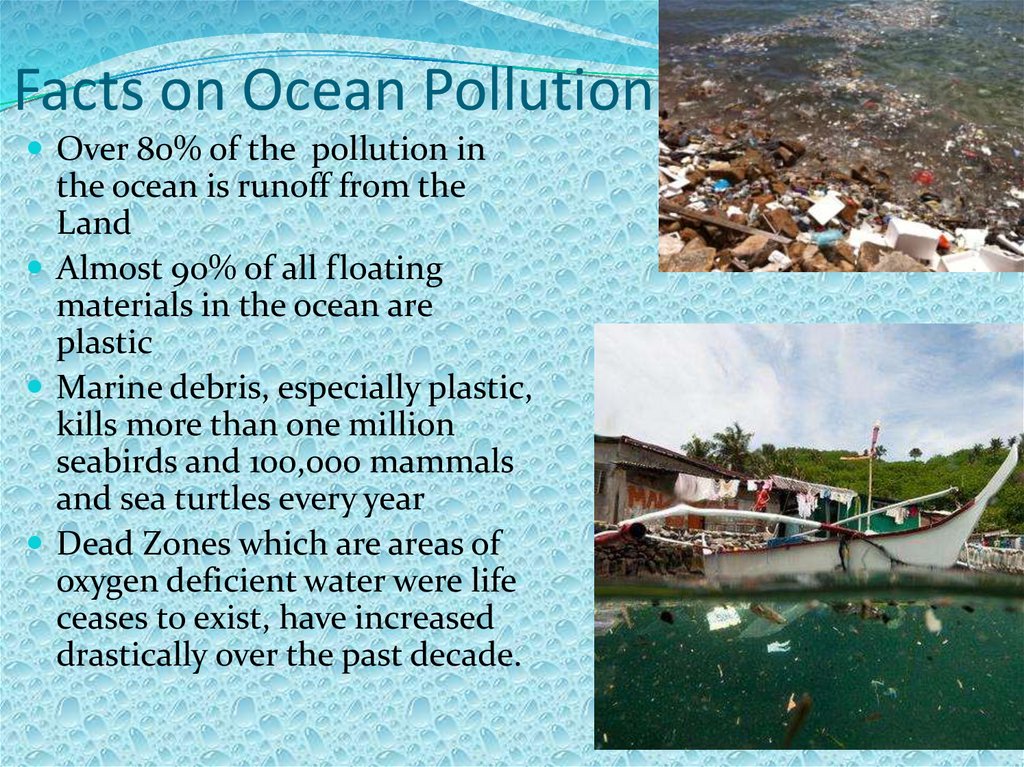
Over 80% of the pollution inthe ocean is runoff from the
Land
Almost 90% of all floating
materials in the ocean are
plastic
Marine debris, especially plastic,
kills more than one million
seabirds and 100,000 mammals
and sea turtles every year
Dead Zones which are areas of
oxygen deficient water were life
ceases to exist, have increased
drastically over the past decade.
3.
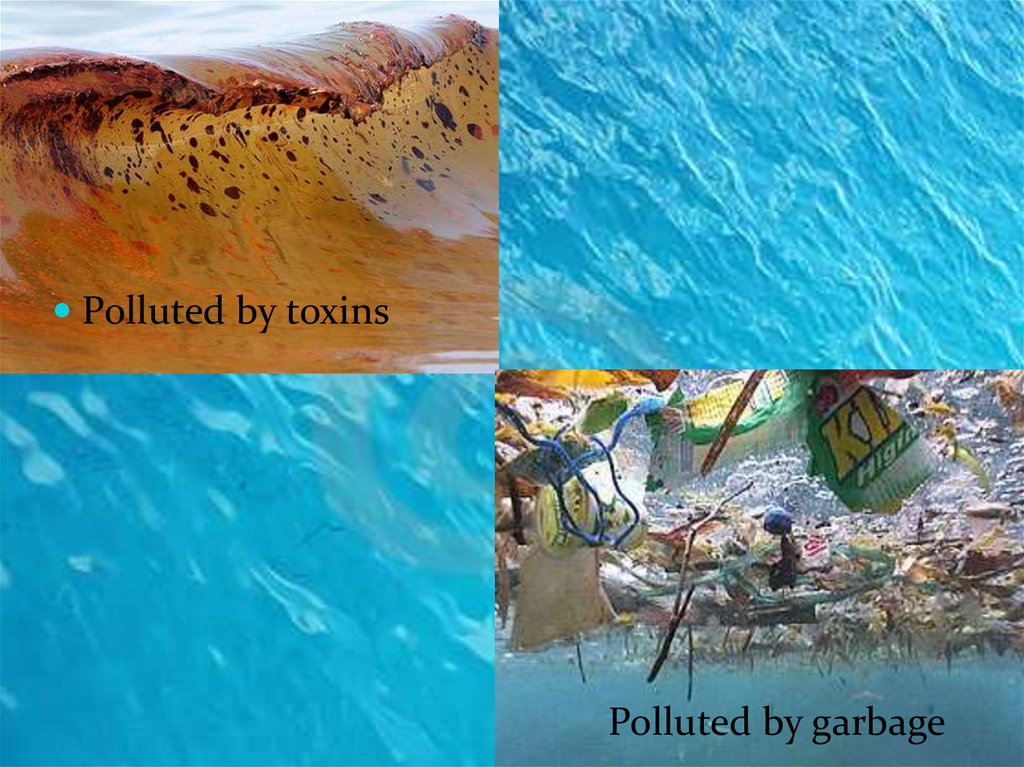
Polluted by toxinsPolluted by garbage
4. Types Of Pollution
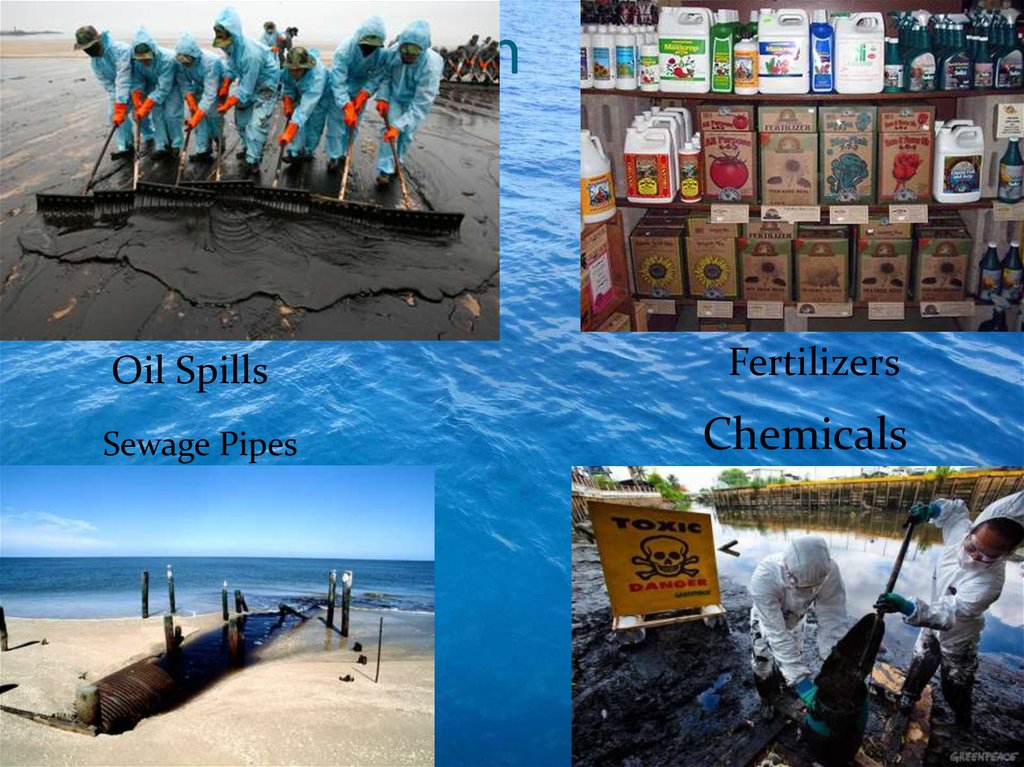
Oil SpillsFertilizers
Sewage Pipes
Chemicals
5.
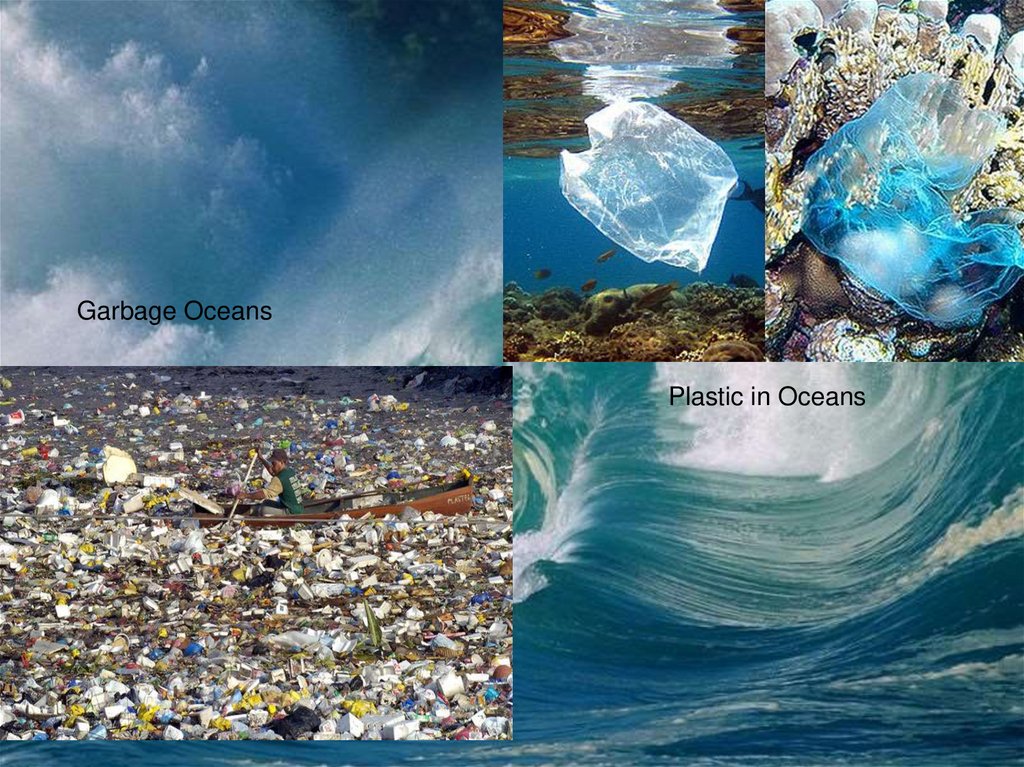
Garbage OceansPlastic in Oceans
6. Oil Spills
Oil spills have huge and immediate economic, social, and environmentalimpacts.
Local people lose their livelihoods as fisheries and tourism areas are
temporarily closed; the clean up costs are enormous; and tens of thousands of
marine animals and plants are killed or harmed.
And the damage goes on. The chemicals used to break up the oil can be toxic,
and it's impossible to remove all the spilled oil. Even after an area has been
cleaned up, it can take a decade or more to fully recover.
There's also the problem of the oil that goes down with the ship, which can
contaminate the seabed and marine organisms.
This oil can also resurface. In 2001, a cyclone off the island of Yap in Micronesia
disturbed the oil tanker USS Mississinewa, which was sunk during World War
II. For two months, thousands of liters of oil and gasoline leaked out of the
rusted ship wreck onto the beaches of the atoll, stopping the 700 islanders from
fishing. There are hundreds of other shipwrecked tankers around the world.
7. Information on Oil Spills
http://seawifs.gsfc.nasa.gov/OCEAN_PLANET/HTML/peril_oil_pollution.html
http://www.noaawatch.gov/themes/oilspill.php
http://ocean.si.edu/gulf-oil-spill
8. Fertilizers
Fertilizers that runoff from farms and lawns is a hugeproblem for coastal areas. The extra nutrients cause
Eutrophication.
The run off kills the Algae which depletes the water's
dissolved oxygen and suffocate other marine life.
Eutrophication is the addition of artificial or natural
substances, such as nitrates and phosphates,
through fertilizers or sewage, to an aquatic system.
Eutrophication has created enormous dead zones in
several parts of the world, including the Gulf of
Mexico and the Baltic Sea
9. Information on Fertilizers
http://www.organicconsumers.org/corp/oceans101104.cfm
http://www.scientificamerican.com/article.cfm?id=oc
eanic-dead-zones-spread
http://pubs.acs.org/cen/science/86/8613sci1.html
10.
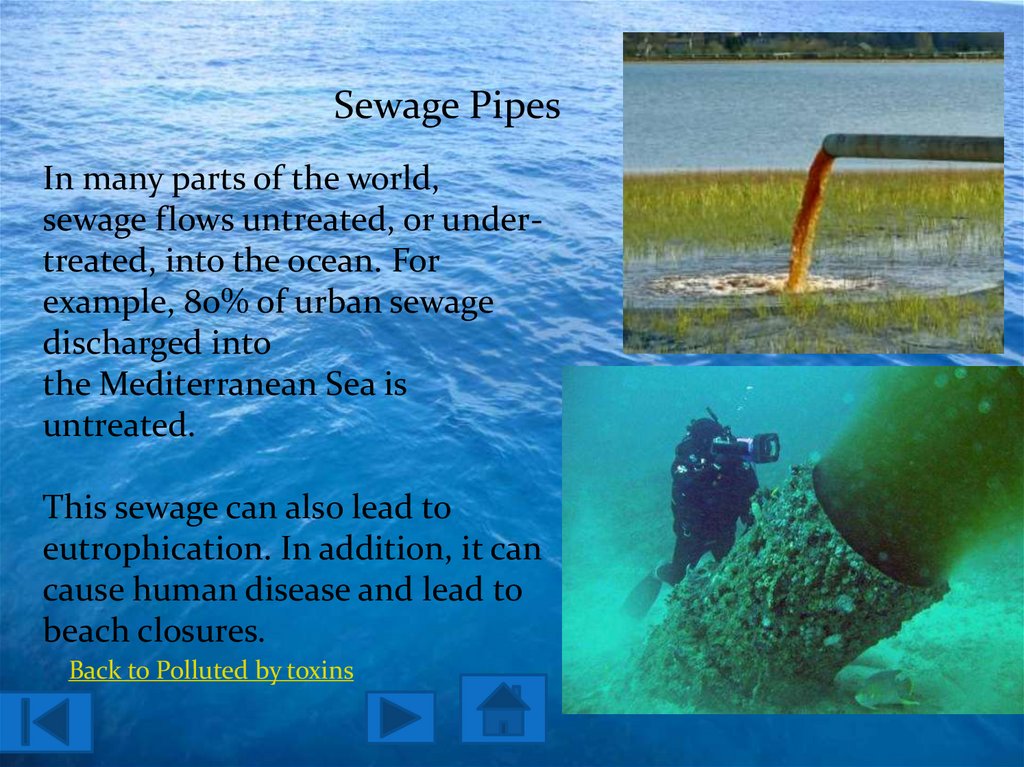
Sewage PipesIn many parts of the world,
sewage flows untreated, or undertreated, into the ocean. For
example, 80% of urban sewage
discharged into
the Mediterranean Sea is
untreated.
This sewage can also lead to
eutrophication. In addition, it can
cause human disease and lead to
beach closures.
Back to Polluted by toxins
11. Outside information on Sewage Pipes
http://articles.sun-sentinel.com/2010-11-01/health/fl-waste-outfall-broward-20101025_1_sewage-bills-reefrescue-water-shortage
http://www.nytimes.com/1994/05/04/us/sewage-pipe-
bursts-in-mexico-fouling-beaches-in-san-diego.html
http://www.reuters.com/article/2008/04/23/us-usa-
florida-pollution-idUSN2230092520080423
12.
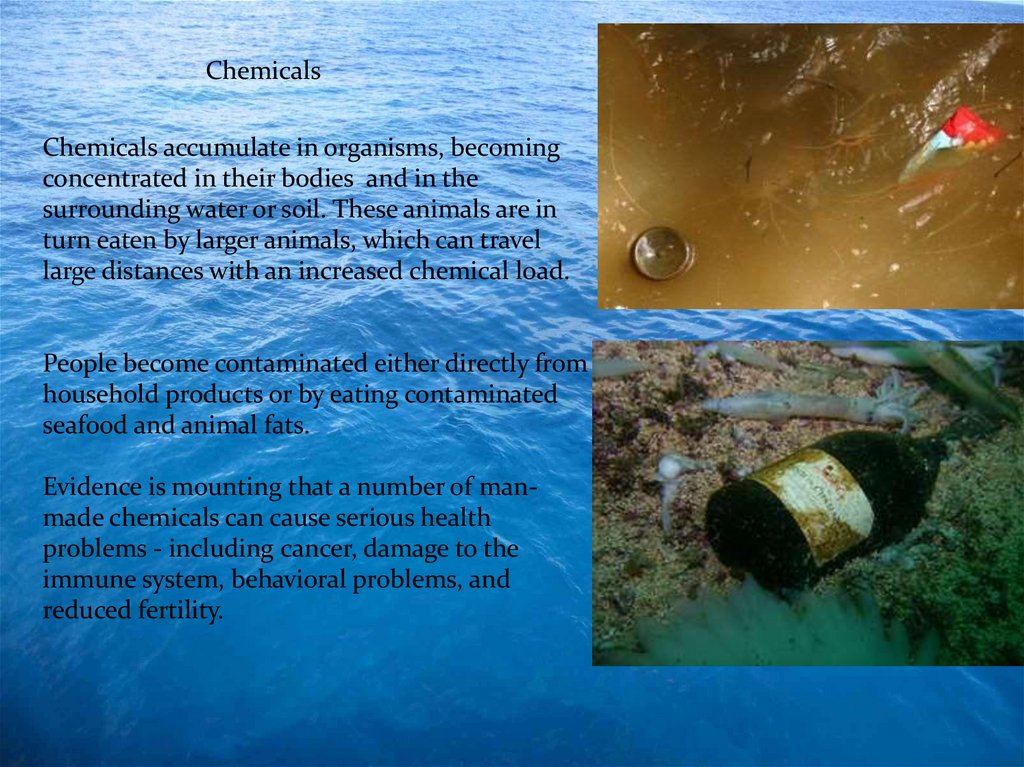
ChemicalsChemicals accumulate in organisms, becoming
concentrated in their bodies and in the
surrounding water or soil. These animals are in
turn eaten by larger animals, which can travel
large distances with an increased chemical load.
People become contaminated either directly from
household products or by eating contaminated
seafood and animal fats.
Evidence is mounting that a number of manmade chemicals can cause serious health
problems - including cancer, damage to the
immune system, behavioral problems, and
reduced fertility.
13. Information on Chemical Toxins
http://www.seaweb.org/resources/briefings/toxic.phphttp://seawifs.gsfc.nasa.gov/OCEAN_PLANET/HTML
/peril_toxins.html
http://www.cleanoceanaction.org/index.php?id=117
http://org2.democracyinaction.org/o/6122/p/dia/actio
n/public/?action_KEY=4342
14. Garbage Dump
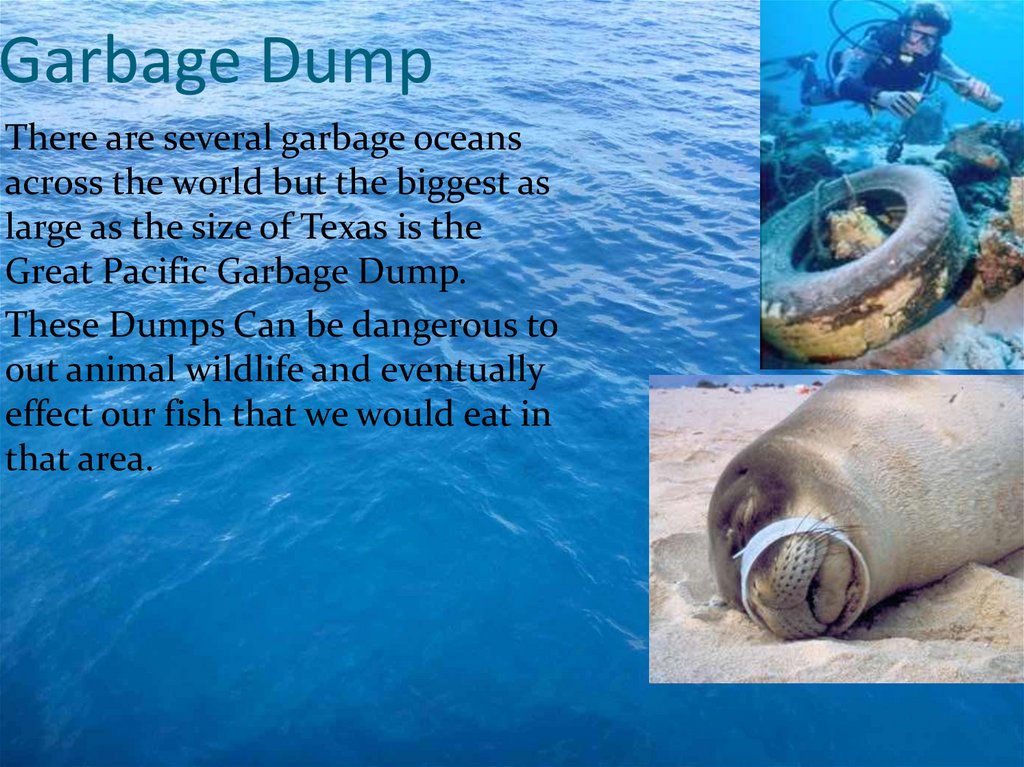
There are several garbage oceansacross the world but the biggest as
large as the size of Texas is the
Great Pacific Garbage Dump.
These Dumps Can be dangerous to
out animal wildlife and eventually
effect our fish that we would eat in
that area.
15. Information on Garbage Dump
http://science.howstuffworks.com/environmental/earth/oceanography/great-pacific-garbage-patch.htm
http://discovermagazine.com/2008/jul/10-the-worlds-
largest-dump
http://www.ecology.com/2008/08/14/pacific-plastic-
waste-dump/
16. Plastic
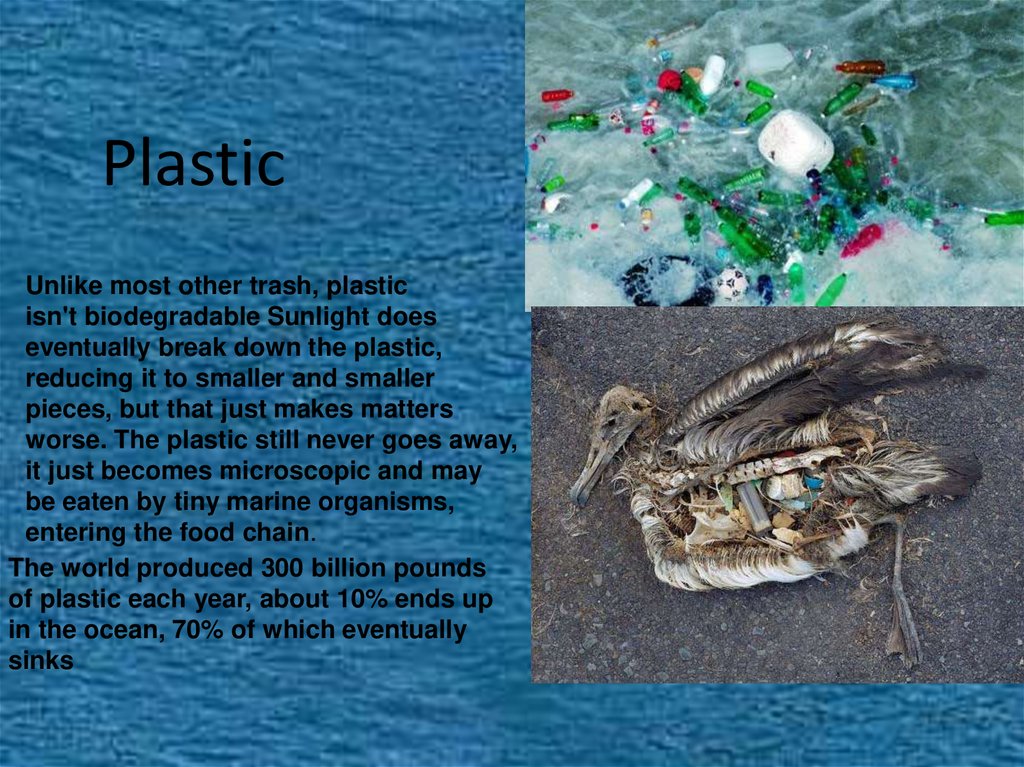
Unlike most other trash, plasticisn't biodegradable Sunlight does
eventually break down the plastic,
reducing it to smaller and smaller
pieces, but that just makes matters
worse. The plastic still never goes away,
it just becomes microscopic and may
be eaten by tiny marine organisms,
entering the food chain.
The world produced 300 billion pounds
of plastic each year, about 10% ends up
in the ocean, 70% of which eventually
sinks
17. Outside information on Plastic
http://www.savemyoceans.com/plastics.phphttp://www.plasticoceans.net/
http://www.whoi.edu/science/B/people/kamaral/plast
icsarticle.html
http://www.seeturtles.org/1128/ocean-plastic.html
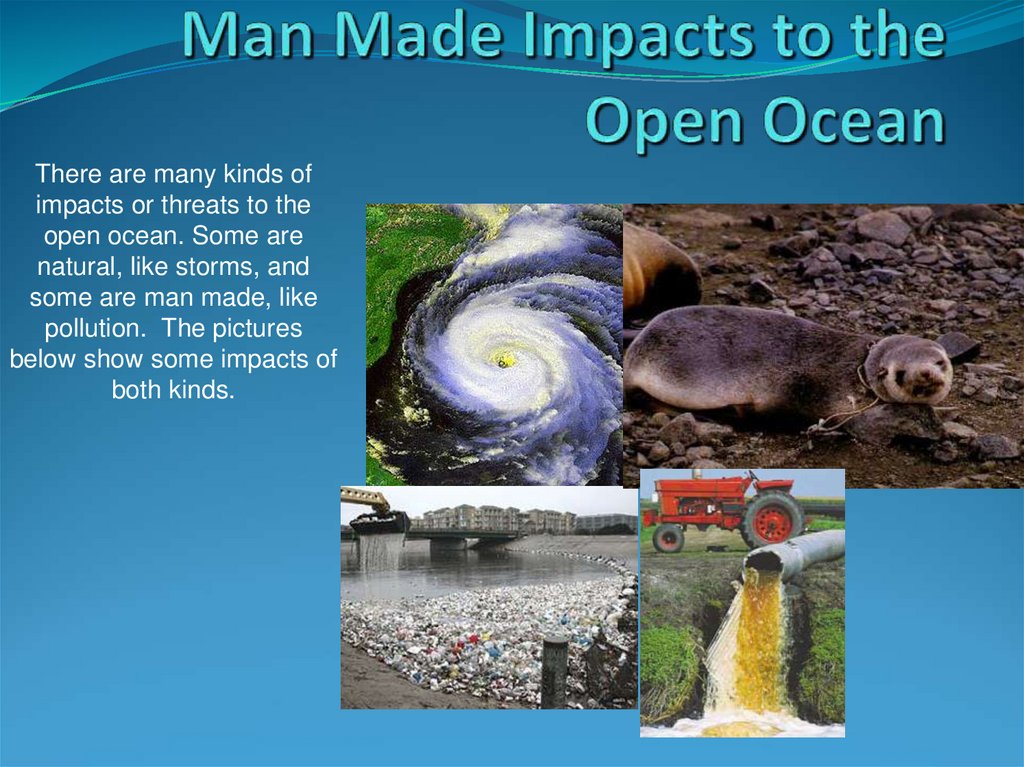
18. Man Made Impacts to the Open Ocean
There are many kinds ofimpacts or threats to the
open ocean. Some are
natural, like storms, and
some are man made, like
pollution. The pictures
below show some impacts of
both kinds.
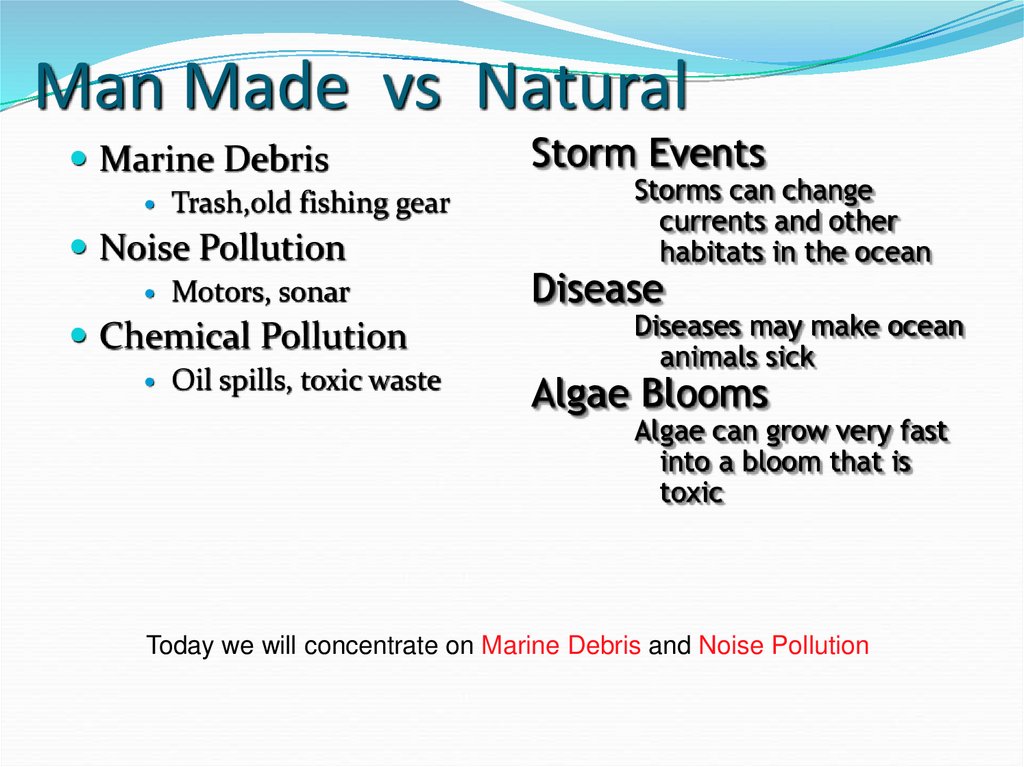
19. Man Made vs Natural
Marine DebrisTrash,old fishing gear
Noise Pollution
Motors, sonar
Chemical Pollution
Oil spills, toxic waste
Storm Events
Storms can change
currents and other
habitats in the ocean
Disease
Diseases may make ocean
animals sick
Algae Blooms
Algae can grow very fast
into a bloom that is
toxic
Today we will concentrate on Marine Debris and Noise Pollution
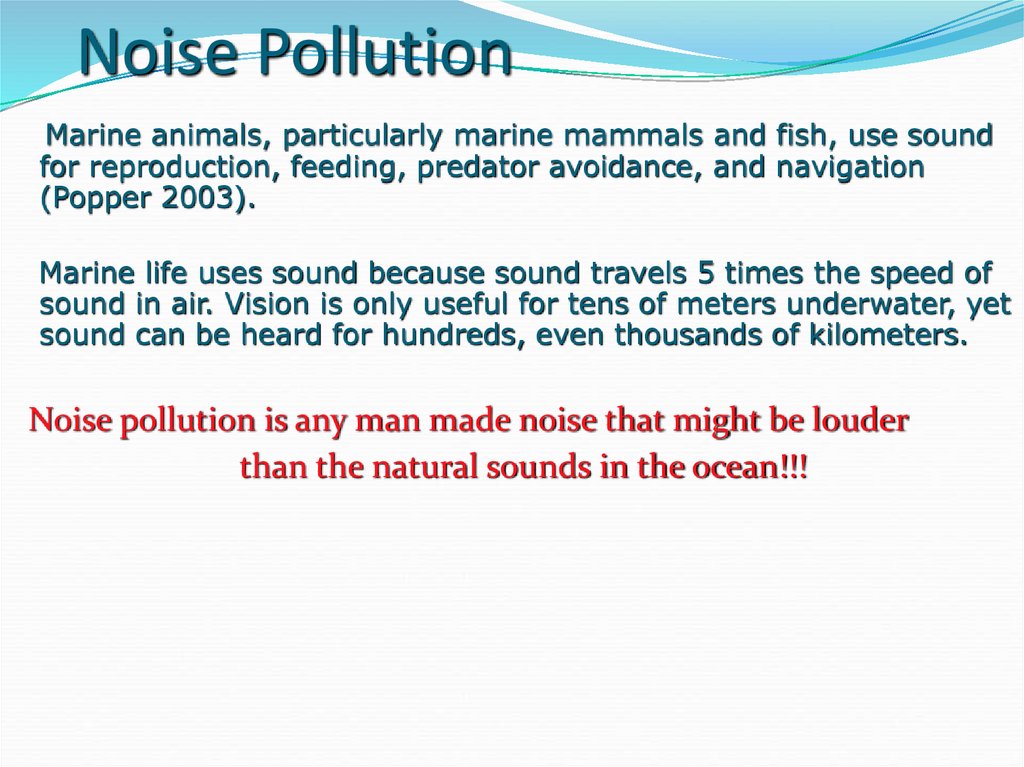
20. Noise Pollution
Marine animals, particularly marine mammals and fish, use soundfor reproduction, feeding, predator avoidance, and navigation
(Popper 2003).
Marine life uses sound because sound travels 5 times the speed of
sound in air. Vision is only useful for tens of meters underwater, yet
sound can be heard for hundreds, even thousands of kilometers.
Noise pollution is any man made noise that might be louder
than the natural sounds in the ocean!!!
21. Volume Levels of Sounds in the Ocean
NaturalWind and waves 85 dB
Man Made
Large tanker ships 177 dB
continuous noise on shipping pathways
all over the world
Earthquake 95-135 dB
Harp seal call 130 - 140 dB
Icebreaker ships 183 dB
cycling noise primarily in Arctic Ocean,
north of Canada, Alaska, and Russia
Bottlenose dolphin 150 dB
Humpback whale moan 175 dBLow frequency sonar 235 dB
Gray whale moan 185 dB
Continuous pulses of sound used to find
navy ships and submarines
Seismic oil exploration 210 dB
Sounds above 90 dB can damage the
human ear
http://scicom.ucsc.edu/SciNotes/9601/O
ceanNoise/Sounds/Humpback.aiff
Low pitched pulses of sound, used to
find oil in ocean areas world-wide
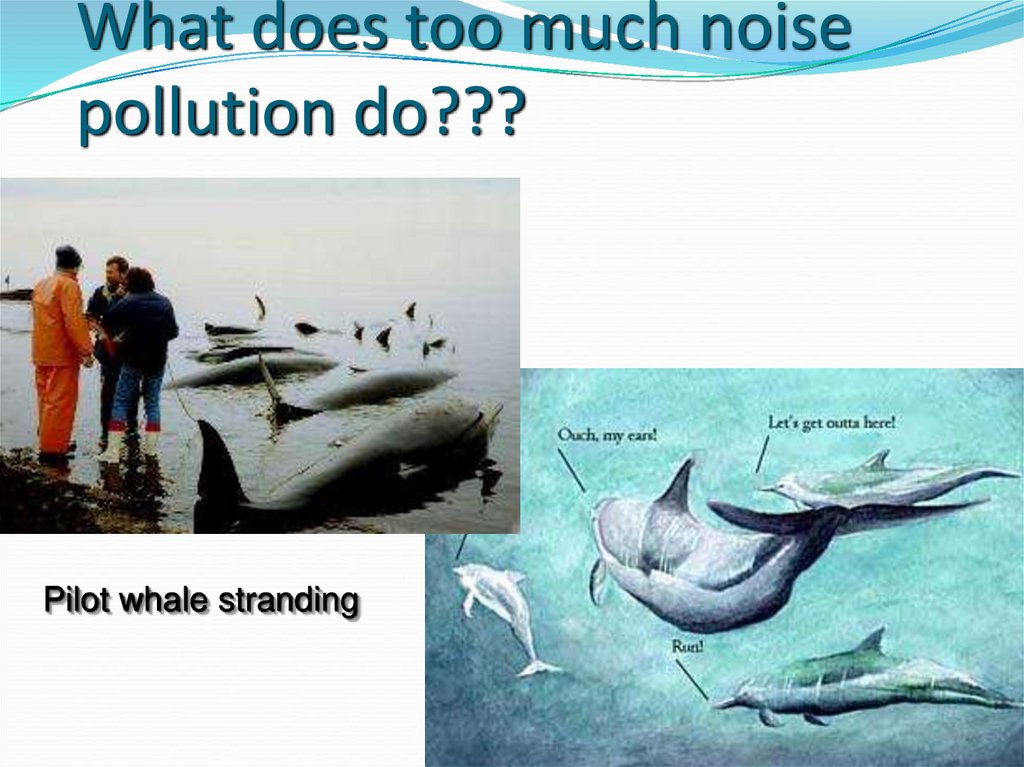
22. What does too much noise pollution do???
Pilot whale stranding23. What is Marine Debris???
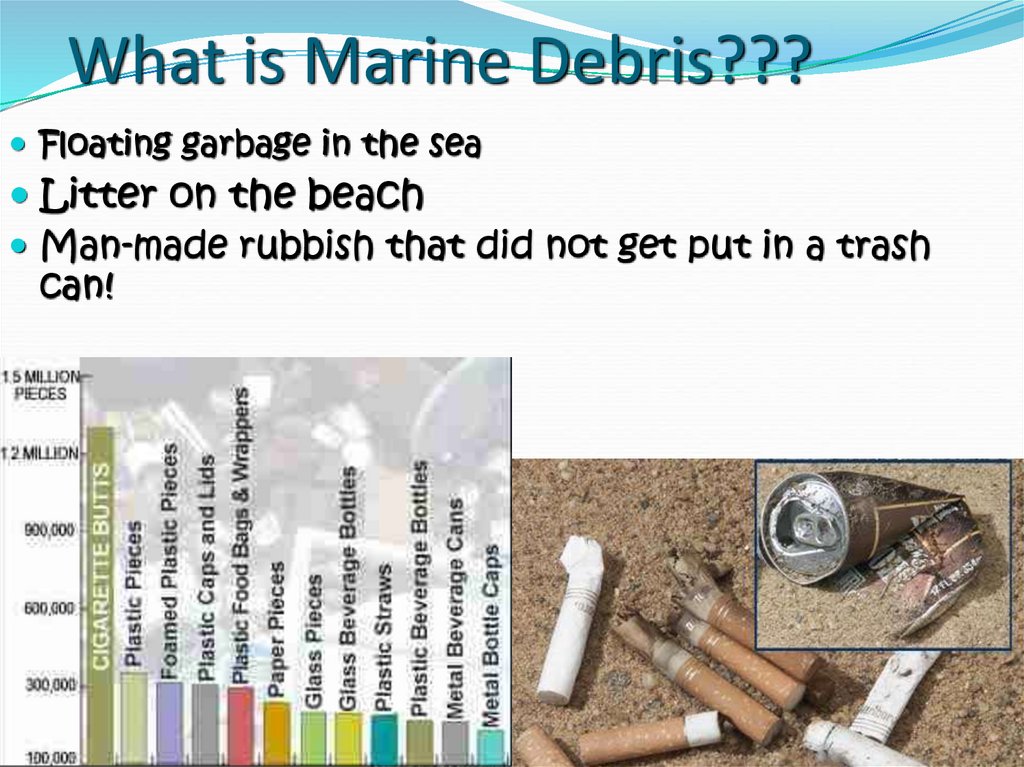
Floating garbage in the seaLitter on the beach
Man-made rubbish that did not get put in a trash
can!
24. Why should we care about Marine Debris
Marine debris is the #1 killer of all ocean life.Millions of ocean animals die every year.
90% of marine debris is plastic
Some plastics may take 450 years to biodegrade
You can make a difference!
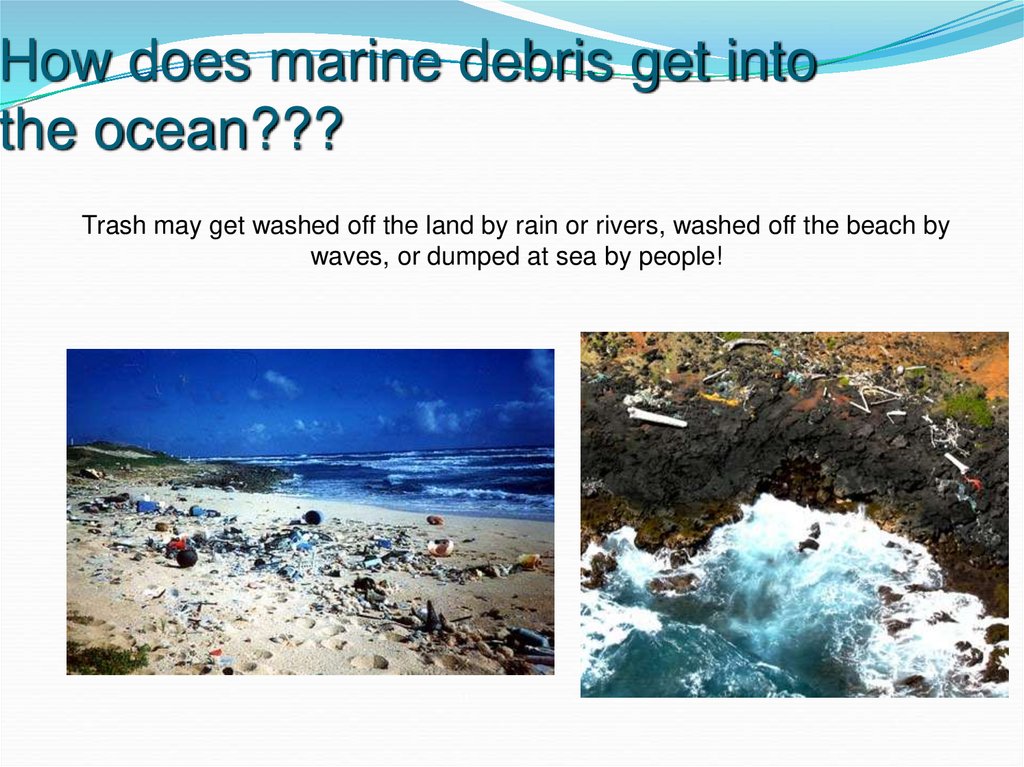
25. How does marine debris get into the ocean???
Trash may get washed off the land by rain or rivers, washed off the beach bywaves, or dumped at sea by people!
26. What does marine debris do to the open ocean environment??
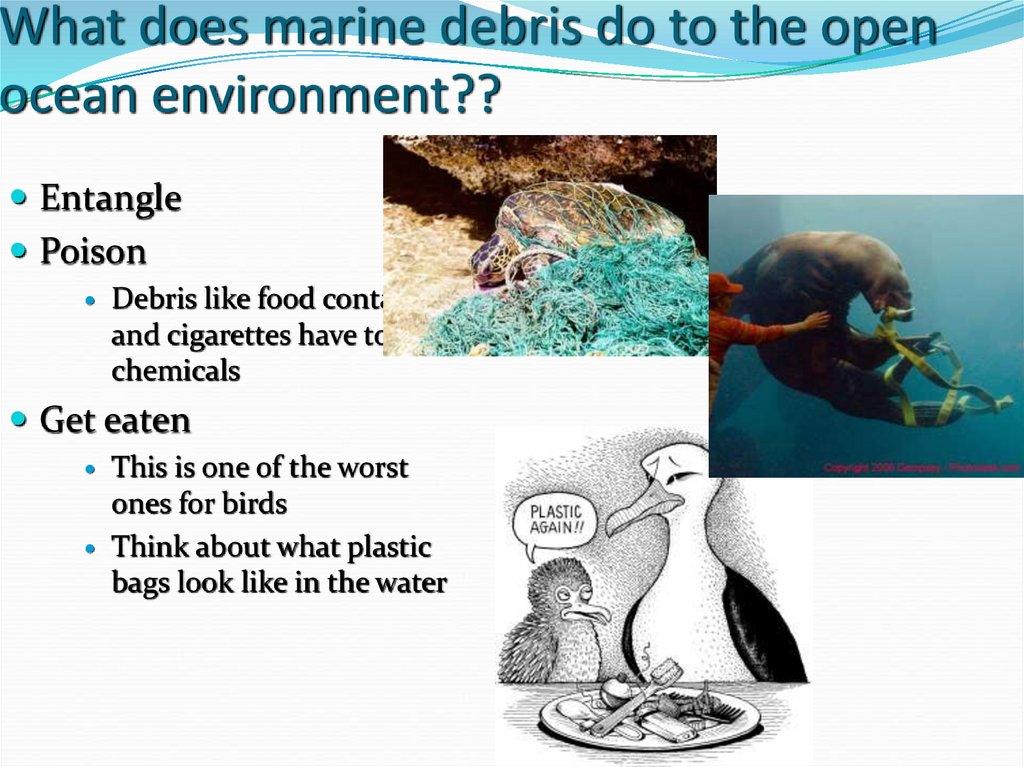
EntanglePoison
Debris like food containers
and cigarettes have toxic
chemicals
Get eaten
This is one of the worst
ones for birds
Think about what plastic
bags look like in the water
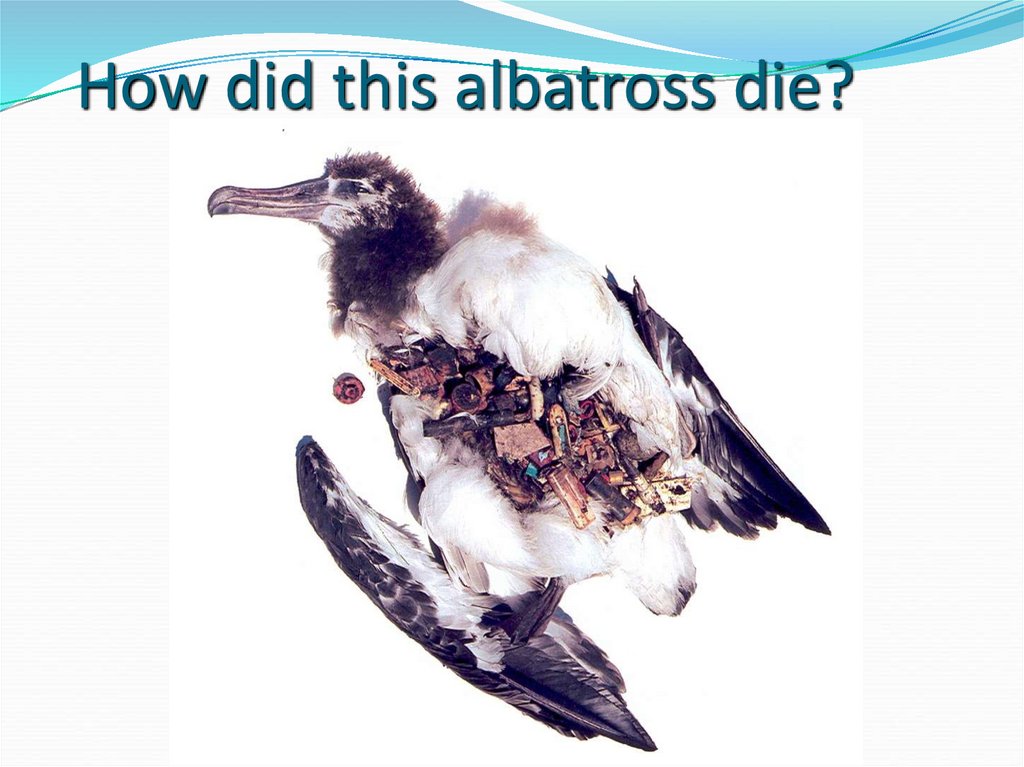
27. How did this albatross die?
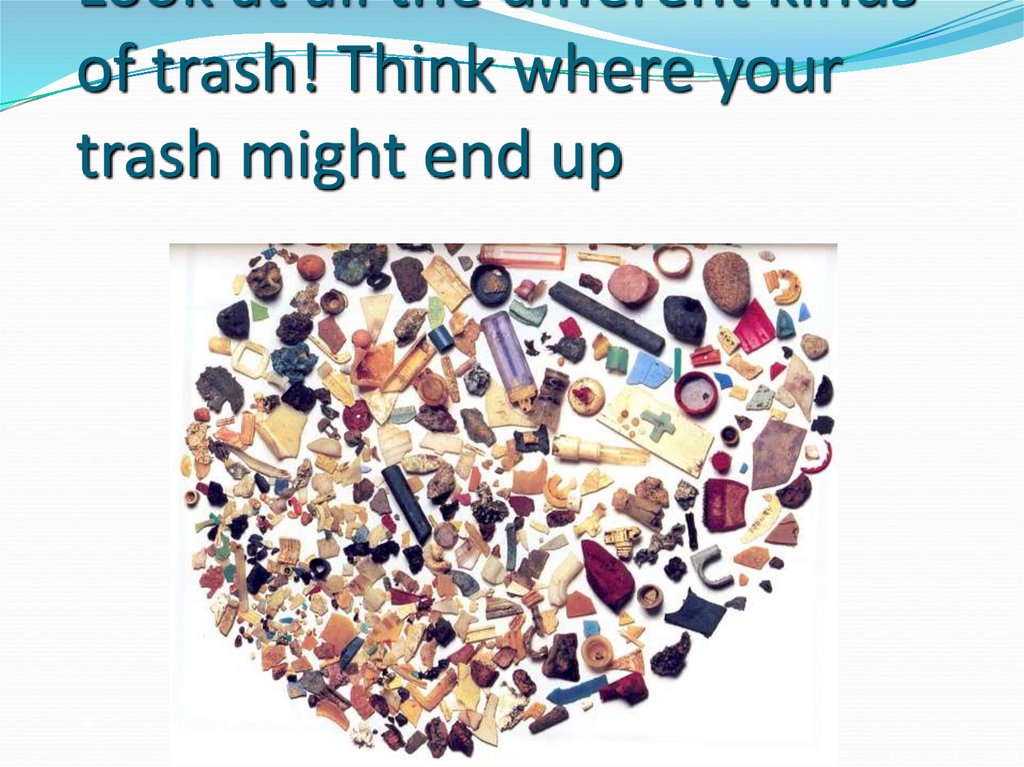
28. Look at all the different kinds of trash! Think where your trash might end up
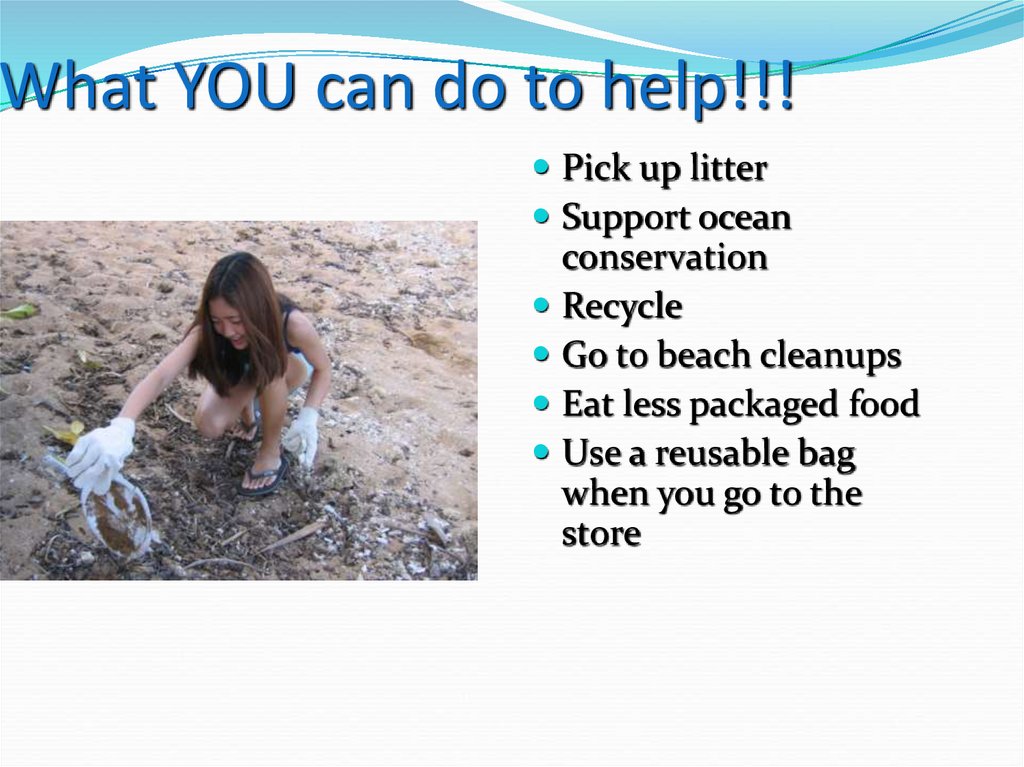
29. What YOU can do to help!!!
Pick up litterSupport ocean
conservation
Recycle
Go to beach cleanups
Eat less packaged food
Use a reusable bag
when you go to the
store
30. Ocean acidification
is occurringnegative impacts climate
negative impacts fisheries
31.
Sybil SeitzingerExecutive Director, IGBP
www.IGBP.net
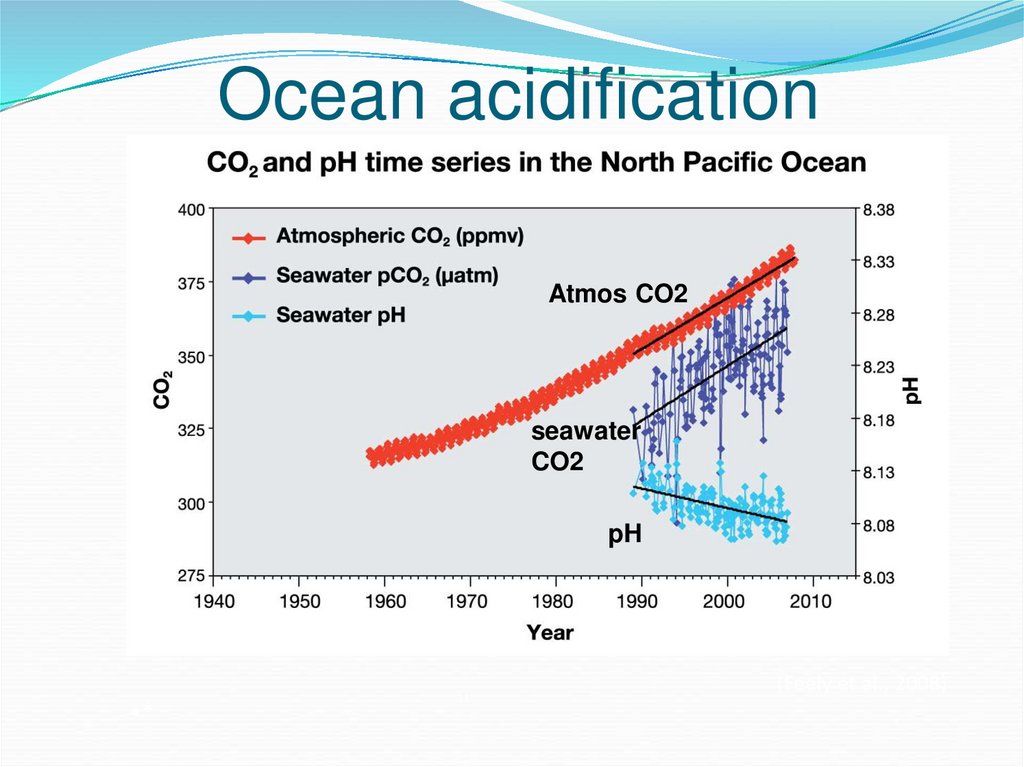
32. Ocean acidification
Atmos CO2seawater
CO2
pH
(Feely et al., 2008)
•*
33. Ocean acidification
• is occurring• negative impacts climate
• negative impacts fisheries
34.
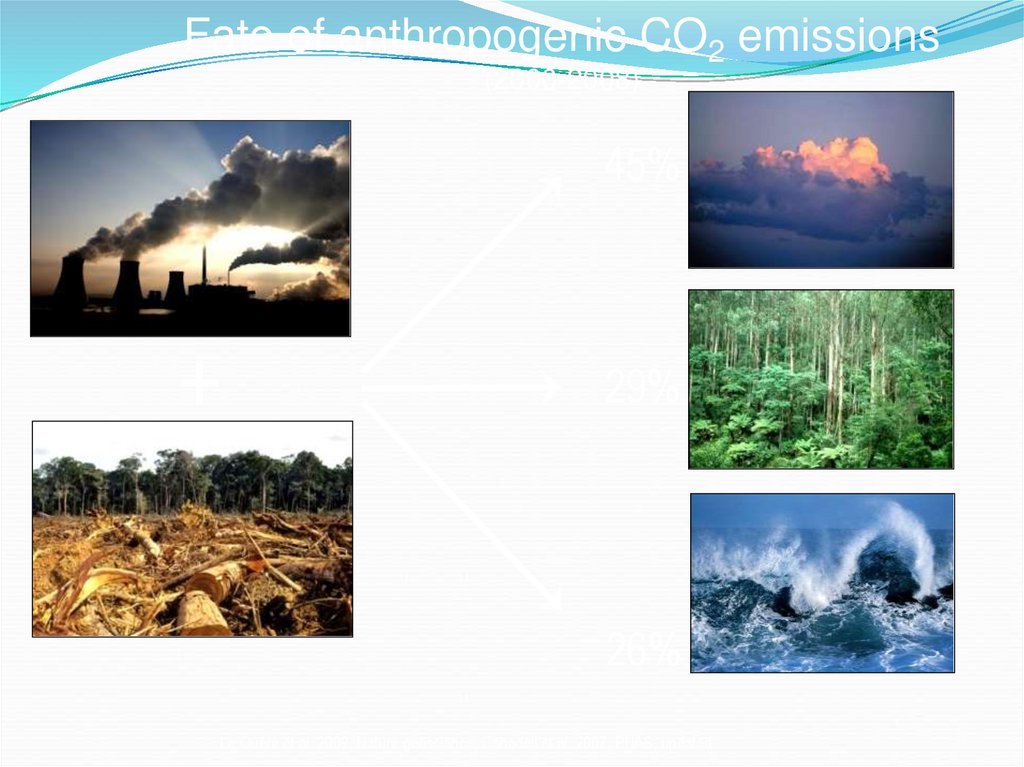
Fate of anthropogenic CO2 emissions(2000-2008)
45%
+
29%
26%
Le Quéré et al. 2009, Nature geoscience; Canadell et al. 2007, PNAS, updated
35. Climate & ocean acidification
Climate & oceanacidification
CO2 dissolves sw
decreases with
pH
36. Climate & ocean acidification
Climate & oceanacidification
• CO2 dissolves sw
• decreases with
pH
• Organisms remove CO2
• make biomass
• calcium carbonate shells
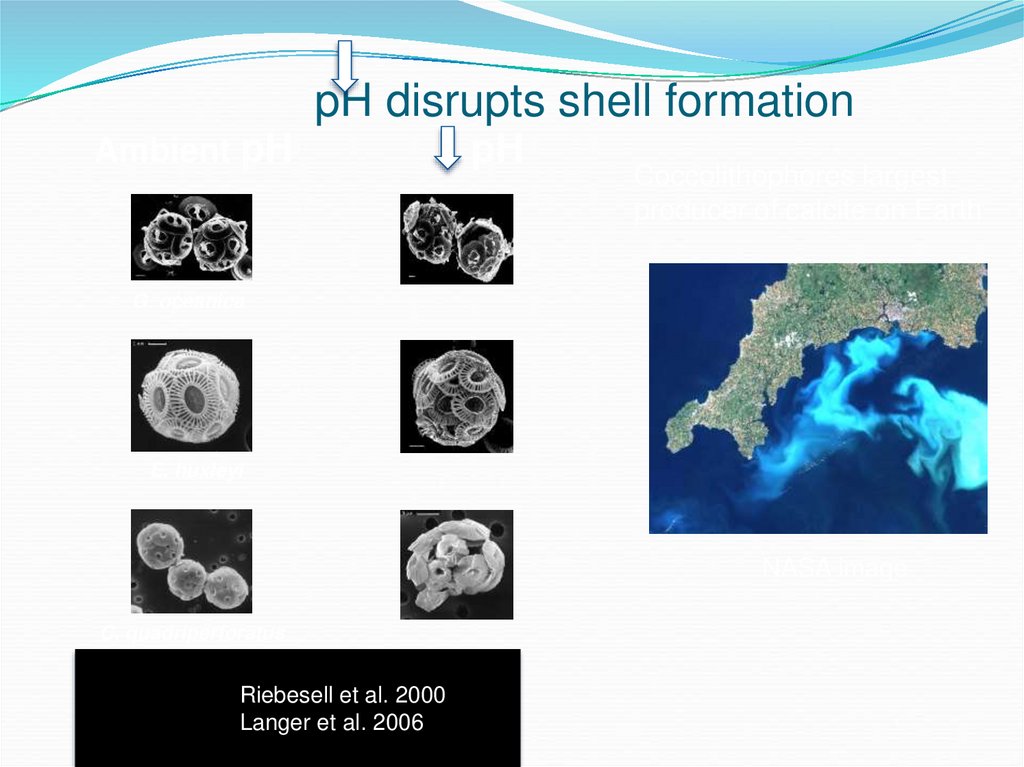
37. Coccolithophores
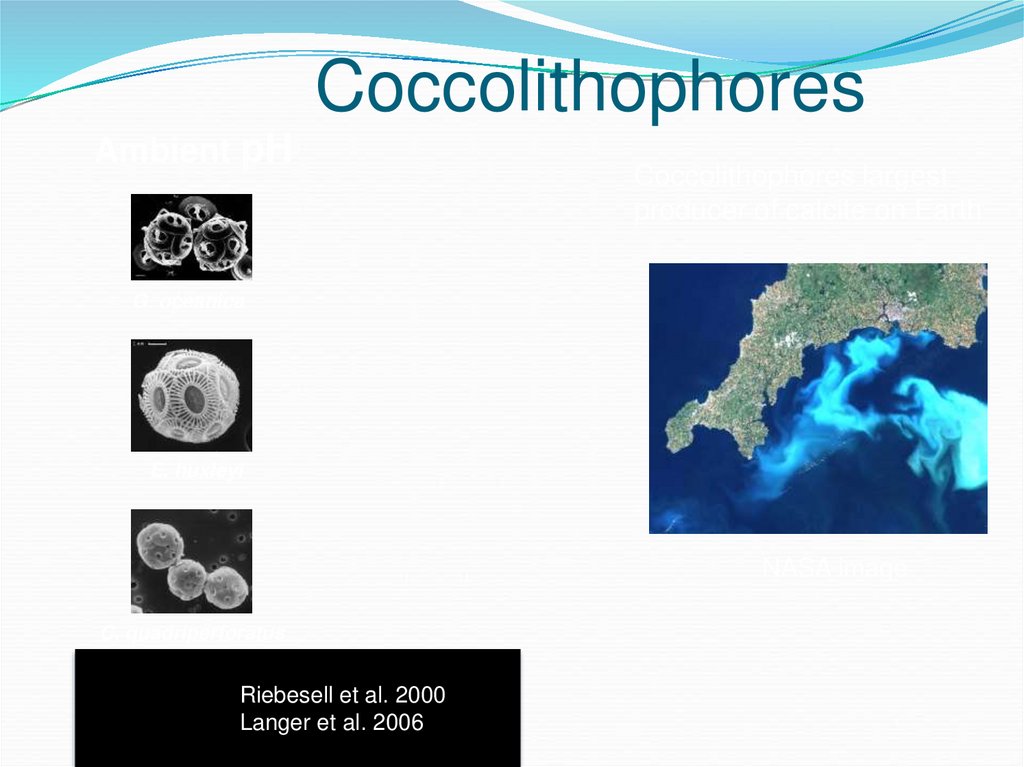
Ambient pHCoccolithophores largest
producer of calcite on Earth
G. oceanica
E. huxleyi
NASA image
C. quadriperforatus
Riebesell et al. 2000
Langer et al. 2006
38. pH disrupts shell formation
Ambient pHpH
Coccolithophores largest
producer of calcite on Earth
G. oceanica
E. huxleyi
NASA image
C. quadriperforatus
Riebesell et al. 2000
Langer et al. 2006
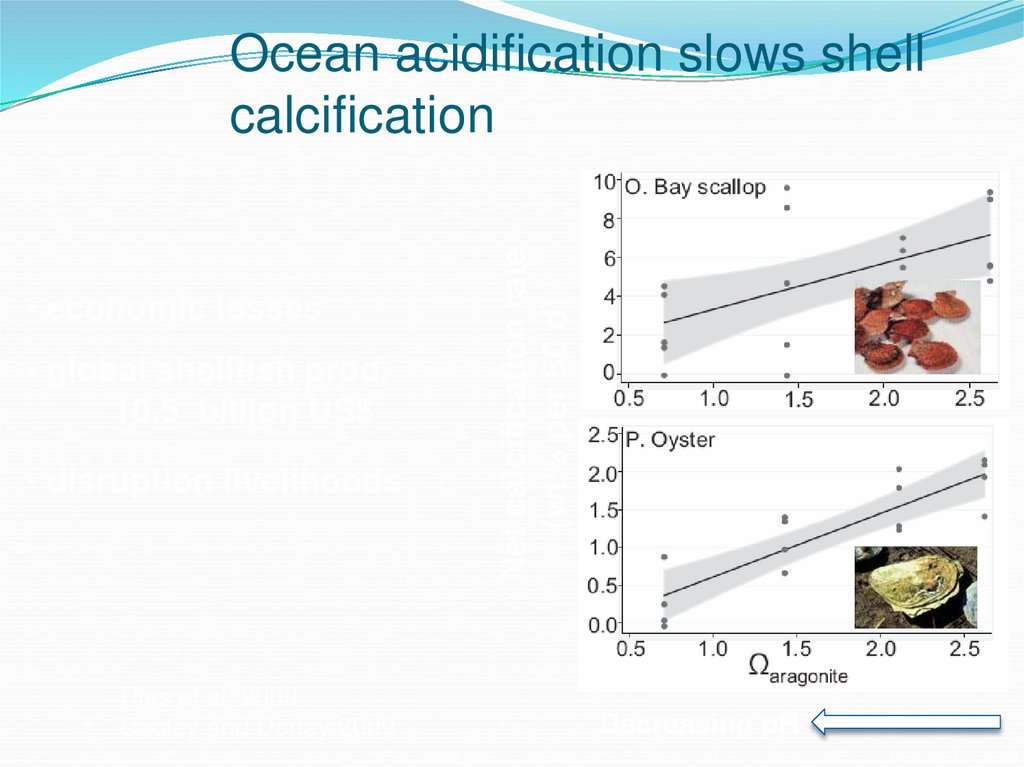
39. Ocean acidification slows shell calcification
• economic losses• global shellfish prod.
10.5 billion US$
• disruption livelihoods
Ries et al. 2009
Cooley and Doney 2009
Net calcification rate
(wt% per 60 d)
Ocean acidification slows shell
calcification
Decreasing pH
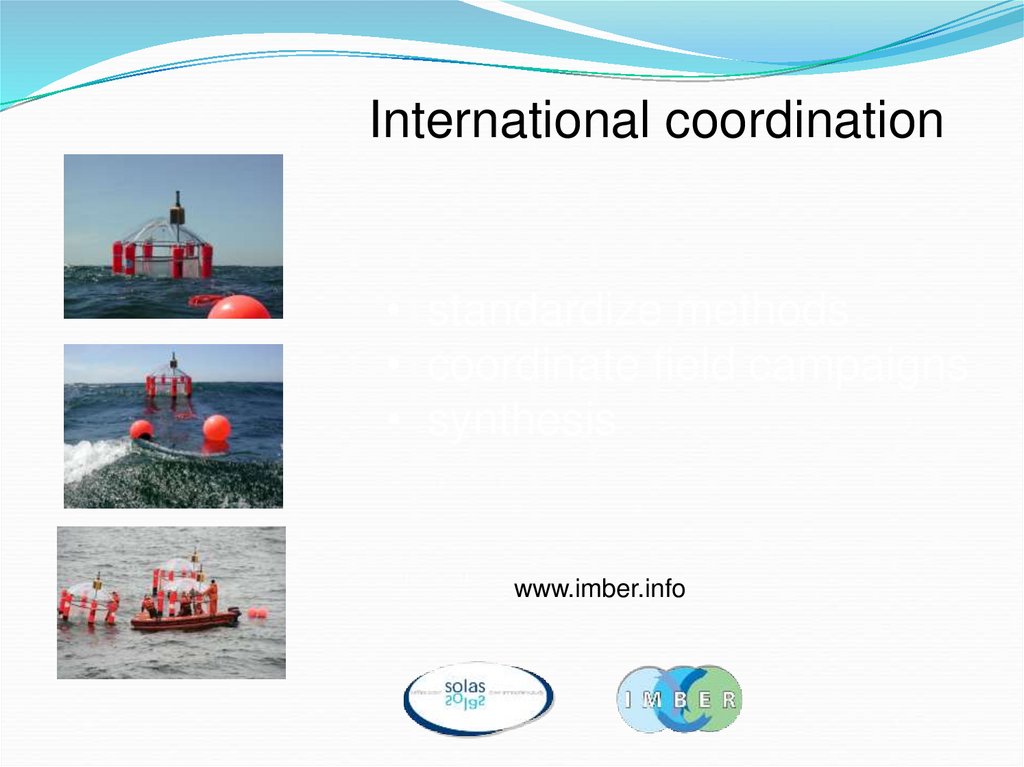
40.
International coordination• standardize methods
• coordinate field campaigns
• synthesis
www.imber.info