
 industry
Similar presentations:








Production process
1. Production Process
CHAPTERProduction Process
ESSENTIALS OF
Economics
Teacher: Yerlan Iskanderov
© 2009 South-Western, a part of Cengage Learning, all rights reserved
2. Lesson Objectives
To define the main stages of theproduction process
processing, output).
To
understand
production.
the
(e.g.,
input,
stages
of
To differentiate types of production
processes.
2
3. What production processes are?
is a methodA production process
businesses use to convert economic
inputs like labor, equipment, or land
into goods
and
services for
consumers. This process focuses on
manufacturing products efficiently
and delivering them to customers
quickly while maintaining product
quality.
3
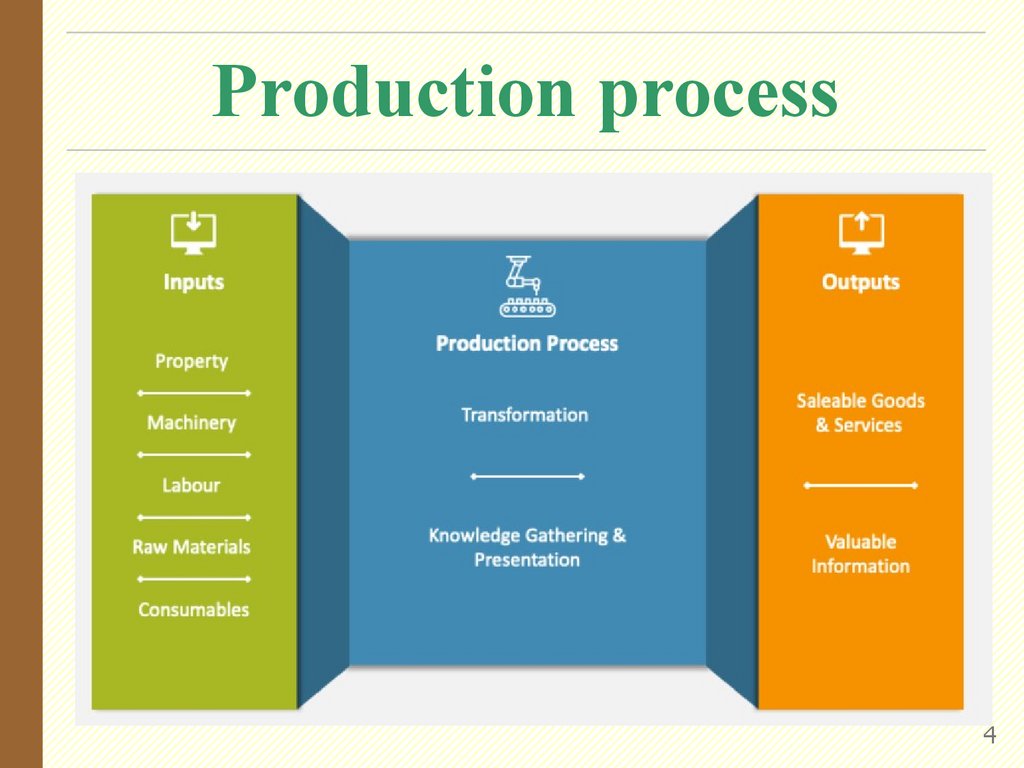
4. Production process
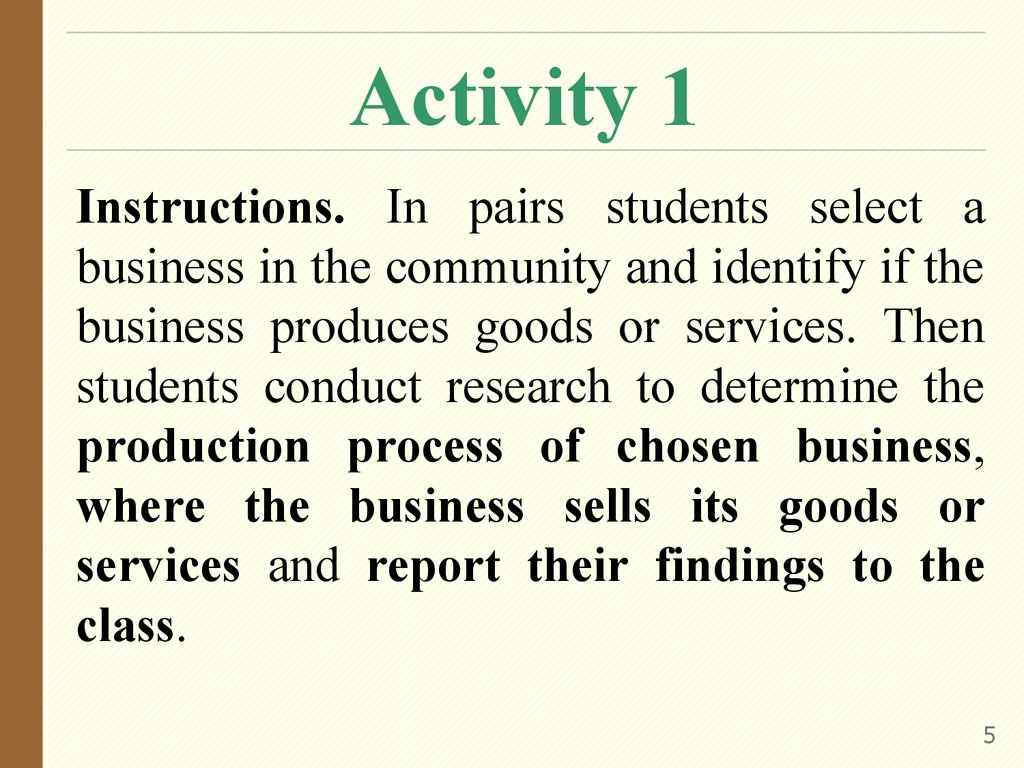
45. Activity 1
Instructions. In pairs students select abusiness in the community and identify if the
business produces goods or services. Then
students conduct research to determine the
production process of chosen business,
where the business sells its goods or
services and report their findings to the
class.
5
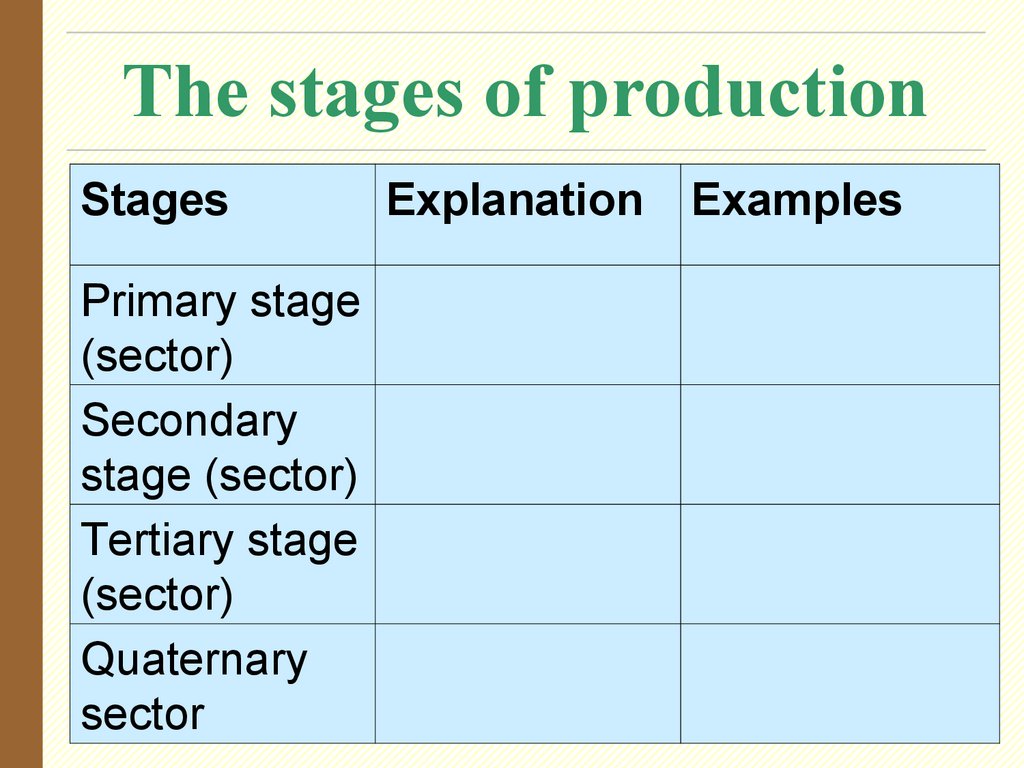
6. The stages of production
StagesPrimary stage
(sector)
Secondary
stage (sector)
Tertiary stage
(sector)
Quaternary
sector
Explanation
Examples
6
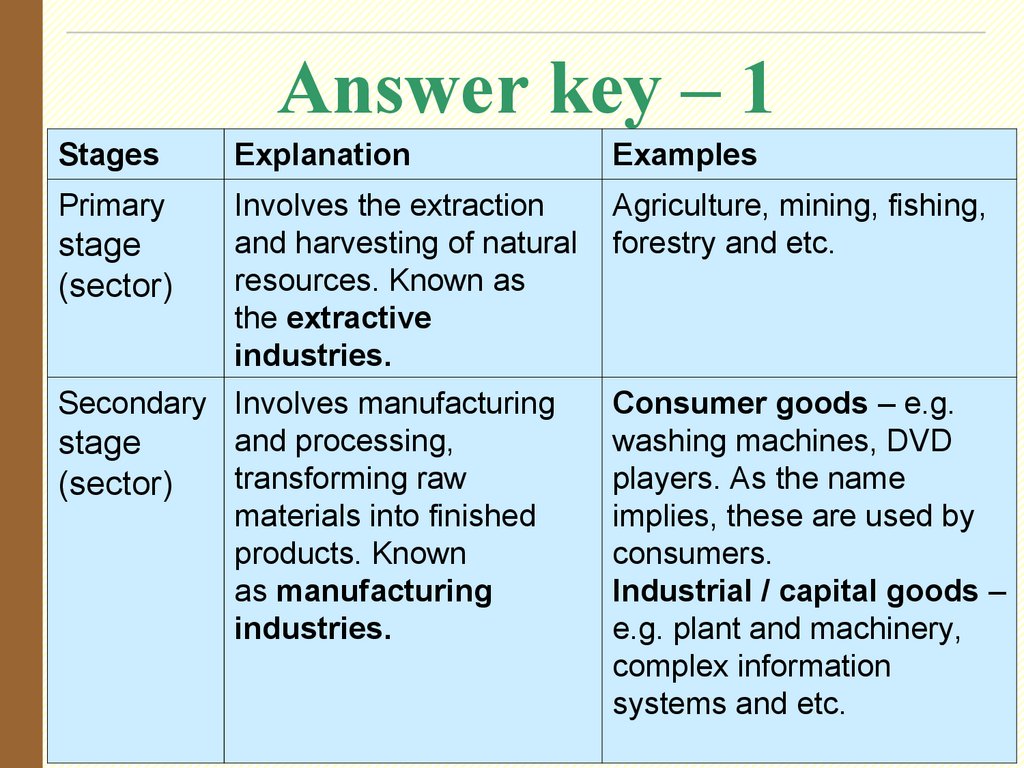
7. Answer key – 1
StagesExplanation
Examples
Primary
Involves the extraction
and harvesting of natural
resources. Known as
the extractive
industries.
Agriculture, mining, fishing,
forestry and etc.
stage
(sector)
Secondary Involves manufacturing
and processing,
stage
transforming raw
(sector)
materials into finished
products. Known
as manufacturing
industries.
Consumer goods – e.g.
washing machines, DVD
players. As the name
implies, these are used by
consumers.
Industrial / capital goods –
e.g. plant and machinery,
complex information
systems and etc.
7
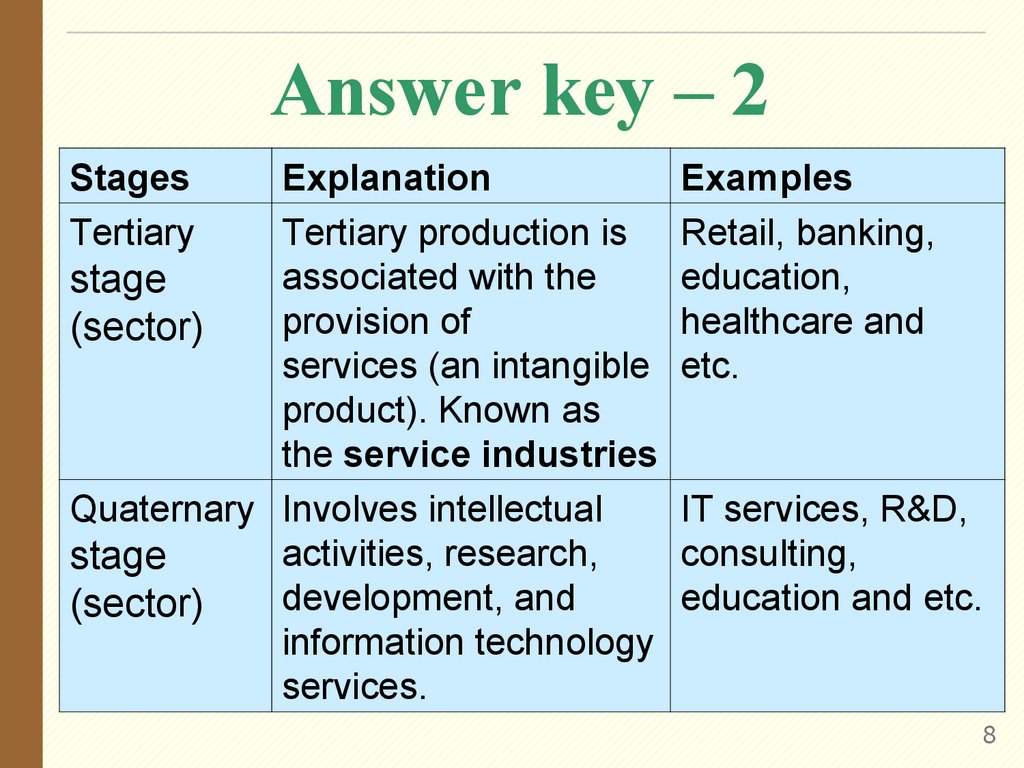
8. Answer key – 2
StagesTertiary
Explanation
Examples
Tertiary production is Retail, banking,
associated with the
education,
stage
provision of
healthcare and
(sector)
services (an intangible etc.
product). Known as
the service industries
Quaternary Involves intellectual
IT services, R&D,
activities, research,
consulting,
stage
development, and
education and etc.
(sector)
information technology
services.
8
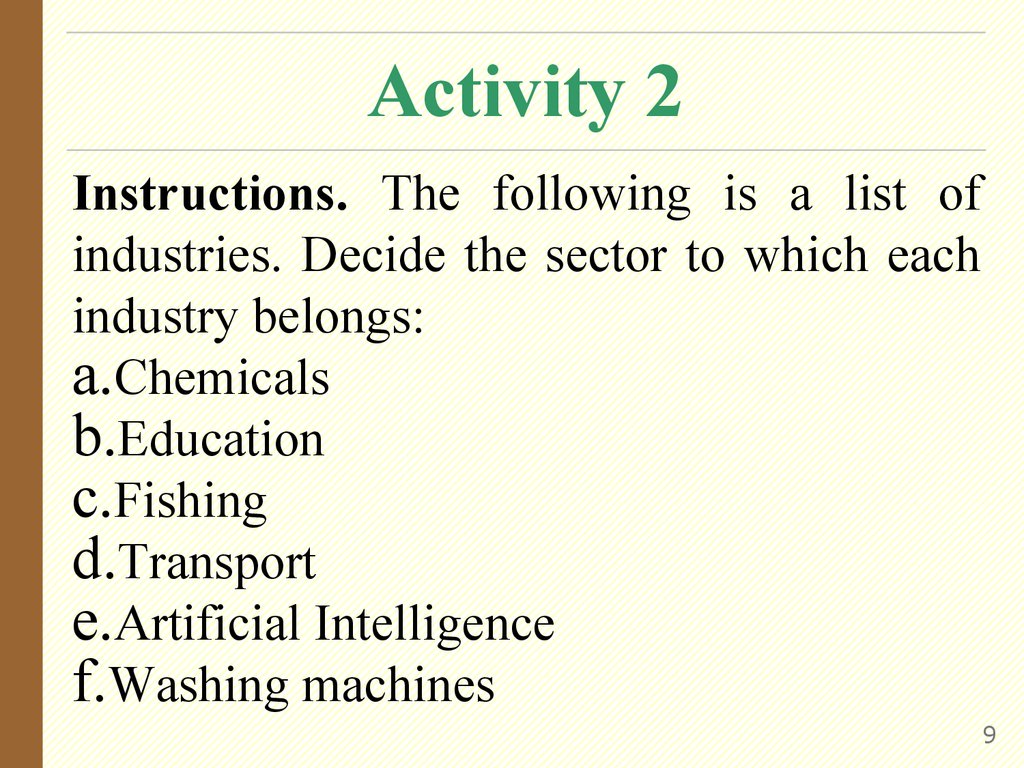
9. Activity 2
Instructions. The following is a list ofindustries. Decide the sector to which each
industry belongs:
a.Chemicals
b.Education
c.Fishing
d.Transport
e.Artificial Intelligence
f.Washing machines
9
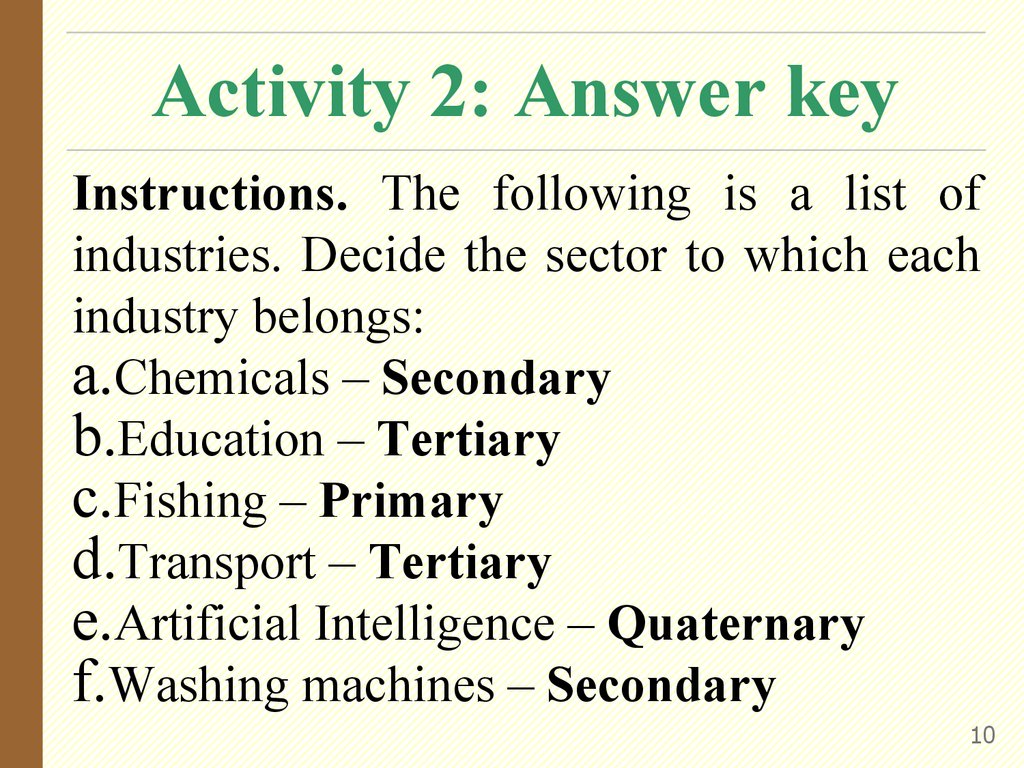
10. Activity 2: Answer key
Instructions. The following is a list ofindustries. Decide the sector to which each
industry belongs:
a.Chemicals – Secondary
b.Education – Tertiary
c.Fishing – Primary
d.Transport – Tertiary
e.Artificial Intelligence – Quaternary
f.Washing machines – Secondary
10
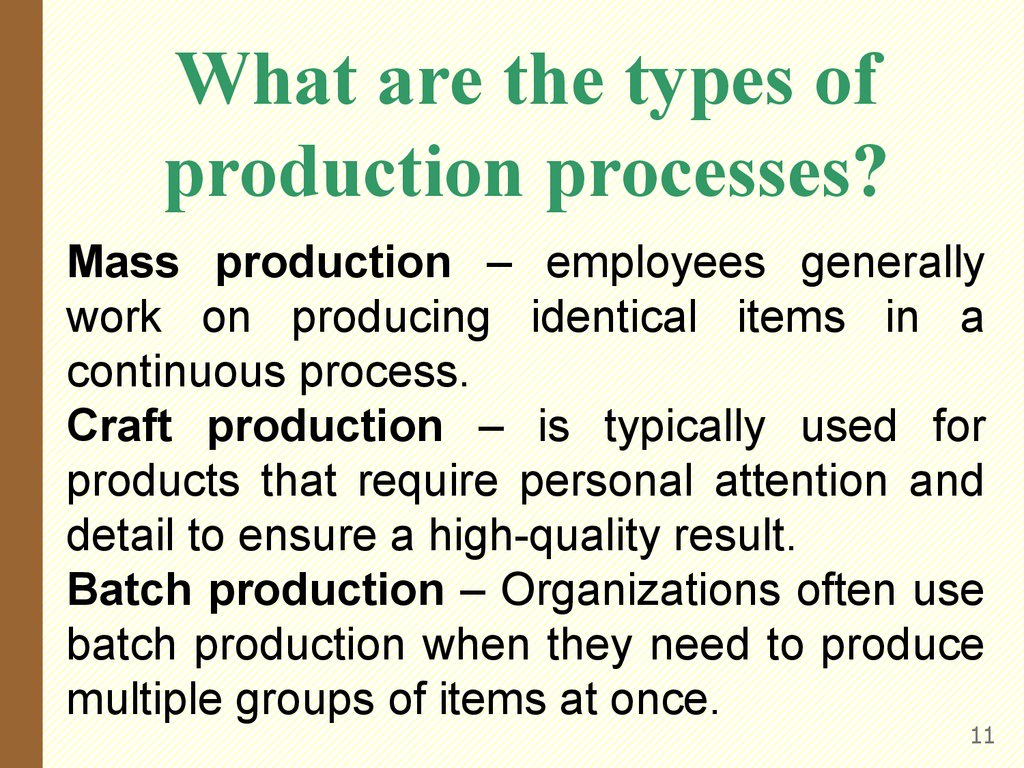
11. What are the types of production processes?
Mass production – employees generallywork on producing identical items in a
continuous process.
Craft production – is typically used for
products that require personal attention and
detail to ensure a high-quality result.
Batch production – Organizations often use
batch production when they need to produce
multiple groups of items at once.
11
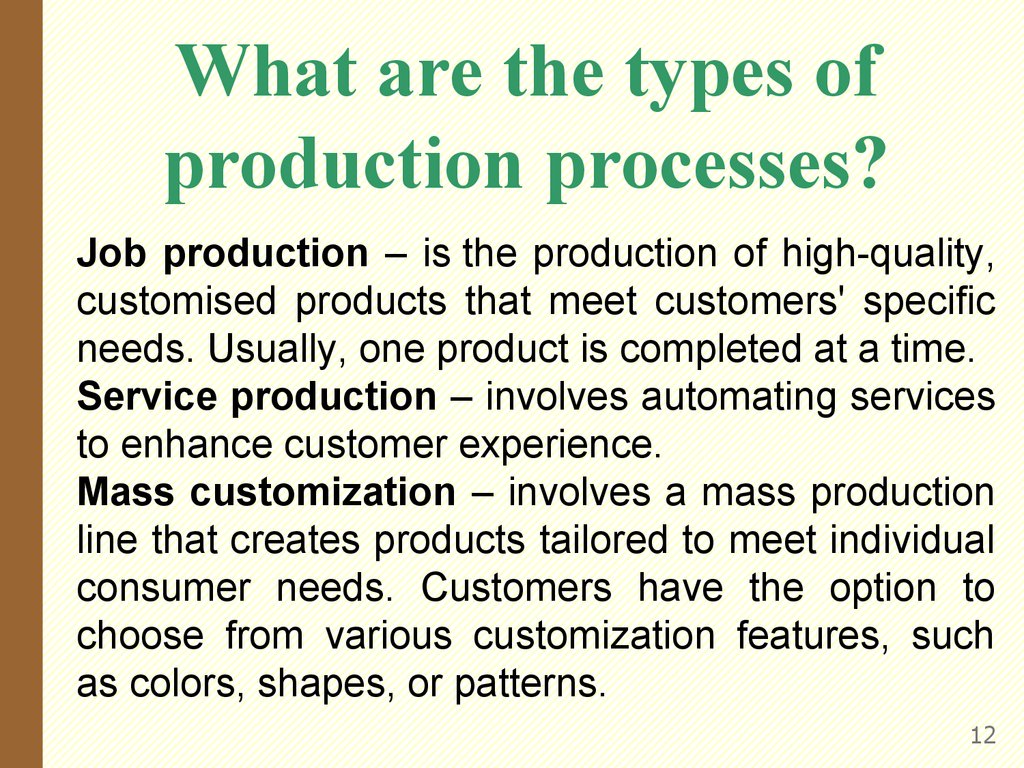
12. What are the types of production processes?
Job production – is the production of high-quality,customised products that meet customers' specific
needs. Usually, one product is completed at a time.
Service production – involves automating services
to enhance customer experience.
Mass customization – involves a mass production
line that creates products tailored to meet individual
consumer needs. Customers have the option to
choose from various customization features, such
as colors, shapes, or patterns.
12
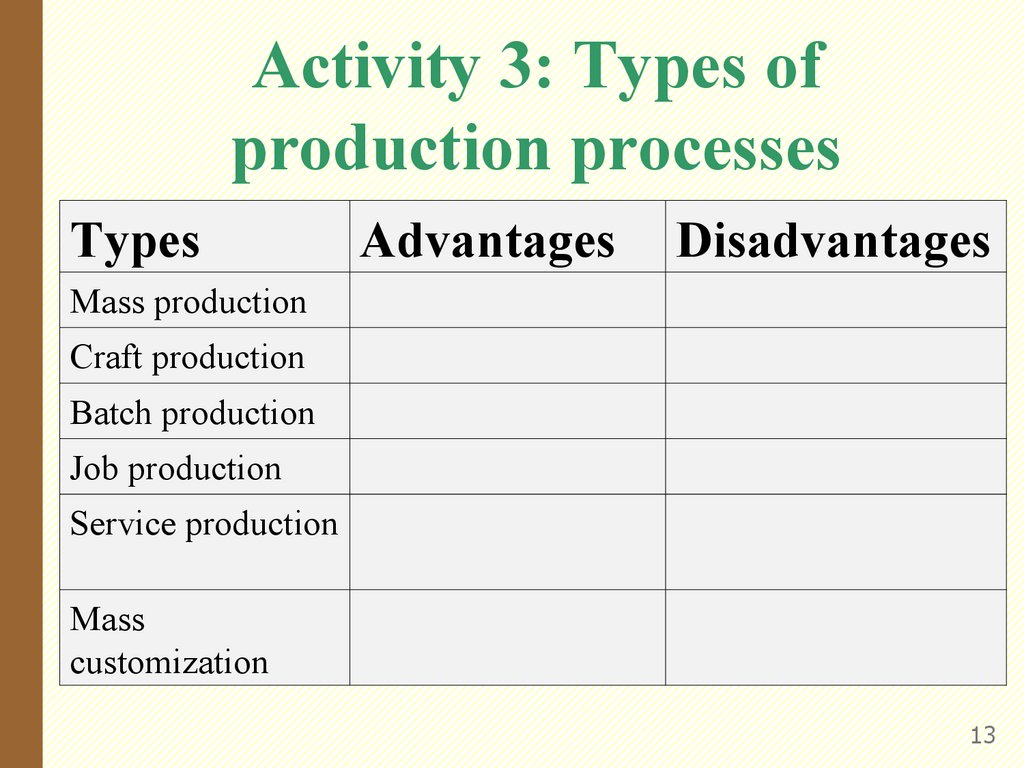
13. Activity 3: Types of production processes
TypesAdvantages
Disadvantages
Mass production
Craft production
Batch production
Job production
Service production
Mass
customization
13
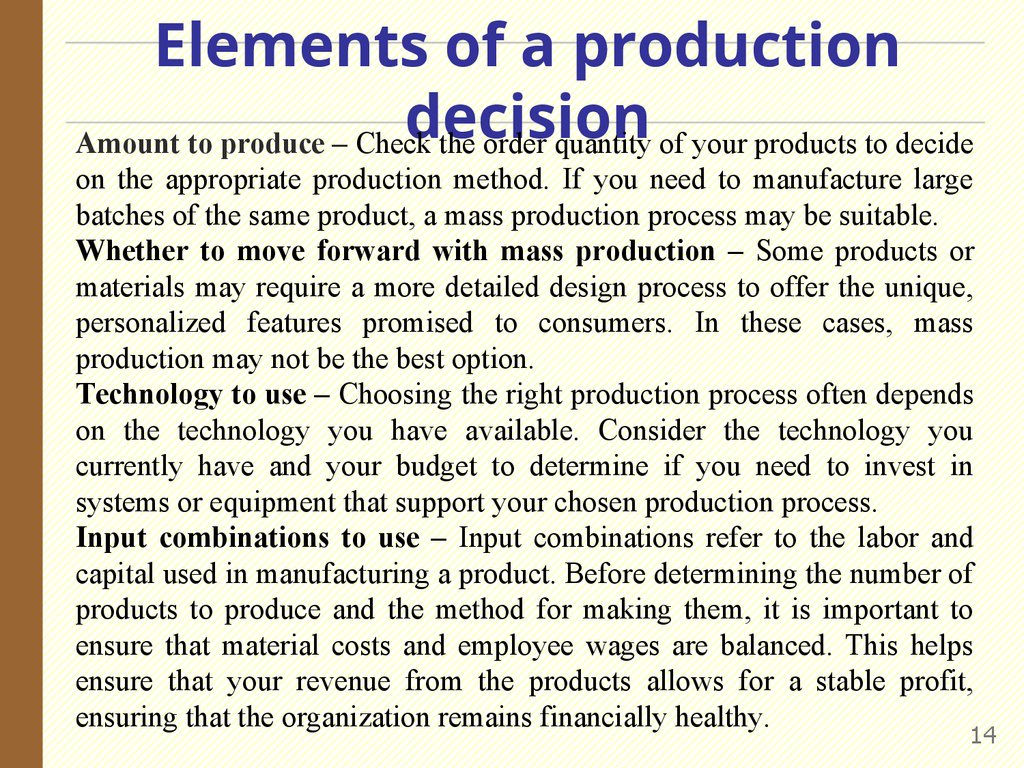
14. Elements of a production decision
Amount to produce – Checkthe order quantity of your products to decide
on the appropriate production method. If you need to manufacture large
batches of the same product, a mass production process may be suitable.
Whether to move forward with mass production – Some products or
materials may require a more detailed design process to offer the unique,
personalized features promised to consumers. In these cases, mass
production may not be the best option.
Technology to use – Choosing the right production process often depends
on the technology you have available. Consider the technology you
currently have and your budget to determine if you need to invest in
systems or equipment that support your chosen production process.
Input combinations to use – Input combinations refer to the labor and
capital used in manufacturing a product. Before determining the number of
products to produce and the method for making them, it is important to
ensure that material costs and employee wages are balanced. This helps
ensure that your revenue from the products allows for a stable profit,
ensuring that the organization remains financially healthy.
14
15. REFLECTION
1. What were the key concepts or ideasintroduced in today’s lesson?
2. How might you apply what you learned
today in real-world situations or future
studies?
3. If you were to explain today’s lesson to
someone else, what would you focus on to
help them understand it?
15