 english
Similar presentations:




PPP to Lecture 6 and 7 Lexical SDs and EM part 3 and Syntactical SDs and EMs
1.
ClicheA cliche is generally defined
as an expression that has
become hackneyed and
trite.
Examples of real cliches
are 'rosy dreams of youth',
'the patter of little feet',
2. Cliche
But most of the widelyrecognized wordcombinations which have
been adopted by the
language are unjustly
classified as cliches.
3. Cliche
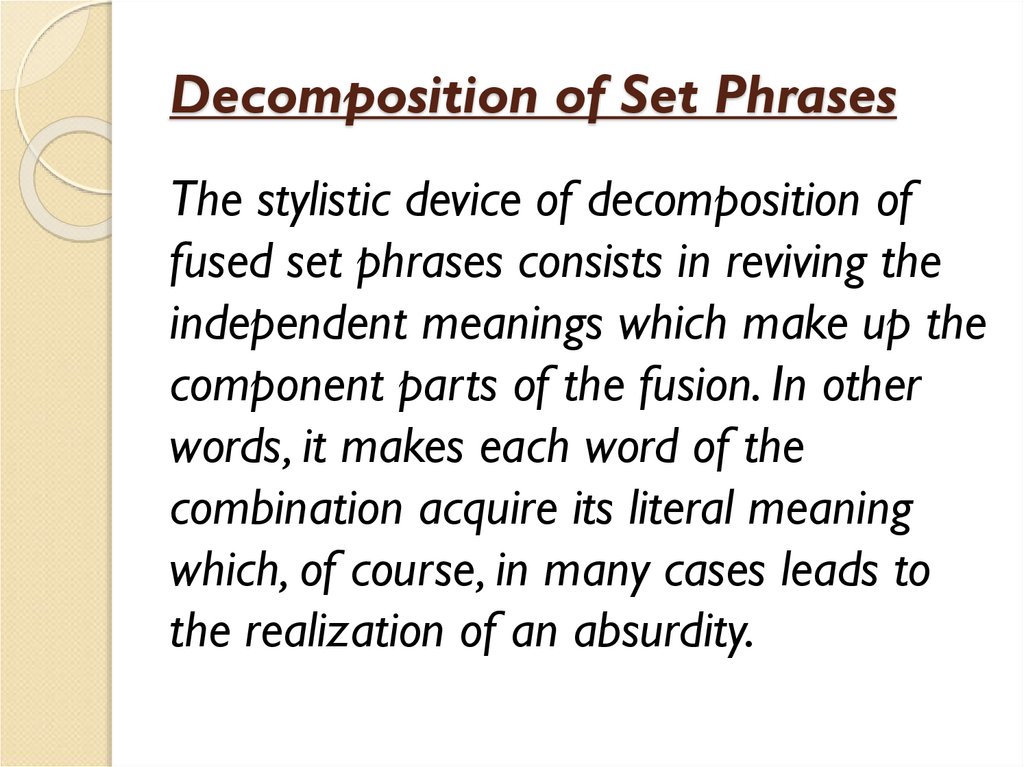
What is familiar should not be givena derogatory label.
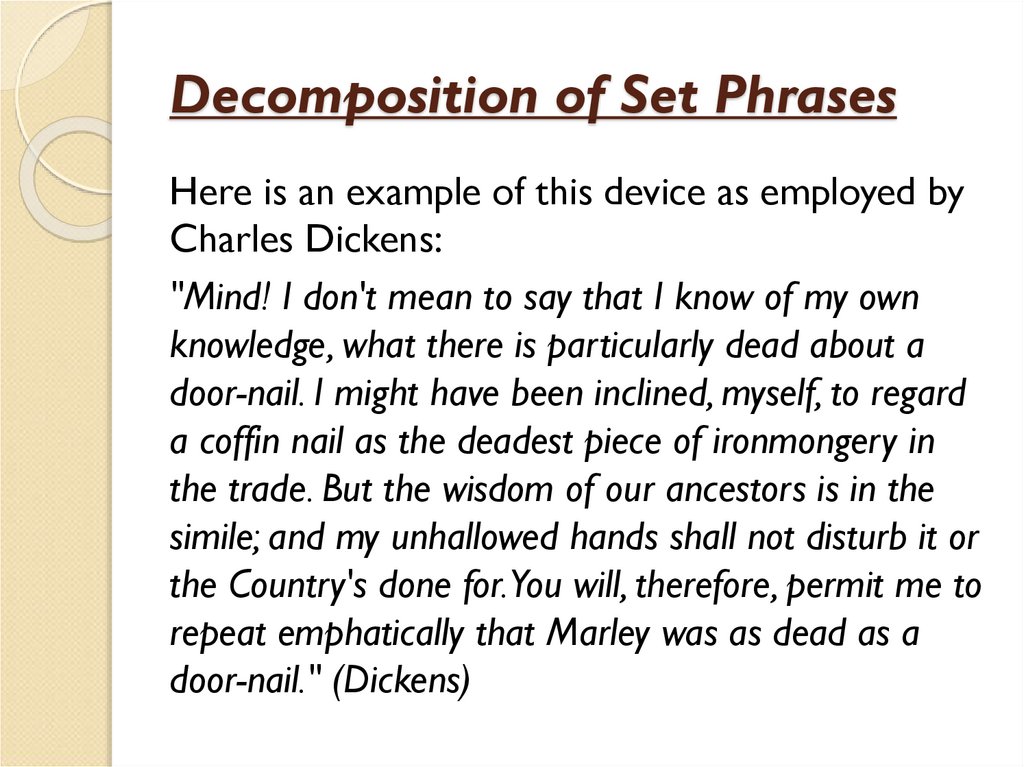
The set expressions of a language
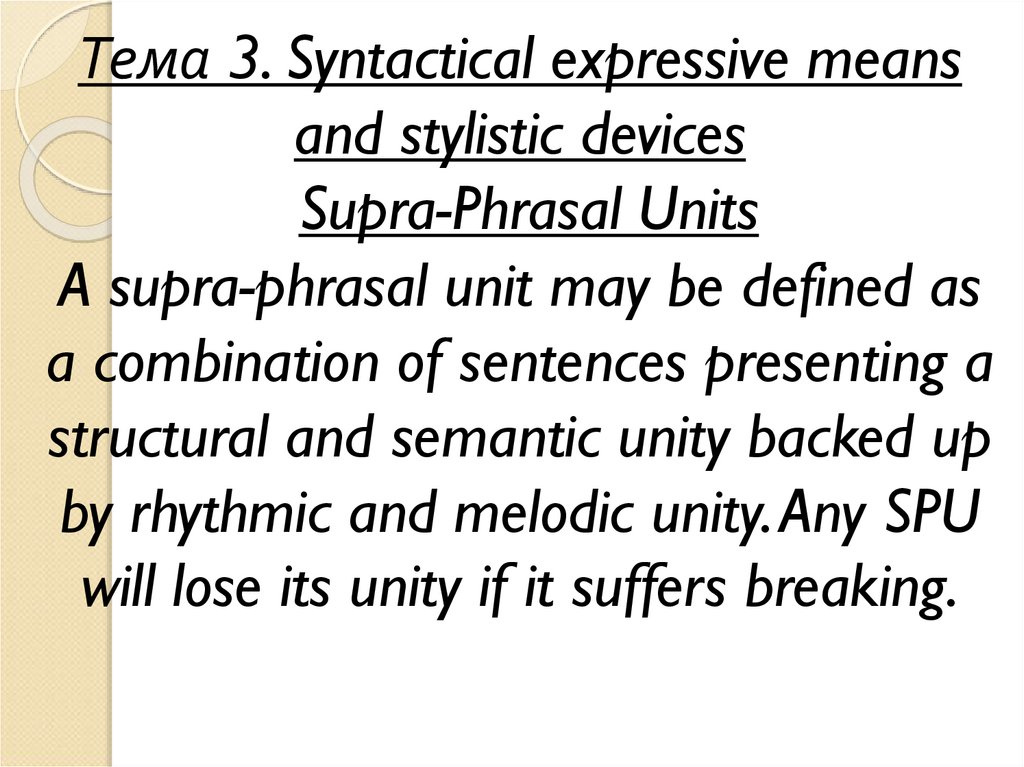
are 'part and parcel' of the
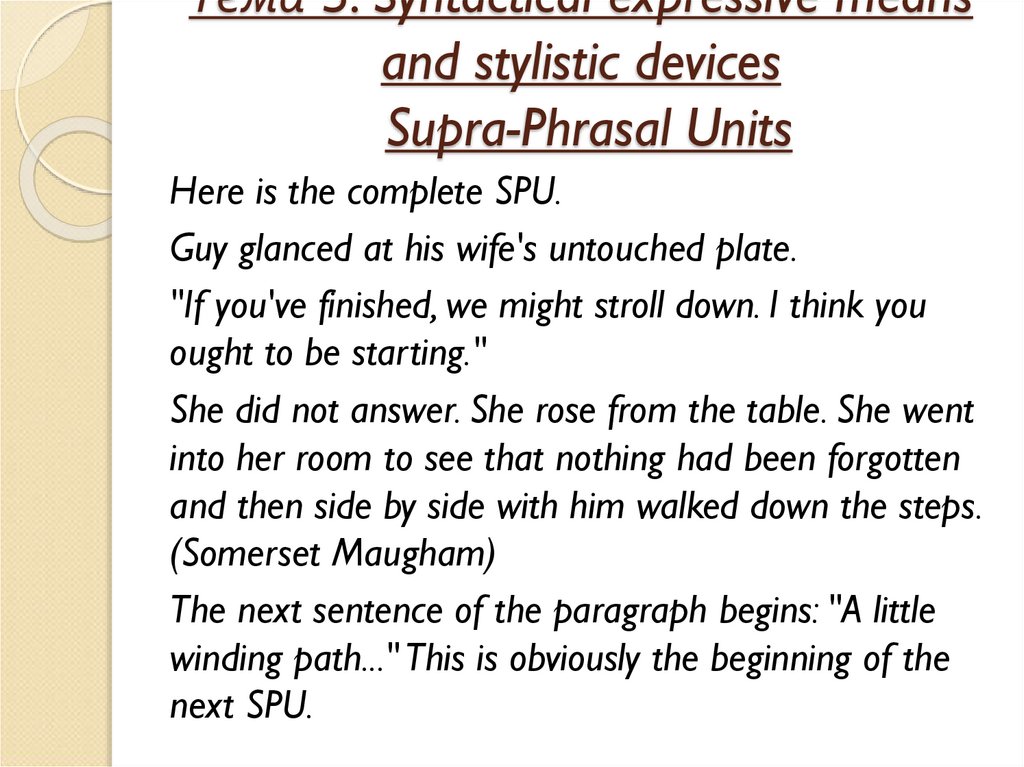
vocabulary of the language and
cannot be dispensed with by merely
labelling them cliches.
4. Proverbs and Sayings
A proverb or a saying is a peculiarmode of utterance which is mainly
characterized by its brevity.The
utterance itself, taken at its face
value, presents a pattern which
can be successfully used for other
utterances.
5.
The peculiarity of the use of aproverb lies in the fact that the
actual wording becomes a
pattern which needs no new
wording to suggest extensions
of
meaning
which
are
contextual.
6. Proverbs and Sayings
The main feature distinguishingproverbs and sayings from ordinary
utterances remains their semantic
aspect.
Their literal meaning is suppressed
by what may be termed their
transferred meaning.
7. Epigram
An epigram is a stylistic deviceakin to a proverb, the only
difference being that epigrams are
coined by individuals whose names
we know, while proverbs are the
coinage of the people.
8. Epigram
In other words, we are always awareof the parentage of an epigram and
therefore, when using one, we usually
make a reference to its author.
e.g."A God that can be understood is
no God."
9. Epigram
Epigrams possess a great degreeof independence and therefore, if
taken out of the context, will retain
the wholeness of the idea they
express. They have a generalizing
function and are self-sufficient.
10. Epigram
The most characteristic feature of anepigram is that the sentence gets
accepted as a word-combination and
often becomes part of the language
as a whole. Like proverbs, epigrams
can be expanded to apply to abstract
notions.
11. Quotations
A quotation is a repetition of aphrase or statement from a
book, speech and the like used
by way of authority, illustration,
proof or as a basis for further
speculation on the matter in
hand.
12. Quotations
Quotations are usuallymarked off in the text by
inverted commas (" "),
dashes (—), italics or other
graphical means.
13. Quotations
They are mostly usedaccompanied by a reference
to the author of the
quotation, unless he is well
known to the reader or
audience.
14. Quotations
The reference is made either in the text orin a foot-note and assumes various forms,
as, for instance:
"as (so and so) has it"; "(So and so) once
said that"...; "Here we quote (so and
so)" or in the manner the reference to
Emerson has been made in the epigraph
to this chapter.
15. Allusion
Allusion is a brief and indirect referenceto a person, place, thing or idea of
historical, cultural, literary or political
significance. It does not describe in
detail the person or thing to which it
refers.
It is just a passing comment and the
writer expects the reader to possess
enough knowledge to spot the allusion
and grasp its importance in a text.
16. Allusion
For instance, you make a literaryallusion the moment you say, “I
do
not
approve
of
this quixotic idea,” Quixotic
means stupid and impractical
derived from Cervantes’s “Don
Quixote”, a story of a foolish
knight and his misadventures.
17. Decomposition of Set Phrases
The stylistic device of decomposition offused set phrases consists in reviving the
independent meanings which make up the
component parts of the fusion. In other
words, it makes each word of the
combination acquire its literal meaning
which, of course, in many cases leads to
the realization of an absurdity.
18. Decomposition of Set Phrases
Here is an example of this device as employed byCharles Dickens:
"Mind! I don't mean to say that I know of my own
knowledge, what there is particularly dead about a
door-nail. I might have been inclined, myself, to regard
a coffin nail as the deadest piece of ironmongery in
the trade. But the wisdom of our ancestors is in the
simile; and my unhallowed hands shall not disturb it or
the Country's done for.You will, therefore, permit me to
repeat emphatically that Marley was as dead as a
door-nail." (Dickens)
19.
Тема 3. Syntactical expressive meansand stylistic devices
Supra-Phrasal Units
A supra-phrasal unit may be defined as
a combination of sentences presenting a
structural and semantic unity backed up
by rhythmic and melodic unity. Any SPU
will lose its unity if it suffers breaking.
20. Тема 3. Syntactical expressive means and stylistic devices Supra-Phrasal Units
Тема 3. Syntactical expressive meansand stylistic devices
Supra-Phrasal Units
Here is the complete SPU.
Guy glanced at his wife's untouched plate.
"If you've finished, we might stroll down. I think you
ought to be starting."
She did not answer. She rose from the table. She went
into her room to see that nothing had been forgotten
and then side by side with him walked down the steps.
(Somerset Maugham)
The next sentence of the paragraph begins: "A little
winding path..." This is obviously the beginning of the
next SPU.
21. Paragraph
A paragraph is a graphical termused to name a group of
sentences
marked
off
by
indentation at the beginning and a
break in the line at the end.
22. Paragraph
Paragraph structure is not always built onlogical principles alone, as is generally the case
in the style of scientific prose.
In the building of paragraphs in newspaper
style, other requirements are taken into
consideration, for instance, psychological
principles, in particular the sensational effect of
the communication and the grasping capacity
of the reader for quick reading.
23. Paragraph
Considerations of space also play animportant part.
This latter consideration sometimes
overrules the necessity for logical
arrangement and results in breaking the
main rule of paragraph building, i.e. the
unity of idea.