
 mathematics
Similar presentations:









Section 8.1. Relations on sets
1.
CHAPTER 8RELATIONS
Copyright © Cengage Learning. All rights reserved.
2.
SECTION 8.1Relations on Sets
Copyright © Cengage Learning. All rights reserved.
3. Relations
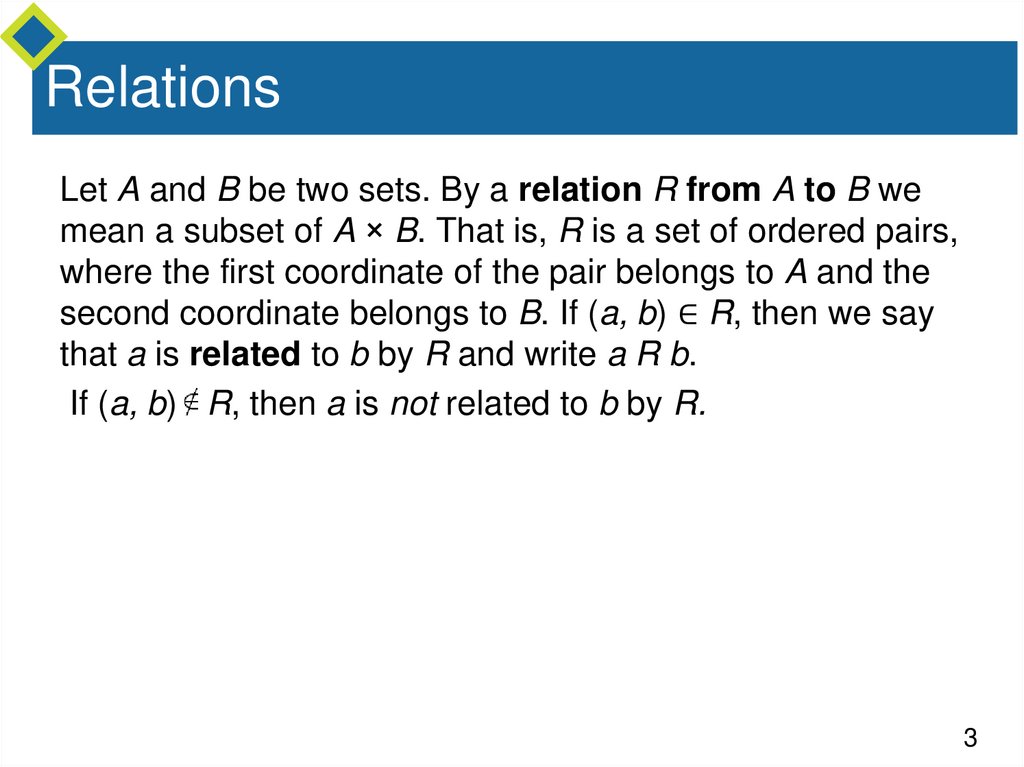
Let A and B be two sets. By a relation R from A to B wemean a subset of A × B. That is, R is a set of ordered pairs,
where the first coordinate of the pair belongs to A and the
second coordinate belongs to B. If (a, b) ∈ R, then we say
that a is related to b by R and write a R b.
If (a, b) R, then a is not related to b by R.
3
4. Domain and Range
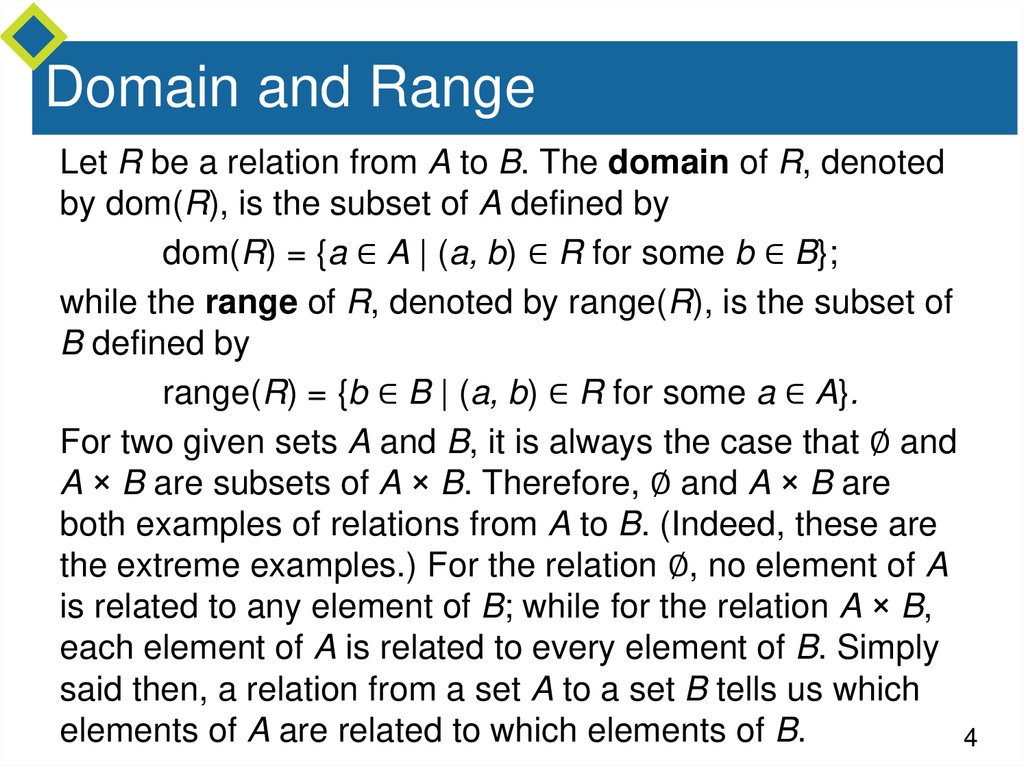
Let R be a relation from A to B. The domain of R, denotedby dom(R), is the subset of A defined by
dom(R) = {a ∈ A | (a, b) ∈ R for some b ∈ B};
while the range of R, denoted by range(R), is the subset of
B defined by
range(R) = {b ∈ B | (a, b) ∈ R for some a ∈ A}.
For two given sets A and B, it is always the case that ∅ and
A × B are subsets of A × B. Therefore, ∅ and A × B are
both examples of relations from A to B. (Indeed, these are
the extreme examples.) For the relation ∅, no element of A
is related to any element of B; while for the relation A × B,
each element of A is related to every element of B. Simply
said then, a relation from a set A to a set B tells us which
elements of A are related to which elements of B.
4
5. Example
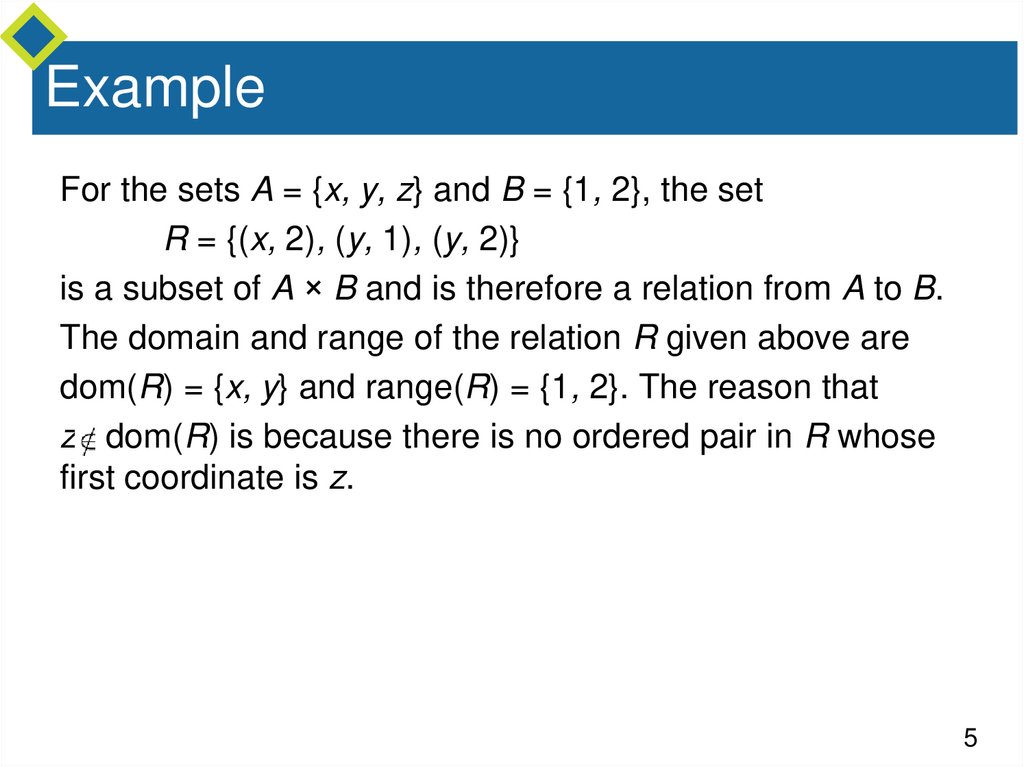
For the sets A = {x, y, z} and B = {1, 2}, the setR = {(x, 2), (y, 1), (y, 2)}
is a subset of A × B and is therefore a relation from A to B.
The domain and range of the relation R given above are
dom(R) = {x, y} and range(R) = {1, 2}. The reason that
z dom(R) is because there is no ordered pair in R whose
first coordinate is z.
5
6. Relations on Sets
A more formal way to refer to the kind of relation defined onsets is to call it a binary relation because it is a subset of a
Cartesian product of two sets.
At the end of this section we define an n-ary relation to be a
subset of a Cartesian product of n sets, where n is any
integer greater than or equal to two.
Such a relation is the fundamental structure used in
relational databases. However, because we focus on
binary relations in this text, when we use the term relation
by itself, we will mean binary relation.
6
7. Example 2 – The Congruence Modulo 2 Relation
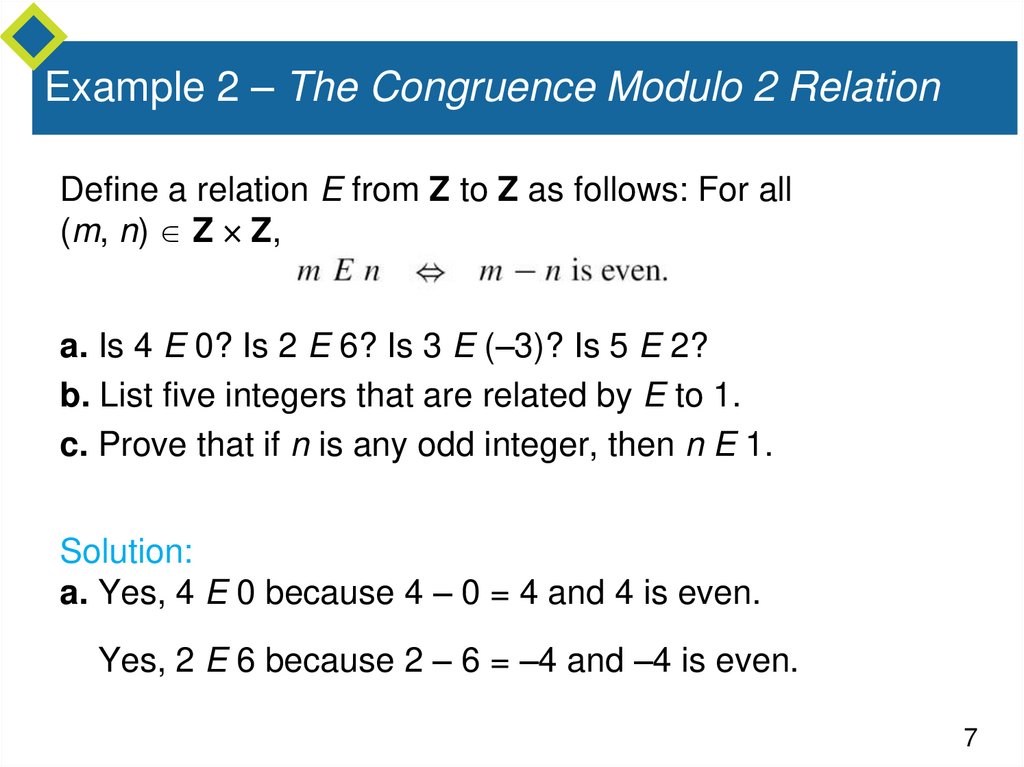
Define a relation E from Z to Z as follows: For all(m, n) Z Z,
a. Is 4 E 0? Is 2 E 6? Is 3 E (–3)? Is 5 E 2?
b. List five integers that are related by E to 1.
c. Prove that if n is any odd integer, then n E 1.
Solution:
a. Yes, 4 E 0 because 4 – 0 = 4 and 4 is even.
Yes, 2 E 6 because 2 – 6 = –4 and –4 is even.
7
8. Example 2 – Solution
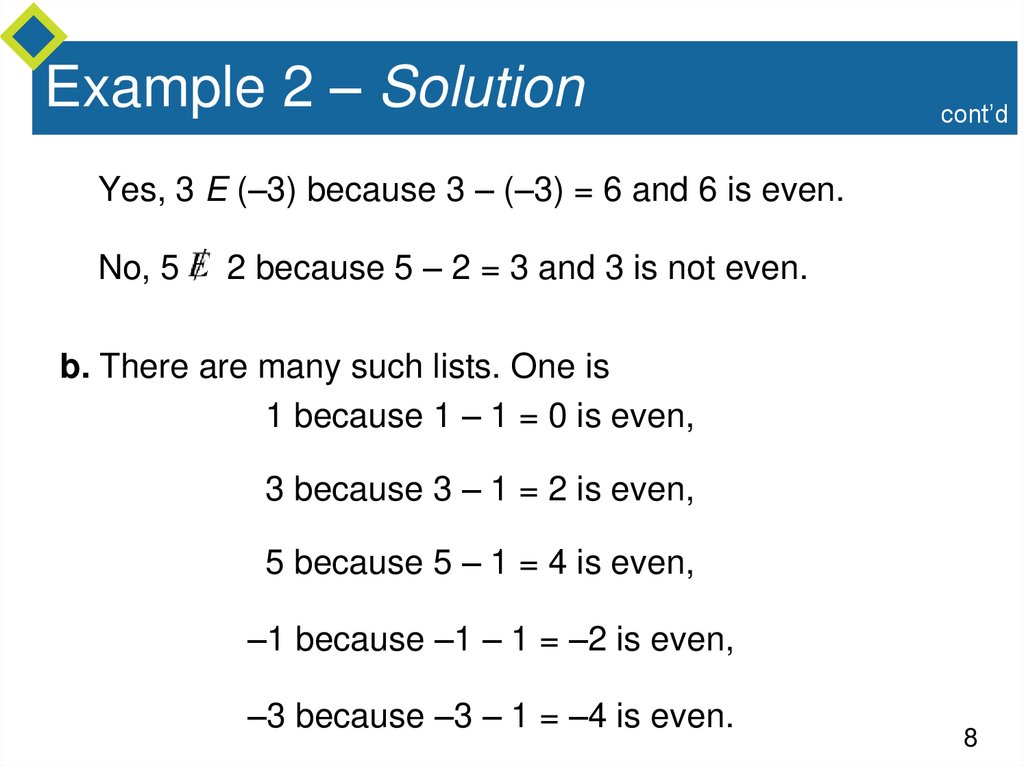
cont’dYes, 3 E (–3) because 3 – (–3) = 6 and 6 is even.
No, 5
2 because 5 – 2 = 3 and 3 is not even.
b. There are many such lists. One is
1 because 1 – 1 = 0 is even,
3 because 3 – 1 = 2 is even,
5 because 5 – 1 = 4 is even,
–1 because –1 – 1 = –2 is even,
–3 because –3 – 1 = –4 is even.
8
9. Example 1 – Solution
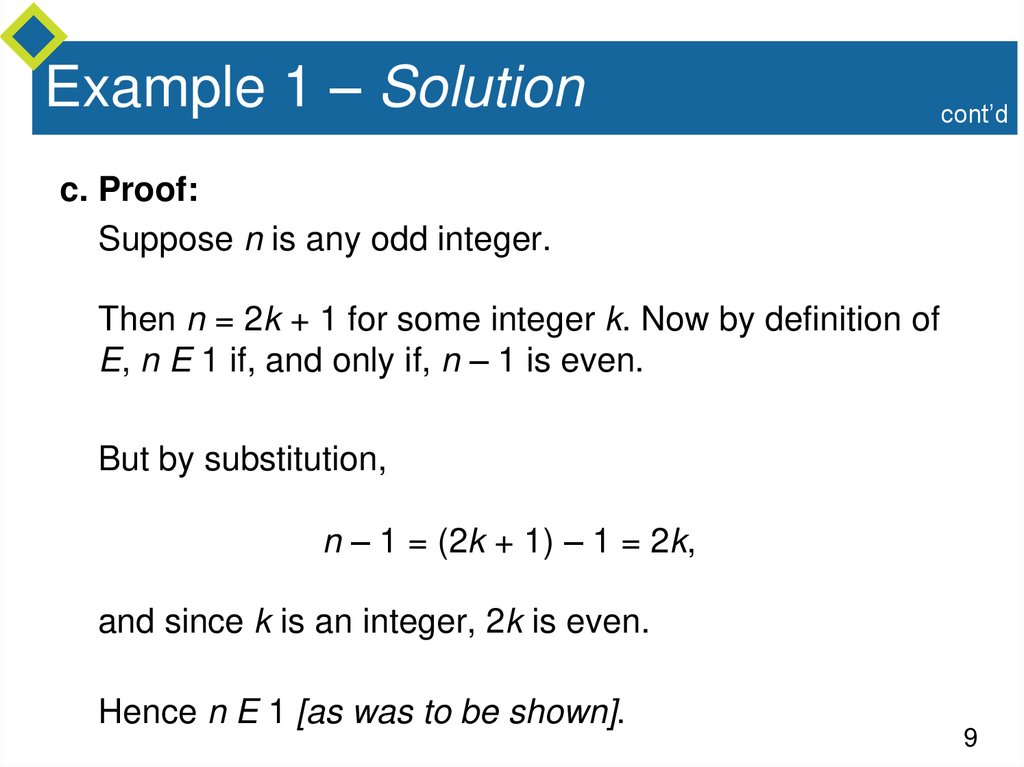
cont’dc. Proof:
Suppose n is any odd integer.
Then n = 2k + 1 for some integer k. Now by definition of
E, n E 1 if, and only if, n – 1 is even.
But by substitution,
n – 1 = (2k + 1) – 1 = 2k,
and since k is an integer, 2k is even.
Hence n E 1 [as was to be shown].
9
10. Example 1 – Solution
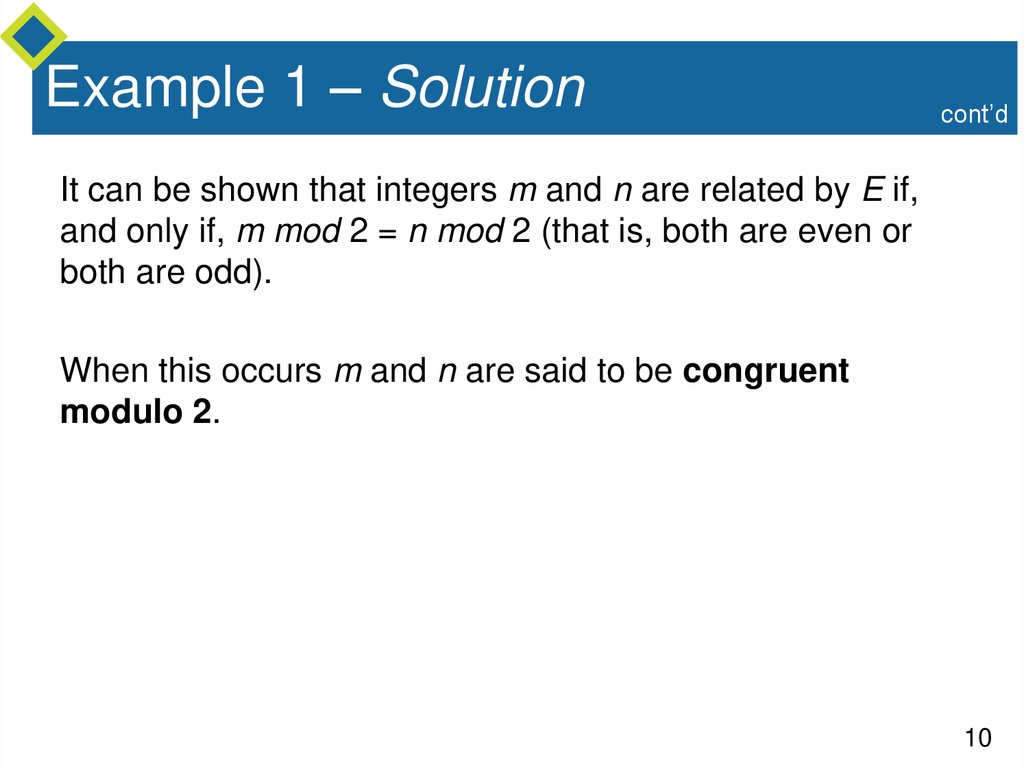
cont’dIt can be shown that integers m and n are related by E if,
and only if, m mod 2 = n mod 2 (that is, both are even or
both are odd).
When this occurs m and n are said to be congruent
modulo 2.
10
11.
The Inverse of a Relation11
12. The Inverse of a Relation
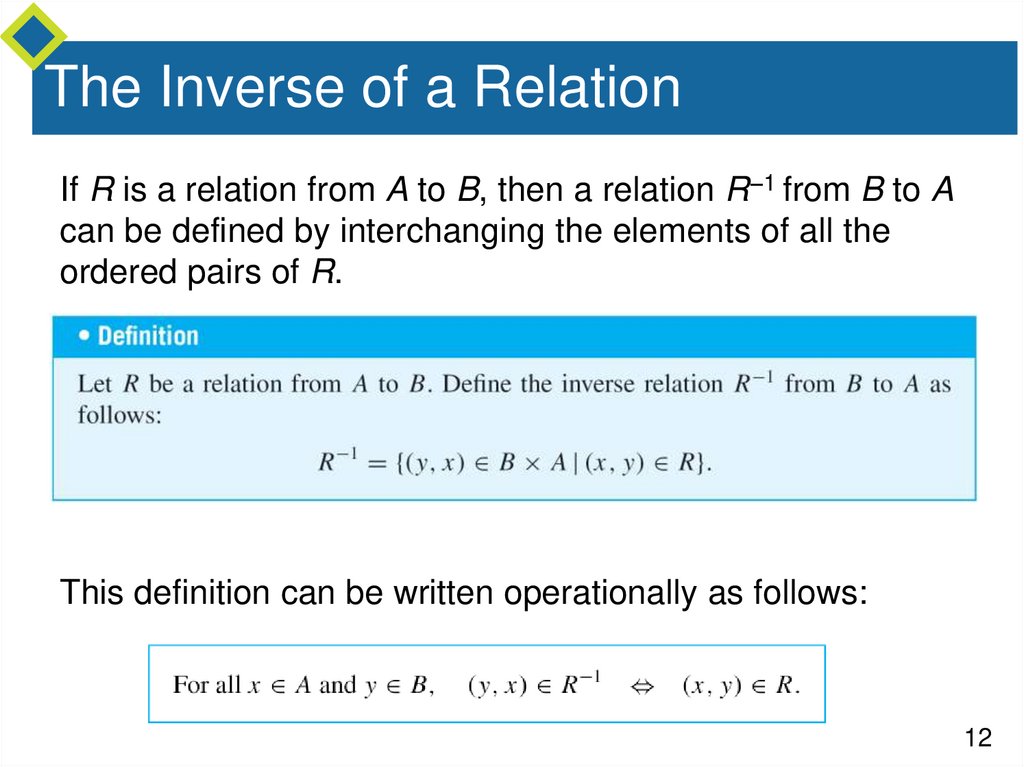
If R is a relation from A to B, then a relation R –1 from B to Acan be defined by interchanging the elements of all the
ordered pairs of R.
This definition can be written operationally as follows:
12
13. Example 4 – The Inverse of a Finite Relation
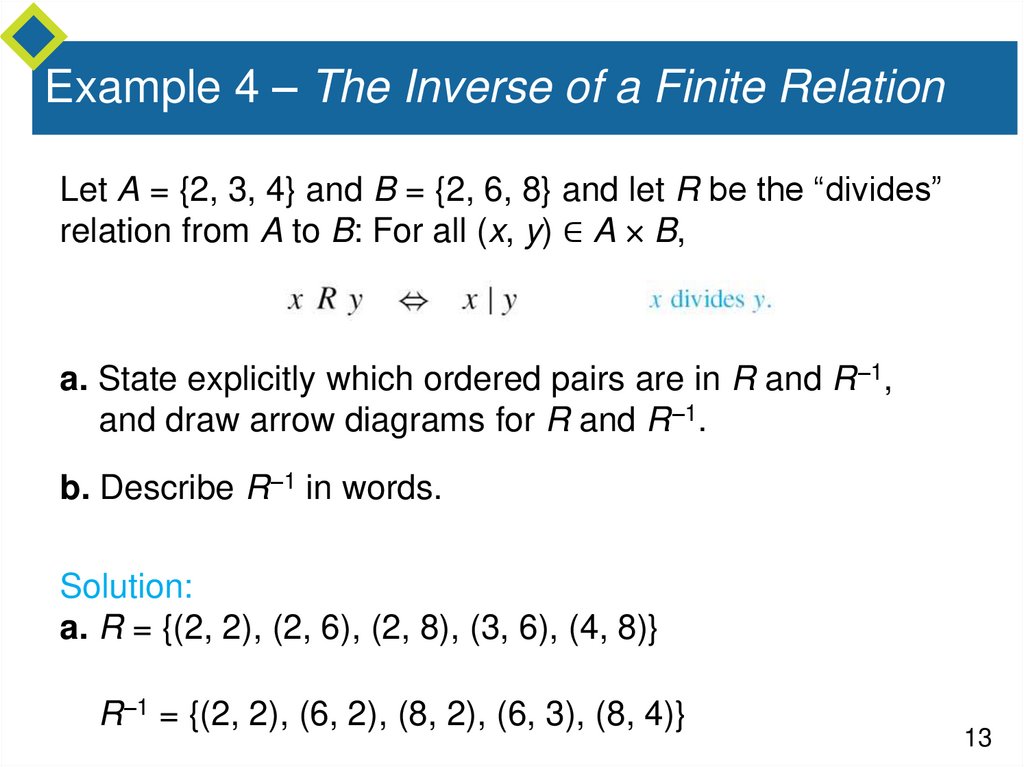
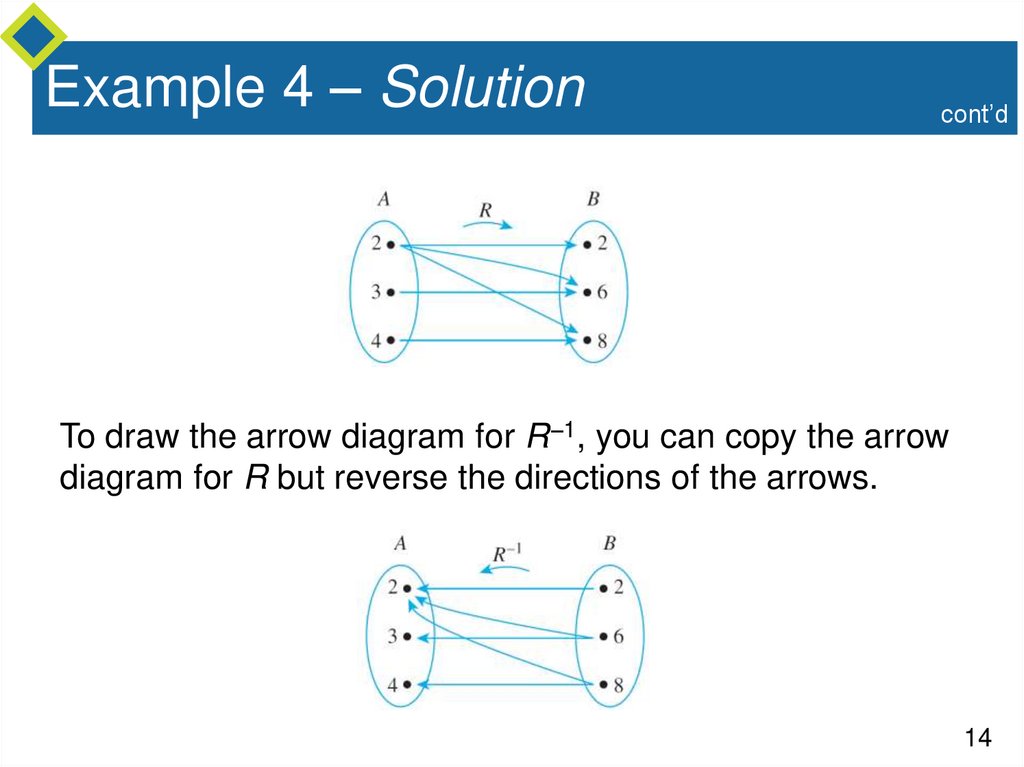
Let A = {2, 3, 4} and B = {2, 6, 8} and let R be the “divides”relation from A to B: For all (x, y) ∈ A B,
a. State explicitly which ordered pairs are in R and R –1,
and draw arrow diagrams for R and R –1.
b. Describe R –1 in words.
Solution:
a. R = {(2, 2), (2, 6), (2, 8), (3, 6), (4, 8)}
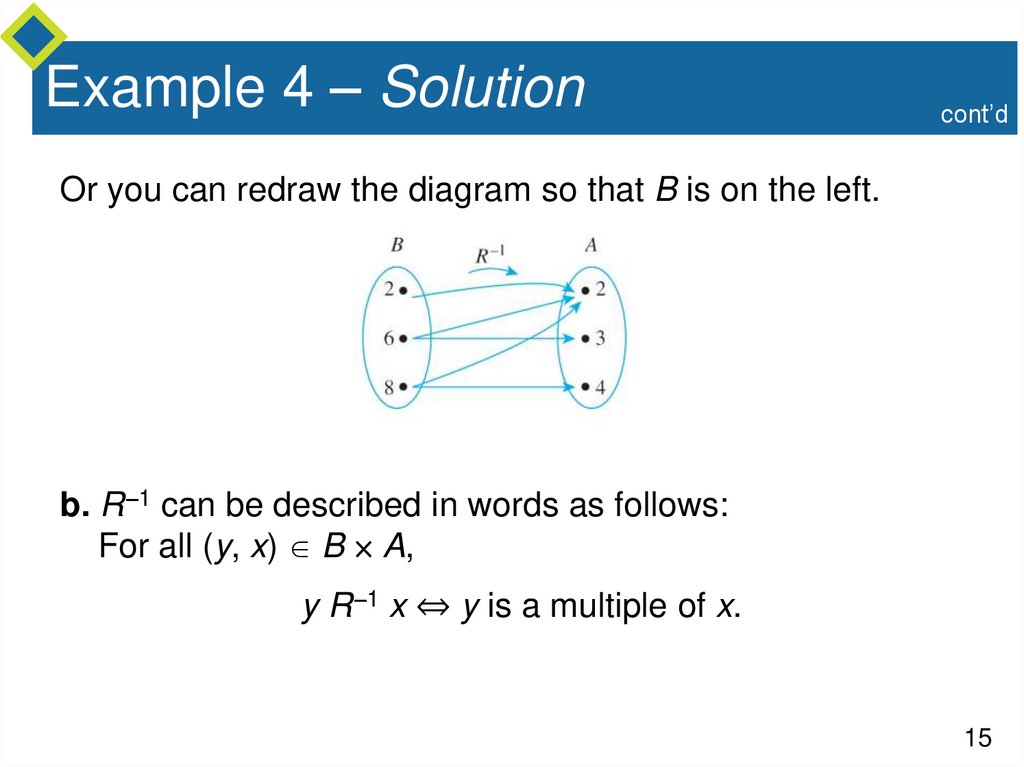
R –1 = {(2, 2), (6, 2), (8, 2), (6, 3), (8, 4)}
13
14. Example 4 – Solution
cont’dTo draw the arrow diagram for R –1, you can copy the arrow
diagram for R but reverse the directions of the arrows.
14
15. Example 4 – Solution
cont’dOr you can redraw the diagram so that B is on the left.
b. R –1 can be described in words as follows:
For all (y, x) B A,
y R –1 x ⇔ y is a multiple of x.
15
16.
Directed Graph of a Relation16
17. Directed Graph of a Relation
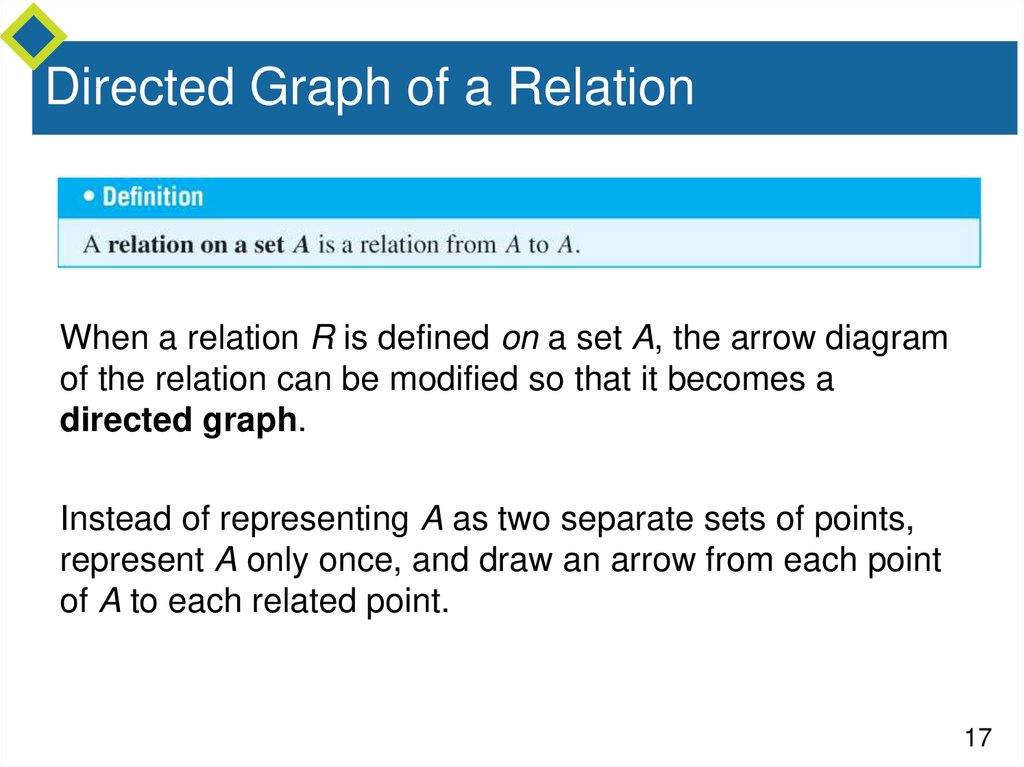
When a relation R is defined on a set A, the arrow diagramof the relation can be modified so that it becomes a
directed graph.
Instead of representing A as two separate sets of points,
represent A only once, and draw an arrow from each point
of A to each related point.
17
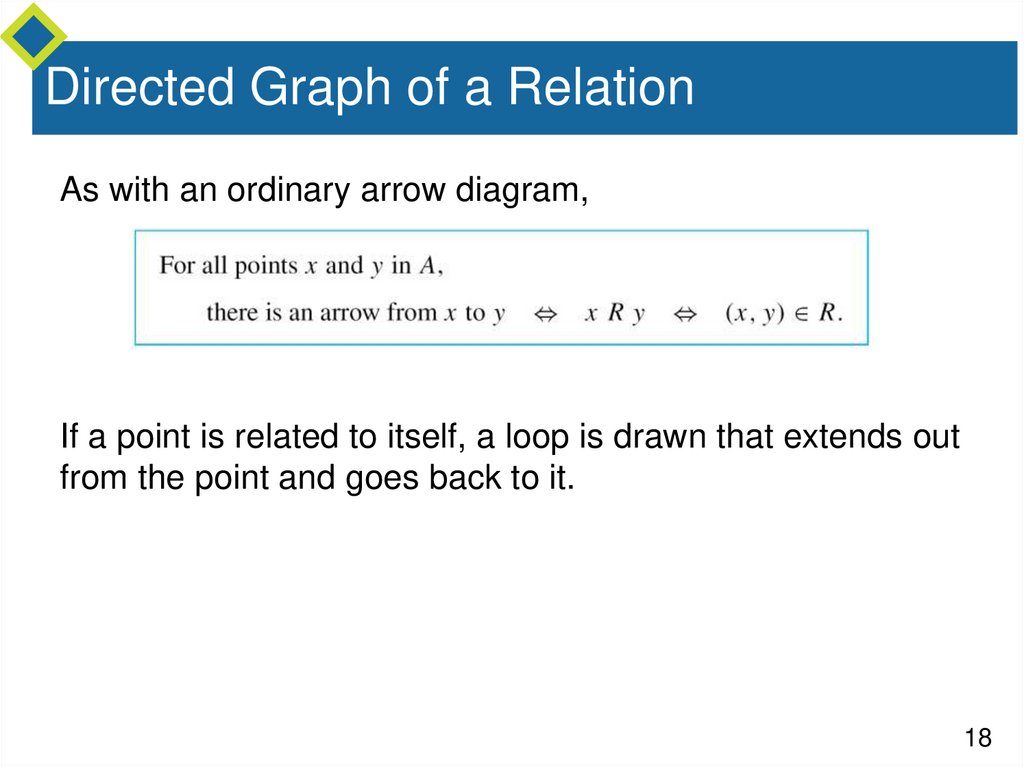
18. Directed Graph of a Relation
As with an ordinary arrow diagram,If a point is related to itself, a loop is drawn that extends out
from the point and goes back to it.
18
19. Example 6 – Directed Graph of a Relation
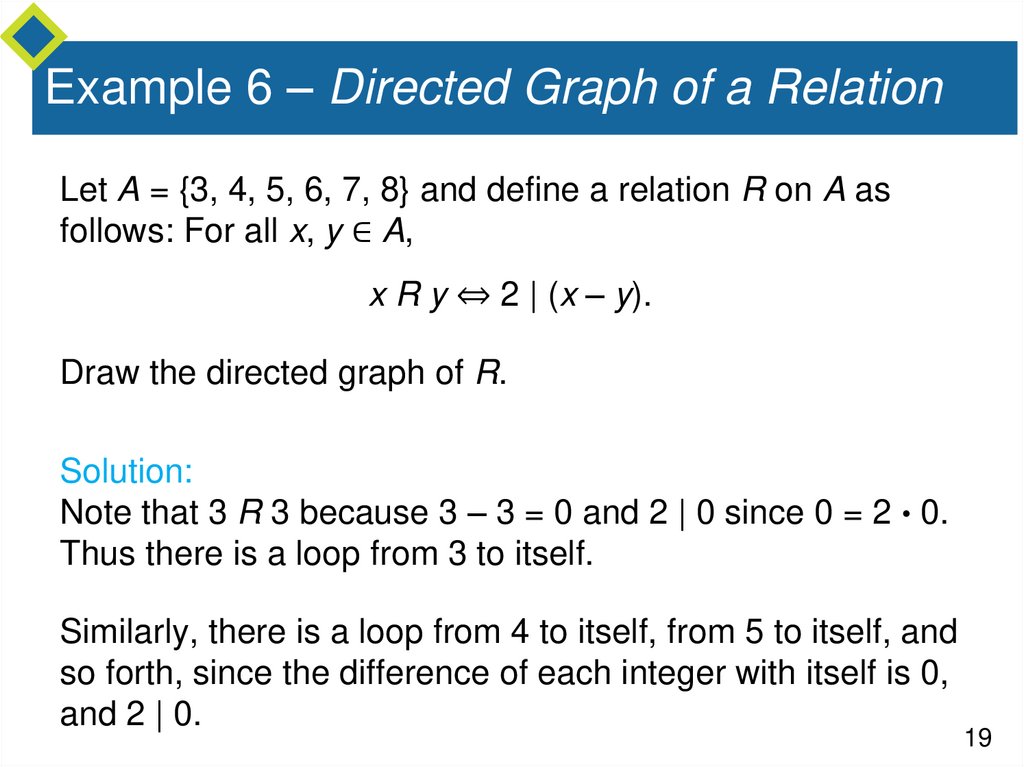
Let A = {3, 4, 5, 6, 7, 8} and define a relation R on A asfollows: For all x, y ∈ A,
x R y ⇔ 2 | (x – y).
Draw the directed graph of R.
Solution:
Note that 3 R 3 because 3 – 3 = 0 and 2 | 0 since 0 = 2 0.
Thus there is a loop from 3 to itself.
Similarly, there is a loop from 4 to itself, from 5 to itself, and
so forth, since the difference of each integer with itself is 0,
and 2 | 0.
19
20. Example 6 – Solution
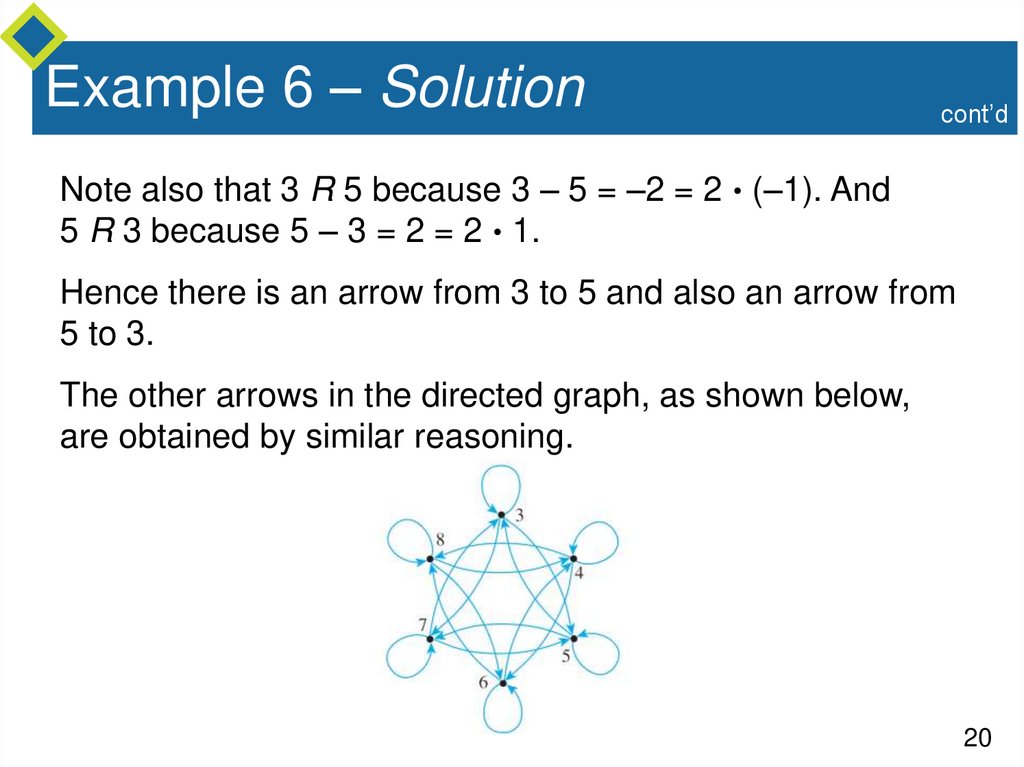
cont’dNote also that 3 R 5 because 3 – 5 = –2 = 2 (–1). And
5 R 3 because 5 – 3 = 2 = 2 1.
Hence there is an arrow from 3 to 5 and also an arrow from
5 to 3.
The other arrows in the directed graph, as shown below,
are obtained by similar reasoning.
20
21.
N-ary Relations and RelationalDatabases
21
22. N-ary Relations and Relational Databases
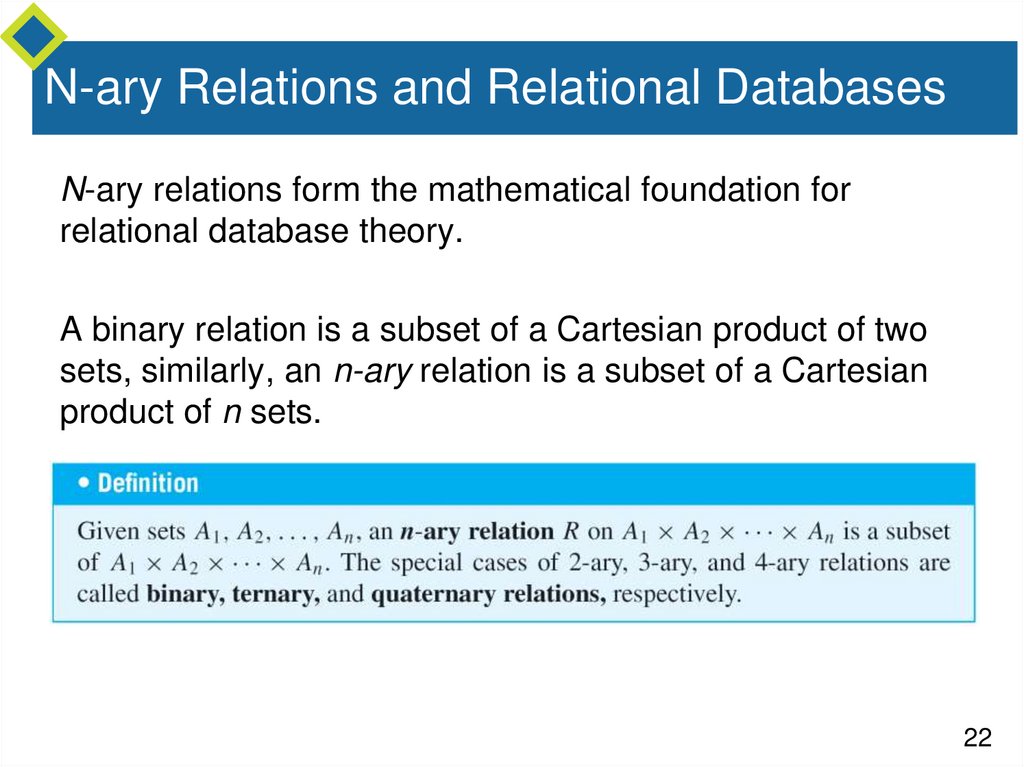
N-ary relations form the mathematical foundation forrelational database theory.
A binary relation is a subset of a Cartesian product of two
sets, similarly, an n-ary relation is a subset of a Cartesian
product of n sets.
22
23. Example 7 – A Simple Database
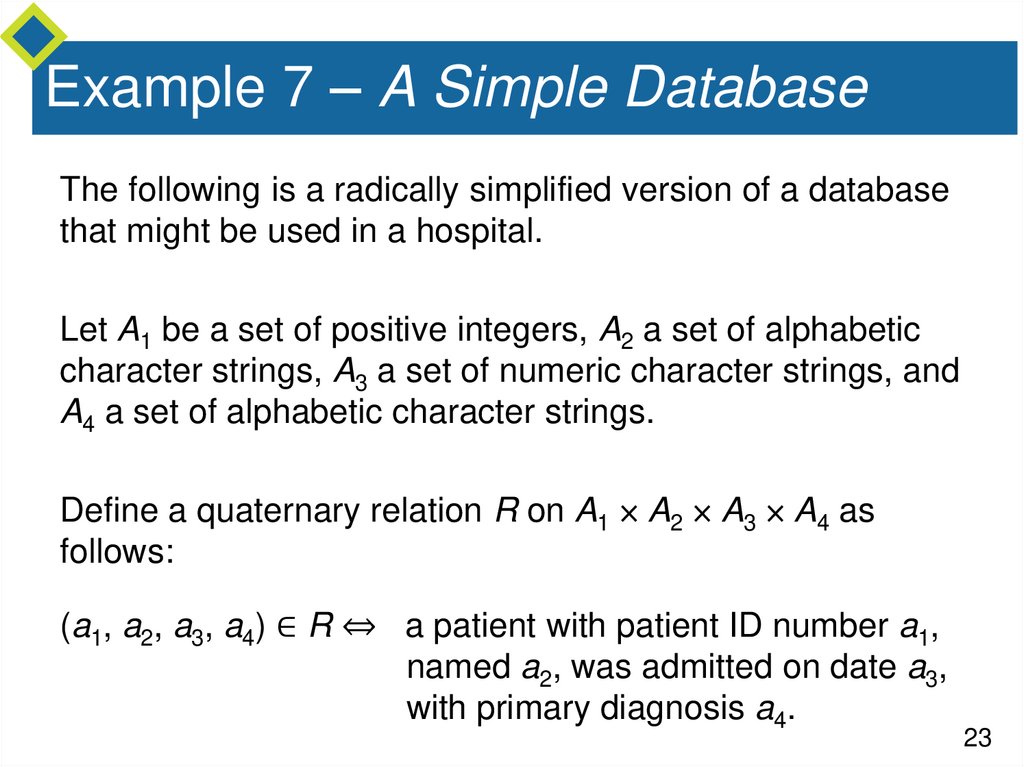
The following is a radically simplified version of a databasethat might be used in a hospital.
Let A1 be a set of positive integers, A2 a set of alphabetic
character strings, A3 a set of numeric character strings, and
A4 a set of alphabetic character strings.
Define a quaternary relation R on A1 A2 A3 A4 as
follows:
(a1, a2, a3, a4) ∈ R ⇔ a patient with patient ID number a1,
named a2, was admitted on date a3,
with primary diagnosis a4.
23
24. Example 7 – A Simple Database
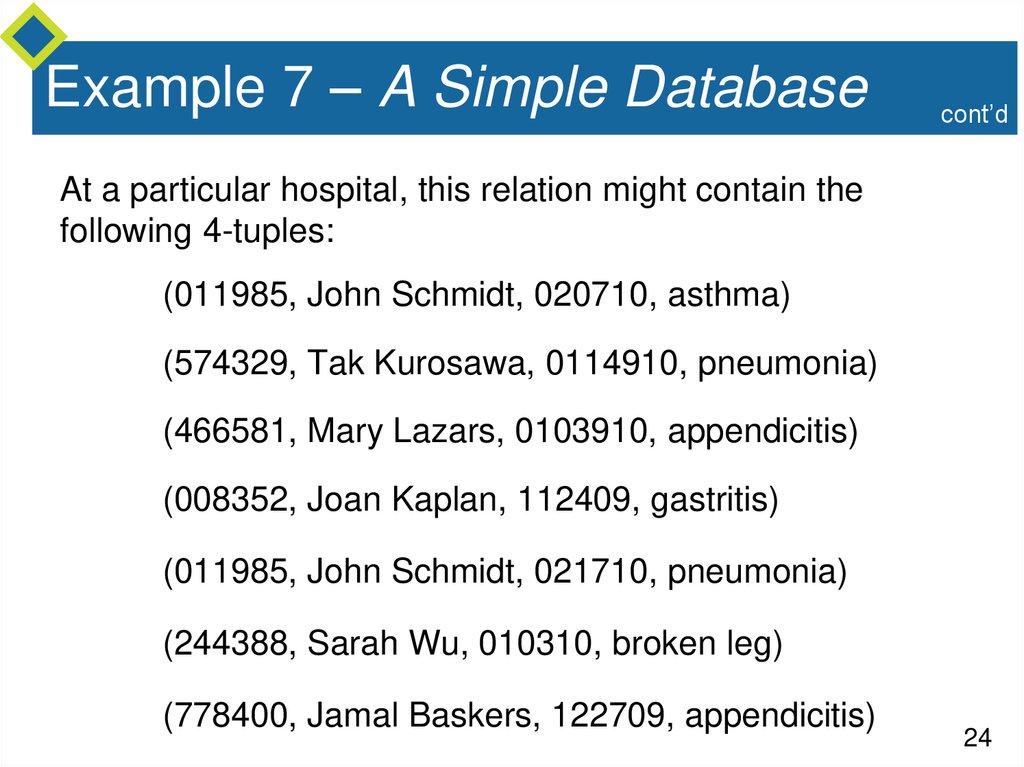
cont’dAt a particular hospital, this relation might contain the
following 4-tuples:
(011985, John Schmidt, 020710, asthma)
(574329, Tak Kurosawa, 0114910, pneumonia)
(466581, Mary Lazars, 0103910, appendicitis)
(008352, Joan Kaplan, 112409, gastritis)
(011985, John Schmidt, 021710, pneumonia)
(244388, Sarah Wu, 010310, broken leg)
(778400, Jamal Baskers, 122709, appendicitis)
24
25. Example 7 – A Simple Database
cont’dIn discussions of relational databases, the tuples are
normally thought of as being written in tables.
Each row of the table corresponds to one tuple, and the
header for each column gives the descriptive attribute for
the elements in the column.
Operations within a database allow the data to be
manipulated in many different ways.
25
26. Example 7 – A Simple Database
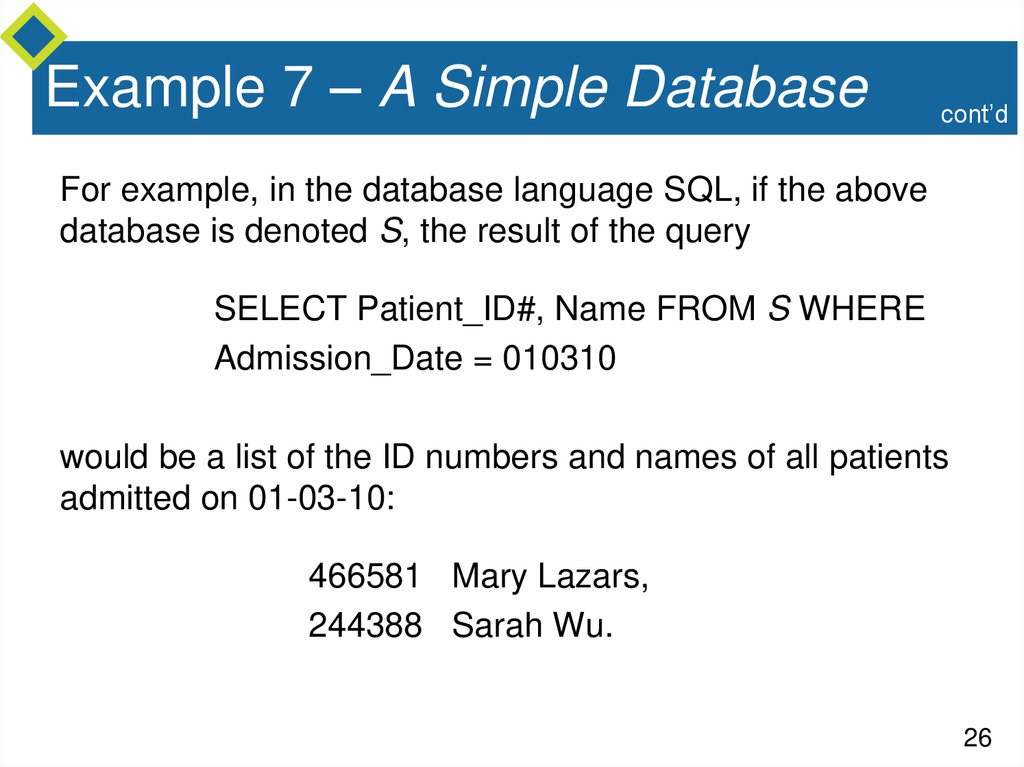
cont’dFor example, in the database language SQL, if the above
database is denoted S, the result of the query
SELECT Patient_ID#, Name FROM S WHERE
Admission_Date = 010310
would be a list of the ID numbers and names of all patients
admitted on 01-03-10:
466581 Mary Lazars,
244388 Sarah Wu.
26
27. Example 7 – A Simple Database
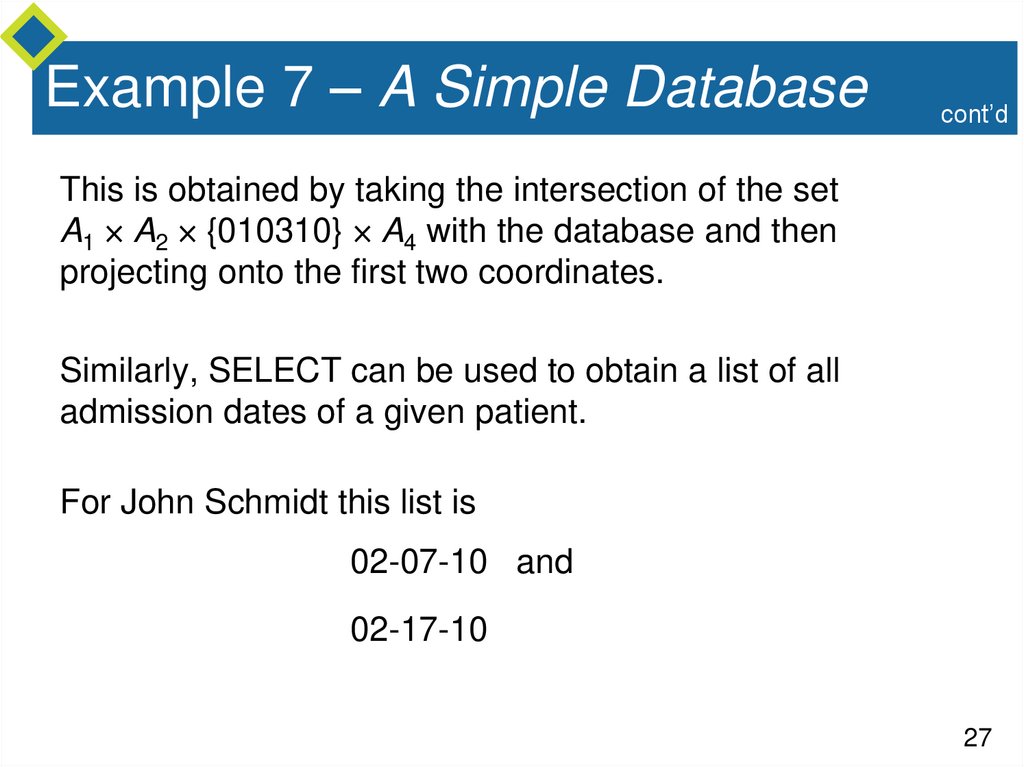
cont’dThis is obtained by taking the intersection of the set
A1 A2 {010310} A4 with the database and then
projecting onto the first two coordinates.
Similarly, SELECT can be used to obtain a list of all
admission dates of a given patient.
For John Schmidt this list is
02-07-10 and
02-17-10
27
28. Example 7 – A Simple Database
cont’dIndividual entries in a database can be added, deleted, or
updated, and most databases can sort data entries in
various ways.
In addition, entire databases can be merged, and the
entries common to two databases can be moved to a new
database.
28