 english
Similar presentations:





Basics of English grammar. Sentence word order Part II
1. Basics of English grammar. Sentence word order Part II
Basics of English grammarSentence word order
Part II
OUTLINE
Parts of the sentence in English.
The Subject.
The Predicate.
The Object.
The Attribute.
The Adverbial modifier.
2. Revision tasks:
1. Name 2 types of languages according to the grammar structure?Enumerate their main features.
2. Name notional and structural parts of speech. Provide examples.
3. Analyze parts of speech in the given sentences:
1. I must buy a postcard.
2. She did not bring me a magazine, she brought me a newspaper.
3. In the bedroom a candle was burning.
4. She talked to them naturally, sang a little song to them... And gave them their Sunday toys.
5. The clock struck eight. There was no sign of any of the other guests.
6. Morris was walking too quickly for Sally to keep up with him.
7. At the top of the stairs she paused to wave to him.
8. To be a complete artist it is not enough to be a painter, sculptor or architect.
9. I looked at the photograph above the mantelpiece and saw my own lace for the first time.
10. He's coming Saturday at one o'clock.
3.
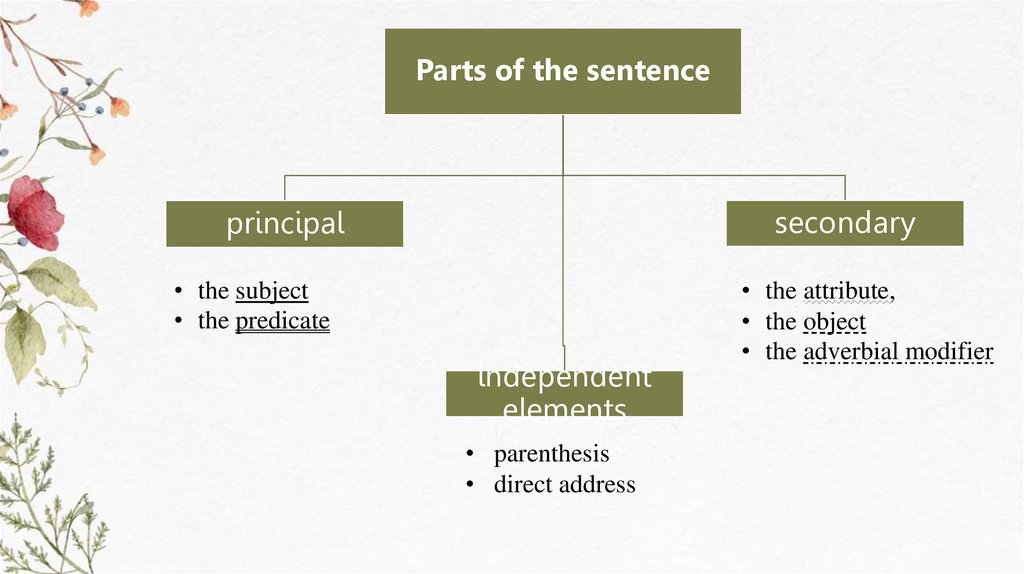
Parts of the sentencesecondary
principal
• the subject
• the predicate
independent
elements
• parenthesis
• direct address
• the attribute,
• the object
• the adverbial modifier
4.
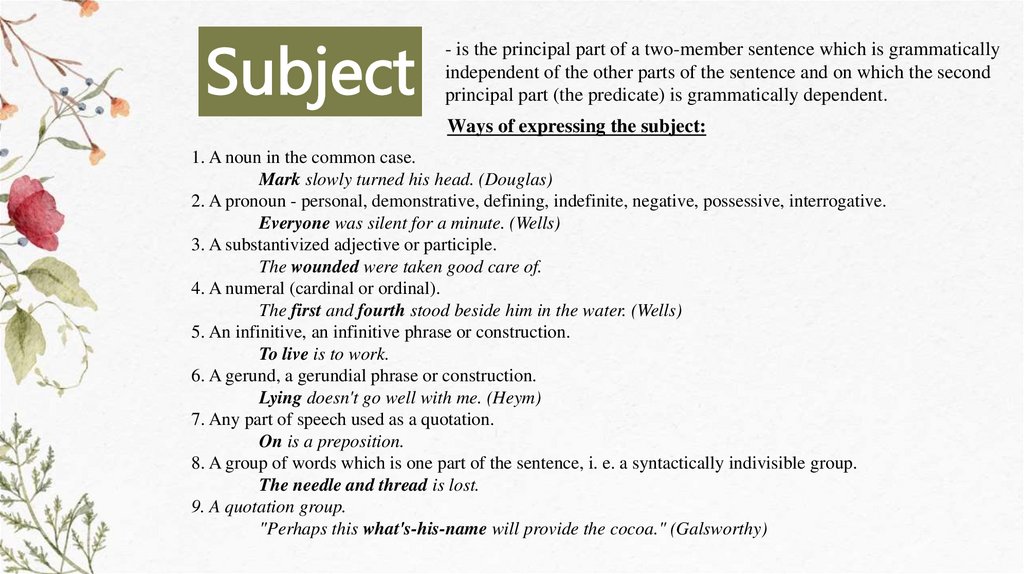
Subject- is the principal part of a two-member sentence which is grammatically
independent of the other parts of the sentence and on which the second
principal part (the predicate) is grammatically dependent.
Ways of expressing the subject:
1. A noun in the common case.
Mark slowly turned his head. (Douglas)
2. A pronoun - personal, demonstrative, defining, indefinite, negative, possessive, interrogative.
Everyone was silent for a minute. (Wells)
3. A substantivized adjective or participle.
The wounded were taken good care of.
4. A numeral (cardinal or ordinal).
The first and fourth stood beside him in the water. (Wells)
5. An infinitive, an infinitive phrase or construction.
To live is to work.
6. A gerund, a gerundial phrase or construction.
Lying doesn't go well with me. (Heym)
7. Any part of speech used as a quotation.
On is a preposition.
8. A group of words which is one part of the sentence, i. e. a syntactically indivisible group.
The needle and thread is lost.
9. A quotation group.
"Perhaps this what's-his-name will provide the cocoa." (Galsworthy)
5.
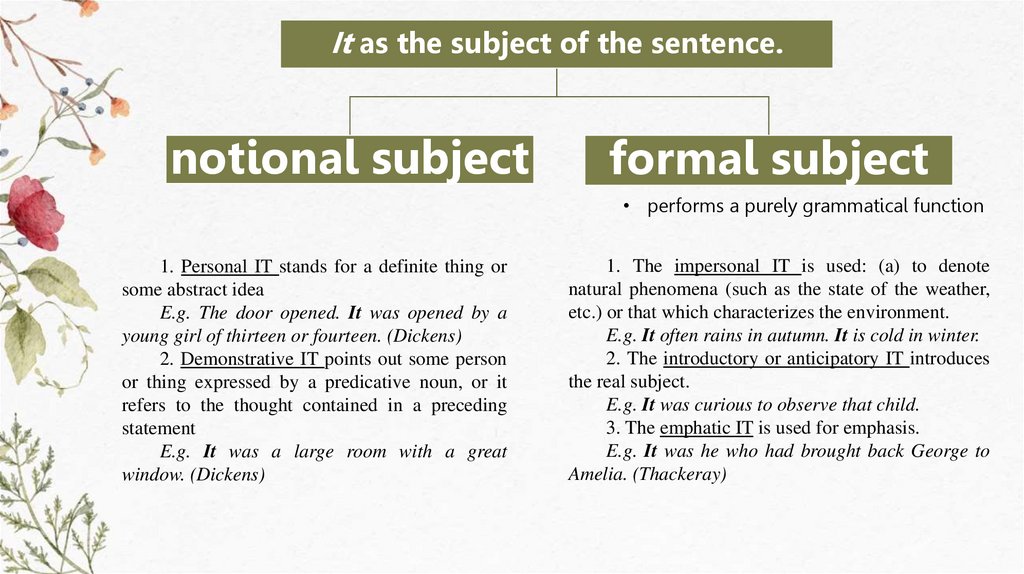
It as the subject of the sentence.notional subject
formal subject
• performs a purely grammatical function
1. Personal IT stands for a definite thing or
some abstract idea
E.g. The door opened. It was opened by a
young girl of thirteen or fourteen. (Dickens)
2. Demonstrative IT points out some person
or thing expressed by a predicative noun, or it
refers to the thought contained in a preceding
statement
E.g. It was a large room with a great
window. (Dickens)
1. The impersonal IT is used: (a) to denote
natural phenomena (such as the state of the weather,
etc.) or that which characterizes the environment.
E.g. It often rains in autumn. It is cold in winter.
2. The introductory or anticipatory IT introduces
the real subject.
E.g. It was curious to observe that child.
3. The emphatic IT is used for emphasis.
E.g. It was he who had brought back George to
Amelia. (Thackeray)
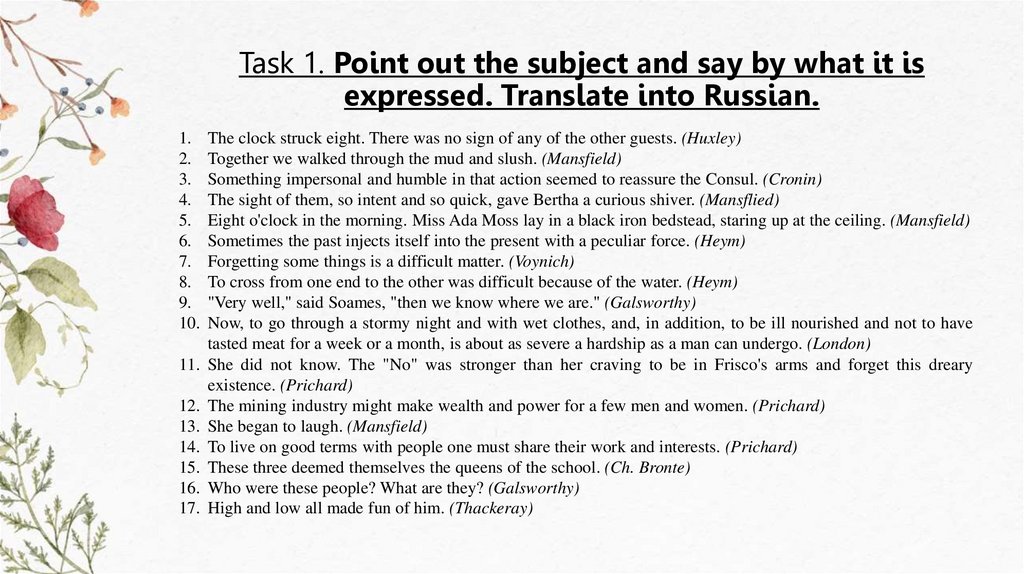
6. Task 1. Point out the subject and say by what it is expressed. Translate into Russian.
1. The clock struck eight. There was no sign of any of the other guests. (Huxley)2. Together we walked through the mud and slush. (Mansfield)
3. Something impersonal and humble in that action seemed to reassure the Consul. (Cronin)
4. The sight of them, so intent and so quick, gave Bertha a curious shiver. (Mansflied)
5. Eight o'clock in the morning. Miss Ada Moss lay in a black iron bedstead, staring up at the ceiling. (Mansfield)
6. Sometimes the past injects itself into the present with a peculiar force. (Heym)
7. Forgetting some things is a difficult matter. (Voynich)
8. To cross from one end to the other was difficult because of the water. (Heym)
9. "Very well," said Soames, "then we know where we are." (Galsworthy)
10. Now, to go through a stormy night and with wet clothes, and, in addition, to be ill nourished and not to have
tasted meat for a week or a month, is about as severe a hardship as a man can undergo. (London)
11. She did not know. The "No" was stronger than her craving to be in Frisco's arms and forget this dreary
existence. (Prichard)
12. The mining industry might make wealth and power for a few men and women. (Prichard)
13. She began to laugh. (Mansfield)
14. To live on good terms with people one must share their work and interests. (Prichard)
15. These three deemed themselves the queens of the school. (Ch. Bronte)
16. Who were these people? What are they? (Galsworthy)
17. High and low all made fun of him. (Thackeray)
7.
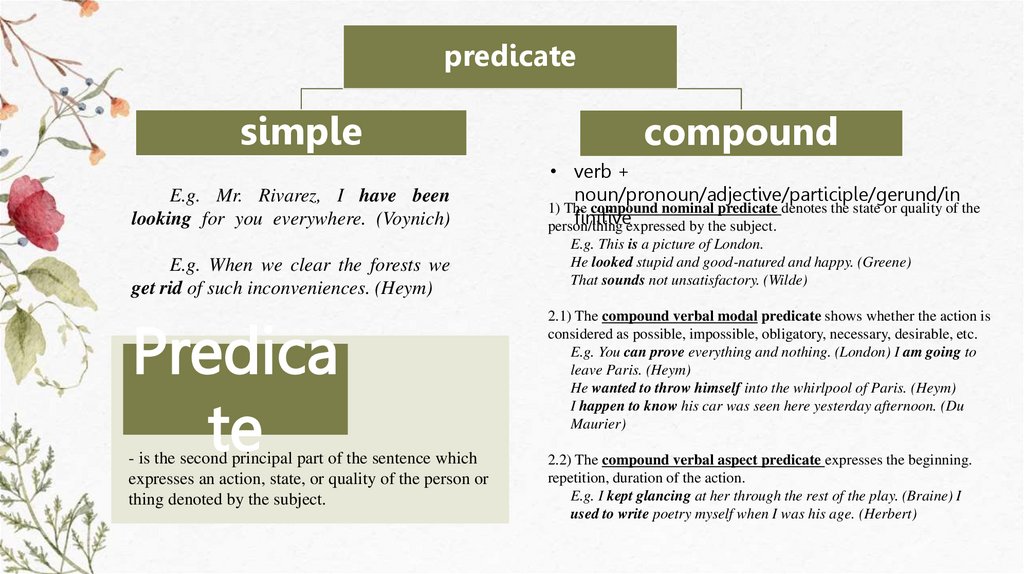
predicatesimple
E.g. Mr. Rivarez, I have been
looking for you everywhere. (Voynich)
E.g. When we clear the forests we
get rid of such inconveniences. (Heym)
Predica
te
- is the second principal part of the sentence which
expresses an action, state, or quality of the person or
thing denoted by the subject.
compound
• verb +
noun/pronoun/adjective/participle/gerund/in
1) The compound nominal predicate denotes the state or quality of the
finitiveexpressed by the subject.
person/thing
E.g. This is a picture of London.
He looked stupid and good-natured and happy. (Greene)
That sounds not unsatisfactory. (Wilde)
2.1) The compound verbal modal predicate shows whether the action is
considered as possible, impossible, obligatory, necessary, desirable, etc.
E.g. You can prove everything and nothing. (London) I am going to
leave Paris. (Heym)
He wanted to throw himself into the whirlpool of Paris. (Heym)
I happen to know his car was seen here yesterday afternoon. (Du
Maurier)
2.2) The compound verbal aspect predicate expresses the beginning.
repetition, duration of the action.
E.g. I kept glancing at her through the rest of the play. (Braine) I
used to write poetry myself when I was his age. (Herbert)
8.
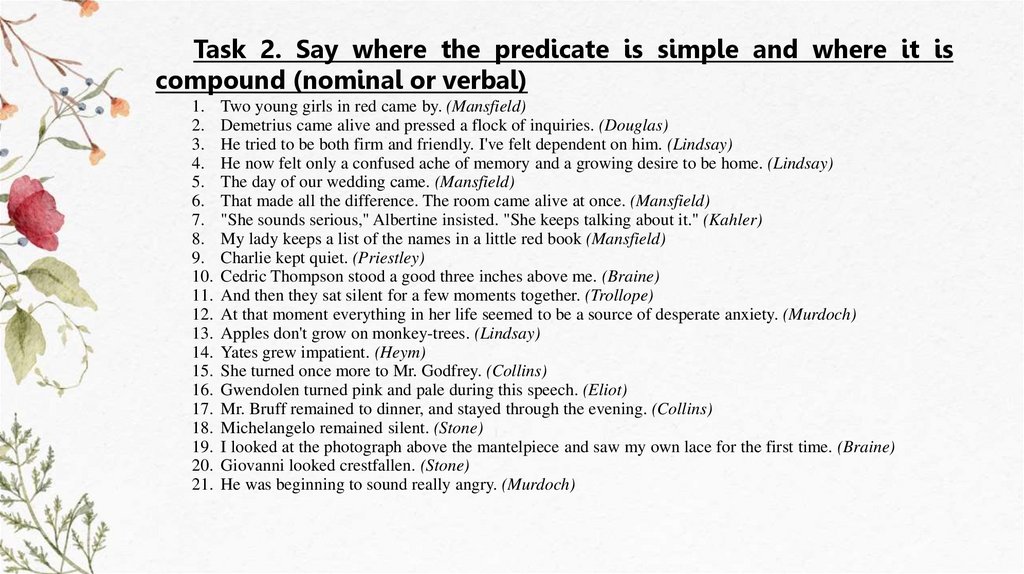
Task 2. Say where the predicate is simple and where it iscompound (nominal or verbal)
1. Two young girls in red came by. (Mansfield)
2. Demetrius came alive and pressed a flock of inquiries. (Douglas)
3. He tried to be both firm and friendly. I've felt dependent on him. (Lindsay)
4. He now felt only a confused ache of memory and a growing desire to be home. (Lindsay)
5. The day of our wedding came. (Mansfield)
6. That made all the difference. The room came alive at once. (Mansfield)
7. "She sounds serious," Albertine insisted. "She keeps talking about it." (Kahler)
8. My lady keeps a list of the names in a little red book (Mansfield)
9. Charlie kept quiet. (Priestley)
10. Cedric Thompson stood a good three inches above me. (Braine)
11. And then they sat silent for a few moments together. (Trollope)
12. At that moment everything in her life seemed to be a source of desperate anxiety. (Murdoch)
13. Apples don't grow on monkey-trees. (Lindsay)
14. Yates grew impatient. (Heym)
15. She turned once more to Mr. Godfrey. (Collins)
16. Gwendolen turned pink and pale during this speech. (Eliot)
17. Mr. Bruff remained to dinner, and stayed through the evening. (Collins)
18. Michelangelo remained silent. (Stone)
19. I looked at the photograph above the mantelpiece and saw my own lace for the first time. (Braine)
20. Giovanni looked crestfallen. (Stone)
21. He was beginning to sound really angry. (Murdoch)
9.
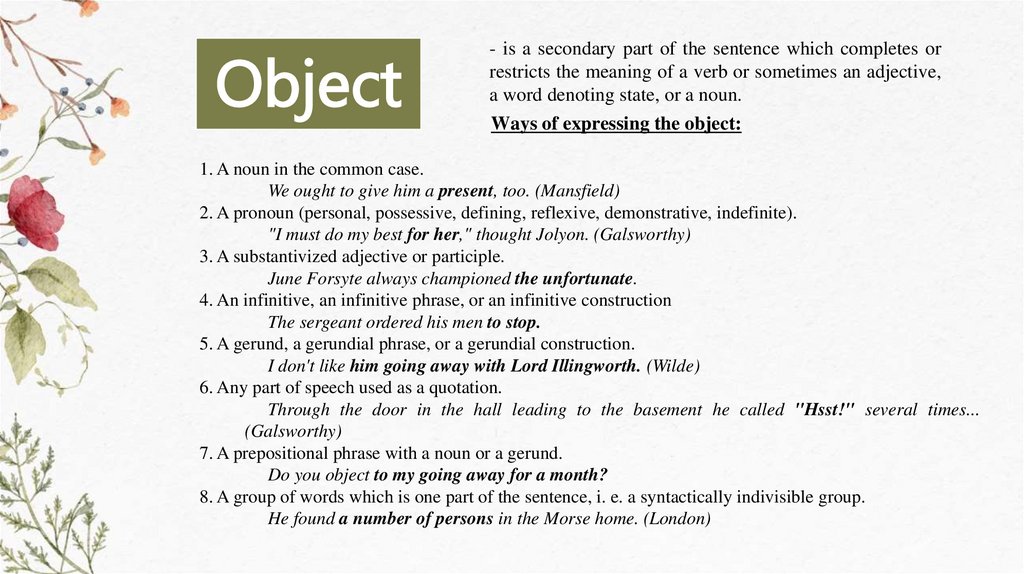
Object- is a secondary part of the sentence which completes or
restricts the meaning of a verb or sometimes an adjective,
a word denoting state, or a noun.
Ways of expressing the object:
1. A noun in the common case.
We ought to give him a present, too. (Mansfield)
2. A pronoun (personal, possessive, defining, reflexive, demonstrative, indefinite).
"I must do my best for her," thought Jolyon. (Galsworthy)
3. A substantivized adjective or participle.
June Forsyte always championed the unfortunate.
4. An infinitive, an infinitive phrase, or an infinitive construction
The sergeant ordered his men to stop.
5. A gerund, a gerundial phrase, or a gerundial construction.
I don't like him going away with Lord Illingworth. (Wilde)
6. Any part of speech used as a quotation.
Through the door in the hall leading to the basement he called "Hsst!" several times...
(Galsworthy)
7. A prepositional phrase with a noun or a gerund.
Do you object to my going away for a month?
8. A group of words which is one part of the sentence, i. e. a syntactically indivisible group.
He found a number of persons in the Morse home. (London)
10.
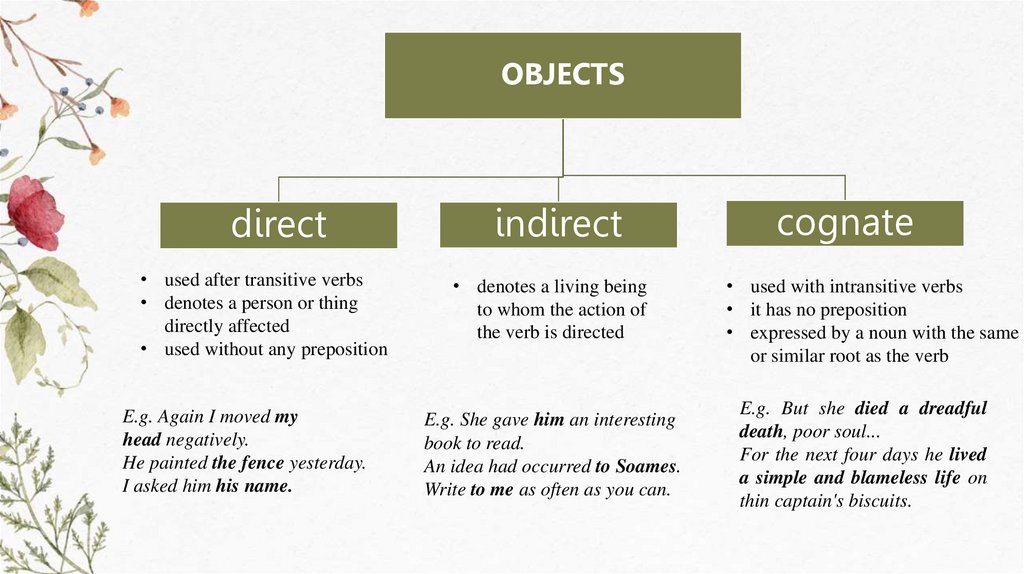
OBJECTSdirect
• used after transitive verbs
• denotes a person or thing
directly affected
• used without any preposition
E.g. Again I moved my
head negatively.
He painted the fence yesterday.
I asked him his name.
indirect
• denotes a living being
to whom the action of
the verb is directed
E.g. She gave him an interesting
book to read.
An idea had occurred to Soames.
Write to me as often as you can.
cognate
• used with intransitive verbs
• it has no preposition
• expressed by a noun with the same
or similar root as the verb
E.g. But she died a dreadful
death, poor soul...
For the next four days he lived
a simple and blameless life on
thin captain's biscuits.
11.
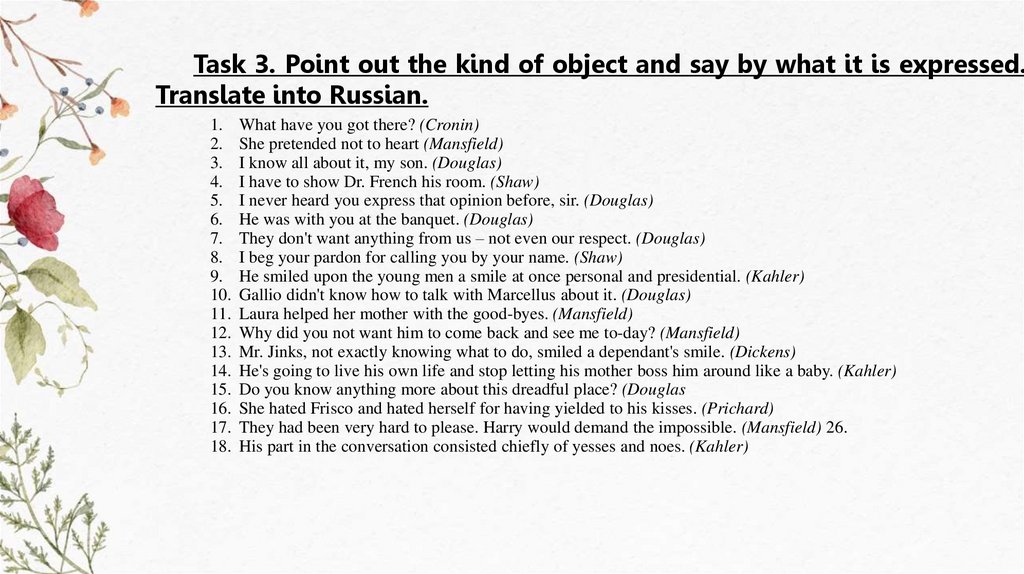
Task 3. Point out the kind of object and say by what it is expressed.Translate into Russian.
1. What have you got there? (Cronin)
2. She pretended not to heart (Mansfield)
3. I know all about it, my son. (Douglas)
4. I have to show Dr. French his room. (Shaw)
5. I never heard you express that opinion before, sir. (Douglas)
6. He was with you at the banquet. (Douglas)
7. They don't want anything from us – not even our respect. (Douglas)
8. I beg your pardon for calling you by your name. (Shaw)
9. He smiled upon the young men a smile at once personal and presidential. (Kahler)
10. Gallio didn't know how to talk with Marcellus about it. (Douglas)
11. Laura helped her mother with the good-byes. (Mansfield)
12. Why did you not want him to come back and see me to-day? (Mansfield)
13. Mr. Jinks, not exactly knowing what to do, smiled a dependant's smile. (Dickens)
14. He's going to live his own life and stop letting his mother boss him around like a baby. (Kahler)
15. Do you know anything more about this dreadful place? (Douglas
16. She hated Frisco and hated herself for having yielded to his kisses. (Prichard)
17. They had been very hard to please. Harry would demand the impossible. (Mansfield) 26.
18. His part in the conversation consisted chiefly of yesses and noes. (Kahler)
12.
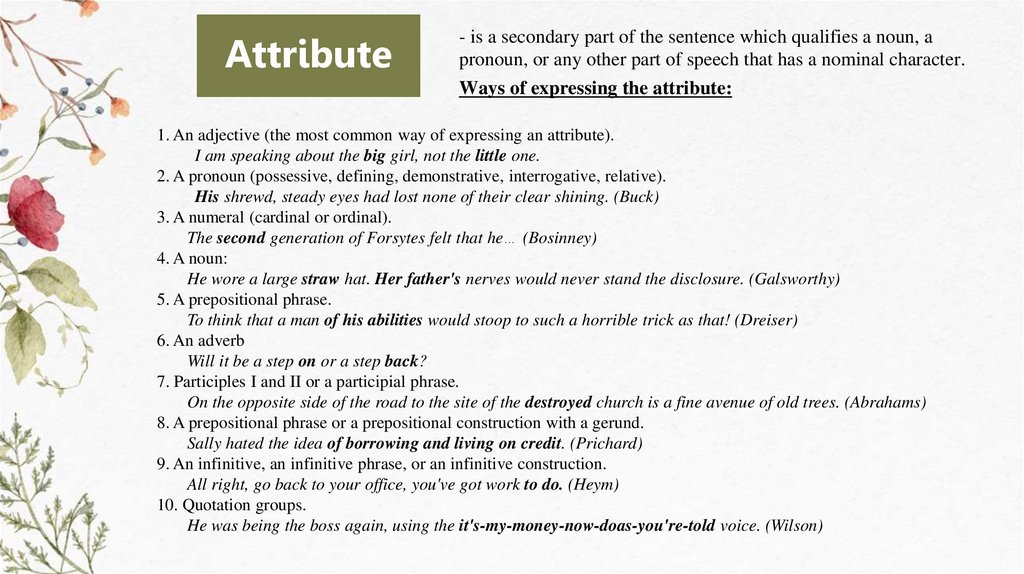
Attribute- is a secondary part of the sentence which qualifies a noun, a
pronoun, or any other part of speech that has a nominal character.
Ways of expressing the attribute:
1. An adjective (the most common way of expressing an attribute).
I am speaking about the big girl, not the little one.
2. A pronoun (possessive, defining, demonstrative, interrogative, relative).
His shrewd, steady eyes had lost none of their clear shining. (Buck)
3. A numeral (cardinal or ordinal).
The second generation of Forsytes felt that he… (Bosinney)
4. A noun:
He wore a large straw hat. Her father's nerves would never stand the disclosure. (Galsworthy)
5. A prepositional phrase.
To think that a man of his abilities would stoop to such a horrible trick as that! (Dreiser)
6. An adverb
Will it be a step on or a step back?
7. Participles I and II or a participial phrase.
On the opposite side of the road to the site of the destroyed church is a fine avenue of old trees. (Abrahams)
8. A prepositional phrase or a prepositional construction with a gerund.
Sally hated the idea of borrowing and living on credit. (Prichard)
9. An infinitive, an infinitive phrase, or an infinitive construction.
All right, go back to your office, you've got work to do. (Heym)
10. Quotation groups.
He was being the boss again, using the it's-my-money-now-doas-you're-told voice. (Wilson)
13.
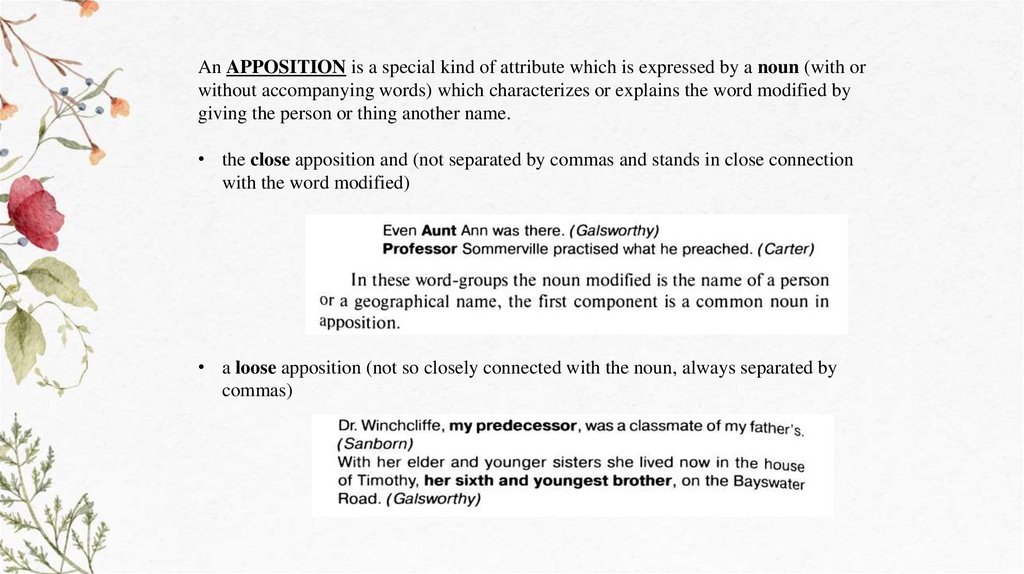
An APPOSITION is a special kind of attribute which is expressed by a noun (with orwithout accompanying words) which characterizes or explains the word modified by
giving the person or thing another name.
• the close apposition and (not separated by commas and stands in close connection
with the word modified)
• a loose apposition (not so closely connected with the noun, always separated by
commas)
14.
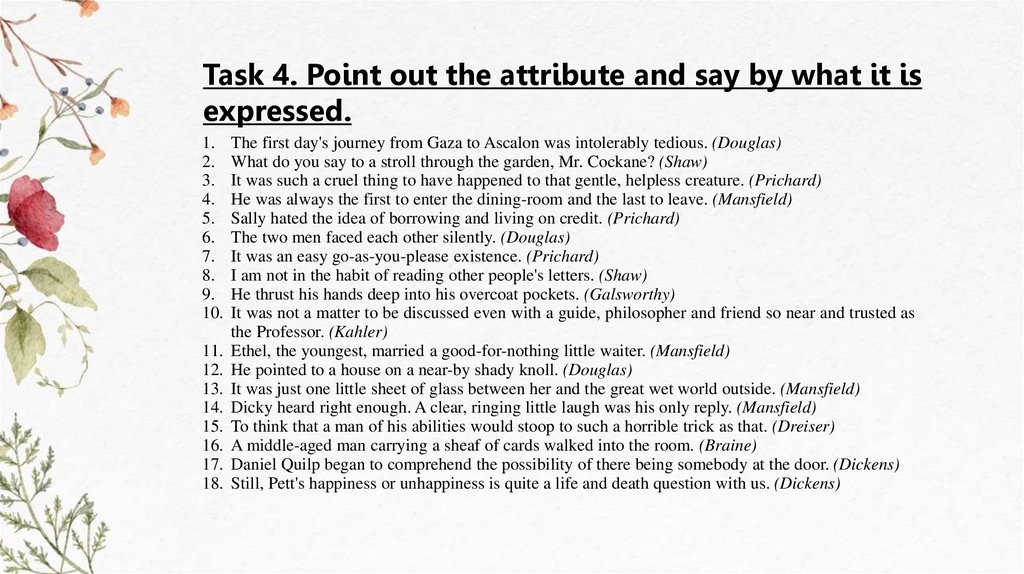
Task 4. Point out the attribute and say by what it isexpressed.
1. The first day's journey from Gaza to Ascalon was intolerably tedious. (Douglas)
2. What do you say to a stroll through the garden, Mr. Cockane? (Shaw)
3. It was such a cruel thing to have happened to that gentle, helpless creature. (Prichard)
4. He was always the first to enter the dining-room and the last to leave. (Mansfield)
5. Sally hated the idea of borrowing and living on credit. (Prichard)
6. The two men faced each other silently. (Douglas)
7. It was an easy go-as-you-please existence. (Prichard)
8. I am not in the habit of reading other people's letters. (Shaw)
9. He thrust his hands deep into his overcoat pockets. (Galsworthy)
10. It was not a matter to be discussed even with a guide, philosopher and friend so near and trusted as
the Professor. (Kahler)
11. Ethel, the youngest, married a good-for-nothing little waiter. (Mansfield)
12. He pointed to a house on a near-by shady knoll. (Douglas)
13. It was just one little sheet of glass between her and the great wet world outside. (Mansfield)
14. Dicky heard right enough. A clear, ringing little laugh was his only reply. (Mansfield)
15. To think that a man of his abilities would stoop to such a horrible trick as that. (Dreiser)
16. A middle-aged man carrying a sheaf of cards walked into the room. (Braine)
17. Daniel Quilp began to comprehend the possibility of there being somebody at the door. (Dickens)
18. Still, Pett's happiness or unhappiness is quite a life and death question with us. (Dickens)
15.
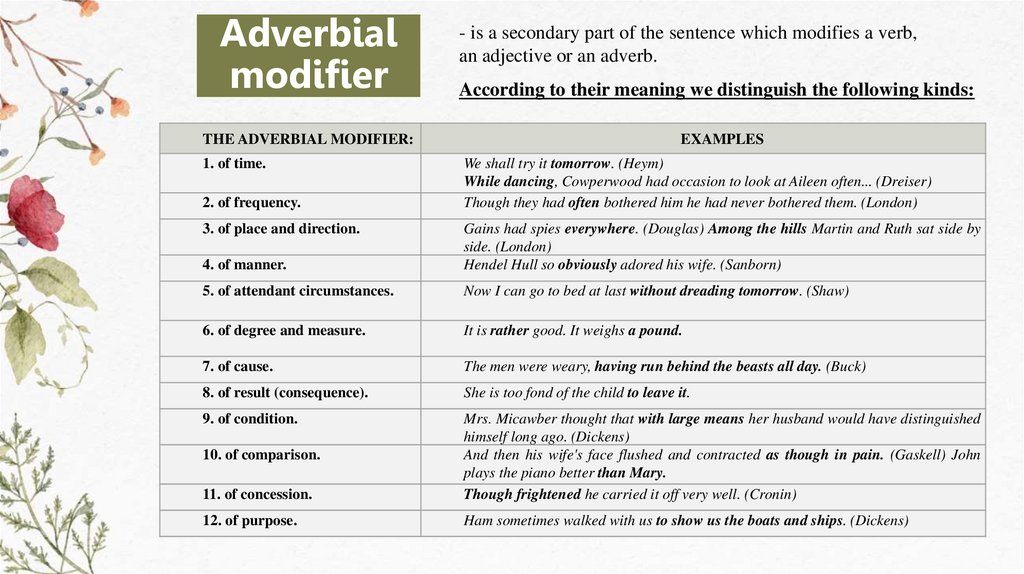
Adverbialmodifier
THE ADVERBIAL MODIFIER:
1. of time.
2. of frequency.
3. of place and direction.
- is a secondary part of the sentence which modifies a verb,
an adjective or an adverb.
According to their meaning we distinguish the following kinds:
EXAMPLES
We shall try it tomorrow. (Heym)
While dancing, Cowperwood had occasion to look at Aileen often... (Dreiser)
Though they had often bothered him he had never bothered them. (London)
4. of manner.
Gains had spies everywhere. (Douglas) Among the hills Martin and Ruth sat side by
side. (London)
Hendel Hull so obviously adored his wife. (Sanborn)
5. of attendant circumstances.
Now I can go to bed at last without dreading tomorrow. (Shaw)
6. of degree and measure.
It is rather good. It weighs a pound.
7. of cause.
The men were weary, having run behind the beasts all day. (Buck)
8. of result (consequence).
She is too fond of the child to leave it.
9. of condition.
11. of concession.
Mrs. Micawber thought that with large means her husband would have distinguished
himself long ago. (Dickens)
And then his wife's face flushed and contracted as though in pain. (Gaskell) John
plays the piano better than Mary.
Though frightened he carried it off very well. (Cronin)
12. of purpose.
Ham sometimes walked with us to show us the boats and ships. (Dickens)
10. of comparison.
16.
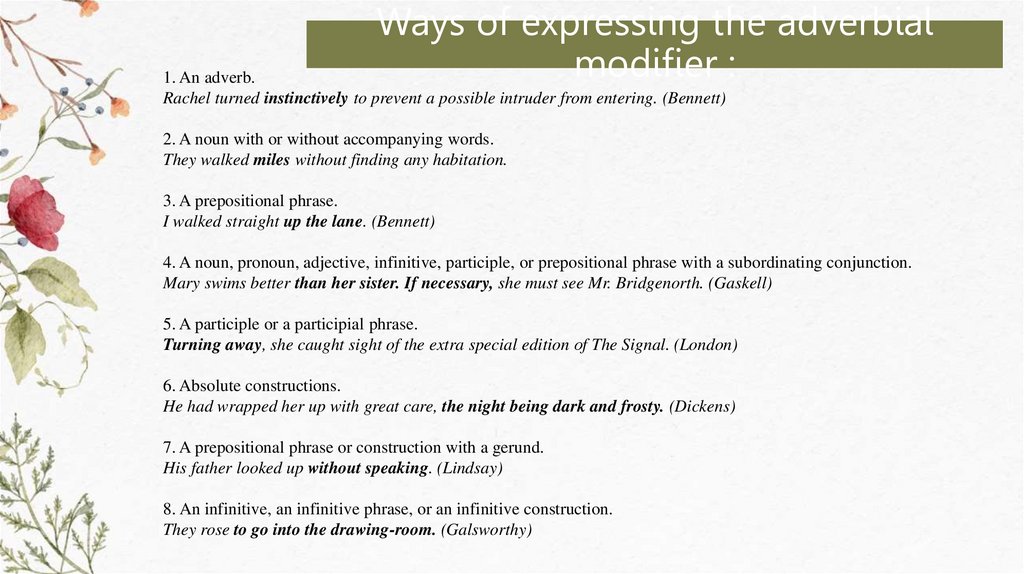
Ways of expressing the adverbialmodifier :
1. An adverb.
Rachel turned instinctively to prevent a possible intruder from entering. (Bennett)
2. A noun with or without accompanying words.
They walked miles without finding any habitation.
3. A prepositional phrase.
I walked straight up the lane. (Bennett)
4. A noun, pronoun, adjective, infinitive, participle, or prepositional phrase with a subordinating conjunction.
Mary swims better than her sister. If necessary, she must see Mr. Bridgenorth. (Gaskell)
5. A participle or a participial phrase.
Turning away, she caught sight of the extra special edition оf The Signal. (London)
6. Absolute constructions.
He had wrapped her up with great care, the night being dark and frosty. (Dickens)
7. A prepositional phrase or construction with a gerund.
His father looked up without speaking. (Lindsay)
8. An infinitive, an infinitive phrase, or an infinitive construction.
They rose to go into the drawing-room. (Galsworthy)
17.
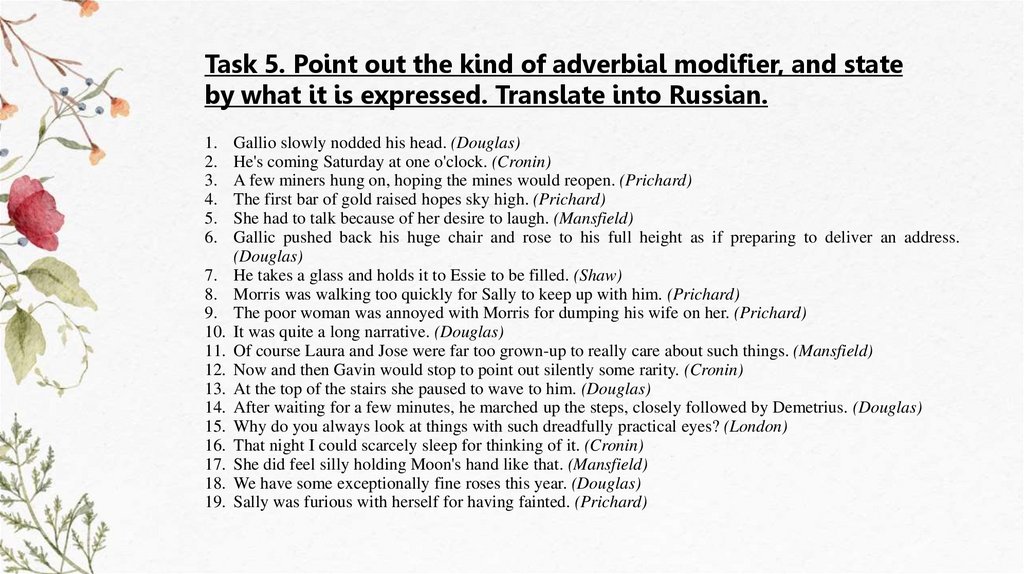
Task 5. Point out the kind of adverbial modifier, and stateby what it is expressed. Translate into Russian.
1.
2.
3.
4.
5.
6.
Gallio slowly nodded his head. (Douglas)
He's coming Saturday at one o'clock. (Cronin)
A few miners hung on, hoping the mines would reopen. (Prichard)
The first bar of gold raised hopes sky high. (Prichard)
She had to talk because of her desire to laugh. (Mansfield)
Gallic pushed back his huge chair and rose to his full height as if preparing to deliver an address.
(Douglas)
7. He takes a glass and holds it to Essie to be filled. (Shaw)
8. Morris was walking too quickly for Sally to keep up with him. (Prichard)
9. The poor woman was annoyed with Morris for dumping his wife on her. (Prichard)
10. It was quite a long narrative. (Douglas)
11. Of course Laura and Jose were far too grown-up to really care about such things. (Mansfield)
12. Now and then Gavin would stop to point out silently some rarity. (Cronin)
13. At the top of the stairs she paused to wave to him. (Douglas)
14. After waiting for a few minutes, he marched up the steps, closely followed by Demetrius. (Douglas)
15. Why do you always look at things with such dreadfully practical eyes? (London)
16. That night I could scarcely sleep for thinking of it. (Cronin)
17. She did feel silly holding Moon's hand like that. (Mansfield)
18. We have some exceptionally fine roses this year. (Douglas)
19. Sally was furious with herself for having fainted. (Prichard)
18.
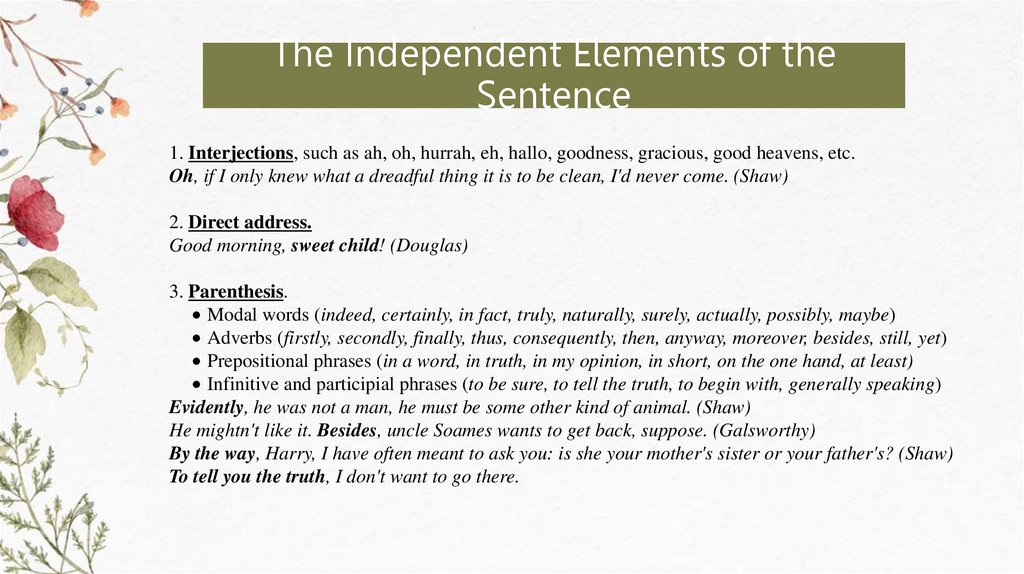
The Independent Elements of theSentence
1. Interjections, such as ah, oh, hurrah, eh, hallo, goodness, gracious, good heavens, etc.
Oh, if I only knew what a dreadful thing it is to be clean, I'd never come. (Shaw)
2. Direct address.
Good morning, sweet child! (Douglas)
3. Parenthesis.
Modal words (indeed, certainly, in fact, truly, naturally, surely, actually, possibly, maybe)
Adverbs (firstly, secondly, finally, thus, consequently, then, anyway, moreover, besides, still, yet)
Prepositional phrases (in a word, in truth, in my opinion, in short, on the one hand, at least)
Infinitive and participial phrases (to be sure, to tell the truth, to begin with, generally speaking)
Evidently, he was not a man, he must be some other kind of animal. (Shaw)
He mightn't like it. Besides, uncle Soames wants to get back, suppose. (Galsworthy)
By the way, Harry, I have often meant to ask you: is she your mother's sister or your father's? (Shaw)
To tell you the truth, I don't want to go there.
19.
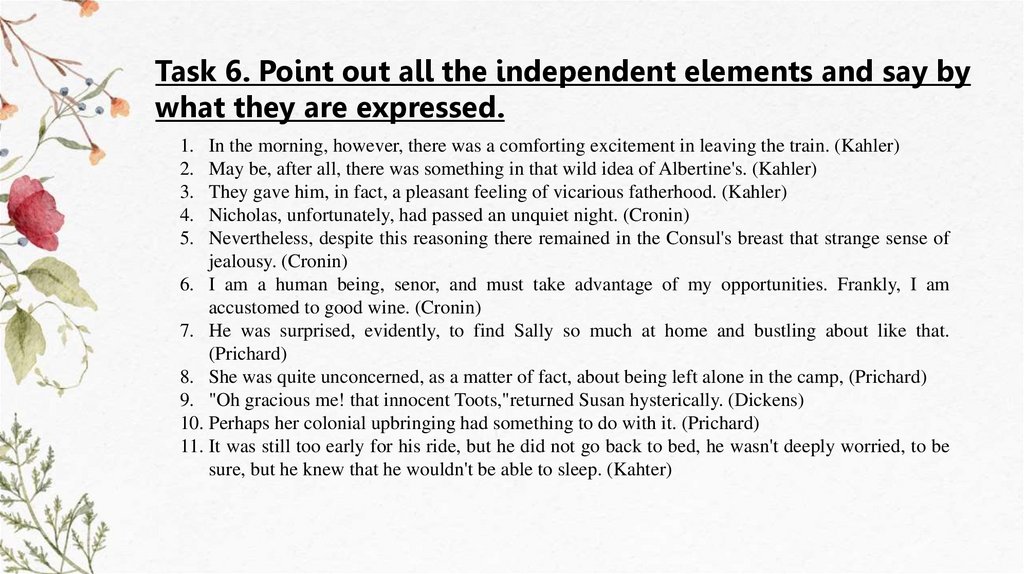
Task 6. Point out all the independent elements and say bywhat they are expressed.
1.
2.
3.
4.
5.
In the morning, however, there was a comforting excitement in leaving the train. (Kahler)
May be, after all, there was something in that wild idea of Albertine's. (Kahler)
They gave him, in fact, a pleasant feeling of vicarious fatherhood. (Kahler)
Nicholas, unfortunately, had passed an unquiet night. (Cronin)
Nevertheless, despite this reasoning there remained in the Consul's breast that strange sense of
jealousy. (Cronin)
6. I am a human being, senor, and must take advantage of my opportunities. Frankly, I am
accustomed to good wine. (Cronin)
7. He was surprised, evidently, to find Sally so much at home and bustling about like that.
(Prichard)
8. She was quite unconcerned, as a matter of fact, about being left alone in the camp, (Prichard)
9. "Oh gracious me! that innocent Toots,"returned Susan hysterically. (Dickens)
10. Perhaps her colonial upbringing had something to do with it. (Prichard)
11. It was still too early for his ride, but he did not go back to bed, he wasn't deeply worried, to be
sure, but he knew that he wouldn't be able to sleep. (Kahter)
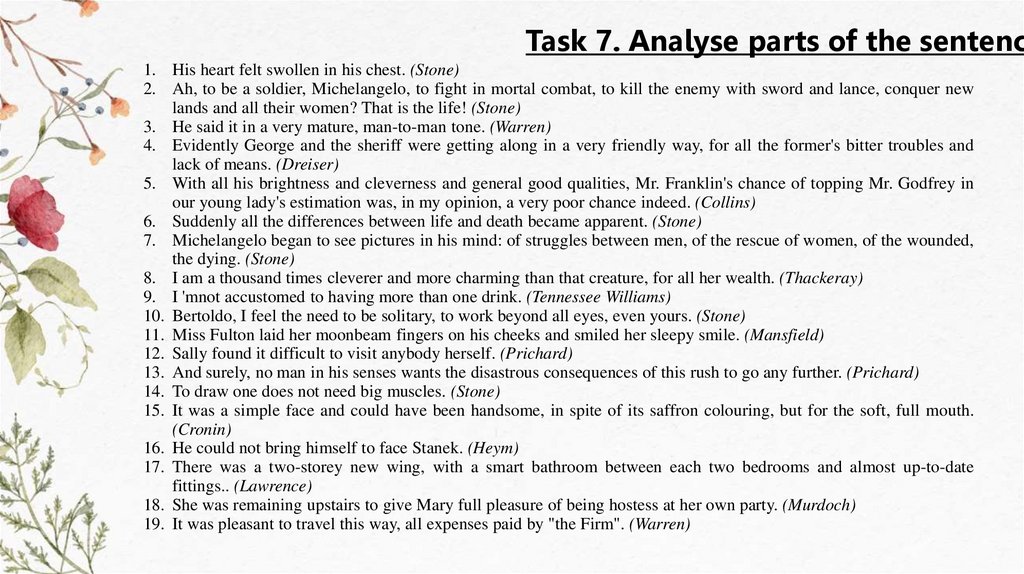
20.
Task 7. Analyse parts of the sentenc1. His heart felt swollen in his chest. (Stone)
2. Ah, to be a soldier, Michelangelo, to fight in mortal combat, to kill the enemy with sword and lance, conquer new
lands and all their women? That is the life! (Stone)
3. He said it in a very mature, man-to-man tone. (Warren)
4. Evidently George and the sheriff were getting along in a very friendly way, for all the former's bitter troubles and
lack of means. (Dreiser)
5. With all his brightness and cleverness and general good qualities, Mr. Franklin's chance of topping Mr. Godfrey in
our young lady's estimation was, in my opinion, a very poor chance indeed. (Collins)
6. Suddenly all the differences between life and death became apparent. (Stone)
7. Michelangelo began to see pictures in his mind: of struggles between men, of the rescue of women, of the wounded,
the dying. (Stone)
8. I am a thousand times cleverer and more charming than that creature, for all her wealth. (Thackeray)
9. I 'mnot accustomed to having more than one drink. (Tennessee Williams)
10. Bertoldo, I feel the need to be solitary, to work beyond all eyes, even yours. (Stone)
11. Miss Fulton laid her moonbeam fingers on his cheeks and smiled her sleepy smile. (Mansfield)
12. Sally found it difficult to visit anybody herself. (Prichard)
13. And surely, no man in his senses wants the disastrous consequences of this rush to go any further. (Prichard)
14. To draw one does not need big muscles. (Stone)
15. It was a simple face and could have been handsome, in spite of its saffron colouring, but for the soft, full mouth.
(Cronin)
16. He could not bring himself to face Stanek. (Heym)
17. There was a two-storey new wing, with a smart bathroom between each two bedrooms and almost up-to-date
fittings.. (Lawrence)
18. She was remaining upstairs to give Mary full pleasure of being hostess at her own party. (Murdoch)
19. It was pleasant to travel this way, all expenses paid by "the Firm". (Warren)