



![to strangle (v) [ˈstræŋɡl] to prevent something from developing They allowed bureaucracy to strangle initiative.](https://cf5.ppt-online.org/files5/slide/p/pt7hcf6IzPblZxACSreGT2VqK85QOJYWHMjRLo/slide-21.jpg "to strangle (v) [ˈstræŋɡl] to prevent something from developing They allowed bureaucracy to strangle initiative.")
![chief executive (n) [ʧiːf ɪgˈzekjʊtɪv] the top-ranking corporate officer charged with the management of an organization](https://cf5.ppt-online.org/files5/slide/p/pt7hcf6IzPblZxACSreGT2VqK85QOJYWHMjRLo/slide-23.jpg "chief executive (n) [ʧiːf ɪgˈzekjʊtɪv] the top-ranking corporate officer charged with the management of an organization")
![indispensable (adj) [ˌɪndɪˈspensəbl] completely necessary Libraries have been indispensable resources for universities](https://cf5.ppt-online.org/files5/slide/p/pt7hcf6IzPblZxACSreGT2VqK85QOJYWHMjRLo/slide-24.jpg "indispensable (adj) [ˌɪndɪˈspensəbl] completely necessary Libraries have been indispensable resources for universities")
![dismissal (n) [dɪsˈmɪsəl] when your employer ends your employment](https://cf5.ppt-online.org/files5/slide/p/pt7hcf6IzPblZxACSreGT2VqK85QOJYWHMjRLo/slide-25.jpg "dismissal (n) [dɪsˈmɪsəl] when your employer ends your employment")
![constructive dismissal (n) [dɪsˈmɪsəl] when an employee resigns because their employer's conduct has made the workplace](https://cf5.ppt-online.org/files5/slide/p/pt7hcf6IzPblZxACSreGT2VqK85QOJYWHMjRLo/slide-26.jpg "constructive dismissal (n) [dɪsˈmɪsəl] when an employee resigns because their employer's conduct has made the workplace")
![employee harassment (n) [ˈhærəsmənt] any unwelcome and offensive conduct that intimidates or offends employees and can create a](https://cf5.ppt-online.org/files5/slide/p/pt7hcf6IzPblZxACSreGT2VqK85QOJYWHMjRLo/slide-27.jpg "employee harassment (n) [ˈhærəsmənt] any unwelcome and offensive conduct that intimidates or offends employees and can create a")
![redundant (adj) [rɪˈdʌndənt] not working because your employer has told you there is not enough work Eight thousand people have](https://cf5.ppt-online.org/files5/slide/p/pt7hcf6IzPblZxACSreGT2VqK85QOJYWHMjRLo/slide-29.jpg "redundant (adj) [rɪˈdʌndənt] not working because your employer has told you there is not enough work Eight thousand people have")
![shape up (phrasal verb) [rɪˈdʌndənt] to develop or improve Things at work seem to be shaping up quite nicely.](https://cf5.ppt-online.org/files5/slide/p/pt7hcf6IzPblZxACSreGT2VqK85QOJYWHMjRLo/slide-30.jpg "shape up (phrasal verb) [rɪˈdʌndənt] to develop or improve Things at work seem to be shaping up quite nicely.")
![steady (adj) [ˈstedi] happening in a smooth, gradual, and regular way, not suddenly or unexpectedly: Progress has been slow but](https://cf5.ppt-online.org/files5/slide/p/pt7hcf6IzPblZxACSreGT2VqK85QOJYWHMjRLo/slide-33.jpg "steady (adj) [ˈstedi] happening in a smooth, gradual, and regular way, not suddenly or unexpectedly: Progress has been slow but")
![humdrum (adj) [ˈhʌmdrʌm] lacking excitement or variety; boringly monotonous I hate humdrum routine work.](https://cf5.ppt-online.org/files5/slide/p/pt7hcf6IzPblZxACSreGT2VqK85QOJYWHMjRLo/slide-34.jpg "humdrum (adj) [ˈhʌmdrʌm] lacking excitement or variety; boringly monotonous I hate humdrum routine work.")
![mundane(adj) [ˌmʌnˈdeɪn] lacking interest or excitement; dull: It is a mundane task/life.](https://cf5.ppt-online.org/files5/slide/p/pt7hcf6IzPblZxACSreGT2VqK85QOJYWHMjRLo/slide-35.jpg "mundane(adj) [ˌmʌnˈdeɪn] lacking interest or excitement; dull: It is a mundane task/life.")
![contingent(adj) [kənˈtɪn(d)ʒ(ə)nt] occurring or existing only if (certain circumstances) are the case; dependent on: Outdoor](https://cf5.ppt-online.org/files5/slide/p/pt7hcf6IzPblZxACSreGT2VqK85QOJYWHMjRLo/slide-37.jpg "contingent(adj) [kənˈtɪn(d)ʒ(ə)nt] occurring or existing only if (certain circumstances) are the case; dependent on: Outdoor")
![intrinsic(adj) [ɪnˈtrɪnzɪk] being an extremely important and basic characteristic of a person or thing: Design is intrinsic to](https://cf5.ppt-online.org/files5/slide/p/pt7hcf6IzPblZxACSreGT2VqK85QOJYWHMjRLo/slide-38.jpg "intrinsic(adj) [ɪnˈtrɪnzɪk] being an extremely important and basic characteristic of a person or thing: Design is intrinsic to")
![vision(n)[ˈvɪʒn] the ability to imagine how a country, society, industry, etc. could develop in the future and to plan for](https://cf5.ppt-online.org/files5/slide/p/pt7hcf6IzPblZxACSreGT2VqK85QOJYWHMjRLo/slide-39.jpg "vision(n)[ˈvɪʒn] the ability to imagine how a country, society, industry, etc. could develop in the future and to plan for")
![continuity(n) [ˌkɒntɪˈnjuːəti] the state of continuing for a long period of time without being changed or stopped: That](https://cf5.ppt-online.org/files5/slide/p/pt7hcf6IzPblZxACSreGT2VqK85QOJYWHMjRLo/slide-40.jpg "continuity(n) [ˌkɒntɪˈnjuːəti] the state of continuing for a long period of time without being changed or stopped: That")
![escalate(v) [ˈeskəleɪt] to rise or increase quickly: Airline prices escalate during the holiday season.](https://cf5.ppt-online.org/files5/slide/p/pt7hcf6IzPblZxACSreGT2VqK85QOJYWHMjRLo/slide-41.jpg "escalate(v) [ˈeskəleɪt] to rise or increase quickly: Airline prices escalate during the holiday season.")
 management
Similar presentations:






Leadership Styles. Unit 7
1. Unit 7. Leadership Styles PhD in Pedagogical Sciences, MBA, ESL Teacher Elena Alexandrovna Perova
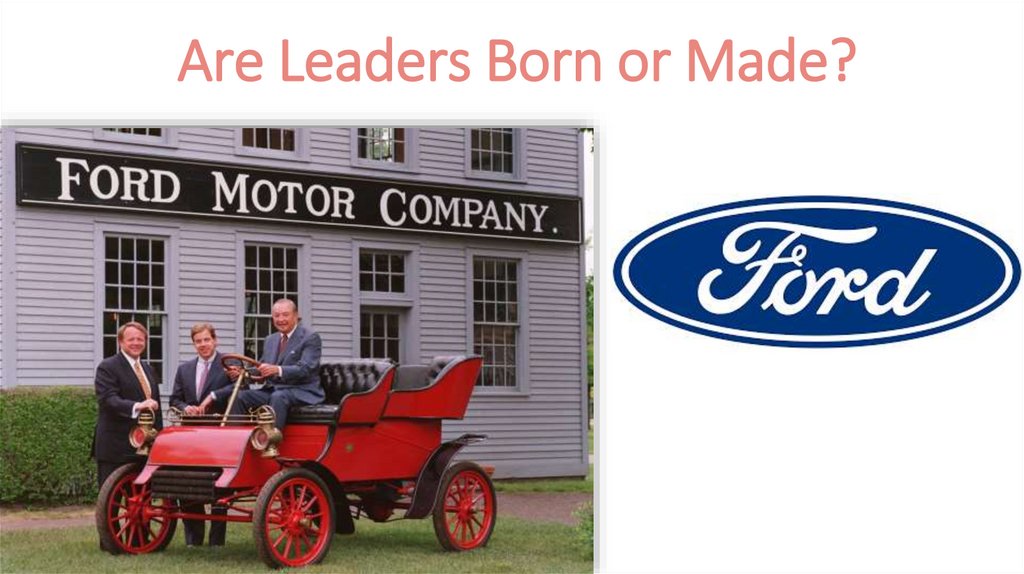
2. Are Leaders Born or Made?
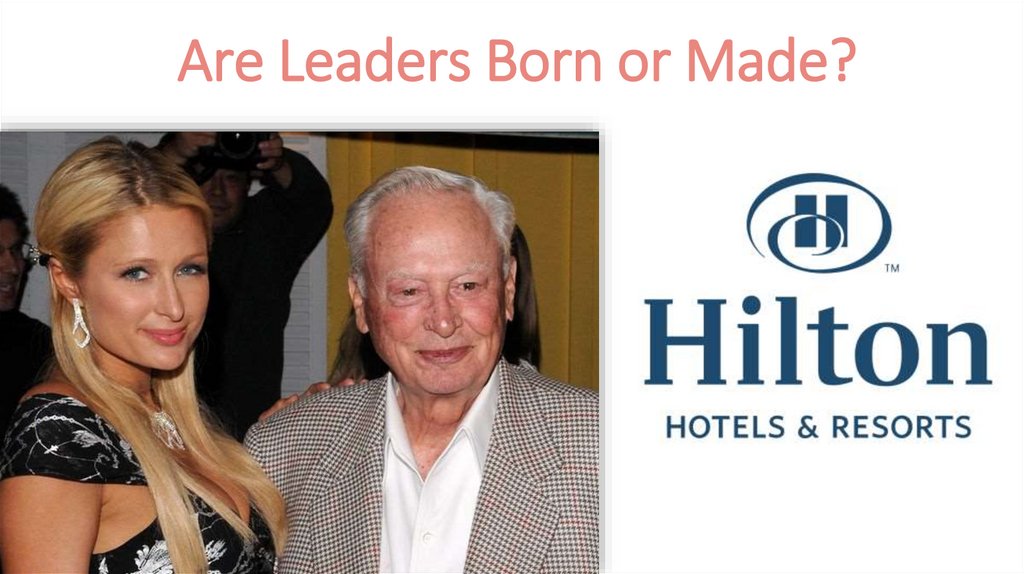
3. Are Leaders Born or Made?
4. Are Leaders Born or Made?
5. Leadership
ability to influence a group toward the achievementof a vision or set of goals
o extraverted;
o disciplined;
o conscientious;
o open.
6. Transactional Leadership
o relies on “give and take”reward-based system;
o a leader sets clear team goals
or tasks;
o concerned with efficiently
following established routines
and procedures.
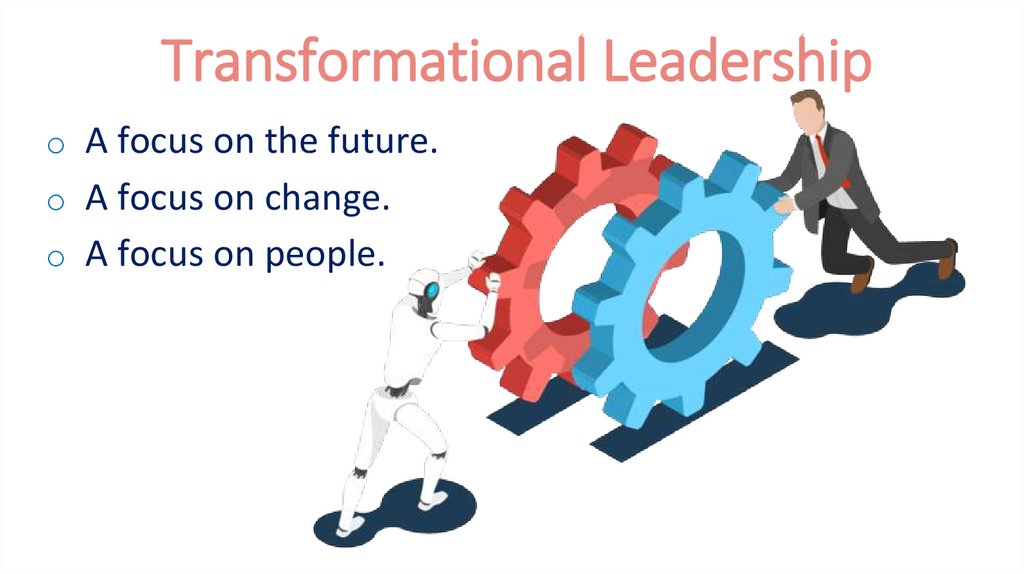
7. Transformational Leadership
o A focus on the future.o A focus on change.
o A focus on people.
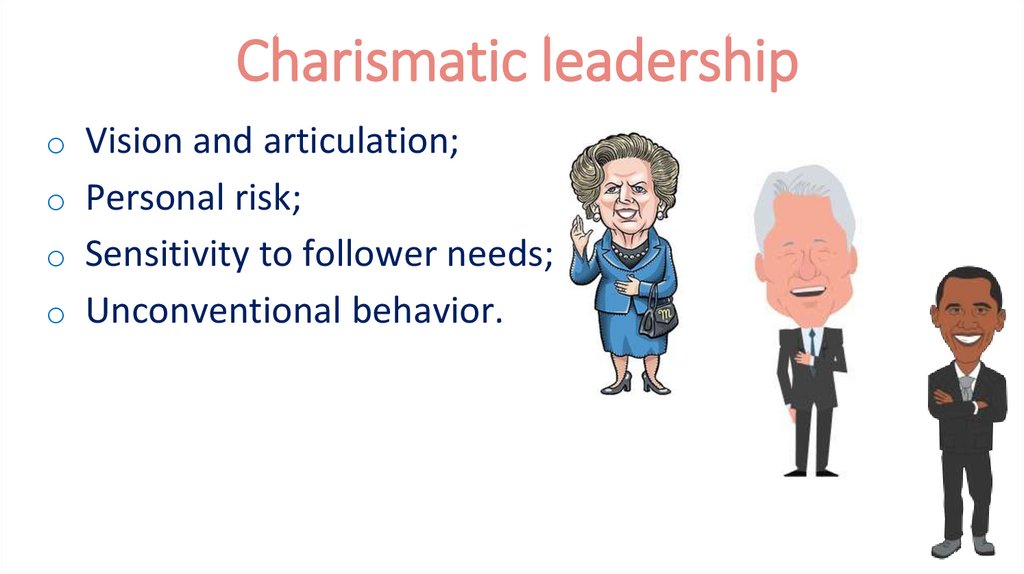
8. Charismatic leadership
o Vision and articulation;o Personal risk;
o Sensitivity to follower needs;
o Unconventional behavior.
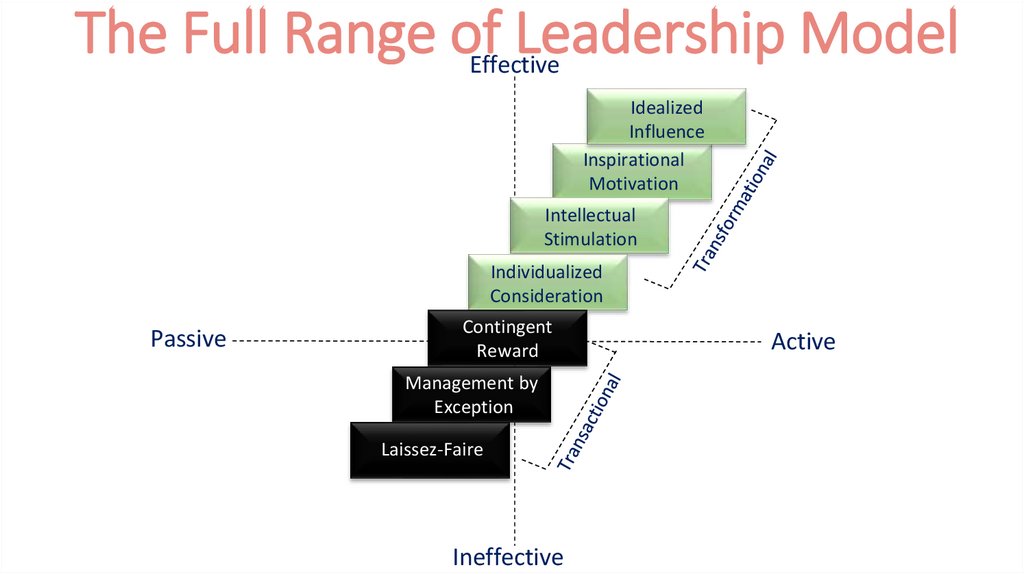
9. The Full Range of Leadership Model
EffectiveIdealized
Influence
Inspirational
Motivation
Intellectual
Stimulation
Individualized
Consideration
Passive
Contingent
Reward
Management by
Exception
Laissez-Faire
Ineffective
Active
10. Common Leadership Responsibilities
o liaisons with external constituencies;o trouble-shooters;
o conflict managers;
o coaches.
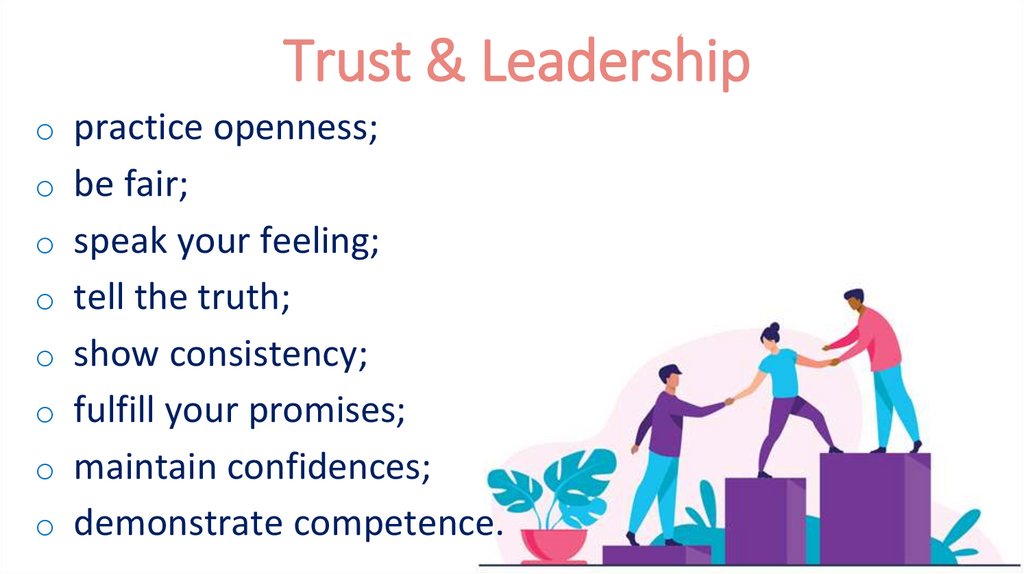
11. Trust & Leadership
Trust & Leadershipo practice openness;
o be fair;
o speak your feeling;
o tell the truth;
o show consistency;
o fulfill your promises;
o maintain confidences;
o demonstrate competence.
12.
13. The First Temptation
CEO may be more interested inprotecting his/her career status than
in making sure his/her company
achieves results.
Simple advice for CEOs: make results
the most important measure of
personal success, or step down from
the job.
14. The Second Temptation
wanting to be popular with yourdirect reports instead of holding
them accountable.
Simple advice for CEOs: work for
the long-term respect of your
direct reports, not for their
affection.
15. The Third Temptation
to choose certainty over claritySimple advice for CEOs: make
clarity more important than
accuracy. It is your job to risk being
wrong.
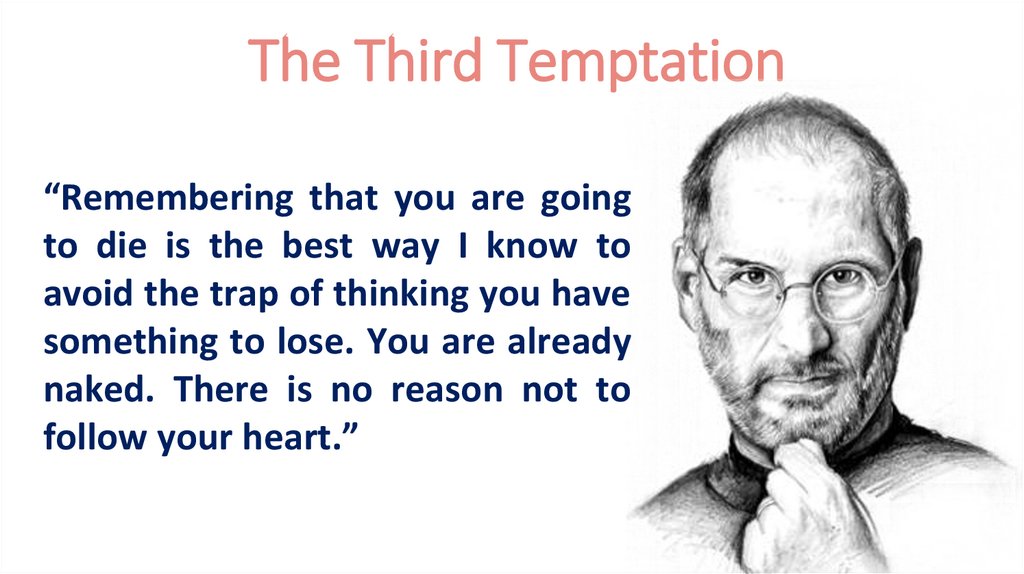
16. The Third Temptation
“Remembering that you are goingto die is the best way I know to
avoid the trap of thinking you have
something to lose. You are already
naked. There is no reason not to
follow your heart.”
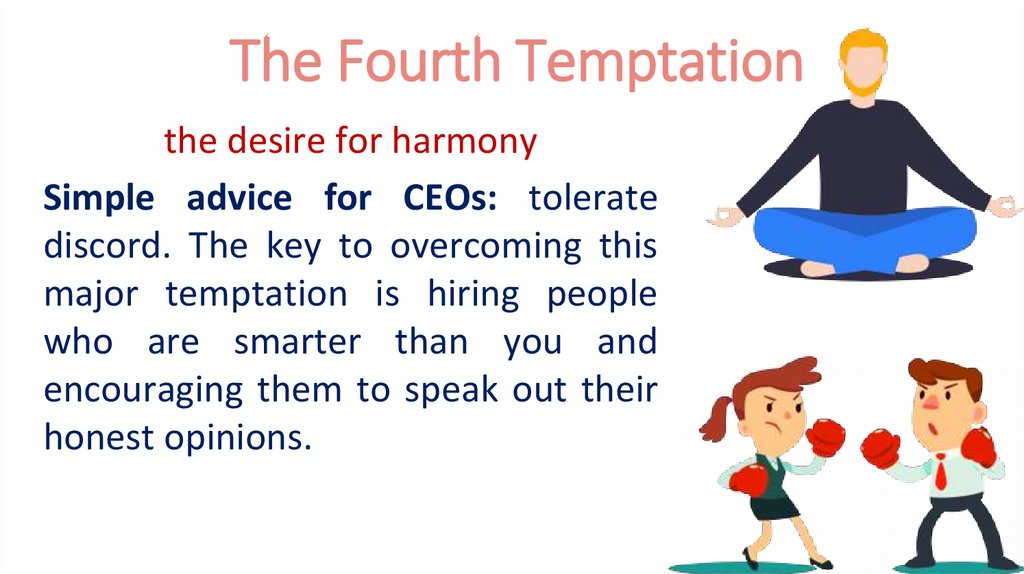
17. The Fourth Temptation
the desire for harmonySimple advice for CEOs: tolerate
discord. The key to overcoming this
major temptation is hiring people
who are smarter than you and
encouraging them to speak out their
honest opinions.
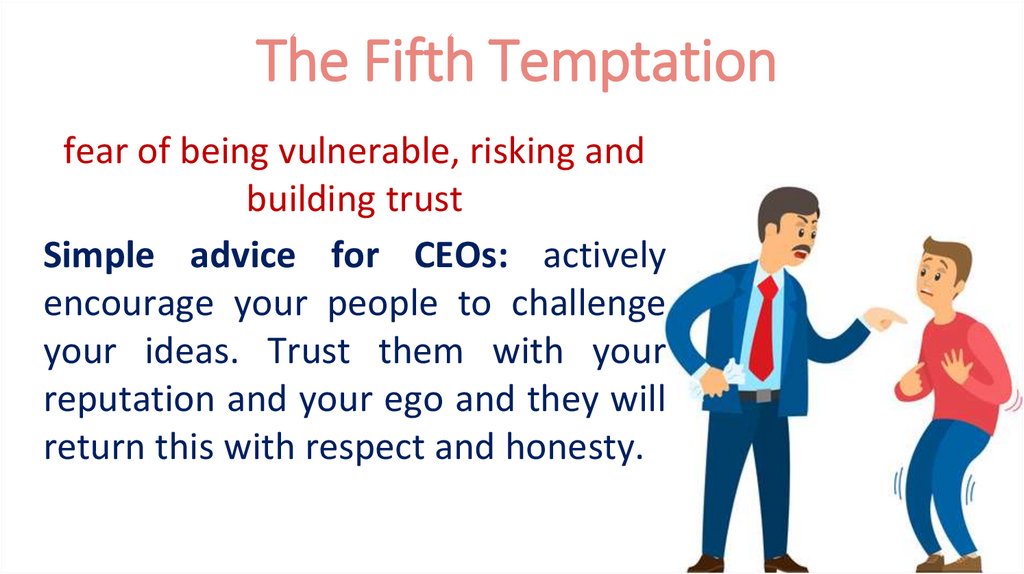
18. The Fifth Temptation
fear of being vulnerable, risking andbuilding trust
Simple advice for CEOs: actively
encourage your people to challenge
your ideas. Trust them with your
reputation and your ego and they will
return this with respect and honesty.
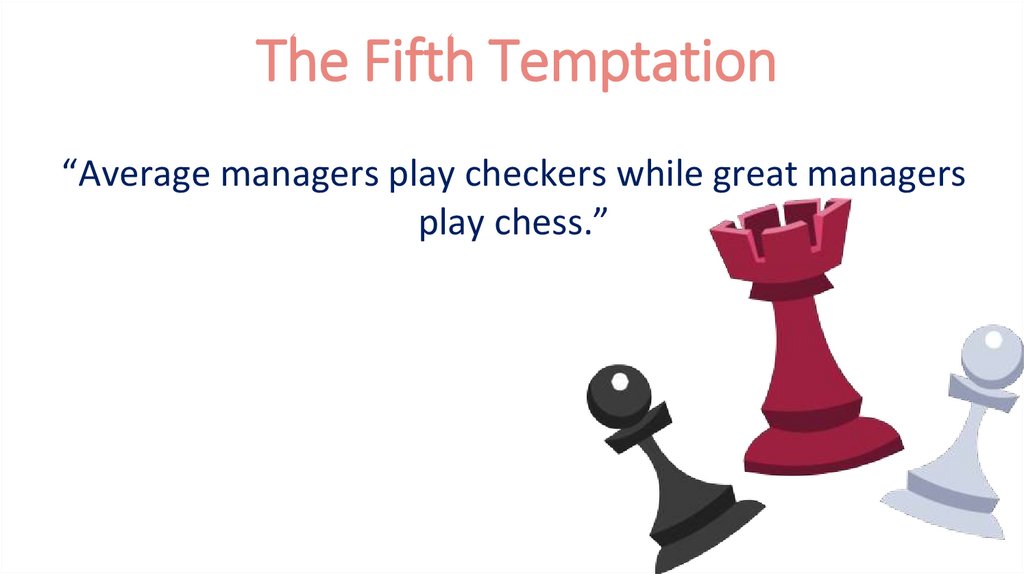
19. The Fifth Temptation
“Average managers play checkers while great managersplay chess.”
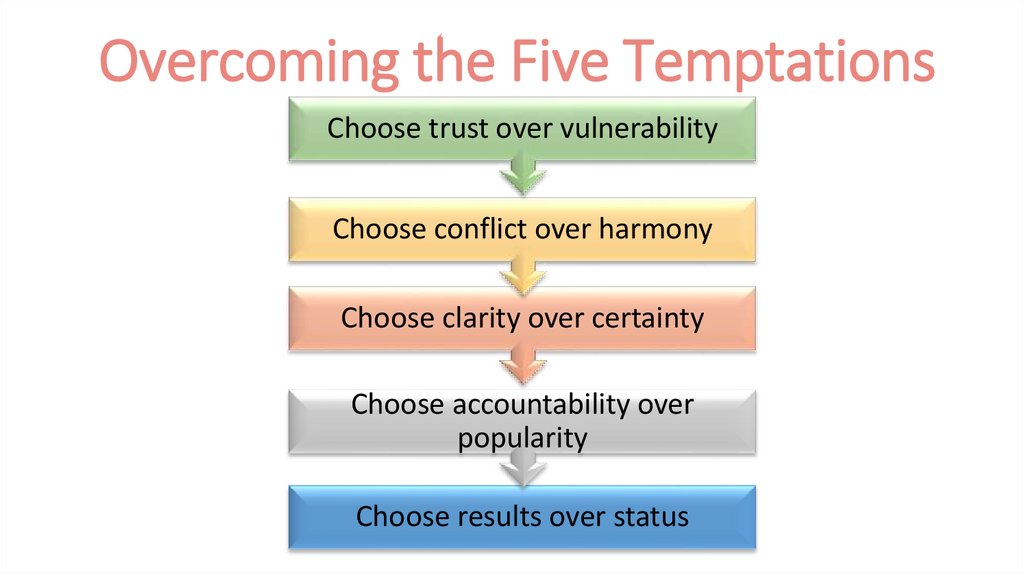
20. Overcoming the Five Temptations
Choose trust over vulnerabilityChoose conflict over harmony
Choose clarity over certainty
Choose accountability over
popularity
Choose results over status
21. Awesome words
22. to strangle (v) [ˈstræŋɡl] to prevent something from developing They allowed bureaucracy to strangle initiative.
23. out in the open (idiom) no longer hidden or secret, but known to the public The scandal is now out in the open.
24. chief executive (n) [ʧiːf ɪgˈzekjʊtɪv] the top-ranking corporate officer charged with the management of an organization
25. indispensable (adj) [ˌɪndɪˈspensəbl] completely necessary Libraries have been indispensable resources for universities
throughout history.26. dismissal (n) [dɪsˈmɪsəl] when your employer ends your employment
27. constructive dismissal (n) [dɪsˈmɪsəl] when an employee resigns because their employer's conduct has made the workplace
constructive dismissal (n)[dɪsˈmɪsəl]
when an employee resigns because their
employer's conduct has made the
workplace intolerable, effectively forcing
them out
28. employee harassment (n) [ˈhærəsmənt] any unwelcome and offensive conduct that intimidates or offends employees and can create a
hostile work environment29. to swing (v) If someone's opinion or their feelings swing, they suddenly change. Her moods swing with absolutely no warning.
to swing (v)If someone's opinion or their feelings
swing, they suddenly change.
Her moods swing with absolutely no
warning.
30. redundant (adj) [rɪˈdʌndənt] not working because your employer has told you there is not enough work Eight thousand people have
been maderedundant in Britain this year.
31. shape up (phrasal verb) [rɪˈdʌndənt] to develop or improve Things at work seem to be shaping up quite nicely.
32. strike a balance(idiom) to achieve a state in which different things have an equal or proper amount of importance He needs to
strike a better balancebetween his work life and his family life.
33. productively neurotic describes individuals who channel traits like perfectionism, anxiety, and worry into productive behaviors
such as selfimprovement, hard work, and attention todetail
34. steady (adj) [ˈstedi] happening in a smooth, gradual, and regular way, not suddenly or unexpectedly: Progress has been slow but
steady.35. humdrum (adj) [ˈhʌmdrʌm] lacking excitement or variety; boringly monotonous I hate humdrum routine work.
36. mundane(adj) [ˌmʌnˈdeɪn] lacking interest or excitement; dull: It is a mundane task/life.
37. self-reflecting(adj) the ability to think about your own feelings and behaviour, and the reasons that may lie behind them: He
seems to be a self-reflecting leader.38. contingent(adj) [kənˈtɪn(d)ʒ(ə)nt] occurring or existing only if (certain circumstances) are the case; dependent on: Outdoor
activities are contingent on theweather.
39. intrinsic(adj) [ɪnˈtrɪnzɪk] being an extremely important and basic characteristic of a person or thing: Design is intrinsic to
every product.40. vision(n)[ˈvɪʒn] the ability to imagine how a country, society, industry, etc. could develop in the future and to plan for
this:A company's vision is a forward-looking statement that
describes its long-term goals and what it wants to
achieve in the future.
41. continuity(n) [ˌkɒntɪˈnjuːəti] the state of continuing for a long period of time without being changed or stopped: That
preparation creates a sense ofcontinuity and responsibility.