 english
Similar presentations:



Common Tones in AP English
1.
Common Tones in AP EnglishWe study common tones in AP English to understand how
writers express their attitudes and emotions toward a
subject. Recognizing tone helps us interpret meaning beyond
the literal words. It also strengthens our ability to analyze
rhetorical strategies in essays and literature. Knowing tone
words improves both reading comprehension and writing
precision. Overall, understanding tone makes us more
thoughtful and effective readers and writers.
2.
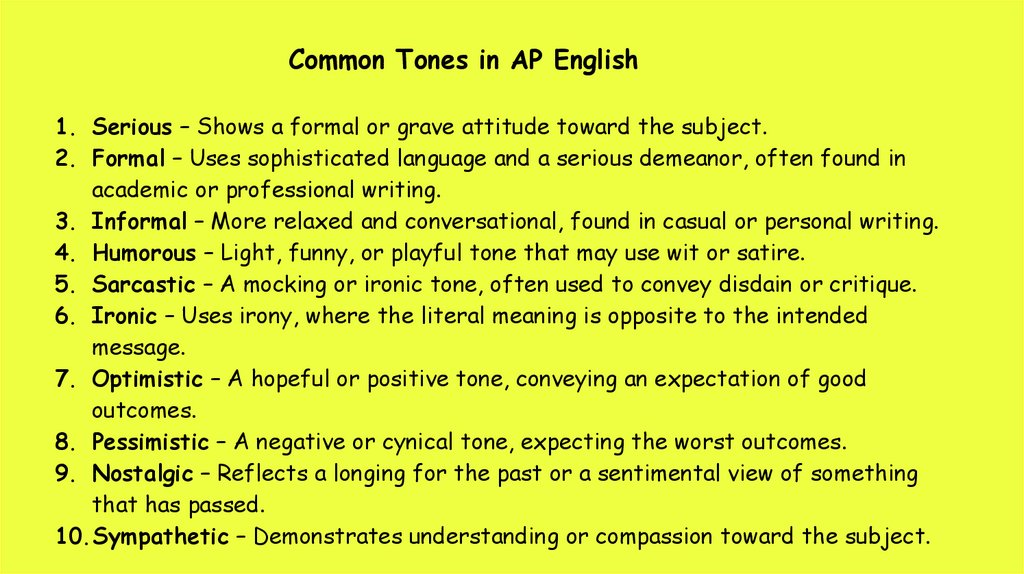
Common Tones in AP English1. Serious – Shows a formal or grave attitude toward the subject.
2. Formal – Uses sophisticated language and a serious demeanor, often found in
academic or professional writing.
3. Informal – More relaxed and conversational, found in casual or personal writing.
4. Humorous – Light, funny, or playful tone that may use wit or satire.
5. Sarcastic – A mocking or ironic tone, often used to convey disdain or critique.
6. Ironic – Uses irony, where the literal meaning is opposite to the intended
message.
7. Optimistic – A hopeful or positive tone, conveying an expectation of good
outcomes.
8. Pessimistic – A negative or cynical tone, expecting the worst outcomes.
9. Nostalgic – Reflects a longing for the past or a sentimental view of something
that has passed.
10.Sympathetic – Demonstrates understanding or compassion toward the subject.
3.
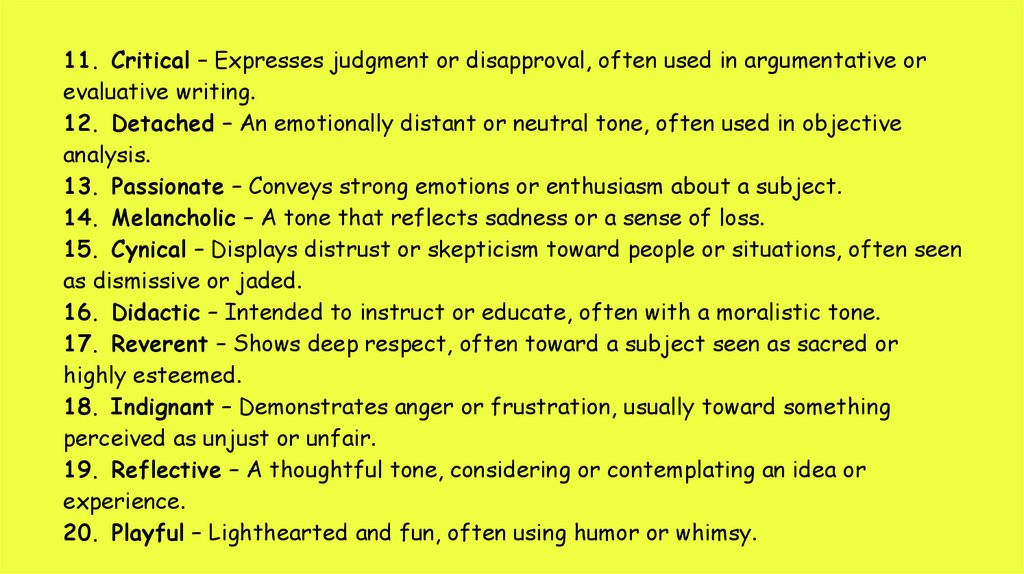
11. Critical – Expresses judgment or disapproval, often used in argumentative orevaluative writing.
12. Detached – An emotionally distant or neutral tone, often used in objective
analysis.
13. Passionate – Conveys strong emotions or enthusiasm about a subject.
14. Melancholic – A tone that reflects sadness or a sense of loss.
15. Cynical – Displays distrust or skepticism toward people or situations, often seen
as dismissive or jaded.
16. Didactic – Intended to instruct or educate, often with a moralistic tone.
17. Reverent – Shows deep respect, often toward a subject seen as sacred or
highly esteemed.
18. Indignant – Demonstrates anger or frustration, usually toward something
perceived as unjust or unfair.
19. Reflective – A thoughtful tone, considering or contemplating an idea or
experience.
20. Playful – Lighthearted and fun, often using humor or whimsy.
4.
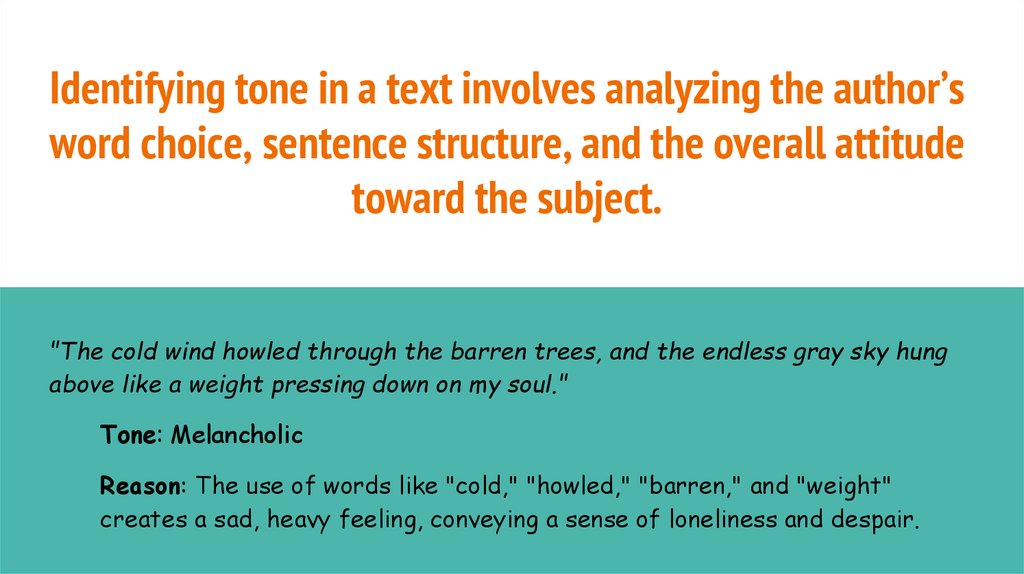
Identifying tone in a text involves analyzing the author’sword choice, sentence structure, and the overall attitude
toward the subject.
"The cold wind howled through the barren trees, and the endless gray sky hung
above like a weight pressing down on my soul."
Tone: Melancholic
Reason: The use of words like "cold," "howled," "barren," and "weight"
creates a sad, heavy feeling, conveying a sense of loneliness and despair.
5.
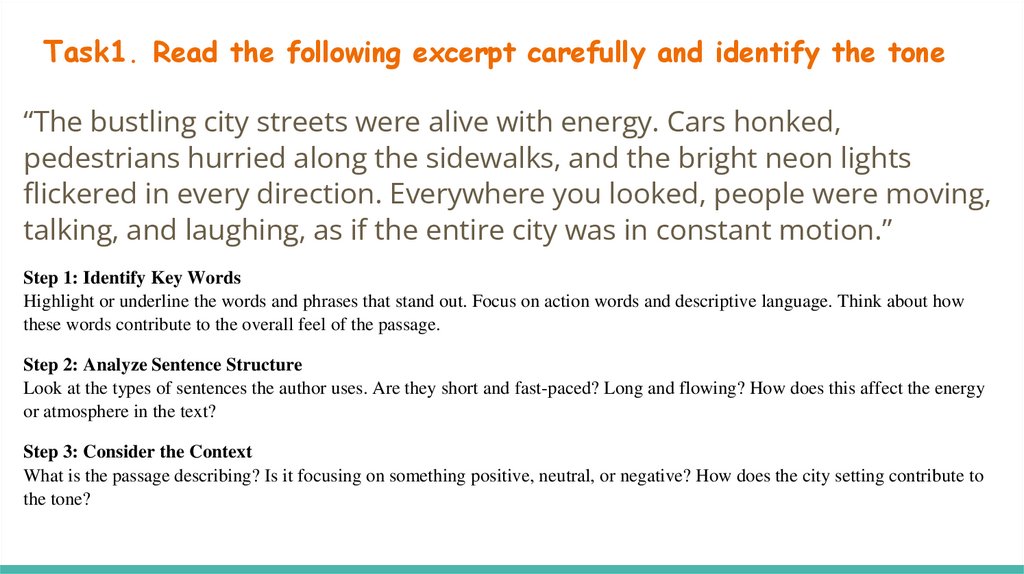
Task1. Read the following excerpt carefully and identify the tone“The bustling city streets were alive with energy. Cars honked,
pedestrians hurried along the sidewalks, and the bright neon lights
flickered in every direction. Everywhere you looked, people were moving,
talking, and laughing, as if the entire city was in constant motion.”
Step 1: Identify Key Words
Highlight or underline the words and phrases that stand out. Focus on action words and descriptive language. Think about how
these words contribute to the overall feel of the passage.
Step 2: Analyze Sentence Structure
Look at the types of sentences the author uses. Are they short and fast-paced? Long and flowing? How does this affect the energy
or atmosphere in the text?
Step 3: Consider the Context
What is the passage describing? Is it focusing on something positive, neutral, or negative? How does the city setting contribute to
the tone?
6.
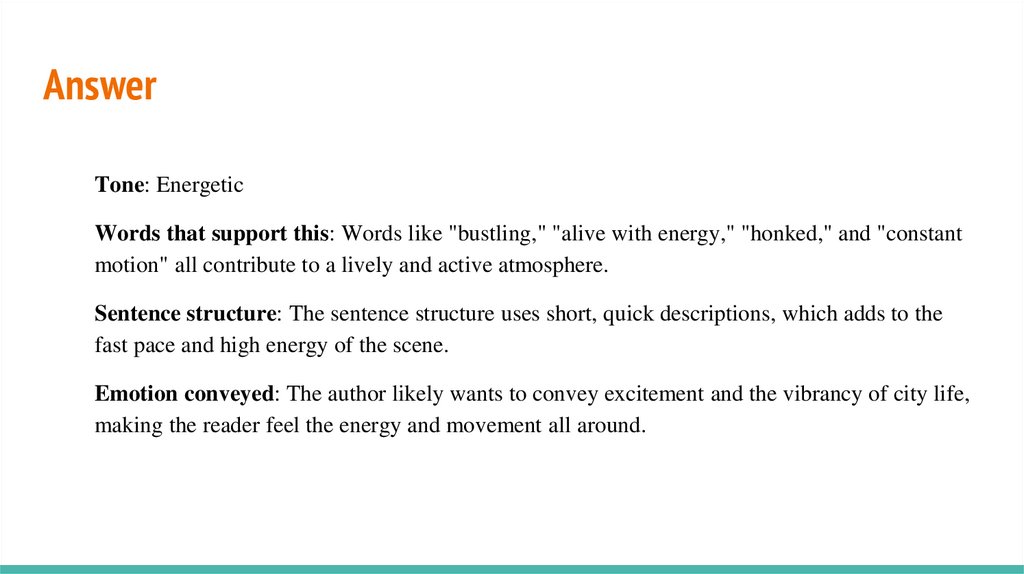
AnswerTone: Energetic
Words that support this: Words like "bustling," "alive with energy," "honked," and "constant
motion" all contribute to a lively and active atmosphere.
Sentence structure: The sentence structure uses short, quick descriptions, which adds to the
fast pace and high energy of the scene.
Emotion conveyed: The author likely wants to convey excitement and the vibrancy of city life,
making the reader feel the energy and movement all around.
7.
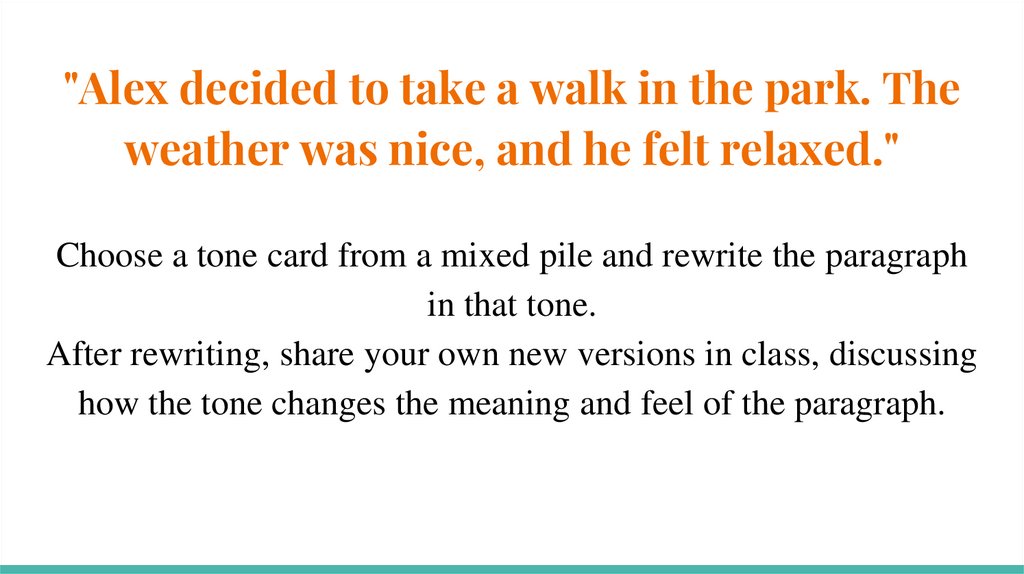
"Alex decided to take a walk in the park. Theweather was nice, and he felt relaxed."
Choose a tone card from a mixed pile and rewrite the paragraph
in that tone.
After rewriting, share your own new versions in class, discussing
how the tone changes the meaning and feel of the paragraph.
8.
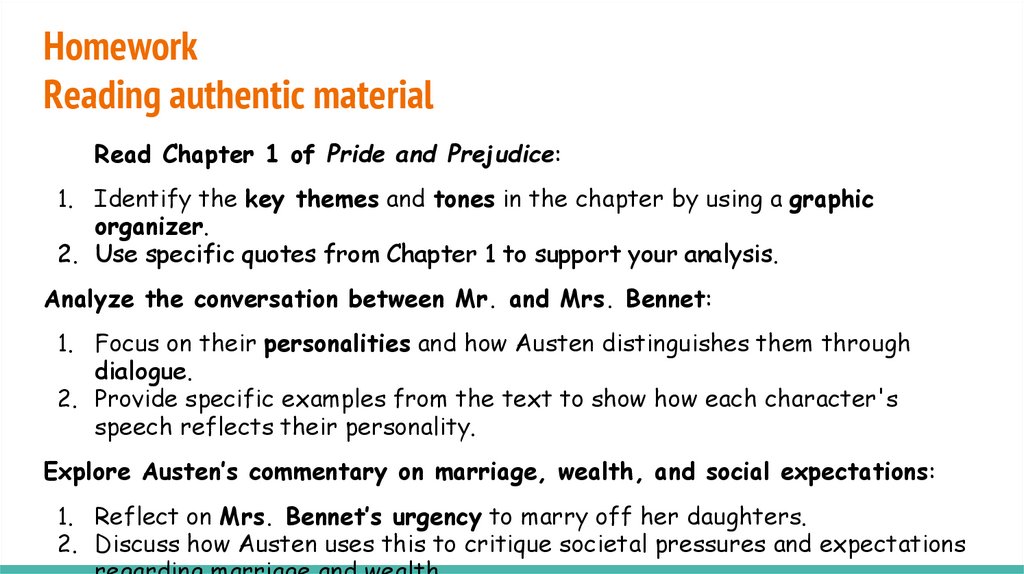
HomeworkReading authentic material
Read Chapter 1 of Pride and Prejudice:
1. Identify the key themes and tones in the chapter by using a graphic
organizer.
2. Use specific quotes from Chapter 1 to support your analysis.
Analyze the conversation between Mr. and Mrs. Bennet:
1. Focus on their personalities and how Austen distinguishes them through
dialogue.
2. Provide specific examples from the text to show how each character's
speech reflects their personality.
Explore Austen’s commentary on marriage, wealth, and social expectations:
1. Reflect on Mrs. Bennet’s urgency to marry off her daughters.
2. Discuss how Austen uses this to critique societal pressures and expectations