 industry
Similar presentations:










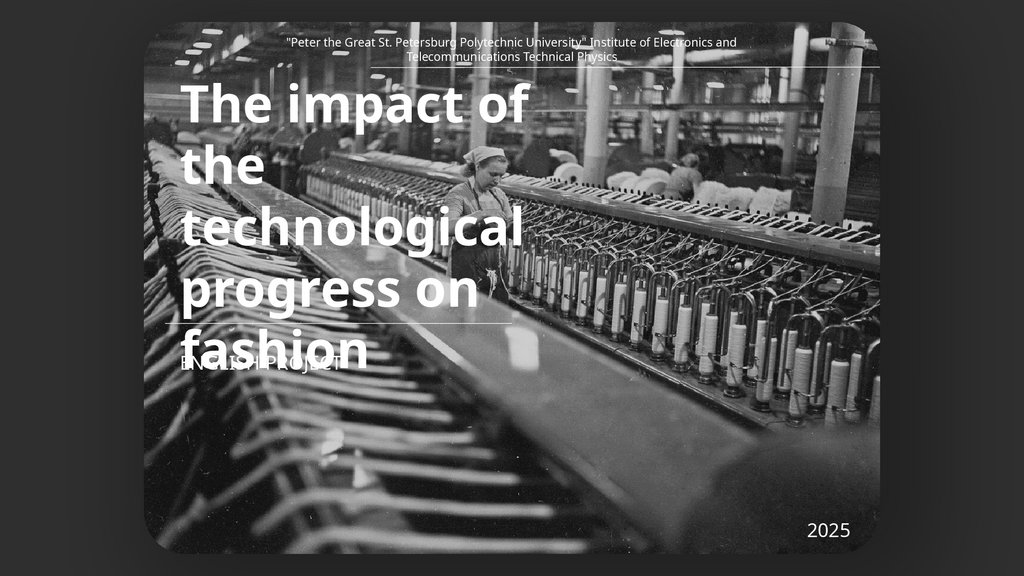
The impact of the technological progress on fashion
1.
"Peter the Great St. Petersburg Polytechnic University" Institute of Electronics andTelecommunications Technical Physics
The impact of
the
technological
progress on
fashion
ENGLISH PROJECT
2025
2.
The Sewing Machine:The Start of Mass
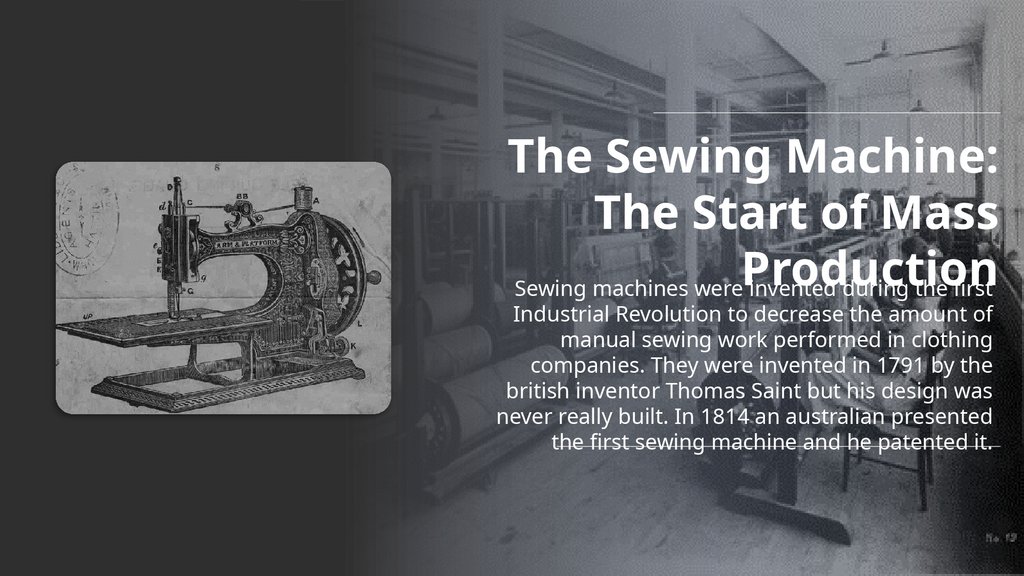
Sewing machines wereProduction
invented during the first
Industrial Revolution to decrease the amount of
manual sewing work performed in clothing
companies. They were invented in 1791 by the
british inventor Thomas Saint but his design was
never really built. In 1814 an australian presented
the first sewing machine and he patented it.
3.
Synthetic Fabrics:Affordable Style and New
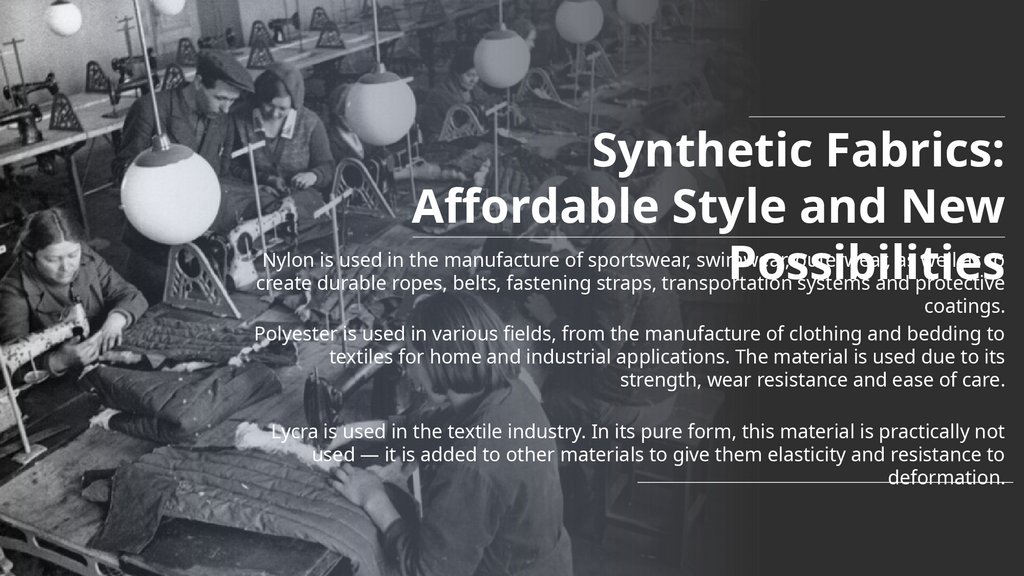
Nylon is used in the manufacture of sportswear, swimwear, outerwear, as well as to
Possibilities
create durable ropes, belts, fastening straps, transportation systems and protective
coatings.
Polyester is used in various fields, from the manufacture of clothing and bedding to
textiles for home and industrial applications. The material is used due to its
strength, wear resistance and ease of care.
Lycra is used in the textile industry. In its pure form, this material is practically not
used — it is added to other materials to give them elasticity and resistance to
deformation.
4.
Fashion Magazines:Creating a Global
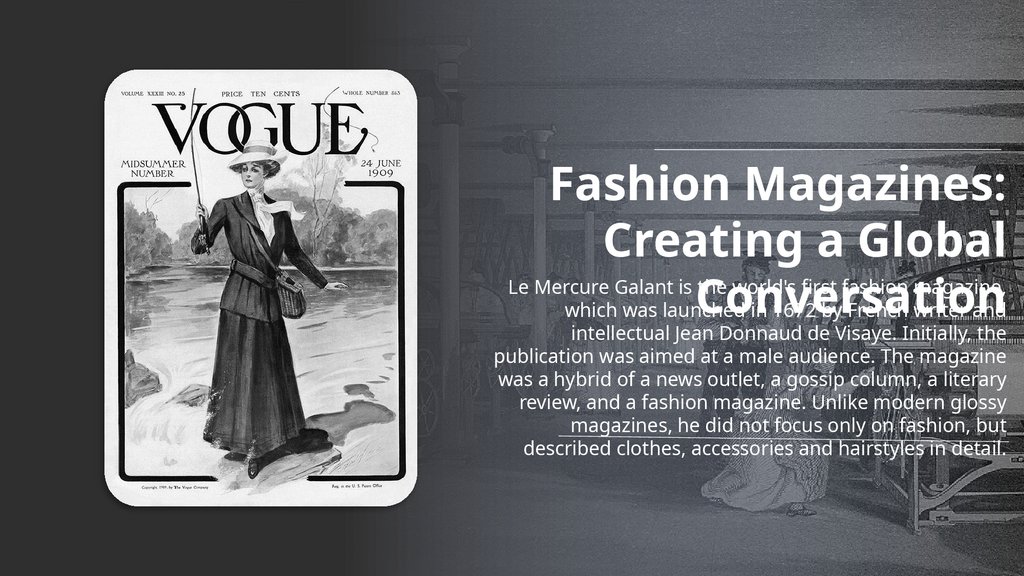
Le Mercure Galant is the world's first fashion magazine,
Conversation
which was launched
in 1672 by French writer and
intellectual Jean Donnaud de Visaye. Initially, the
publication was aimed at a male audience. The magazine
was a hybrid of a news outlet, a gossip column, a literary
review, and a fashion magazine. Unlike modern glossy
magazines, he did not focus only on fashion, but
described clothes, accessories and hairstyles in detail.
5.
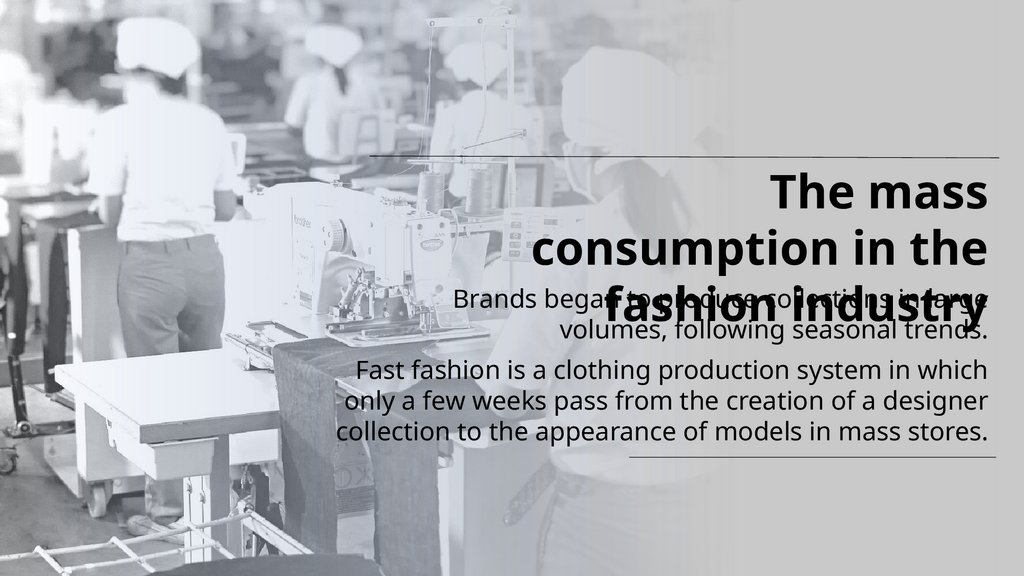
The massconsumption in the
Brands began to produce collections in large
fashion
industry
volumes, following seasonal trends.
Fast fashion is a clothing production system in which
only a few weeks pass from the creation of a designer
collection to the appearance of models in mass stores.
6.
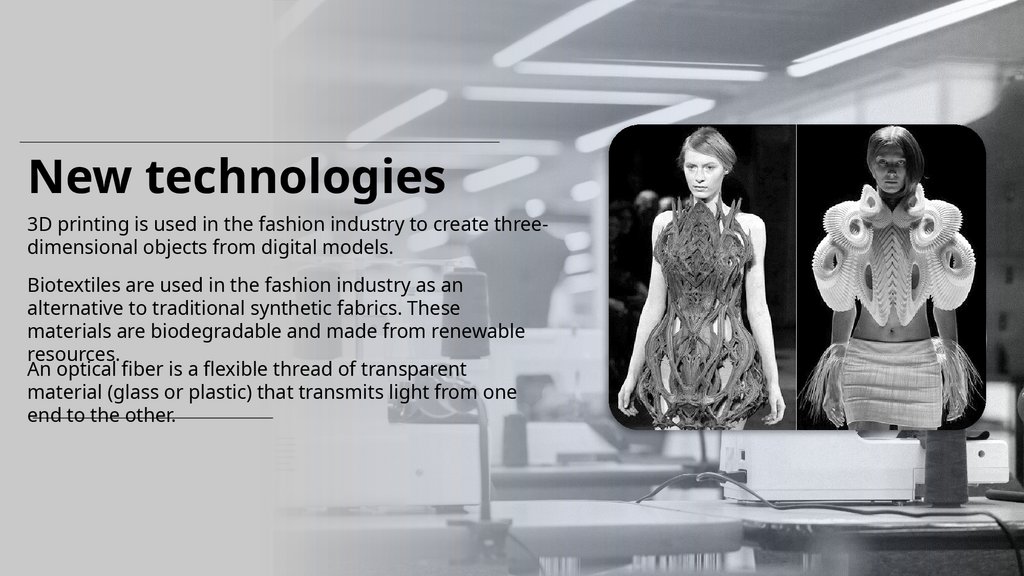
New technologies3D printing is used in the fashion industry to create threedimensional objects from digital models.
Biotextiles are used in the fashion industry as an
alternative to traditional synthetic fabrics. These
materials are biodegradable and made from renewable
resources.
An optical fiber is a flexible thread of transparent
material (glass or plastic) that transmits light from one
end to the other.
7.
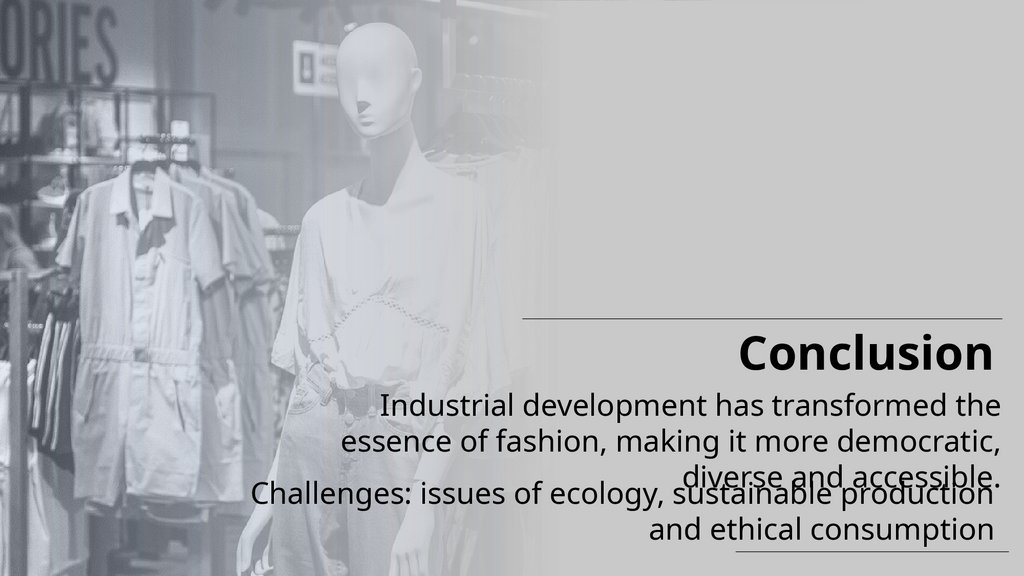
ConclusionIndustrial development has transformed the
essence of fashion, making it more democratic,
diverse and accessible.
Challenges: issues of ecology, sustainable production
and ethical consumption
8.
Online resourcesШвейная машинка // URL: https://ru.wikipedia.org/wiki/Швейная_машина (date of request:
28.09.2025).
Всё о полимерах в тканях // URL: https://theblueprint.ru/fashion/industry/polymers-in-fabrics (date of
request: 28.09.2025).
Как и когда появился первый журнал о моде? // URL: https://burdastyle.ru/stati/kak-i-kogdapoyavilsya-pervyj-zhurnal-o-mode/ (date of request: 28.09.2025).
Bacterial cellulose biotextiles for the future of sustainable fashion: a review // URL:
https://link.springer.com (date of request : 28.09.2025).
The Indefinite Guide To 3D Printing In Fashion // URL: https://techpacker.com/blog/design/indefiniteguide-to-3d-printing-in-fashion/ (date of request : 28.09.2025).
9.
"Peter the Great St. Petersburg Polytechnic University" Institute of Electronics andTelecommunications Technical Physics
The impact of
the
technological
progress on
fashion
ENGLISH PROJECT
2025