 physics
Similar presentations:




His surname sounds
1.
2.
3.
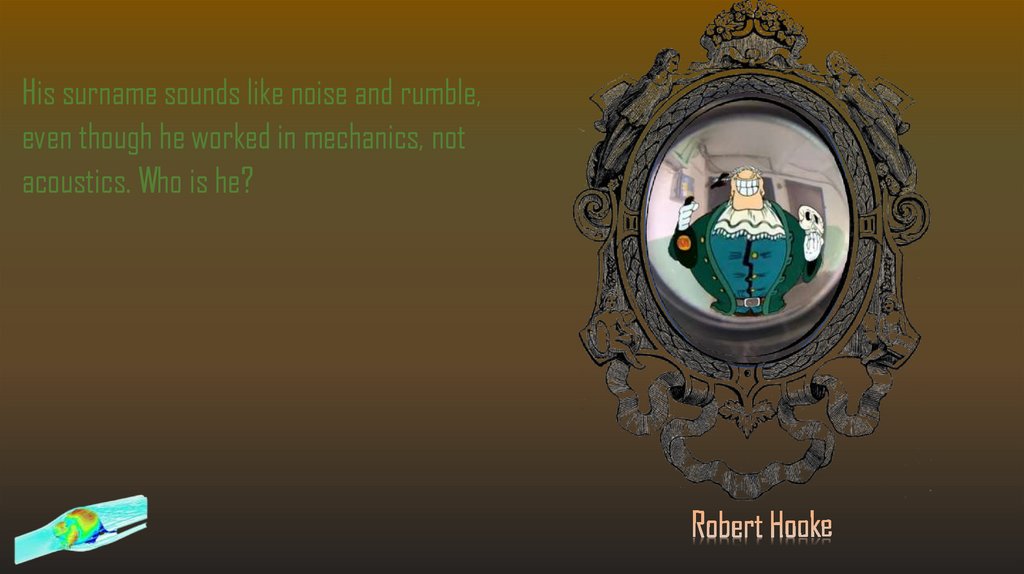
His surname sounds like noise and rumble,even though he worked in mechanics, not
acoustics. Who is he?
4.
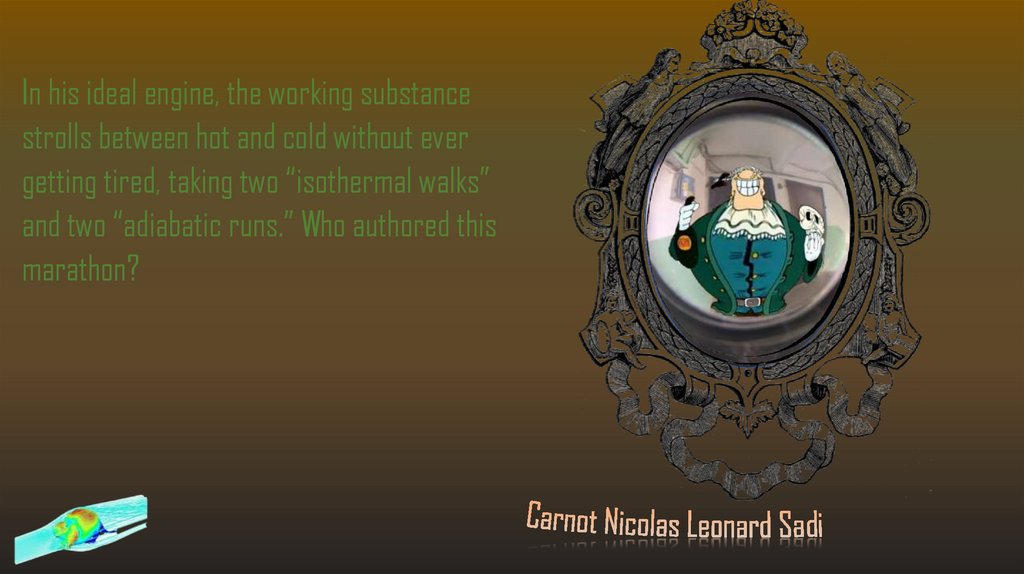
In his ideal engine, the working substancestrolls between hot and cold without ever
getting tired, taking two “isothermal walks”
and two “adiabatic runs.” Who authored this
marathon?
5.
There’s a simple formula for force:magnetic field, current, conductor length,
and angle. And if you read it aloud in
Russian, it sounds like a harsh parenting
command: “Beat your son!” Who came up
with it?
6.
This physicist studied springs and elasticity,but also debated Newton about light
experiments: who discovered first and who
won was decided by the Royal Society. Who
is this master of elasticity and apple-related
disputes?
7.
He built an entire empire… not a politicalone, but an electric one: his name became a
symbol for electric current. Who is this
“emperor of conductors”?
8.
In hydrodynamics, he describes vortices; inmathematics, contours and surfaces. His
theorem helps you “go around” any
integrals. Who is he?
9.
He loved light so much that he literally madeelectrons “come out into the light” - and his
name has been shining ever since. Who is
he?
10.
Students often try to invent a perpetualmotion machine on exams… until the
professor reminds them that this scientist’s
theorem forbids the efficiency of thermal
cycles from being equal to or greater than
one. Who is this physicist?
11.
Some students fear the "ten" almost asmuch as exams. But this "ten" isn’t a grade
— it’s an entire course of theoretical
physics. Which scientist are we talking
about?
12.
He prepared the experiments and data onwhich Einstein later built his theory. Who is
this physicist, without whom the
photoelectric effect would have remained
just an idea?
13.
This physicist survived a severe accident,proving firsthand that the principle of
quantum uncertainty works in real life: his
position was shaken, but the momentum he
gave to physics was enormous. Who is he?
14.
His equations describe fluid flow and stillkeep mathematicians up at night—it’s
officially one of the Millennium Prize
Problems. Who is this physicist?