 english
Similar presentations:









Listening Part 2
1.
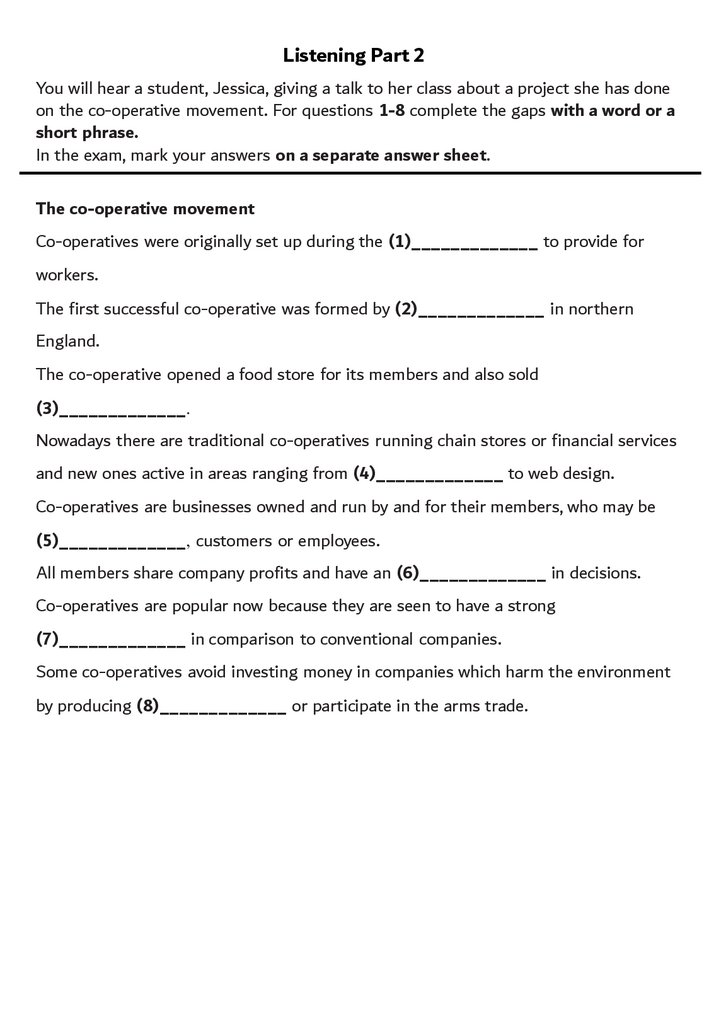
Listening Part 2You will hear a student, Jessica, giving a talk to her class about a project she has done
on the co-operative movement. For questions 1-8 complete the gaps with a word or a
short phrase.
In the exam, mark your answers on a separate answer sheet.
The co-operative movement
Co-operatives were originally set up during the (1)_____________ to provide for
workers.
The first successful co-operative was formed by (2)_____________ in northern
England.
The co-operative opened a food store for its members and also sold
(3)_____________.
Nowadays there are traditional co-operatives running chain stores or financial services
and new ones active in areas ranging from (4)_____________ to web design.
Co-operatives are businesses owned and run by and for their members, who may be
(5)_____________, customers or employees.
All members share company profits and have an (6)_____________ in decisions.
Co-operatives are popular now because they are seen to have a strong
(7)_____________ in comparison to conventional companies.
Some co-operatives avoid investing money in companies which harm the environment
by producing (8)_____________ or participate in the arms trade.
2.
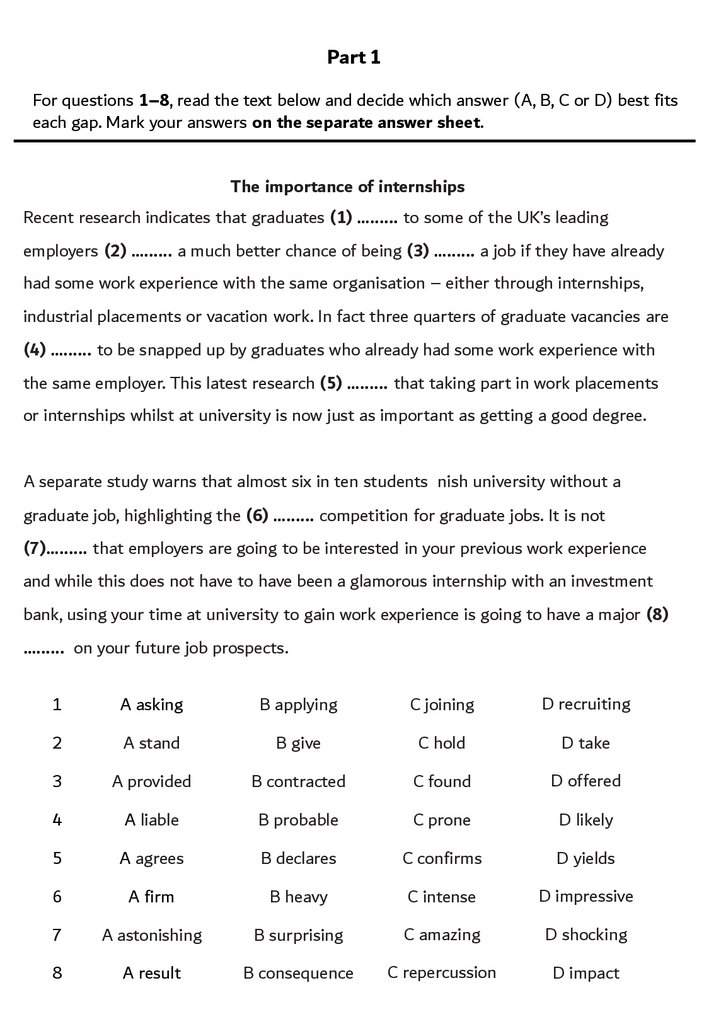
Part 1For questions 1–8, read the text below and decide which answer (A, B, C or D) best fits
each gap. Mark your answers on the separate answer sheet.
The importance of internships
Recent research indicates that graduates (1) …...... to some of the UK’s leading
employers (2) …...... a much better chance of being (3) …...... a job if they have already
had some work experience with the same organisation – either through internships,
industrial placements or vacation work. In fact three quarters of graduate vacancies are
(4) …...... to be snapped up by graduates who already had some work experience with
the same employer. This latest research (5) …...... that taking part in work placements
or internships whilst at university is now just as important as getting a good degree.
A separate study warns that almost six in ten students nish university without a
graduate job, highlighting the (6) …...... competition for graduate jobs. It is not
(7)…...... that employers are going to be interested in your previous work experience
and while this does not have to have been a glamorous internship with an investment
bank, using your time at university to gain work experience is going to have a major (8)
…...... on your future job prospects.
1
A asking
B applying
C joining
D recruiting
2
A stand
B give
C hold
D take
3
A provided
B contracted
C found
D offered
4
A liable
B probable
C prone
D likely
5
A agrees
B declares
C confirms
D yields
6
A firm
B heavy
C intense
D impressive
7
A astonishing
B surprising
C amazing
D shocking
8
A result
B consequence
C repercussion
D impact
3.
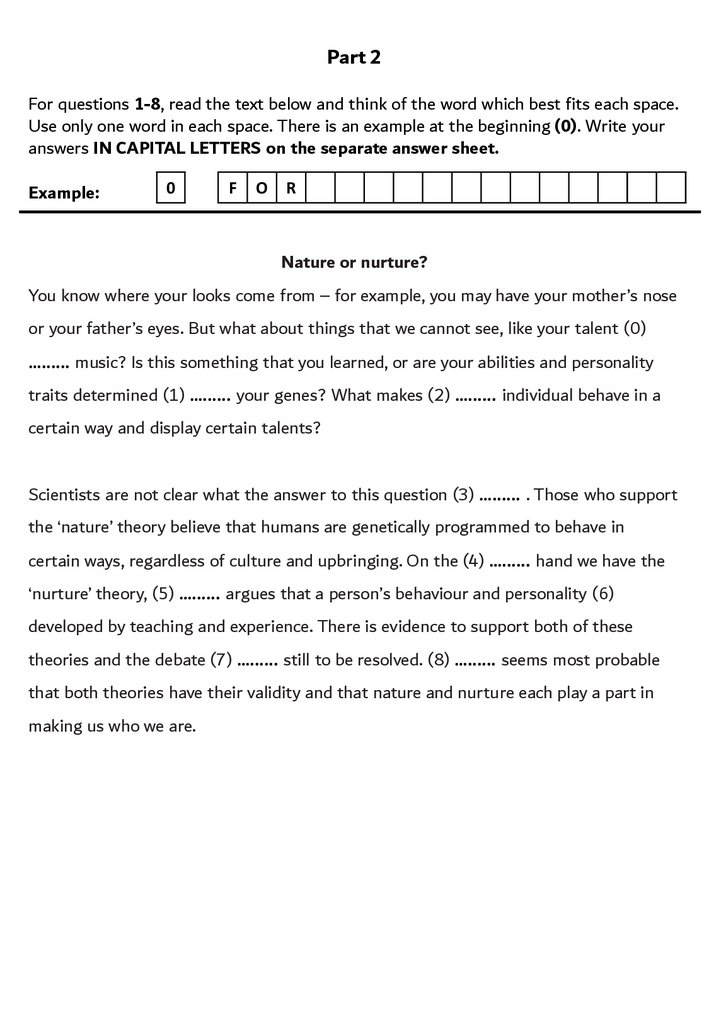
Part 2For questions 1-8, read the text below and think of the word which best fits each space.
Use only one word in each space. There is an example at the beginning (0). Write your
answers IN CAPITAL LETTERS on the separate answer sheet.
Example:
0
F
O
R
Nature or nurture?
You know where your looks come from – for example, you may have your mother’s nose
or your father’s eyes. But what about things that we cannot see, like your talent (0)
…...... music? Is this something that you learned, or are your abilities and personality
traits determined (1) …...... your genes? What makes (2) …...... individual behave in a
certain way and display certain talents?
Scientists are not clear what the answer to this question (3) …...... . Those who support
the ‘nature’ theory believe that humans are genetically programmed to behave in
certain ways, regardless of culture and upbringing. On the (4) …...... hand we have the
‘nurture’ theory, (5) …...... argues that a person’s behaviour and personality (6)
developed by teaching and experience. There is evidence to support both of these
theories and the debate (7) …...... still to be resolved. (8) …...... seems most probable
that both theories have their validity and that nature and nurture each play a part in
making us who we are.
4.
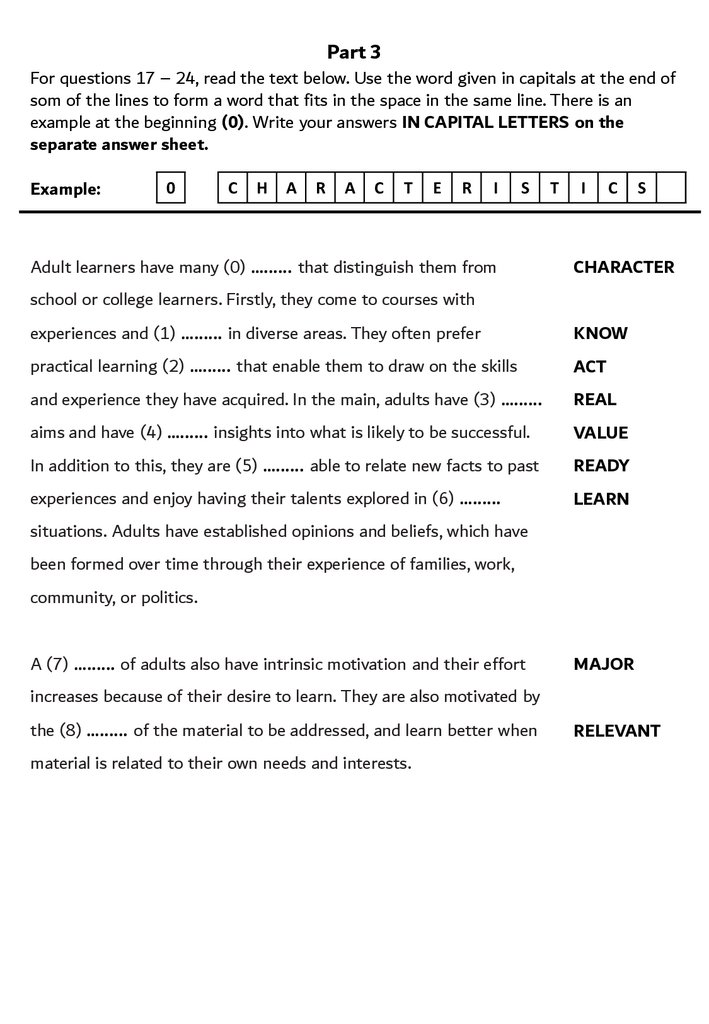
Part 3For questions 17 – 24, read the text below. Use the word given in capitals at the end of
som of the lines to form a word that fits in the space in the same line. There is an
example at the beginning (0). Write your answers IN CAPITAL LETTERS on the
separate answer sheet.
Example:
0
C
H
A
R
A
C
T
E
R
I
S
Adult learners have many (0) …...... that distinguish them from
T
I
C
S
CHARACTER
school or college learners. Firstly, they come to courses with
experiences and (1) …...... in diverse areas. They often prefer
KNOW
practical learning (2) …...... that enable them to draw on the skills
ACT
and experience they have acquired. In the main, adults have (3) …......
REAL
aims and have (4) …...... insights into what is likely to be successful.
VALUE
In addition to this, they are (5) …...... able to relate new facts to past
READY
experiences and enjoy having their talents explored in (6) …......
LEARN
situations. Adults have established opinions and beliefs, which have
been formed over time through their experience of families, work,
community, or politics.
A (7) …...... of adults also have intrinsic motivation and their effort
MAJOR
increases because of their desire to learn. They are also motivated by
the (8) …...... of the material to be addressed, and learn better when
material is related to their own needs and interests.
RELEVANT
5.
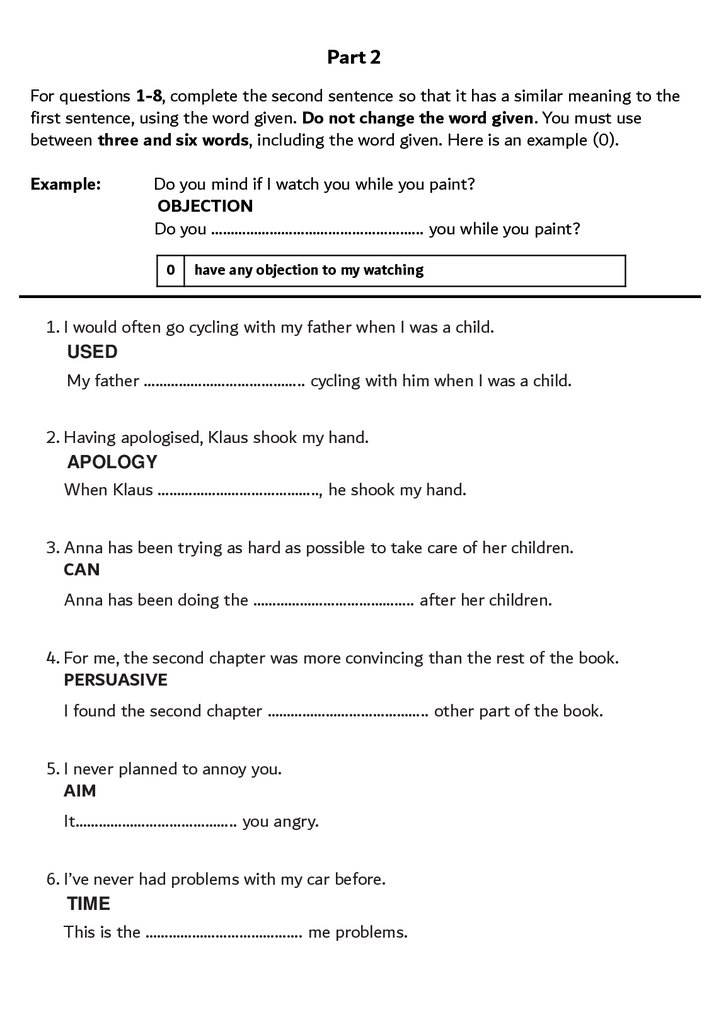
Part 2For questions 1-8, complete the second sentence so that it has a similar meaning to the
first sentence, using the word given. Do not change the word given. You must use
between three and six words, including the word given. Here is an example (0).
Example:
Do you mind if I watch you while you paint?
OBJECTION
Do you ……………………………………………... you while you paint?
0
have any objection to my watching
1. I would often go cycling with my father when I was a child.
USED
My father ………………………………….. cycling with him when I was a child.
2. Having apologised, Klaus shook my hand.
APOLOGY
When Klaus ………………………………….., he shook my hand.
3. Anna has been trying as hard as possible to take care of her children.
CAN
Anna has been doing the ………………………………….. after her children.
4. For me, the second chapter was more convincing than the rest of the book.
PERSUASIVE
I found the second chapter ………………………………….. other part of the book.
5. I never planned to annoy you.
AIM
It………………………………….. you angry.
6. I’ve never had problems with my car before.
TIME
This is the …………………………………. me problems.
6.
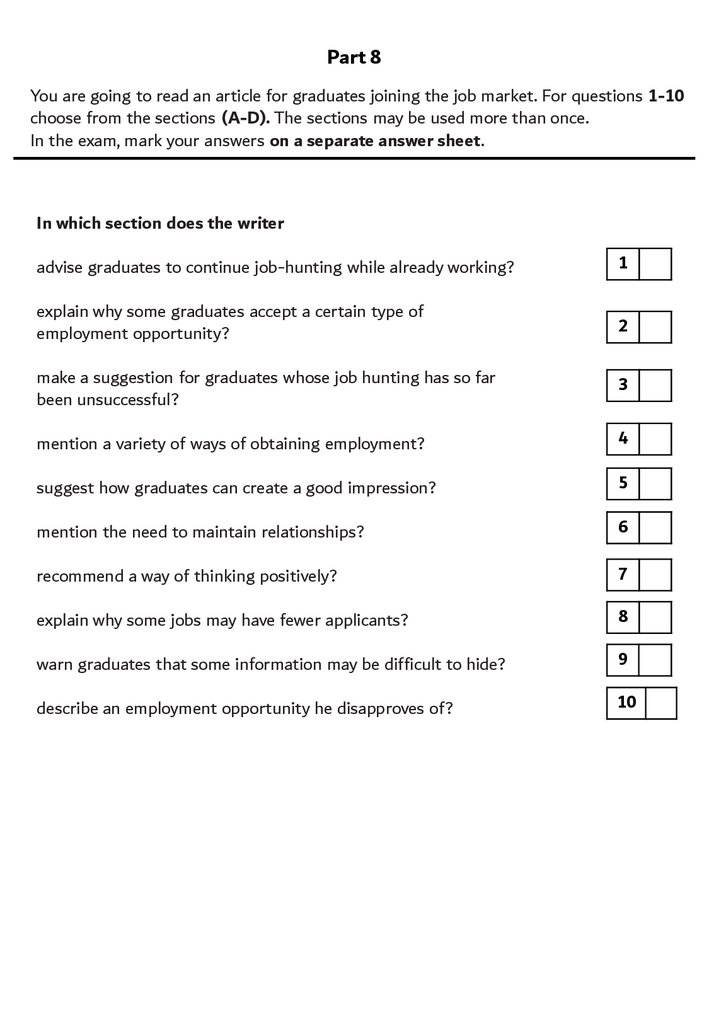
Part 8You are going to read an article for graduates joining the job market. For questions 1-10
choose from the sections (A-D). The sections may be used more than once.
In the exam, mark your answers on a separate answer sheet.
In which section does the writer
advise graduates to continue job-hunting while already working?
1
explain why some graduates accept a certain type of
employment opportunity?
2
make a suggestion for graduates whose job hunting has so far
been unsuccessful?
3
mention a variety of ways of obtaining employment?
4
suggest how graduates can create a good impression?
5
mention the need to maintain relationships?
6
recommend a way of thinking positively?
7
explain why some jobs may have fewer applicants?
8
warn graduates that some information may be difficult to hide?
9
describe an employment opportunity he disapproves of?
10
7.
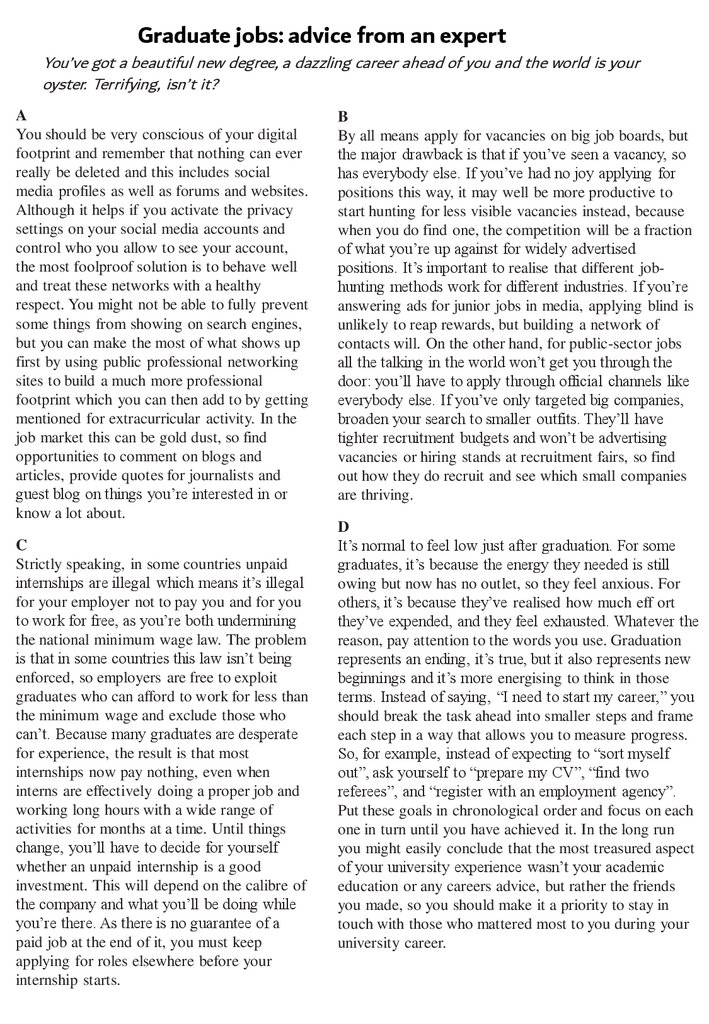
Graduate jobs: advice from an expertYou’ve got a beautiful new degree, a dazzling career ahead of you and the world is your
oyster. Terrifying, isn’t it?
A
You should be very conscious of your digital
footprint and remember that nothing can ever
really be deleted and this includes social
media profiles as well as forums and websites.
Although it helps if you activate the privacy
settings on your social media accounts and
control who you allow to see your account,
the most foolproof solution is to behave well
and treat these networks with a healthy
respect. You might not be able to fully prevent
some things from showing on search engines,
but you can make the most of what shows up
first by using public professional networking
sites to build a much more professional
footprint which you can then add to by getting
mentioned for extracurricular activity. In the
job market this can be gold dust, so find
opportunities to comment on blogs and
articles, provide quotes for journalists and
guest blog on things you’re interested in or
know a lot about.
C
Strictly speaking, in some countries unpaid
internships are illegal which means it’s illegal
for your employer not to pay you and for you
to work for free, as you’re both undermining
the national minimum wage law. The problem
is that in some countries this law isn’t being
enforced, so employers are free to exploit
graduates who can afford to work for less than
the minimum wage and exclude those who
can’t. Because many graduates are desperate
for experience, the result is that most
internships now pay nothing, even when
interns are effectively doing a proper job and
working long hours with a wide range of
activities for months at a time. Until things
change, you’ll have to decide for yourself
whether an unpaid internship is a good
investment. This will depend on the calibre of
the company and what you’ll be doing while
you’re there. As there is no guarantee of a
paid job at the end of it, you must keep
applying for roles elsewhere before your
internship starts.
B
By all means apply for vacancies on big job boards, but
the major drawback is that if you’ve seen a vacancy, so
has everybody else. If you’ve had no joy applying for
positions this way, it may well be more productive to
start hunting for less visible vacancies instead, because
when you do find one, the competition will be a fraction
of what you’re up against for widely advertised
positions. It’s important to realise that different jobhunting methods work for different industries. If you’re
answering ads for junior jobs in media, applying blind is
unlikely to reap rewards, but building a network of
contacts will. On the other hand, for public-sector jobs
all the talking in the world won’t get you through the
door: you’ll have to apply through official channels like
everybody else. If you’ve only targeted big companies,
broaden your search to smaller outfits. They’ll have
tighter recruitment budgets and won’t be advertising
vacancies or hiring stands at recruitment fairs, so find
out how they do recruit and see which small companies
are thriving.
D
It’s normal to feel low just after graduation. For some
graduates, it’s because the energy they needed is still
owing but now has no outlet, so they feel anxious. For
others, it’s because they’ve realised how much eff ort
they’ve expended, and they feel exhausted. Whatever the
reason, pay attention to the words you use. Graduation
represents an ending, it’s true, but it also represents new
beginnings and it’s more energising to think in those
terms. Instead of saying, “I need to start my career,” you
should break the task ahead into smaller steps and frame
each step in a way that allows you to measure progress.
So, for example, instead of expecting to “sort myself
out”, ask yourself to “prepare my CV”, “find two
referees”, and “register with an employment agency”.
Put these goals in chronological order and focus on each
one in turn until you have achieved it. In the long run
you might easily conclude that the most treasured aspect
of your university experience wasn’t your academic
education or any careers advice, but rather the friends
you made, so you should make it a priority to stay in
touch with those who mattered most to you during your
university career.